Osaka · Autumn Festivals
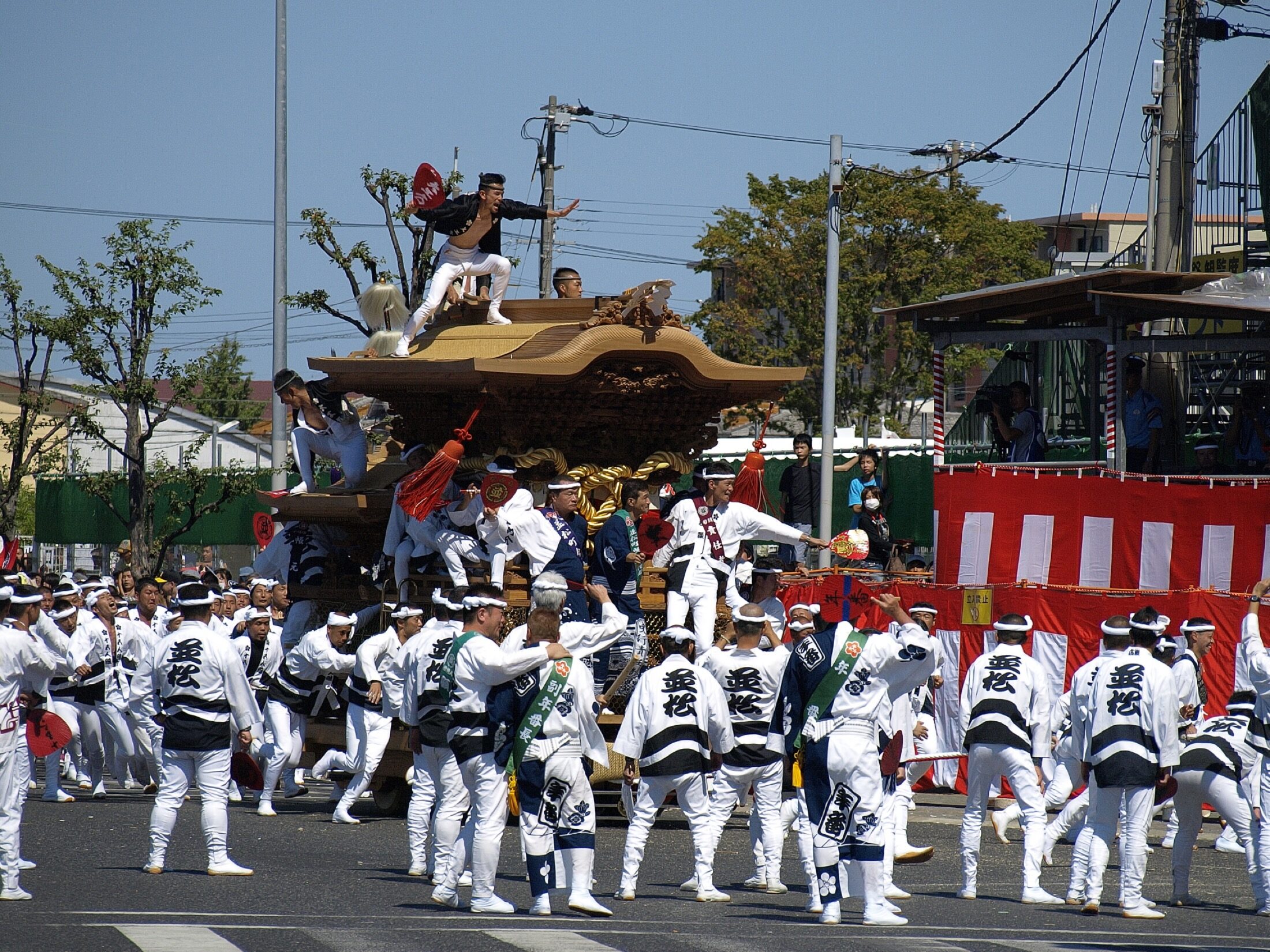
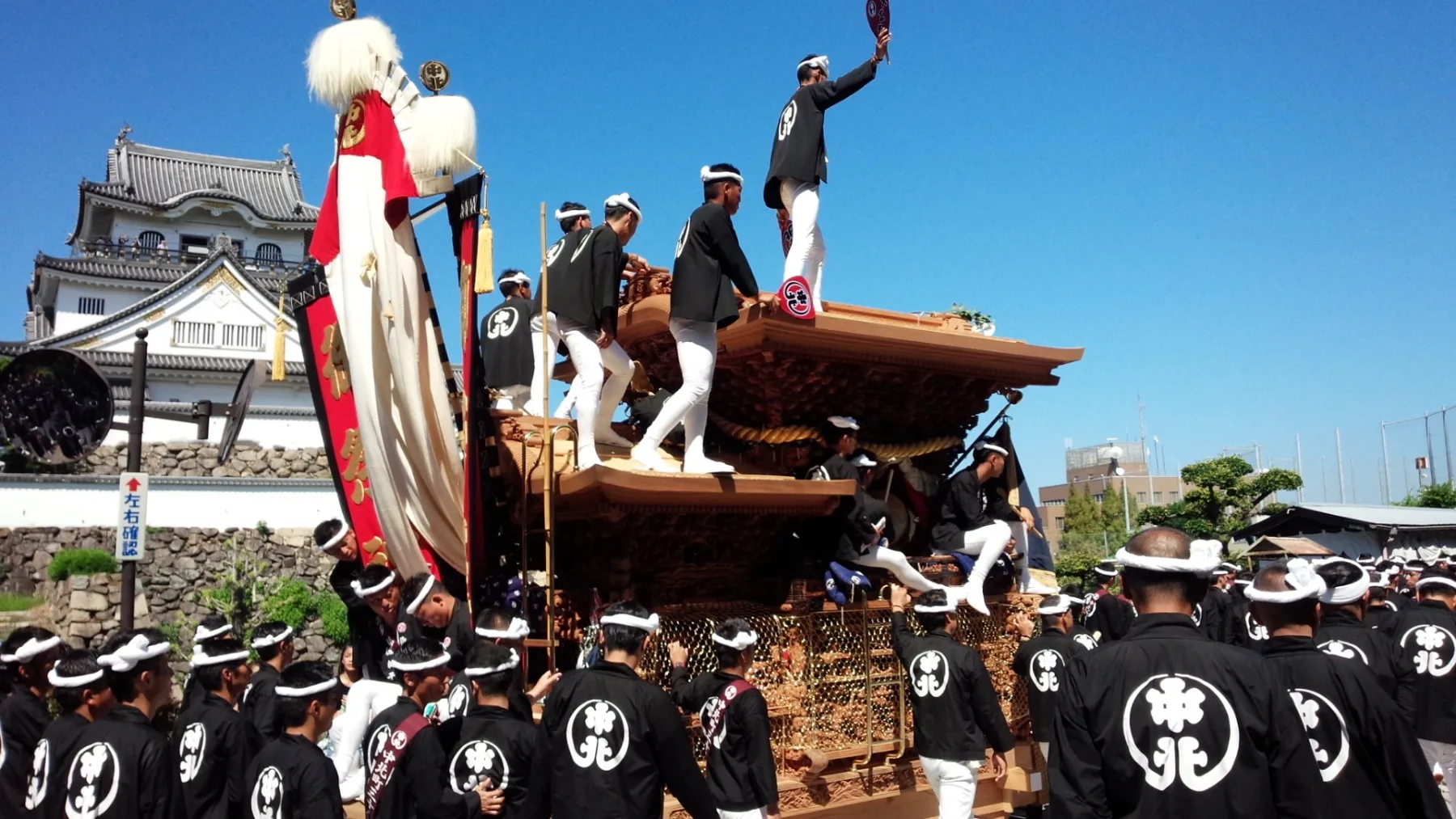
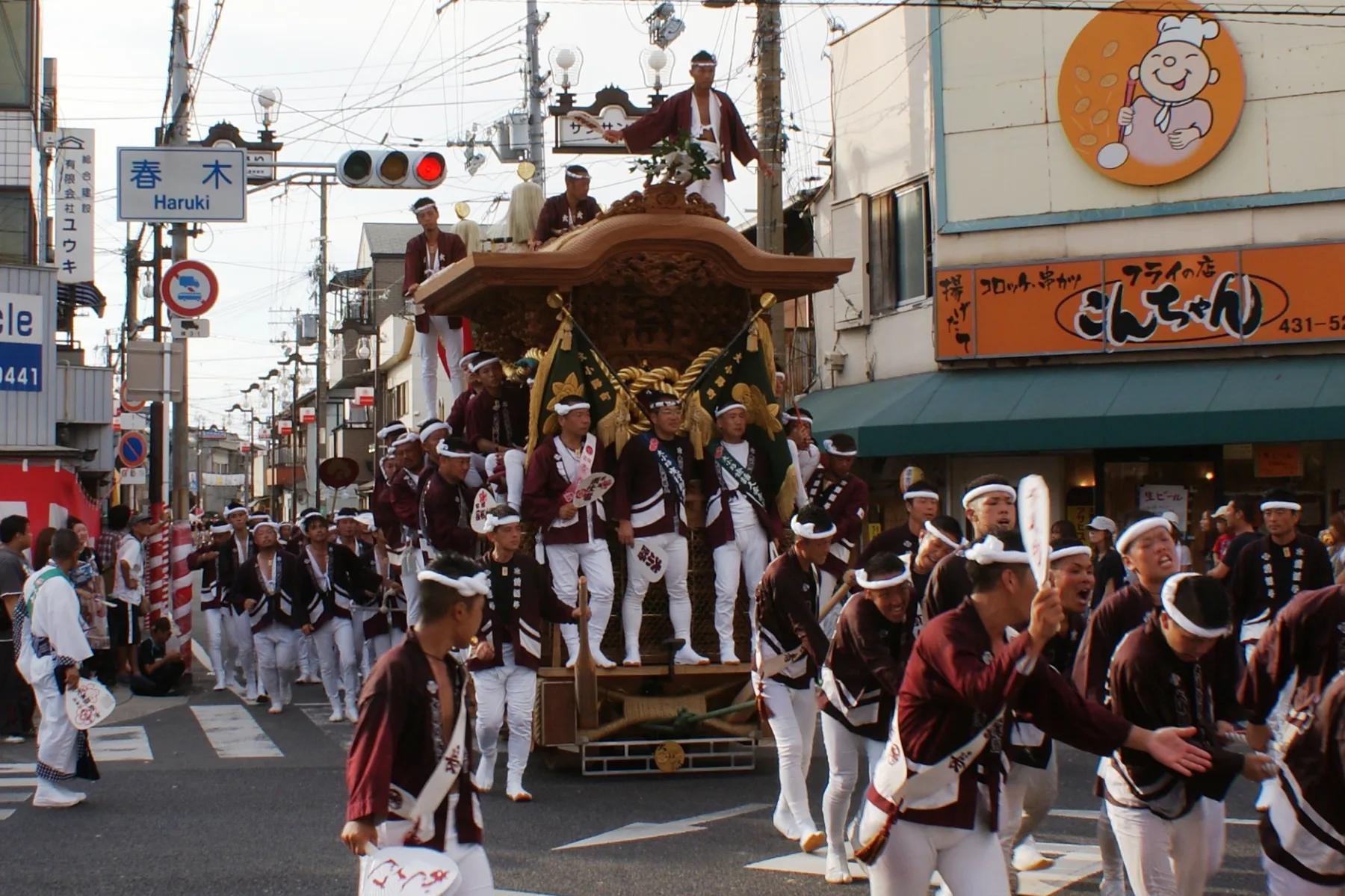
Most float festivals in Japan move at walking pace. Kishiwada’s does not. Teams of several hundred people run a four-tonne wooden float down a street at a sprint and then turn it around a right-angled corner without slowing — the move is called yarimawashi, and it is the whole reason people come. In 2026 the September festival is Saturday 19 and Sunday 20 September. This guide is about the thing nobody tells you in English: not what it is, but exactly when and where to stand, and when there is nothing to see at all.
The timetable nobody prints: three blocks, three dead gaps
Every English listing tells you the festival runs “06:00–22:00”. That is a wrapper, not a schedule. Kishiwada City’s own 2026 district maps break each day into discrete blocks, and between them nothing pulls at all. I have seen people arrive at 08:00 on the Saturday and find an empty street, conclude they had the wrong day, and leave.
| Block | Sat 19 Sep (yoimiya) | Sun 20 Sep (honmiya) |
|---|---|---|
| Dawn pull-out (hikidashi) | 06:00–07:30 — every town sets off at once on the city hall siren and converges on Kankan-ba. The fastest running of the whole festival | — none |
| Dead gap | 07:30–09:30 | — |
| Morning | 09:30–11:30 — floats scatter into the neighbourhoods | 09:00–12:30 shrine entry (miyairi) |
| Dead gap | 11:30–13:00 | 12:30–13:00 |
| Afternoon | 13:00–17:00 — station-front parade, then the afternoon run | 13:00–17:00 — afternoon run |
| Dead gap | 17:00–19:00 | 17:00–19:00 |
| Lantern run (hi-ire hikō) | 19:00–22:00 — slow, lit, gentle | 19:00–22:00 |
The city publishes the real thing as two illustrated PDFs for September 2026 — one for the Kishiwada district and one for Haruki — and they carry the block times above, the route, and the toilet and bin locations. They are large files; download them on hotel wifi the night before, not on the street. The city’s festival portal is the place to check for changes in the final week.
The Haruki district next door runs its own clock: the same 06:00–07:30 pull-out on Saturday, but its parade sits in the morning block (09:30–12:00, by Haruki station) where Kishiwada’s is in the afternoon, and its shrine entry starts earlier, at 08:30. That is a genuine advantage if you want to see two parades in one day.
Where to stand, corner by corner
There are really only four decisions here, and they are not equivalent. Pick one and commit — once the floats are running you will not be able to move between them.
Kankan-ba — the famous one, and the trap
The Kishiwada-port intersection, ten minutes on foot from the station. Its name comes from the big scales (kankan) once used to weigh cargo at the old port. Every town has to pass through it, and the turns are the sharpest on the route, so this is the postcard.
It is also where you get stuck. With 22 floats queued through the area, spectators cannot cross the intersection at all — one long-time watcher describes the inside of the zone as riku no kotō, a desert island on dry land, and a reporter who covered a roof-riding family put the practical version plainly: once the floats are running, the road belongs to them, and you can be pinned in one place for one to two hours. For the dawn pull-out, attendees who want the front row talk about being in Kishiwada by 03:30–05:00. That is not an exaggeration for effect; it is what the front row costs. Practically: the first trains out of Namba on the Saturday leave around 04:58 (local) and 05:17 (airport express), putting you in Kishiwada shortly before the siren — which is late for the front row but fine if you are content to stand three deep.
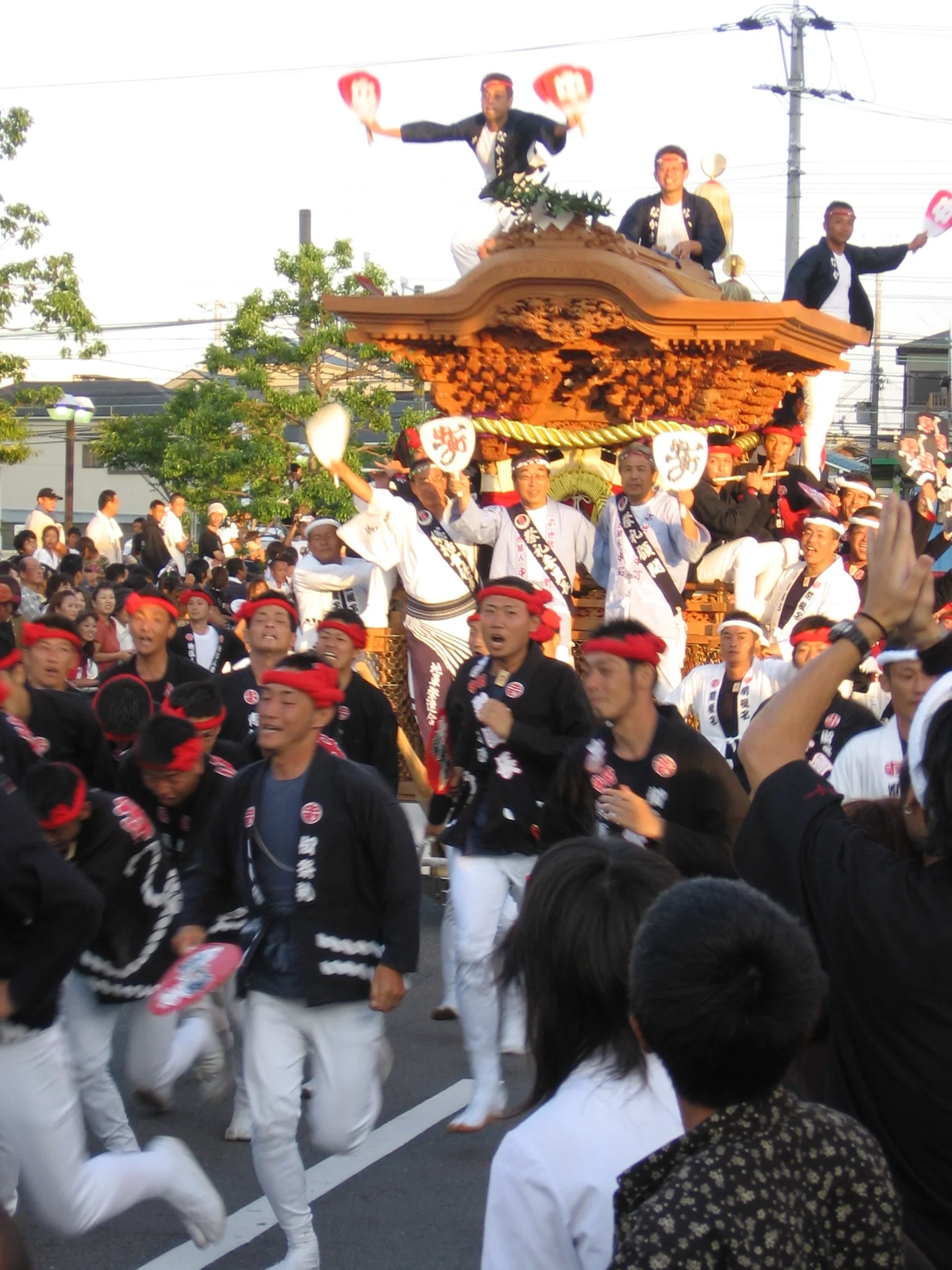
Who it suits: people who want the single most dramatic view and are prepared to give up their morning to it. Who should avoid it: anyone with a train to catch, small children, or a bladder.
Konakara-zaka — Sunday morning only, and the one the enthusiasts pick
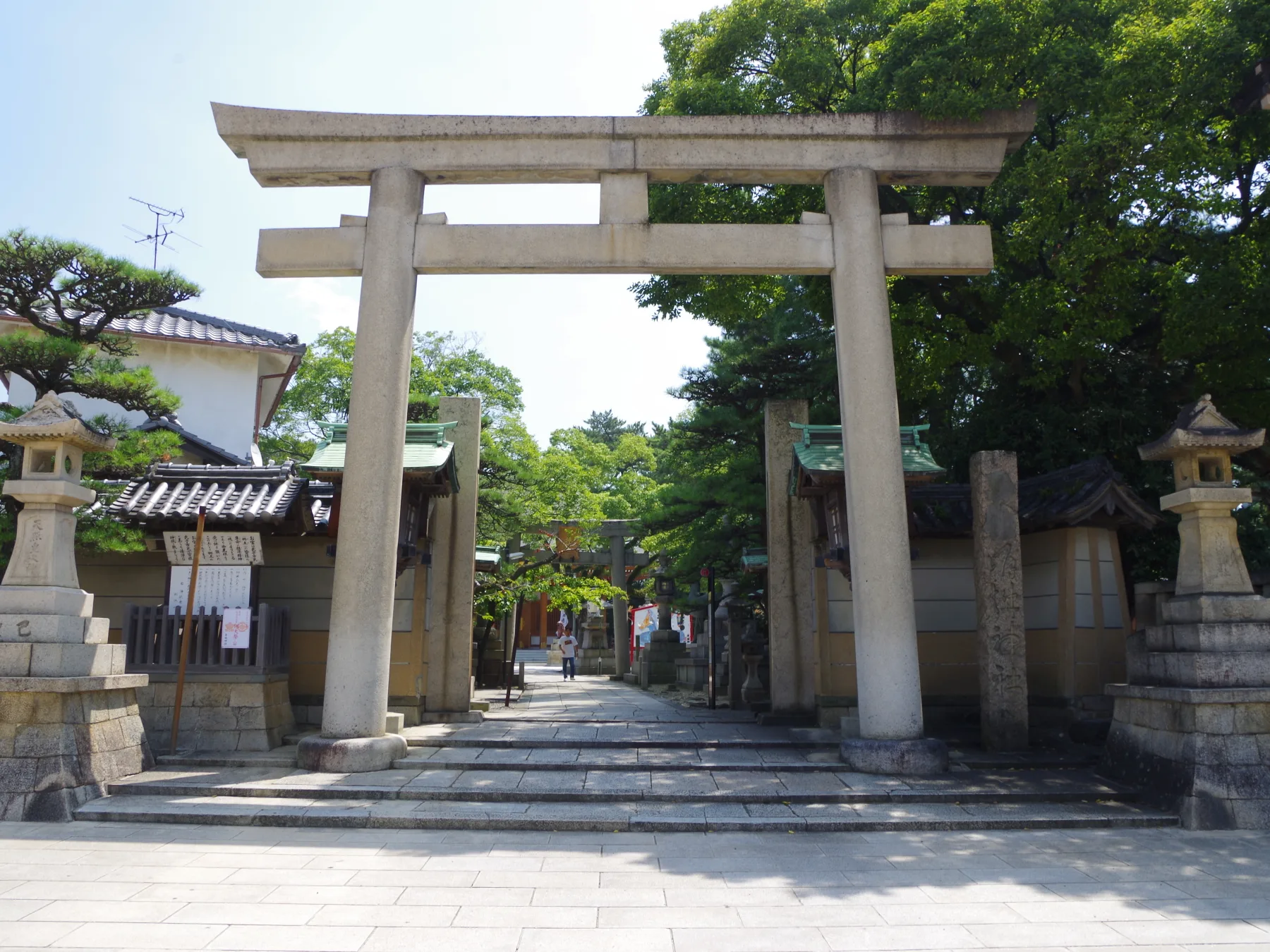
A slope fifteen minutes’ walk from the station, on the approach to Kishiki Shrine. The name means “a quarter”, from how steep the gradient looks. This is where the floats charge up on their way to the shrine entry — and according to one veteran guide it is the only place left on the route where you still see the old style: accelerating from the bottom of the slope and turning straight through, with none of the preliminary stop used elsewhere.
Two things follow from that, and neither appears in English coverage. First, it only happens on Sunday morning — the city’s own English map marks Konakara-zaka “Sunday AM only”, because floats pass it on the shrine-entry course and nowhere else in the schedule. Turn up on Saturday and you will find a quiet residential slope.
Second, and this is the trick: the tourism association publishes the shrine-entry running order with times, and states that the listed times are the moment each town sets off from the bottom of Konakara slope. The order sheet is therefore a minute-by-minute timetable for this exact spot. For 2026 the Kishiki Shrine entries run from 09:30 (first town) at eight-minute intervals to 11:22 (twelfth). You can pick your slot, arrive twenty minutes before it, and know what you are waiting for.
The S-curve on the Kishū Kaidō — the technical one
South of Kankan-ba, the old Kishū highway kinks through a pair of turns in quick succession — two direction changes inside a very short distance, taken without the run-up that the big intersection allows. It is narrower than Kankan-ba, which means both a better view of the crews working the rear pole and less room for you. Photographers gather here. If you stand on this stretch, the rule about backing up when a float comes is not advice, it is the whole arrangement.
The station-front street and the arcade — the easy option
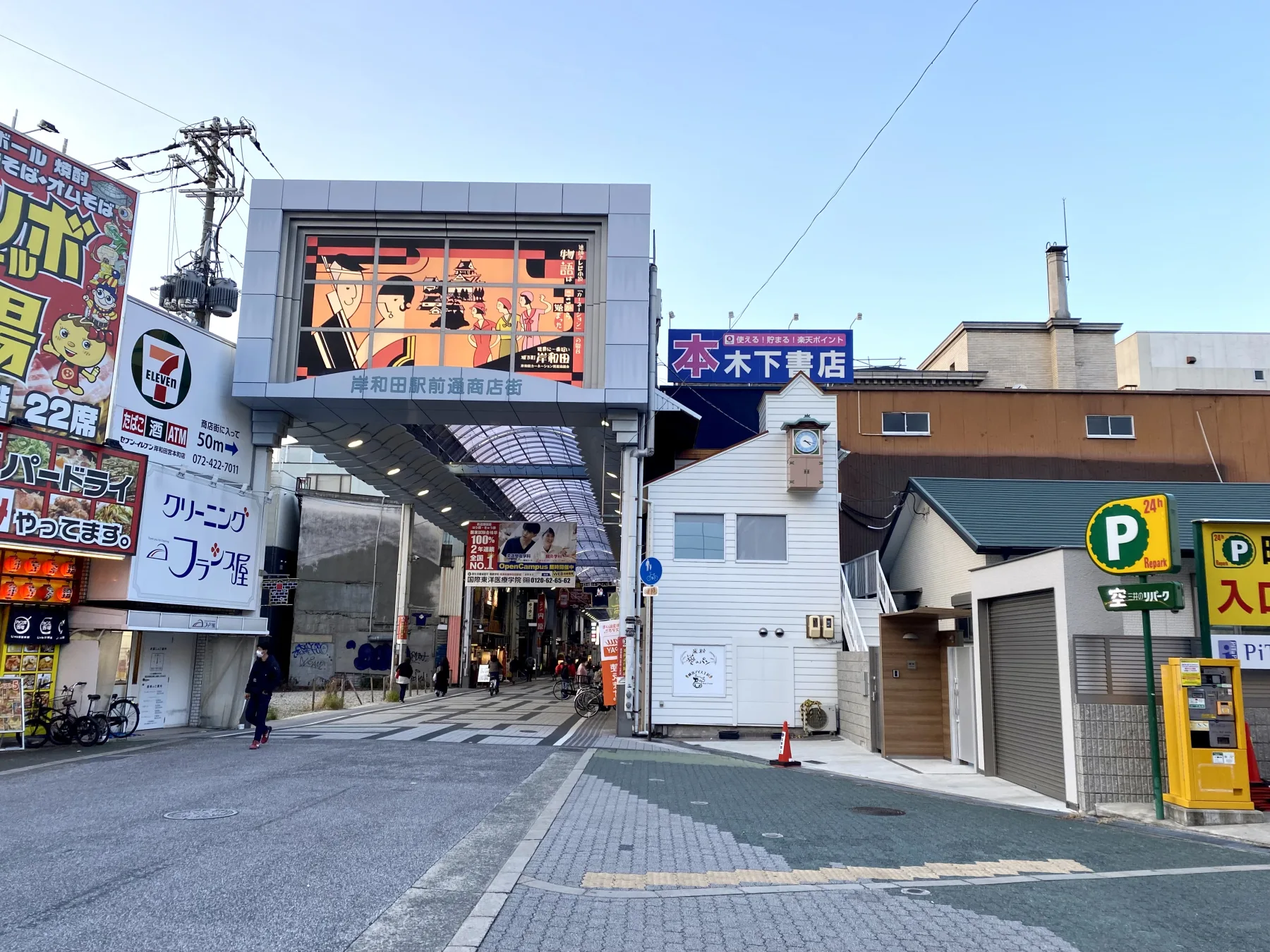
On Saturday afternoon all 22 Kishiwada floats come to the station front in sequence: slots run from 13:00 at five-minute intervals, finishing around 14:45. It is the one time of the festival when everything comes to you in a predictable order, which makes it the sane choice for a first visit or with children.
The covered arcade beside it is worth a look on its own account: it is 10.6 metres to the ceiling, and it is that tall because the floats go through it. The first arcade, built in 1963, was the tallest in Japan at the time. A four-tonne float running under a shopping arcade roof is a strange and very Kishiwada sight.
Haruki, and the Friday test pull — the two quiet answers
Haruki is the same festival with a fraction of the crowd — and it has its own station, Nankai Haruki, one stop up the line toward Namba, not Kishiwada. and its morning parade means you can watch there and still reach Kishiwada for the afternoon. And if you happen to be in Osaka on the Friday, the test pull on 18 September, 14:00–16:00, is a full-speed rehearsal on the same streets, free, with a fraction of the spectators. One three-day attendee treated the test pull as reconnaissance and used it to choose his spots for the real days. If your schedule only allows one danjiri afternoon, this is the one I would take a first-timer to. (For everything else happening that month, see Japan in September 2026.)
What you are actually looking at
Watch a float for five minutes and it is chaos. Watch with three things in mind and it resolves into a machine.
The man on the roof
The daiku-gata dances on the roof with a fan — and the fan is not decoration. He signals the rear steering crew with it before the corner, so his arm tells you which way four tonnes is about to go, a beat before it goes. On a narrow street, that is also how you know when to get out of the way.
The drums
There are four rhythms. The fastest, kizami, is played on the straight runs; the slowest during rest. You can hear a run coming before you can see it.
The rear pole
The turn is made by 20–30 people on a 3.5-metre steering pole at the back, against a pair on the front brakes — a role the city’s own page calls extremely dangerous and requiring great skill. The corner is a collision of those two forces.
House signatures
Towns have their own roof styles. Namimatsu-chō sometimes puts two roof dancers up together; Hon-machi’s trademark is the one-legged hikōki-nori, the “aeroplane rider”; Gokenya’s roof dancer wears a black kimono. Locals can name the town from the roof alone.
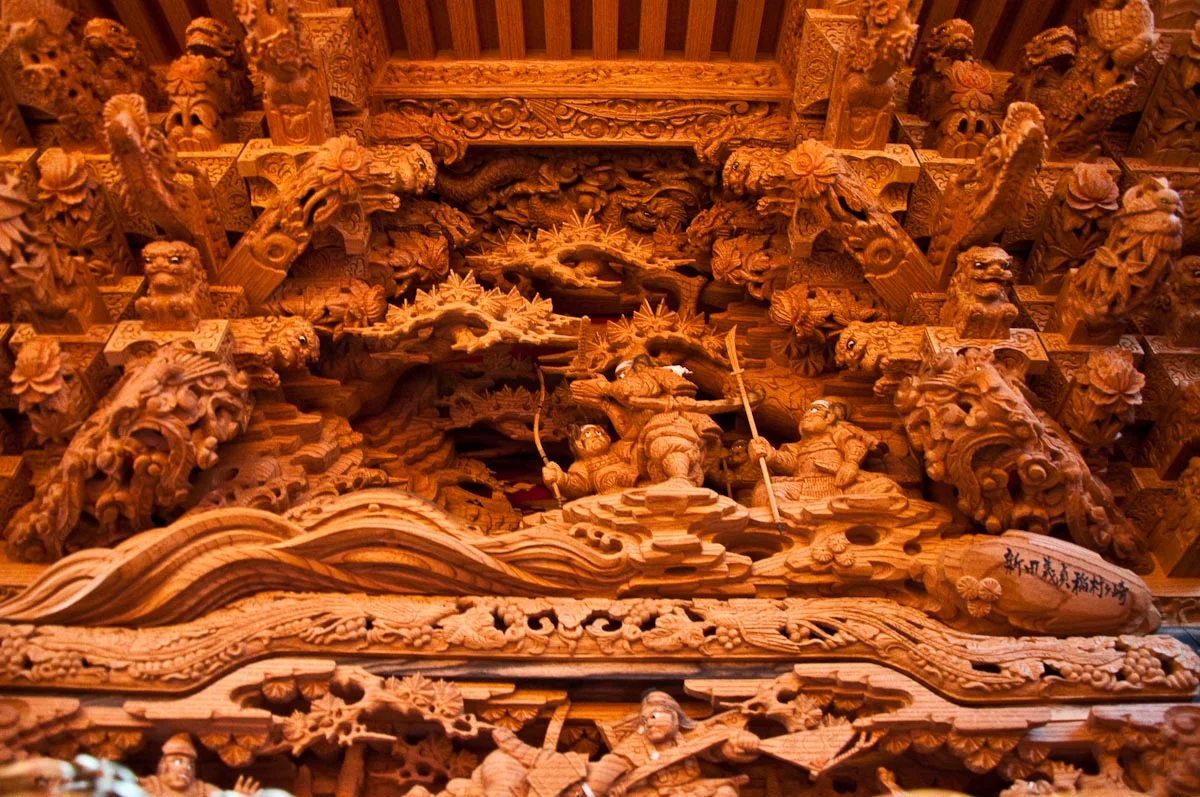
The roof riders wear no safety line — tradition forbids it. One former daiku-gata told an interviewer he had broken bones four times in the role. When you understand that the man dancing above the crowd has no rope, the atmosphere on the street makes more sense.
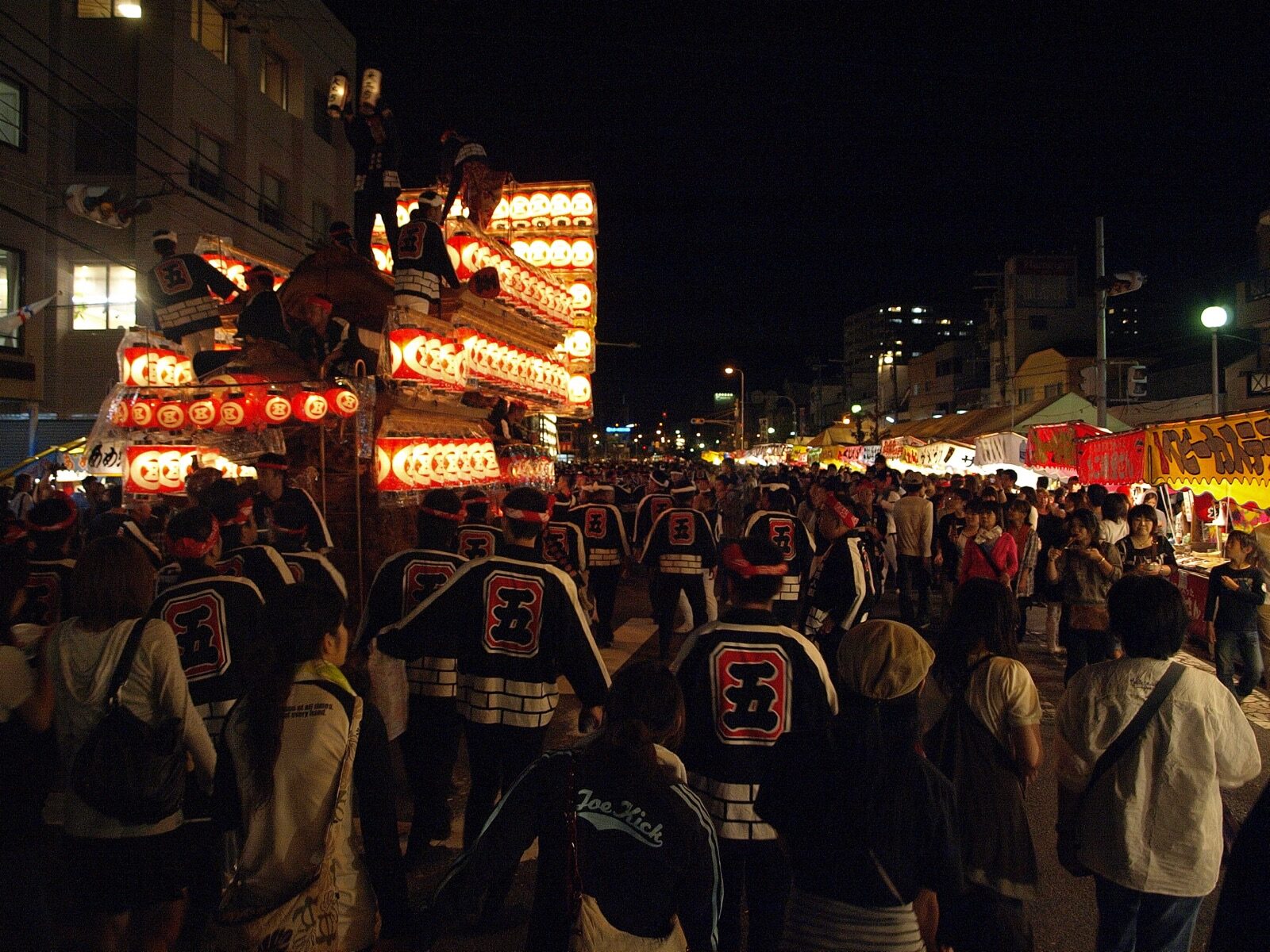
The night run is a different festival
From 19:00 the floats are hung with lanterns and walked, not run. Attendees describe the carving and the outline of the float floating up out of the dark as the lanterns light it from inside. Small children take the front of the rope. The stalls are busy, the crowd is relaxed, and nobody is sprinting. If the daytime running is too much — or you have children with you — this is the part of the day to plan around, not the part to skip.
One photography note from an attendee who shoots it: stand further back than you think. The lanterns blow out the exposure at close range.
Safety: the rules, and what they are actually about
This festival injures people every year and has killed people, spectators among them. That is not a disclaimer; ambulances move through the town all day, and a three-day attendee’s account simply notes them passing continually. Every rule below exists because of a specific accident. Read them as instructions, not as suggestions.
How to read the street
The thing no English guide explains is the difference between watching and being in the way, and a visitor gets it wrong in a specific, predictable manner: you see a gap at the kerb and read it as space available to you. It is not. It is working space.
Start with the scale, because it is not what you picture. The float itself is about four tonnes, 3.8 metres tall and 2.5 metres wide — but the tow rope runs 100 to 200 metres out in front of it, pulled by five hundred to a thousand people. The dangerous object is not the cart. It is the two hundred metres of running crowd that arrives before the cart, on a street where you may not be able to see the float yet at all. If you can hear it and cannot see it, you are already inside the thing.
The float is turned by a steering pole at the back, and the city’s own guidance puts it plainly — the crews need roughly twice the width of the float to work that pole. The empty road you are standing at the edge of is the width the pole is about to sweep through. And because the wheels are fixed wooden ones, the turn is a controlled skid: the back of the float goes somewhere the front did not.
Which produces the most important sentence in this article: the dangerous moment is after the front has gone past. That is exactly when a spectator relaxes, steps forward, and lifts a phone. Stay back until the whole float, the rear crew and the trailing rope have cleared you.
The other half of the system is physical and you can learn it in thirty seconds. Tape and rope are instructions. Taped-off ground is not a viewing area with a barrier; it is ground you may not watch from. Do not lean out past a rope line to get a clear shot — leaning out is the thing the rope exists to stop. Marshals in matching jackets direct the crowd by hand; when one gestures you back, move first and understand later. None of this is negotiable on the day and none of it is explained in English on site.
Two more that mark you out instantly if you get them wrong:
- Never stand on the tow rope — and never step over it either. Standing on it is unthinkable; straddling it is the mistake visitors actually make. Walk around the end.
- When a float comes, back up and give the corner room. Marshals are posted at each corner specifically to catch rope-pullers thrown off balance by the turn. The space they are protecting is the space you may be standing in.
And the practical one: use a toilet before you take up your position, and ideally before you pass the ticket gate at the station. Once you are inside a viewing area during a running block, you may not be able to leave it for an hour or more.
Paid seats: what they are, and what they are not
The grandstands around Kankan-ba are not run by the city. They are a commercial product — “Viewing Seats” from a private company, now in its fourth year — and Kishiwada City’s own festival pages carry no seat product at all. That is worth knowing before you pay, because it also explains the failure mode: in 2018, when a typhoon hit the region days before the festival, the festival went ahead and the paid grandstands were cancelled, because the operator could not get the scaffolding. If your dates are in typhoon range, our Japan typhoon season guide explains what actually gets cancelled and what does not.
| What | Detail (checked 1 September 2026) |
|---|---|
| Where | Two stands facing Kankan-ba: a mountain-side stand (close to the turns) and a sea-side stand (calmer, wider view) |
| Dates | Fri 18 Sep (test pull), Sat 19 Sep, Sun 20 Sep — seven ticketed sessions in all |
| Prices (1 Sep 2026) | Fri 18 Sep test pull is much the cheapest: sea-side bench from ¥3,300. Saturday and Sunday sessions start around ¥8,800 and run to roughly ¥15,000 for the best single seats. Shaded sofa boxes are a different market entirely — a four-person box on the main day was listed at ¥484,000 |
| Availability | Still on sale for all seven sessions on 1 September, including Sunday. The “sells out in minutes” line you will read elsewhere did not match what the vendor was showing |
| Shade | The stands are uncovered except for the sofa tier. In late-September Osaka heat, in an afternoon session, that is not a small detail |
| Sales close | Two days before each session (18 Sep tickets close 16 Sep, and so on) |
The catch for a foreign visitor is the checkout, not the price. The main Japanese ticketing route issues smartphone-only digital tickets that require advance registration of a face photograph and of every companion in your party before you can even apply — and the voucher has to be shown on a connected phone at the gate, so a dead battery or no data is a real failure mode. Bring a power bank. If that is a wall, the seats are also listed through international resellers — but treat those listings with suspicion: when I checked, several international pages titled for 2026 were describing 2023 or 2024 dates and showing “sold out”. Confirm the date on the listing before you pay — the Japanese experience platforms and the international resellers both carry seats, and both carry stale listings alongside them.
My honest read: for a first visit, the free street on the Friday test pull or the Saturday station-front parade beats a paid seat. The seat is worth it if you specifically want to photograph the turns at Kankan-ba without being crushed, and are travelling with someone who cannot stand for four hours.
Getting in, and the harder problem of getting out
The train
Nankai Main Line to Kishiwada. Ordinary expresses take about 30 minutes from Namba. The reserved Rapi:t does it in 21 — but note it does not stop at Kishiwada in the morning on a weekend, so it is not the way to reach a dawn pull-out.
The local trick
Get off one stop early instead. From Namba, Takojizō; from the airport side, Izumi-Ōmiya. Walk straight downhill toward the sea and you arrive at the route without queueing through Kishiwada station. Both are local-stop-only, so you trade a slower train for a calmer arrival.
Leaving late
Kishiwada’s ticket window closes at 21:30 and ordinary ticket sales stop at 19:00 — while the lantern run goes to 22:00. Have your return fare on an IC card before the evening, or you will be sorting it out at a machine in a crowd.
Not by car, and not by bus
The closure is a permit zone, not a cordon: residents with garages inside it had to apply in person, in August, for a paper permit. Local bus routes are altered all day on both festival days. Come by train.
Which leads to the lodging question, and the answer is short: base in Osaka, not in Kishiwada. There is essentially one hotel within walking distance of Nankai Kishiwada station — a 71-room business hotel three minutes from the central exit — and the next nearest is well over a kilometre away, several of them on a different railway line despite carrying “Kishiwada” in the name. Namba is 21–35 minutes away and has everything; rooms around Namba and Shinsaibashi put you on the right line for a 05:00 start. If you are pricing the whole trip, our Silver Week 2026 guide covers the same weekend across the country.
Two things in English that almost nobody links
The International Friendship Association of Kishiwada publishes a free English festival map for 2026. It prints the pulling course and the shrine-entry course, marks the three officially-named viewing spots, and — the part that matters at 07:00 on a closed-off street — carries symbols for toilets, convenience stores, police boxes and post offices. Download it before you go.
The same association also runs a Danjiri Information Centre for foreign visitors during the September festival, staffed in English. If something goes wrong — you are lost, separated, or need to explain a problem — that is the desk to find. Check their danjiri information page for this year’s location and hours. One caution: when I checked on 1 September 2026, the association’s own landing text was still showing last year’s dates even though the linked PDF was the correct 2026 edition. Trust the PDF, not the page copy.
Food, heat, cash and one useful app
Do not plan to eat in a restaurant. Many shops are shut for the festival — the owners are out pulling — and the ones that open are jammed. Over 300 stalls line the route instead, concentrated at the station front, around Kankan-ba and near Kishiki Shrine. Look for hashimaki, okonomiyaki wound onto a chopstick, which is the local favourite, and the Senshu specialities kashimin-yaki and pickled mizu-nasu. Bring cash: most stalls take nothing else. There is also a food-truck market by the Danjiri Kaikan, 10:00–17:00 on both days.
The city’s own top-line warning to visitors is not about rain. It is heat: September in Osaka averages a daily high near 29.5°C, and 2026’s late-summer heat has been severe. Water, salt, shade, and a plan to sit down somewhere air-conditioned in one of those dead gaps.
One genuinely useful thing: there is a free Japanese festival app that shows float positions on a live map along with the locations of the portable toilets. The interface is Japanese and coverage depends on which floats carry the tracker, but for finding a toilet in a closed-off old town it earns its download — assuming you have data, which in a crowd of this size is not a given on a hotel wifi plan. A local eSIM is the boring answer.
If you cannot make 19–20 September
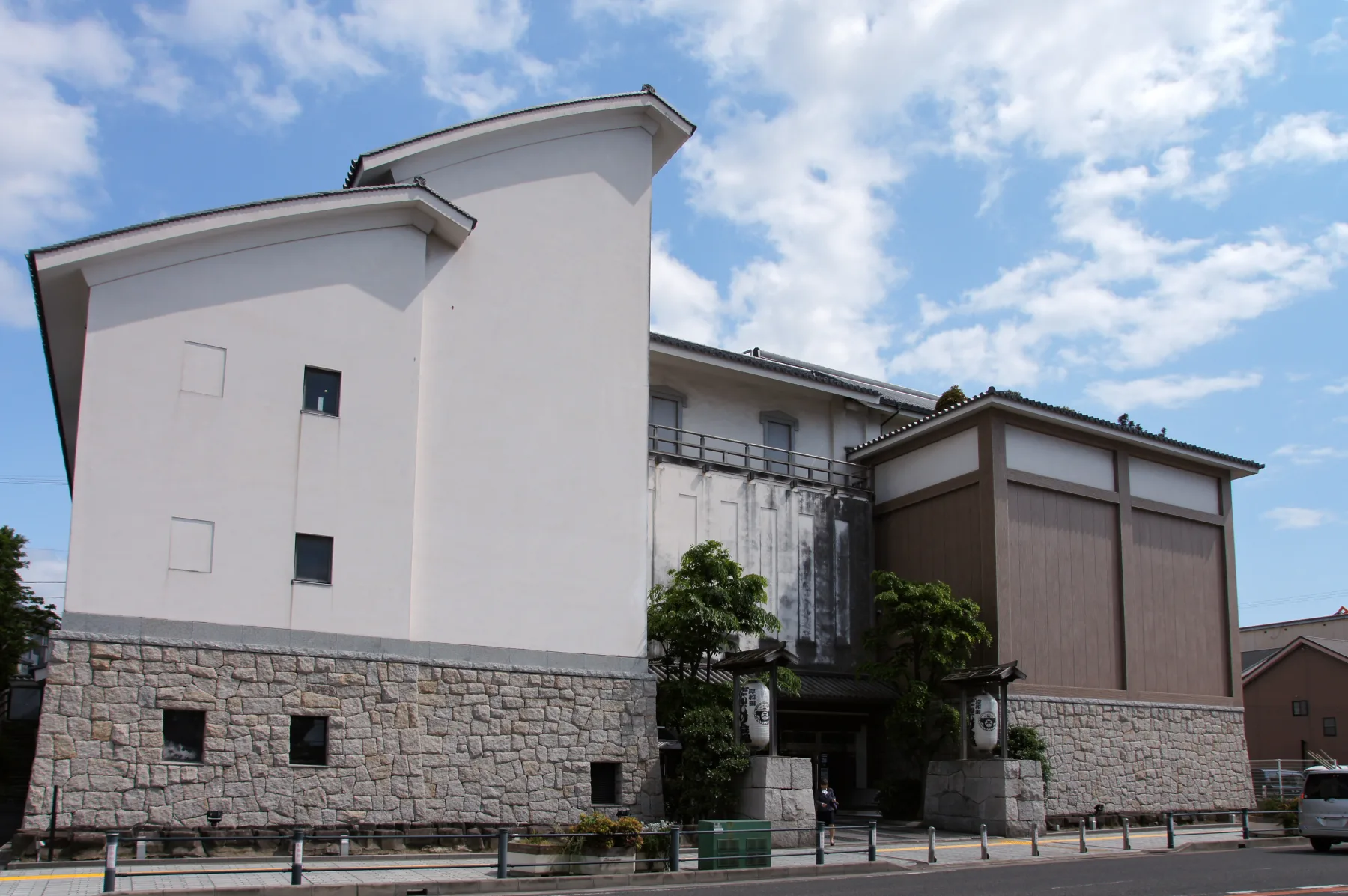
The Danjiri Kaikan museum by the station puts a real float in front of you year-round — ¥600 for adults and ¥300 for school-age children, 10:00–17:00 with last entry at 16:00, closed Mondays (open if the Monday is a public holiday) and over the New Year period. It is about 13 minutes’ walk from Nankai Kishiwada station. It is a genuinely good hour, and it is the only way to look closely at the carving, which you will never manage on a festival day. With the rest of the day free, Osaka’s bookable sights are 30 minutes back up the line.
Or come in October. The October festival — test pull 4 October, eve 10 October, main day 11 October — covers six outer districts of the city and is a quieter, more local affair. It also sits alongside the rest of the autumn calendar in our Japan in October guide, and the Naniwa Yodogawa fireworks follow the weekend after. Note it starts earlier on the main day (07:00) and is reached from the JR Hanwa line rather than the Nankai line.
How I would spend the weekend
| If you have… | Do this |
|---|---|
| One afternoon, and it is Friday | The 18 September test pull, 14:00–16:00, from the street. Full speed, no crowd, no ticket. |
| One day, Saturday | Station-front parade from 13:00 (all 22 floats, in order), then stay for the lantern run at 19:00. Skip the 06:00 start unless you are committed to it. |
| One day, Sunday | Konakara-zaka from about 09:10, using the shrine-entry order as your timetable. Then the afternoon run from 13:00. |
| The full weekend | Saturday dawn pull-out at Kankan-ba (in place by 05:00), rest through the dead gap, parade at 13:00, lantern run. Sunday at Konakara-zaka, then Haruki in the afternoon for the contrast. |
| Children with you | Station-front parade and the night run only. Not Kankan-ba, and not the dawn pull-out. |
Questions travellers ask
When exactly is the Kishiwada Danjiri Festival in 2026?
The September festival is Saturday 19 September (yoimiya, 06:00–22:00) and Sunday 20 September (honmiya, 09:00–22:00), in the Kishiwada and Haruki districts. There are two free test pulls beforehand, on Sunday 6 September and Friday 18 September, both 14:00–16:00. A separate October festival for the city’s outer districts runs 10–11 October, with its own test pull on 4 October.
What time should I arrive?
It depends entirely on which block you are there for, and the answer is not “early” in general. For the dawn pull-out at Kankan-ba on Saturday, attendees aiming for the front row talk about arriving between 03:30 and 05:00. For the Saturday station-front parade, being in place by around noon is comfortable. For Konakara-zaka on Sunday morning, you can use the published shrine-entry order — the listed time for each town is the moment it sets off from the bottom of the slope — and arrive twenty minutes before the slot you want. Between blocks, nothing runs at all.
Is there really nothing happening between the blocks?
Correct — but the pattern is not the same on both days, which is the part that catches people out. On Saturday the gaps are roughly 07:30–09:30, 11:30–13:00 (12:00–13:00 in Haruki) and 17:00–19:00. On Sunday there is no early gap because nothing is scheduled before 09:00 at all; the midday gap is the shorter 12:30–13:00, and the evening gap is again 17:00–19:00. Those windows are when you eat, sit somewhere cool, or visit the museum — not when you hold a position on a kerb.
Is it safe to watch?
The risk is real and it is not zero: people are injured most years and have been killed. It is also very manageable if you behave like the locals do. Stand well back from corners, never on or over the tow rope, obey the marshals immediately, and do not push forward for a photograph. The city’s printed rules also ban umbrellas and parasols, strollers, tripods, step-ladders and drones along the route. The safest viewing of all is the Saturday afternoon parade or the night run.
Do I need a paid seat?
No. Street viewing is free and, for a first visit, the Friday test pull or the Saturday parade is better value than a grandstand. The paid seats are a private commercial product around Kankan-ba, not a city service, starting at ¥3,300 and rising steeply. As of 1 September 2026 they were still on sale for all seven ticketed sessions, so the “sells out instantly” warning you will read elsewhere did not hold this year. The real obstacle for foreign buyers is the Japanese ticketing checkout, which can require registering a face photo and each companion in advance.
Where do I put my luggage?
Not in Kishiwada. The station has one small locker bank, roughly eighteen lockers, none of them large, and attendees report them full on festival days. Leave bags at Namba or your hotel.
What happens if there is a typhoon?
The festival is pulled in rain and a typhoon does not automatically cancel it. The best-documented case cuts the other way: in 2018 a major typhoon struck the region days beforehand, the festival went ahead, and it was the paid grandstands that were cancelled because the operator could not source scaffolding. Watch the city’s announcements rather than assuming either way.
Can I bring children?
Yes, to the right parts. The Saturday station-front parade and the evening lantern run are calm, and local children pull at the front of the rope at night. The dawn pull-out and the Kankan-ba corner during running blocks are not places for small children — you cannot leave quickly, and strollers are asked to be left at home.
Kankan-ba or Konakara-zaka?
Kankan-ba if you want the sharpest turns and the biggest atmosphere and you are willing to be stuck in one place for an hour or more. Konakara-zaka if you are there on Sunday morning and want the run enthusiasts rate most highly — the floats accelerate up the slope and turn straight through, without the preliminary stop used elsewhere. Konakara-zaka is Sunday-morning only; there is nothing to see there on the Saturday.
Sources and how this was checked
Join travelers discovering Japan's hidden side
Weekly dispatches from off-the-beaten-path Japan — spots and stories you won't find in guidebooks.
No spam. Unsubscribe anytime.
Welcome aboard!
You're in. See you in your inbox soon.