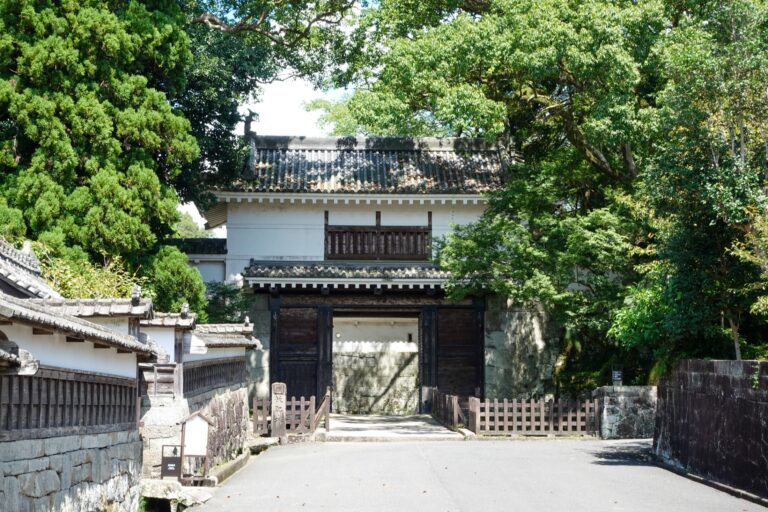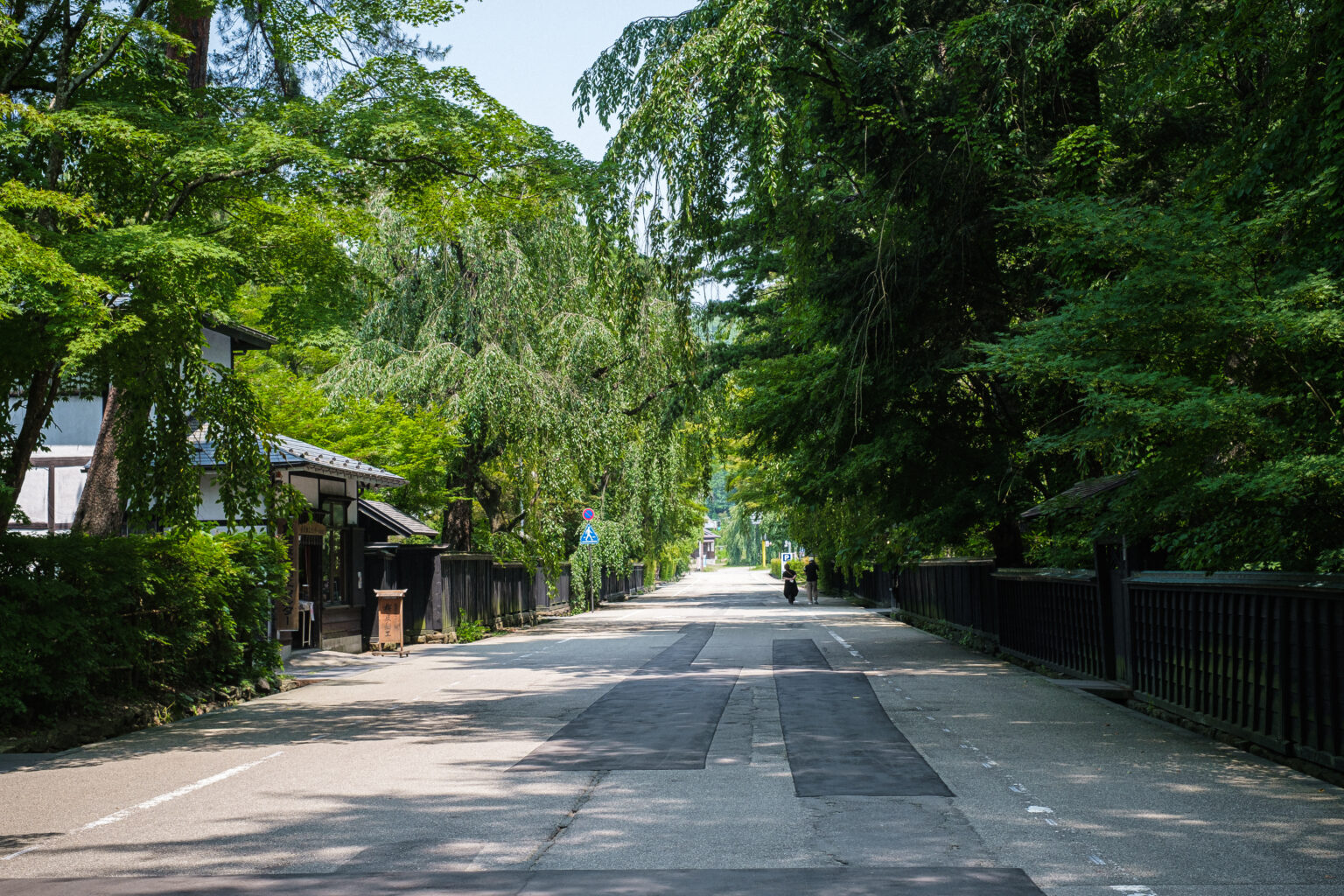

Yes, you can walk real former samurai districts across Japan, from Kanazawa’s Nagamachi and Akita’s Kakunodate to Chiran, Hagi, Kitsuki, Matsue, Matsushiro and Obi. The streets are usually free to wander, and a selection of samurai houses are open to step inside. The catch is that many of the walled homes behind the lanes are still lived in, so only the properties officially open to the public can be entered.
| District (Prefecture) | Best known for | Can you enter the houses? |
|---|---|---|
| Nagamachi, Kanazawa (Ishikawa) | Earthen walls and canals below the castle | A few named houses; easiest to combine with a city trip |
| Kakunodate (Akita) | Weeping cherries over a broad samurai street | Yes, six houses listed open |
| Chiran (Kagoshima) | Seven scenic samurai gardens | Gardens only; houses still lived in |
| Hagi (Yamaguchi) | A whole preserved castle town | Yes, surviving samurai residences |
| Kitsuki (Oita) | “Sandwich” town, samurai hills over a merchant valley | Yes, several on a common ticket |
| Shiomi Nawate, Matsue (Shimane) | An Edo street along the castle moat | Yes, a surviving samurai residence |
| Matsushiro (Nagano) | Sanada-clan castle town | Yes, an Important Cultural Property house |
| Obi, Nichinan (Miyazaki) | Kyushu’s first preserved district | Yes, six sites on a common ticket |
What is a samurai district, a buke yashiki, and a castle town?
A buke yashiki (武家屋敷) is a samurai residence, the home and grounds of a warrior-class family, a term rooted in the castle towns of the Edo period. It covers samurai dwellings across ranks, not only lords’ mansions. A castle town (jōkamachi) is the whole town that grew up around a castle, and the warrior quarter (buke-chi) is the samurai housing zone inside it, usually laid out by rank near the castle.
The best walkable samurai districts in Japan
Nagamachi, Kanazawa (Ishikawa)
Nagamachi is Kanazawa’s preserved former samurai quarter, where lanes of earthen walls (dobei), stone-paved alleys and the historic Onosho canal survive from the Edo period, when middle- and upper-ranking Kaga-domain retainers lived here. It sits just below the former Kanazawa Castle, tucked behind the Korinbō shopping district, which makes it the easiest samurai district to fold into a normal city trip. The centrally located Nomura Family Samurai Residence (Nomura-ke) is open to visitors. It is best described as a restored residence on the Nomura family estate: the original samurai house is gone, and the rooms you tour today include reception rooms relocated from a wealthy Kitamaebune shipping merchant’s mansion. As of 2026 admission is around ¥550 for adults, open 8:30–17:30 April–September and 8:30–16:30 October–March. Nearby, the free Ashigaru Museum lets you step inside two relocated foot-soldier houses that show the plainer life of low-ranking retainers, and the free Takada-ke residence site preserves a restored long service gate. Much of Nagamachi is still a lived-in neighbourhood, so enter only the named public sites, such as Nomura-ke, the Ashigaru Museum, Takada-ke and any garden sites currently listed as open. In autumn, nearby Kenrokuen adds maple colour and the yukitsuri rope supports.
Kakunodate (Akita)
For atmosphere, Kakunodate is the standout. Its warrior quarter is a nationally selected Important Preservation District in the “samurai town” category, covering about 6.9 hectares and selected in 1976, among Japan’s earliest. As of 2026 the city lists six samurai residences open along the broad street (the Aoyagi, Ishiguro, Iwahashi, Kawarada, Matsumoto and Odano houses), though which are open, and whether each is free or charges a small fee of roughly ¥400–500, varies, so reconfirm before you go. The district is famous for its weeping (shidare) cherries: around 400 line the streets, of which 162 are a designated Natural Monument. (The separate avenue of Somei-Yoshino along the Hinokinai River embankment is a National Place of Scenic Beauty, a different thing.) It is an easy 15-to-20-minute walk from JR Kakunodate Station.
Chiran (Kagoshima)
Chiran is a “fumoto” settlement (one of the outlying warrior villages of the old Satsuma domain) rather than a conventional castle town, which gives it a distinctive, garden-heavy character. Seven gardens are open to the public as the Chiran samurai-residence garden group, and they are collectively a nationally designated Place of Scenic Beauty (registered as Chiran-fumoto Teien in 1981); the wider district is an Important Preservation District in the samurai-town category from the same year. The important practical detail is that the houses themselves are still lived in, so here the visit is the gardens, not the house interiors — keep to the marked areas and respect residents’ privacy. As of 2026 common admission to the garden group is around ¥530 for adults and ¥320 for children, open roughly 9:00–17:00 year-round. Access is by local bus from Kagoshima-Chūō Station (about 1 hour 20 minutes), and services are limited, so check the timetable.
Hagi (Yamaguchi)
Hagi is less a single district than a whole preserved castle town. Its Horiuchi and Hiyako (平安古) areas were both selected as Important Preservation Districts on 4 September 1976, among Japan’s very first, and both are classified as samurai-town quarters. Hagi actually has four nationally selected preservation districts in all (the two samurai quarters plus a port quarter and a post town), tying it with Kyoto and Kanazawa for the most of any Japanese city. Among the houses you can enter, Kuchiba-ke and the former Asa-Mōri family long service quarters (nagaya) in Horiuchi are surviving samurai residences and national Important Cultural Properties, and the nearby former home of the Meiji statesman Kido Takayoshi reflects that same warrior-era world. Which houses are open, and their prices and hours, vary by season.
Kitsuki (Oita)
Kitsuki has the most unusual layout of any town here. Its Kitadai and Minamidai quarters, selected as an Important Preservation District only in 2017 in the samurai-town category, sit on two facing hills, north and south, with the old merchant street running through the valley between them, the two sides linked by stone-paved slopes such as the Vinegar-Shop and Salt-Shop slopes. The town promotes itself as Japan’s only “sandwich-shaped” castle town. As of 2026 a common viewing ticket costs around ¥1,500 for adults (a rate that took effect on 1 April 2026, up from roughly ¥800) and covers seven paid sites including Kitsuki Castle, Ōhara-tei and the castle-town museum; the Nomi-tei residence is free and separate from the pass. Confirm the current price and which houses are open when you go.
Shiomi Nawate, Matsue (Shimane)
Shiomi Nawate is a preserved Edo-period street of about 500 metres running along the north moat of Matsue Castle, where you can walk the old townscape and step inside a surviving samurai residence, the Buke Yashiki. As of 2026 individual admission is ¥400 for adults, and the house is open year-round with seasonal hours (roughly 9:00–18:00 in summer and 9:00–17:00 in winter). It is also covered by a three-site combined ticket, around ¥1,760 for adults, that adds the Matsue Castle keep and the Lafcadio Hearn Memorial Museum — a good-value loop if you are seeing the castle anyway. If you stay the night, Matsue has good options near the castle. Matsue also pairs with a half-day inland to the Okuizumo tatara and sword museum — the forge culture that armed these districts.
Matsushiro (Nagano)
Matsushiro was the castle town of the Sanada clan, and several samurai residences survive here. The former Yokota Family Residence, home of a mid-ranking Sanada retainer, was designated a national Important Cultural Property in 1986 and is a rare chance to see a genuine surviving warrior house. As of 2026 admission is ¥400 for adults. It closed for a stretch in 2023–2025 for fire-safety work, so confirm current opening days and hours before you make the trip.
Obi, Nichinan (Miyazaki)
Obi was selected as a national Important Preservation District in 1977, the first in Kyushu, and is a well-preserved former castle town whose streets keep the character of their samurai residences. A single common ticket, around ¥800 for adults as of 2026, covers six heritage sites, including the Yoshōkan villa, Matsuo-no-Maru, the local history museum and the Komura Jutarō Memorial Hall. Confirm the current price before you go.
What you actually see inside a samurai house
Once you are through the gate, the houses reward a slow look. Rank shows in the architecture: a higher-ranking home has a formal entrance hall, a raised reception room for receiving guests, and a clear split between the family’s private space and the rooms used for official business. Most residences open onto a garden meant to be viewed from the veranda rather than walked through, and the outer walls, long service gates (nagayamon) and gatehouses tell you at a glance who lived where. It is worth remembering that any given building may be an original survivor, a restoration, a relocated structure moved from elsewhere, or a modern reconstruction — the good sites say which on their own signs, and that history is part of the interest.
Streets are free; houses are not — and half the lanes are still someone’s home.
Practical tips for visiting
| Town | Combined ticket | Covers |
|---|---|---|
| Matsue | ~¥1,760 (adults), three sites | Buke Yashiki + Matsue Castle keep + Lafcadio Hearn Memorial Museum |
| Kakunodate | Sold per house; some multi-house deals | Check at the first house you enter — offers change |
| Kitsuki | Multi-site pass | Samurai houses on both hills; kimono rental discounts often attached |
Prices as of 2026 — every town revises these, so confirm at the ticket window.
- Streets are free; houses are not. Wandering the districts costs nothing, but stepping inside individual residences, museums or gardens usually carries a small admission, often just a few hundred yen. Fees and hours change, so treat any figure here as “as of 2026, confirm locally.”
- Look for a combined ticket. Several towns sell one — Chiran’s single ticket covers all its gardens, Matsue bundles the samurai residence with the castle, and Kitsuki and Obi each have a common pass. If you plan to enter more than one or two sites, it usually pays off.
- Follow the posted signs on shoes and photos. Many residences ask you to remove your shoes, and photography rules vary from house to house, especially where buildings are still lived in. Check each entrance rather than assuming one rule for everywhere, and never photograph residents or private living areas.
- Carry some cash. These are small, individually run sites, so it is safest not to count on cards at every ticket booth.
- Respect the neighbourhood. In places like Nagamachi and Chiran you are walking through people’s homes, not a theme park — keep to the public lanes and marked areas.
When to go
Any season works for a walk, but a few are special. In Kakunodate the weeping cherries are usually at their best from around mid-to-late April into early May, and the autumn colours from late October to early November (see our November guide for how that month works nationwide) — though the exact timing shifts every year, so check the latest local forecast before you travel. Winter brings a quiet, snow-lined version of the same streets in the northern towns. For getting there, the Akita Shinkansen runs to Kakunodate and the Hokuriku Shinkansen to Kanazawa, so run the fares first: if you are crossing several regions a Japan Rail Pass can still help on some routes, though not automatically. Kakunodate pairs naturally with the Lake Tazawa and Nyūtō Onsen area (it slots straight into our Tohoku 5-day itinerary), and many of these towns have an old inn or two worth a night — compare ryokan and hotels near the castle towns, or search places to stay close to each district. For two more samurai-history stops nearer the big cities, there is a samurai-history walk in Kyoto’s Fushimi and the surviving lordly palace at Kawagoe Castle near Tokyo.
Some of the links above are affiliate links. If you book through them we may earn a small commission, at no extra cost to you.
Frequently asked questions
Can tourists enter samurai houses in Japan?
Yes, but only the residences officially open to the public. Many houses in a samurai district are still private homes, so you walk the streets freely and enter only the named, ticketed houses — such as Nomura-ke in Kanazawa, the six listed houses in Kakunodate, or the Buke Yashiki in Matsue.
What is a buke yashiki?
A buke yashiki (武家屋敷) is a samurai residence, the home and grounds of a warrior-class family. The term covers samurai houses of all ranks, from modest foot-soldier dwellings to substantial retainers’ mansions, not only lords’ homes.
Which samurai town is best to visit first?
Nagamachi in Kanazawa is the easiest, since it sits inside a major city you are likely to visit anyway. Kakunodate is the best for atmosphere and cherry blossoms, and Chiran for its scenic gardens. Choose by what you want most and how it fits your route.
What’s the difference between a samurai town and a post town?
A samurai town was the residential quarter where warrior families lived in a castle town; a post town was a relay station along a highway, such as the Nakasendo, that served travellers with lodging and horses. They are recorded as separate settlement types and covered in our post-town guide.
When is the best time to visit Kakunodate?
Late April to early May for the weeping cherry blossoms, and late October to early November for autumn colour — but both shift year to year, so check the current forecast close to your trip.
Are the samurai districts free to visit?
Walking the streets is generally free. Entering individual residences, gardens or museums usually costs a small admission, often only a few hundred yen, and several towns offer a combined ticket if you plan to see more than one site.
Sources and last checked
Last checked: August 2026. Cultural-property designations and access were verified against official Japanese sources, including the Agency for Cultural Affairs’ Preservation Districts scheme and Cultural Heritage Online, and the official town and tourism sites for Kakunodate, Kanazawa Nagamachi, Chiran (Minamikyushu City), Hagi, Kitsuki, Matsue, Matsushiro (Sanada Treasures Museum) and Obi (Nichinan). Admission prices, opening hours, closed days and which houses are open change over time and vary by facility, so confirm the current details directly with each site before you visit.
Join travelers discovering Japan's hidden side
Weekly dispatches from off-the-beaten-path Japan — spots and stories you won't find in guidebooks.
No spam. Unsubscribe anytime.
Welcome aboard!
You're in. See you in your inbox soon.