
Yamanashi · Fuji Five Lakes · Seasonal
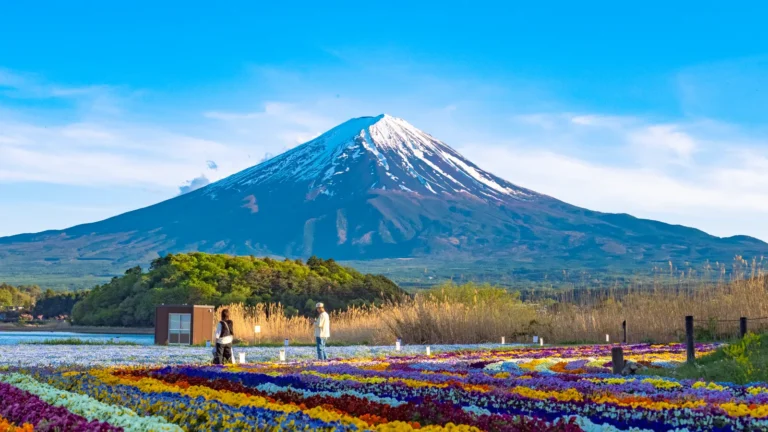
The Rainbow Flower Festival 2026 runs August 29 to October 12 at Fuji Motosuko Resort in Yamanashi — the same grounds that host spring’s famous Fuji Shibazakura Festival — with about 80,000 zinnias and rudbeckias in ten varieties flowering at roughly 1,000 metres under Mt Fuji. Admission is ¥1,000 for adults, ¥700 if you buy the web ticket in advance, ¥500 for children, and parking is free.
I know these fields in their spring costume. I stood in them when half a million shibazakura turned the ground pink and the queue for the car park stretched back toward Route 139. The autumn version is the same stage with a different script: fewer flowers, taller ones, warmer colours, and a fraction of the people. If you are in the Fuji Five Lakes area between late August and mid-October, this is one of the easiest ¥1,000 you will spend — and if the summit stays hidden, one of the easiest to skip. I will get to that honesty below.
What the Rainbow Flower Festival actually is
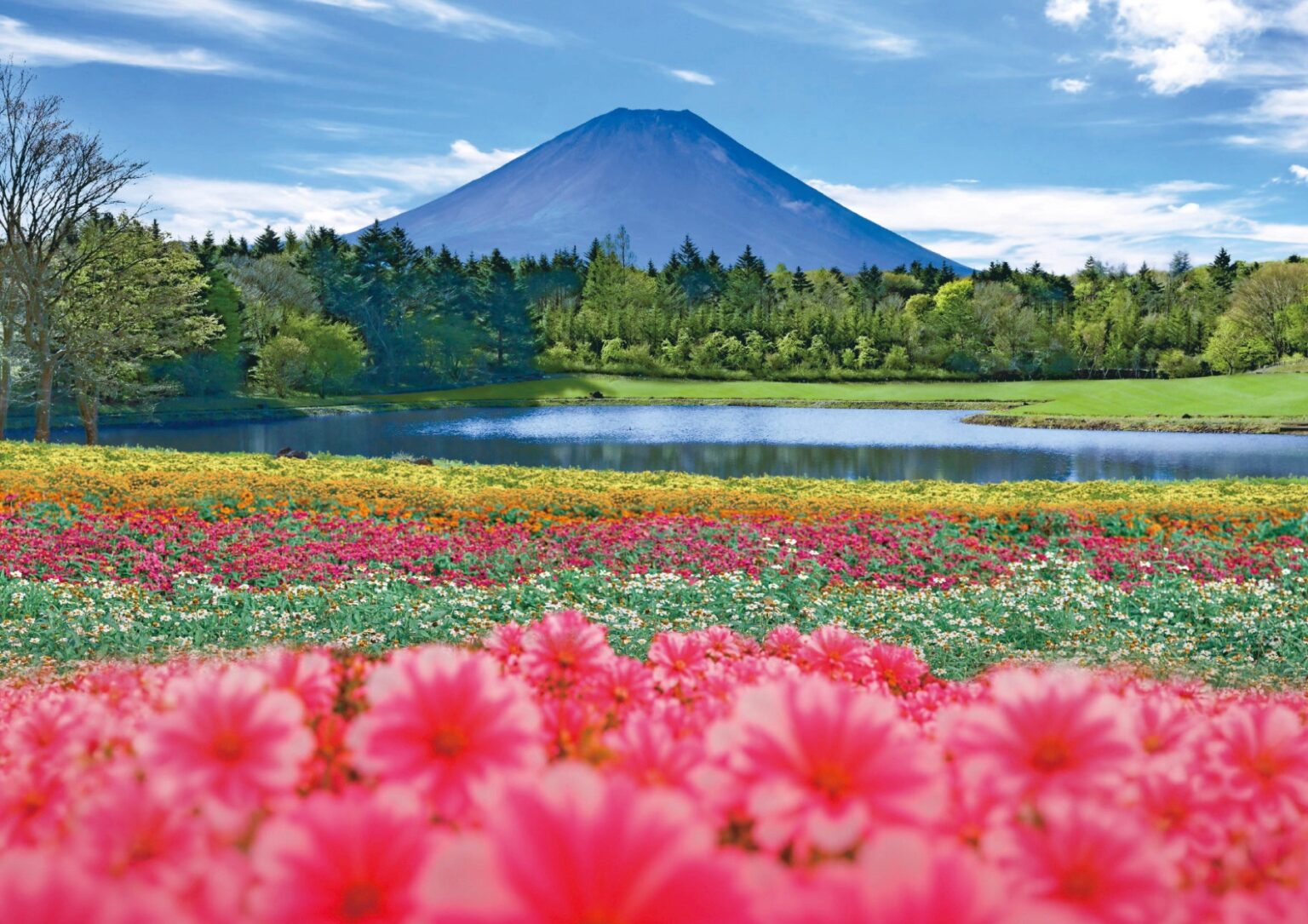
Fuji Motosuko Resort is a high plateau near Lake Motosu, best known for the Fuji Shibazakura Festival each April and May. Since the shibazakura is a spring-only carpet, the resort replants the slopes for a second act: an autumn festival of about 80,000 annuals across roughly 4,000 square metres — mostly Zinnia Profusion, of which the resort names seven colourways (white, hot cherry, red, orange, lemon and two bicolours), plus Rudbeckia ‘Prairie Sun’, among ten varieties in total. The 2026 edition runs 45 days, from August 29 to October 12.
Let me set expectations, because I would rather you arrive with the right ones. Eighty thousand plants is a big number, but it is not spring’s 500,000, and zinnia beds read as broad painted stripes rather than a wall-to-wall carpet. What you get in exchange is real: the same full-frontal view of Mt Fuji, flowers at eye-height instead of ankle-height, October air you can actually walk in, free parking, and weekday mornings quiet enough that the loudest thing in the park may well be a dog discovering the dog run. The resort’s own tagline this year is “hanakaze, fuwari” — a soft flower breeze — and that is honestly the register of the whole event.
The photo spots
The festival is built for cameras, and the installations are placed so Mt Fuji lands in the frame behind them.
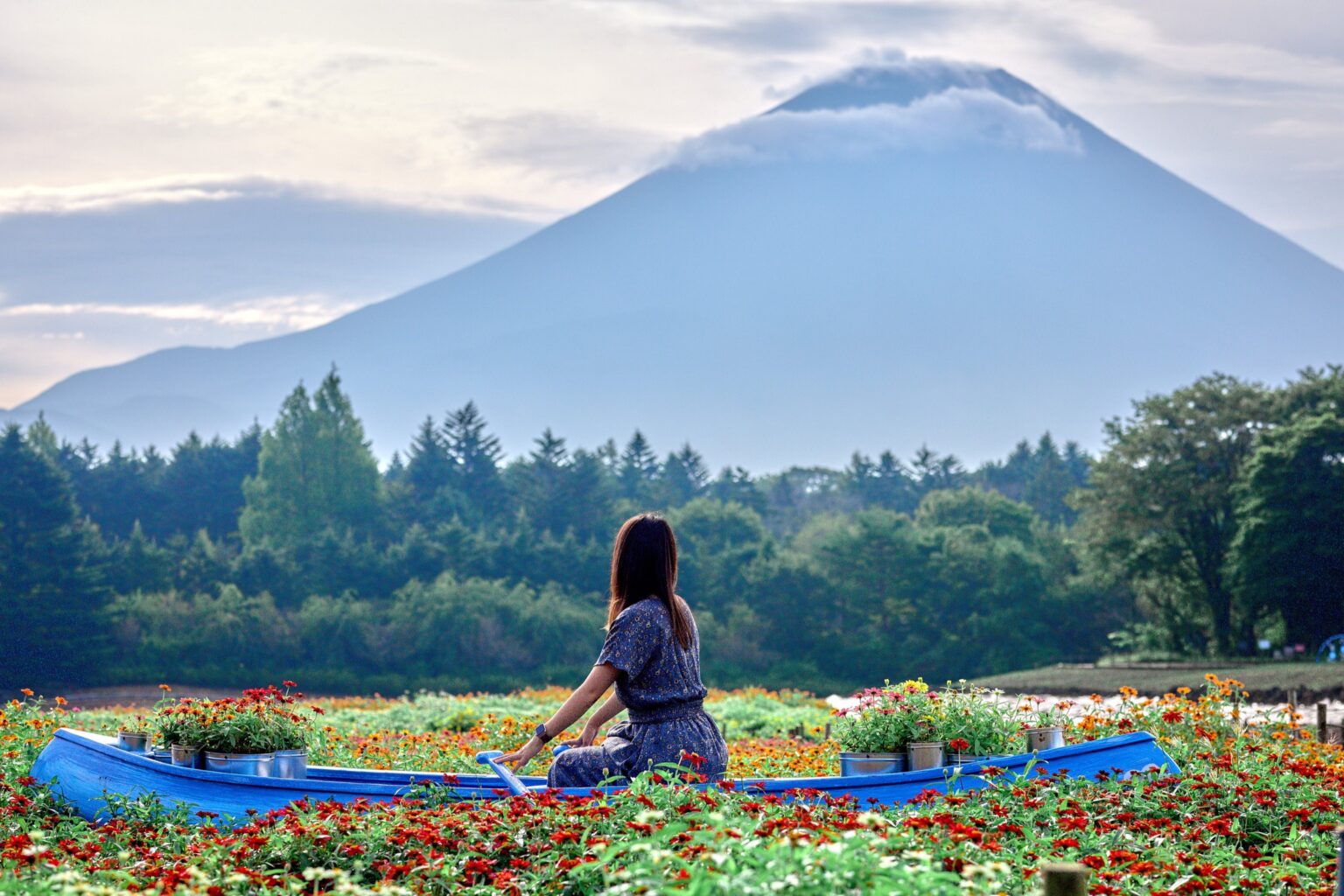
The rowboat in the flowers
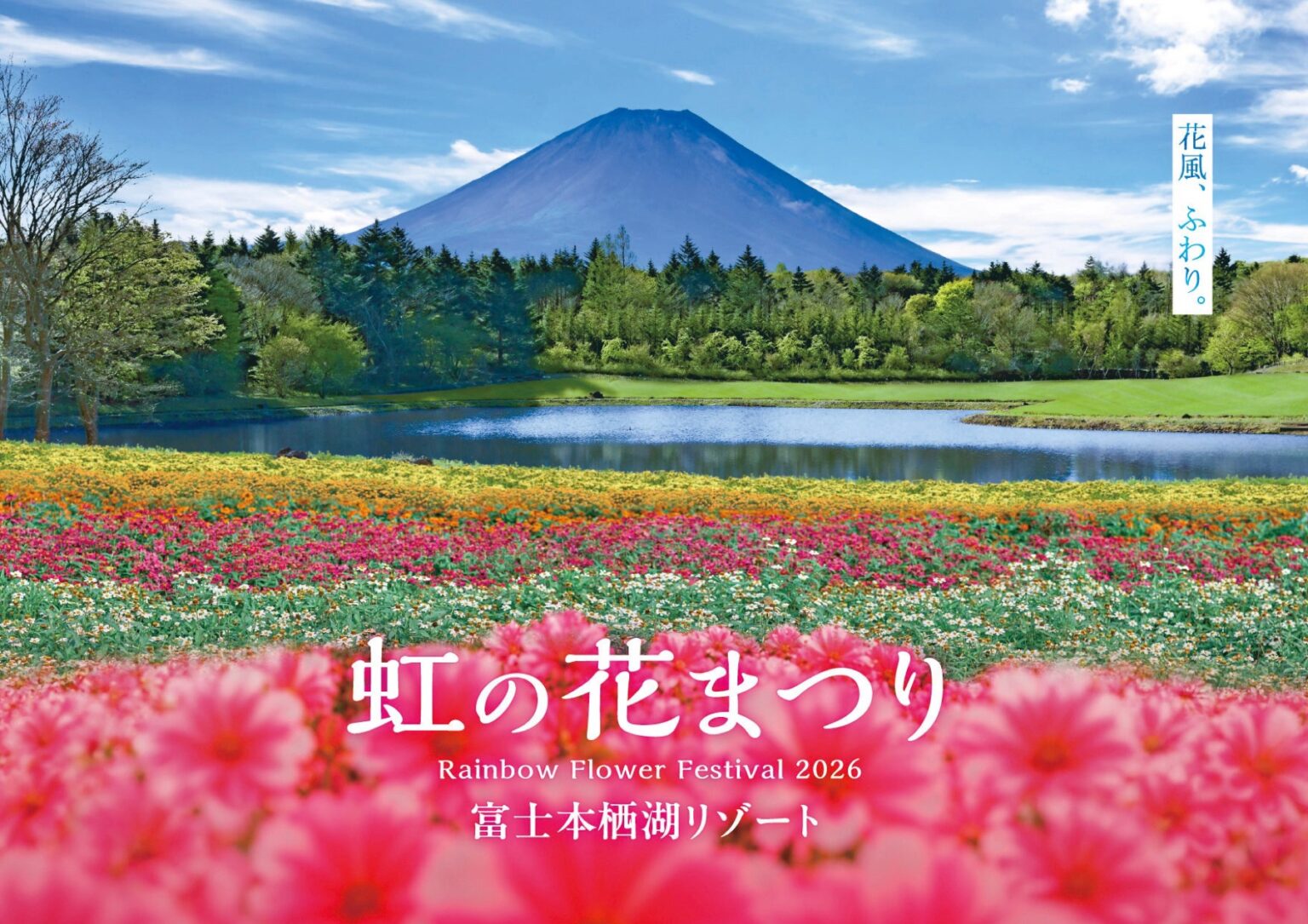
A sky-blue rowboat “sailing” a sea of zinnias — the festival’s signature shot (it is the one on this page’s hero image). You are meant to sit in it. Note the venue faces Fuji to the east-southeast, so mornings shoot into the light; go early anyway, because that is when the summit is most likely to be out, and the soft haze has its own look.
The Mt.FUJI object
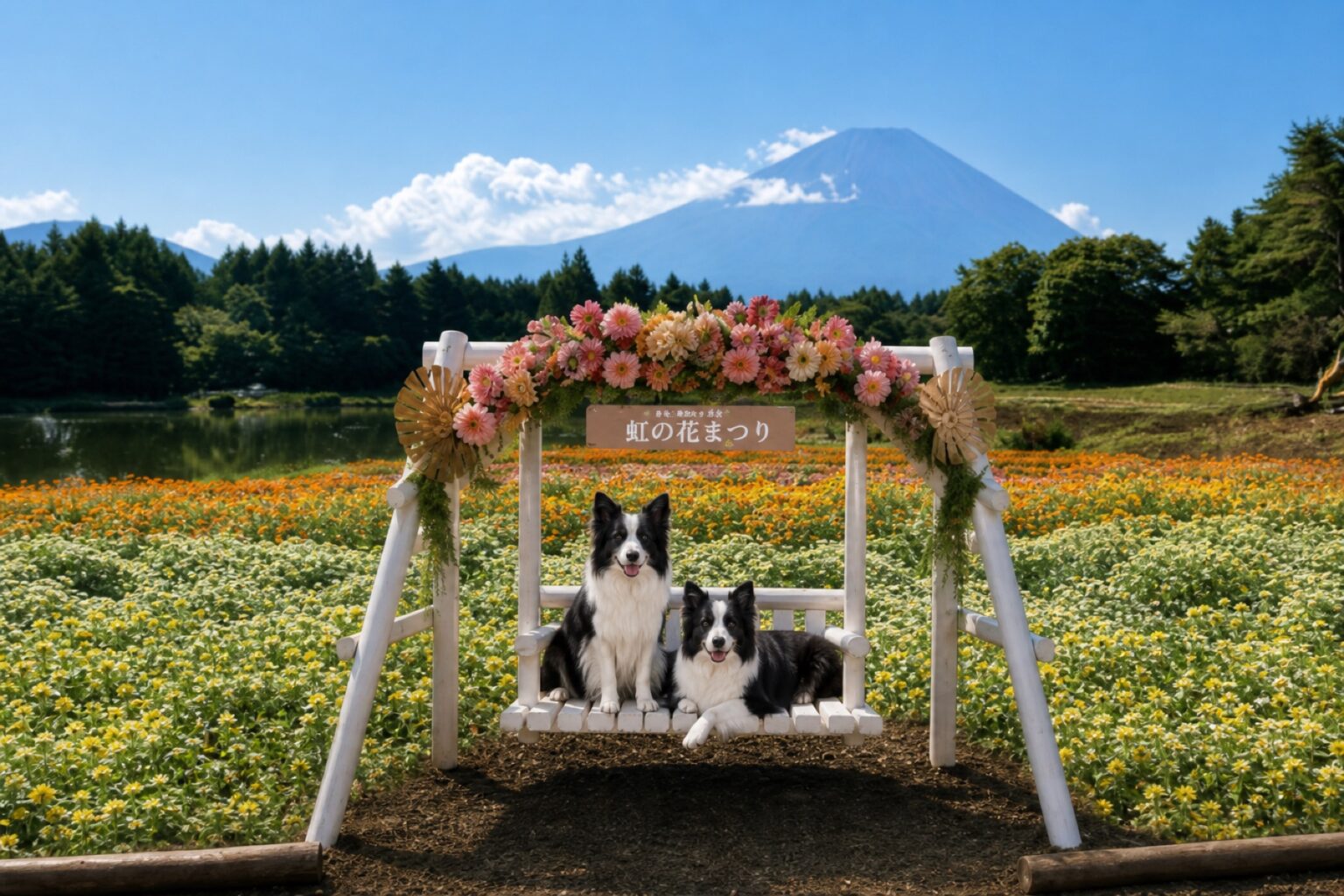
A pink heart beside white MtFUJI letters, lined up so the real mountain floats above the sign. Shameless, effective, and on a weekday outside Silver Week the queue should barely exist.
The yellow door
A free-standing “door to happiness” in the middle of the beds — open it and the frame is flowers, forest, mountain. Best in the softer afternoon light.
The dog swing bench
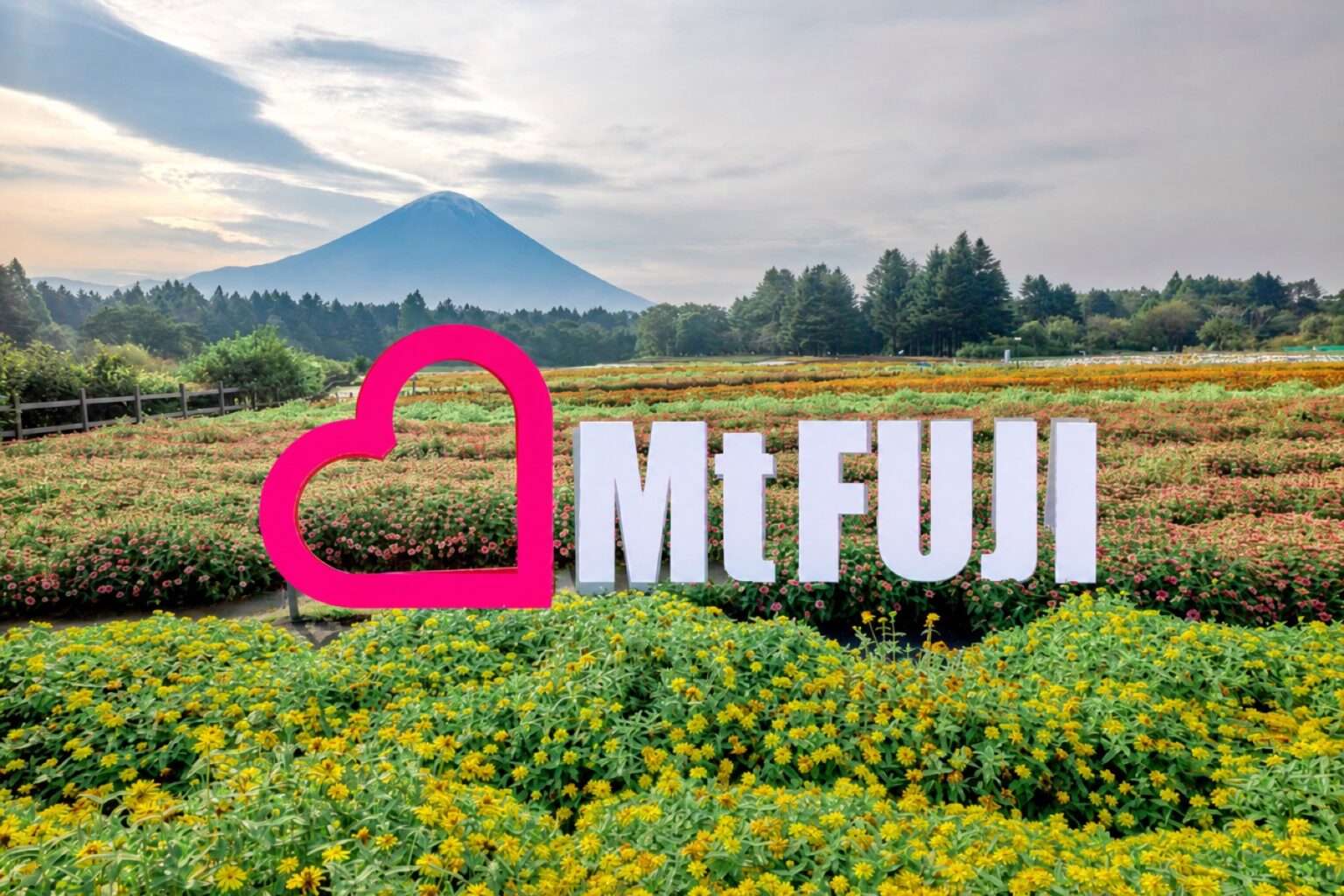
New for 2026: a white swing bench built for dog portraits, garlanded with flowers, Fuji behind. My border-collie-owning friends would lose their minds here.
Bring the dog — this year they are guests of honour
First, the fine print: entry itself is limited to small and medium dogs up to 50 cm at the shoulder — bigger dogs cannot come in at all. Within that rule, dogs enter free, and 2026 leans into it: the new dog photo spot above, a spacious dog run, and — for the first time — a dog menu at the cafe: chicken sasami jerky for ¥300 and a proper dog meal at ¥500 or ¥700. Keep them on a lead on the grounds (the stricter cage-or-cart rule applies only during spring’s Golden Week), stay out of indoor areas, take the terrace seats if you visit the cafe together, and handle your own clean-up. For travellers doing Japan with a dog — not a small tribe these days — a flower park that treats the dog as a customer rather than a tolerated accessory is still rare here.
The Peter Rabbit™ English Garden turns one page older
Inside the resort sits the Peter Rabbit™ English Garden — about 300 kinds of plants arranged by British garden designer Mark Chapman, open April 11 to November 23 this year, with no separate charge listed beyond your festival admission. Early autumn is a good moment for it: the borders are still full while the beds outside shift to autumn colours.
September also happens to be Peter Rabbit’s birthday. The character was born on September 4, 1893, in a picture letter Beatrix Potter wrote to a sick five-year-old named Noel Moore. The garden marks the date with character greetings and photo sessions on September 4 and again through the September 19–23 holiday run, at 11:00 and 14:00, about 20 minutes each. There is a 50-set birthday goods box (¥5,500, from September 1) and a small herb-tin gift for the first 500 spending ¥4,000 or more at the garden shop. I mention the dates mostly as a warning disguised as a tip: they are lovely, and they fall exactly on the most crowded days of the whole festival.
When to go (and the Silver Week problem)
The park opens at 8:00, and the first two hours are the best of the day — not for flattering light (you shoot toward the sun here in the morning) but for empty photo spots and, above all, for the mountain actually being visible. Fuji in autumn is a morning creature; by late morning the summit often pulls a cloud cap over itself. I keep a whole page on reading Mt Fuji’s weather and visibility if you want to play those odds properly.
Mark your calendar, then avoid it: September 19–23, 2026 is a five-day Silver Week — Japan’s first since 2015 (Respect-for-the-Aged Day, a sandwiched national holiday, and the Autumn Equinox line up in a row). Domestic crowds will be at their peak, and the Peter Rabbit birthday events run those exact days. If you want the quiet version of this festival, come on any weekday outside that window. If you want the festive version, that is the window.
One more expectation to calibrate: the classic postcard of flowers under a snow-capped Fuji is mostly a spring image. The mountain’s first snowcap arrives, on average, around October 2 (Kofu Local Meteorological Office, 1991–2020 normals) — but it came on October 23 in 2025 and a record-late November 7 in 2024. Plan on a bare blue summit for most of the festival, and treat any early dusting in the festival’s final days as a bonus. And pack a layer: the fields sit at about 1,000 metres, and September mornings at that altitude will bite in a way Tokyo forgets.
Getting there
| From | Route | Time / notes |
|---|---|---|
| Tokyo (train) | Fuji Excursion limited express, Shinjuku → Kawaguchiko; or JR Chuo Line to Otsuki + Fujikyu Railway | Approx. 2 – 2.5 hours to Kawaguchiko Station |
| Tokyo (bus) | Highway bus, Busta Shinjuku → Kawaguchiko Station | Approx. 1 h 45 min |
| Kawaguchiko Station | Fujikyu route bus (Mt Fuji Station → Kawaguchiko → the resort) — it stops at the venue only during festival periods | Two departures a day: 9:05 and 11:05, arriving 10:07 / 12:07 (about an hour). Returns at 8:30, 13:20 and 15:30. There is no direct liner in autumn — that is a spring-only service |
| Shizuoka side | Route bus from Shin-Fuji Station via Fujinomiya Station | Take the 7:16 (arrives 8:30 — the only bus anywhere near the 8:00 opening). Returns toward Shin-Fuji leave at 10:07 and 12:07 only, so the later 12:16 departure has no same-day bus back |
| By car | Chuo Expressway Kawaguchiko IC via Route 139 | Approx. 25 min · parking free in autumn |
Driving? Set your navigation to “Fuji Motosuko Resort” or the older name “Motosu Highland” (本株ハイランド) — the official site recommends either. Outside festival periods the route buses skip the resort stop entirely, which is worth knowing if you visit the area off-season: the nearest stop becomes a 20-minute walk. And if you do ride the bus, pick your return before you leave — the timetable is thin, and the official site warns of road delays.
Plan This Trip
Tickets: the ¥300 you save by planning one day ahead
Gate price is ¥1,000 for anyone of junior-high age and up, ¥500 for children three and over. Buy the web ticket on the official site before you go and it drops to ¥700 and ¥300 — a 30–40% cut for about ninety seconds of phone admin, per the resort’s 2026 announcement. The festival runs every day of its 45-day window, though the resort notes dates can shift with the state of the bloom. Hours are 8:00 to 16:00 — note that last part, because a sunset visit is not on the menu; the cafe opens at 9:00 per the resort’s FAQ (hours can shift seasonally).
Make a half-day of it: Lake Motosu is ten minutes away
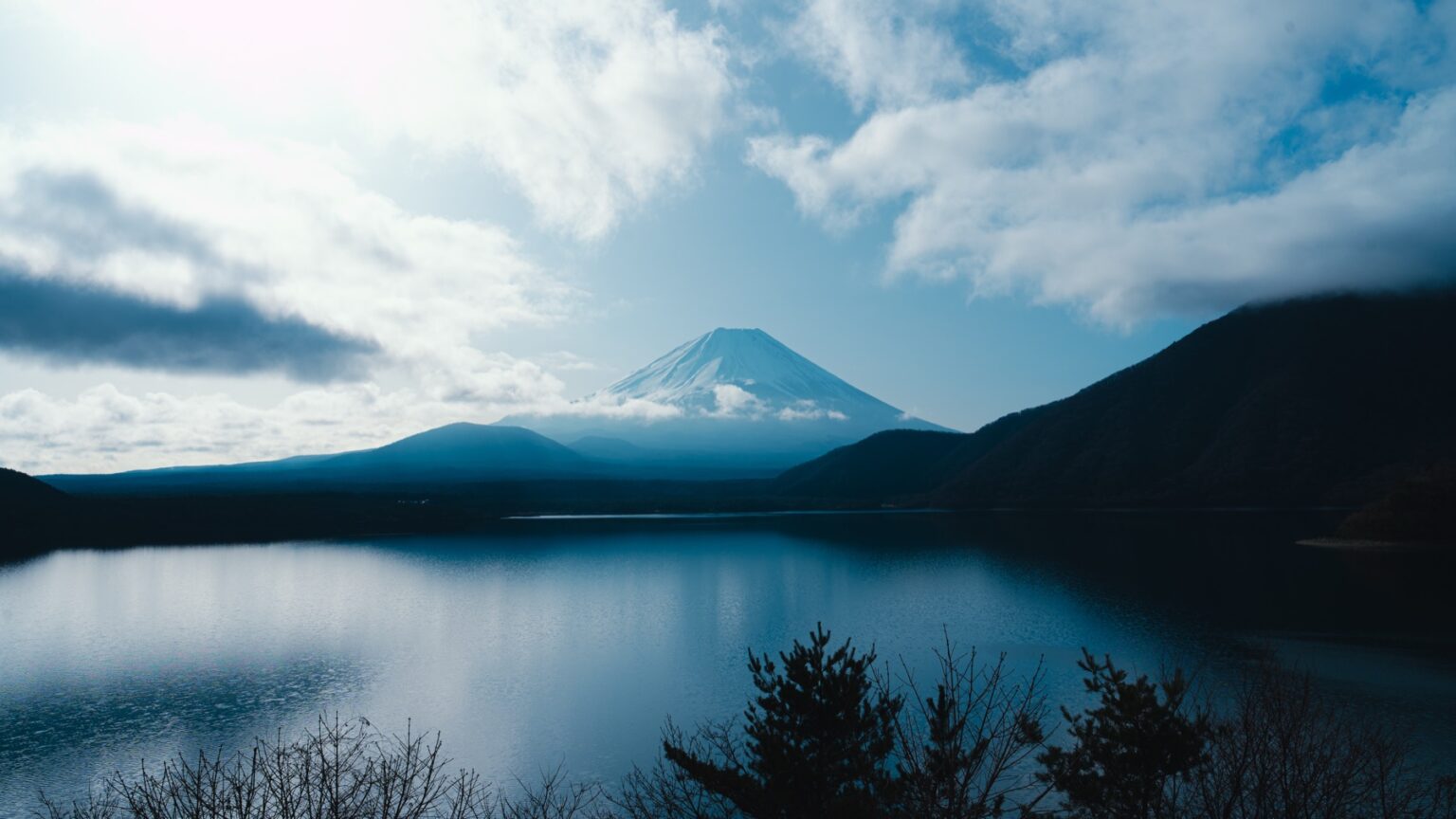
The festival alone is a 90-minute visit, so pair it. Drive (or ride) ten minutes north and you are at Lake Motosu, the lake on the back of the former ¥1,000 note — the 2004–2024 series, still legal tender, though today’s note swapped the view for Hokusai’s Great Wave — and the deepest, clearest and quietest of the Fuji Five Lakes. The classic banknote angle, shot by photographer Okada Koyo, is from Nakanokura Pass above the northwest shore, about a 30-minute climb from the road; standing there with one of the old notes in hand is exactly the kind of small ceremony I travel for. On the way back toward Kawaguchiko, Oishi Park keeps its own flower borders going into autumn, and the whole corridor slots neatly into my larger Mt Fuji guide.
Autumn vs spring: which festival should you pick?
If you can only visit these fields once, here is the honest comparison with the Fuji Shibazakura Festival I wrote up in spring:
| Shibazakura (Apr 11 – May 24) | Rainbow Flower (Aug 29 – Oct 12) | |
|---|---|---|
| Scale | ~500,000 moss phlox, a full pink carpet | ~80,000 zinnias & rudbeckias in stripes |
| Fuji’s look | Usually snow-capped | Usually bare; first snow averages Oct 2 |
| Crowds | Heavy; Golden Week is intense | Far lighter (smaller event, two buses a day) outside Silver Week (Sep 19–23) |
| Admission | ¥1,000 – ¥1,300, parking paid | ¥1,000 flat (¥700 advance), parking free |
| Comfort | Spring haze, GW queues | Cool 1,000 m air, flowers at eye height |
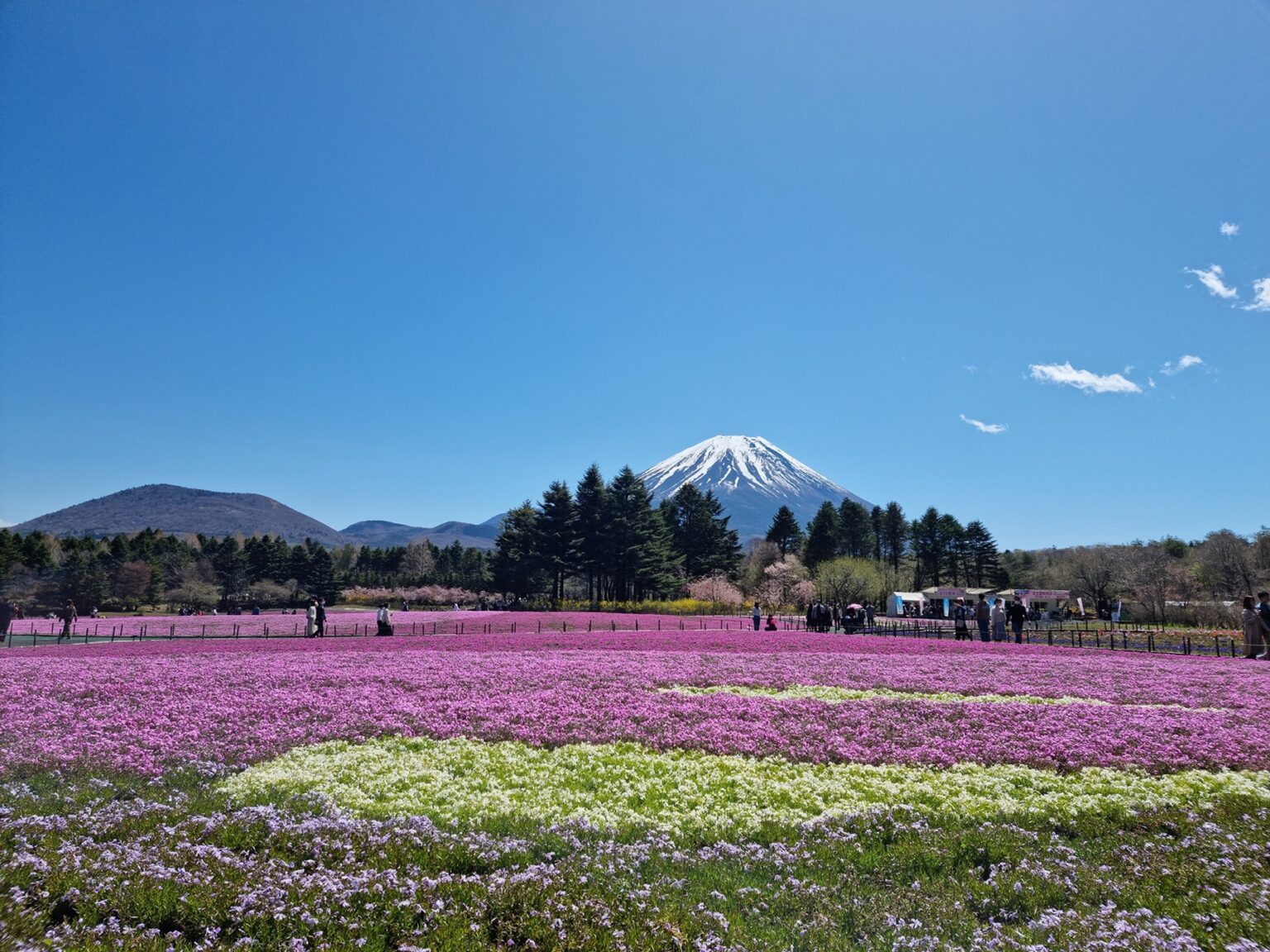
My verdict: spring is the spectacle, autumn is the experience. I would send a first-time visitor chasing the iconic photo to April–May, and send anyone who has already done a Japan spring — or anyone travelling with a dog, or anyone allergic to queues — to this one.
Where to stay for an 8:00 gate entry
Kawaguchiko is the practical base: a 25–30 minute drive from the fields (about an hour by the festival-period bus) with the widest choice of Fuji-view hotels and onsen. Booking has the mainstream inventory; Rakuten Travel is consistently better for small ryokan and lakeside onsen inns around the Five Lakes. No car? I keep a full guide to staying near Mt Fuji without driving.
A half-day plan that works
7:30 — Leave Kawaguchiko
Drive the 25-odd minutes so you are at the gate for the 8:00 opening, when Fuji is most likely to be clear. (By bus, the first arrival from Kawaguchiko is 10:07 — only the Shizuoka-side bus gets you in near opening, at 8:30.)
8:00 – 9:30 — The fields
Photo spots first (boat, then the Mt.FUJI object), then wander the beds and the Peter Rabbit garden before the tour buses arrive.
9:30 — Cafe or dog run
The cafe is open by now; the dog gets jerky. You have already banked the day’s best odds of a visible summit.
10:15 — Lake Motosu
Ten minutes to the old-banknote lake, then back along the lakes — Oishi Park, lunch in Kawaguchiko, done by early afternoon.
Rainbow Flower Festival 2026: FAQ
When is the Rainbow Flower Festival 2026?
August 29 to October 12, 2026, open every day, 8:00–16:00, at Fuji Motosuko Resort in Yamanashi. The resort notes the period can shift slightly depending on how the flowers are doing.
How much does it cost, and is there a discount?
¥1,000 for adults (junior-high age and up) and ¥500 for children three and over at the gate. Advance web tickets on the official site are ¥700 and ¥300. Pets enter free, and parking is free during the autumn festival.
Can I bring my dog?
If they are 50 cm or under at the shoulder, yes — larger dogs cannot enter the park at all. Entry is free, on a lead (the cage-or-cart requirement applies only during spring’s Golden Week). There is a dog run, a new dog photo spot for 2026, and a cafe dog menu (jerky ¥300, dog meals ¥500/¥700) — terrace seating only with a dog. No indoor areas, and you clean up after your own dog.
Will Mt Fuji be snow-capped during the festival?
Probably not — and it is better to know that going in. The average first snowcap is around October 2, but it arrived October 23 in 2025 and a record-late November 7 in 2024. Expect a bare summit; a white cap in the festival’s last days is a bonus, not a promise.
Is it worth it compared to the spring Shibazakura Festival?
Different trip. Spring has six times the flowers and the snow-capped-Fuji postcard, but heavy crowds and paid parking. Autumn has striped zinnia fields, eye-level blooms, cool air, free parking and far fewer people outside the September 19–23 Silver Week. First visit to Japan in spring: choose shibazakura. Repeat visitor, dog owner, or crowd-averse: choose this.
How do I get there without a car?
Take the Fuji Excursion from Shinjuku (or highway bus, about 1 h 45 min) to Kawaguchiko Station, then the Fujikyu route bus that stops at the venue during festival periods: two departures a day (9:05 and 11:05, about an hour), returns at 8:30, 13:20 and 15:30 — so fix your return before you set out. There is no direct liner in autumn; that is a spring-only service. From the Shizuoka side, take the 7:16 from Shin-Fuji Station (via Fujinomiya), arriving 8:30 — but note the returns toward Shin-Fuji leave at 10:07 and 12:07 only, so the later 12:16 departure strands you for the day. If the timetable feels too tight, a day tour or rental car honestly suits this corner of the lakes better.
How long should I plan for the visit?
Ninety minutes to two and a half hours covers the fields, the photo spots and the Peter Rabbit garden at an easy pace. Pair it with Lake Motosu and the Kawaguchiko lakeside to fill a half day.
Join travelers discovering Japan's hidden side
Weekly dispatches from off-the-beaten-path Japan — spots and stories you won't find in guidebooks.
No spam. Unsubscribe anytime.
Welcome aboard!
You're in. See you in your inbox soon.