Hokkaido · Noboribetsu Onsen · Day-use baths, Jigokudani, buses
Noboribetsu Onsen is a hot-spring town in southwest Hokkaido where an adult day-use bath costs ¥1,200 to ¥2,500 at the four hotels that publish a price; the top figure, at Dai-ichi Takimotokan, dates from a rise on 1 August 2026. Getting in is the harder part: on busy dates the hotels stop taking day bathers at a few days’ notice, and the direct buses from Sapporo and New Chitose Airport arrive in the afternoon and leave in the morning, which suits an overnight stay rather than a same-day return.
Noboribetsu Onsen day use: which hotels sell a bath in 2026?
Six places in the town show day-use bathing on their own websites as of 4 October 2026: four hotels that publish prices, a fifth that confirms day bathing without posting a price, and the Sagiri-yu public bathhouse. A seventh, Hotel Yumoto Noboribetsu, is still on the tourism association’s list, but its former day-bath page returned a 404 on 4 October 2026.
The town’s list is kept by the Noboribetsu International Tourism and Convention Association, which I’ll call the tourism association. Each card below is built from the hotel’s own page first and says where I fell back on the association’s entry. The four hotels with published prices all state that the price includes tax. “Nearest stop” is the stop Donan Bus names for that hotel on its October 2026 timetable.
| Bath | Adult price, hours and what to watch |
|---|---|
| Dai-ichi Takimotokan | ¥2,500; entry 9:00–18:00, out by 21:00; no regular closing day; whole hotel closed 5–15 April 2027 |
| Noboribetsu Grand Hotel | ¥2,000; 12:30–20:00 (from 14:30 on Mondays and Thursdays) and 7:00–10:00; suspends or shortens day bathing on busy dates |
| Noboribetsu Manseikaku | ¥1,300; 13:30–20:00 (last entry 18:00) and 7:00–9:30; restricts entry at weekends, on holidays and other busy days |
| Noboribetsu Sekisuitei | ¥1,200; 11:00–19:00 and 5:00–9:00; hours can change at the year-end, during Obon and on fully booked days |
| Kashoutei Hanaya | No price on the hotel’s notice (the association lists ¥1,000 in a 2022 entry); day bathing off on 1–9 and 13–30 Oct, 4–20 and 24–30 Nov and 1–10 Dec 2026 |
| Hotel Yumoto Noboribetsu | Current rate and hours not confirmed by the hotel; phone before going |
| Sagiri-yu (public bath) | ¥500 on its own page, ¥550 on the association’s; 9:00–21:00, last entry 20:30 |
Dai-ichi Takimotokan (第一滝本館)
¥2,500 adult, ¥1,500 child (3 to 12; under 3 free), bath towel and face towel included, and the heated pool comes with the ticket. Entry 9:00–18:00, out by 21:00. No reservation. No regular closing day; the whole hotel closes 5–15 April 2027 for maintenance. Some tubs close during daytime cleaning. When its car park is full, or at weekends and peak times, parking can be kept for staying guests: the hotel points day visitors to the Jigokudani car park opposite (¥500 a day). Nearest stop: Dai-ichi Takimoto-mae.
Noboribetsu Grand Hotel (登別グランドホテル)
¥2,000 adult (junior high and up), ¥1,000 child (2 to primary school). 12:30–20:00 with last entry 19:00; afternoon entry starts at 14:30 on Mondays and Thursdays, rather than 12:30. A separate morning slot runs 7:00–10:00, last entry 9:00. No day bathing over the year-end and New Year, and day bathers can be refused when the car park is full. The hotel suspends or shortens day bathing on busy days and posts it on its news page; it took no day bathers 2–5 October 2026. Its Oni Sauna swaps sides daily: women on odd dates, men on even dates. The 50-minute family bath is ¥4,400 plus the day-bath fee, booking required. Nearest stop: Noboribetsu Onsen.
Noboribetsu Sekisuitei (登別石水亭)
¥1,200 adult (¥1,091 before tax), ¥600 primary school, infants free. Two slots: 11:00–19:00 (last entry 18:00) and 5:00–9:00 (last entry 8:00), a morning slot the tourism association’s list leaves out. Bath towel and towel ¥300. Hours can change at the year-end, during Obon and on fully booked days, so the hotel asks you to check first. From Tuesday to Friday one bath is shut each morning for cleaning: the 8th-floor bath until 14:00 on Wednesdays (men) and Thursdays (women), the 7th-floor open-air bath until 15:00 on Tuesdays (men) and Fridays (women). Nearest stop: Ashiyu-iriguchi.
Noboribetsu Manseikaku (登別万世閣)
¥1,300 adult, ¥650 child, under 3 free, consumption tax and bathing tax included. 13:30–20:00 with last entry 18:00, plus 7:00–9:30 with last entry 9:00. Towel set ¥400. People with tattoos, tattoo stickers or body paint are refused entry. It restricts day-bath entry on Saturdays, Sundays, holidays and other days it expects crowds, and took no day bathers at all on 19–22 September 2026. A dinner buffet with a bath is ¥6,000 (adult, by phone reservation). Nearest stop: Noboribetsu Onsen.
Hotel Yumoto Noboribetsu (ホテルゆもと登別)
Not currently confirmed by the hotel. The former day-bath page returned a 404 on 4 October 2026, and I could not find a current hotel-published day-bath offer. An archived copy of that page dated 15 January 2026 gave 13:00–20:00 with last entry 19:00, ¥1,400 adult, ¥700 primary school, ¥300 from age 2 to before primary school, towels ¥200, and no day bathing when the whole hotel is privately booked. The tourism association’s entry, last edited in January 2024, matches. Phone 0143-84-2277 before you go. Nearest stop: Noboribetsu Onsen.
Kashoutei Hanaya (花鐘亭はなや)
Mostly closed to day bathers until 10 December 2026. Exterior repair and waterproofing work runs from 7 September to 10 December (planned), and day bathing is off on 1–9 and 13–30 October, 4–20 and 24–30 November, and 1–10 December; the inn says dates may shift and suggests phoning on the day. The inn’s closure notice gives no day-bath price; the tourism association lists 11:00–14:00 (last entry 13:30), ¥1,000 adult and ¥500 child, in an entry last edited in October 2022.
Yumoto Sagiri-yu (夢元さぎり湯, public bath)
¥500 adult (junior high and up), ¥180 primary school, preschoolers free, on its own site; the tourism association’s entry, edited on 3 October 2026, says ¥550. The two published figures conflict, so phone Sagiri-yu if the exact fare matters. The site also lists a ¥710 one-day ticket, and its paid rest area opens 9:00–20:00; its FAQ says the rest room lets you bathe as often as you like, go out and bring your own food, and comes with a bath towel. Confirm whether the ¥710 ticket is that rest room. Open 9:00–21:00, last entry 20:30. No free towels or soap with standard entry: see the rules section below. A notice dated 26 June 2026 says the women’s jacuzzi is out of service, with no restart date. It shares its address, Noboribetsu Onsen-machi 60, with the tourist information centre.
Hotel Mahoroba (ホテルまほろば), one of the other hotels people ask about, isn’t on the association’s day-bath list, and its bath page doesn’t mention day visitors when I read it on 4 October 2026, so ask the hotel directly if you are thinking of a day visit.
- 1 April 2025: Sagiri-yu moved its opening from 7:00 to 9:00, citing difficulty staffing early mornings. Older guides that say 7:00 predate this.
- 28 February 2026: Takimotokan ended its evening discount fare.
- By 4 October 2026, Hotel Yumoto’s former day-bath URL returned a 404; an archived copy dated 15 January 2026 still shows the old rates.
- 1 August 2026: Takimotokan rose from ¥2,250 to ¥2,500 for adults and from ¥1,100 to ¥1,500 for children. The Noboribetsu residents’ rate stays at ¥1,920.
- 7 September to 10 December 2026: Hanaya’s exterior works, with day bathing off on most weekdays.
- 1 October 2026: Donan Bus revised the timetable between JR Noboribetsu Station and the town.
- 5–15 April 2027: Takimotokan closes completely, day bathing included.
When do Noboribetsu hotels stop taking day bathers?
On busy days, and the notice can be short. Between 8 and 29 September 2026 the Grand Hotel posted four notices cutting or cancelling day bathing, and Manseikaku cancelled it for 19–22 September, a weekend followed by two public holidays. Takimotokan says it has no regular closing day and announces closures in advance on its website; the closure I found on its day-bath page is 5–15 April 2027.
| Dates (2026 unless stated) | What the hotel posted |
|---|---|
| Fri 11 – Sun 13 Sep | Grand Hotel: entry 12:30–14:00 only on the Friday and Sunday, out by 15:00; no day bathers on the Saturday. Posted 8 Sep. |
| Fri 18 – Wed 23 Sep | Grand Hotel: no day bathers 19–22 Sep, shortened to 12:30–14:00 on the 18th and 23rd. Manseikaku: no day bathers 19–22 Sep. Both posted 14 Sep. |
| Thu 24 – Sat 26 Sep | Grand Hotel: no day bathers on the 24th and 26th, shortened on the 25th. Posted 22 Sep. |
| Sun 27 Sep | Manseikaku: may stop taking day bathers if the baths are crowded with guests. Posted 26 Sep. |
| Fri 2 – Tue 6 Oct | Grand Hotel: no day bathers 2–5 Oct, shortened on the 6th; normal again on the 7th. Posted 29 Sep. |
| Oct – 10 Dec | Hanaya: day bathing off on 1–9 and 13–30 October, 4–20 and 24–30 November and 1–10 December, for building works. |
| 5–15 Apr 2027 | Takimotokan: whole hotel closed for maintenance. |
| Year-end and New Year (2026–27) | Grand Hotel: no day bathing. Sekisuitei: hours may change. |
Most of the Grand Hotel and Manseikaku dates in September and October fall on Fridays, weekends and the public holidays of 21–23 September, but the Grand Hotel also closed on Thursday 24 September and Monday 5 October, and its 22 September notice gave two days’ warning. If your bath has to be on a Saturday or a holiday, I found no crowd-related day-bath suspension on the Takimotokan and Sagiri-yu pages cited here, but that is not a promise of entry, and Takimotokan warns that parking can be kept for staying guests. Whichever hotel you pick, open its news page the evening before.
Towels, tattoos and what to bring
Bring a face towel to Sagiri-yu; the hotels include or rent towels. Manseikaku and Sagiri-yu state a tattoo rule, and both refuse entry. The other pages I read don’t mention tattoos at all, which means asking at the front desk before you pay, not assuming.
| Bath | Towels, and what its pages say about tattoos |
|---|---|
| Takimotokan | Bath and face towel included in the price. Tattoos not mentioned on its day-bath page or its Japanese and English FAQ. |
| Grand Hotel | Towel rental is listed by the tourism association, not on the hotel’s page. Tattoos not mentioned; it welcomes bathing garments worn by people with surgical scars. |
| Sekisuitei | Bath towel and towel ¥300. Tattoos not mentioned; bathing garments for surgical scars are allowed, but you bring your own. |
| Manseikaku | Towel set ¥400. Tattoos, tattoo stickers and body paint: refused. |
| Sagiri-yu | No bath towel, face towel, shampoo or soap is included. A face towel is required; there is no face-towel rental, and its own towel cost ¥400 in December 2025. Rental bath towel ¥200; shampoo and body soap ¥80 each. The paid rest room comes with a bath towel. Tattoos, tattoo stickers and body paint: refused (its FAQ). |
Sagiri-yu’s face-towel rule is a safety one: in a December 2025 notice it says people stepping out of the bath dripping wet flood the changing-room floor, which risks someone slipping and falling. It works like a neighbourhood bathhouse, so my Japanese sentō guide covers the routine. For the hotel baths, the general order of washing, soaking and what to do with your towel is in how to use a hot spring in Japan, which also covers tattoo-friendly options in general.
Is a Noboribetsu day trip worth it, or should you stay the night?
A day trip works by JR and the local bus, best on a weekday, with the bath saved for last. Stay the night if you want the direct buses, the hotels’ morning bath slots, or a weekend, when hotels may limit day bathing at short notice.
A day trip that fits the timetables
| When | What to do |
|---|---|
| By 10:45 | Reach JR Noboribetsu Station for the 11:00 bus. Buses up leave at 10:25, 10:44, 11:00, 11:13, 11:45 and 12:25. |
| Late morning | The 11:00 bus reaches the Noboribetsu Onsen terminal at 11:14 and carries on to the hotel stops. |
| Midday | Walk from the terminal via Jigokudani and the Oyunuma viewpoint to the river footbath and back to town: about 3.8 km by the foot router, not counting side trips to Tessen-ike or Oku-no-yu. |
| 14:00–18:00 | Bathe. Last entry is 18:00 at Takimotokan, Manseikaku and Sekisuitei, 19:00 at the Grand Hotel, 20:30 at Sagiri-yu. |
| Evening | Buses down leave the terminal at 17:13, 18:00, 19:10 and 20:35, reaching the station at 17:30, 18:15, 19:22 and 20:47. |
I haven’t listed train times: check JR Hokkaido’s timetable for the last train back to Sapporo before you settle on a bus. Bags can go to the hand-luggage service at the tourist information centre in town: ¥500 to ¥700 an item depending on size, 9:00–16:30 (counter open until 17:00). It does close for events: it was suspended on 22–31 August 2026 during the Jigoku Matsuri (Hell Festival) period.
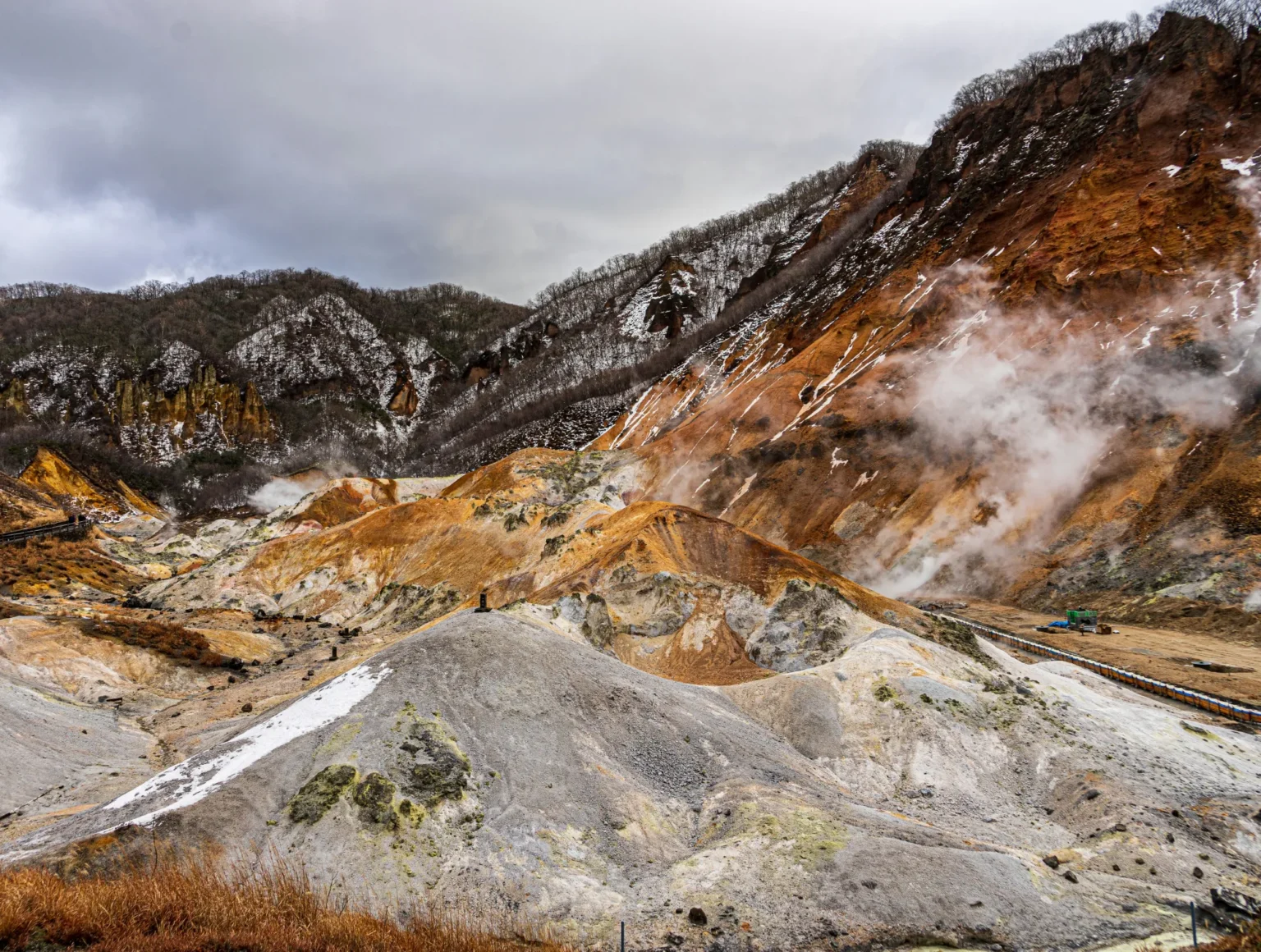
What staying the night adds
- The direct buses. The Onsen-go from Sapporo and the Airport-go both arrive mid-afternoon and leave mid-morning, so neither works as a same-day round trip; a direct bus one way and JR the other can work if the trains fit.
- A second hotel before breakfast. Day-bath morning slots run 5:00–9:00 at Sekisuitei, 7:00–9:30 at Manseikaku and 7:00–10:00 at the Grand Hotel, so a guest at one hotel can ask to use another’s; if you want that before the Sapporo bus, allow time to bathe and reach your stop, since the bus leaves Ashiyu-iriguchi at 9:20 and the terminal at 9:30.
- Baths around check-in. Takimotokan’s FAQ says staying guests can use the baths and pool free before check-in and after check-out, and its indoor baths open 4:00–25:00 for guests.
- Weekends. On the dates in the table above, the Grand Hotel and Manseikaku cited high numbers of staying guests when restricting day bathing; their notices don’t say how the baths were managed for those guests.
For how meals, check-in and room types work at a Japanese inn, see my Japanese ryokan stay guide. If you’re weighing onsen towns, Kinosaki in Hyogo runs the other way round: its public bathhouses are the draw and the inns hand guests a pass to them, as my Kinosaki Onsen guide sets out.
Staying the night? Compare the inns
Type “Noboribetsu Onsen” as the destination on either site. If you want a particular hotel’s bath, check that its own site doesn’t sell the same room for less before you pay.
How do I get from Sapporo to Noboribetsu?
From Sapporo to Noboribetsu, take a JR limited express to Noboribetsu Station, about 1 hour 10 minutes by the tourism association’s figure, then the Donan bus up the hill. JR Hokkaido’s fare is ¥4,890 one way, made up of the ¥2,530 fare and the ¥2,360 reserved-seat limited express charge, and every seat on JR Hokkaido’s limited expresses is reserved. The direct highway bus runs once a day in each direction.
By train: JR to Noboribetsu Station, then the bus
The limited expresses are the Hokuto and the Suzuran. JR Hokkaido’s own example puts a Sapporo–Noboribetsu return at ¥9,780, against ¥10,000 for the four-day Sapporo-Noboribetsu Area Pass bought before you arrive (¥11,000 at the station), so the pass costs ¥220 more than that return and pays off only if you make further covered JR journeys, such as to Otaru or the airport, within its four days. My Hokkaido Rail Pass guide works through those sums. The pass covers JR; the bus up the hill is ¥450 each way on top.
The Donan bus from the station to the town costs ¥450 for an adult (¥230 child) and takes 14 to 21 minutes. Two kinds of bus share the route. The NA and NB buses, which go via Noboribetsu Date Jidaimura and serve the hotel stops above the terminal, are boarded at the front door and paid in advance, a flat ¥450. The NC and ND buses go only as far as the Noboribetsu Onsen terminal; you board at the middle door, take a numbered ticket and pay when you get off, ¥450 from the station by Donan’s fare table. The first bus up leaves the station at 6:52 and the last at 20:04. Coming down, the 6:40 doesn’t run on Saturdays, Sundays or holidays, and the 10:15 from the terminal runs only from 1 October 2026 to 31 March 2027.
By the direct bus: the Onsen-go
Donan Bus’s Kosoku Onsen-go (高速おんせん号) needs a booking on Donan’s website, which closes two hours before the first departure of the day. The fare varies by month, from ¥2,800 to ¥3,800, and is ¥3,200 in October and November 2026; Donan hadn’t set December’s when I checked.
| Onsen-go, Nov 2026 timetable | Time |
|---|---|
| Sapporo Station-mae, bay 7 | dep 13:40 |
| Noboribetsu Onsen (terminal) | arr 15:20 |
| Dai-ichi Takimoto-mae | arr 15:23 |
| Ashiyu-iriguchi | arr 15:32 |
| Ashiyu-iriguchi / Dai-ichi Takimoto-mae | dep 9:20 / 9:24 |
| Noboribetsu Onsen (terminal) | dep 9:30 |
| Sapporo Station-mae (Kita 2 Nishi 3) | arr 11:15 |
That is 1 hour 40 to 45 minutes on Donan’s timetable; the tourism association’s access page still says about 1 hour 20 minutes. One way, the bus can still help a day visitor: arrive at 15:20, bathe, and take the local bus and JR back, if the last train suits.
If Sapporo is your base, for the Sapporo Snow Festival or otherwise, a hotel near Sapporo Station puts you at the start of both the JR trains and the Onsen-go; check the last JR train to Sapporo before choosing a local bus from the onsen down to JR Noboribetsu Station.
From New Chitose Airport, and by car
The listed direct airport buses take about 68–70 minutes outbound and 63–65 minutes back and cost ¥2,200 in October and November 2026, booked online. Donan’s Muroran-bound Hayabusa buses also stop at the Noboribetsu Onsen terminal on the way. By train, take the Rapid Airport to Minami-Chitose and change to a Hokuto or Suzuran limited express for Noboribetsu, then the bus. If you’re flying in from Tokyo, my Tokyo to Hokkaido comparison covers the flight against the train.
| Airport buses, Nov 2026 timetable | Times |
|---|---|
| Hayabusa, airport to town | 13:20 → Noboribetsu Onsen terminal 14:30, then on to Muroran |
| Airport-go, airport to town | 14:10 → terminal 15:18 → Ashiyu-iriguchi 15:30 |
| Hayabusa, airport to town | 15:10 → terminal 16:20, then on to Muroran |
| Hayabusa, town to airport | Terminal 9:55 → airport 11:00 |
| Airport-go, town to airport | Ashiyu-iriguchi 10:20, terminal 10:30 → airport 11:33 |
| Hayabusa, town to airport | Terminal 11:45 → airport 12:50 |
Airport times are for stop 86 on Donan’s timetable; stops 29 and 2 are two to seven minutes apart, so check the time for your stop. The fare for Noboribetsu Onsen to the airport is the same on both services: ¥1,900, ¥2,200 or ¥2,400 depending on the month.
By car, the town is about 6 km from the Noboribetsu-Higashi interchange on the Do-O Expressway, by the tourism association’s figure. The Jigokudani car park charges ¥500 a day per car, and the ticket also covers the Oyunuma car park except in winter, when the Oyunuma car park is closed. Hotel car parks are the weak point: Takimotokan may keep its car park for guests, and the Grand Hotel and Manseikaku say they may turn day bathers away when theirs is full. A car lets you come from the airport for a day without waiting for the buses’ afternoon arrivals; TOCOO’s Hokkaido page searches rental car outlets across Hokkaido, with New Chitose Airport among the pick-up locations.
Jigokudani Noboribetsu: Hell Valley and the walk to Oyunuma
Jigokudani is free and its entrance at the park service centre is about 850 m from the bus terminal; a loop out to Oyunuma and the river footbath and back to town is about 3.8 km by my measurement on OpenStreetMap. This is Noboribetsu’s Jigokudani in Hokkaido, not the Jigokudani Snow Monkey Park in Nagano, which is a different place with the same name.
The tourism association describes it as an explosion crater left by Mt Hiyori, about 450 m across and 11 hectares, where it estimates around 10,000 tonnes of hot-spring water emerge each day; the town’s hotels and inns draw their water from the area. The Japan Meteorological Agency monitors Mt Hiyori as part of Kuttara volcano, which its September 2026 report kept at Volcanic Alert Level 1 (“potential for increased activity”; the Japanese wording is a reminder that it is an active volcano), describing activity as quiet with no sign of an eruption and steam from Mt Hiyori’s summit crater no more than 100 m above the rim.
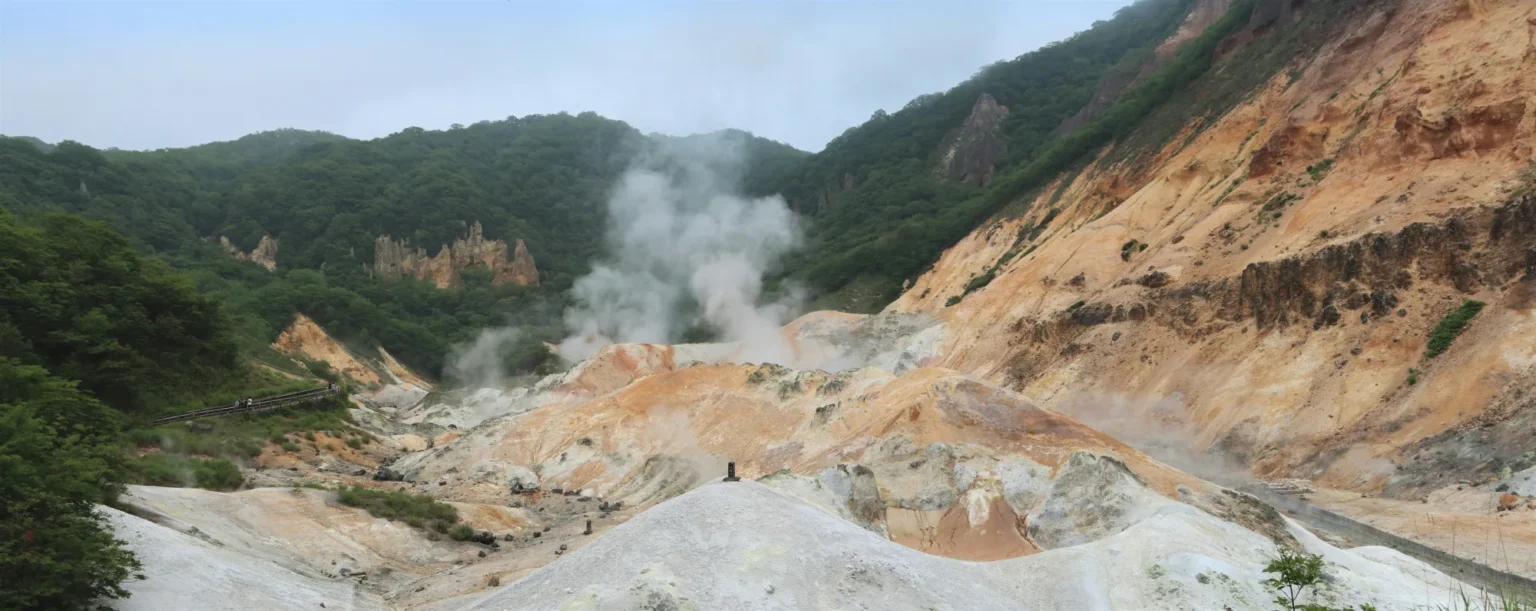
The distances below are walking distances from OpenStreetMap’s foot router, measured on 4 October 2026. They are route lengths, not walking times; the route has slopes and steps, so allow extra time.
| Leg | Distance |
|---|---|
| Bus terminal to the park service centre (Jigokudani entrance) | about 850 m |
| Park service centre to Tessen-ike, a small geyser near the middle of the valley that spouts less than it used to | about 400 m |
| Park service centre to the Oyunuma viewpoint | about 940 m |
| Oyunuma viewpoint to Oku-no-yu | about 280 m |
| Oyunuma viewpoint to the Oyunuma River natural footbath | about 480 m |
| Footbath back to the bus terminal | about 1.5 km |
| Footbath to the Ashiyu-iriguchi bus stop instead | about 530 m |
The tourism association’s pages fill in what you’re walking past. Oyunuma is a gourd-shaped crater lake about 1 km round, where sulphur water at about 130°C wells up from the bottom and the grey surface sits at 40 to 50°C. Oku-no-yu, just beyond it, is hotter at the surface, about 75 to 85°C. Below Oyunuma, the overflow runs down as the Oyunuma River, and near the spot called Taisho Jigoku you can sit with your feet in it at the free natural footbath. Back in town, the Sengen Park geyser erupts roughly every three hours.
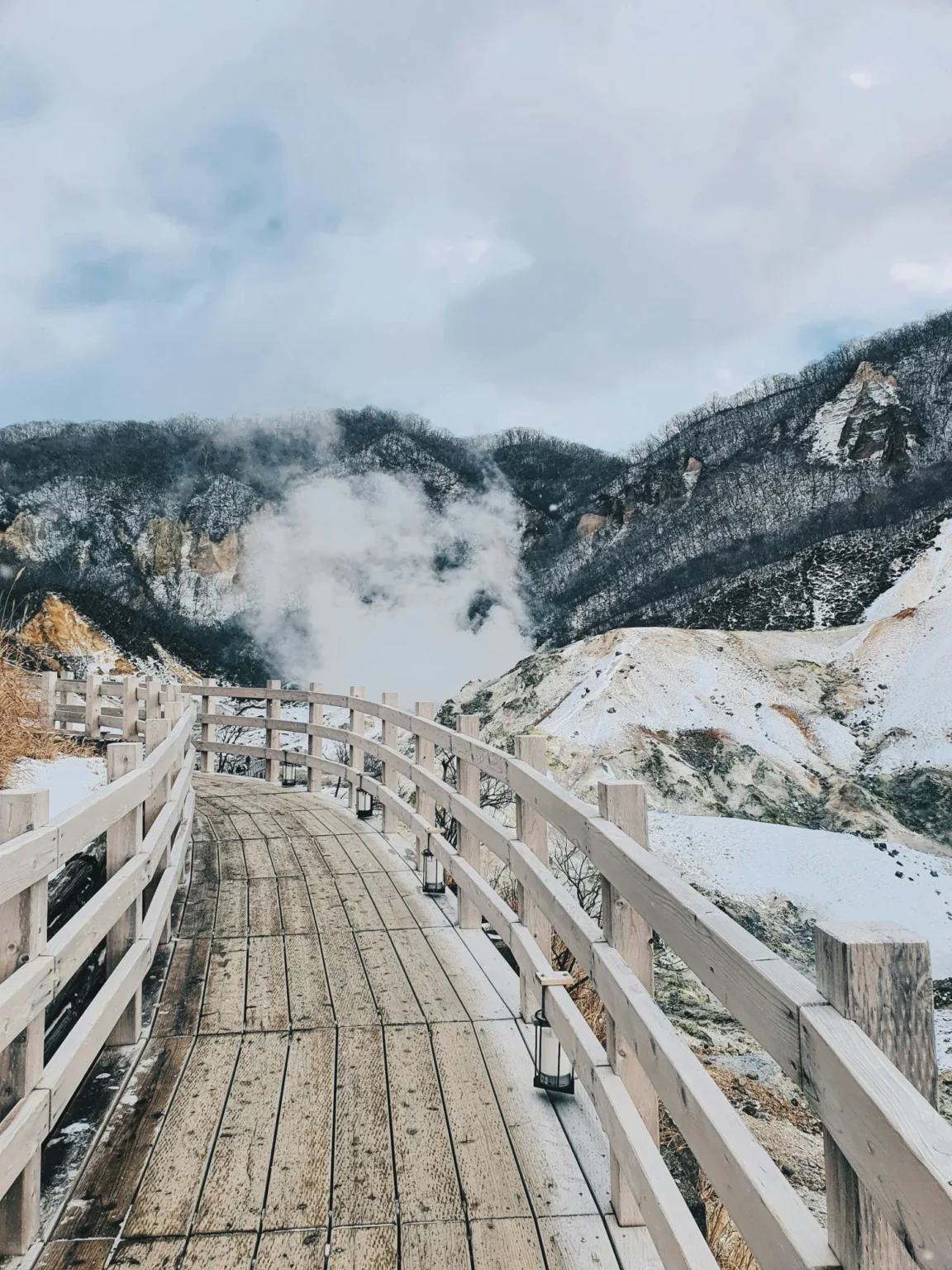
The association says there’s a wheelchair ramp, at a gradient of up to 8%, from the park service centre to the Jigokudani observation deck; check the rest of the route locally. Paths do close for repairs: on 28 September 2026 the Oyunuma River path shut from 9:00 to 13:00 to fix a leaking hot-water pipe, cutting off the footbath for the morning. On summer fireworks nights, Mondays and Thursdays in June and Thursdays in July and September in 2026, Jigokudani closed to everyone without a ticket from 18:30 to 21:00. The tourism association posts these on its news page.
The Enma-do hall in town, with its mechanical King Enma, resumed its performances on 21 August 2026 after a pause; the association lists showings at 10:00, 11:00, 13:00, 15:00, 17:00, 20:00 and 21:00 and warns that the hall can close in bad weather.
Stay on the paths: hot ground, bears and winter access
Stay on the boardwalks and signed paths in Jigokudani, and check Noboribetsu City’s bear notices before any walk at dawn or dusk; the city reported bear sightings on the road toward the onsen town in 2026.
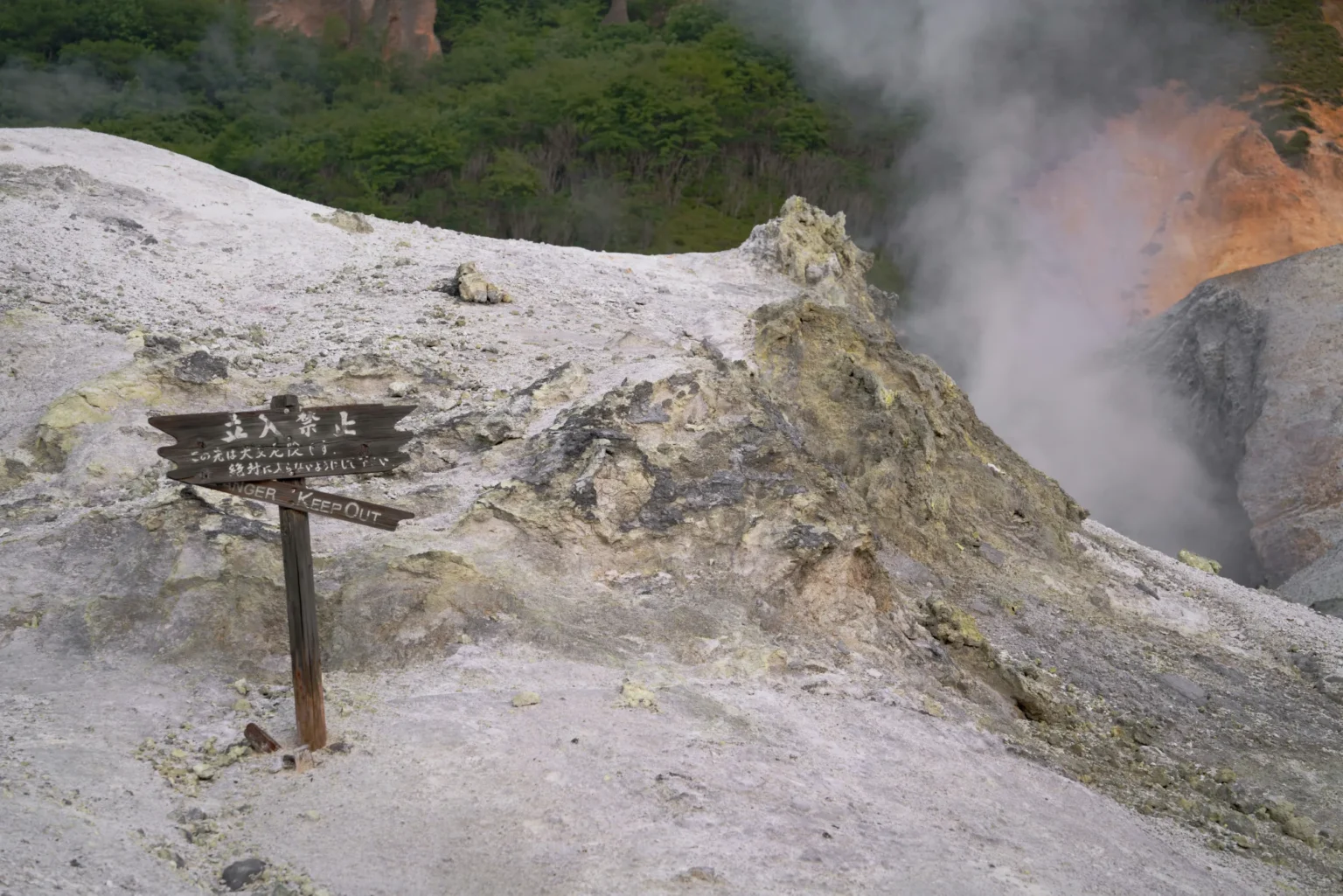
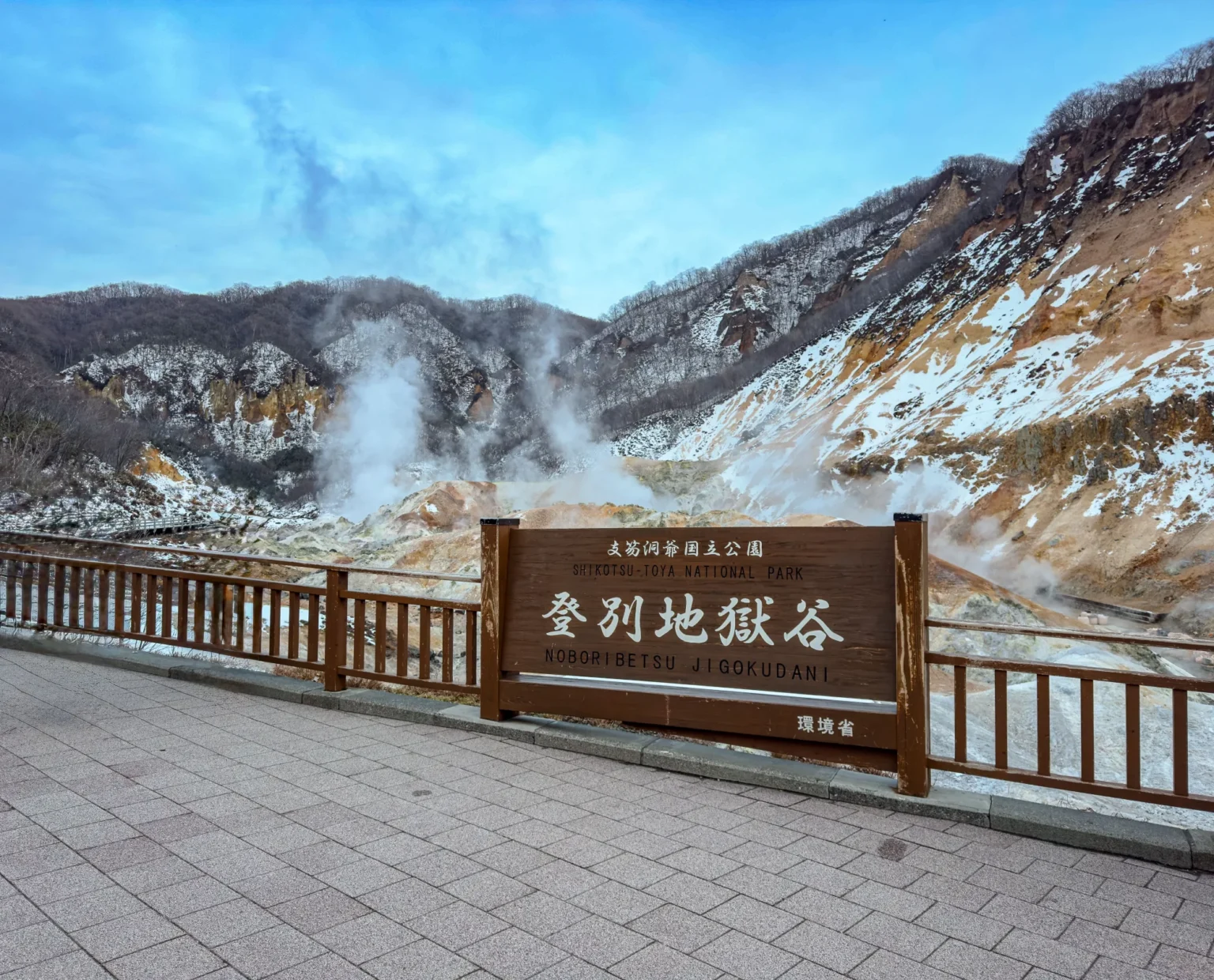
The ground. Signs like the one above read 立入禁止 (no entry) and, in Japanese, ask you never to go beyond them. The Japan Meteorological Agency’s monthly report for Kuttara is the one to read before a visit; the next, for October, is scheduled for 10 November 2026.
Bears. Noboribetsu City’s 2026 notices include two confirmed sightings of brown bears crossing the road up to the onsen town: an animal about 2 m long at 18:25 on 5 June, and one about 1.5 m long at 18:45 on 22 July near the Sakurazaka parking area. The city’s advice is to avoid early mornings and dusk near sighting areas, to check its website for sightings, and to turn back if you see droppings or footprints. The Oyunuma River path runs through forest; I’d walk it in daylight.
Winter. The Oyunuma car park is closed in winter; check the current parking arrangement before driving. In heavy snow, check bus and train status on the day; my notes on travelling in Japan during heavy snow cover what to do before it lands.
Noboribetsu Onsen FAQ
Can you visit Noboribetsu Onsen as a day trip from Sapporo?
Yes, by JR and the local bus. Take a Hokuto or Suzuran limited express to Noboribetsu Station (about 1 h 10 min, ¥4,890 one way with the reserved seat), then the Donan bus up the hill (¥450, 14 to 21 minutes). Using the direct Onsen-go both ways doesn’t make a day trip: it reaches the town at 15:20 and leaves at 9:30.
How much is a day-use bath at Dai-ichi Takimotokan?
¥2,500 for an adult and ¥1,500 for a child aged 3 to 12 since 1 August 2026, up from ¥2,250 and ¥1,100. The price includes a bath towel, a face towel and the heated pool. Entry is 9:00–18:00 and day visitors leave by 21:00.
Which Noboribetsu baths allow tattoos?
None of the day-bath pages I read says tattoos are welcome. Manseikaku and Sagiri-yu say people with tattoos, tattoo stickers or body paint are refused. Takimotokan, the Grand Hotel and Sekisuitei don’t mention tattoos on their pages, so ask at the counter before paying.
Do hotels in Noboribetsu stop day bathing on weekends?
Some do on busy dates. The Grand Hotel took no day bathers on 2–5 October 2026 and on several September days, and Manseikaku took none on 19–22 September 2026. Takimotokan says it has no regular closing day; check each hotel’s news page the evening before.
Is Jigokudani in Noboribetsu free to visit?
Yes. The valley and its paths are free; the Jigokudani car park charges ¥500 a day per car. From the Noboribetsu Onsen bus terminal it’s about 850 m on foot to the park service centre at the entrance.
Is Noboribetsu’s Jigokudani the snow monkey park?
No. The snow monkey park is in Nagano and only shares the name. Noboribetsu’s Jigokudani is a volcanic crater valley in Hokkaido that supplies the town’s hot springs.
How do I get from New Chitose Airport to Noboribetsu Onsen?
By Donan’s Airport-go bus, 14:10 from the airport to the Noboribetsu Onsen terminal at 15:18 (¥2,200 in October and November 2026, booked online), or by JR: airport rapid to Minami-Chitose, a limited express to Noboribetsu, then the local bus.
Sources
The primary sources behind the prices, hours, timetables and notices above
- Dai-ichi Takimotokan — day bathing (Japanese), day visits (English), top page notices: 1 August 2026 price change, April 2027 closure, FAQ (Japanese), FAQ (English), archived day-bath page, 15 May 2026 (previous price)
- Noboribetsu Grand Hotel — hot springs and day bathing, FAQ, news: day-bath suspensions, September–October 2026
- Noboribetsu Sekisuitei — hot springs and day bathing
- Noboribetsu Manseikaku — day bathing, FAQ, 19–22 September 2026 notice, 27 September 2026 notice
- Hotel Yumoto Noboribetsu — current website, archived day-bath page, 15 January 2026
- Kashoutei Hanaya — day bathing paused for exterior works, September–December 2026, exterior works notice
- Yumoto Sagiri-yu — fees, hours and supplies, notices: face towels, opening time from April 2025, women’s jacuzzi
- Noboribetsu International Tourism and Convention Association — day-trip onsen list (Japanese), English list, access, hand-luggage service, Jigokudani, Oyunuma, news: path closures, fireworks closures, Enma-do
- Donan Bus — Onsen-go and Airport-go timetable and November 2026 fares, Noboribetsu Station–Noboribetsu Onsen timetable from 1 October 2026, Muroran–Noboribetsu route fare table
- JR Hokkaido — rail passes, all-reserved limited expresses and the Sapporo–Noboribetsu return fare, fares and limited express charges from Sapporo
- Noboribetsu City — bear sighting, 5 June 2026, bear sighting, 22 July 2026
- Japan Meteorological Agency — Kuttara volcanic activity report, September 2026
- Walking distances — OpenStreetMap data via the routing.openstreetmap.de foot router, measured on 4 October 2026
Join travelers discovering Japan's hidden side
Weekly dispatches from off-the-beaten-path Japan — spots and stories you won't find in guidebooks.
No spam. Unsubscribe anytime.
Welcome aboard!
You're in. See you in your inbox soon.