Gunma · Minakami · Railway oddity
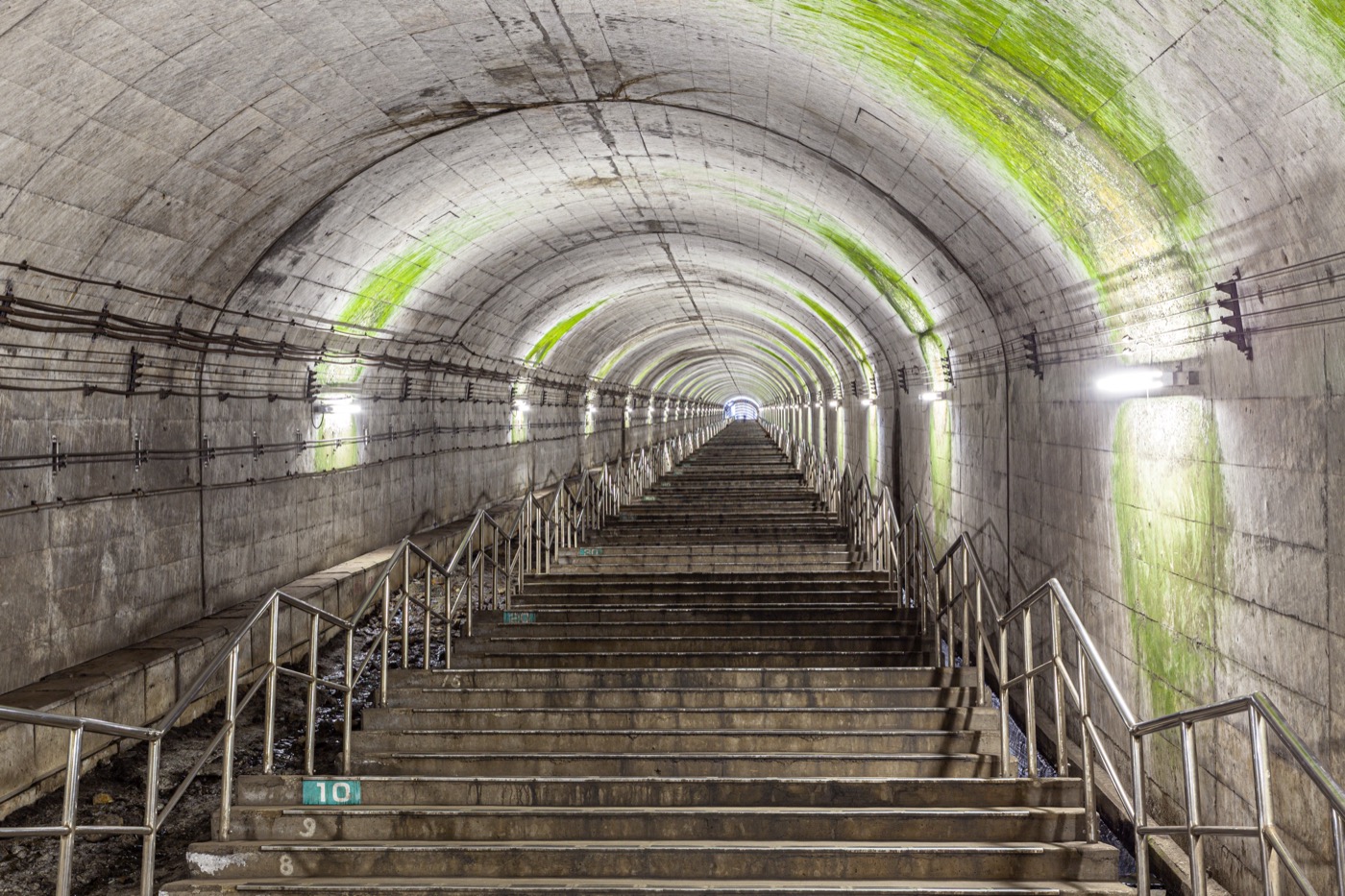
Doai Station on the JR Joetsu Line is one of Japan’s most unusual working stations. Its down-line platform is buried deep inside a mountain tunnel, and to reach it — or to climb out of it — you take a staircase of 486 steps. Locals call it Nihon-ichi no mogura eki, “Japan’s number-one mole station.” It sits in the mountains of Minakami, near the foot of Tanigawadake, and for railway fans the descent alone is the reason to come.
What makes Doai Station strange
When the Joetsu Line was double-tracked in the 1960s, a long new tunnel — the Shin-Shimizu Tunnel — was bored under the mountains for the down-line, the tracks heading toward Niigata. Rather than build a second station up top, the down-line platform was left where the tunnel put it: deep underground. So today the station is effectively in two places. The up-line platform, for trains back toward Minakami and Takasaki, sits at ground level beside the station building. The down-line platform, for trains onward to Niigata, is roughly 70 metres below the surface, inside the tunnel. The only way between them is on foot.
Climbing the 486 steps
The famous number is 486, and it is honest: from the underground platform you climb 462 steps, walk a 143-metre connecting passage, then take a final 24 — a climb of about 70 metres that takes most people around ten minutes at a steady pace. The steps are numbered as you go, the walls are bare concrete, and there is no escalator and no lift. The climb can be hard work with luggage, and because it runs inside a mountain tunnel it stays cool even in summer, so bring a layer.
Which way you meet the stairs depends on your direction. Arrive on a train heading toward Niigata and you climb up the 486 steps to leave; leave on one and you climb down to the platform — give yourself well over ten minutes so you are not running for a train at the bottom. Trains toward Minakami and Takasaki use the ground-level platform, no stairs involved.
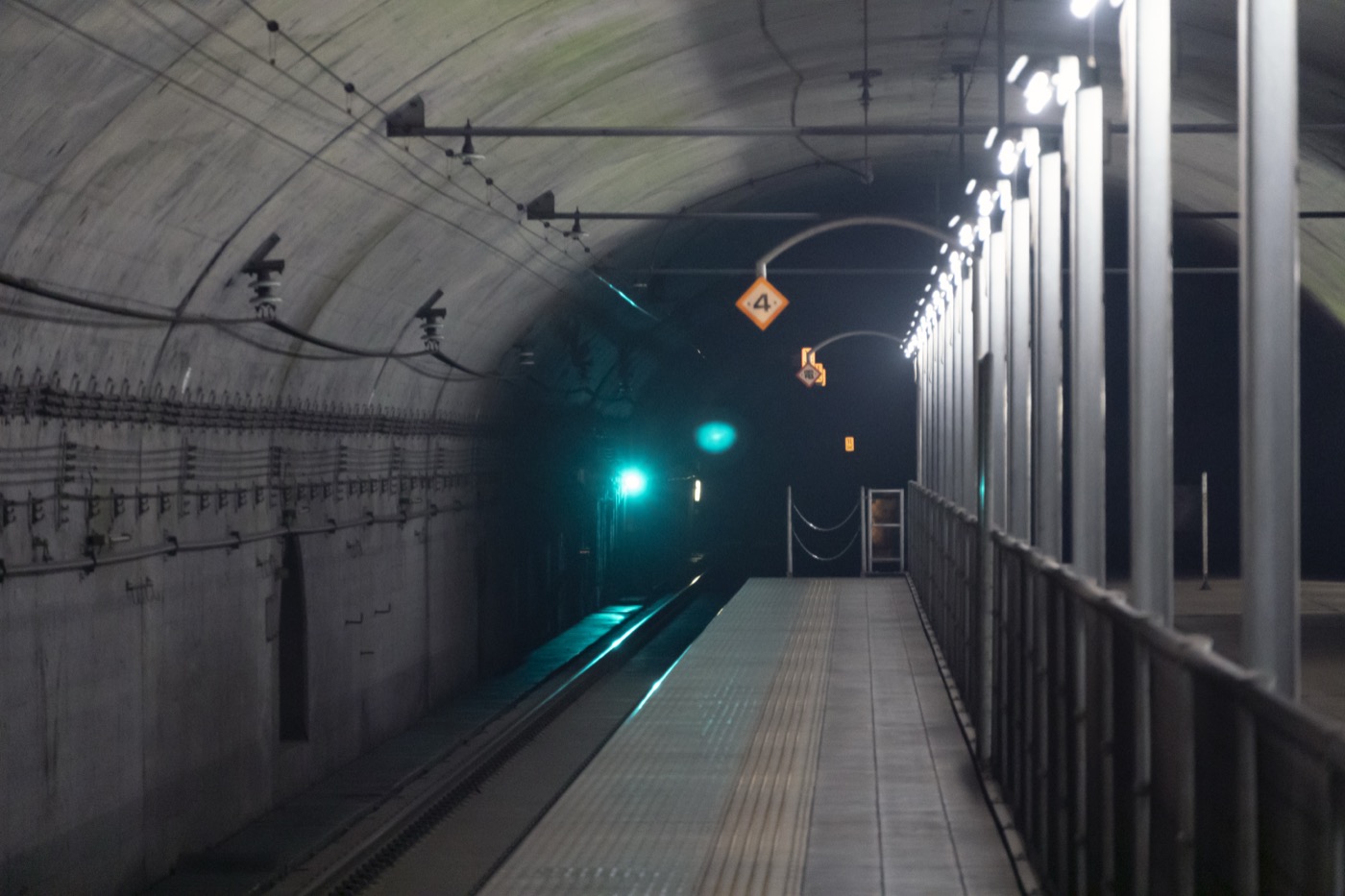
The catch: very few trains
The main thing to plan around is the timetable. Doai is served by only a handful of local trains a day in each direction — the Joetsu Line through the mountains is a quiet route — so the station can sit empty for hours. If you want to actually ride in or out rather than just look, you have to plan around the timetable, in both directions, before you go. The station is unstaffed, with no ticket office or machines, so arrange a ticket or top up your IC card in advance, and save the day’s timetable before you arrive — there is little phone signal down on the tunnel platform. Miss a train here and the wait is long. In summer, JR sometimes runs special excursion services (branded around Tanigawadake, “Mogura” and “Loop”) that call at Doai for railway fans; check whether one is running when you visit.
The station building, a café and glamping
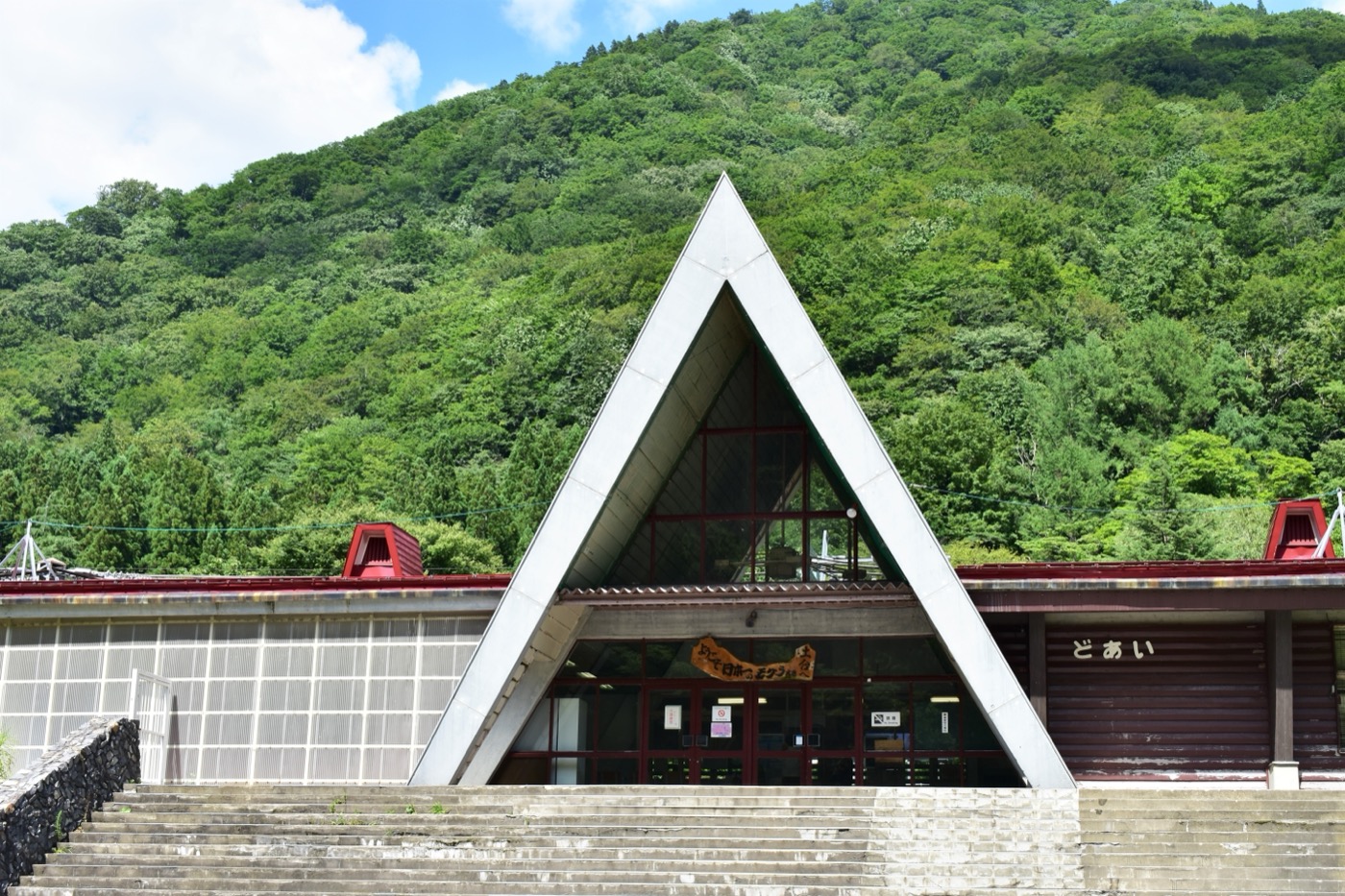
Up at ground level, the station building is worth a look in its own right: a triangular A-frame building against the green valley wall, with a banner announcing the “mole station.” The former station office has been turned into a small café, Kissa Mogura, and in 2020 a glamping site, DOAI VILLAGE, opened next to the station — so what was a purely functional halt now has somewhere to sit, and somewhere to stay. Opening days for the café and glamping vary by season, so confirm before you build a visit around them.
Getting there, and what to pair it with
Doai is in the north of Minakami, Gunma’s big mountain-and-onsen district. The area is easiest with a car; on rails, the Joetsu Line runs up from Takasaki through Minakami, and the Jomo-Kogen Shinkansen station is the fast way in from Tokyo, then a bus or taxi toward Minakami and Tanigawadake; on the conventional Joetsu Line, trains run up from Takasaki through Minakami to Doai. About 20 minutes’ walk from the station is the ropeway up Tanigawadake (recently rebranded by Hoshino Resorts), which opens up the high mountain scenery and hiking. Minakami itself is full of hot-spring inns, so the honest way to do Doai is as one strange stop on a wider Minakami trip rather than a destination on its own.
The down-line here runs on toward Niigata Prefecture; if you are carrying on that way (it takes a few changes to reach the coast), our guide to the Sasagawa Nagare coast covers what to see up there.
Where to stay: Minakami & Tanigawadake
Minakami is hot-spring country, with everything from riverside ryokan to mountain lodges near the ropeway, and it makes the natural base for a Doai visit. Booking and Agoda cover the hotels and pensions; Rakuten Travel is the one to check for the Japanese-run onsen ryokan, which is what most people come to Minakami for.
More ways to set it up: compare stays on Agoda · rent a car (Minakami and Tanigawadake are far easier with one) · and a Japan eSIM so you can save the sparse train timetable before you go — there is little signal on the underground platform.
Good to know
Is Doai Station worth visiting?
For railway fans and anyone who likes a genuine oddity, yes — few places offer anything like the descent to an underground platform. For most travellers it is a short, strange add-on to a Minakami onsen or Tanigawadake trip rather than a destination in itself. Plan it around the trains and the wider area.
How many steps is it, and how deep?
486 steps in all: 462 up from the underground platform, a 143-metre connecting passage, then 24 more. The down-line platform sits roughly 70 metres below the station building, and the climb takes most people about ten minutes. There is no lift or escalator.
Which trains use the underground platform?
Only the down-line trains, heading toward Niigata, use the deep tunnel platform reached by the 486 steps. Trains in the up direction, toward Minakami and Takasaki, use a platform at ground level beside the station building. Either way, service is sparse — only a few trains a day — so check the timetable in both directions.
Is there anywhere to sit or stay at the station?
Yes. The former station office is now a small café, Kissa Mogura, and a glamping site, DOAI VILLAGE, opened next to the station in 2020. Both keep seasonal hours, so confirm openings before relying on them.
Is the station staffed, and can I use Suica?
No — Doai is unstaffed, with no ticket office and no ticket machines. Sort out a ticket or top up your IC card (Suica, Pasmo and the rest work on the line) before you arrive, and don’t rely on buying anything at the station itself.
How do I get to Doai?
It is in northern Minakami, Gunma. The area is easiest by car. By rail, take the Joetsu Line up from Takasaki through Minakami; from Tokyo, the Jomo-Kogen Shinkansen station is the fast route in, with a bus or local connection onward. The Tanigawadake ropeway is about a 20-minute walk from the station.
Sasagawa Nagare, Niigata
Continuing toward Niigata (with transfers) — the Japan Sea coast by boat.
Getting Around Japan (2026)
When a rental car beats the rails — useful for Minakami.
Skip the Crowds
More off-the-track places like this one.
JR Pass vs Individual Tickets
Whether a pass is worth it for a mountain detour.
Join travelers discovering Japan's hidden side
Weekly dispatches from off-the-beaten-path Japan — spots and stories you won't find in guidebooks.
No spam. Unsubscribe anytime.
Welcome aboard!
You're in. See you in your inbox soon.