Lake Yamanaka · Diamond Fuji 2026-27
Lake Yamanaka publishes official reference dates for nine Diamond Fuji viewing locations, and they work like a relay: the alignment starts near Panorama-dai around 16 October, hands over spot by spot along the shore into December, and runs back the other way to finish at Panorama-dai around 25 February. The association publishes these dates without a year — a season-specific 2026-27 calendar had not been released when I checked on 14 September 2026 — so treat every date below as a planning reference that can shift a day or two, not a confirmed schedule.
Autumn bonus: the alignment’s late-October–mid-November leg coincides with the Lake Yamanaka Autumn Leaves Festival at Asahigaoka (planned 30 October–15 November 2026, light-up 16:30–20:30) — on a clear day you can catch Diamond Fuji from that week’s reference spot and walk the lit maple corridor the same evening.
How the nine spots actually work
One misunderstanding ruins more Diamond Fuji trips than the weather, so here it is up front: each viewing location has two short reference dates a year, not a months-long window. Panorama-dai’s official reference dates are around 16 October and around 25 February. Between those dates the alignment is happening somewhere else — at the other spots down the shore, one after another. The “mid-October to late February season” belongs to the lake as a whole, only if you move.
The dates below are the tourism association’s official reference list, which it publishes without a year. The ministry’s own Diamond Fuji calculations carry the same caveat: the calendar can differ by a day or two from year to year. Confirm the date and your exact standing position against the association’s page before you commit an evening. For a specific evening this season, I also cross-check the daily shooting calendar by Fujiyoshida photographer Oi (Japanese; independent calculated predictions with the site’s own error caveats) — how to read it is in the calendar guide. On mobile, scroll the table horizontally.
| Location | Autumn reference | Winter reference |
|---|---|---|
| 1 · Panorama-dai (hillside viewpoint) | ~Oct 16 · 16:22 | ~Feb 25 · 16:50 |
| 2 · Asahigaoka lakeshore | ~Oct 18 · 16:08 | ~Feb 22 · 16:35 |
| 3 · Hirano lakeshore (Kirara area) | ~Oct 27 · 16:03 | ~Feb 16 · 16:33 |
| 4 · Hirano lakeshore 2 (inflow area) | ~Oct 31 · 16:00 | ~Feb 11 · 16:29 |
| 5 · Below Mama-no-Mori | ~Nov 3 · 15:48 | ~Feb 8 · 16:19 |
| 6 · Nagaike waterside park | ~Nov 6 · 15:44 | ~Feb 5 · 16:13 |
| 7 · Oike-hama | ~Nov 13 · 15:33 | ~Jan 30 · 16:03 |
| 8 · Yanajiri (below Hotel Mt. Fuji) | ~Nov 15 · 15:30 | ~Jan 27 · 15:55 |
| 9 · Hana no Miyako Park | Late Nov – mid-Jan across the park grounds · 15:23–15:46 | |
Times are the association’s approximate alignment times (JST) for each reference date — the moment the sun meets the summit, which is well before the flat-horizon sunset. Hana no Miyako is the exception to the two-date pattern: its grounds are large enough that the alignment tracks across the park for weeks, which is why the association lists a period instead of a pair of dates.
The two ends of the relay
1 · Panorama-dai
The hillside viewpoint above the lake’s east end, and the classic frame: lake, forest, then the mountain with the sun on it. Reference dates around 16 October and 25 February. The official car park holds seven cars plus one accessible space — the association asks visitors to park at Mikuni Pass or Kirara plaza and walk in, and never on the roadside. Winter tyres are essential in season.
2–8 · The lakeshore chain
Seven shoreline points from Asahigaoka on the south shore around to Yanajiri on the west, each catching the alignment a few days after its neighbour. On a windless evening the shoreline spots add the double diamond — the reflection in the lake. Local etiquette from the association: designated car parks only, and leave the fishermen’s launch areas clear.
9 · Hana no Miyako Park
The flower park northeast of the lake carries the alignment from late November to mid-January — the winter-solstice period the other spots miss. Be straight about one thing: the outdoor flower fields are not in bloom in this season. What you get is an open, unobstructed foreground, not tulips; the paid greenhouse zone is a separate matter from the viewing fields.
Which spot for which trip date
The progression, using the official reference dates — all of them ±1–2 days by year:
| Your dates | Check these spots |
|---|---|
| Mid-October | #1 Panorama-dai (~16th), #2 Asahigaoka (~18th) |
| Late October | #3 Hirano (~27th), #4 Hirano 2 (~31st) |
| Early November | #5 Mama-no-Mori (~3rd), #6 Nagaike (~6th) |
| Mid-November | #7 Oike-hama (~13th), #8 Yanajiri (~15th) |
| Late Nov – mid-Jan | #9 Hana no Miyako, position varies through the period |
| Late January | #8 Yanajiri (~27th), #7 Oike-hama (~30th) |
| Early February | #6 Nagaike (~5th), #5 Mama-no-Mori (~8th), #4 Hirano 2 (~11th) |
| Mid–late February | #3 Hirano (~16th), #2 Asahigaoka (~22nd), #1 Panorama-dai (~25th) |
Each spot gets the diamond on its dates, not for the season — match your evening to the relay, and you only need one clear sky.
February is the month the village leans into: Diamond Fuji Weeks 2027 is listed for 1–22 February in the association’s annual events plan (dated April 2026, marked subject to change). Programme details for 2027 — and the Ice Candle Festival date that traditionally falls inside it — had not been published when I checked, so treat the festival window as scheduled rather than final and re-check the official event page before booking around it.
Getting there and getting positioned
From Tokyo
Highway bus from Shinjuku towards Yamanakako (around 2.5 hours), or train to Mt. Fuji Station and a local bus onward. Driving takes roughly 2 hours via the Chuo Expressway when traffic behaves.
Between the spots
A car is the comfortable answer — the nine locations spread over several kilometres of shoreline — but it is not the only one: local buses serve the lakeshore, and Panorama-dai can be reached on foot from the Hirano area (about an hour uphill from the bus stop). Whatever you ride, check the last return service; the show ends after four and the buses thin out fast.
Parking discipline
The association’s rules are blunt: use the designated car parks, walk to the shore, and do not stop on the roadside — the viewing dates concentrate cars exactly where the road is narrowest. At Panorama-dai (seven spaces), assume you will park below and walk.
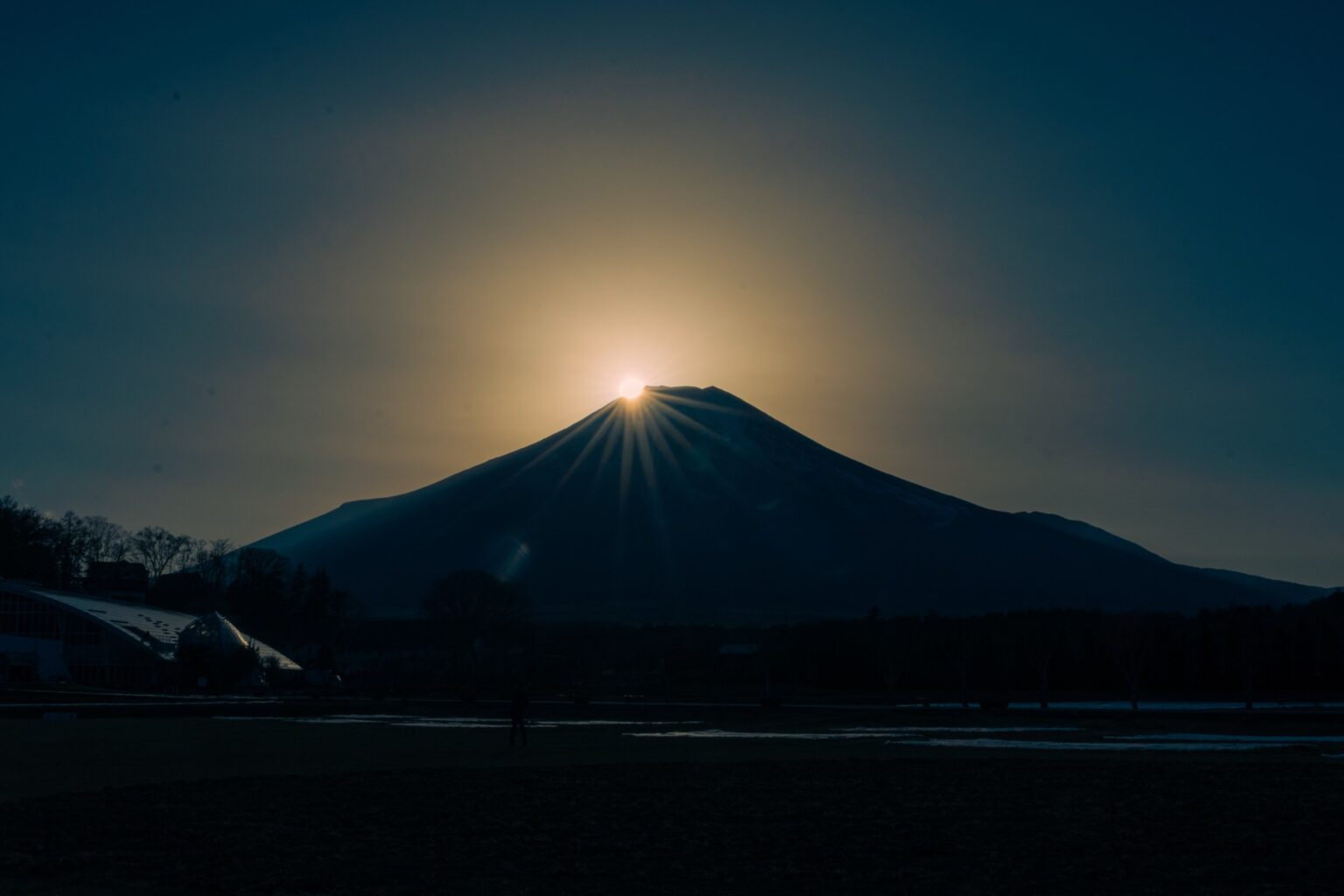
Cold is the practical enemy: late-December to mid-February evenings at the lake routinely sit well below freezing by the time the sun touches the summit. Layer for standing still, not for walking, and keep camera batteries warm — the moment you came for lasts seconds. If clouds win, my morning Fuji visibility report from Fujiyoshida tells you whether the mountain itself is out, and the seasonal visibility guide explains why winter evenings are your best odds in the first place.
Staying inside the window
Staying the night beats day-tripping here: you can hold your position for the alignment, try again the next evening if clouds interfere, and the February festival dates book out ahead. For the photography kit itself — a travel tripod for the low-light minute, a spare battery kept warm in a pocket, and touchscreen gloves — that trio covers the freezing wait. Never look at the sun through an optical viewfinder while you line up the shot; compose on the rear screen and remember an ordinary ND filter is not a solar filter.
Rounding out the trip: the Lake Yamanakako access guide covers the bus routes in detail, Hana no Miyako has its own guide for the green months, and the national Diamond Fuji calendar maps where the phenomenon goes when it leaves this lake, and the Mt. Fuji hub holds the rest of the mountain.
Frequently asked questions
Can I see Diamond Fuji at Lake Yamanaka any day between October and February?
No — that range is the lake’s combined season across nine different locations. Each individual spot aligns around two reference dates only (Panorama-dai: around 16 October and 25 February). Match your date to the right spot using the tables above.
Are these dates confirmed for the 2026-27 season?
Not yet. The tourism association publishes its reference list without a year, and a dedicated 2026-27 calendar had not appeared as of 14 September 2026. Year-to-year drift is small — typically a day or two — but confirm against the official page once you have travel dates.
When is Diamond Fuji Weeks 2027?
The association’s annual plan lists 1–22 February 2027, marked as subject to change. Details of the programme and the Ice Candle Festival date had not been announced when this guide was last checked.
Do I need a car?
It is the easiest way to chase spots on consecutive evenings, but not mandatory: highway buses reach the lake from Shinjuku, local buses run the shoreline, and Panorama-dai is a roughly one-hour uphill walk from the Hirano bus stop. If you rely on buses, plan around the last departure — alignments end just after sunset.
Will there be flowers in the foreground at Hana no Miyako?
No. The Diamond Fuji period there (late November to mid-January) is outside the park’s flowering season — the draw is the wide, unobstructed field, plus the longest continuous alignment period on the lake.
What is the double diamond?
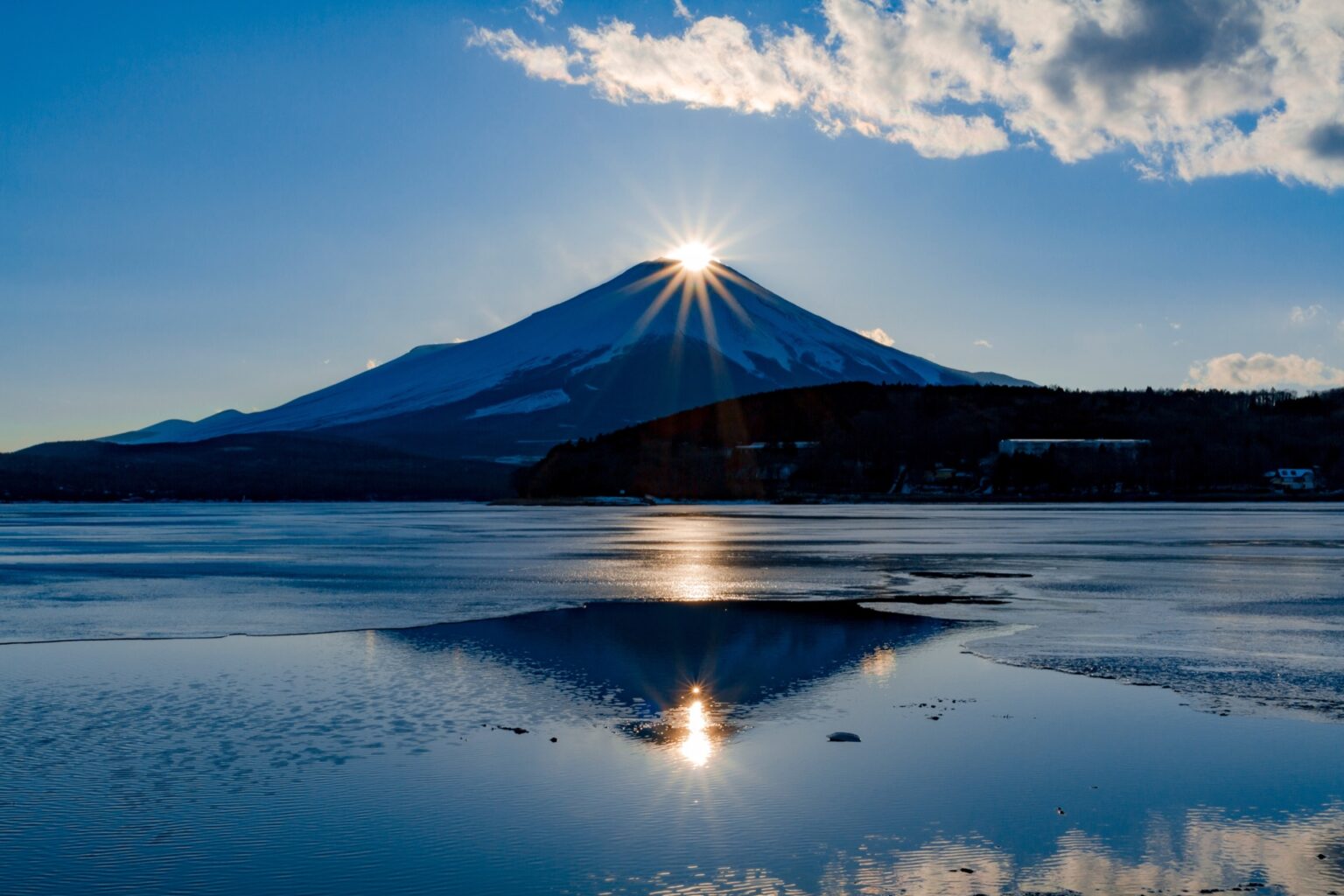
On a calm evening the lake surface mirrors the sun-on-summit moment, so you photograph two diamonds — one real, one reflected. Shoreline spots (#2–#8) offer it when the wind drops; Panorama-dai, being elevated, gives the panorama instead.
Sources
Official sources for the dates and rules above, checked 14 September 2026
- Yamanakako Tourism Association — Diamond Fuji feature (nine locations, yearless reference dates and times, parking and manner rules)
- Yamanakako Tourism Association — 2026-27 annual events plan (PDF, dated 10 April 2026) (Diamond Fuji Weeks 2027 listing) and Diamond Fuji Weeks page
- Yamanakako Tourism Association — Panorama-dai spot page (parking capacity and walking guidance)
- MLIT Kanto — Diamond Fuji date lists (the one-to-two-day year-to-year variation note)
Join travelers discovering Japan's hidden side
Weekly dispatches from off-the-beaten-path Japan — spots and stories you won't find in guidebooks.
No spam. Unsubscribe anytime.
Welcome aboard!
You're in. See you in your inbox soon.