Art & Architecture
Japan’s art hotels are not one category. At Benesse House on Naoshima, guests get into the Tadao Ando museum free and can stay in the galleries until 11 p.m., two hours after the public is turned out. At The Ritz-Carlton Kyoto, the art is a commissioned collection hung through a luxury hotel. Five of the six below sell rooms on Booking.com. Benesse House does not — its Museum and Oval wings are sold only through Benesse’s own system, which opens exactly 180 days ahead and, in spring and autumn, empties in minutes.
The one distinction that decides everything
“Art hotel” gets used for all six of these, and it flattens a real difference. In some of them the art was there first and the beds were added. In others the beds were there first and the art was commissioned to sit among them. That is not a ranking — a hung collection can be superb — but it changes what you get for the money, and it changes what happens after the reception desk closes.
The useful question is not “is there art here.” It is: can I still be with the work once the day visitors have gone? Exactly one of these six sells that as a stated, timed benefit, and it is Benesse House. Two more have the art in the fabric of the building, so the question does not arise. The rest give you free or included museum entry inside normal opening hours — Simose adds early and late access to its grounds, but not to the exhibition rooms.
| Property | What the art actually is | Access as a guest | Where the rooms are sold |
|---|---|---|---|
| Benesse House Naoshima, Kagawa | A working contemporary art museum with hotel wings built into and around it | Free entry, and viewing until 23:00 — public hours end at 21:00 | Direct only Park & Beach also on Rakuten |
| Simose Art Garden Villa Otake, Hiroshima | A Shigeru Ban museum plus ten villas; the buildings are the exhibit | Museum ticket included; guest-only hours on the terrace and garden, not in the galleries | Booking.com direct was cheaper — see below |
| Museum Hotel Keyforest Hokuto, Yamanashi | A six-room hotel beside a museum devoted primarily to Keith Haring | Free admission ticket, during opening hours | Booking.com |
| Shiroiya Hotel Maebashi, Gunma | A Sou Fujimoto building with works commissioned into its fabric | The art is in the building — you live in it | Booking.com |
| Sumiya Kiho-an Kameoka, Kyoto | A 1955 onsen ryokan that commissioned one artist, Yukio Yanagi | The gallery is the lobby; you pass through it | Booking.com but direct was cheaper — see below |
| The Ritz-Carlton Kyoto Nakagyo, Kyoto | A hotel with a large curated collection on public and guest floors | Hung throughout — no ticket, no hours | Booking.com |
Benesse House, Naoshima — the museum you sleep inside
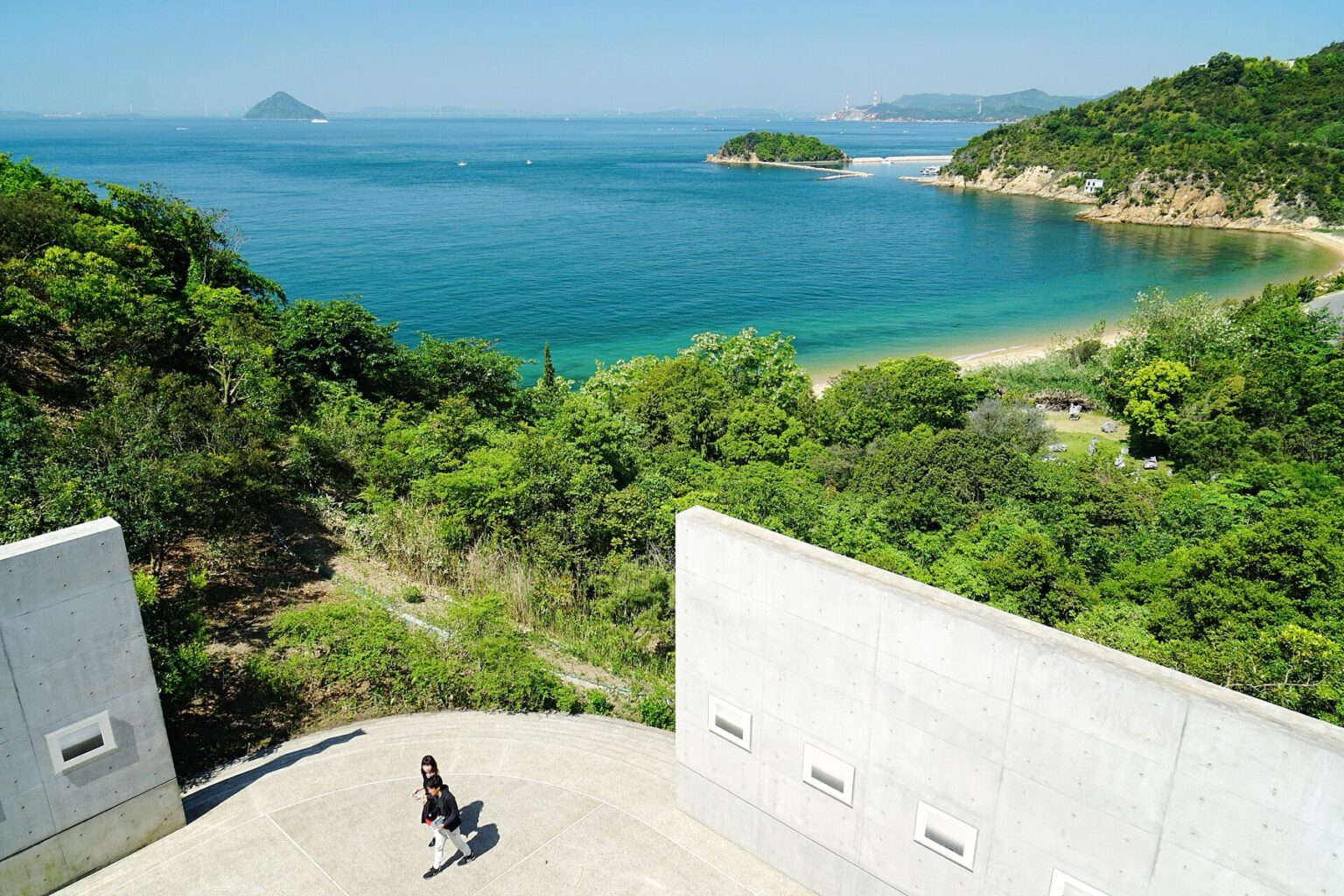
This is the one that earns the phrase without argument. Tadao Ando’s Museum wing opened in 1992 as a museum and a hotel in one building, and the arrangement has not been diluted since.
The guest benefit is specific enough to plan around. Benesse House guests get free admission to Benesse House Museum and may view it until 11 p.m., against public hours of 8 a.m. to 9 p.m. The same free-and-until-23:00 arrangement covers the Hiroshi Sugimoto Gallery, and Valley Gallery is included in the same ticket. That is the two-hour window people are really buying, and it applies to guests of any wing — not only the Museum wing.
Where people go wrong is assuming “Benesse House” is one hotel. It is four wings built across fourteen years, and they are not interchangeable:
Museum (1992)
Rooms inside the museum building. The original, and the only one where sleeping in the museum is literal. From about ¥57,000 per room, room only.
Oval (1995)
Six rooms above the Museum, reached by a private monorail. Closed to everyone except Oval guests — you cannot go and look. No breakfast plan exists for it.
Park (2006)
The largest wing, at beach level, and the cheapest way in — from about ¥48,000 per room. The only wing with no under-six restriction.
Beach (2006)
Suites on the shoreline, closest to the water, and the most expensive after the Museum Suite.
Booking is a race, not a search. Reservations open exactly 180 days before the stay date, at midnight Japan time, through Benesse’s own system. The operator states plainly that April–May and October–November can sell out within minutes of opening. There is no Booking.com listing at all; Rakuten Travel carries the Park and Beach wings only, so the Museum wing, the Oval and the Beach Suite Double have to be booked direct. Cancellation runs 50% from ten days out and 100% from the day before — you commit long before you can know anything about the weather.
The age rule catches families, and it is narrower than the internet suggests. Children aged five and under cannot stay in the Museum, the Oval, or the Beach Suite Double. The Park wing has no such restriction. It is a refusal rather than a surcharge, so it is worth reading before you fall in love with a room.
One more thing worth knowing before you budget: guest admission covers Benesse House Museum, Valley Gallery and the Sugimoto Gallery — and nothing else. Chichu Art Museum and the Lee Ufan Museum are neither free nor discounted for Benesse House guests, which surprises a lot of people. Budget those separately.
Benesse House has no Booking.com listing. Book the Museum and Oval wings direct through Benesse Art Site Naoshima, 180 days out. If your dates are already gone — and in spring and autumn they will be — this searches the rest of the island.
Other stays on NaoshimaNaoshima works better inside a wider Setouchi trip than as a single overnight. I’ve written up a five-day Shikoku route that folds Naoshima in with the Iya Valley and Dogo Onsen, which is roughly the shape I would use.
Simose Art Garden Villa, Hiroshima — where the building is the exhibit
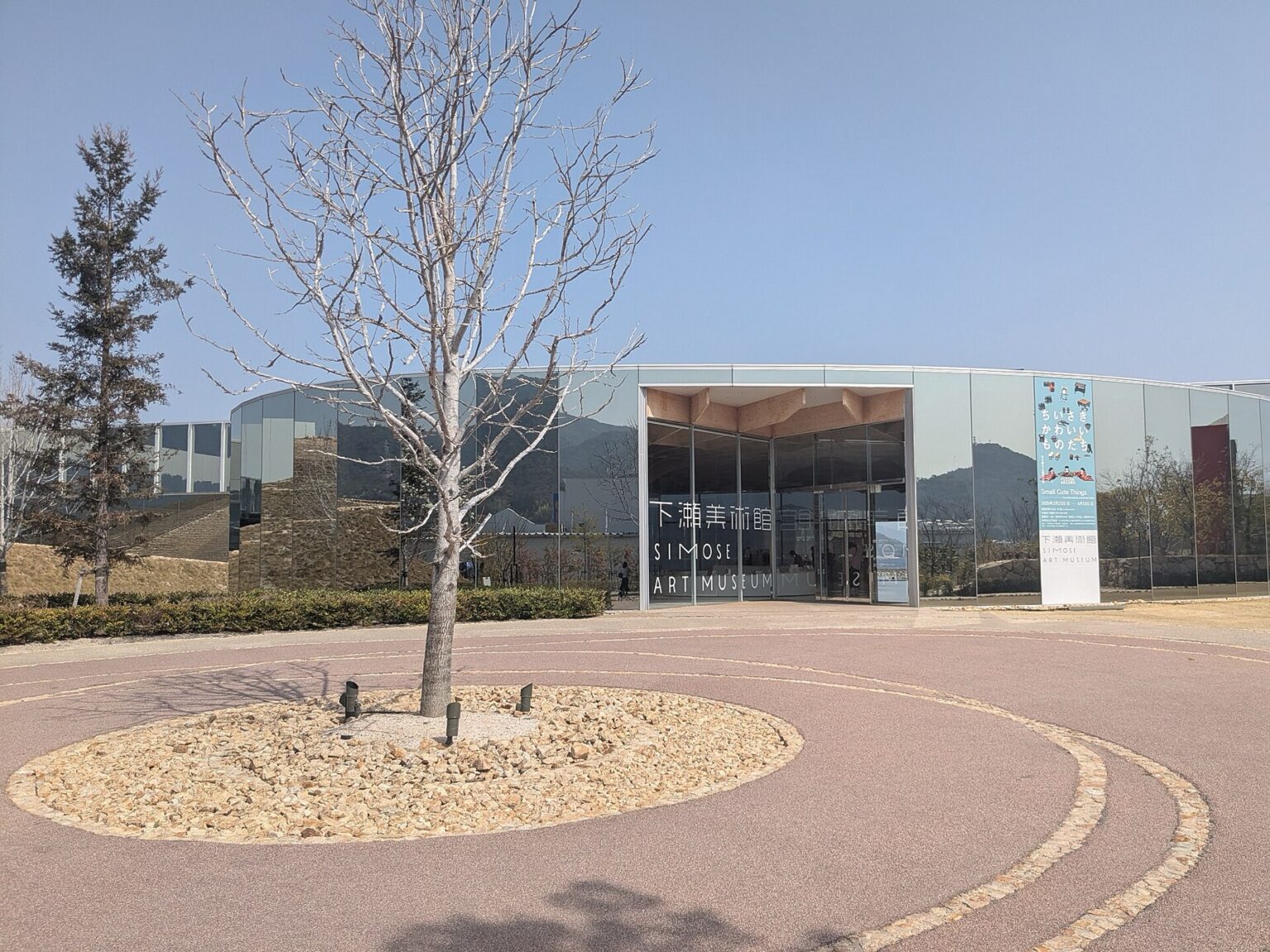
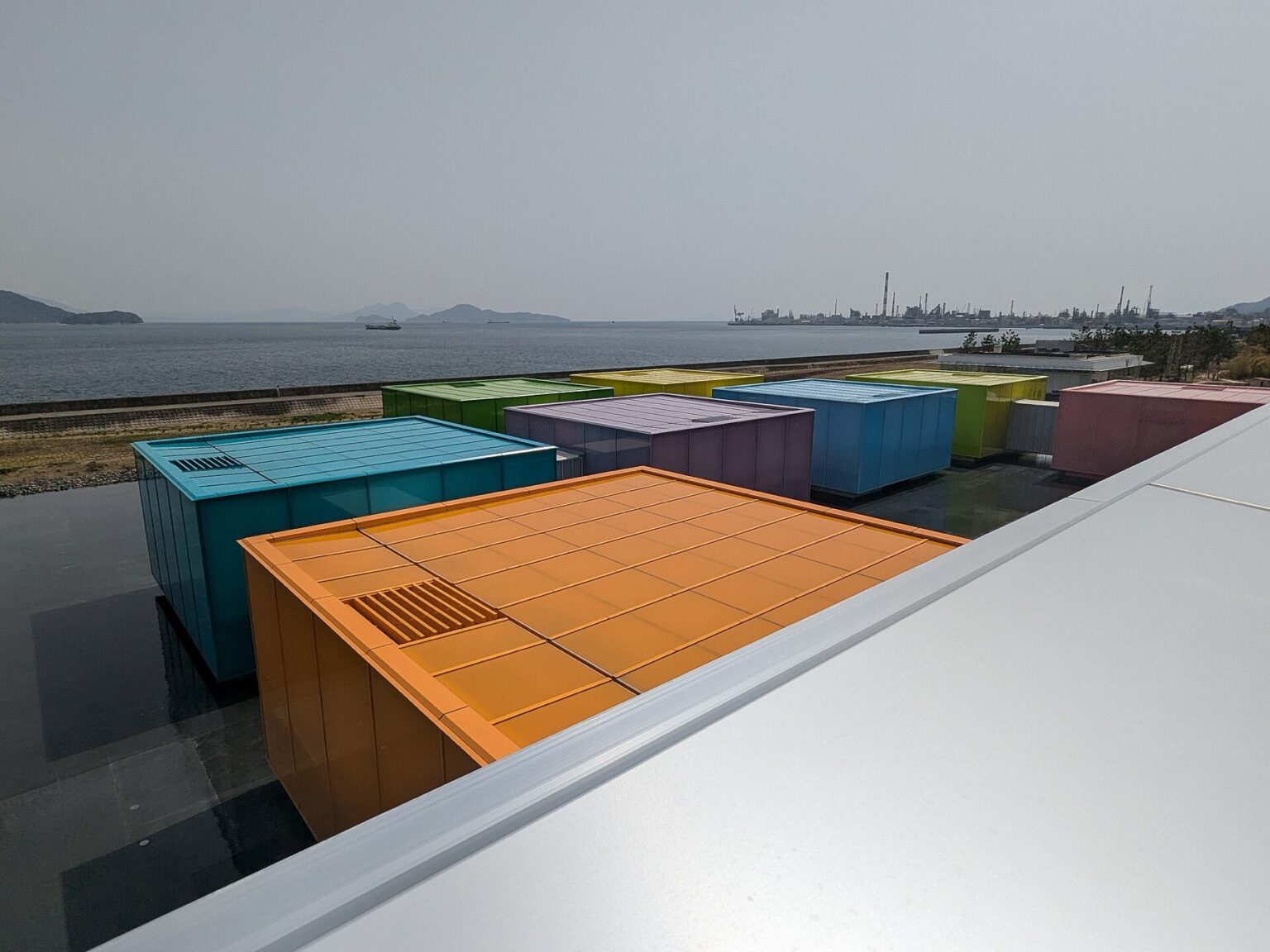
Simose opened in Otake in March 2023, with the villa following that spring. Shigeru Ban designed both. The museum’s signature is the group of eight movable galleries sitting on a shallow water basin, which can be physically rearranged — the photograph at the top of this page. The collection’s anchor is Émile Gallé and French Art Nouveau glass, an unusual holding for western Japan.
The villa side is where it gets interesting if you follow Ban’s work. Ten villas in two groups. The five forest villas include four that are recreated versions of houses Ban designed earlier in his career, plus one new build, the Cross-Wall House. The five waterfront villas are new, built with Kielsteg timber panels.
That distinction is worth knowing when you choose — and choosing is the hard part, as I’ll come to. Villa guests get the museum ticket included in every plan, and there is a genuine guest-only window: the Seaview Terrace and Émile Gallé’s Garden open to residents from 6–9 a.m. and 5.30–9 p.m., against public hours of 9.30 a.m. to 5 p.m. That window covers the grounds, not the exhibition rooms. Nobody is unlocking the galleries for you at night.
Two other things shape when you go. Guests must be 13 or over (10 for the Furniture House) — a rule that appears only in the booking engine’s fine print. And the museum shuts the exhibition rooms for changeovers several times a year, including a stretch in mid-January and another in late April 2027. The cheapest villa nights I found all fell inside those closures, which is not a coincidence: the rate drops because the galleries are shut. Check the closure dates before you congratulate yourself on a bargain.
Booking this one needs care. Booking.com files the property under the town name Kuba rather than Otake, so a destination search for Otake can miss it entirely. Worse for anyone who came for the architecture: the OTA lists all ten Shigeru Ban houses under the single generic name Villa with Sea View, so the only way to tell a recreated Ban house from a new Kielsteg build is the floor area — 55 m² is a Kielsteg. On the night I compared, booking direct was also about ¥16,000 cheaper for the same villa and dinner plan, and the room-only rate is not sold through the OTA at all. Use the OTA to check dates; check the property’s own site before you pay.
This goes straight to the property page rather than an area search — the part that trips people up here. Good for checking which nights are open; compare against the property’s own site before booking, for the reasons above.
Check dates on Booking.comOtake sits between Hiroshima and Iwakuni, which makes this an add-on to a Miyajima trip rather than a separate journey. My Hiroshima and Miyajima day route covers the transport spine you would be extending.
Museum Hotel Keyforest, Yamanashi — six rooms beside a Keith Haring museum
The Nakamura Keith Haring Collection sits in the highlands of Hokuto, in my own prefecture, and it is the only museum in the world dedicated primarily to Haring. Atsushi Kitagawara designed the museum, which opened in 2007, and then the hotel beside it, which opened in 2015 — so the two buildings belong together rather than one being bolted to the other.
Six rooms. Museum admission is ¥1,500 for adults, ¥800 for students aged 16 and over, and free for under-16s — and free for hotel guests, with the ticket handed over at the front desk. That ratio tells you what the place is: the museum is the reason, and the hotel is a way to stay longer with it. Normal opening hours apply; no source promises guests anything after closing.
Three things to check before you book.
The name has drifted. The operator now brands it Museum Hotel Keyforest, but every booking channel still lists “HOTEL KEYFOREST HOKUTO”. Search the new name on an OTA and you will find nothing.
The age policy genuinely conflicts between channels. The hotel’s own site says guests must be 12 or older. Rakuten, Ikyu and Yahoo carry hotel-supplied text saying under-11s are declined. Booking.com classifies the property as adults-only with a minimum check-in age of 18. These are all operator-supplied and they do not agree. If anyone in your party is under 18, phone the hotel before you pay rather than trusting whichever page you happen to be on.
The museum closes on Wednesdays. A Tuesday-in, Wednesday-out stay burns the free admission entirely. The museum also shuts for exhibition changeovers — it closed for most of the second half of May 2026 for one — so check the calendar against your dates.
Six rooms sell out on museum-event weekends, and the date is the binding constraint here rather than the price. Agoda lists it under the old name too — look for HOTEL KEYFOREST HOKUTO.
Check availability on AgodaSince May 2026 the hotel interior has been closed to the general public — overnight guests and cafe customers only. If you were planning to look round the building on a museum day trip, that door has shut. And Hokuto is high: this is the Yatsugatake side of Yamanashi, not the Fuji side, and it is cold outside summer.
Shiroiya Hotel, Maebashi — the building is the artwork
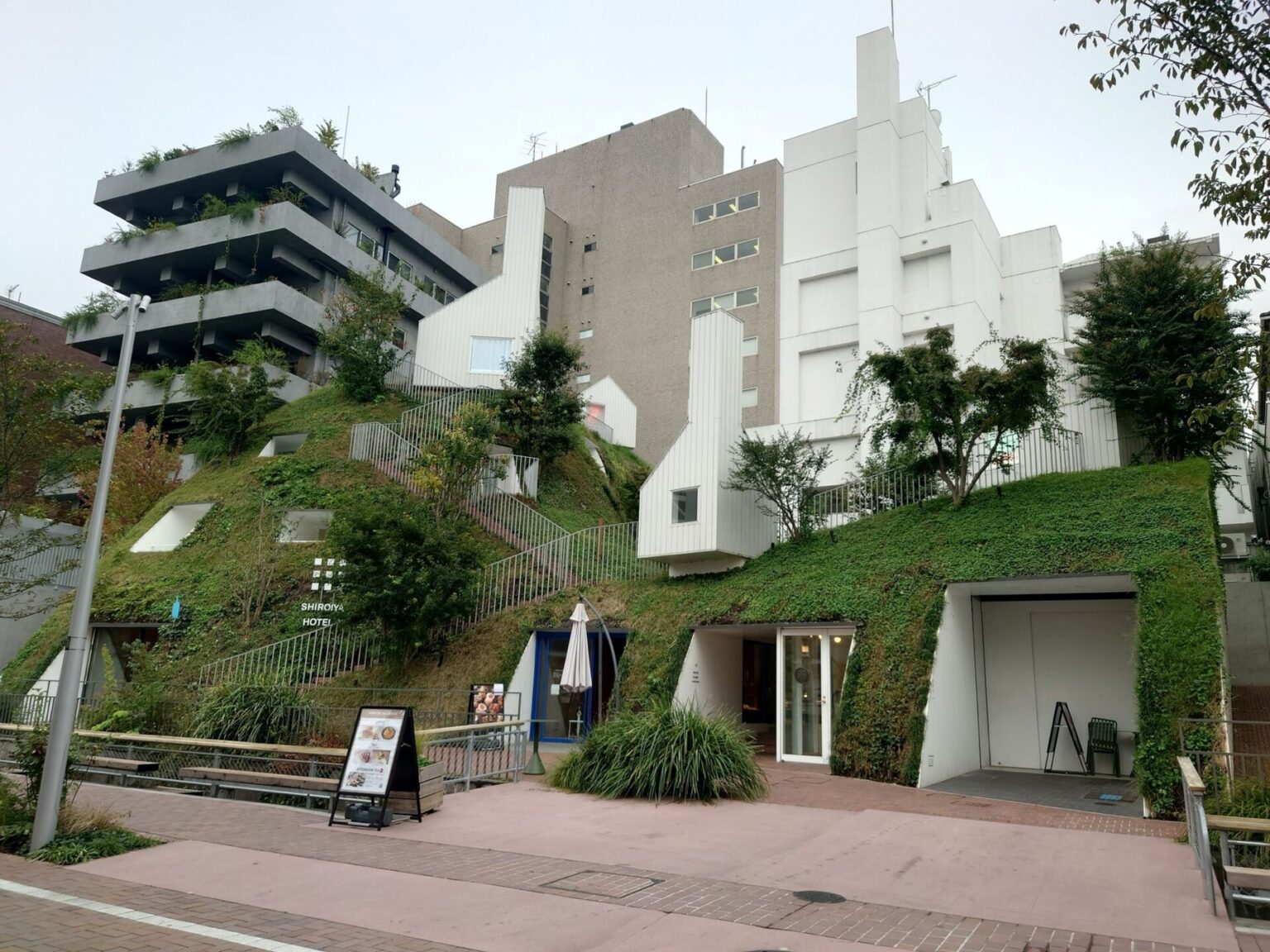
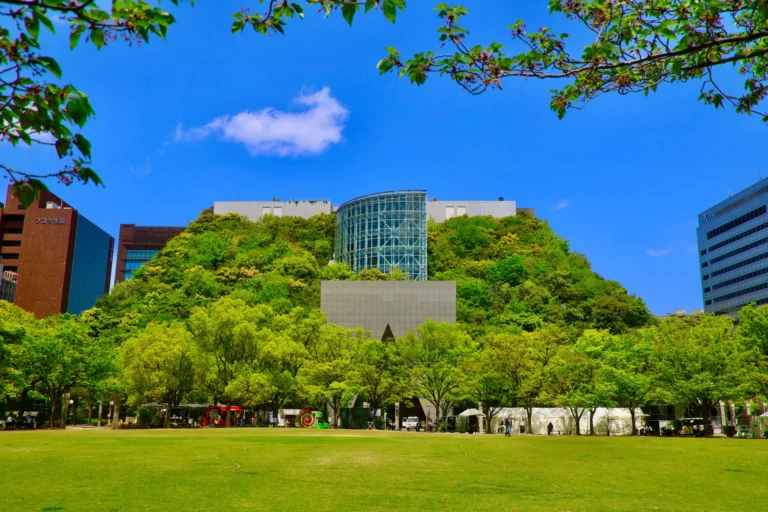
Shiroiya is a former ryokan in Maebashi that Sou Fujimoto turned into two buildings: the Heritage Tower, the old concrete structure gutted into a four-storey atrium, and the Green Tower, a planted artificial hill with rooms buried in its slope. The photograph above is the Green Tower from the north — those white cabins are guest rooms.
The hotel lists 28 rooms. You will see 25 quoted in a lot of coverage. Two separate things also get muddled together, so to be precise: the original concept rooms are by Michele De Lucchi, Sou Fujimoto, Leandro Erlich and Jasper Morrison. The residence rooms added in April 2025 are a later, separate set — 301 valo and 302 metsä by minä perhonen, and 401 with work by baanai.
Maebashi is a working regional city rather than a sightseeing stop, and the hotel is the reason to anchor a night there. That is not a criticism — it is exactly why the place is calm, and why it costs what it costs rather than what a Kyoto equivalent would.
The named rooms are a small share of 28 and go first. If a specific designer room is the point of the trip, book further out than feels necessary and check the room name, not just the room grade.
Check dates on Booking.comShiroiya’s Green Tower is one of the buildings in my roundup of Japanese architecture where the planting is structural rather than decorative, if that is the thread you are pulling.
Sumiya Kiho-an, Kameoka — one artist, in an old onsen ryokan
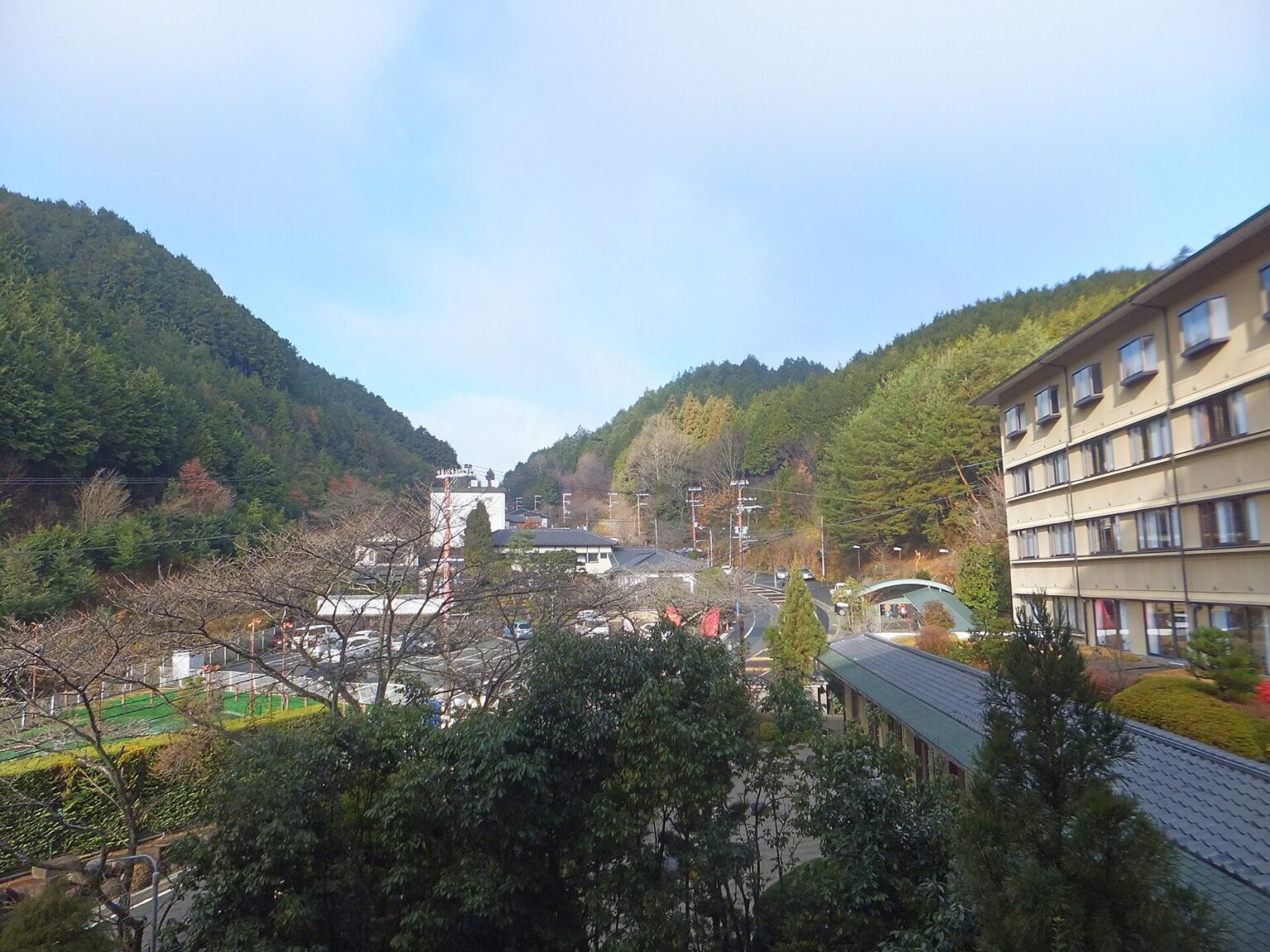
Sumiya Kiho-an is a hot-spring ryokan in Yunohana Onsen, in the hills above Kameoka, and it has been there since 1955. That date matters, because the coverage sometimes implies an artist designed the inn. He did not.
What Yukio Yanagi did is narrower and, I think, more interesting: two interventions into an existing ryokan. Gallery Hakutai (百代), which is the lobby, renovated in 2021 into a 200-square-metre gallery you walk through rather than visit. And a single guest room, Kohoo (呼風), one group per day. A commissioned room by a serious artist inside a seventy-year-old inn is a genuinely unusual thing to be able to sleep in.
Note the readings — the property romanises them Hakutai and Kohoo, not Momoyo and Kofu. Search the wrong ones and you will find nothing.
You can book the art room, but read three things first. On the OTAs, Kohoo is not called Kohoo — Booking.com sells it as the “Japanese-Style Modern Art Suite Room with Open-Air Hot Spring Bath,” and other channels use similar descriptive names. A standard room is not the Yanagi room, and it is easy to book one by accident, so match the room description rather than the price. Children cannot stay in Kohoo under the ryokan’s own rules, and that ban extends to the whole party even across separate rooms — while Booking.com’s property-level page says children of all ages are welcome. And on the night I priced, booking direct came out roughly ¥31,000 cheaper than the OTA once the OTA’s excluded 10% tax was added back in. For this one room, check the ryokan’s own site before you book anywhere else.
For a standard room an OTA is straightforward, and Kameoka is close enough to Kyoto to be a first or last night rather than a detour. For the Kohoo art room specifically, price the ryokan’s own site first.
Check availability on AgodaGetting there is train plus a transfer, not a walk: JR Sagano Line from Kyoto to Kameoka takes about 20 minutes, and the ryokan is a further 8 km. The free shuttle from Kameoka station takes about 20 minutes but is reservation-only by phone and does not run otherwise — booking a room through an OTA does not book the shuttle. A taxi is about 15 minutes and roughly ¥4,000. Note also that the inn’s own pages publish different shuttle timetables from one another, so confirm your pickup by phone rather than trusting any single page.
If you have not stayed in a ryokan before, the meal timings and bathing order catch most people out on the first night — my ryokan guide covers what actually happens between check-in and breakfast.
The Ritz-Carlton Kyoto — a collection, properly hung
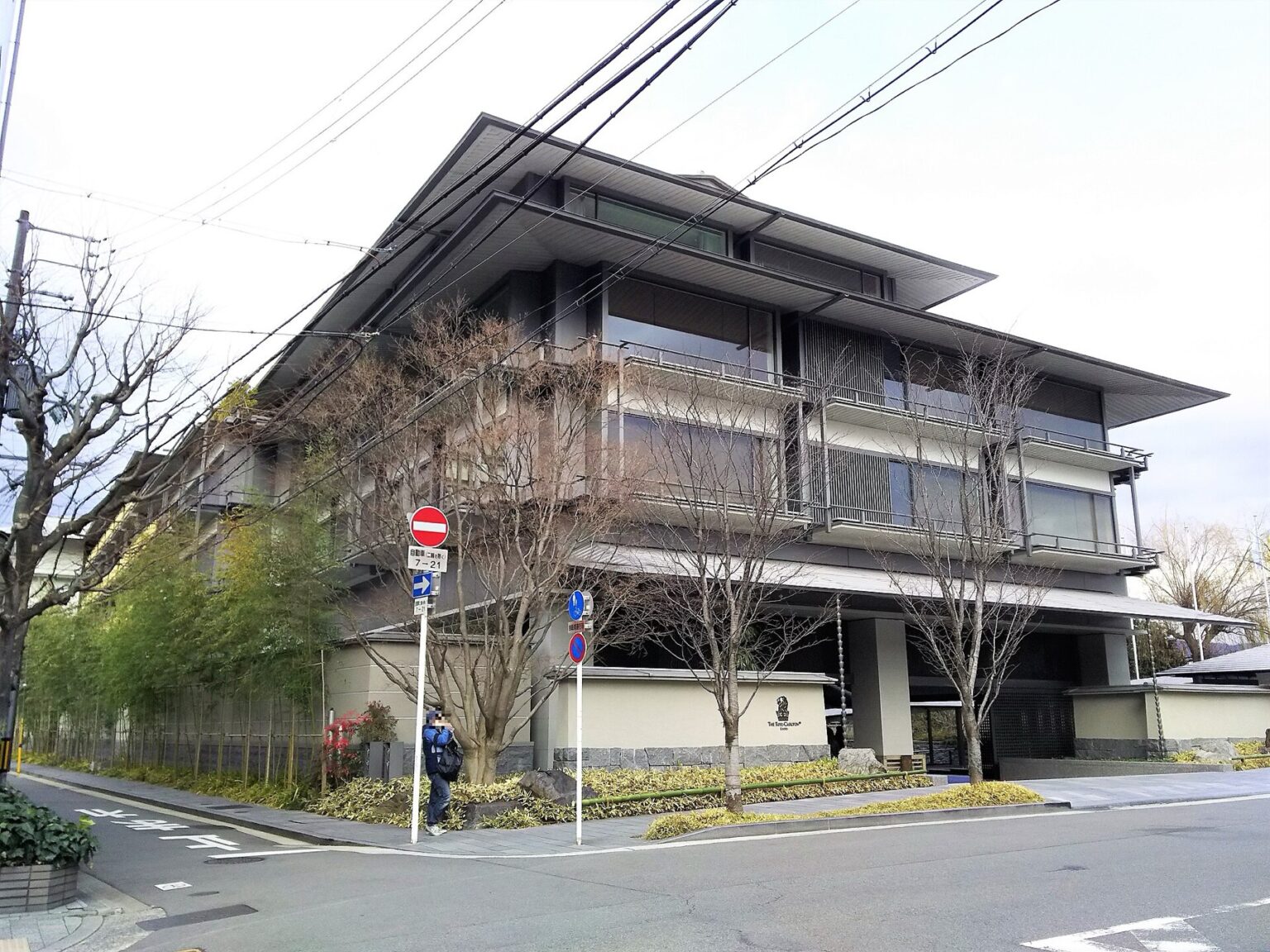
This is the least “art hotel” of the six and the most straightforwardly comfortable place to stay. It opened on the Kamogawa on 7 February 2014 with 134 rooms, and its art programme was coordinated by Art Front Gallery — the Tokyo gallery behind the Echigo-Tsumari and Setouchi triennales, which is why the collection is better than hotel art usually is.
The numbers are firmer than they look. The hotel’s own material states 409 works by 80 Japanese artists, themed around The Tale of Genji and spread through the public floors, the guest rooms and the spa. The developer’s opening release in January 2014 put it at 394 works by the same 80 artists, so the collection has grown since. Art Front’s published list names fifteen of those artists and then says “etc.” — it is a sample, not a contradiction. Their own label for the job is art coordination rather than curation, which is the honest description of what a gallery does for a hotel.
The hotel has also published a free one-hour art tour for staying guests, run through its Guest Activities desk. I could only find that on archived pages — the dedicated page now redirects — so I cannot tell you it still runs in 2026. It costs nothing to ask at check-in, and if it does still run it is the best thing on this list that nobody advertises.
The building is worth a minute before you go in. Four floors above ground and three below, deep eaves, screened balconies. Kyoto’s height and design ordinances are why a hotel of this size went downwards instead of upwards, and the riverside frontage is what those rules are for.
One budgeting note that applies to any Kyoto stay at this level: the city’s lodging tax was restructured on 1 March 2026 and the top bands rose sharply. It is charged per person per night on top of the room rate, and OTA headline prices generally exclude it along with consumption tax.
The river-facing rooms are the ones worth the difference. Nijo-Ohashi puts you on the Kamogawa with Gion a short walk downriver. Remember the headline rate excludes consumption tax and the city lodging tax.
Check availability on AgodaKyoto has a second building worth looking at on the same trip for opposite reasons — Hiroshi Hara’s station, which is the argument against the low-rise ordinance rather than for it.
What to watch at each one
Rates at all six move hard with season and occupancy — Benesse’s own Park Twin ranges from about ¥48,000 to about ¥99,000 for the same room depending on the night — so a number quoted without its date is worth very little. What does not move is the shape of the trap at each property, so that is what this table holds.
| Property | Getting there | The thing that catches people |
|---|---|---|
| Benesse House | Ferry from Uno (20 min) or Takamatsu (60 min) to Miyanoura | Booking opens 180 days ahead at midnight and spring/autumn can go in minutes. Last guest bus from the port is 19:15. |
| Simose Art Garden Villa | JR Sanyo Line ~40 min from Hiroshima to Otake or Kuba, then a transfer | Listed on Booking under Kuba, with all ten villas named identically. Guests must be 13+. The cheapest nights are gallery-changeover nights. |
| Museum Hotel Keyforest | Highland Hokuto, Yamanashi | Listed on OTAs under the old name. Age policy differs by channel. Museum closed Wednesdays. |
| Shiroiya Hotel | Central Maebashi, Gunma | The concept rooms and the 2025 residence rooms are two different sets. |
| Sumiya Kiho-an | JR to Kameoka, then reservation-only shuttle or taxi | The art room is one specific room type, bans children, and was cheaper booked direct. |
| The Ritz-Carlton Kyoto | Nijo-Ohashi, on the Kamogawa | Easy to book. Just remember the headline rate excludes consumption tax and Kyoto’s lodging tax, which rose in March 2026. |
The pattern across all six: the thing you actually want is usually a named room or a named wing, and the default booking path does not give it to you.
Which one to pick
You want the art, above everything
Benesse House. Nothing else here sells you the galleries after the public has gone. Accept the 180-day race and the direct-booking friction.
You follow architecture
Simose, for the recreated Shigeru Ban houses, or Shiroiya for Sou Fujimoto. Both are buildings first.
You have one night and no car
The Ritz-Carlton Kyoto or Shiroiya. Both sit in walkable city centres.
You want an onsen with it
Sumiya Kiho-an — the only one of the six that is a hot-spring ryokan first.
Questions people ask
Can I really sleep inside a museum in Japan?
At Benesse House on Naoshima, yes, and it is not a marketing phrase. The Museum wing opened in 1992 as a single building containing galleries and guest rooms, and all Benesse House guests get free museum admission with viewing until 11 p.m., two hours after the public close at 9 p.m. Keyforest and Simose both put a hotel and a museum on one site, which is a different arrangement — you walk between buildings, during normal opening hours.
Why can’t I find Benesse House on Booking.com?
Because it is not there. Rakuten Travel lists the Park and Beach wings only. The Museum wing, the Oval and the Beach Suite Double are sold exclusively through Benesse Art Site Naoshima’s own reservation system. That system opens exactly 180 days before your stay date, at midnight Japan time, and the operator itself warns that April–May and October–November can sell out within minutes.
Are children allowed at these hotels?
Four of the six restrict them. At Benesse House, children aged five and under cannot stay in the Museum wing, the Oval or the Beach Suite Double — the Park wing has no such rule. Simose accepts guests aged 13 and over only, or 10 and over for the Furniture House. At Museum Hotel Keyforest the published age policy differs between the hotel’s own site (12 and over), the Japanese OTAs (under-11s declined) and Booking.com (adults only, 18+), so phone before booking. At Sumiya Kiho-an the Kohoo art room does not accept children at all, and the ban extends to the whole party. Shiroiya and The Ritz-Carlton Kyoto have no unusual restriction.
Do I need a car?
For Simose and Keyforest a car makes the trip substantially easier. Benesse House is on an island reached by ferry and the island is small enough to manage without one, though the last guest bus from Miyanoura port leaves at 19:15. Shiroiya and The Ritz-Carlton Kyoto are both in city centres where a car is a liability. Sumiya Kiho-an is reachable by train to Kameoka plus the ryokan’s shuttle — which must be reserved by phone in advance — or a taxi of about ¥4,000.
Is museum entry included when I stay?
At Museum Hotel Keyforest, yes — the ticket is handed over at the front desk, against a public price of ¥1,500. Villa guests at Simose get the museum ticket included, plus guest-only access to the terrace and garden early and late — though not to the exhibition rooms. Benesse House guests get free entry to Benesse House Museum, Valley Gallery and the Hiroshi Sugimoto Gallery, with viewing until 11 p.m. Importantly, that does not extend to Chichu Art Museum or the Lee Ufan Museum, which charge guests full price. At Shiroiya and The Ritz-Carlton the art is in the building rather than behind a ticket barrier.
Which is the best value?
Shiroiya, for most people — a significant Sou Fujimoto building in a city that carries no tourist premium, which is not a combination you get often. The Ritz-Carlton Kyoto is a luxury-hotel spend rather than the strongest art-per-yen choice: you are paying for the hotel, and the collection is a bonus rather than the reason.
Can I see the art without staying?
It depends which kind of art. The three public museums — the Nakamura Keith Haring Collection, the Simose Art Museum and Benesse House Museum — all sell general admission, so anyone can visit during opening hours; staying simply buys the quieter window. At Shiroiya and The Ritz-Carlton the works are inside a hotel rather than a museum, so seeing them properly means being a guest or at least a restaurant customer. At Sumiya, Gallery Hakutai is open only to overnight guests and to visitors who have booked the day-trip onsen and lunch plan — there is no walk-in ticket.
Sources
Checked on 29 August 2026: Benesse Art Site Naoshima for the wings, guest benefits, age policy and the 180-day booking rule; the Nakamura Keith Haring Collection and keyforesthotel.com for admission, hours and the age policy; Shiroiya Hotel for the room count and the concept and residence rooms; Sumiya Kiho-an and hakutai.sumiya.ne.jp for Gallery Hakutai, Kohoo and the shuttle; the Simose Art Museum for the villa composition and opening dates; the Ritz-Carlton Kyoto and Art Front Gallery for the art programme. Rates come from each property’s own booking system on the dates stated. Where channels contradicted each other — the Keyforest age policy, the Sumiya child rule — this article says so rather than picking one.
Join travelers discovering Japan's hidden side
Weekly dispatches from off-the-beaten-path Japan — spots and stories you won't find in guidebooks.
No spam. Unsubscribe anytime.
Welcome aboard!
You're in. See you in your inbox soon.