Japan · Architecture · Nature
Green architecture is building so that nature — planting, landform, or the way a place makes its own energy — is part of the structure, not a decoration on top. That can mean a planted roof you can walk on, a hundred-terrace garden climbing a concrete slope, or a library buried inside a living hill. Japan’s biggest names — Tadao Ando, Toyo Ito, Kengo Kuma, Terunobu Fujimori — have all built it. These nine buildings, from a tiny Shibuya greenhouse to a brand-new Kengo Kuma garden in Miyazaki, are chosen for their public access, geographic range and distinct design — with what makes each one “green,” and exactly how to visit in 2026.
Green architecture in Japan: quick facts
What is “green architecture,” and why is Japan good at it?
Instead of adding a few planters to a finished building, the aim is to make the plants — or the land, or the building’s own energy loop — part of the architecture. A roof becomes a hill you walk over; a facade becomes a terraced garden; a building disappears into the ground under a coat of turf; a new distillery complex makes its power from sweet-potato waste. Japanese landscape traditions like borrowed scenery (shakkei) give useful context, though these modern projects reach the idea through very different technology and materials. The result is a scattered national collection of buildings that are also landscapes. Here are nine you can visit, running roughly from Tokyo south to Kyushu.
Kanto — Tokyo & Chiba
1. Shibuya Fureai Botanical Center 渋谷区ふれあい植物センター
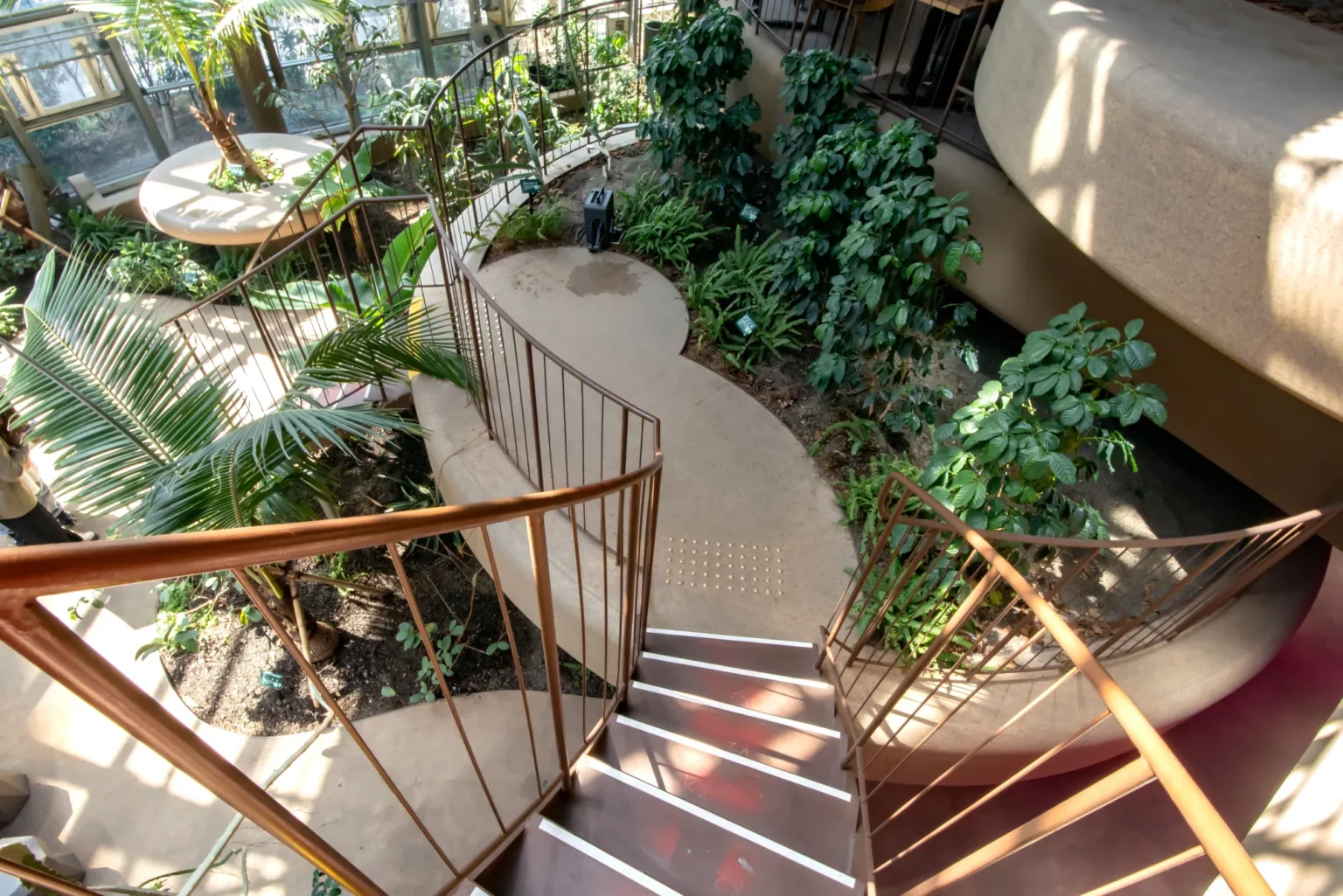
Billed as Japan’s smallest botanical garden, this greenhouse a short walk from Shibuya Station was reborn in 2023 as an edible urban farm you climb through. SUPPOSE DESIGN OFFICE built five soft, mushroom-shaped earthen mounds finished in layered cork that work as floor, stairs, tables and roof at once — the curved terrain doubles as planting and display surface, so you move among the crops instead of just looking at them. The theme is “rich soil”: food scraps become compost in a closed grow-harvest-eat loop, and the building runs largely on waste heat and power from the neighbouring incineration plant.
2. Chichu Library 地中図書館 · KURKKU FIELDS
Hiroshi Nakamura buried this library inside an earth-covered mound so that, from outside, it reads as a planted hill rather than a building. You descend underground into a cave-like reading space — Nakamura drew the analogy to soil, where microbes feed the plants above, so visitors “go down into the earth” to find books. Deep in the plan the space opens into a hall where daylight filters down through a ceiling opening, so the sun reaches even the underground level. It sits inside KURKKU FIELDS, a roughly 30-hectare regenerative farm with solar power, composting and outdoor art, which reinforces the buried-in-nature idea.
Kansai — Shiga, Osaka & Hyogo
3. La Collina Omihachiman ラ コリーナ近江八幡
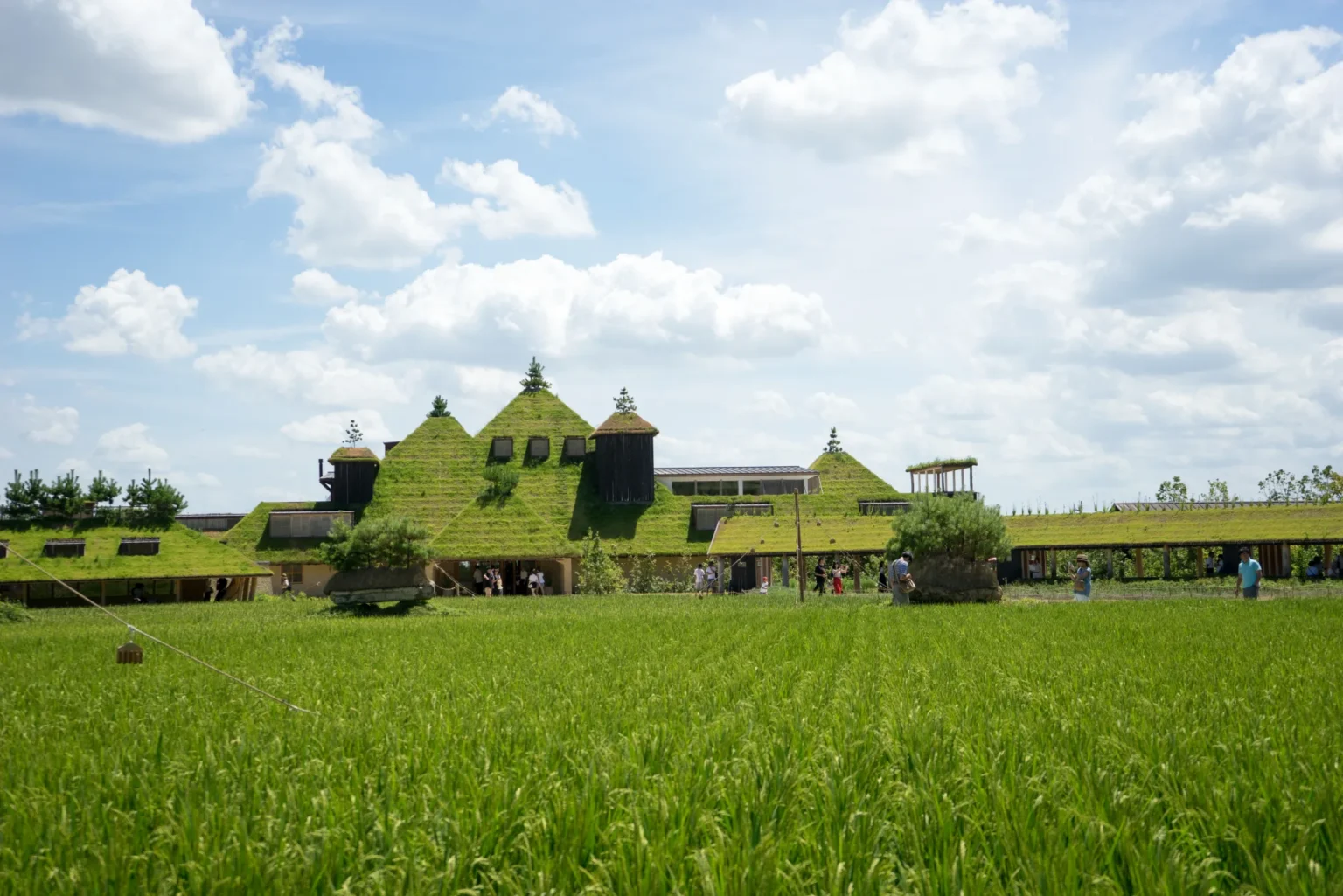
The flagship of the Taneya / Club Harie confectionery, and its turf roof is the project’s defining feature. Terunobu Fujimori topped the main shop — called “Kusayane,” literally “grass roof” — with a gently sloping living roof of real turf that is mowed and tended, so the whole building rises out of the rice fields like a green hill. This is Fujimori’s approach: the turf covers the structure itself rather than sitting beside it. Charcoal is set into the exterior plaster, a pine tree crowns the roof, and the surrounding paddies, terraced fields and forest carry the “building as landscape” idea across the roughly 12-hectare site.
4. Hattori Ryokuchi — Flower & Green Consultation Center 服部緑地 花と緑の相談所
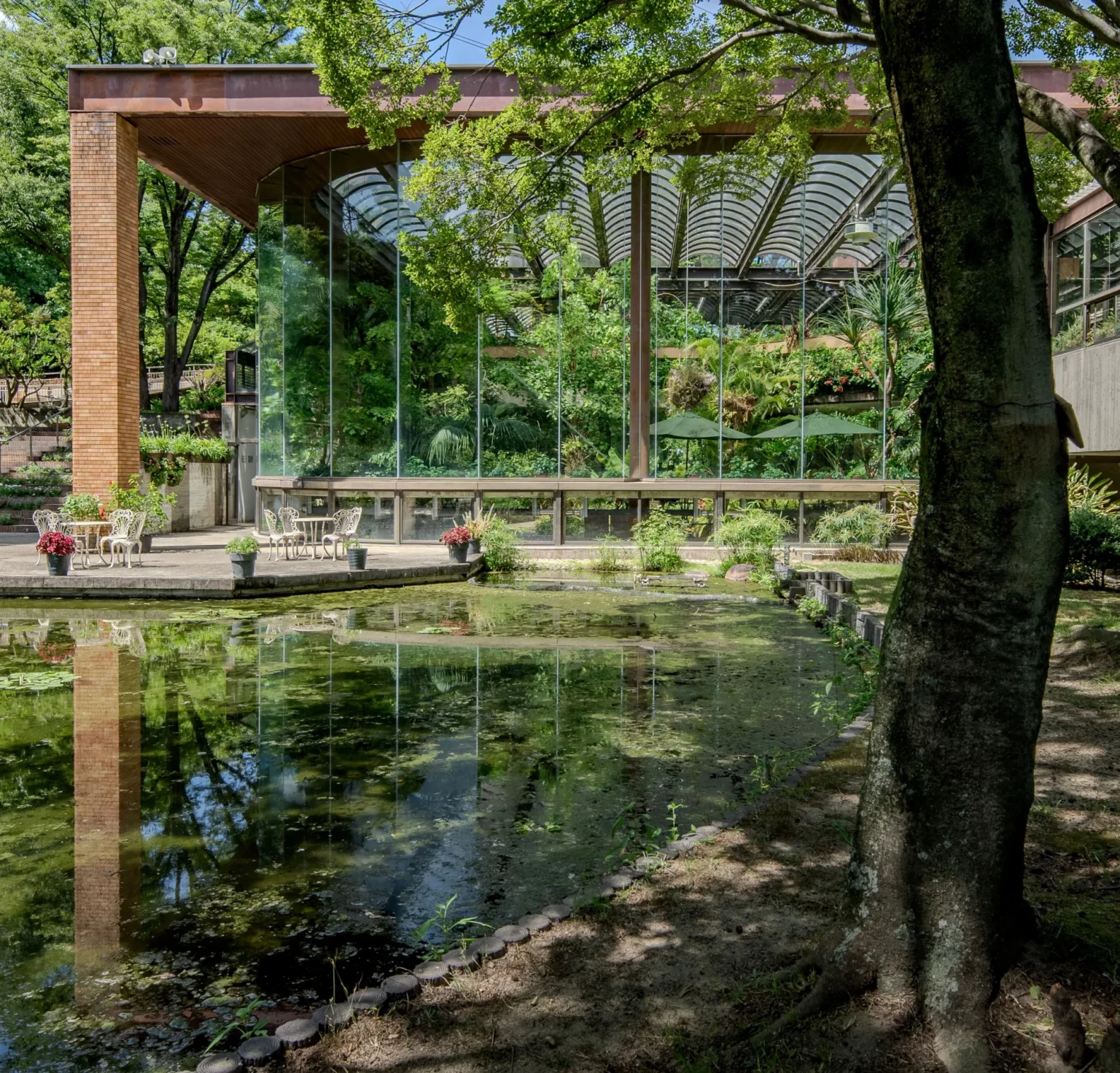
A quieter, older piece of green architecture in a big Osaka park. The landscape architect Mitsuo Taki — who specialised in buildings that merge with plants — designed this greenhouse and consultation centre as a modernist glass pavilion that opens onto the botanical garden around it, so the greenery reads straight through the glass wall. Here the glass, the planting and the visitor route are treated as one system rather than a building set apart from its garden. A good, low-key add-on for anyone already exploring Osaka’s green spaces.
5. Awaji Yumebutai 淡路夢舞台
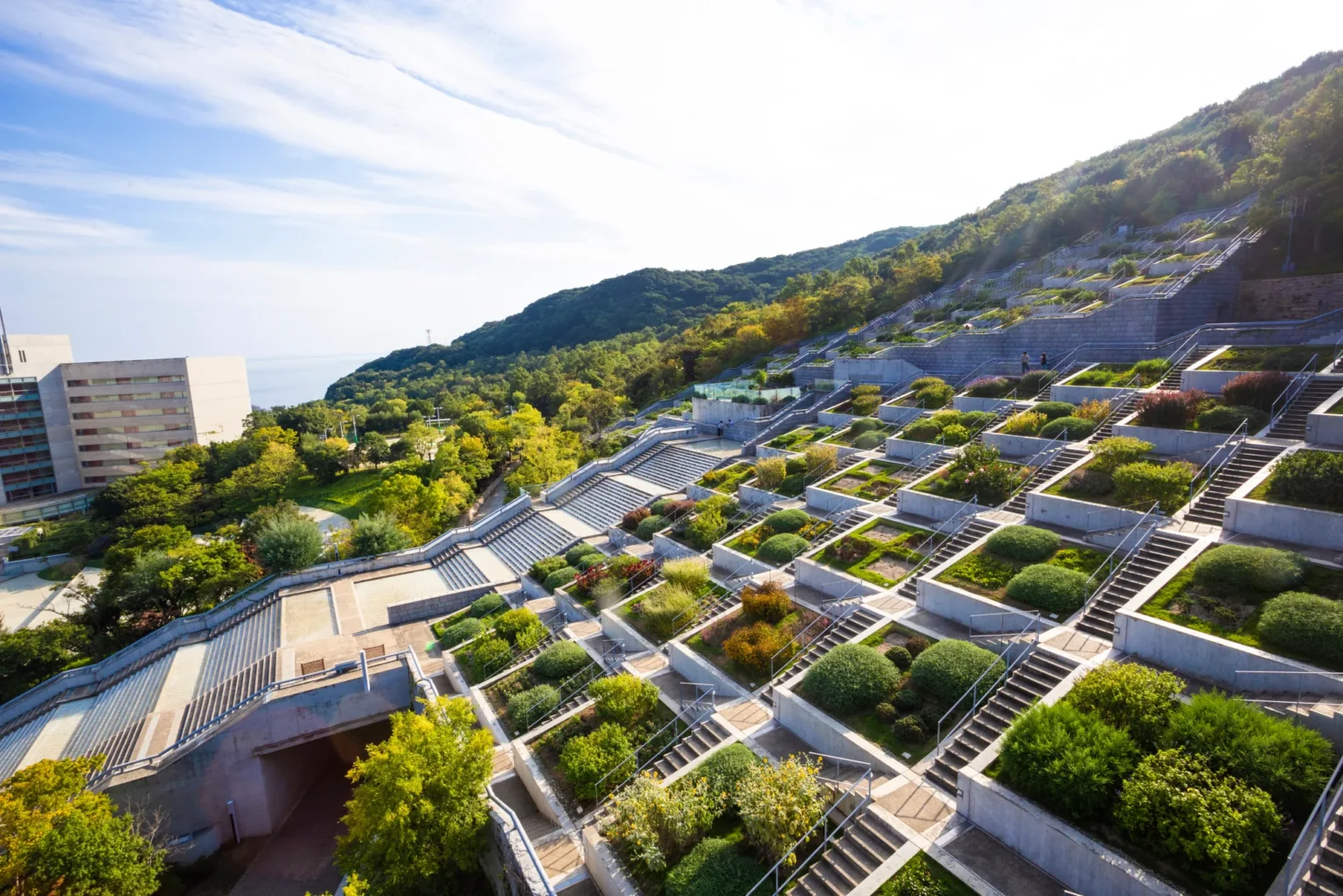
Tadao Ando’s project of repair. The hill here was stripped bare when its earth was dug out to build Kansai International Airport, leaving a raw quarry scar; the project restored the slope as planted forest and threaded a complex of board-formed concrete, terraces and water into the recovering landscape. The signature is the Hyakudanen — a “hundred-terrace garden” of one hundred stepped square beds climbing the hillside in a grid, planted seasonally and conceived partly as a memorial after the 1995 Great Hanshin-Awaji Earthquake. Around it run cascading water gardens, a sky garden, and long sea-and-mountain promenades over Osaka Bay and the Akashi-Kaikyo Bridge.
Shikoku — Kochi
6. Makino Botanical Garden — Makino Memorial Hall 高知県立牧野植物園 牧野富太郎記念館
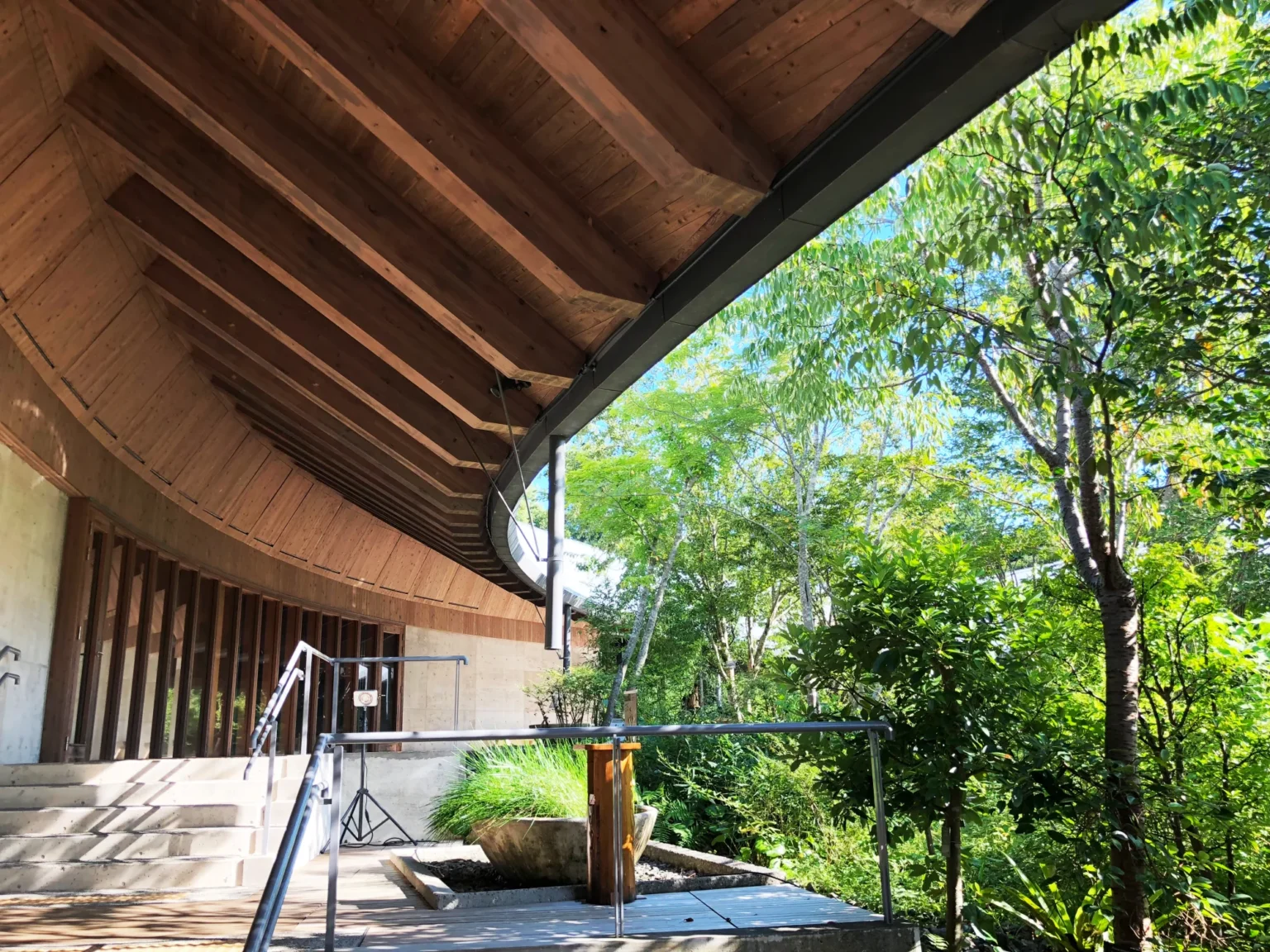
On Mt. Godai above Kochi, Hiroshi Naito set two gently curved pavilions into a botanical garden and linked them with a corridor around planted courtyards — so nearly a third of the plan is semi-outdoor space, and the route moves between building and garden almost seamlessly. The hallmark is a large, sweeping curved roof of laminated timber, computer-analysed for structure but built with traditional Tosa woodwork; the interiors are lined with wood, and the low curving forms hug the hillside rather than dominating it. It honours the botanist Makino Tomitaro, who called himself “the spirit of plants,” and it was designed to sink deeper into the greenery as the plantings mature.
Kyushu — Fukuoka & Miyazaki
7. Island City Central Park “Grin Grin” アイランドシティ中央公園 ぐりんぐりん
On a flat reclaimed island in Hakata Bay, Toyo Ito used the building itself to “make topography.” Grin Grin is an organic, free-form concrete shell of three connected blocks whose roof surface twists through two full rotations and is turfed so that it flows continuously into the ground — visitors walk up and over the planted roof for broad views across the park and Island City, and inside are greenhouse and subtropical planting zones. At Grin Grin, Ito turns the roof into part of the park’s topography.
8. ACROS Fukuoka アクロス福岡
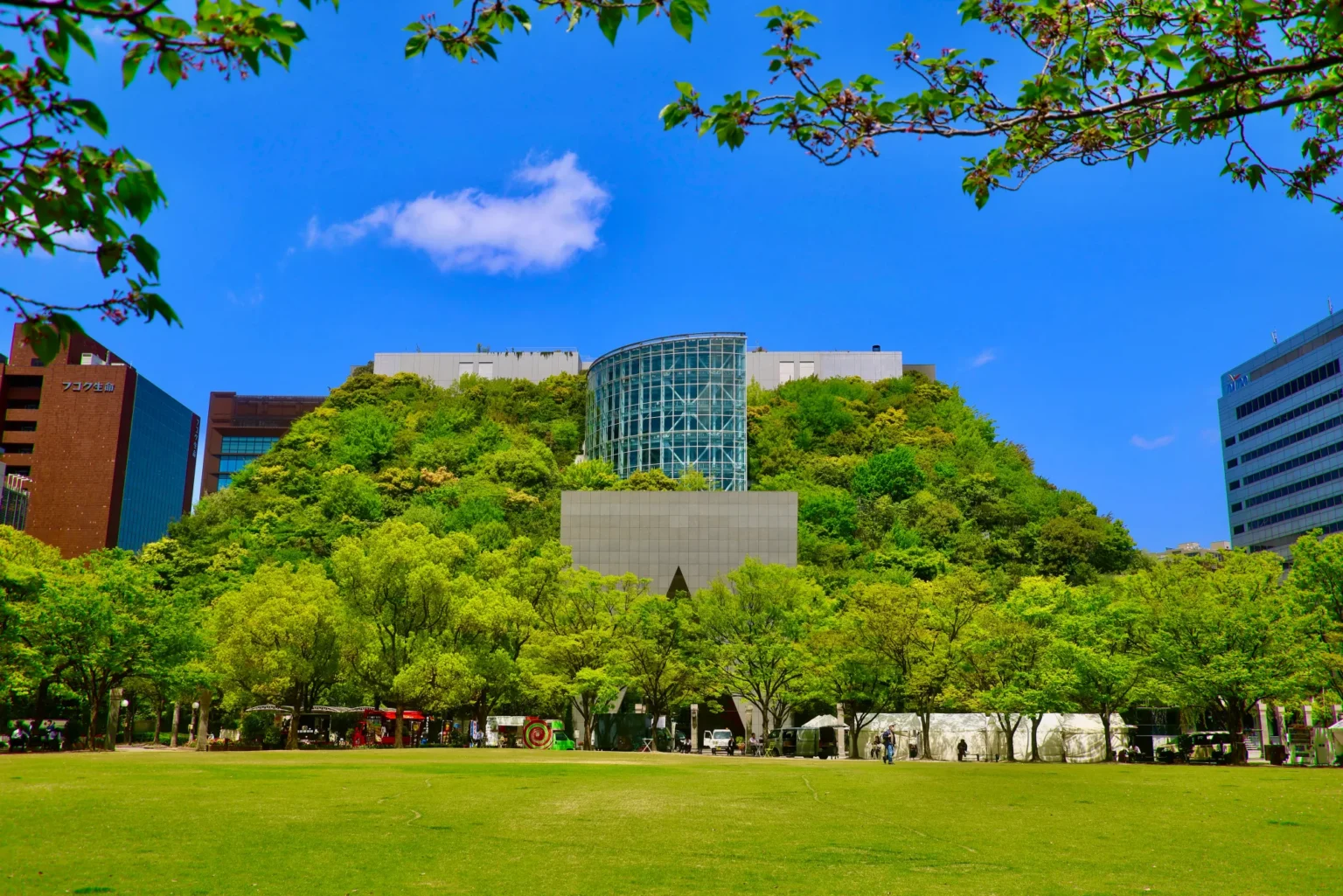
One of Japan’s most widely cited green buildings. Emilio Ambasz conceived this downtown Tenjin complex — built with Nihon Sekkei and Takenaka — giving it a south face of fifteen stepped, planted terraces that climb from the park at street level to a rooftop around 60 m up — so the building doubles as a green “mountain” folded into the city. It started with 76 species and about 37,000 plants; with extra planting and seeds carried in by birds, ACROS now reports 150-plus species growing (and 200-plus observed over time), exactly as Ambasz intended when he said it should “become a forest sixty years later.” CNN has named it one of the world’s most beautiful sky gardens.
9. KIRISHIMA GREENSHIP “icoia” キリシマ グリーンシップ イコイア
The newest entry — and it earns its place less for a planted roof than for how the distillery site handles energy, waste heat and materials. Opened in January 2026 at the Kirishima Shuzo shochu distillery in Miyakonojo, Miyazaki (the “Kirishima” name refers to the distillery, not Kirishima City), Kengo Kuma designed the complex — a Starbucks, shop and gardens — with bamboo and natural materials, and even coffee grounds are mixed into the wall material. Its “green” is as much about energy as planting: the operator says the site runs on power generated from sweet-potato and shochu-distillation byproducts, and distillery waste heat warms the botanical garden in winter. Around the Kuma-designed Starbucks sit a botanical garden (“Meguri no Mori”), a rooftop garden and a lawn terrace.
Which of these are free, and which can you go inside?
Most are open to visitors, and several cost nothing. Here’s the quick planning grid.
| Building | Prefecture | Cost | Inside / roof access | Getting there |
|---|---|---|---|---|
| ACROS Fukuoka | Fukuoka | Free (deck weekends only) | Step Garden 9:00–18:00 (to 17:00 Nov–Feb); rooftop deck weekends/holidays only | Very easy — central Tenjin |
| La Collina Omihachiman | Shiga | Free | Enter shop & grounds freely | Bus from Omi-Hachiman |
| Awaji Yumebutai | Hyogo | Free grounds; greenhouse ¥750 | Walk the gardens; greenhouse inside (paid) | Highway bus ~1 hr from Sannomiya |
| KIRISHIMA GREENSHIP icoia | Miyazaki | Free | Enter gardens, shop & café freely | Car (or bus/taxi from Miyakonojo) |
| Shibuya Fureai Botanical Center | Tokyo | ¥100 | Go inside the greenhouse | Very easy — near Shibuya Stn |
| Grin Grin (Island City) | Fukuoka | ¥100 | Walk the roof + inside greenhouses | Bus/car — no station |
| Hattori Ryokuchi center | Osaka | ~¥220 | Go inside the glass greenhouse | Easy — near Ryokuchi-koen Stn |
| Makino Memorial Hall | Kochi | ¥850 | Enter the hall + gardens | Bus/tram from Kochi Stn |
| Chichu Library | Chiba | Membership + conservation fee + reservation | Inside — membership & reservation required | Car/taxi; plan ahead |
How to see them on a trip
They’re scattered, but they cluster. Fukuoka is the simplest pairing — ACROS is in the centre and Grin Grin is a bus ride away, so you can see two in a day. Kansai holds three within reach of Osaka/Kobe: La Collina (Shiga), Hattori Ryokuchi (Osaka) and Awaji Yumebutai (a day trip to Awaji Island). Tokyo has the tiny Shibuya centre for a quick stop, with Chiba’s Chichu Library as a car-based add-on. Kochi’s Makino and Miyazaki’s brand-new KIRISHIMA are the outliers, worth building into a wider Shikoku or southern-Kyushu route. Awaji is reachable by highway bus, but a rental car adds flexibility for it and the other rural or island sites (Grin Grin, Chichu Library, KIRISHIMA); the rest are fine by train and bus.
Some links below are affiliate links — booking through them supports this site at no extra cost to you.
Plan an architecture trip
Common questions
What is green architecture?
Green architecture is building so that greenery is part of the structure itself rather than a decorative add-on — a walkable planted roof, a terraced garden facade, or a building buried under a living hill. In Japan it draws on older traditions of borrowed scenery and moss gardens, updated in concrete, glass and timber by architects like Tadao Ando, Toyo Ito and Kengo Kuma.
Which is the most famous green building in Japan?
ACROS Fukuoka, conceived by Emilio Ambasz (1995, with Nihon Sekkei and Takenaka). Its south face is fifteen stepped, planted terraces that climb about 60 m from a downtown park to the roof — 150-plus species growing today, with 200-plus recorded over time. It’s free to visit in central Tenjin, though the topmost rooftop deck opens only on weekends and holidays.
Which green buildings in Japan are free to visit?
ACROS Fukuoka, La Collina Omihachiman, the outdoor gardens of Awaji Yumebutai, and the new KIRISHIMA GREENSHIP icoia are all free. Shibuya Fureai Botanical Center (¥100), Grin Grin (¥100), Hattori Ryokuchi (~¥220) and Makino Memorial Hall (¥850) charge modest admissions; Chichu Library needs site admission plus membership and a reservation.
Can you go inside these buildings?
Yes for most. Shibuya Fureai, Grin Grin, Makino Memorial Hall, Hattori Ryokuchi, Awaji’s greenhouse and KIRISHIMA are all open to enter. ACROS’s step-garden is a climbable exterior (with a weekend-only rooftop deck), La Collina is an open shop-and-café complex, and Chichu Library is enterable but only with the KURKKU FIELDS ticket, membership and a reservation.
Which architects designed them?
Tadao Ando (Awaji Yumebutai), Toyo Ito (Grin Grin), Kengo Kuma (KIRISHIMA GREENSHIP), Terunobu Fujimori (La Collina), Hiroshi Naito (Makino Memorial Hall), Hiroshi Nakamura/NAP (Chichu Library), SUPPOSE DESIGN OFFICE (Shibuya Fureai), Mitsuo Taki (Hattori Ryokuchi), and Emilio Ambasz (ACROS Fukuoka).
Which is the newest?
KIRISHIMA GREENSHIP “icoia” by Kengo Kuma, which opened in January 2026 at the Kirishima Shuzo distillery in Miyakonojo, Miyazaki — a bamboo-and-natural-materials complex run largely on power made from sweet-potato and shochu byproducts.
Plan the trip
Book the city base first, then rail or a car for the scattered ones.
Keep reading
- GREENable Hiruzen — Kengo Kuma’s travelling timber pavilion in Okayama.
- The Kengo Kuma Starbucks at Dazaifu — a woven-wood coffee shop near Fukuoka.
- Shoji Ueda Museum — concrete architecture that frames Mt. Daisen.
- Art hotels in Japan — six places where you can sleep with the collection, including Shiroiya’s Green Tower and Shigeru Ban’s Simose villas.
Written by Nobu, hiddenjapan-gems.com. Last updated August 2026. Architects, completion years, 2026 opening hours, admission fees and access checked against each facility’s official site (Shibuya Fureai / sbgf.jp, KURKKU FIELDS, La Collina / Taneya, Hattori Ryokuchi, Awaji Yumebutai, Makino Botanical Garden, Island City Central Park, ACROS Fukuoka, and the KIRISHIMA GREENSHIP press materials). Hours, closed days and fees shift — especially at the newest and the seasonal sites — so confirm the official page for your date, and check reservation rules for Chichu Library before travelling.
Join travelers discovering Japan's hidden side
Weekly dispatches from off-the-beaten-path Japan — spots and stories you won't find in guidebooks.
No spam. Unsubscribe anytime.
Welcome aboard!
You're in. See you in your inbox soon.