
Kyoto · Higashiyama · Tofukuji · Tsutenkyo Bridge · Hojo gardens · autumn 2026
Tofukuji is a Zen head temple in south-east Kyoto, best known for the view of maples from Tsutenkyo, a covered wooden bridge. Its autumn period runs 14 November to 6 December 2026, when the bridge opens at 8:30 and costs adults ¥1,000; the Hojo garden is ¥600 from 1 November, and no combined ticket is sold. Keihan gives mid-November to early December as the usual peak. JR Tofukuji Station is one stop from Kyoto, then about 10 minutes on foot.
JR Inari, the station for Fushimi Inari Taisha, is the next stop south, 2 minutes from Tofukuji; a timed half-day route is below. In the autumn period (14 November to 6 December 2026), a weekday train that reaches Tofukuji around 8:05 puts you at the Tsutenkyo gate before it opens at 8:30; the Hojo garden opens at 9:00.
What Tofukuji is
From the temple’s history page: Tofukuji is the head temple of the Tofukuji branch of Rinzai Zen. The regent Kujo Michiie built it as the largest temple complex in Kyoto, taking the character to from Todaiji and fuku from Kofukuji, the two great temples of Nara; construction ran 19 years, from 1236 to 1255. Its founding abbot was Enni Ben’en, known as Shoichi Kokushi, who had studied in Song China from 1235 to 1241. He was the first Zen monk in Japan to be given a national-teacher title by an emperor, and he died here in 1280, aged 79. Before the fire of 1334 the temple was already ranked among Kyoto’s Five Mountains (Gozan), the ranking of the city’s leading Zen temples.
Fires in 1319, 1334 and 1336 burned most of the early buildings. A fire in December 1881 took the Buddha hall, the Dharma hall, the Hojo and the kitchen hall; the Hojo was rebuilt in 1890 and the present main hall finished in 1934. Among the medieval buildings that escaped the fires are the Sanmon, the Zendo, the Tosu latrine and the bathhouse. Kyoto City’s tourism site quotes an old saying about the scale of the complex: “Tofuku no garan-zura”, Tofukuji’s face is its buildings.
Sanmon gate
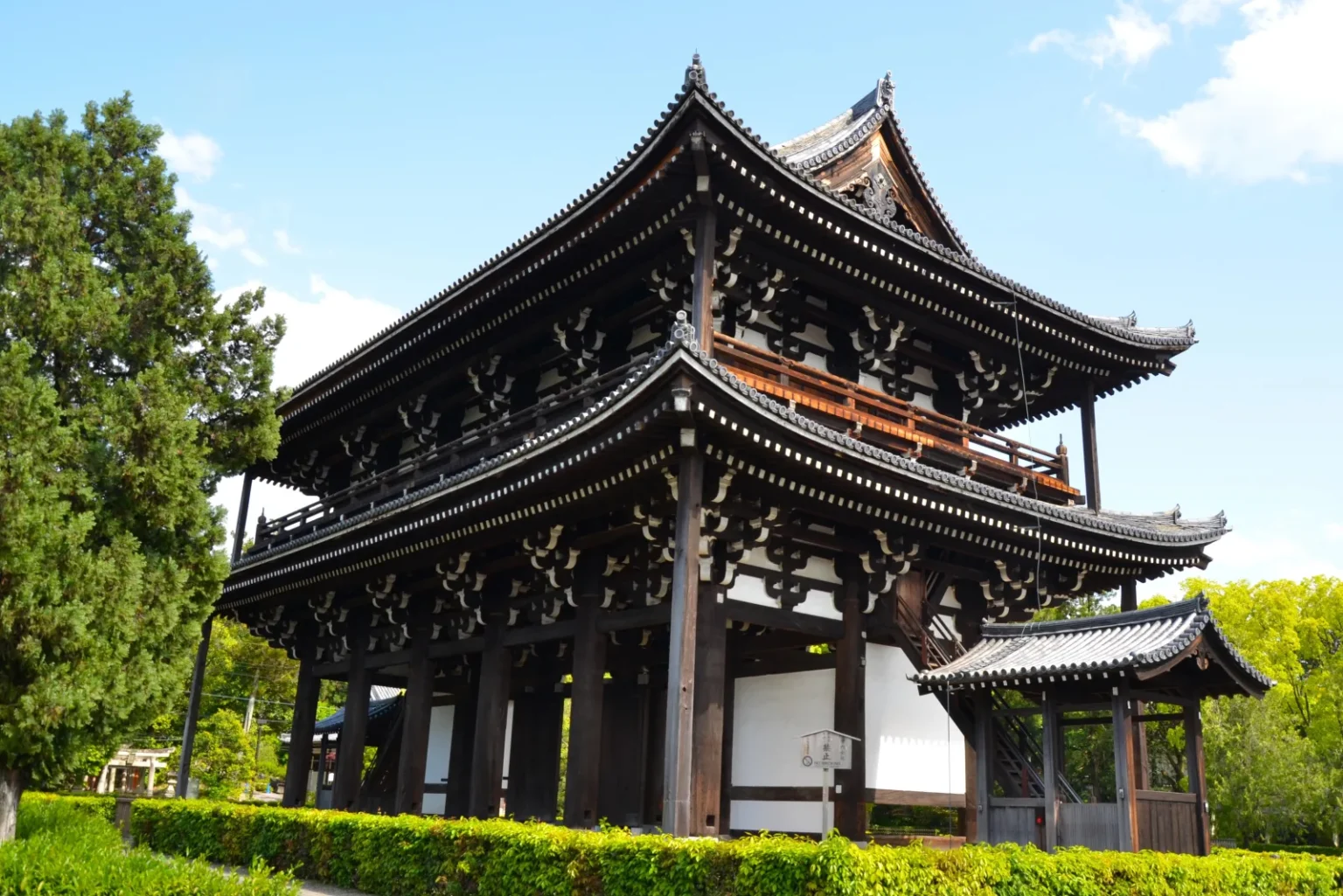
National Treasure, 1405. Upper floor painted by Mincho and his pupils. Usually seen from outside only.
Hondo (main hall)
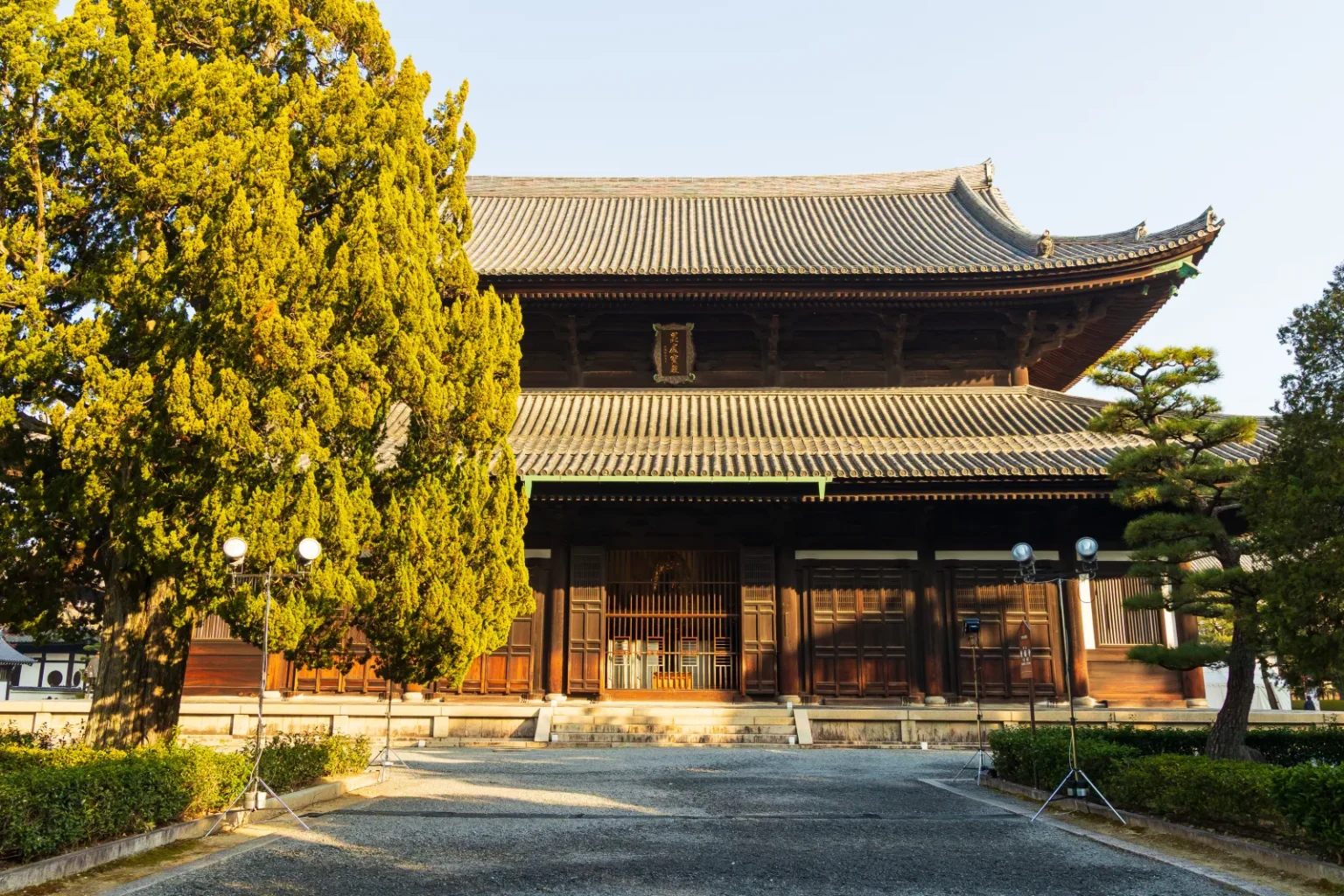
Built 1934. Dragon on the ceiling by the painter Domoto Insho.
Hojo gardens
Four gardens by Shigemori Mirei, 1939, including the moss checkerboard. ¥600 from 1 Nov 2026.
Tsutenkyo bridge
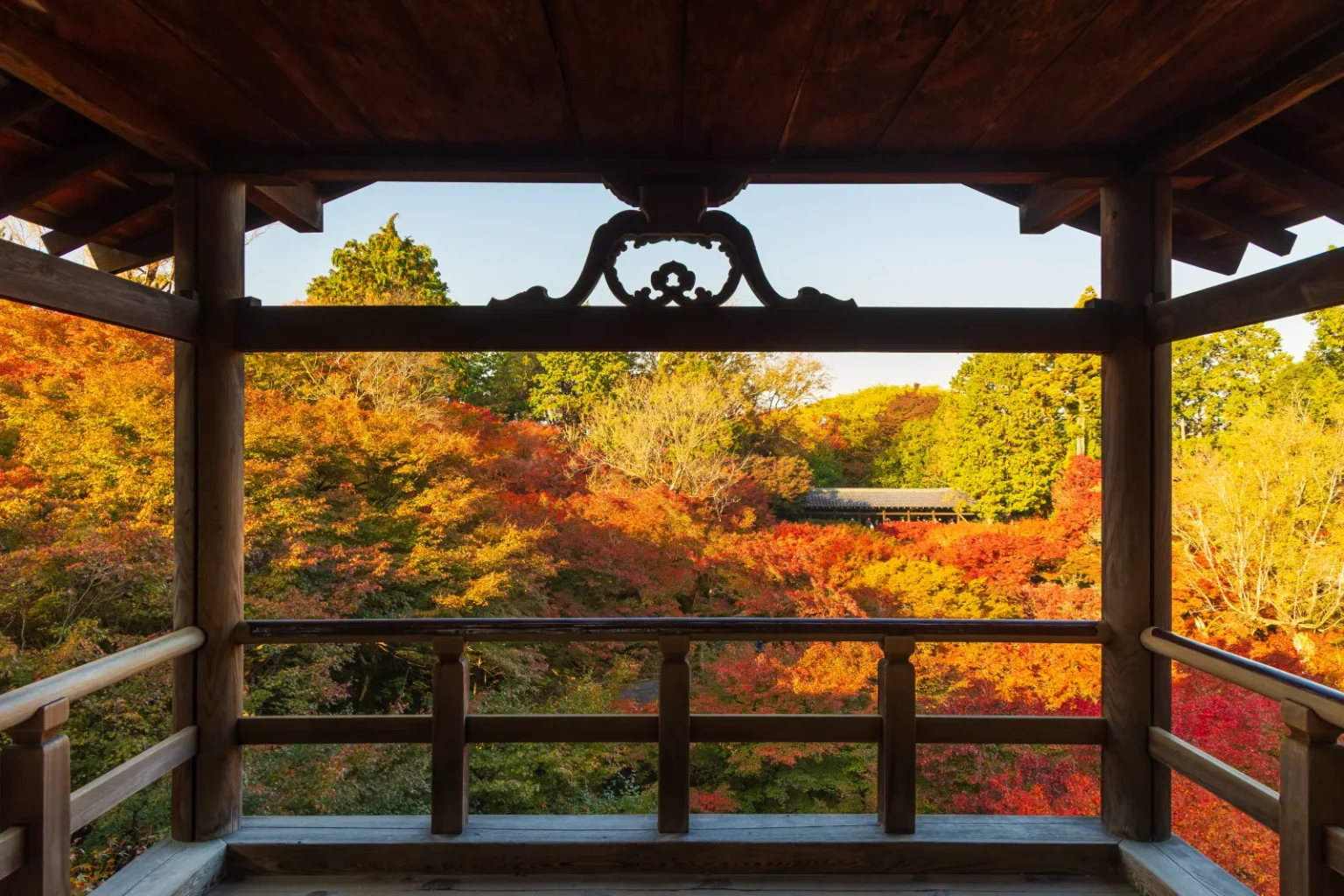
Covered bridge looking down on the Sengyokukan maples. ¥1,000 in the autumn period.
Kaisando
The founder’s hall on the highest ground, reached across Tsutenkyo; same ticket as the bridge.
Zendo, Tosu, Yokushitsu
Medieval meditation hall, latrine and bathhouse, all Important Cultural Properties. Seen from outside.
The precinct, place by place
The outer grounds are free and open every day, says Kyoto City’s official tourism site. The paid areas are Tsutenkyo with the Kaisando and the Hojo garden, plus the Sanmon upper floor and Ryuginan when they open (see below). There is no re-entry, the temple warns, so see everything you want in each paid area before you leave it. Below, facts are from the temple’s visitor guide unless another source is named.
Sanmon: the oldest Zen main gate
The two-storey gate south of the main hall dates from 1405. Japan’s Agency for Cultural Affairs database records that ink inscriptions found during the 1969–1977 dismantling repair date the roofing and upper storey to between 1405 and about 1413; it was designated a National Treasure on 29 March 1952. The temple calls it the oldest sanmon in Japan, one of the largest in Zen, and the first of its type made a National Treasure. Inside the upper floor, Buddhist figures sit under ceilings painted by Mincho and his pupils.
The upper floor opens only in special periods. Keihan’s 2026 autumn page lists a Sanmon and Ryuginan opening from 7 November to 6 December 2026, 9:00 to 16:00 (last entry), adults ¥1,000. The temple had not posted its own 2026 notice when checked on 16 October 2026; in 2025 it sold separate ¥1,000 tickets for the Sanmon and for Ryuginan, each with its own entrance, and warned that the Sanmon stairs are high-stepped and steep.
Hondo, the main hall
The present Hondo combines the Buddha hall and the Dharma hall in one building, finished in 1934 after the 1881 fire. At the spring Nehan-e ceremony (14–16 March in 2026), Mincho’s large painting of the Buddha’s death is shown here. The set of 47 Five Hundred Arhats paintings (45 by Mincho, dated 1386, and two replacement copies by Kano Takanobu) was raised from Important Cultural Property to National Treasure, the temple announced on 27 March 2026.
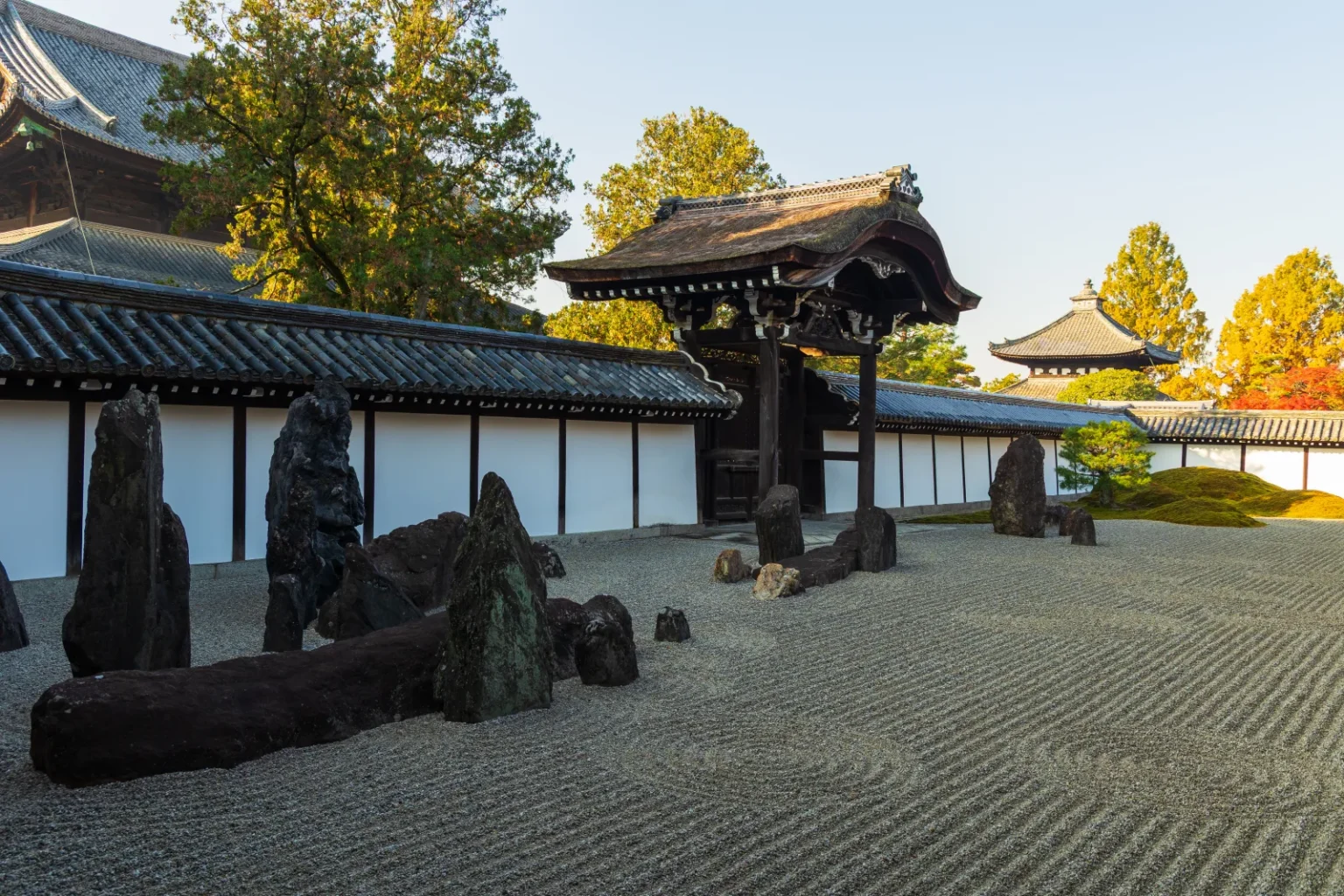
Hojo gardens: Shigemori Mirei’s four gardens
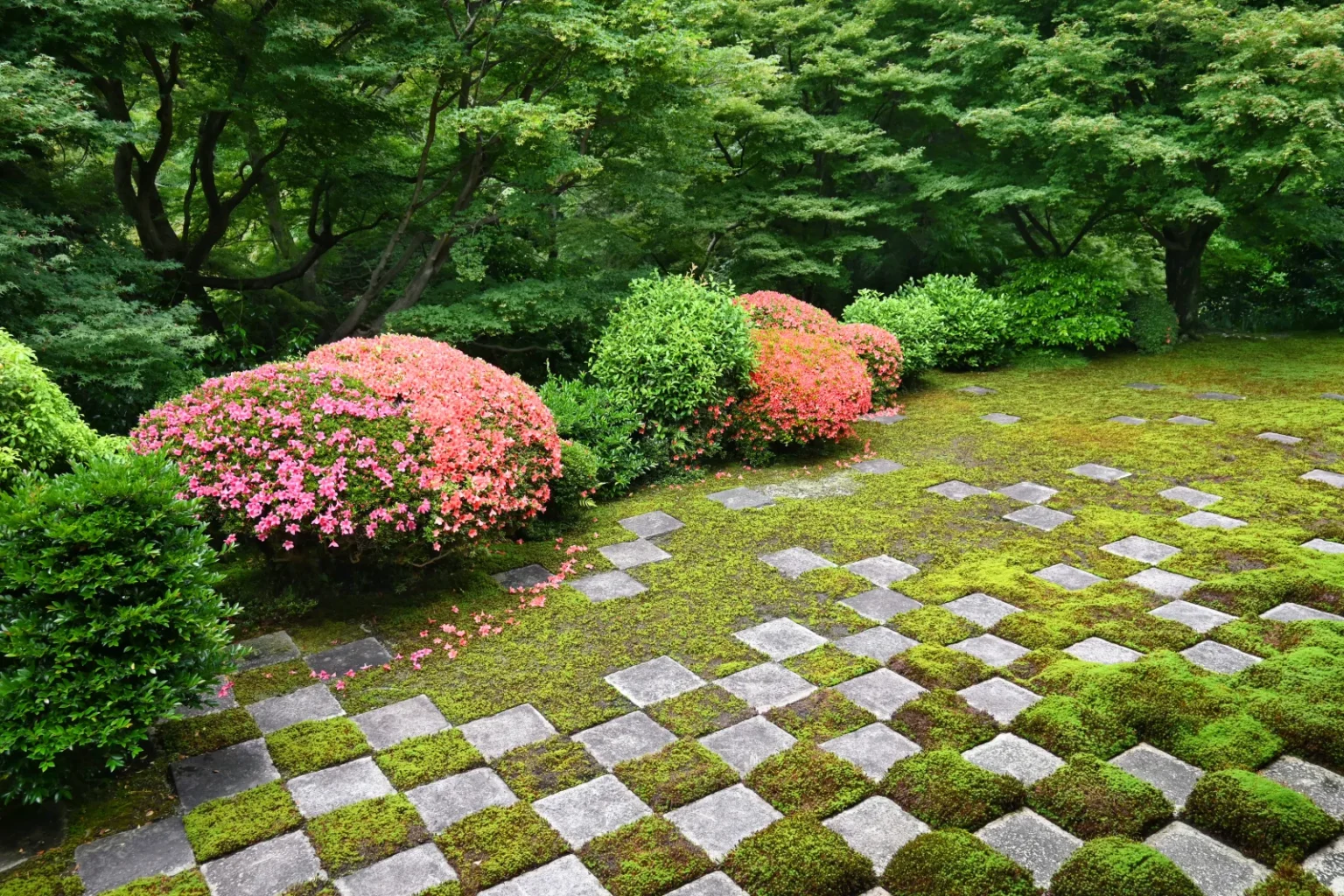
The garden designer Shigemori Mirei made these between 27 June and 11 November 1939. They surround the Hojo, the abbot’s hall, on all four sides, which no other Zen hojo garden does, and in 2014 they were designated a national Place of Scenic Beauty. The one condition Shigemori was given was to throw nothing away and reuse every material already in the compound. The garden page ties the checkerboards and the Big Dipper to that rule:
| Garden | What you see |
|---|---|
| South | Four rock islands (three with stones about 6 m long laid flat) and five moss mounds for the Five Mountains |
| West | A large checkerboard of clipped azalea and kerb stones taken from old paving |
| North | Square paving stones in moss, reused from an old path; the pattern breaks up towards the valley |
| East | Seven stone cylinders as the Big Dipper, left over from repairs to the Tosu latrine |
Shigemori called it the “Garden of the Eight Aspects” (Hasso no Niwa): eight motifs, matching the eight events of the Buddha’s life. Moss, fed by moist air from the valley, has since spread over the white gravel that once edged the North garden.
Tsutenkyo and the Sengyokukan valley
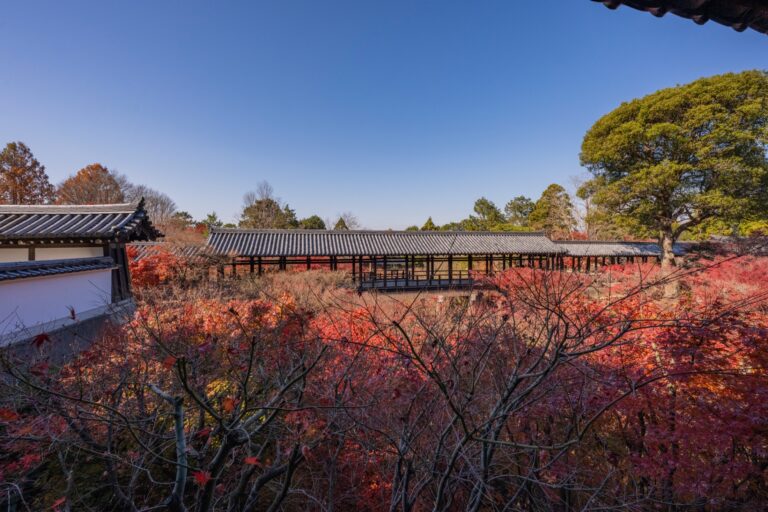
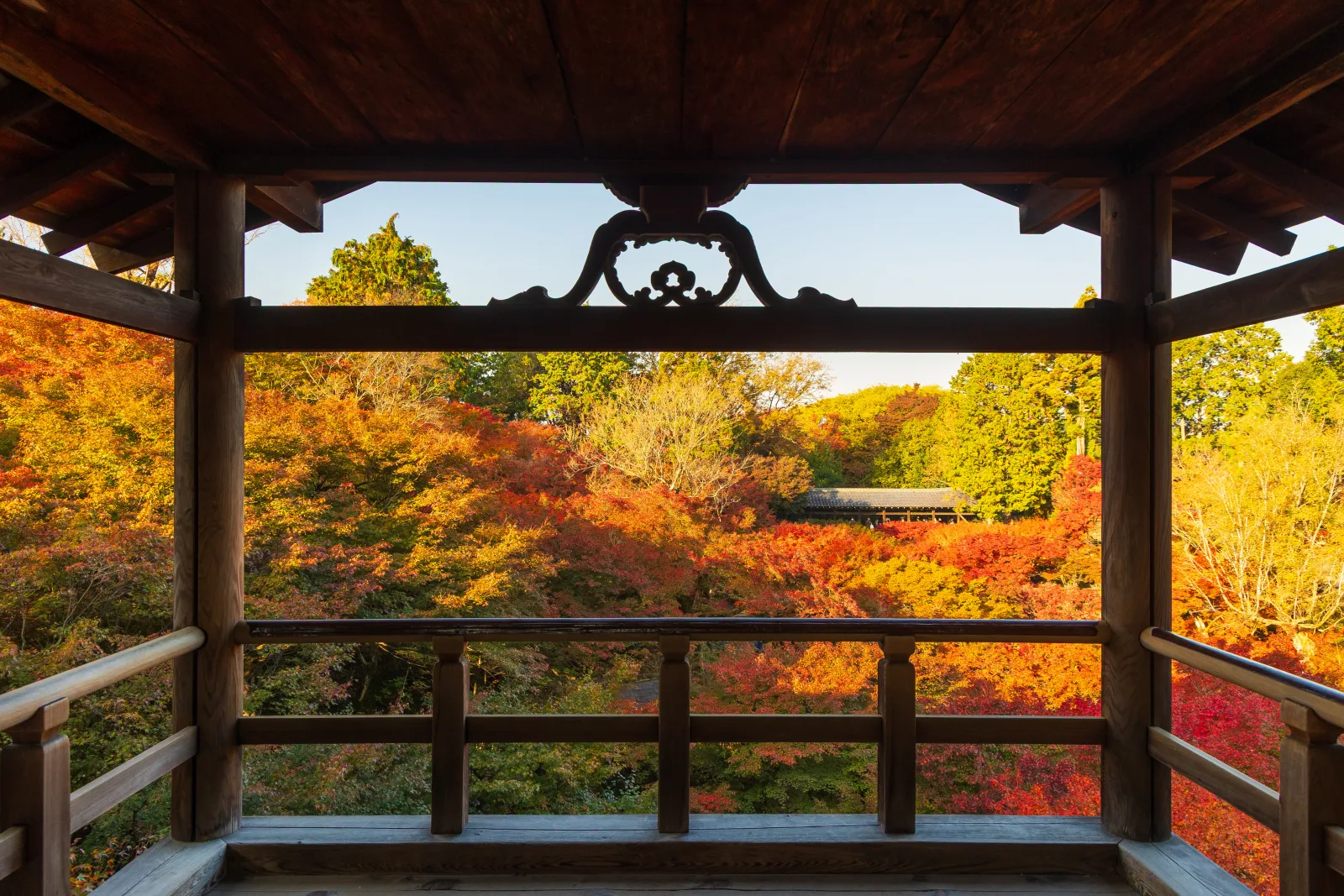
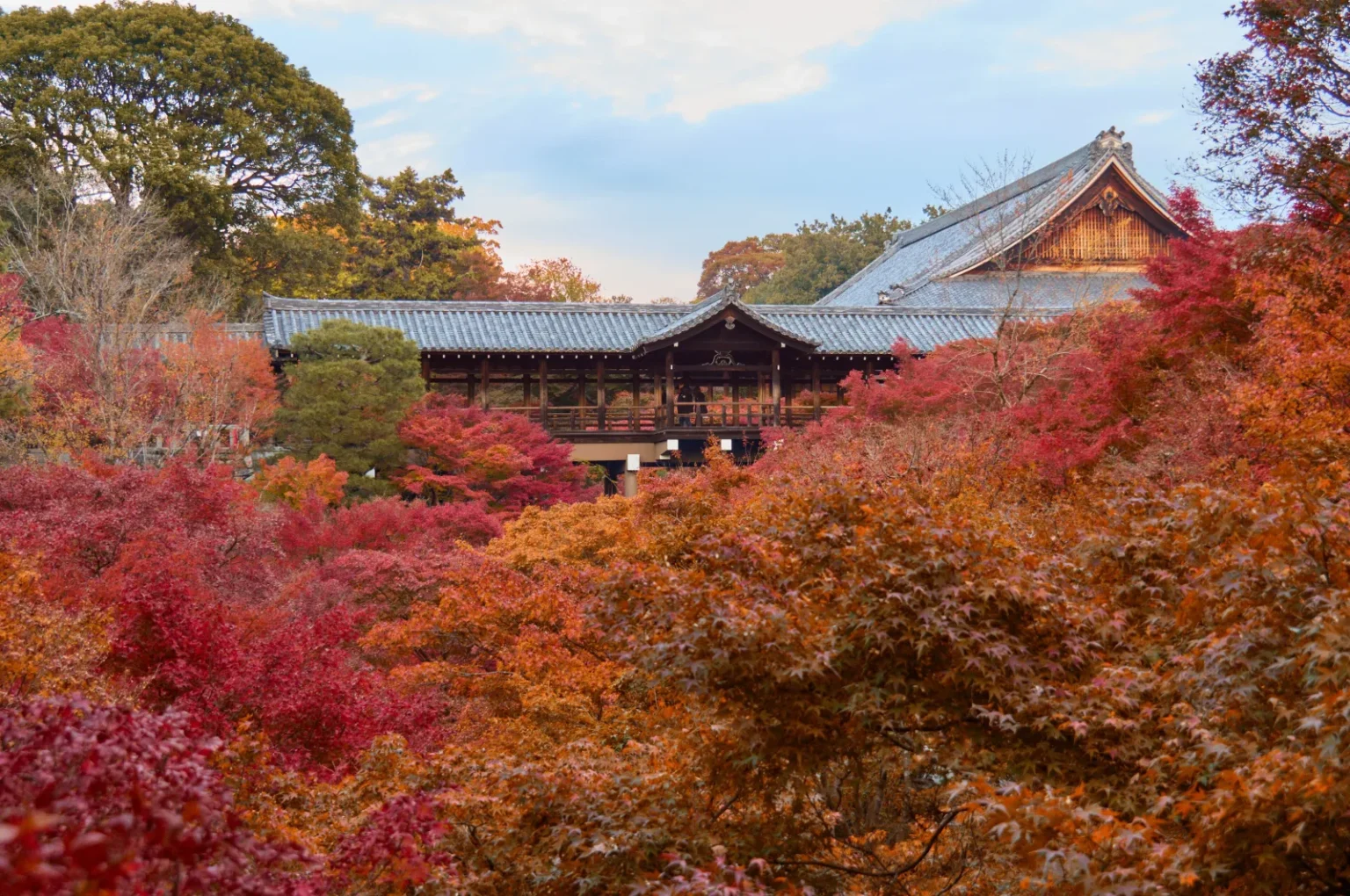
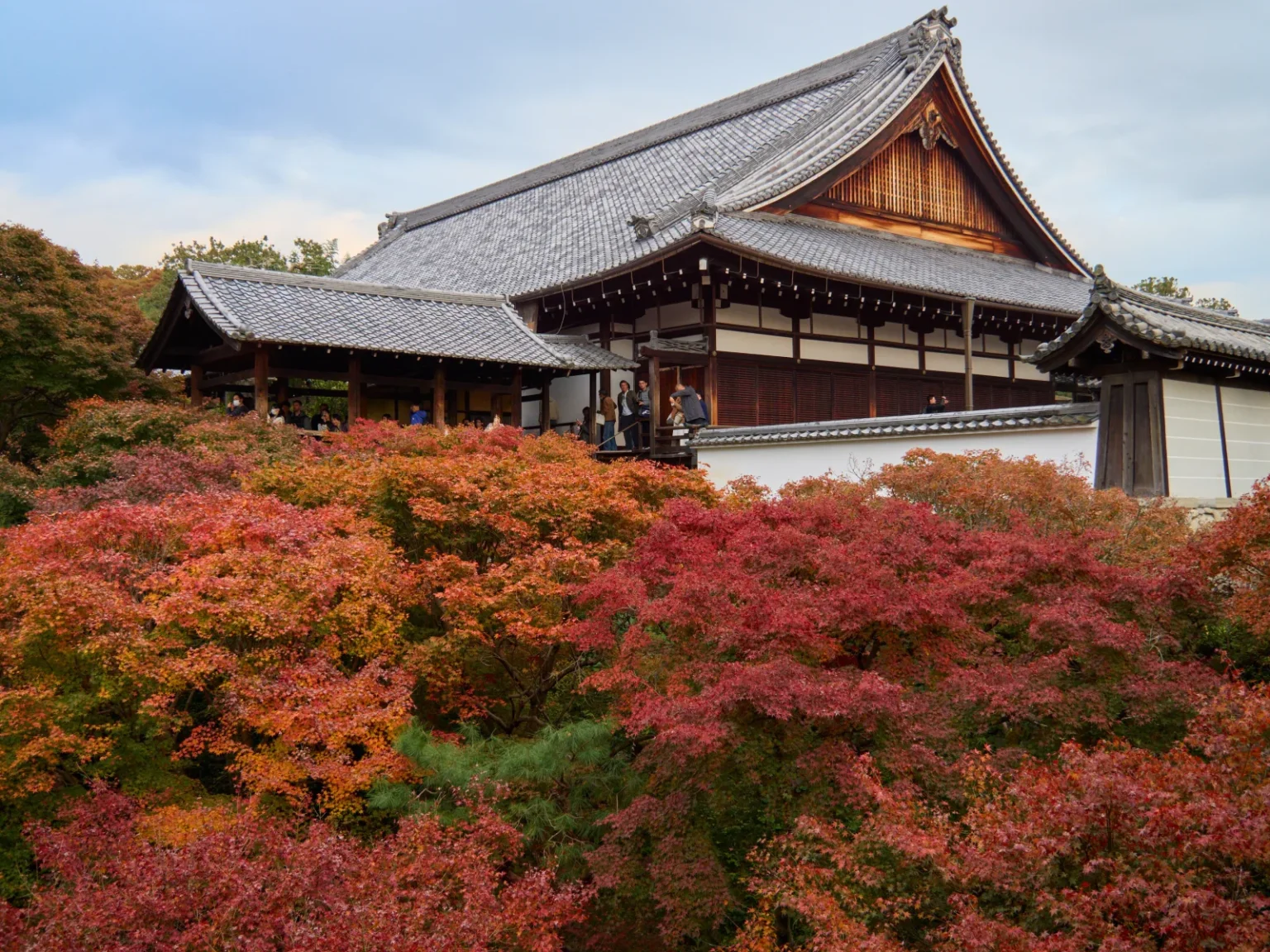
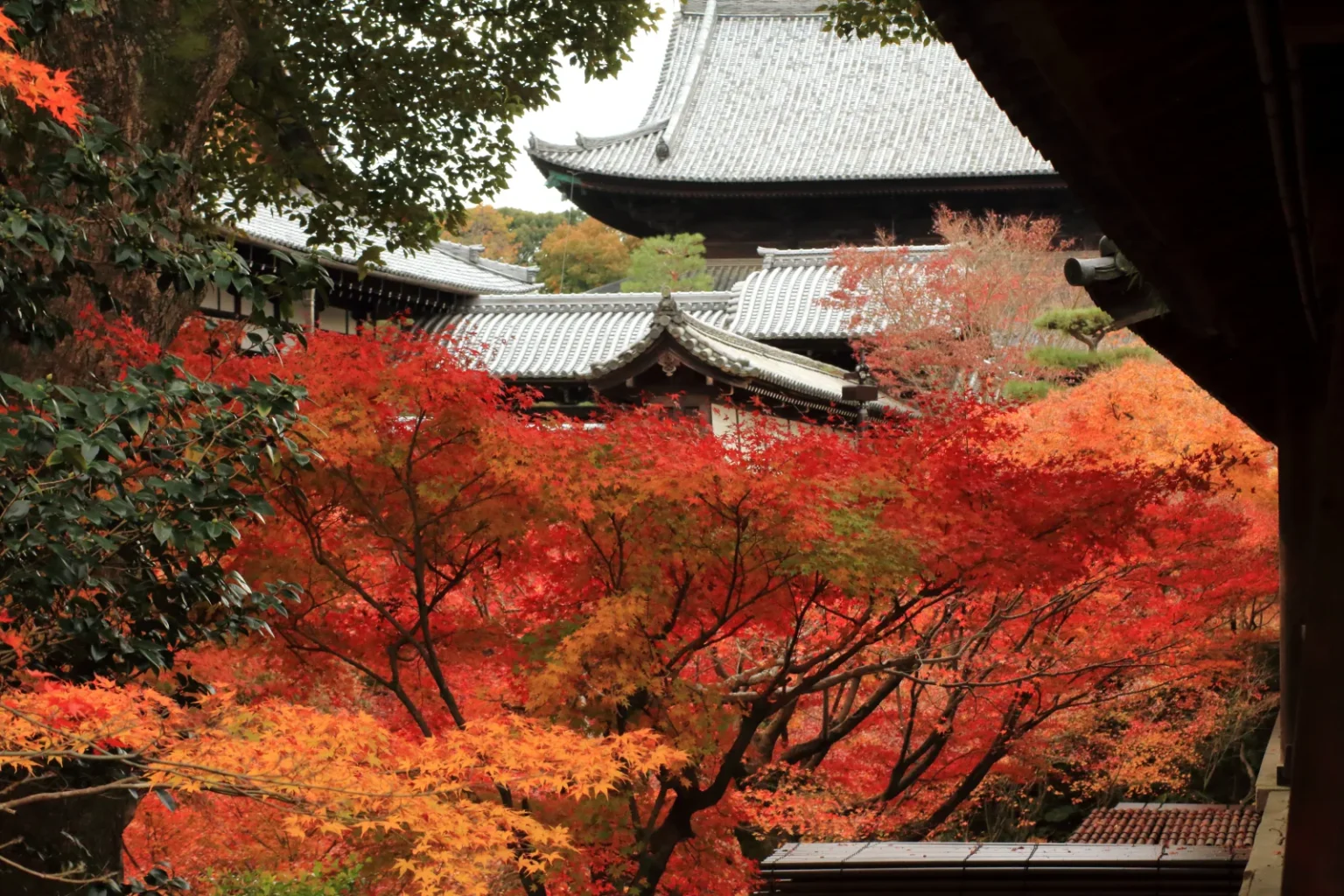
Tsutenkyo is a roofed corridor bridge across the Sengyokukan, a small wooded ravine, linking the main buildings with the Kaisando on the far side. It is believed to have been built in 1380 by the monk Shun’oku Myoha. From it you look down on the maples filling the valley; Keihan counts about 2,000 maples in the grounds. One maple here turns gold, not red: the three-lobed maple that the temple says is believed to be the Tang maple Shoichi Kokushi brought back from Song China.
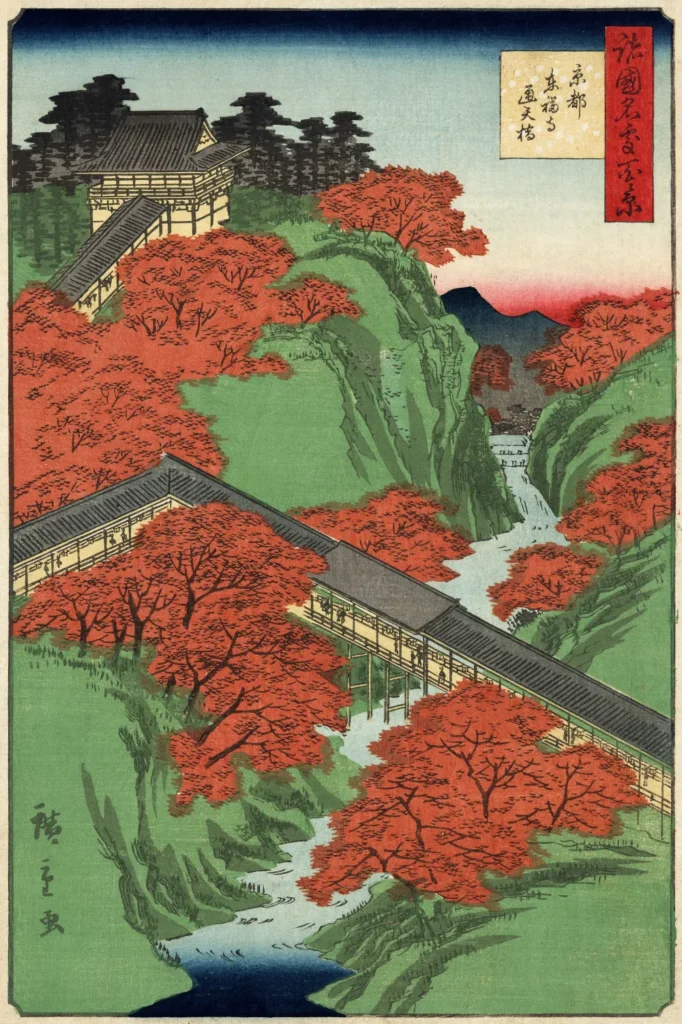
In 1859 Utagawa Hiroshige II included Tsutenkyo in his series One Hundred Famous Views of the Provinces, with red maples on both sides of the gorge:
Kaisando and Fumon-in
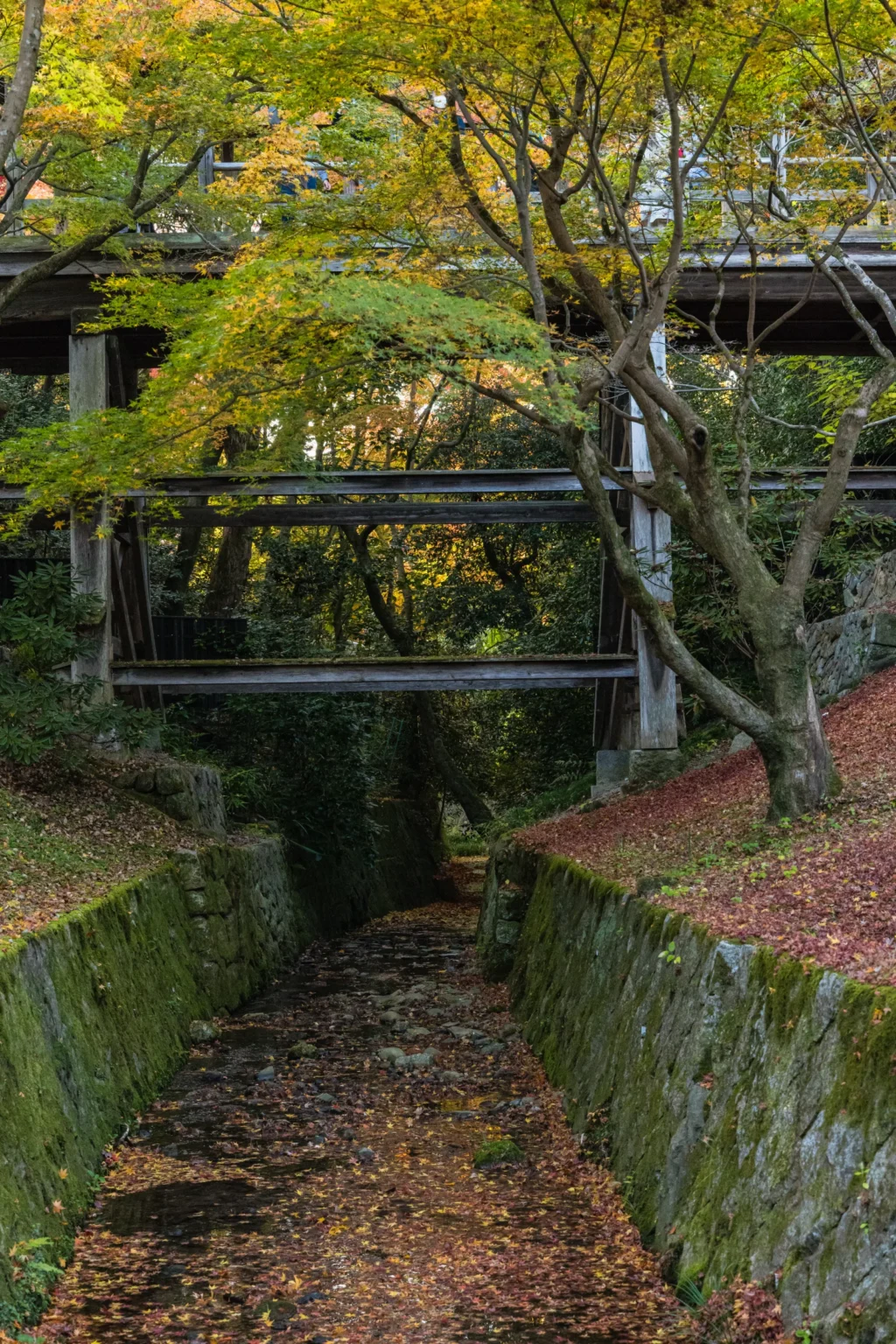
Across the bridge, the Kaisando stands on the highest ground of the precinct. It enshrines a statue of the founder, but the building’s interior is not open. Shoichi lived in the neighbouring Fumon-in and watched the temple being built from there; the garden in front of Fumon-in dates from the mid-Edo period, and Shigemori measured its checkerboard sand pattern in February 1938, a year before he designed the Hojo gardens. Entry is on the Tsutenkyo ticket.
Gaunkyo and Engetsukyo
With Tsutenkyo, these make up the temple’s “three famous bridges”. Gaunkyo, a prefecture-designated cultural property, crosses the same valley and looks across at Tsutenkyo. The temple asks cyclists and motorcyclists to get off and push on it, and in the autumn period the photo rule below covers Gaunkyo too. Engetsukyo, further up the Sannohashi stream, is a roofed wooden bridge of 1603 and an Important Cultural Property.
Zendo, Tosu and Yokushitsu
All three are seen from outside. The Zendo, rebuilt in 1347, is the oldest and largest meditation hall in Japan and the only one surviving from the Middle Ages. The Tosu, nicknamed the “hundred privies”, is an early-Muromachi latrine, the oldest in Japan. The Yokushitsu is a steam bathhouse, the second oldest in Japan after Todaiji’s, with a roof tile dated 1459. Sunday zazen in the Zendo (6:30–7:00, free) is not held from 1 November to 6 December 2026.
Visiting in 2026: hours, fees and booking
All figures are from the temple’s visitor guide and its 1 July 2026 fee notice, read on 16 October 2026. The temple notes that the autumn dates change every year; the 14 November to 6 December dates match Keihan’s 2026 page.
| Period | Hours (last entry = 30 min before the gate closes) |
|---|---|
| 1 Apr – 13 Nov 2026 | 9:00–16:00 entry; gate closes 16:30 |
| 14 Nov – 6 Dec 2026 | Tsutenkyo from 8:30, Hojo garden from 9:00; last entry 16:00; closes 16:30 |
| From 7 Dec 2026 (winter) | 9:00–15:30 entry; gate closes 16:00 |
To be at the Tsutenkyo gate for 8:30, a hotel near Kyoto Station or Keihan Gion-Shijo keeps the train ride to a few minutes; check the first train from your hotel.
Kyoto hotels on Agoda| Ticket (adults) | 2026 price |
|---|---|
| Tsutenkyo & Kaisando, 14 Nov – 6 Dec | ¥1,000 |
| Tsutenkyo & Kaisando, rest of the year | ¥600 |
| Hojo garden, to 31 Oct | ¥500 |
| Hojo garden, from 1 Nov (autumn included) | ¥600 |
| Combined ticket, outside 14 Nov – 6 Dec | ¥1,000 |
| Combined ticket, 14 Nov – 6 Dec | Not sold |
Children here means elementary and junior-high pupils: ¥300 for the Hojo garden and, outside autumn, for the bridge. For the bridge in the autumn period the sources differ: the temple’s 1 July 2026 notice and Kyoto City give ¥300, while the temple’s visitor-guide table and Keihan’s 2026 page give ¥500, so have the higher figure ready. There is no group rate. A disability certificate shown at the window gives free entry for the holder and one companion. Neither the guide nor the fee notice lists payment methods (checked 16 October 2026), so bring cash in case cards are not taken.
Kyoto City’s official tourism page for Tofukuji, checked the same day, lists the autumn adult prices the other way round (bridge ¥600, garden ¥1,000). On adult prices the temple’s two pages agree with each other; go by them.
Booking. In its 2025 notice the temple said ordinary daytime admission needed no reservation and that it did not take bookings itself. Separately, JR Central’s “Souda Kyoto” campaign sells capacity-limited private viewings of Tofukuji in 2026, in the morning from 19 November and at night from 18 November, both to 6 December, for members of its EX train-booking service only. Those are booked on JR Central’s site, not at the temple. The temple had not posted a 2026 statement on booking for ordinary admission when checked on 16 October 2026.
Can you take photos on Tsutenkyo?
The visitor guide’s general rules ask visitors not to use tripods for photography in the grounds and refuse commercial photography without permission. For the autumn special opening it adds, in my translation: “Heavy crowding is expected during the autumn special opening period. You may be asked to refrain from taking photographs on the Tsutenkyo and Gaunkyo bridges.” The wording is conditional, so follow what staff ask on the day.
Its notice of 28 November 2025 gave the reason: weekends and holidays in the autumn period were expected to be very crowded, and, depending on the crowding, it might restrict photography on Tsutenkyo “to keep visitors safe”.
When are the autumn leaves at Tofukuji?
None of these is a forecast from the temple. For the week you go, see our Japan koyo tracker.
| Source | What it says |
|---|---|
| Keihan (railway), 2026 page | Usual peak mid-November to early December |
| Weathernews spot page, checked 16 Oct 2026 | Peak from about 23 Nov 2026; leaves falling from about 10 Dec. Forecasts can change |
| Temple’s event calendar | Autumn special viewing “November to early December, when the leaves colour” |
| Temple’s leaf page | Last updated 18 Nov 2025 (November 2025 photos); now titled “at its best”. The update date does not give a 2025 peak date |
| Same page, 2022 photos | About half on 8 Nov; 50–70% on 12 Nov; at its best 16, 19 and 21 Nov; falling 1 Dec |
The 2022 row is one year’s record, not a pattern. The 21–23 November 2026 holiday weekend (Saturday to Monday) falls inside the usual window, and its last day is the date Weathernews’s spot page gave on 16 October for the start of peak. That weekend is the one I would avoid if I had a choice (see the photo section for the temple’s crowding notice).
JMA’s Kyoto averages (1991–2020), for packing:
| Kyoto, JMA normals | November / December |
|---|---|
| Daily high | 17.3°C / 11.6°C |
| Daily low | 8.4°C / 3.5°C |
| Precipitation | 73.9 mm / 57.3 mm |
Getting to Tofukuji
The temple asks visitors to come by public transport in the autumn season, and its own car parks close from 25 October to 10 December (no year is given on its access page; checked 16 October 2026). Its access page gives these routes:
| From | To the temple |
|---|---|
| JR Kyoto Station | JR Nara Line to Tofukuji (temple: about 3 min), then about 10 min on foot |
| Keihan Gion-Shijo | Keihan Main Line to Tofukuji, about 5 min, then about 10 min on foot |
| Hankyu Kyoto-Kawaramachi | Walk about 7 min to Keihan Gion-Shijo, then as above |
| Keihan Toba-kaido | About 10 min on foot |
| Kyoto Station bus stop | City Bus 88 or 208, about 15 min to the Tofukuji stop, then about 4 min on foot |
On JR West’s timetable for Saturday 14 November 2026, the Miyakoji Rapid and the Regional Rapid both stop at Tofukuji and at Inari, two minutes from Kyoto to Tofukuji. The “Inishie” limited express to Nara, which runs on Saturdays and holidays until 29 November, passes through Tofukuji without stopping, so do not board it. JR West lists no coin lockers at JR Tofukuji Station; JR Inari Station has them. Between 9:00 and the temple’s 16:30 closing on that Saturday, a train that stops at Tofukuji leaves Kyoto every 7 to 12 minutes.
| Kyoto departure | Tofukuji arrival |
|---|---|
| Mon 16 Nov 2026, 8:02 (weekdays) | 8:05 |
| Mon 16 Nov 2026, 8:13 (weekdays) | 8:16 |
| Sat 14 Nov 2026, 8:01 (Sat/holidays) | 8:04 |
| Sat 14 Nov 2026, 8:15 (Sat/holidays) | 8:17 |
Times are from JR West’s online timetable (based on the October 2026 edition of the JR Timetable) and can change; check on the day. The walk from the station to the Tsutenkyo gate is about 10 minutes.
Mobile data lets you check train times on your phone away from Wi-Fi. If you plan to use an eSIM, confirm your phone supports it before you buy.
See eSIM options
A half-day route with Fushimi Inari
Fushimi Inari Taisha is “right by” JR Inari Station, the shrine’s access page says. This plan uses the autumn opening times and JR West’s timetable for Monday 16 November 2026, a weekday; Saturday changes are given below it.
| Time (Mon 16 Nov 2026) | Place and how you move |
|---|---|
| 8:02 | JR Kyoto, Nara Line local |
| 8:05 | JR Tofukuji; walk about 10 min to the Tsutenkyo gate |
| 8:30 onward | Tsutenkyo (after any queue at the gate): bridge, valley path, Kaisando |
| About 9:45 | Hojo gardens (open from 9:00), separate ticket |
| About 10:45 | Sanmon and Zendo from outside; Sanmon upper floor if open (Keihan: 7 Nov–6 Dec 2026) |
| 12:00 | JR Tofukuji, local towards Nara; JR Inari 12:02 (daily train) |
| 12:05 onwards | Fushimi Inari Taisha, next to the station |
| Return | JR Inari to Kyoto, about 5 min |
| Inari departures, 12:00–15:59 | :08 :20 :27 :38 :50 :57 |
On Saturday 14 November. Take the 8:01 from Kyoto (Tofukuji 8:04) or the 8:15 (8:17, about 8:27 at the gate); the 12:00 to Inari and the Inari departure pattern above are the same on that Saturday. If you miss the planned train: southbound trains (towards Uji, Joyo and Nara) leave Tofukuji at 12:07, 12:18, 12:30 and 12:37 on both days, and every one of them stops at Inari. On a stormy morning, see the weather note under Practical notes before you set out.
Sub-temples nearby
Ryuginan
Its Hojo is the oldest surviving abbot’s hall in Japan and a National Treasure, with three Shigemori gardens made 25 years after the Hojo gardens, including the “Garden of the Dragon”. Opens with the Sanmon: 7 Nov–6 Dec 2026, 9:00–16:00 entry (Keihan). Fee in 2025: adults ¥1,000.
Komyoin
Open every day, from about 7:00 to about sunset, ¥500, says Kyoto City’s tourism site. About 5 min from Keihan Toba-kaido, 10 min from Tofukuji Station. With those hours you can see it before Tsutenkyo opens at 8:30.
Sokushuin
Founded in 1387 by Shimazu Ujihisa of Satsuma; its garden is a Kyoto City Place of Scenic Beauty, known for autumn leaves (Sokushuin and Kyoto City). Open to visitors only in spring and autumn: Kyoto City lists the autumn opening as early November to early December, 9:00–16:00 entry (gate 16:30), ¥300, with irregular closed days (no year given). About 12 min from the stations.
If you prefer a guided walk, check the itinerary and meeting time before booking; not every Kyoto tour includes Tofukuji.
Kyoto tours with local guidesPractical notes
- Weather: in 2026 the temple said it would close Tsutenkyo and the Hojo garden if a storm warning was still in force at 7:00 (August notice), and would limit or stop visits in heavy snow (February notice).
- Pets: the temple asks visitors not to bring pets into the grounds or onto the approaches.
- Car: the temple car parks close 25 October to 10 December (no year given; see Getting to Tofukuji). In 2025 the temple posted Higashiyama traffic measures for 22, 23, 24, 29 and 30 November; check its news page for 2026.
Who this is for, and when to skip it
Go for the maple valley under Tsutenkyo (usual peak mid-November to early December, Keihan) or for Shigemori Mirei’s 1939 gardens, which are open all year. Outside 14 November to 6 December 2026 the bridge is ¥600 and a combined ticket ¥1,000.
Avoid autumn weekends and holidays if you want to photograph from the bridge: the temple’s 2025 notice named them for crowding and possible photo limits. For other autumn temples, with crowd notes, see our lesser-known Kyoto autumn temples, and for prices and booking rules elsewhere in the city, Kyoto in November 2026. If you are staying in Kyoto to see the autumn leaves, compare Kyoto stays on Booking.com.
Questions travellers ask
What is there to see at Tofukuji, and how long does it take?
Tsutenkyo, a covered bridge over a valley of maples (¥1,000 in the autumn period, ¥600 otherwise), and the Hojo, with Shigemori Mirei’s four gardens of 1939 (¥600 from 1 November 2026). The Sanmon of 1405 and the medieval Zendo are seen from outside, free. The half-day route above gives them from 8:30 until about 11:50, leaving the walk back for the 12:00 train.
When is the best time to see autumn leaves at Tofukuji?
Keihan gives mid-November to early December as the usual peak. Weathernews’s Tofukuji page, checked on 16 October 2026, puts the start of peak around 23 November 2026; forecasts change. The temple’s autumn period is 14 November to 6 December 2026, and its 2025 notice said weekends and holidays in that period were expected to be very crowded.
Can I take photos on Tsutenkyo bridge?
In the autumn period (14 November to 6 December 2026) the temple says you may be asked not to take photos on Tsutenkyo and Gaunkyo because of crowding; its 2025 notice gave visitor safety as the reason for Tsutenkyo. The temple also asks visitors not to use tripods in the grounds.
How much is the entrance fee?
From 14 November to 6 December 2026, adults pay ¥1,000 for Tsutenkyo and the Kaisando and ¥600 for the Hojo garden, with no combined ticket. Outside those dates, the bridge is ¥600, the garden ¥500 to 31 October and ¥600 from 1 November 2026, and the combined ticket ¥1,000. The grounds are free.
What are the opening hours in autumn?
From 14 November to 6 December 2026, Tsutenkyo opens at 8:30 and the Hojo garden at 9:00; last entry is 16:00 and the gate closes at 16:30. From 7 December, last entry is 15:30.
How do I get there from Kyoto Station or Fushimi Inari?
Take the JR Nara Line one stop to Tofukuji (2–3 minutes; local trains and the Miyakoji and Regional Rapids stop; the Inishie limited express, Saturdays and holidays to 29 November, does not), then walk about 10 minutes. From Fushimi Inari, JR Inari to Tofukuji is one stop, about 2 minutes. City Bus 88 or 208 from Kyoto Station takes about 15 minutes.
Do I need to book?
In 2025 the temple said ordinary daytime admission needed no booking and that it took no bookings itself; no 2026 statement was posted when checked on 16 October 2026, so check its news page before you go. JR Central also sells booked private morning and night viewings in 2026, for members of its EX service only.
Kyoto in November 2026
The three Kyoto sites that need advance booking in autumn 2026.
Lesser-Known Kyoto Autumn Temples
Nine temples and shrines with documented autumn colour, access and crowd caveats.
Higashiyama Walking Route
Yasaka Pagoda to Kiyomizudera at golden hour, hour by hour.
Japan Koyo Tracker
Where the leaves are turning across Japan this week.
Fushimi Walking Guide
A one-day walk through Fushimi’s sake district.
Kyoto Station Access Guide
Fifteen places within 90 minutes of Kyoto Station, Fushimi Inari among them.
Sources
- Checked 16 October 2026 — Tofukuji: visitor guide (hours, fees, precinct, rules), fee change from 1 November 2026, history, Hojo gardens, Tsutenkyo, Kaisando, events, access, news (including the 28 November 2025 weekend-crowding notice, the 2025 Sanmon and Ryuginan notices, the August 2026 typhoon notice, the 27 March 2026 National Treasure notice and the 2022 leaf photo log), English guide
- Checked 16 October 2026 — Agency for Cultural Affairs, Cultural Heritage Online: Tofukuji Sanmon (National Treasure)
- Checked 16 October 2026 — Kyoto City official tourism site (Kyoto Kanko Navi): Tofukuji, Komyoin, Sokushuin; Sokushuin; Kyoto City Bus, route 208 stops
- Checked 16 October 2026 — Keihan, Tofukuji autumn leaves 2026; Weathernews, Tofukuji spot page; JR Central, Souda Kyoto autumn 2026
- Checked 16 October 2026 — JR West: Tofukuji Station, Inari Station, station and train timetables for Saturday 14 and Monday 16 November 2026 (Kyoto, Nara Line, Tofukuji, Nara-bound, Inari, Kyoto-bound); Fushimi Inari Taisha, access
- Checked 16 October 2026 — JMA normals, Kyoto
Join travelers discovering Japan's hidden side
Weekly dispatches from off-the-beaten-path Japan — spots and stories you won't find in guidebooks.
No spam. Unsubscribe anytime.
Welcome aboard!
You're in. See you in your inbox soon.