
Kyoto · Autumn leaves 2026 · Beyond the usual circuit
I keep a Google Maps list of 54 lesser-known temples and shrines in Kyoto. The nine here all have autumn colour documented by their own websites, by Kyoto City or by the tenki.jp and Weathernews forecasters, and none is one of the headline maple sights covered in our Kyoto in November guide. Five have a practical difference you can check: a long final walk, no bus to the gate or an early opening. Three others are here for their location, in areas the city promotes to spread visitors out, which is a policy rather than evidence of fewer people. The ninth, Adashino Nenbutsuji, is different: I found no specific reason it would be calmer, and it is here because it sits on the same Okusaga walk as Giōji. None of the nine is guaranteed to be quiet, and each entry says what may help and what can still make it busy. Seven better-known places from the same list, some of them reservation-only, are in a separate section with their 2026 rules.
What “calmer” means in this guide
Nothing here comes from review counts, and none of it is a crowd measurement. The features below come from official access pages, timetables, opening hours or the city’s own statements, and each card names the picks it applies to. Adashino Nenbutsuji has none of them.
Long final walk
15 minutes or more on foot from the nearest station or stop, by the official access page, often uphill: Giōji, Yoshiminedera, Konzōji, Himukai Daijingu.
No bus to the gate
Yoshiminedera and Konzōji. Services vary by approach, so check the timetable and the final walk for your route.
Early opening
Grounds open before 8:00, when most temples here open at 9:00: Hōnen-in daily, Yoshiminedera on 21–23 November.
City dispersal area
Inside one of the six districts Kyoto City and its tourism association promote to spread visitors out (Totteoki no Kyoto): Izumo Daijingu, Zuishin-in and Kajūji, and the two western-hills temples. A policy, not evidence: the city’s own map says some Nishikyo spots still get crowded in the autumn colours.
Kyoto City Tourism Association’s Comfort Map forecasts crowds by the hour for the famous sights, and streams a live camera of Saga-Toriimoto, the street where the first two picks stand: a way to see conditions on the day.
The nine at a glance
Windows are typical years from the source named in each entry, not a 2026 forecast; how to read Japan’s foliage forecasts explains the difference.
| Place | Typical colour · entry and 2026 notes |
|---|---|
| Giōji | Mid–late Nov; leaf carpet to mid-Dec · ¥500; no booking listed on its pages |
| Adashino Nenbutsuji | Mid–late Nov · ¥500; no booking listed on its pages |
| Izumo Daijingu | Mid–late Nov · free; light-up 21–23 Nov, 17:00–20:00 |
| Yoshiminedera | Mid-Nov to early Dec · ¥500, no booking for ordinary entry; opens 6:30 on 21–23 Nov |
| Konzōji | Mid–late Nov · ¥300 offering; 8:00–17:00 (Totteoki, 2025) |
| Zuishin-in | Mid-Nov to early Dec · ¥500; closed all day 2 Nov |
| Kajūji | Late Nov to early Dec · ¥500, garden only, cash only |
| Hōnen-in | Mid–late Nov · grounds free from 6:00; halls 18–24 Nov, ¥800 |
| Himukai Daijingu | No typical window found in the sources checked · free |
Okusaga: Giōji and Adashino Nenbutsuji
Saga-Toriimoto lies north-west of Arashiyama’s bamboo grove, at the far end of the Sagano area. Giōji and Adashino Nenbutsuji make a morning there, and our guide to the Saga-Toriimoto street covers the preserved houses around them. Izumo Daijingu, further out on the same JR Sagano Line, can fill the afternoon.
Giōji (祇王寺): a moss garden under fallen leaves
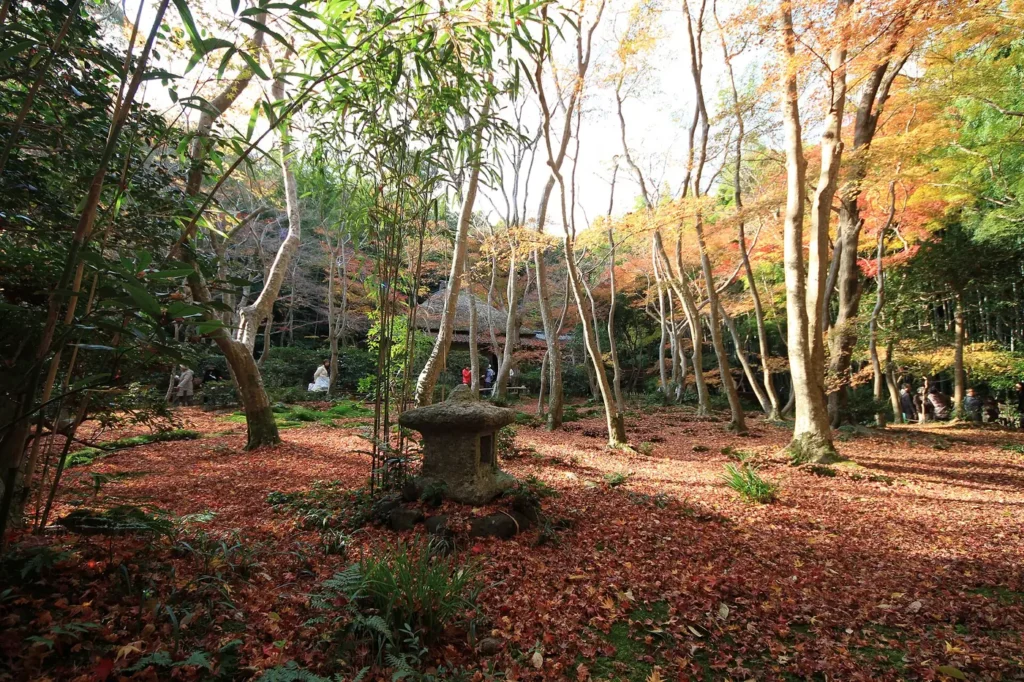
Giōji is a small thatched hermitage remembered from The Tale of the Heike: the dancer Giō, once favoured by Taira no Kiyomori, left the capital when he turned to another and became a nun here with her mother and sister. The hut stands in a moss garden among bamboo and maples. The temple describes its autumn as fallen leaves settling on the paths, the garden, the thatched roof and the bamboo grove until the place is wrapped in deep red. That stage is chiri-momiji, scattered maple leaves; what momiji means explains the word.
Colour, typically: mid to late November for the trees (Kyoto City’s autumn page); late November to mid-December for the leaf carpet on the moss (Weathernews).
2026: no autumn event was listed on the temple’s home page checked on 7 October.
Entry: ¥500 for adults; 9:00 to 16:30 last entry, and you may stay until 16:50. A ¥1,000 combined ticket covers Giōji and the halls of Daikakuji, about 25 minutes’ walk away, but not Daikakuji’s Osawa Pond area.
Getting there: JR Saga-Arashiyama or Randen Arashiyama station, about 25 minutes on foot; or city bus 28 to Saga Shakado-mae, then 15 minutes.
Before you go: there is no toilet for visitors in the grounds, and monopods and tripods are banned.
Why it can be calmer: the long walk from the station.
What can still make it busy: late-November weekends, especially the 21–23 November holiday weekend, which Kyoto in November flags as likely the busiest. The temple has parking for only three cars.
Adashino Nenbutsuji (あだし野念仏寺): maples over 8,000 stone figures
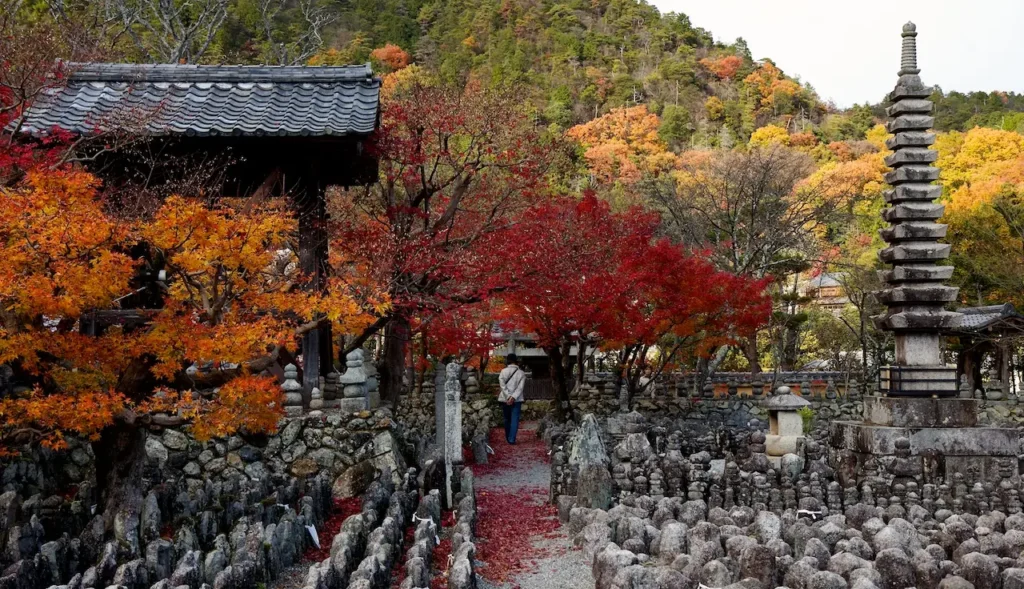
Adashino was a burial ground from the Heian period. In the middle of the temple, the Sai-no-kawara holds about 8,000 stone Buddhas and memorial stones that local people gathered from the surrounding hills in the Meiji period, arranged facing a central pagoda. In autumn the temple points to maples turning red all over the grounds and to fallen leaves settling on the heads of the stone figures. The history and the August candle ceremony are in our Adashino Nenbutsuji guide.
Colour, typically: mid to late November (Weathernews).
2026: no autumn event was listed on the temple’s home page checked on 7 October; its candle ceremony, Sentō Kuyō, is held on the last weekend of August.
Entry: ¥500 for adults, ¥400 for junior and senior high school students; 9:00 to 16:30 last entry.
Getting there: Kyoto Bus to Toriimoto, then about 5 minutes on foot (Kyoto City’s page). From JR Saga-Arashiyama or Randen Arashiyama, the temple suggests a taxi, walking or Kyoto Bus.
Before you go: from 1 December last entry moves forward to 15:30, and the temple closes on days when a storm warning is issued for Kyoto City or the paths are snowy or icy.
Why it can be calmer: I found no specific reason. The bus stop is close, so access is no barrier; it is here because it is on the same walk as Giōji.
What can still make it busy: the same late-November weekends. The city’s Saga-Toriimoto camera shows the street on the day.
Further out on the same line: Izumo Daijingu (出雲大神宮), Kameoka
Izumo Daijingu is the ichinomiya, the principal shrine, of the former Tamba Province, at the foot of its sacred mountain, Mikage-yama, in Kameoka. It is reached from JR Kameoka or Chiyokawa station on the Sagano Line, beyond Saga-Arashiyama. The shrine calls the maples of its forest one of the city’s notable spots, and in 2026 it lights them for three evenings.
Colour, typically: mid to late November (Weathernews).
2026: light-up on Saturday 21, Sunday 22 and Monday 23 November (a public holiday), 17:00 to 20:00, with offerings performed in the worship hall. Buses run to the holiday timetable, and there is no shuttle bus.
Entry: free.
Getting there: from JR Kameoka (north-exit bus stop) or JR Chiyokawa, a bus to Izumo Daijingu-mae; the shrine puts it at about 10 minutes by taxi from either station.
Before you go: from Kameoka the bus is the city’s community Furusato Bus, from the north-exit stop, and the shrine asks you to check you board the right one. If you go for the light-up, look up the last bus back before you leave the station.
Why it can be calmer: no shrine-specific reason found. Kameoka is outside Kyoto City and inside the Nishikyo area of the city’s dispersal project, which is a policy, not a crowd count.
What can still make it busy: the three light-up evenings, which fall on the holiday weekend.
The western hills: Yoshiminedera and Konzōji
These two hill temples are in Oharano, in Nishikyo ward, and neither has a bus to the gate. A taxi from JR Mukomachi or Hankyu Higashi-Muko is the practical way to do both in a morning; book the return before you set out. The city’s Comfort Map calls Nishikyo an area “where you can sightsee comfortably even in busy periods”, while noting that some spots still get crowded in the autumn colours. Kōmyōji, another Nishiyama temple, is in the section further down.
Yoshiminedera (善峯寺): a whole mountainside of maples
Yoshiminedera, temple number 20 of the Saigoku pilgrimage, climbs a steep slope in a series of halls, stairs and stroll paths. The temple says the colour covers not just its 30,000-tsubo grounds (about 10 hectares) but more than 300,000 tsubo of its land: the whole mountain. Its Yūryū-no-matsu, a pine about two metres tall that has spread more than 37 metres sideways, is a natural monument.
Colour, typically: mid-November to early December (the temple; tenki.jp gives the same).
2026: special early opening at 6:30 on Saturday 21, Sunday 22 and Monday 23 November, held again after a well-received 2025 early opening; the car park opens at around 6:00.
Entry: ¥500 for adults, ¥300 for high school students, ¥200 for elementary and junior high; ordinary entry needs no booking. From 8:00 at weekends and on holidays and 8:30 on weekdays, to 17:00 (last entry 16:45).
Getting there: Hankyu bus route 66 to the temple stopped after 31 May 2025. A taxi takes 15 to 20 minutes from JR Mukomachi, Hankyu Higashi-Muko or Hankyu Nagaoka-tenjin; the temple’s ¥2,500 estimate dates from 2018, so ask for a current fare. The temple lists three bus approaches, all ending with a walk of 3.4 to 4 km (43 to 50 minutes): Hankyu bus 63 to Haikata or city bus Nishi 9 to Oharano Shogakko-mae, each about every two hours, or city bus Nishi 4 or Yasaka Bus to Nishitakenosato-cho, about twice an hour.
Before you go: tripods and monopods are banned on Saturdays, Sundays and holidays from 10 to 30 November, and eating and drinking are banned in the grounds all year. The main hall is about 40 steps above the car park, and the garden beyond is mostly stairs and slopes.
Why it can be calmer: no bus to the gate, a long final walk from every bus route, and a 6:30 opening on 21–23 November.
What can still make it busy: cars and coaches. The temple has a 150-space car park and coach parking, and it bans tripods on November weekends because they cause frequent problems.
Konzōji (金蔵寺): a hillside temple with a long walk from the bus
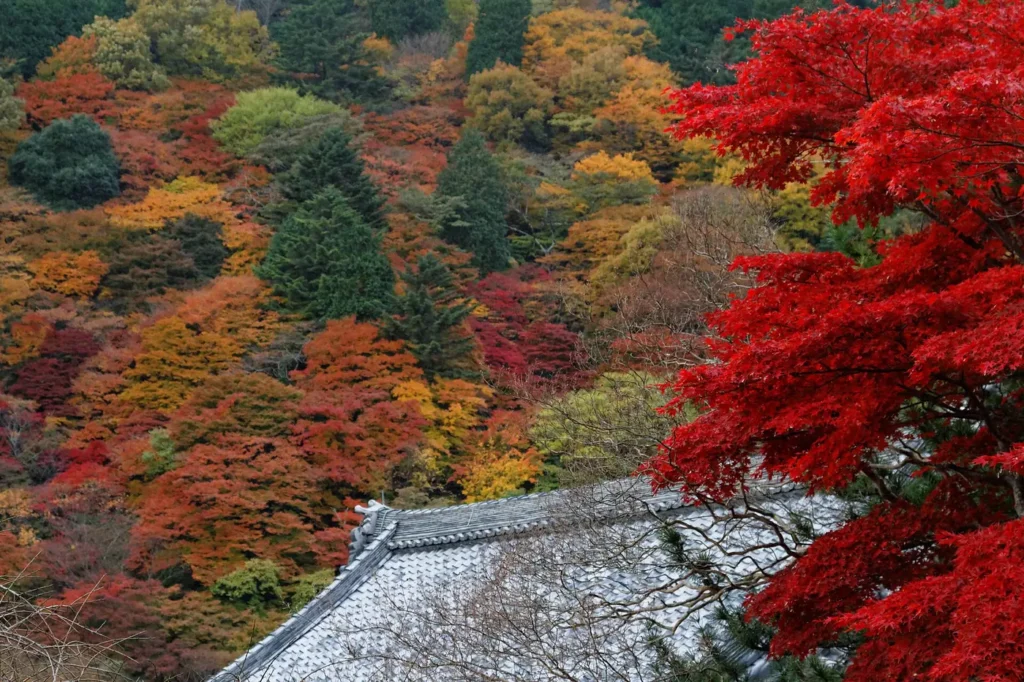
Konzōji, a Tendai temple said to have been founded in 718 at the wish of Empress Genshō, has its halls on a slope of stone walls and stairs in the same Oharano hills. Kyoto City Tourism Association’s Totteoki site describes a tunnel of maples on the stair approach from the gate to the main hall, with the area by the founder’s hall as the high point, and a lookout over the city to the Higashiyama hills and Mount Hiei.
Colour, typically: mid to late November (Totteoki page, November 2025).
2026: Kyoto City’s page gives no temple website. The Totteoki autumn feature is dated November 2025, and I found no 2026 event notice on the pages checked on 7 October.
Entry: the Totteoki page lists visiting hours of 8:00 to 17:00 and a ¥300 offering; bring coins, as there is no change. Telephone 075-331-0023.
Getting there: no scheduled bus runs to the temple. The tourism association lists a walk of about 40 minutes from Nagamine (Keihan Kyoto Kotsu routes 13, 14 and 17 from Hankyu Katsura) or about an hour from Minami-Kasugacho. Nagamine has only a handful of buses a day, so check the operator’s timetable. Otherwise take a taxi from JR Mukomachi, Hankyu Higashi-Muko or the Rakusai bus terminal.
Before you go: arrange your return taxi in advance.
Why it can be calmer: no bus to the gate and a long walk from the nearest stops.
What can still make it busy: taxis can drive up, and the tourism association promotes it as an autumn spot. I found no crowd information in the sources checked.
Data for the hills
Yamashina: Zuishin-in and Kajūji
Yamashina is one of the city’s six dispersal districts. Both temples are a few minutes from Ono station on the Tōzai subway line, so this is the easiest half-day here. Bishamondō and Daigoji, also in this part of the city, are in the section further down.
Zuishin-in (隨心院): maples and a big ginkgo where Ono no Komachi lived
Zuishin-in stands on what is said to be the site of the home of the Heian poet Ono no Komachi. Its halls are linked by corridors around courtyard gardens of moss, azalea and rhododendron. Weathernews lists maples and ginkgo for its autumn colour, and the temple’s 2026 autumn seal pairs Komachi with its large ginkgo.
Colour, typically: mid-November to early December (tenki.jp); Weathernews says late November to early December.
2026: the hidden main image, a seated Nyoirin Kannon, is on view from Sunday 1 to Monday 30 November, 9:00 to 16:30, for ¥500 (junior high ¥300). The temple is closed to visitors all day on Monday 2 November.
Entry: ¥500 for adults, ¥300 for junior high, free for younger children (Kyoto City’s page); 9:00 to 16:30.
Getting there: Ono station on the Tōzai line, about 5 minutes on foot.
Before you go: the 2 November closure falls on the second day of the special display.
Why it can be calmer: no temple-specific reason found. Yamashina is one of the areas the city promotes to spread visitors out, which is a policy, not a crowd count.
What can still make it busy: it is five minutes from a subway station, and the hidden Buddha is on view throughout November.
Kajūji (勧修寺): a pond garden that turns late
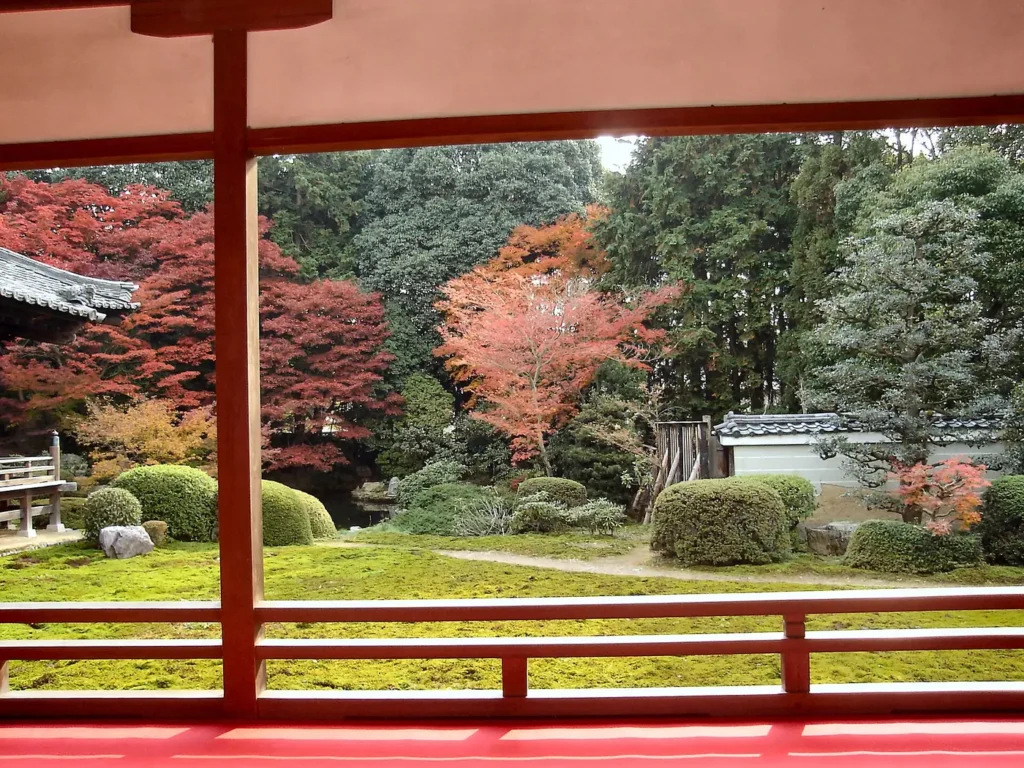
Kajūji is a head temple of the Shingon Yamashina school, a monzeki temple with close ties to the imperial family and the Fujiwara. Only the garden is open, a stroll garden around the Himuro pond. tenki.jp singles out the grove of maples in front of the main hall, red and yellow against the green of the moss.
Colour, typically: late November to early December (the temple); tenki.jp gives mid-November to early December.
2026: the Shinden hall is under renovation from 27 July 2026 to 19 March 2027. The temple’s own colour page, updated on 6 October, still showed the maples green, and it is updated through the season.
Entry: garden only, ¥500 for adults, ¥300 for children, cash only; 9:00 to 16:00.
Getting there: Ono station on the Tōzai line, 6 minutes on foot.
Before you go: cash only.
Why it can be calmer: no temple-specific reason found. Yamashina is one of the areas the city promotes to spread visitors out, which is a policy, not a crowd count.
What can still make it busy: six minutes from the subway, and a free car park for about 15 cars and 4 coaches.
The eastern hills: Hōnen-in and Himukai Daijingu
These two sit in the hills above the Higashiyama sights rather than away from them: one offers an early start, the other a climb. For the famous Higashiyama lanes at the edges of the day, see our Higashiyama route at golden hour.
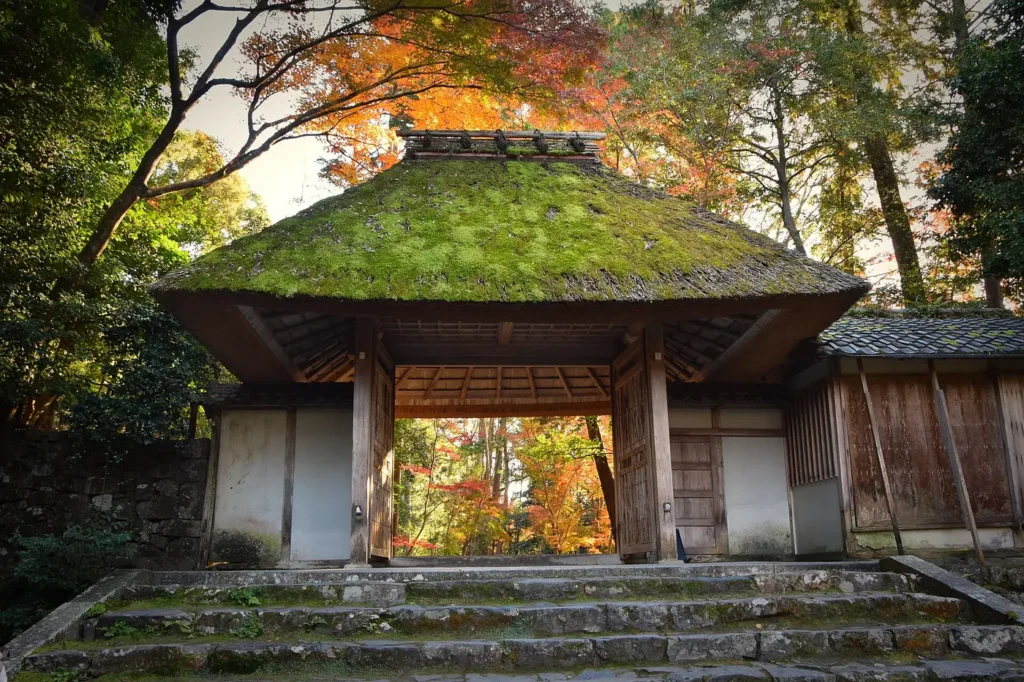
Hōnen-in (法然院): through the gate at opening time
Hōnen-in marks the place where Hōnen and his disciples performed their devotions. Its approach passes through a gate to raised beds of white sand drawn with water patterns, and on to the main hall. Kyoto City lists it in its autumn-colour reports with a typical window of mid to late November. The garden and the painted sliding doors of the abbot’s quarters are shown only for a week in April and a week in November. Our guide to Kyoto early and late explains why the first hour is worth the alarm.
Colour, typically: mid to late November (Kyoto City).
2026: autumn opening of the halls from Wednesday 18 to Tuesday 24 November, 9:30 to 16:00: ¥800, ¥400 for university students, free for high school students and younger. Inside are sliding-door paintings by Kanō Mitsunobu (an Important Cultural Property) and by Dōmoto Inshō.
Entry: grounds 6:00 to 16:00, free; you can go as far as the front of the main hall.
Getting there: city bus 32 to Minamida-cho, then 5 minutes uphill; or city bus 5 to Jōdoji, then 10 minutes.
Before you go: outside 18–24 November you see the approach and the sand beds but not the garden behind the halls.
Why it can be calmer: the approach opens at 6:00, three hours before most temples here.
What can still make it busy: Kyoto City’s autumn-colour reports list it in the same Philosopher’s Path and Okazaki area as Eikan-dō, Nanzen-ji and Ginkaku-ji, and the 2026 hall opening spans the 21–23 November holiday weekend.
Himukai Daijingu (日向大神宮): “the Ise of Kyoto”, up a forest path
Himukai Daijingu has an inner and an outer shrine built in the shinmei style, and was known as “the Ise of Kyoto”; travellers on the Tōkaidō road once prayed here for a safe journey. The shrine’s sights page says its autumn colour is popular as a hidden spot. The shrine office stands at about 140 metres, and the Ama-no-Iwato rock and the place for worshipping Ise from afar are higher still.
Colour, typically: I could not verify a typical window in the sources checked; the shrine is not among the spots on the tenki.jp and Weathernews Kyoto lists.
2026: no autumn event was listed on the shrine’s home page checked on 7 October.
Entry: free; the shrine office is open 10:00 to 16:00.
Getting there: Keage station on the Tōzai line, exit 1, turn left; 15 to 20 minutes on foot up slopes and steps.
Before you go: the toilets in the grounds are out of use, because the water comes from the mountain and the supply is unreliable.
Why it can be calmer: the 15- to 20-minute uphill walk from Keage. I found no crowd data.
What can still make it busy: the shrine says its few parking spaces can fill in the autumn-leaf season.
A base for these half-days
Kyoto Station works for all four areas: the JR Sagano Line to Saga-Arashiyama and on to Kameoka, the JR Kyoto Line to Mukomachi for the western hills, JR to Yamashina and the Tōzai line to Ono or Keage, and city bus 5 for Hōnen-in. Compare prices for your exact November nights.
紅葉期は大変混雑しますので公共交通機関をご利用下さい。
“It is very crowded in the autumn-leaf season, so please use public transport.” That line runs along the foot of Kōmyōji’s website.
Popular stops and reservation-only alternatives
These seven places from my list need different planning. Some warn of autumn crowds or ask visitors not to drive; others use reservations to manage the visit. A reservation requirement on its own does not mean the grounds will be crowded.
- Enkōji (圓光寺), Ichijōji. Timed-entry booking for its special autumn viewing from Tuesday 10 November to Thursday 10 December 2026, 9:00 to 17:00, ¥1,500 for adults. Bookings open on the temple’s site on Tuesday 20 October at 9:00. The temple says the booking system is there to avoid congestion and asks visitors to keep to about an hour. Outside those dates no booking is needed.
- Rurikōin (瑠璃光院), Yase. Autumn opening 1 October to 13 December 2026, ¥2,000; reservation-only from Friday 13 November to Sunday 6 December. Kyoto City’s page says many people visit during its spring and autumn openings. Hours and the booking arrangements are in the FAQ below.
- Saihōji (西芳寺), the Moss Temple. A reservation-only alternative all year, run to keep the grounds quiet. Apply online from two months ahead until 23:59 the day before (up to two people per application, an offering of at least ¥4,000 per person by card, plus a ¥110 system fee per person), or by return postcard postmarked two months to one month ahead. Visitors must be 13 or older, and the visit begins with sutra copying in the main hall.
- Daigoji (醍醐寺), Fushimi. The temple asks visitors to come by public transport, especially at weekends, because parking is scarce and the roads are narrow. The normal-period ticket for all three areas is ¥1,500 for adults. Kami-Daigo, the upper temple, is closed to climbers for now because of landslide risk on the trail. I found no 2026 night-viewing notice in the temple’s news checked on 7 October; in 2025 it ran from 22 November to 7 December.
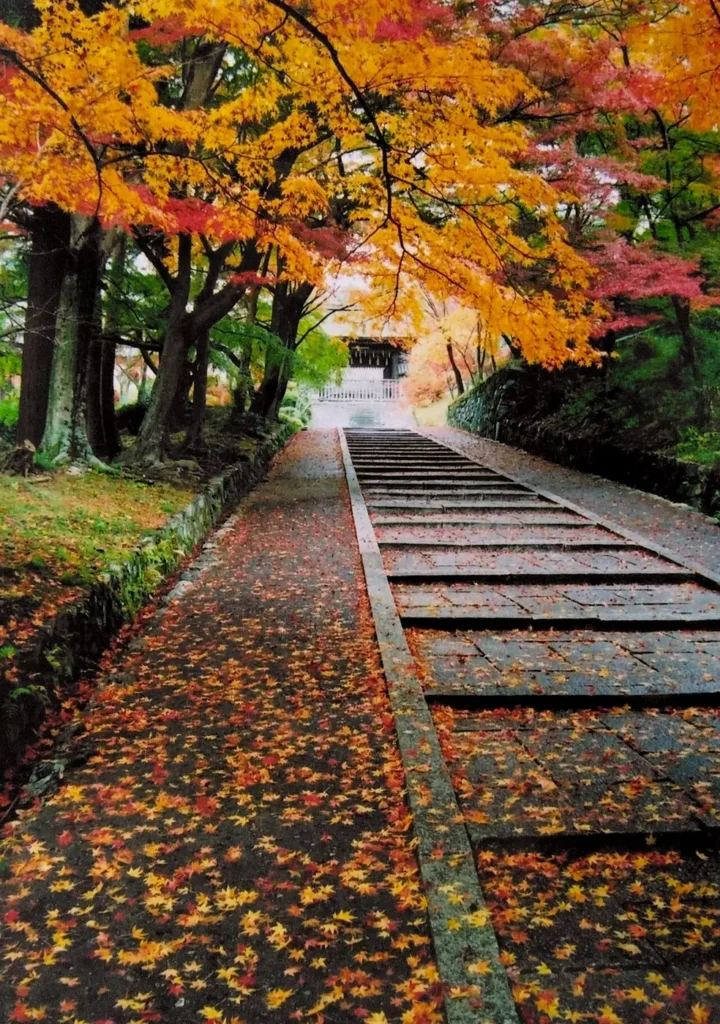
- Kōmyōji (光明寺), Nagaokakyo. In its own words, very crowded in the colour season, with no parking at the temple and parking banned throughout the neighbourhood. Special autumn admission runs from Saturday 14 November to Sunday 6 December 2026, entry 9:00 to 16:00, ¥1,000 for adults, along a 200-metre approach lined with about 250 maples.
- Bishamondō (毘沙門堂), Yamashina. The temple calls autumn its busiest season of the year. Its access page, checked on 7 October, asks visitors not to come by private car from Friday 20 November to Sunday 6 December 2026. A notice dated 28 August 2026 says the Chokushi-zaka slope is closed to walkers after fallen-tree damage, with reopening undecided; check its news page if the fallen-leaf slope up to the Chokushi-mon gate is what you are going for. Autumn entry is ¥1,000 (¥300 for the front garden, ¥700 for the halls).
- Kifune Shrine, including the Okumiya (貴船神社 奥宮), Kibune. Typical colour for the Kibune area is early to late November (tenki.jp, Weathernews). The Hongū, the main shrine, opens at 6:00 until 30 November; I have not verified separate opening hours for the Okumiya, so check before planning an early visit there. The shrine’s 2026 traffic restrictions are for days in August, not November. From the Kibune bus stop it is five minutes on foot to the Hongū, and the Okumiya, which has its own car park, is further up the same valley road. Our Kifune and Kurama guide has the bus times.
For Eikan-dō, Tōfuku-ji and Kiyomizu-dera, including the major autumn events and booking advice, see Kyoto in November. Arashiyama itself is one of Japan’s three great autumn foliage spots.
The colour moves week by week. Our koyo tracker follows the 2026 forecasts for Kyoto and the rest of Japan.
Open the koyo trackerOur full map of 54 lesser-known Kyoto temples and shrines, on Google Maps, includes the places above and many that are better in other seasons. For the rest of the month around the country, see Japan in November 2026.
Lesser-known Kyoto autumn temples: short answers
Which lesser-known Kyoto temples and shrines are worth seeing for autumn leaves in 2026?
From my list: Giōji and Adashino Nenbutsuji in Saga-Toriimoto, Izumo Daijingu in Kameoka, Yoshiminedera and Konzōji in the western hills, Zuishin-in and Kajūji in Yamashina, and Hōnen-in and Himukai Daijingu in the eastern hills.
Will these temples and shrines be quiet in November?
Not guaranteed. Five have a practical access or timing difference; three more, Izumo Daijingu, Zuishin-in and Kajūji, were included for their location in city dispersal areas, a policy rather than evidence of fewer visitors; and Adashino is a companion stop to Giōji; none was chosen on measured crowd levels. Kyoto in November flags the 21–23 November holiday weekend as likely the busiest. An early opening gives you another time to try, though it does not guarantee fewer visitors: Hōnen-in’s approach opens at 6:00, and Yoshiminedera opens at 6:30 on 21–23 November.
Do I need to book any of these temples for autumn 2026?
None of the nine lists a booking requirement for ordinary entry on the pages checked, but check each entry for special openings. Among the better-known places on the same list, Enkōji takes timed bookings for 10 November to 10 December, opening on 20 October at 9:00; Rurikōin’s reservation-only dates are 13 November to 6 December; and Saihōji is booking-only all year.
Can I still visit Rurikōin in autumn 2026 without a reservation?
Yes, outside 13 November to 6 December. Its autumn opening runs from 1 October to 13 December 2026, ¥2,000, and outside the reserved dates the published hours are 10:00 to 17:00 (last entry 16:30), without a reservation. For 13 November to 6 December, places went by a return-postcard lottery that closed on 20 August, and same-day booking is not available; ticket holders go at the time on their confirmation.
How do I get to Yoshiminedera now that its direct bus has stopped?
Hankyu bus route 66 to the temple stopped after 31 May 2025. A taxi from JR Mukomachi, Hankyu Higashi-Muko or Hankyu Nagaoka-tenjin takes 15 to 20 minutes; ask for a current fare when you book. The bus alternatives all end with a walk of 3.4 to 4 km, about 43 to 50 minutes.
Are there evening light-ups at any of these places in 2026?
Izumo Daijingu lights its maples on 21, 22 and 23 November 2026, 17:00 to 20:00. I found no 2026 night-viewing notice on Daigoji’s news page, or 2026 autumn illumination dates on the Kifune Shrine and Eizan Railway pages I checked on 7 October.
Sources
The official pages and forecaster pages behind this article, checked 7 October 2026
- Kyoto City Tourism Association: Kyoto Tourism Comfort Map (updated 15 September 2026), autumn-colour reports, Totteoki no Kyoto and its Konzōji page (November 2025), and the Kyoto Navi pages for Adashino Nenbutsuji, Konzōji, Zuishin-in and Rurikōin (Japanese)
- Japan Weather Association, tenki.jp: Kyoto autumn-colour spots, including Yoshiminedera, Zuishin-in, Kajūji and Kibune
- Weathernews: Kyoto autumn-colour spots, including Giōji, Adashino Nenbutsuji, Izumo Daijingu, Zuishin-in and Kifune Shrine
- Giōji: home page, admission and access, seasons; Adashino Nenbutsuji: official site, seasons; Izumo Daijingu: 2026 light-up, access (Japanese)
- Yoshiminedera: access, including the bus withdrawal, admission and rules, autumn, 2026 early opening; Keihan Kyoto Kotsu: Nagamine timetable (Japanese)
- Zuishin-in: 2026 autumn special opening; Kajūji: admission, access and parking, seasons, colour status, Shinden renovation (Japanese)
- Hōnen-in: visiting and access, October–November 2026 notices; Himukai Daijingu: official site, sights (Japanese)
- Enkōji: 2026 special autumn viewing; Rurikōin: 2026 autumn opening and reservation lottery notice (PDF); Saihōji: official site and online application (Japanese)
- Daigoji: hours and fees, news; Kōmyōji: 2026 autumn admission; Bishamondō: visiting and the autumn car request, Chokushi-zaka notice, 2026 fees, seasons (Japanese)
- Kifune Shrine: visiting, access, 2026 summer traffic restrictions; Eizan Railway (Japanese)
- Images: the Wikimedia Commons files credited in each caption
Join travelers discovering Japan's hidden side
Weekly dispatches from off-the-beaten-path Japan — spots and stories you won't find in guidebooks.
No spam. Unsubscribe anytime.
Welcome aboard!
You're in. See you in your inbox soon.