
Yamanashi · Food · How Koshu korogaki are made, and where to see the persimmon curtains
Koshu korogaki are a Yamanashi style of hoshigaki (dried persimmons), made especially in the Matsusato area of Koshu City and in Minami-Alps City. In Koshu they are made mainly from a large astringent persimmon called Koshu Hyakume, hung for about two to three weeks, then massaged and turned for another seven to ten days until a white bloom of sugar appears. In 2026, the persimmons at Kanzo-yashiki, a one-minute walk from JR Enzan Station, are hung on Saturday 7 November, and the completed hanging-persimmon scene can be viewed only from that day’s afternoon session (13:30–16:00) onward.
This guide uses the producing area’s own public sources (the city, the prefecture and the local farm co-operative) to explain how korogaki are made there, and where a visitor can see the hanging persimmons in November.
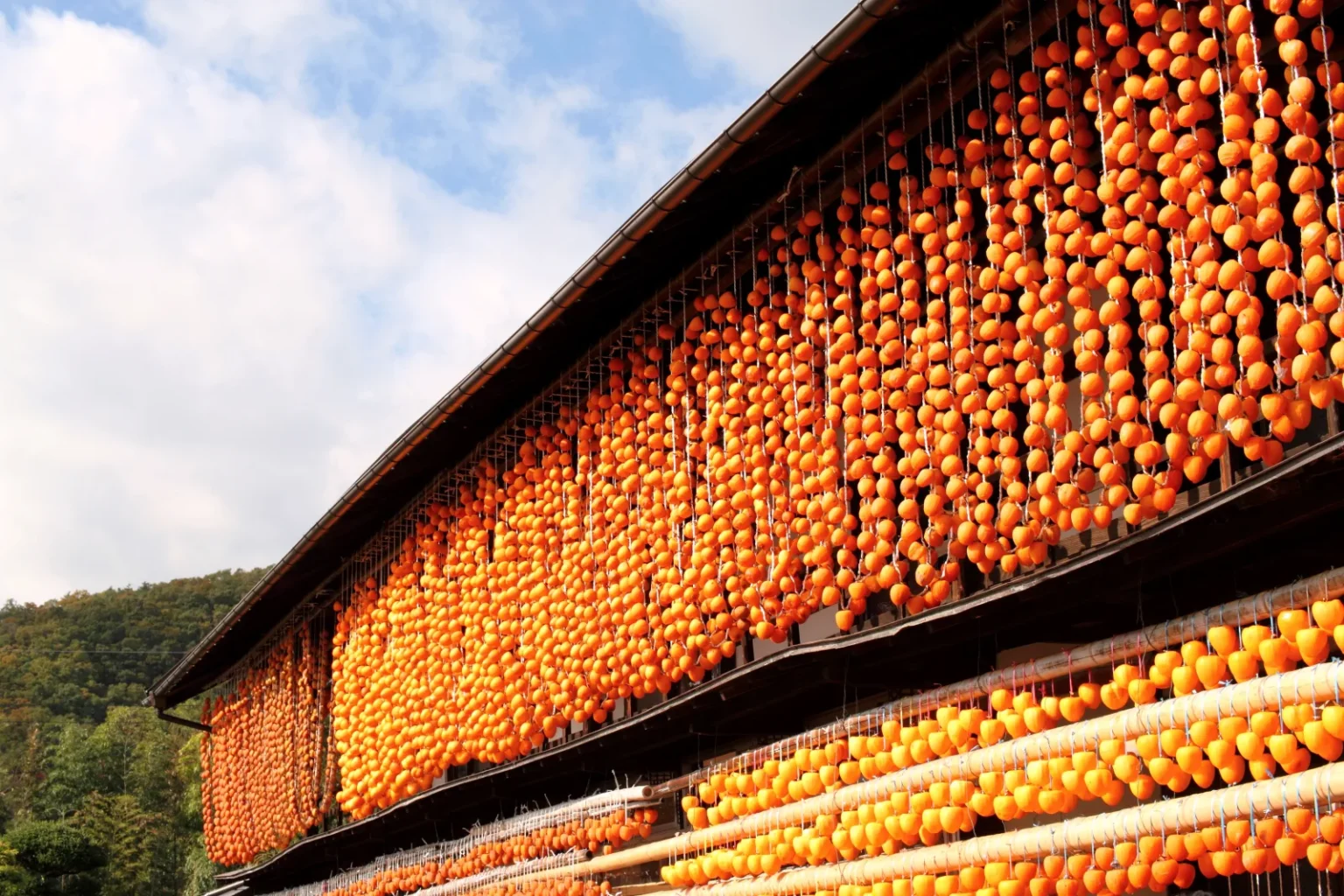
What are Koshu korogaki?
Korogaki (枯露柿, also written ころ柿) are a drier style of hoshigaki, Japan’s dried persimmons. Yamanashi Prefecture describes them as dried to a moisture content of 25 to 30 percent, with a white powder on the surface; soft dried persimmons with around 50 percent moisture are called anpo-gaki. They are sometimes sold as “Koshu korogaki” (甲州枯露柿). The prefecture lists Minami-Alps City and the Matsusato area of Enzan, in Koshu City, as the main places they are made.
The Ministry of Agriculture’s guide to traditional foods says the name is said to come from rolling (koro-koro) the peeled fruit as it dries, so that the sun reaches every side, and that Takeda Shingen is said to have encouraged their production. In the Edo period, it says, korogaki were counted among Koshu’s famous products and presented to the shogunate. They are popular as year-end and New Year gifts, often in wooden boxes.
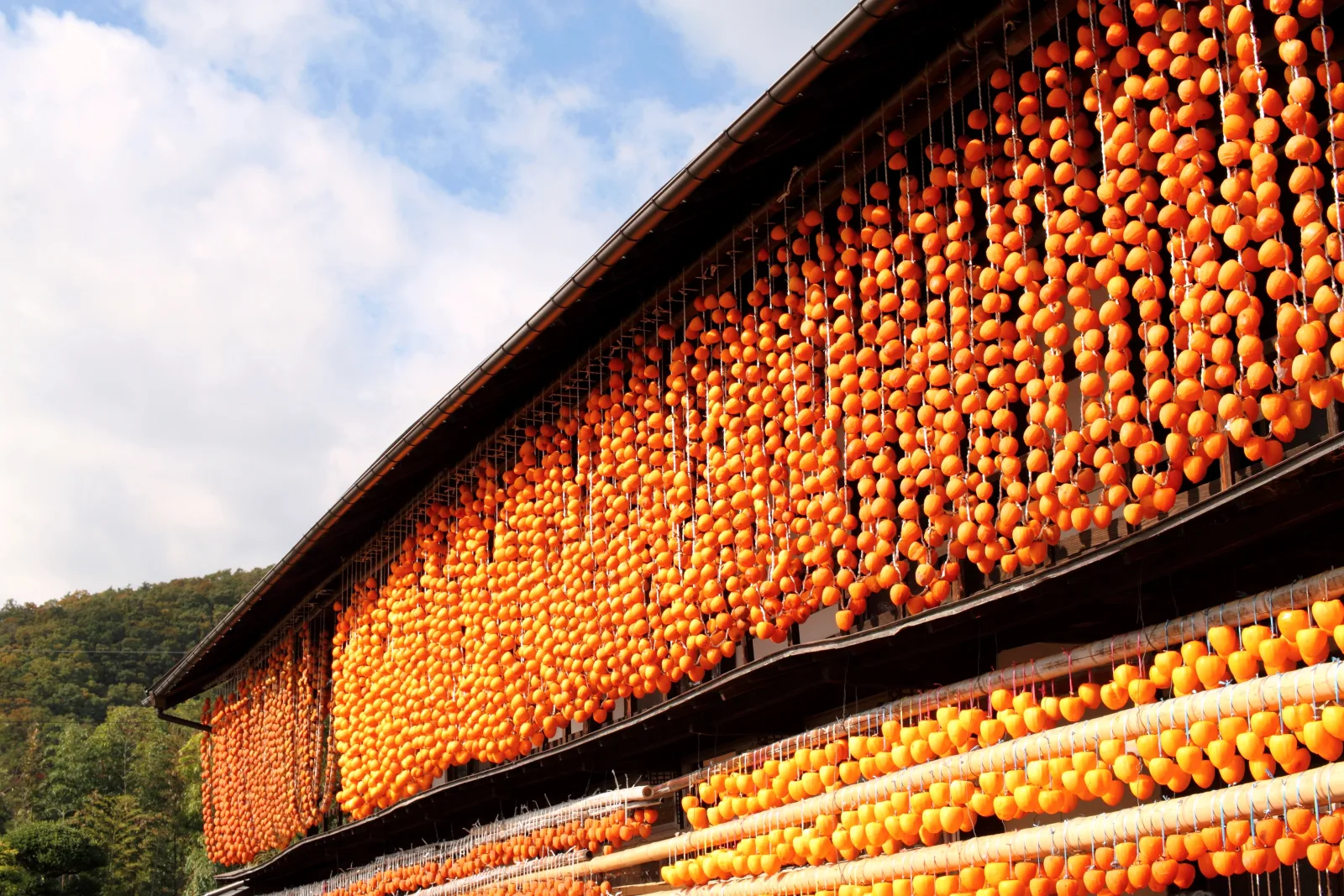
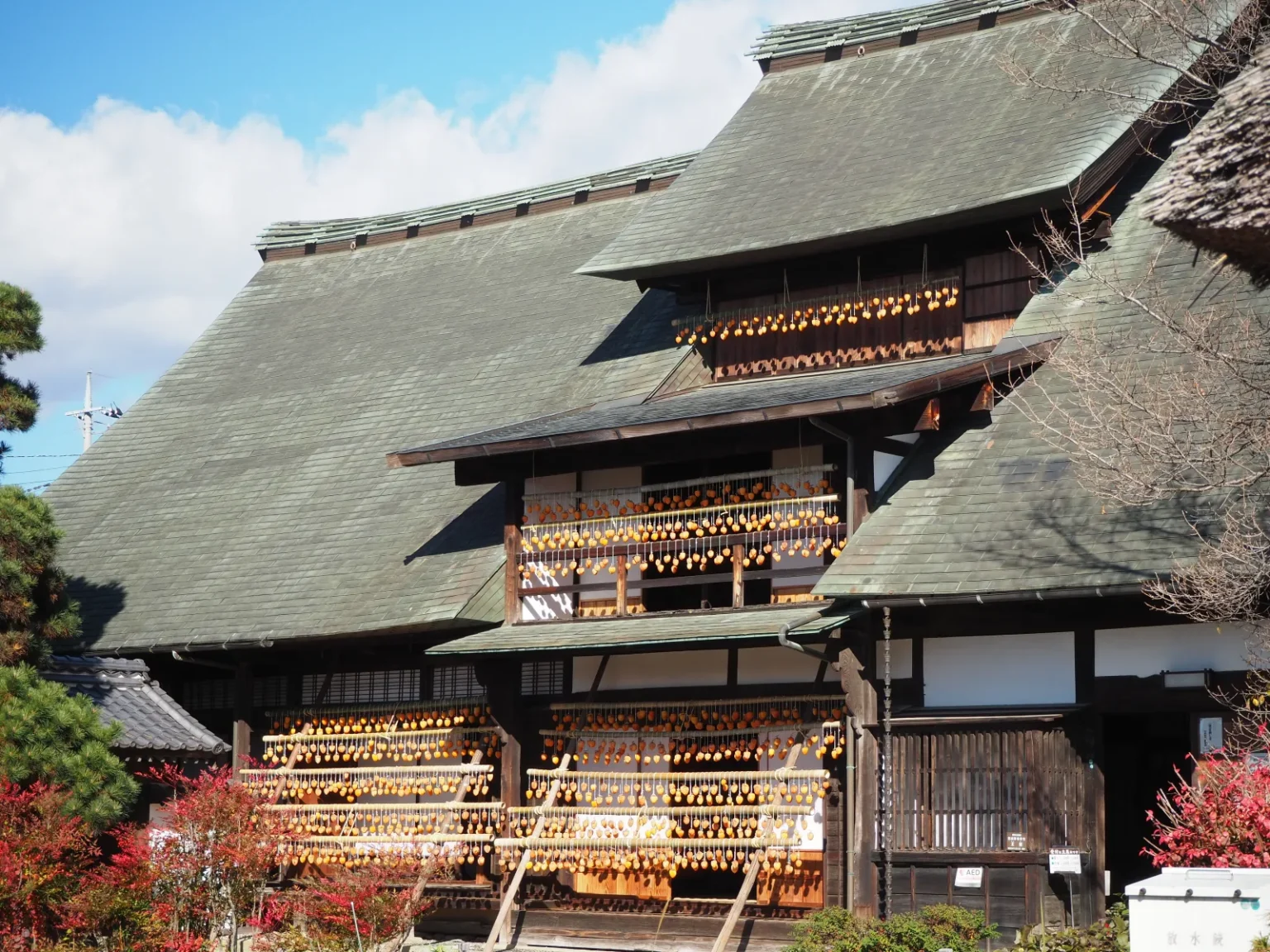
In Matsusato, the ministry adds, persimmons are hung under the eaves and in the gardens of homes every year from November to early December, a late-autumn and early-winter scene in Koshu City.
How are korogaki made in Koshu?
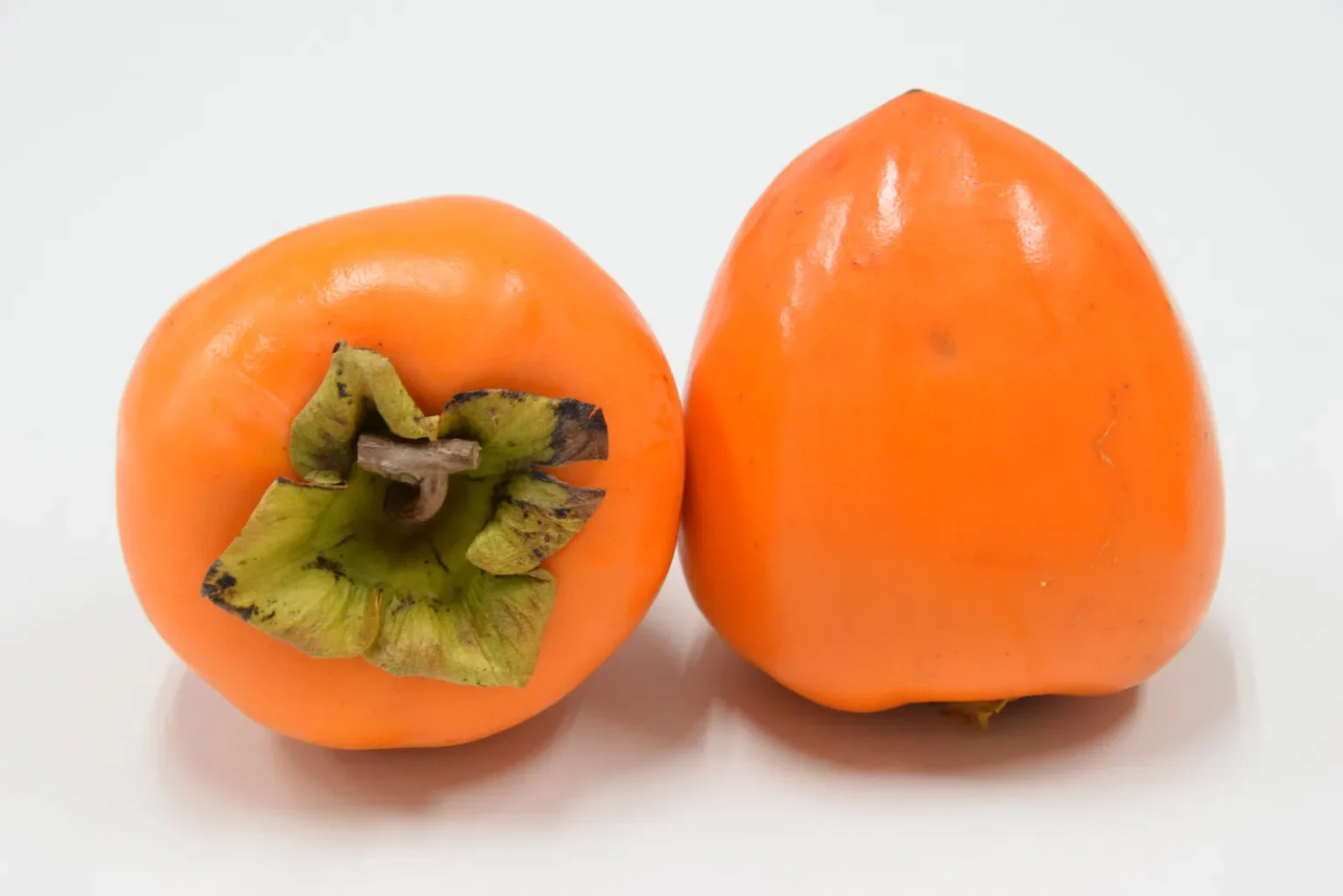
The producing area’s own descriptions follow the same steps. The persimmon is mainly Koshu Hyakume (甲州百目); its older name was 甲州百匁柿, after hyakumonme (百匁), an old unit of about 375 grams. The Ministry of Agriculture says each fruit is over 400 grams; the prefecture’s tourism site gives 350 to 400 grams.
| Step | What happens (Koshu sources) |
|---|---|
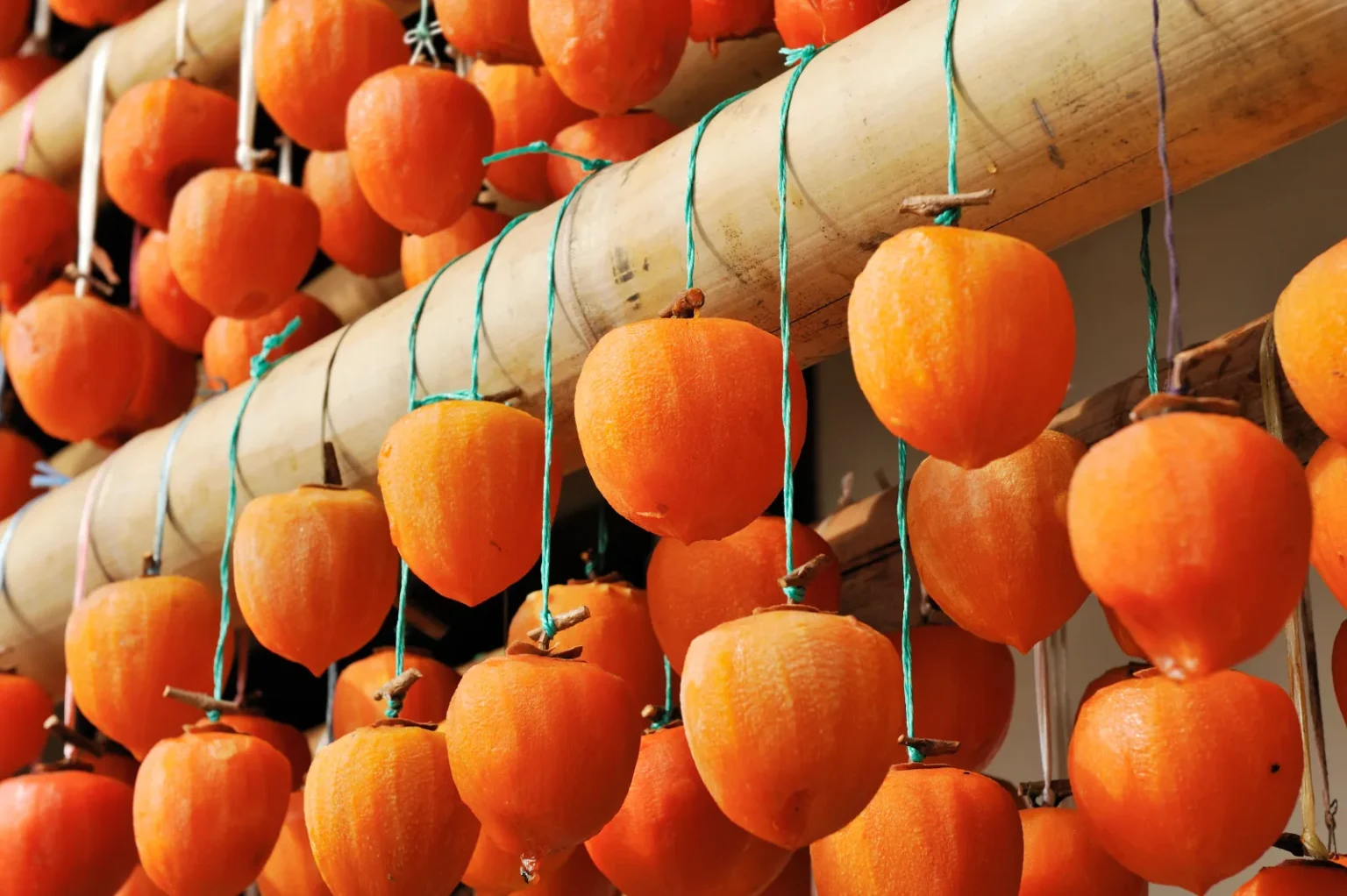
| 1. Harvest | Early November, when the fruit has turned red. The stem is cut so a small T-shaped twig stays on, for tying. |
| 2. Peel | The calyx and the uneven top are removed and the skin is peeled. |
| 3. Fumigate | The peeled fruit is fumigated to prevent mould and kill germs. The prefecture’s tourism site describes about 30 minutes under plastic with a food-grade fumigant; JA Fruits Yamanashi calls it sulphur fumigation for hygiene. |
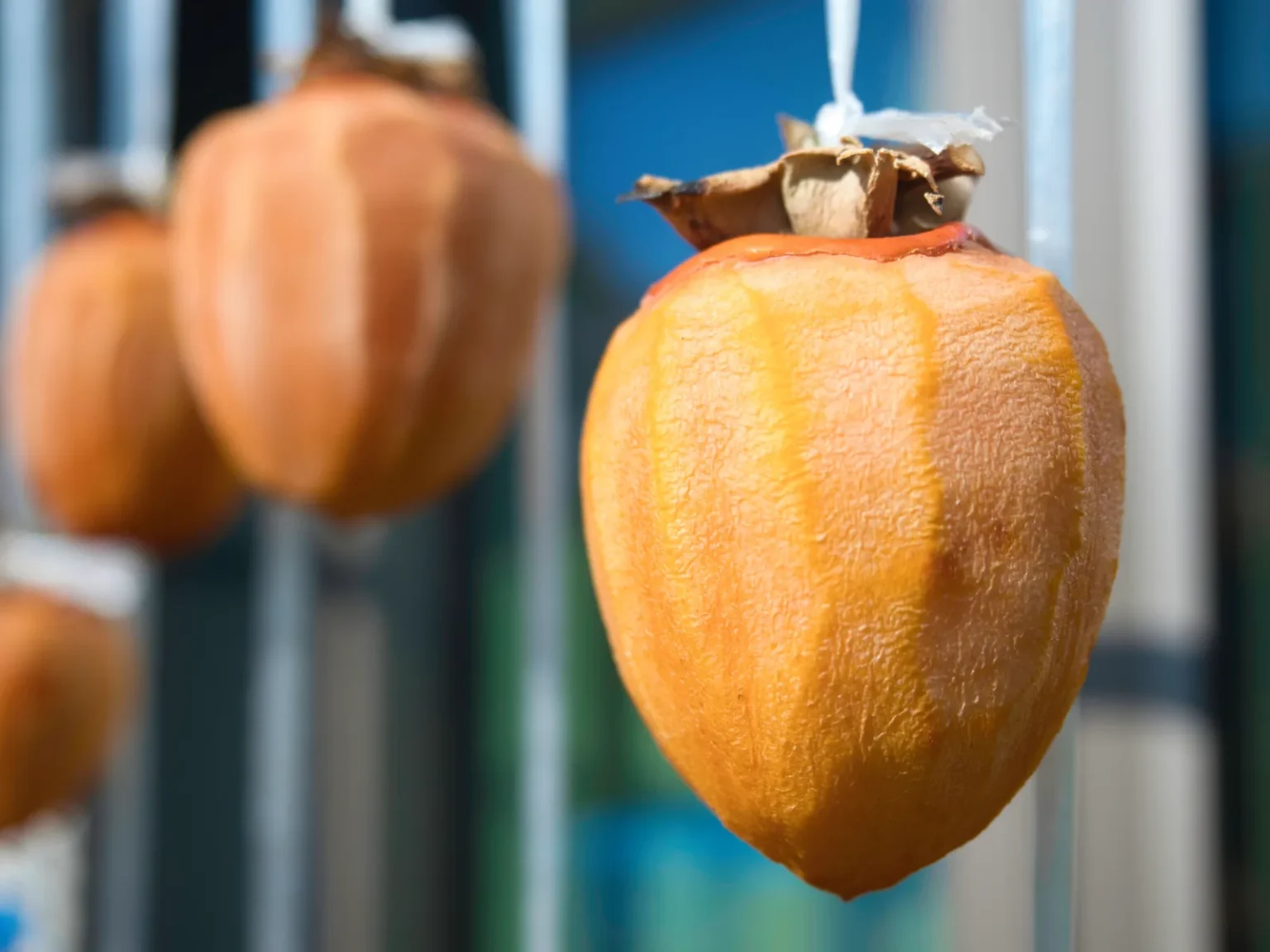
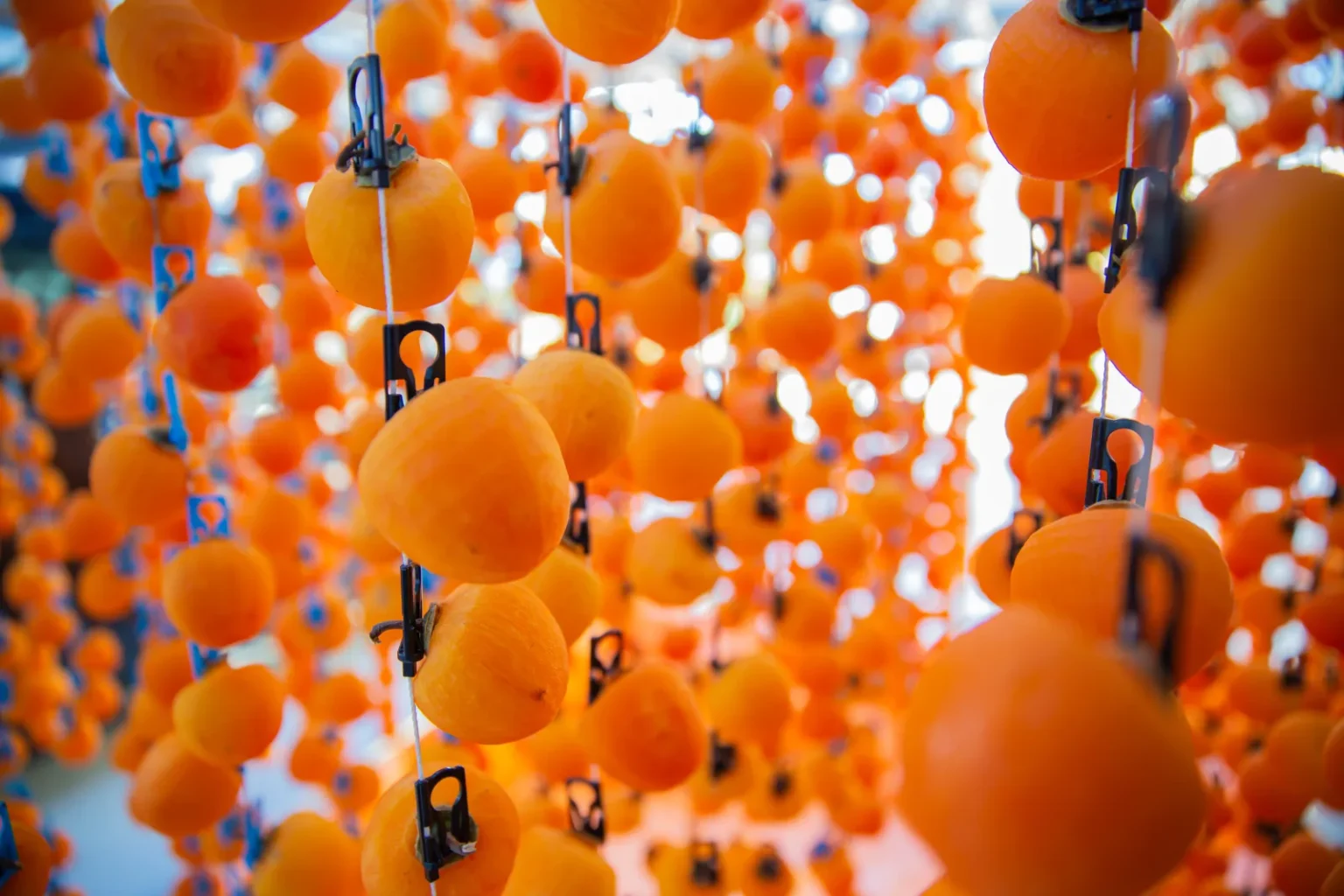
| 4. Hang | Pairs are tied to string by the T-shaped twig and hung from poles under the eaves, out of the rain, for about 14 to 20 days. |
| 5. First massage | When the outside is dry but the inside still soft, each fruit is gently massaged two or three times. |
| 6. Shelf-dry | The fruit comes down and dries flat on bamboo screens for 7 to 10 days, massaged and rolled every day to shape it. |
| 7. Finish | When it is dry and the white powder has come out, it is bagged and boxed. The whole process takes more than a month. |
Why are Koshu korogaki massaged?
In Koshu, the reason given is specific. Both the Ministry of Agriculture’s guide and the prefecture’s tourism site describe the first massage as cutting the fibres that connect the flesh to the seeds, done once the outside has dried and the inside is still soft. After that, the daily massaging and rolling on the drying shelves shapes the fruit.
One English-language guide, Eater, gives a different schedule: it says the fruit is massaged every day for four to six weeks. Koshu’s sources describe two to three weeks of hanging first, then seven to ten days of daily massaging on the shelf.
What is the white powder on hoshigaki?
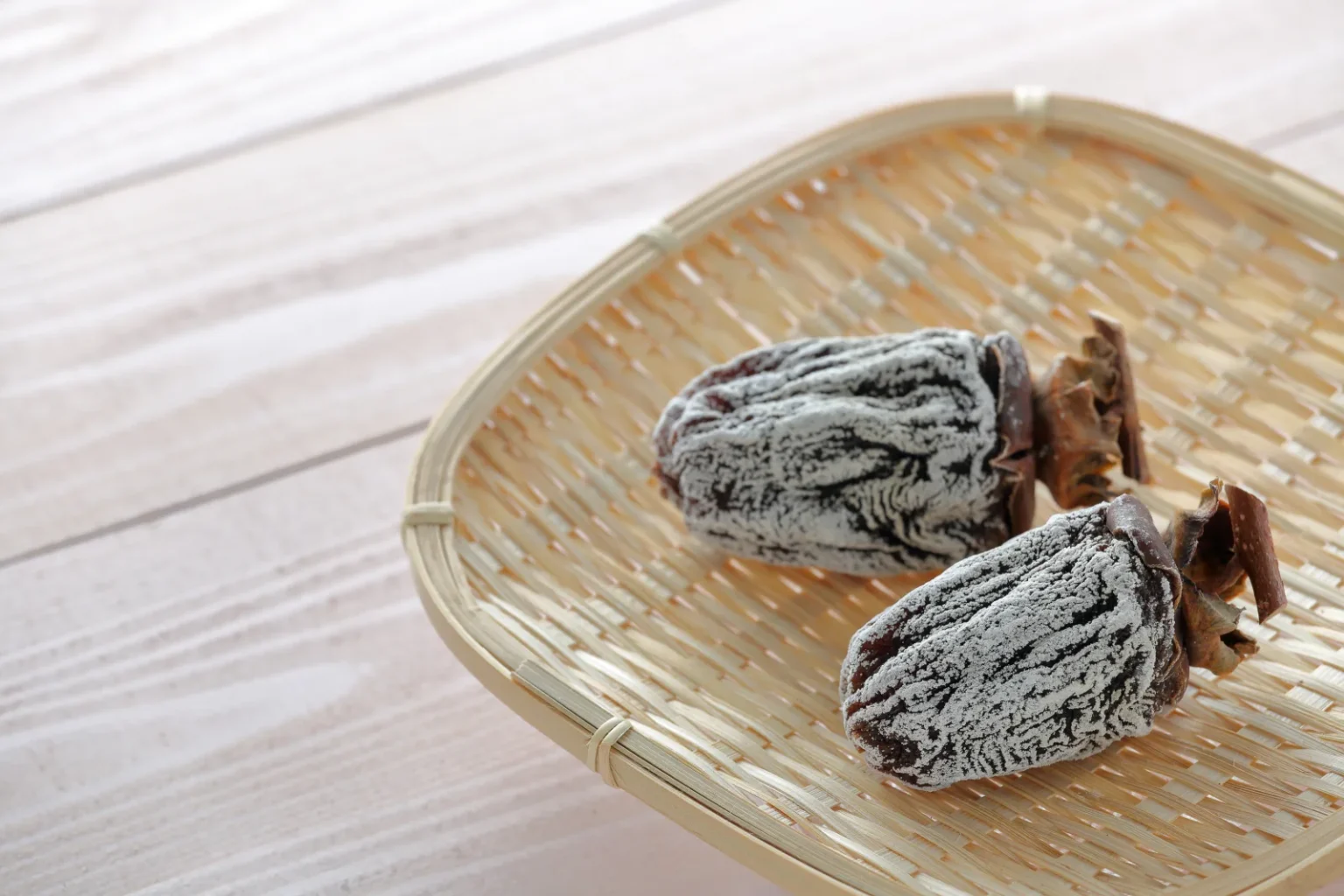
JA Fruits Yamanashi, the farm co-operative for the Koshu area, says the white powder on korogaki is sugar from inside the fruit that has seeped out and crystallised. Its storage advice: keep korogaki away from heat and humidity, direct sunlight and direct lighting, which can melt the powder and lead to mould; avoid putting weight on them, which can draw moisture to the surface; and refrigerate any you are not eating straight away. It also notes that the occasional black spot is hardened tannin and does not affect quality, and that some korogaki still contain seeds.
How are korogaki different from anpo-gaki and Ichida-gaki?
Japan protects some regional foods with a Geographical Indication (GI). On the Ministry of Agriculture’s register, checked on 24 October 2026, Yamanashi’s only GI product is a soybean, Akebono daizu. Koshu korogaki are not on it, but six other dried-persimmon products are.
| Dried persimmon | Where | GI |
|---|---|---|
| Koshu korogaki | Yamanashi (Koshu City and others) | Not registered |
| Ichida-gaki (市田柿) | Southern Nagano | No. 13, registered 12 July 2016 |
| Noto-Shika korogaki (能登志賀ころ柿) | Ishikawa | No. 20, 12 October 2016 |
| Dojo Hachiya-gaki (堂上蜂屋柿) | Gifu | No. 50, 15 December 2017 |
| Higashi-Izumo Maruhata hoshigaki (東出雲のまる畑ほし柿) | Shimane | No. 87, 10 December 2019 |
| Toyama hoshigaki (富山干柿) | Toyama | No. 98, 19 August 2020 |
| Date anpo-gaki (伊達のあんぽ柿) | Fukushima | No. 123, 31 January 2023 |
The register also lists other persimmon products, such as Koge Hanagosho-gaki (Tottori) and Kasshi-gaki (Iwate), which this guide does not cover. “Korogaki” alone does not mean Koshu: the GI-protected korogaki is Noto-Shika’s, in Ishikawa. And anpo-gaki are a softer style, with about twice the moisture of korogaki according to Yamanashi Prefecture.
Where can you see the persimmon curtains in Koshu?
One public place to see them is Kanzo-yashiki (甘草屋敷), the former Takano family house. It is a nationally designated Important Cultural Property, a one-minute walk from the north exit of JR Enzan Station. The Ministry of Agriculture’s guide says korogaki are dried at Kanzo-yashiki every year and that anyone can see them there.
| Kanzo-yashiki | Details (Koshu City and its tourism association) |
|---|---|
| 2026 hanging day | Saturday 7 November, in a free korogaki-making session open to the public with advance registration: 9:30–12:00 and 13:30–16:00, 25 people each. The completed hanging-persimmon scene can be viewed only from the afternoon session onward. |
| Joining the session | Applications by phone or email from 16 October to 4 November, closing early once each session is full; places are first come, first served (the notice is in Japanese); no finished persimmons to take home. Participants get free admission to Kanzo-yashiki on that day. |
| Opening hours | 9:00–16:30 |
| Closed | Tuesdays, except when Tuesday is a public holiday, in which case it closes the following day |
| Admission | Regular admission: adults ¥310, children and students ¥200 |
| Evenings | In 2025 the house was lit up to 24 November, 17:00–21:00, and that notice said the grounds could not be entered after closing. The 2026 notice for the 7 November session does not mention a light-up; check the latest notice before an evening visit. |
The prefecture’s tourism site, reporting on a 2021 visit, mentions seeing the hanging persimmons from inside the house around midday, when the sun comes from the south.
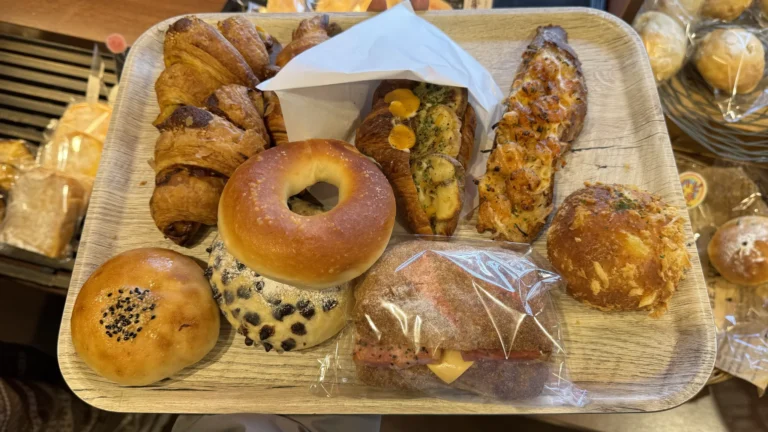
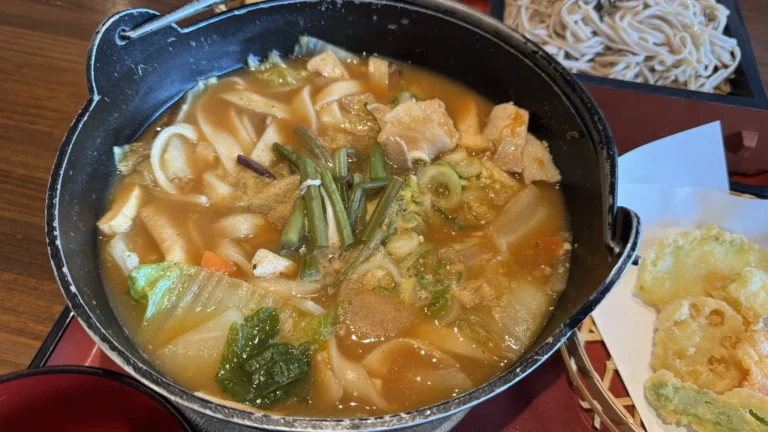
For more Yamanashi food stops, see Mont Marlo, a bakery in Enzan, Koshu City, 3 minutes by car from JR Enzan Station, and Kanjukuya Hyakken, a hoto restaurant in Fuefuki.
Where to stay for a Koshu visit
Kanzo-yashiki is a one-minute walk from JR Enzan Station on the Chuo Line. Isawa Onsen and Kofu, the prefectural capital, also have stations on the Chuo Line.
Search stays in Isawa Onsen, a hot-spring town, or in Kofu.
Search Isawa Onsen stays Search Kofu staysRakuten Travel is another place to search for inns in Japan.
If you are driving over from the Fuji Five Lakes side, the two-day Fuji Five Lakes itinerary covers that area.
Katsunuma’s grape and wine museum
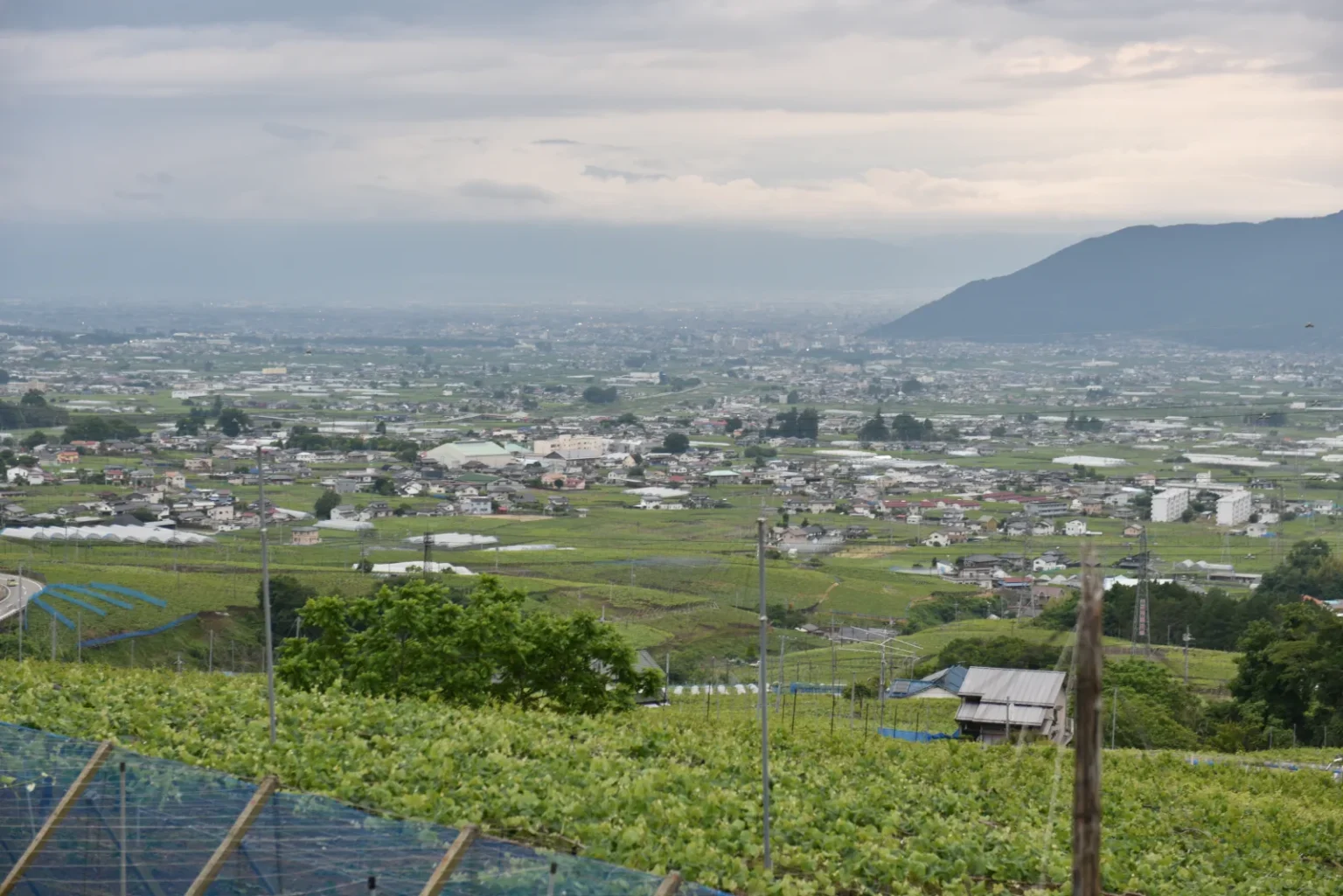
Katsunuma is one of Koshu City’s three areas, with Enzan and Yamato. Budo-no-Kuni Bunkakan, the city’s free museum that tells the history of Katsunuma’s grapes and wine, opens on Saturdays and Sundays only from December to April (9:00–16:30), and Thursday to Sunday from May to November; the city notes that it can close on extra days around public holidays.
For more of Yamanashi’s food, see the 120-year-old Kinseiken wagashi shop.
Hoshigaki and Koshu korogaki: FAQ
What does hoshigaki mean?
Hoshigaki (干し柿) means dried persimmon. Korogaki is a drier style of hoshigaki, dried to 25–30% moisture with a white sugar powder, as described by Yamanashi Prefecture.
What persimmon is used for Koshu korogaki?
Mainly Koshu Hyakume, a large astringent persimmon grown in Koshu City, according to the Ministry of Agriculture and the prefecture’s tourism site.
Why are Koshu korogaki massaged?
In Koshu, the first massage is described as cutting the fibres that connect the flesh to the seeds, once the outside is dry and the inside still soft. Daily massaging and rolling on the drying shelves then shapes the fruit.
What is the white stuff on hoshigaki?
JA Fruits Yamanashi says the white powder on korogaki is sugar from inside the fruit that has seeped out and crystallised. It recommends refrigeration if you are not eating them straight away.
When can you see the persimmon curtains in Koshu?
From November to early December. At Kanzo-yashiki in 2026, the persimmons are hung on Saturday 7 November, and the completed hanging-persimmon scene can be viewed only from that day’s afternoon session (13:30–16:00) onward.
Is Koshu korogaki the same as Ichida-gaki?
No. Ichida-gaki comes from southern Nagano and is a registered GI product. Koshu korogaki is from Yamanashi and is not on the GI register.
Sources (checked 24 October 2026)
- Ministry of Agriculture, Forestry and Fisheries: Korogaki, Japan traditional foods guide (Japanese)
- Yamanashi Prefecture: Korogaki (Yamanashi food database) (Japanese)
- Yamanashi Tourism Organization: Koshu korogaki feature, 2021 (Japanese)
- JA Fruits Yamanashi: Persimmons and korogaki (Japanese)
- Ministry of Agriculture, Forestry and Fisheries: Case studies on traditional food culture (JA Fruits Yamanashi korogaki class) (Japanese, PDF)
- Ministry of Agriculture, Forestry and Fisheries: GI register (Japanese)
- Koshu City: Former Takano residence (Kanzo-yashiki) (Japanese)
- Koshu City Tourism Association: 2026 korogaki-making volunteers, 7 November; 2025 korogaki season and light-up (Japanese)
- Koshu City: Budo-no-Kuni Bunkakan (Japanese)
- Eater: The Art of Hoshigaki at Home
Some links above are affiliate links — they cost you nothing extra and help keep this site going.
Join travelers discovering Japan's hidden side
Weekly dispatches from off-the-beaten-path Japan — spots and stories you won't find in guidebooks.
No spam. Unsubscribe anytime.
Welcome aboard!
You're in. See you in your inbox soon.