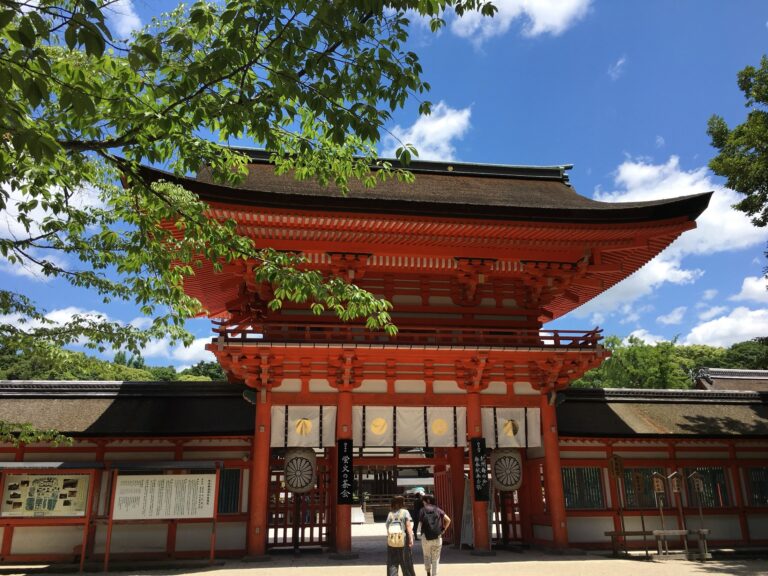
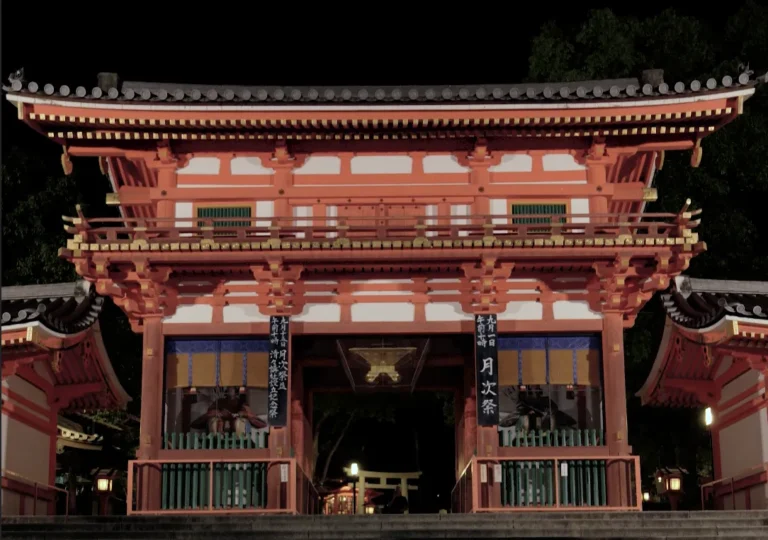
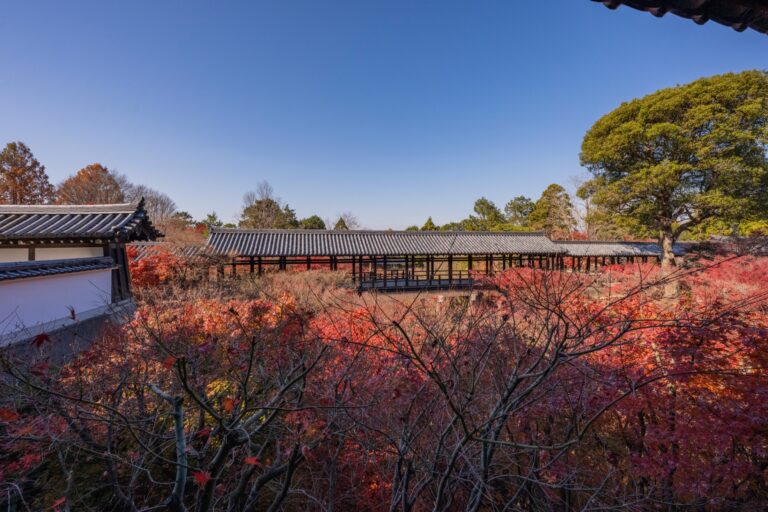
Gion Matsuri is not a single day — it runs the full month of July, with the climax on the Yoiyama nights of July 14–16 (Saki Matsuri) and the Yamaboko Junko procession on July 17. 33 wooden float-towers called yamaboko (23 in the Saki Matsuri + 10 in the Ato Matsuri, including the Ofune Hoko revived in 2014 after 150 years) are assembled in the streets of Kyoto by neighborhood teams using no nails — UNESCO Intangible Cultural Heritage, 2009. This is a guide to Yoiyama 2024, anchored on the Tsuki Hoko (the moon float) and the yatai food stalls that make the evening.
Last updated: 2026-05-29 · Visited Yoiyama July 16, 2024 · Author: Nobutoshi (Kyoto-based)
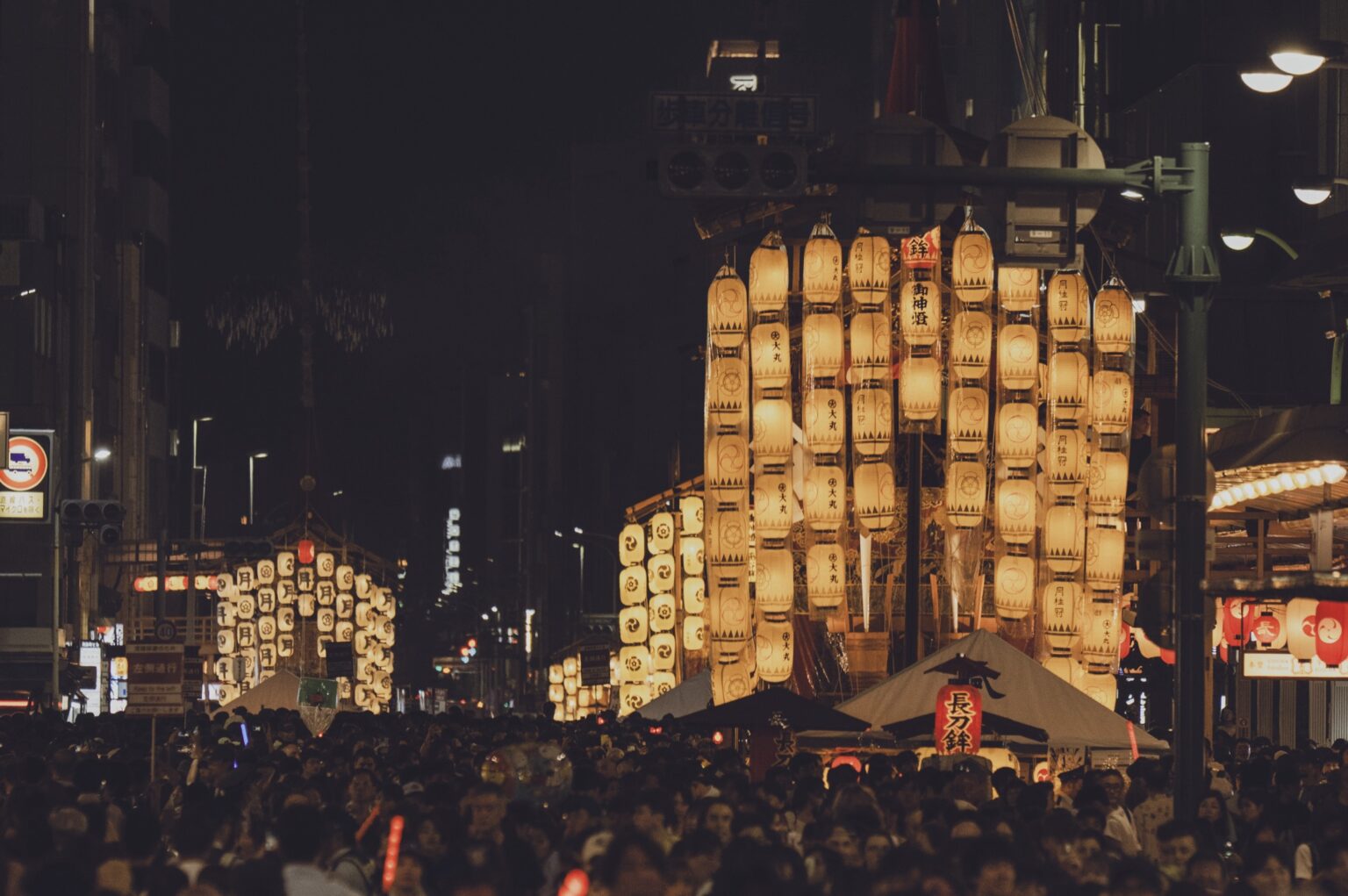
Quick facts
- What it is
- 祇園祭 — Yasaka Shrine’s festival, ~1,154 years old
- Origin
- 869 CE plague purification ritual (Goryo-e)
- UNESCO
- 2009 — Intangible Cultural Heritage
- Length
- The full month of July
- Yoiyama
- July 14–16 — float viewing nights
- Junko procession
- July 17 09:00 + July 24 (Ato Matsuri)
- Floats
- 33 yamaboko (23 Saki + 10 Ato), no nails
- Best night
- July 15 (less crowded than 16, more lit than 14)
I went last year — Yoiyama on July 16
Yoiyama on July 16 is the peak night — about 300,000 people across roughly one square kilometre of central Kyoto, with the 23 Saki Matsuri floats parked in the streets and lit from sunset to about 23:00. The strategy below is anchored on the Tsuki Hoko and bookended with yatai food stops.
I went to Yoiyama in 2024 on the night of July 16 — Yoi-yoiyama proper. It was the third Yoiyama I’d done as an adult, and the first time I bothered to map out a route in advance. The previous two times I’d just walked in from Karasuma station and wandered until my feet gave out. That works for an hour. It does not work for the four hours that the actual festival demands of you, and the crowd density at peak hours makes wandering increasingly painful.
What follows is the route I’d give a friend coming for the first time — anchored on the Tsuki Hoko (the moon float), bookended with yatai food stops, and respecting the practical reality that hundreds of thousands of people are moving through about a square kilometre of central Kyoto in one evening.
What you’re looking at — the yamaboko in 60 seconds
There are two kinds of float: smaller yama carry a tableau on top, and giant hoko tower with a central pole topped by an ornament identifying the float. The Tsuki Hoko (moon halberd) is the largest and heaviest of them all, with imported Mughal and Ottoman carpets, ceiling paintings by Maruyama Okyo, and roof carvings attributed to Hidari Jingoro.
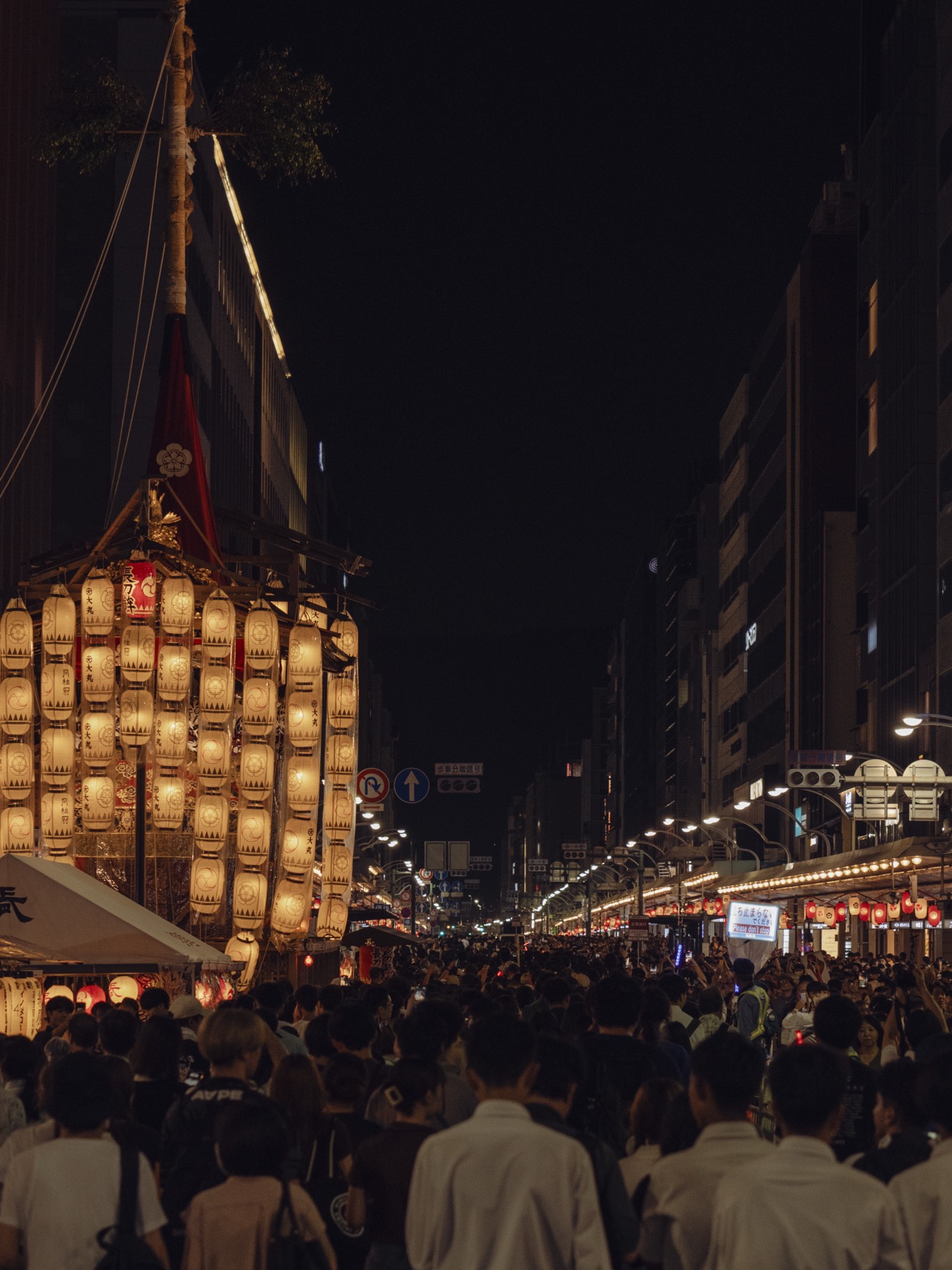
There are two kinds of float. Yama are smaller, sit on wheels or are carried, and feature a tableau on top — a samurai, a mythological figure, a god. Hoko are the giant tower floats topped with a long central pole called a shinki that pierces the sky and carries an ornament identifying the float.
The Tsuki Hoko (月鉾) — literally “moon halberd” — is recorded as the largest and heaviest of all the yamaboko. Its central pole carries a crescent moon ornament at the very top. The float belongs to the Muromachi-cho neighborhood (Shijo-dori west of Muromachi) and predates the Onin War (1467) — making it over 550 years old as a continuous tradition. The Tsuki Hoko is essentially a moving museum: imported Mughal and Ottoman carpets on the side panels, gold-leaf flower paintings on the ceiling by Maruyama Okyo (18th century), and rabbit and turtle carvings on the roof brackets attributed to Hidari Jingoro.
The lead float. The only hoko that carries a child priest (chigo) who performs the rope-cutting ritual to begin the Junko on July 17.
The moon float. Largest and heaviest of all yamaboko. Mughal & Ottoman carpets, Maruyama Okyo ceiling paintings, Hidari Jingoro carvings. Pre-Onin War origin.
The “filial piety” yama. Carries a centuries-old wooden statue depicting the Confucian story of Kakkyō digging a hole and finding gold for his mother.
The “boat float” — shaped like a Heian-period imperial vessel rather than a tower. The final float in the Saki Matsuri procession.
The lantern-arcade hour
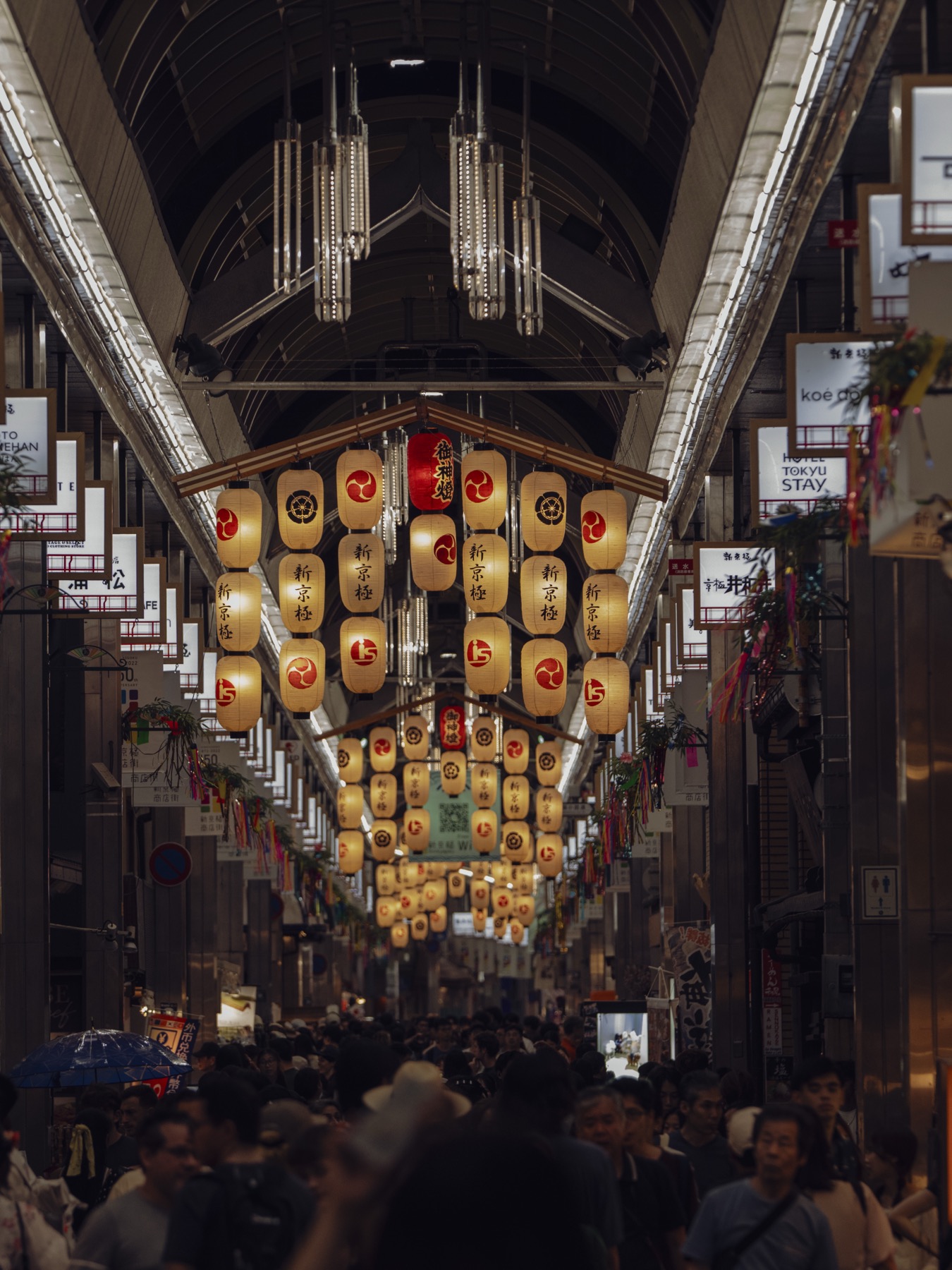
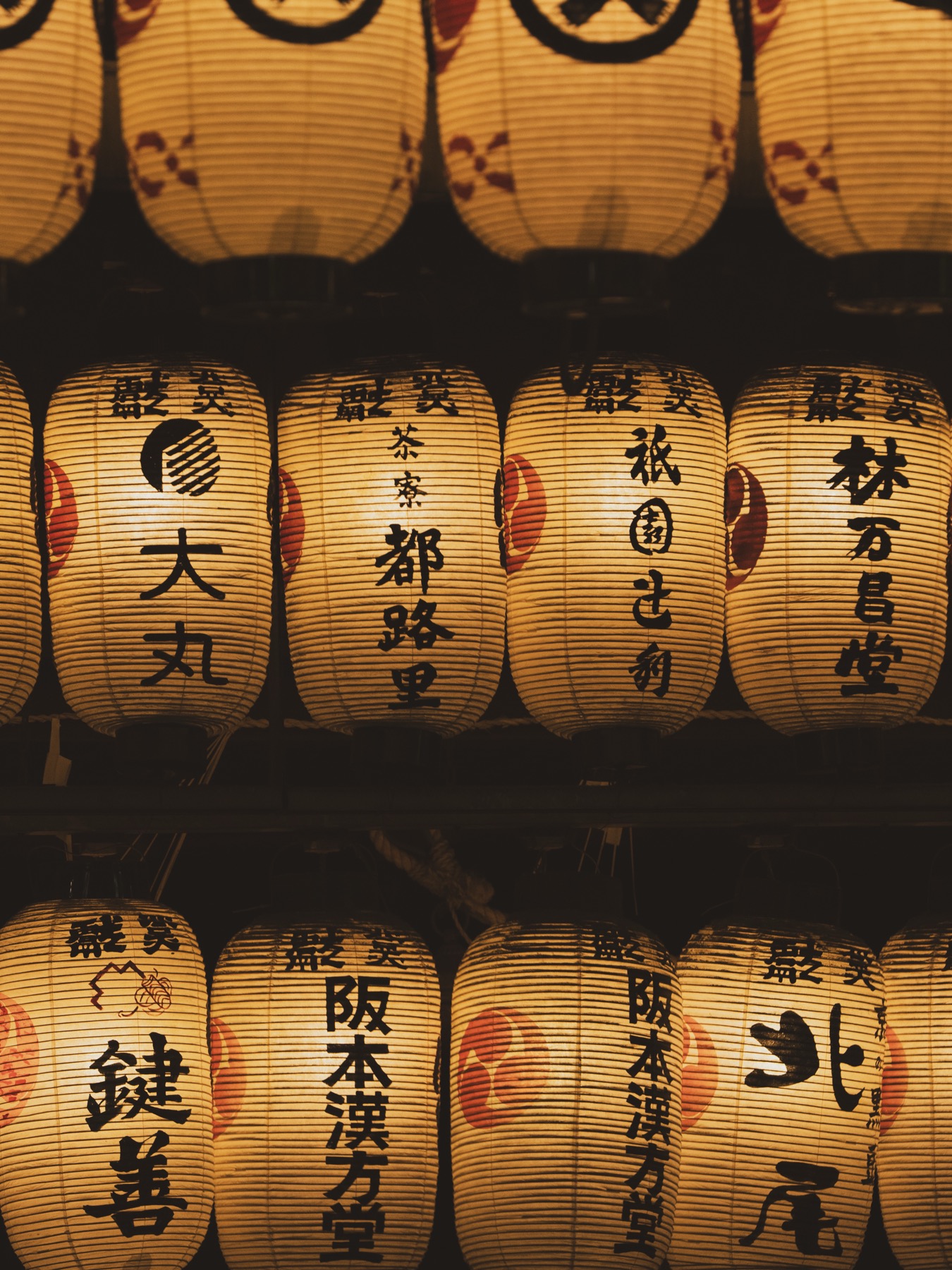
Walk through the Shinkyogoku covered arcade before peak crowds — the ceiling becomes a chochin grid where every shop hangs a lantern with its name brushed in black ink, contributing to the float the neighborhood sponsors.
Before you go to any single float, walk down the Shinkyogoku arcade — the covered shopping street between Sanjo and Shijo. During Gion Matsuri the entire ceiling becomes a chochin grid. Every neighborhood shop hangs a lantern with its name brushed in black ink, contributing to whichever yamaboko the neighborhood sponsors. It’s an entire luminous donor wall, hand-painted.
The crowd reality — Shijo-dori on Yoiyama
Peak hours are 18:30–21:00 — Shijo-dori becomes a one-way pedestrian conveyor belt. The two best windows are 17:30–18:30 (light, low density) and 21:00–22:00 (lanterns fully lit, crowd thinning, photos viable).
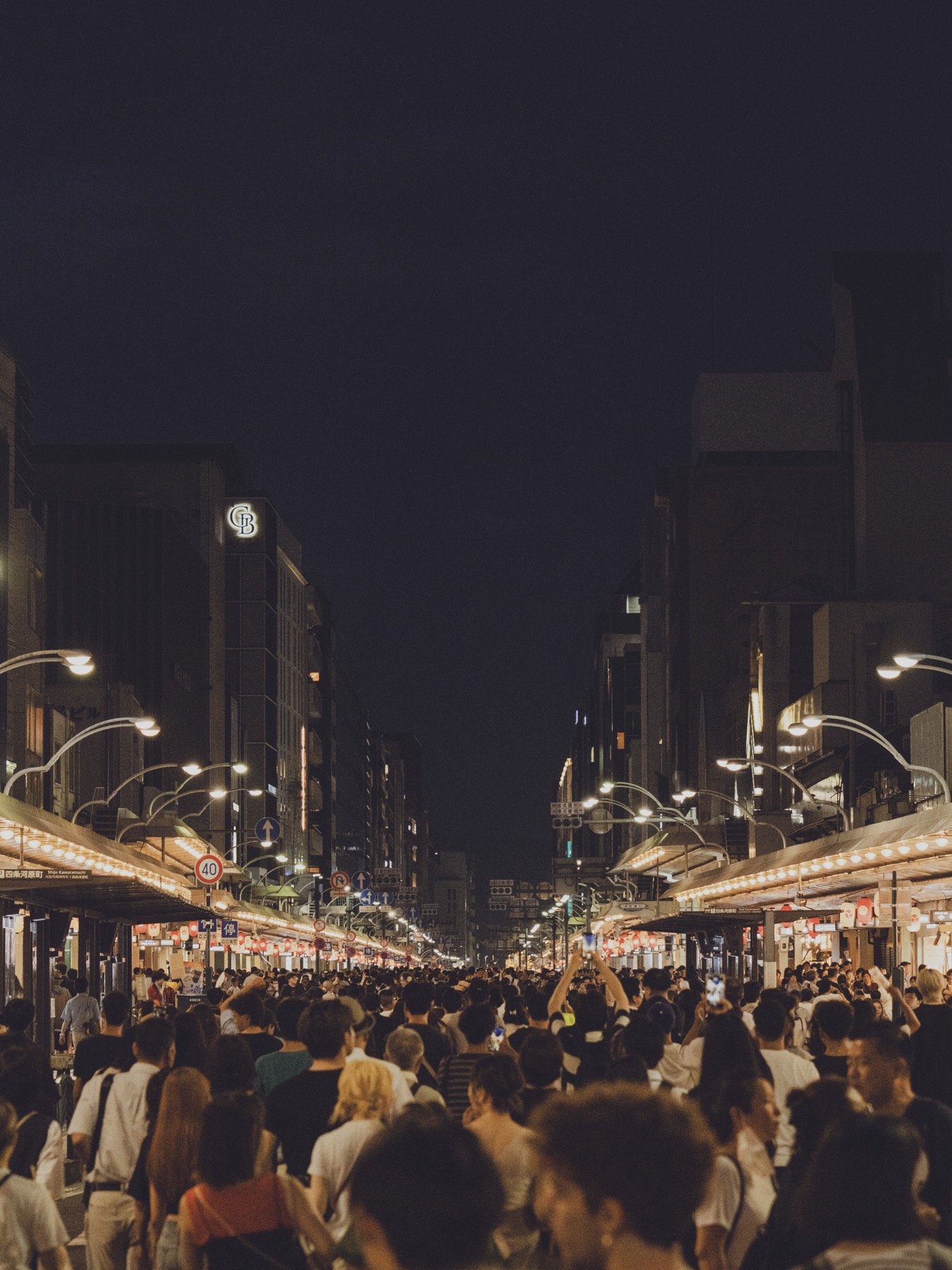
Yoiyama draws roughly 300,000 people per night into a stretch of central Kyoto smaller than two square kilometres. From 18:00 to about 21:00 — the peak hours — Shijo-dori west of Kawaramachi becomes essentially a one-way pedestrian conveyor belt. From 21:00 to 22:30 it thins out enough to be pleasant. From 22:30 to closing (around 23:00) you can actually photograph the floats with no humans in the frame, but most yatai have started shutting down by then.
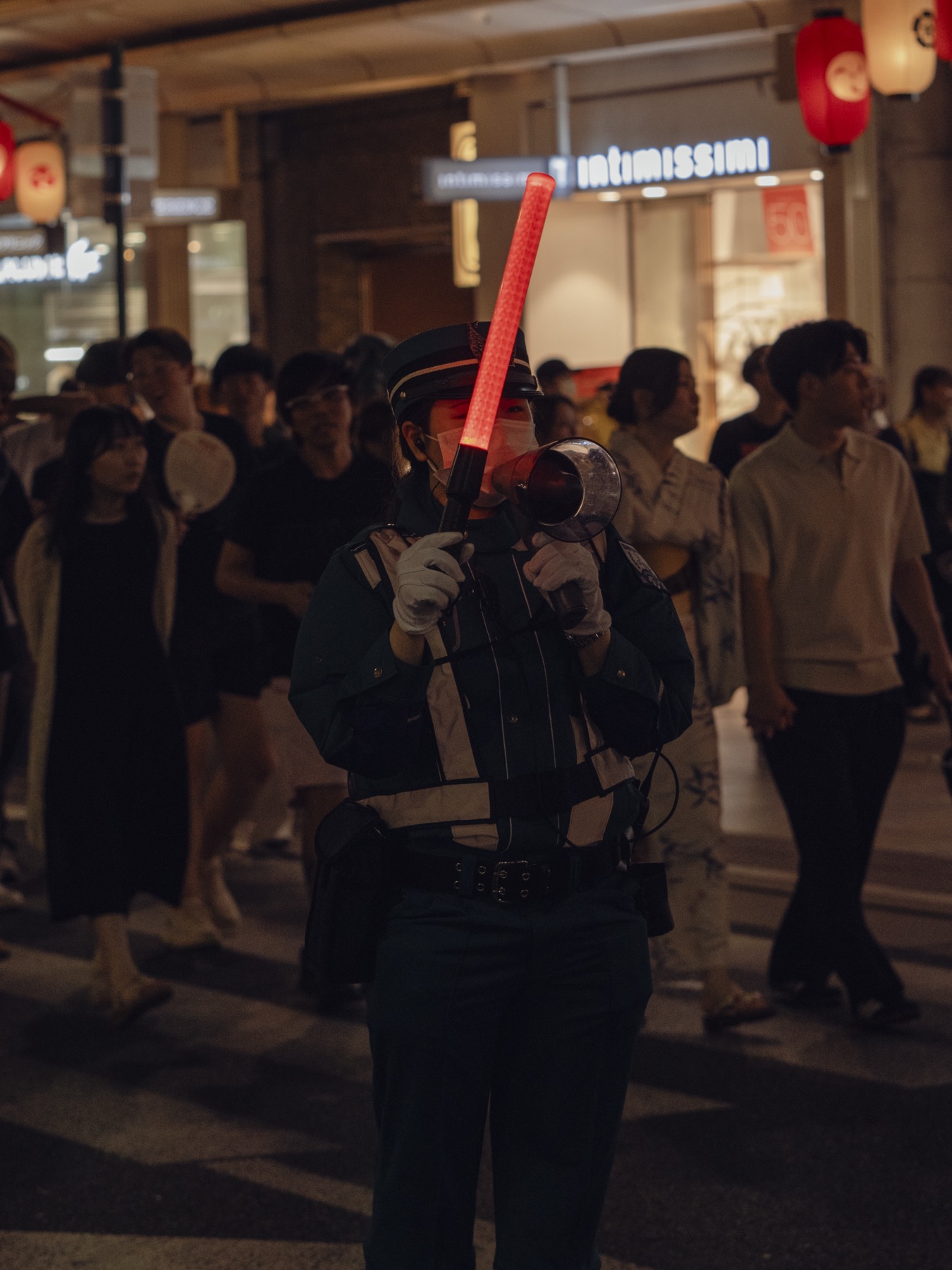
Strategy: arrive at 17:30, leave by 22:00
The two best windows are 17:30–18:30 (still light enough to see float craftsmanship, before peak crowds) and 21:00–22:00 (lanterns at full glow, crowd thinning, photographs viable). The window between is for eating and watching the people. Avoid arriving at 19:30 — peak chaos, no float visibility, hard to find any food stall without a queue.
Yatai — the food half of the experience
For most Japanese, Gion Matsuri = the yatai food stalls as much as the floats. The standard plate is yakisoba, karaage, yakitori and a kakigori or choco-banana — expect ¥1,200–1,800 for the evening. Cash only.
If you ask anyone Japanese what Gion Matsuri means to them, they’ll mention the food. Yatai — the wooden street-food stalls — line the closed-off streets, generally run by neighborhood volunteers rather than professional vendors, and the prices reflect that. The classic Yoiyama plate is:
- Yakisoba — ¥600. Plate of stir-fried noodles. Always.
- Karaage — ¥400–500. Fried chicken, usually 4-5 pieces.
- Yakitori — ¥200–300 per stick. Negima (chicken + green onion) is the safest pick.
- Choco-banana — ¥400. Frozen banana on a stick, dipped in chocolate, sprinkles. Children love it. Adults pretend not to.
- Kakigori — ¥400–500. Shaved ice with syrup; ichigo (strawberry) or melon are standard.
- Lemon sour — ¥400. Canned shochu cocktail. Carry one with you to handle the heat.
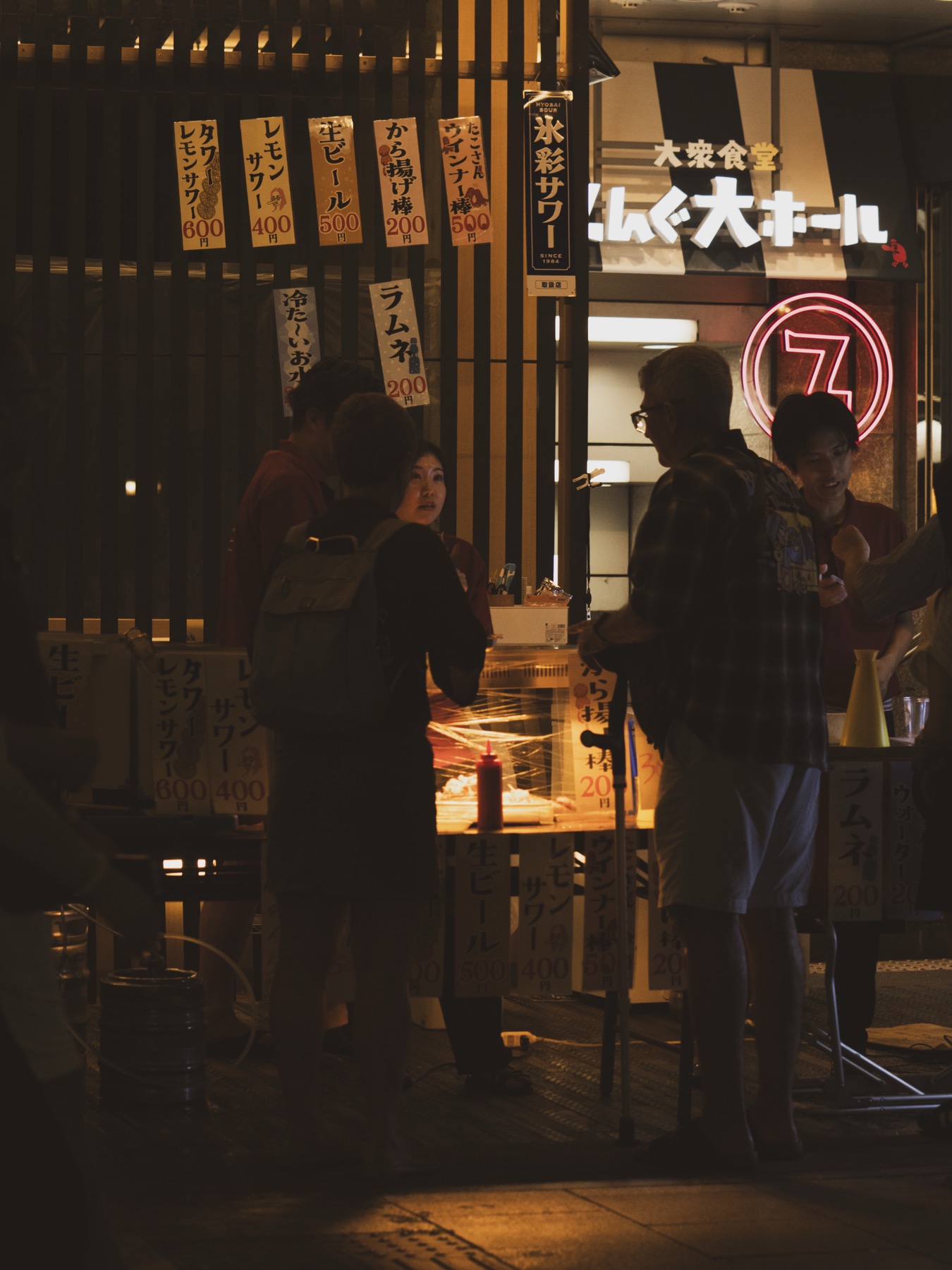
Cash only. Carry coins and ¥1,000 notes; the vendors will hate you for a ¥10,000 note. The food is not gourmet — it’s nostalgia food, the same recipes Japanese parents fed their kids at every summer festival since the 1970s. That is the point.
The clean route — Yoiyama in four hours
17:30 to 22:00 — what I’d actually do
- 17:30 — Karasuma station exit 22Karasuma is calmer than Kawaramachi. Use any of the Karasuma-line exits and walk south. Don’t even try Kyoto Station-based plans; that adds 30 minutes of unnecessary transit.
- 17:40 – 18:30 — Shinkyogoku arcade chochinWalk through the covered arcade before peak crowds and look up. This is the best lantern-density photograph of the whole night.
- 18:30 – 19:00 — First yatai stopEat early. The lines double after 19:00. Yakitori + lemon sour is a clean order.
- 19:00 – 19:30 — Tsuki HokoThe Muromachi-cho intersection on Shijo (Shijo-dori west of Muromachi). Walk slowly around the base — look at the Mughal & Ottoman carpets on the side panels, the bronze fittings, the rope binding (no nails). Some hoko let visitors climb the wooden ladder for ¥500–1,000 between 18:00 and 20:00; Tsuki Hoko sometimes opens, sometimes doesn’t. Check the day-of.
- 19:30 – 20:15 — Walk west along ShijoPass three more hoko in succession — Hoka Hoko, Kanko Hoko, Niwatori Hoko. Don’t try to “do” them, just pass through.
- 20:15 – 21:00 — Pause for the second yatai roundYakisoba + kakigori. Sit on a curb. Watch the crowds.
- 21:00 – 22:00 — Photograph hourThe crowd thins. Walk back to the Tsuki Hoko or whichever hoko caught your eye and stand still. Tripod-free. Long exposure on a railing is enough.
- 22:00 — Leave from KarasumaThe last train leaves around 23:30 but every taxi within 1 km will be taken from 22:30 onward. Public transit is the right answer.
Saki Matsuri vs Ato Matsuri — the two halves
Gion Matsuri is two festivals separated by a week. Saki Matsuri (Yoiyama July 14–16, Junko July 17 09:00) is the main event with 23 floats and 300K+ visitors per night. Ato Matsuri (Yoiyama July 21–23, Junko July 24 09:30) is smaller and quieter with 10 floats and no street closure.
Gion Matsuri is actually two festivals, separated by a week. The Saki Matsuri (前祭, “first festival”) is what most foreign visitors know — Yoiyama July 14–16 and Junko July 17. The Ato Matsuri (後祭, “after festival”) is the smaller, quieter half — Yoiyama July 21–23 and Junko July 24, with 10 floats versus the Saki’s 23 (including the Ofune Hoko revived in 2014 after a 150-year absence).
Main event. 23 floats. 300K+ visitors per night. Shijo-dori closed to traffic on the 15th and 16th. Yatai everywhere. Most chochin.
Procession of 23 floats starting 09:00 from Shijo-Karasuma. The rope-cutting at Shijo-Fuyacho by the chigo boy is the moment of opening.
Quieter Yoiyama. 10 floats. Streets are NOT closed. No yatai. Much smaller crowd. Better for traditional viewing.
Smaller procession starting 09:30 in the opposite direction from the Saki Junko. The Hanagasa procession of women and children follows it.
What to wear
Five things you’ll wish you knew
- Wear a yukata if you have one. Half the local crowd wears them. You won’t stand out and the cotton breathes better than Western synthetics in 30°C humidity.
- Wear walking shoes, not geta sandals. Even with a yukata. You will walk 6+ km on hot pavement. Geta blisters will end your evening.
- Bring a small folding fan (sensu) or paper fan (uchiwa). Both are sold at every convenience store for ¥300-500. You will use it constantly.
- Carry cash in small denominations. ¥1,000 notes and coins. Cards do not work at yatai. Period.
- Bring a portable charger. Photographs + maps + queue waits = your phone dies at 21:00. Bring a 5,000 mAh battery.
How to get to Yoiyama from elsewhere
Shijo-dori in central Kyoto. The Yoiyama street closure runs roughly from Karasuma to Kawaramachi along this stretch. Karasuma and Kawaramachi subway stations bookend the closure.
| From | Route | Time | Cost |
|---|---|---|---|
| Kyoto Station | Karasuma subway to Shijo or Karasuma-Oike | ~5 min | ¥220 |
| Osaka (Umeda) | Hankyu to Kawaramachi → walk 5 min | ~45 min | ¥410 |
| Nara | Kintetsu Limited Express to Kyoto → subway to Shijo | ~55 min | ¥1,400 |
| Tokyo (Shinkansen) | Tokaido to Kyoto → subway to Shijo | ~2h 30 min | ~¥14,000 |
If you are staying in central Kyoto, you can walk in. Avoid taxis on the day of Yoiyama — central streets are closed and surrounding traffic is gridlocked from 18:00 to 23:30.
If you’re combining Yoiyama with a Kyoto walking day, the Higashiyama golden-hour route from Yasaka Pagoda to Kiyomizudera covers the area immediately east of where the festival’s parent shrine (Yasaka) sits, and works as a 16:00 start before walking into Yoiyama for sunset. The Kyoto Tower observation deck gives you a wide view of the float-assembly streets two days before Yoiyama if you want to see the structure in daylight. For permanent Kyoto theatre context, the 400-year-old Minamiza kabuki theatre sits at the foot of Shijo Bridge, the eastern edge of the Yoiyama street closures.
When is Yoiyama in 2026?
| Date (2026) | Event | What’s happening |
|---|---|---|
| July 1 | Kippu-iri | Festival opens. Lottery for the procession order. |
| July 10 | O-mukae chochin | Procession of children with lanterns to Yasaka Shrine. |
| July 14 (Tue) | Saki Yoi-yoi-yoiyama | Floats assembled, lanterns lit from sunset. Streets not yet closed. |
| July 15 (Wed) | Saki Yoi-yoiyama | Same lights, growing crowd. Streets closed from 18:00. |
| July 16 (Thu) | Saki Yoiyama | Peak night. Largest crowd. Streets closed from 18:00. |
| July 17 (Fri) | Saki Junko | Procession 09:00 from Shijo-Karasuma. 23 floats. |
| July 21 (Tue) | Ato Yoi-yoi-yoiyama | Quieter half begins. No street closures. |
| July 22 (Wed) | Ato Yoi-yoiyama | Quieter. |
| July 23 (Thu) | Ato Yoiyama | Yoiyama for the Ato Matsuri. |
| July 24 (Fri) | Ato Junko + Hanagasa | Smaller procession 09:30, then the Hanagasa parade of women and children. |
| July 31 | Eki-jinja Festival | Final purification ritual at Yasaka. Festival ends. |
Tips for visitors from Singapore, Bangkok, KL & Jakarta
Practical notes for SEA travellers
Gion Matsuri in July is also peak humidity season — close to a Singapore evening in feel. Yoiyama dates are the same every year (July 14-16) so flights book early. Hotels for July 16 sell out 6-12 months in advance.
- From SIN/KUL/BKK/CGK: KIX direct via Scoot, AirAsia X, Jetstar Asia, Cebu Pacific. KIX → Kyoto Station 75 min on JR Haruka (¥3,440). Stay near Karasuma or Shijo subway for Yoiyama walking distance.
- Halal & vegetarian at yatai: Yakisoba and karaage usually contain pork lard or chicken oil — ask before ordering. Veg-safe yatai picks: kakigori (shaved ice), choco-banana, kyuri (cucumber on a stick with miso), corn on the cob. Lemon sour is alcohol (shochu) — avoid if halal.
- Climate vs SEA: July Kyoto averages 26-32°C, 75% humidity — basically Singapore in feel but with worse evening UV. Bring a fan, sunscreen, and plenty of water. Cotton yukata breathes far better than Western synthetics.
- Cash for yatai: Cards do not work at any yatai. Carry ¥5,000-10,000 in ¥1,000 notes and coins. Hotel ATMs usually run out by 20:00 on Yoiyama nights.
- Prayer / wudu: Kyoto Station 8F (north building) has a prayer room. Yasaka Shrine itself is open all day and has stone wash basins; bring a small towel if you need to use them for ablution.
- Yukata rental: Shops near Kawaramachi offer same-day yukata rental from around ¥4,000 including dressing. Book ahead during Yoiyama week — walk-in availability is rare.
FAQ
When is Gion Matsuri 2026?
The full festival runs July 1–31, 2026. The peak nights are July 14–16 (Saki Yoiyama) with the main procession on July 17. The smaller Ato Matsuri follows July 21–23 with its procession on July 24. The dates are fixed by date, not by day-of-week, so 2026 weekday positioning is: Yoiyama July 16 falls on a Thursday, Junko July 17 on a Friday.
What’s the difference between Yoiyama and Junko?
Yoiyama (宵山) is the three evenings of float viewing — the floats are parked in the streets near where they were assembled, lanterns are lit, yatai food stalls run, and you walk the streets between them. Junko (巡行) is the daytime procession on July 17 (and again, smaller, on July 24) when the floats are pulled through Shijo and Kawaramachi by rope teams. Most foreign visitors come for Yoiyama; serious students of the festival come for Junko.
How crowded is Yoiyama?
Very. Saki Yoiyama on July 16 typically draws about 300,000 people per night into the Shijo-Karasuma-Sanjo block. Peak hours are 18:30-21:00. After 21:00 it becomes pleasantly busy rather than crushing. If you can manage it, arrive at 17:30 to walk the floats while there’s still light and crowd density is low.
Can you climb the yamaboko floats?
Some hoko allow visitors to climb the wooden interior of the float for ¥500-1,000 between approximately 18:00 and 20:00 on Yoiyama nights, but only certain floats and not every year. The Naginata Hoko has historically restricted entry to men only (this is being relaxed). The Tsuki Hoko sometimes opens. Check the float’s own signage on the night; this is not announced centrally.
What food should I eat at Gion Matsuri?
The standard yatai plate is yakisoba, yakitori, karaage, and one cold thing — either kakigori (shaved ice) or a frozen choco-banana. Adults add a lemon sour. Expect to spend ¥1,200-1,800 to eat at the yatai for the evening. Cash only. Prices are fixed by neighborhood agreement so you cannot meaningfully shop around — find a stall with a short queue and order.
Should I wear a yukata?
Yes if you have one or can rent one. About half the local crowd wears yukata on Yoiyama nights and you blend in rather than stand out. The cotton breathes better than synthetics in Kyoto’s July humidity. Rental shops near Kawaramachi do same-day yukata for around ¥4,000-7,000 including dressing. Wear sneakers under it, not geta — you will walk too far for geta to be comfortable.
Where should I stay for Yoiyama?
Anywhere within walking distance of the Karasuma or Shijo subway stations. The Kawaramachi area is closest but books up first; the Karasuma-Oike side is calmer and a 10-minute walk in. Hotels book out a year in advance for Yoiyama dates — start looking now if you’re visiting in 2026.
Sources used for this article
- Yasaka Shrine official site — yasaka-jinja.or.jp
- Kyoto City Tourism Association Gion Matsuri page — kyokanko.or.jp
- UNESCO Intangible Cultural Heritage listing (2009)
- Personal observation, Yoi-yoiyama night July 16, 2024 (photographs in this article)
Plan a Yoiyama trip — three paths
Gion Matsuri hotels book out a year ahead. Start now if you’re going in 2026:
Akita Kantō Festival
Another of Japan’s great festivals — Akita’s gravity-defying lantern poles.
Tone River Grand Fireworks 2026
For more summer spectacle: ~30,000 shells and four makers competing in Ibaraki.
Where to stay in Kyoto: compare hotels and prices on Booking.com or Trip.com — booking early pays off in peak season.
Top-rated, well-reviewed places, booked through Agoda:
Guesthouse Engawa
Agoda 9.9/10 · 2★ · 267 reviews
Guesthouse KYOTO COMPASS
Agoda 9.8/10 · 1.5★ · 259 reviews
Hotel GOCO Stay Kyoto Shijo Kawaramachi
Agoda 9.7/10 · 3★ · 245 reviews
Or search all Kyoto hotels on Agoda →
We may earn a commission from Agoda bookings, at no extra cost to you.
Join travelers discovering Japan's hidden side
Weekly dispatches from off-the-beaten-path Japan — spots and stories you won't find in guidebooks.
No spam. Unsubscribe anytime.
Welcome aboard!
You're in. See you in your inbox soon.