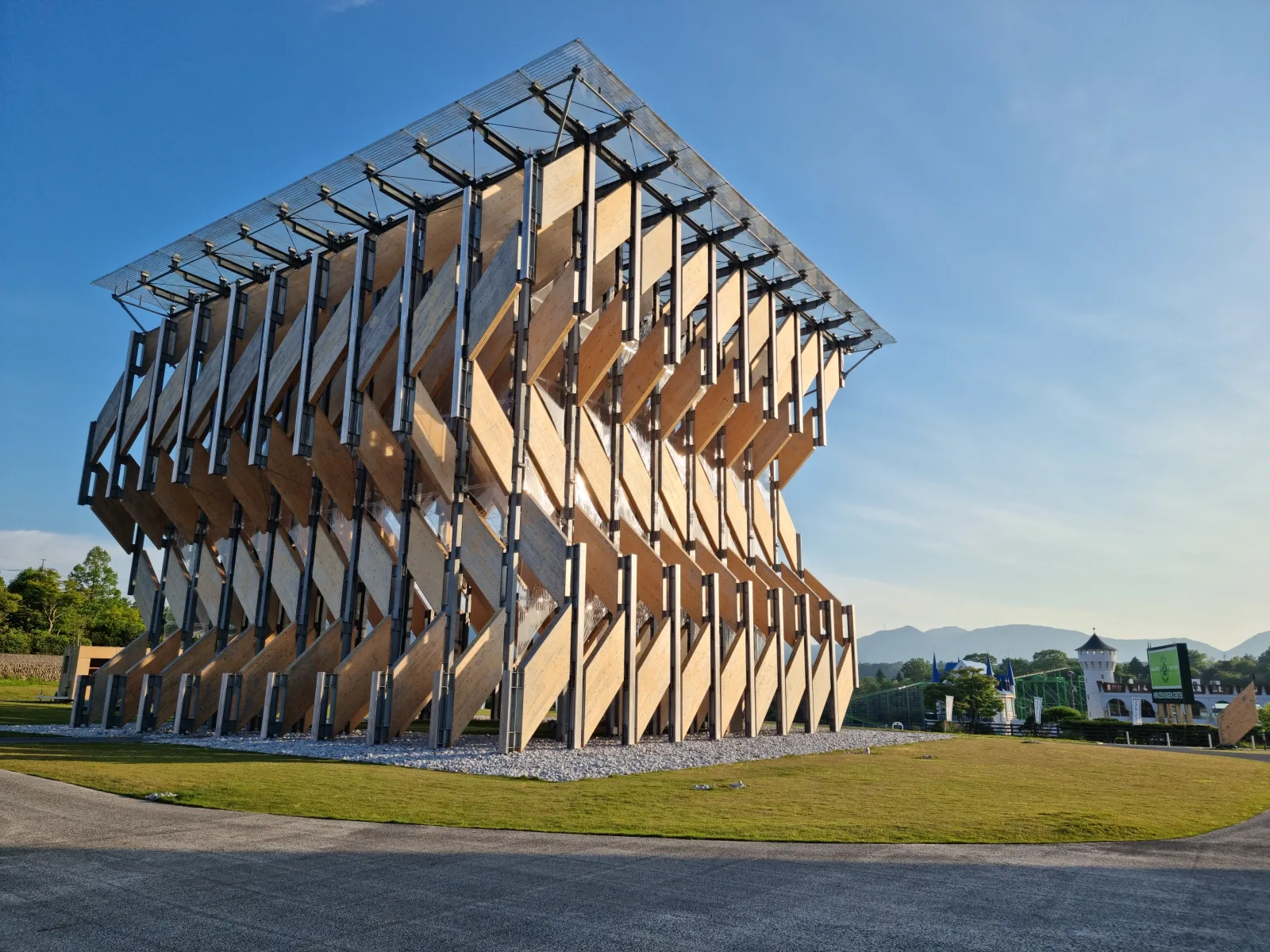
Drive forty minutes north of Okayama on the Yonago Expressway, get off at Hiruzen IC, turn left at a farm stand selling milk, and you come across something you don’t expect to see surrounded by dairy pasture: a three-story wooden pavilion designed by Kengo Kuma. It stands alone in a field, its cedar panels tilted at different angles so the whole structure seems to be shifting in the light. The locals call it 風の葉 — “wind of leaves.” It was supposed to stay in Tokyo.
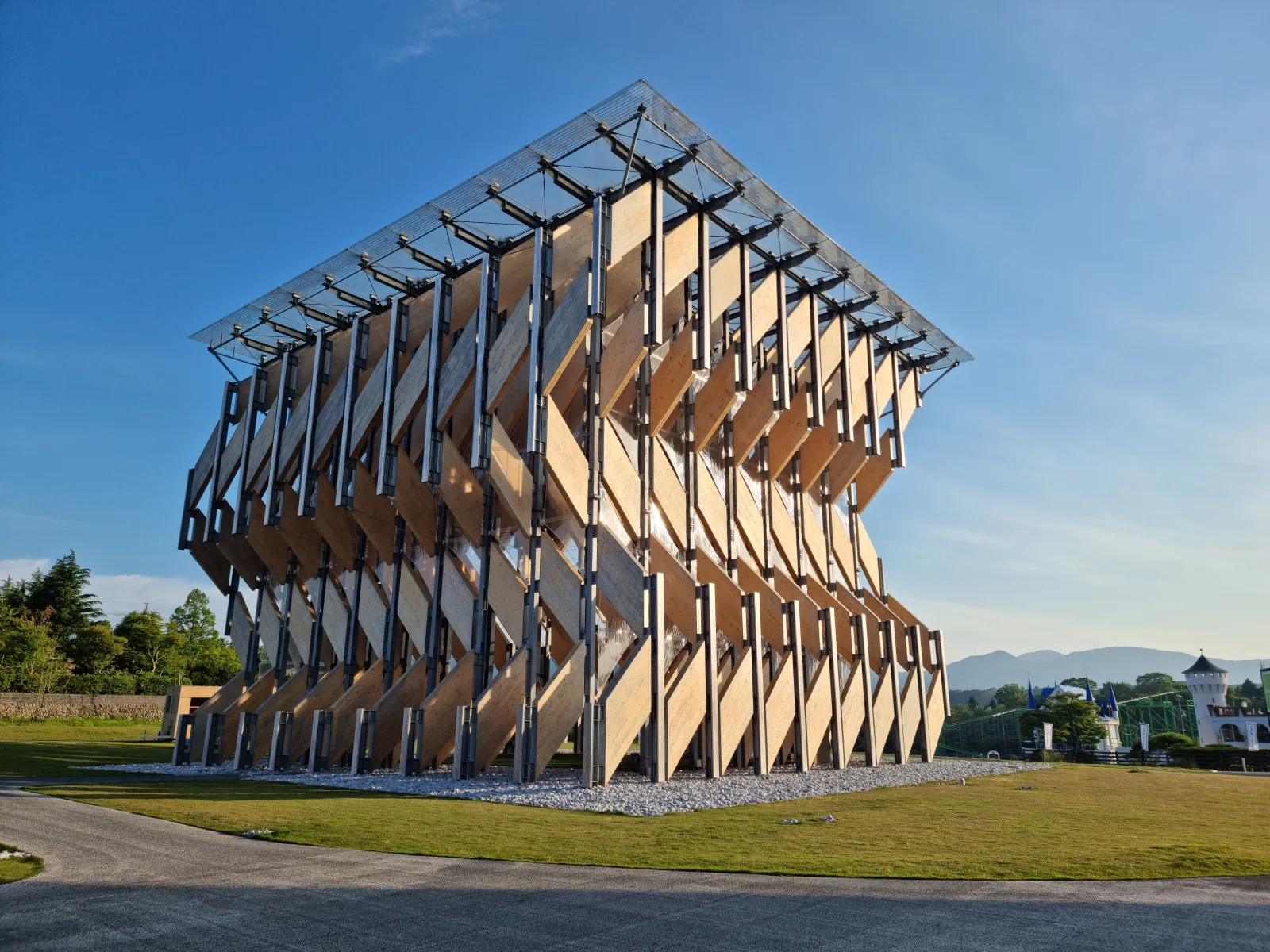
Table of Contents
Quick Facts
Okayama city makes a low-cost base for this corner of western Japan. If you’re weighing where to stay, see our cheaper-than-Kyoto base cities guide.
| What | GREENable HIRUZEN — a sustainability-focused cultural facility with a Kengo Kuma CLT pavilion, a museum, shop, and cycling center. |
| Where | 1205-220 Hiruzenkamifukuda, Maniwa City, Okayama 〒717-0602 |
| Hours | 9:00 AM – 5:00 PM. Closed Wednesdays (or Thursday if Wednesday is a holiday) and over New Year. |
| Cost | Free to enter the grounds and pavilion. Hiruzen Museum: ¥300 (high-school age and up, younger free). |
| Access | 5 minutes by car from Hiruzen IC on the Yonago Expressway. 80 minutes by bus from JR Chugoku-Katsuyama Station. |
| Phone | 0867-45-0750 |
A Building That Moved Prefectures
The pavilion wasn’t built for Hiruzen. In 2019, Kuma designed it for a site in Tokyo’s Harumi district as part of CLT PARK HARUMI — a temporary installation meant to show what could be done with cross-laminated timber in urban settings. When that exhibition ended, most buildings would have been scrapped. This one was taken apart, loaded onto trucks, and driven 600 kilometers southwest to be rebuilt panel by panel on a cow pasture.
The move was the point. The timber that makes the pavilion was milled in Maniwa, the city Hiruzen belongs to — a place that has been quietly turning itself into Japan’s CLT capital for a decade. Maniwa mills about 40% of the nation’s cross-laminated timber. Sending the wood to Tokyo, watching it hold up a pavilion for a few years, and then bringing it back home to stand as a landmark: that’s the circular-economy argument the whole project is making, built into the building itself.
Walking Through the Wind of Leaves
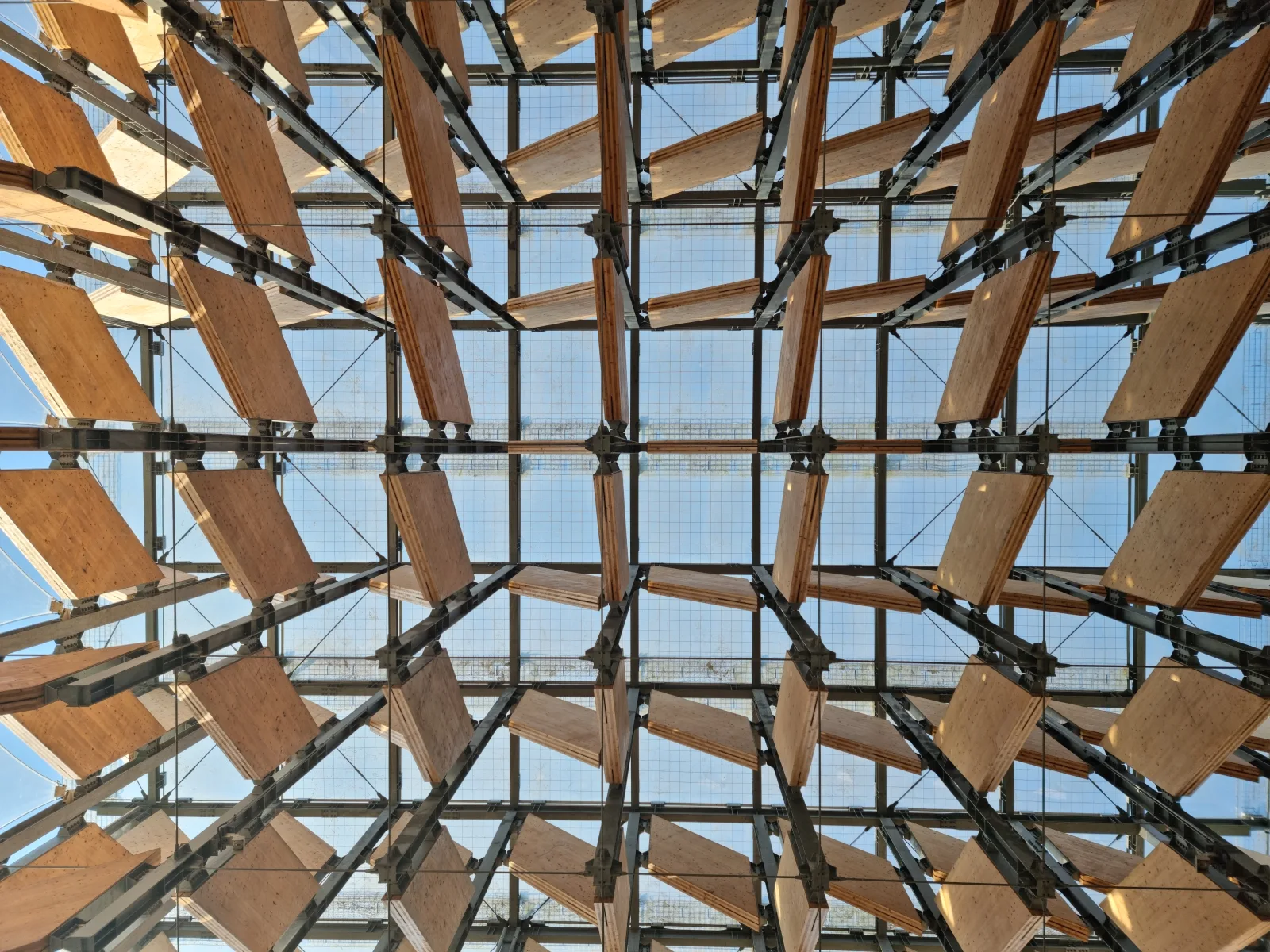
The name 風の葉 is easy to understand once you stand under the canopy. Look up, and the ceiling is a grid of tilted wooden panels, each one angled slightly differently, so the light coming through shifts as you walk. On a cloudy day it reads as a quiet room. On a clear one, the whole grid seems to flicker.
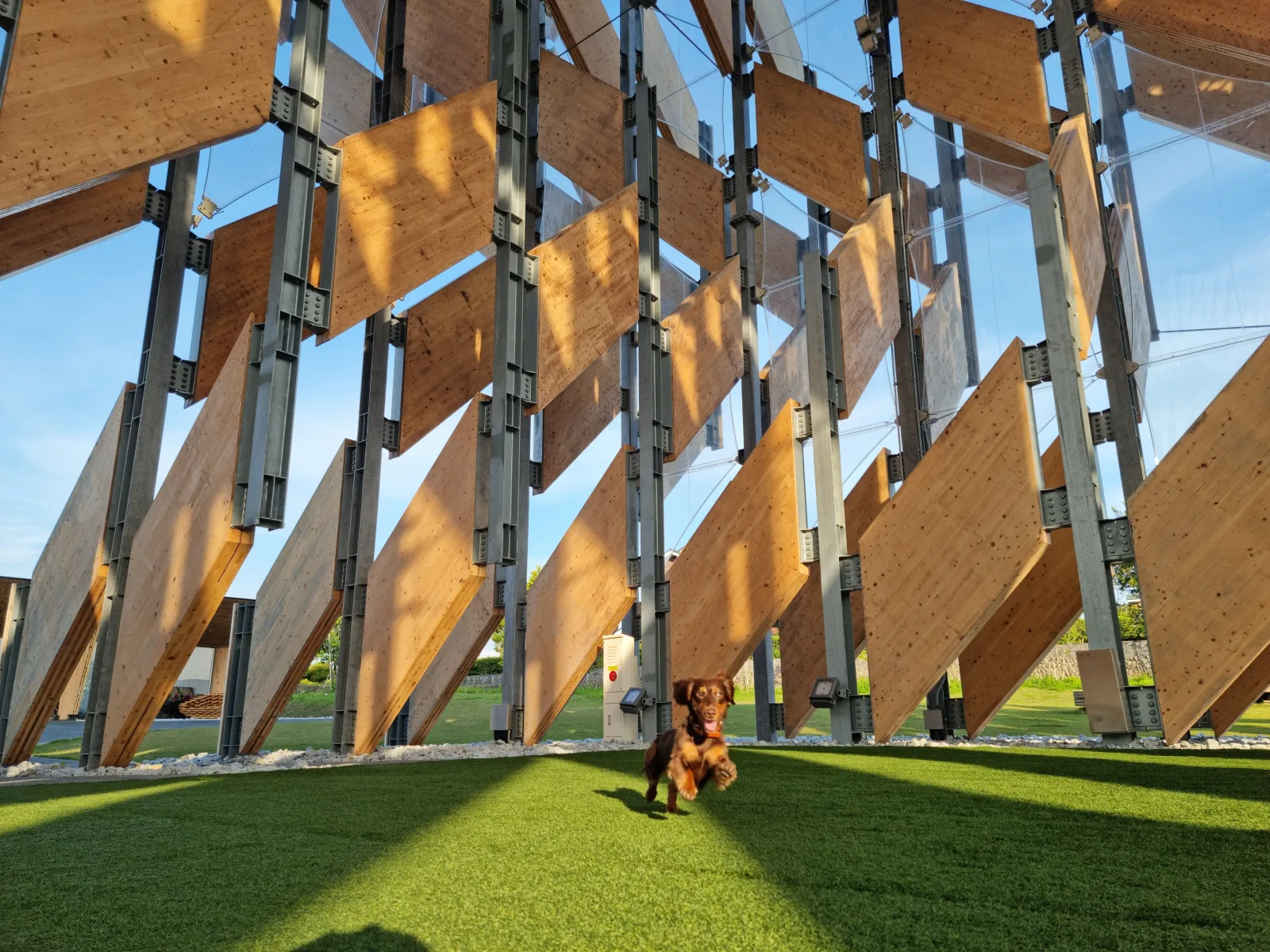
The structure is smaller than it looks in photos — maybe fifteen meters a side — but the way it’s sited, alone on a flat expanse of grass with Mt. Hiruzen in the background, it reads as a landmark. You can walk under it, around it, through it. There’s no admission gate. Dogs on leash are allowed outside; only service dogs inside the museum buildings.
What Else Is On Site
The pavilion is the photogenic centerpiece, but GREENable HIRUZEN is really a compact campus with three parts:
- Hiruzen Museum (蒜山ミュージアム). A small but serious museum tracking the region’s geology, Jersey cattle history, and the CLT story. Architecture models of Kuma’s other work around Japan sit on the top floor. ¥300 entry. Give it forty-five minutes.
- Shop and café. Maniwa cedar crafts, local Jersey milk soft-serve (worth the stop), and goods from nearby makers. The soft-serve is, objectively, good.
- Cycling Center. E-bikes and sport bikes for rent, ¥1,500–¥5,000 depending on the model and how long you take them. A marked 10-km loop runs from the parking lot through the pastures — worth it if the weather holds.
When to Go
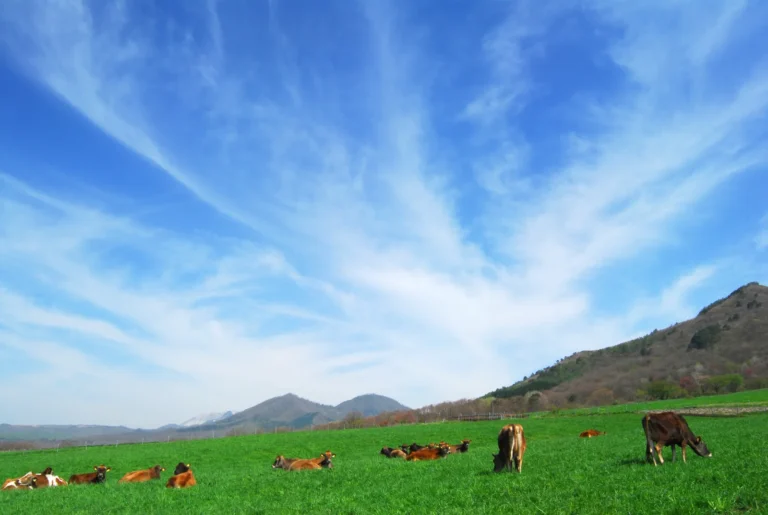
The pavilion doesn’t change with seasons the way a temple garden does, but the surrounding pastures do. Spring turns the grass a loud green around late April. Summer keeps the landscape open and the Jersey cows visible from the parking lot. Autumn, by mid-October, paints the slopes of the three Hiruzen peaks in copper. Winter blankets the whole plateau in snow, and the pavilion itself looks sharper against white — but the bus service thins out, so come by car.
The single best hour to photograph the building is the one starting about ninety minutes before sunset. The low light hits the tilted panels edge-on and the shadows line up like slats in a blind.
Pair It With
A visit here is a half-day at most. The natural things to tack on:
- Hiruzen Jersey Land — a 10-minute drive away. Pastures, cheese, yogurt, and the standard-issue soft-serve tour that every Japanese highland seems to run. Free to walk around; things cost what they cost.
- Hiruzen Highlands hiking — the three peaks (Kami-, Naka-, and Shimo-Hiruzen) form a 1,200-meter ridge walk that takes most of a day end-to-end. See our Hiruzen Highlands guide for routes and seasons.
- Mt. Daisen (Tottori side) — 40 minutes by car. A bigger mountain, an older shrine, and the reason the view to the north always looks dramatic.
Getting There
By car (recommended)
From Osaka: about 3 hours via the Chugoku and Yonago Expressways, exit Hiruzen IC. From Okayama City: roughly 1 hour 45 minutes. Free parking on site (7 spaces at the main lot, plus overflow at the Hiruzen Plateau Center across the road). Car rental is genuinely worth it for this region — public transit in northern Okayama thins out fast. We recommend DiscoverCars for comparing rates across Toyota, Nippon, and Times branches in Okayama.
By train and bus
Take the JR Kishin Line to Chugoku-Katsuyama Station (the end of the line, about 80 minutes from Okayama). From there, the Hiruzen-bound bus runs four to six times a day depending on the season, roughly 80 minutes to the “Hiruzen Plateau Center-mae” stop. Walk five minutes from the stop.
Check the bus schedule in advance: buses from Chugoku-Katsuyama Station to Hiruzen are sparse enough that missing one will cost you two hours.
Where to Stay Nearby
There are no hotels at the GREENable site itself. For an overnight:
- Hiruzen Kogen Center Hotel — 3 minutes by car, dairy-pasture views, onsen bath attached.
- Ryokan and pensions along the Hiruzen-Ōhara road — family-run, jingisukan (grilled lamb) dinner is the local specialty.
Compare rates on Agoda or Booking.com.
Frequently Asked Questions
Is GREENable HIRUZEN worth the trip?
If you’re already in northern Okayama or Tottori, yes — the pavilion is genuinely striking in person and the museum is better than it has any right to be. As a standalone destination from Tokyo, it’s a stretch. Pair it with Hiruzen hiking, Daisen, or a broader San’in circuit.
How much time do I need?
Plan on 90 minutes to 2 hours. That covers the pavilion from several angles, the museum, the shop, and a soft-serve on the bench outside.
Can I photograph the inside of the pavilion?
Yes. The pavilion exterior and interior are open to photography. Inside the Hiruzen Museum, follow the posted rules (generally fine, but flash and tripods can be restricted depending on the exhibit).
Are dogs allowed?
Leashed dogs are welcome on the grounds and around the pavilion. Indoor buildings (museum, shop) allow service dogs only.
What should I know about the weather?
Hiruzen sits at about 500 meters elevation and runs 5–7°C cooler than Okayama City year-round. Pack a layer in summer. Snow from late December through early March; chains or winter tires on the approach roads.
Is the Kengo Kuma pavilion the same as the one in Tokyo’s Harumi district?
Yes — physically the same timber, reassembled. The structure was the main pavilion of CLT PARK HARUMI (2019), dismantled after the installation closed, and rebuilt here in 2021.
Final Take
The best thing about GREENable HIRUZEN isn’t the architecture on its own — it’s the argument the building is making by being here. A Kengo Kuma pavilion doesn’t usually stand alone on a cow pasture 600 km from the city it was made for. That it does, here, is the whole story. Come for the building, stay for the ridge walk across the three Hiruzen peaks, and leave with a stomach full of Jersey soft-serve. Not a bad day.
If you like buildings where architecture and nature merge, GREENable HIRUZEN sits alongside work by Kuma, Ando, Ito and Fujimori in my green architecture in Japan guide — nine you can actually visit.
Last updated: April 2026. Hours, fees, and access verified with the official site and Okayama Prefectural Tourism Association before publication; double-check before you go, especially in winter.
Join travelers discovering Japan's hidden side
Weekly dispatches from off-the-beaten-path Japan — spots and stories you won't find in guidebooks.
No spam. Unsubscribe anytime.
Welcome aboard!
You're in. See you in your inbox soon.