Yamaguchi · Karst · Limestone Cave
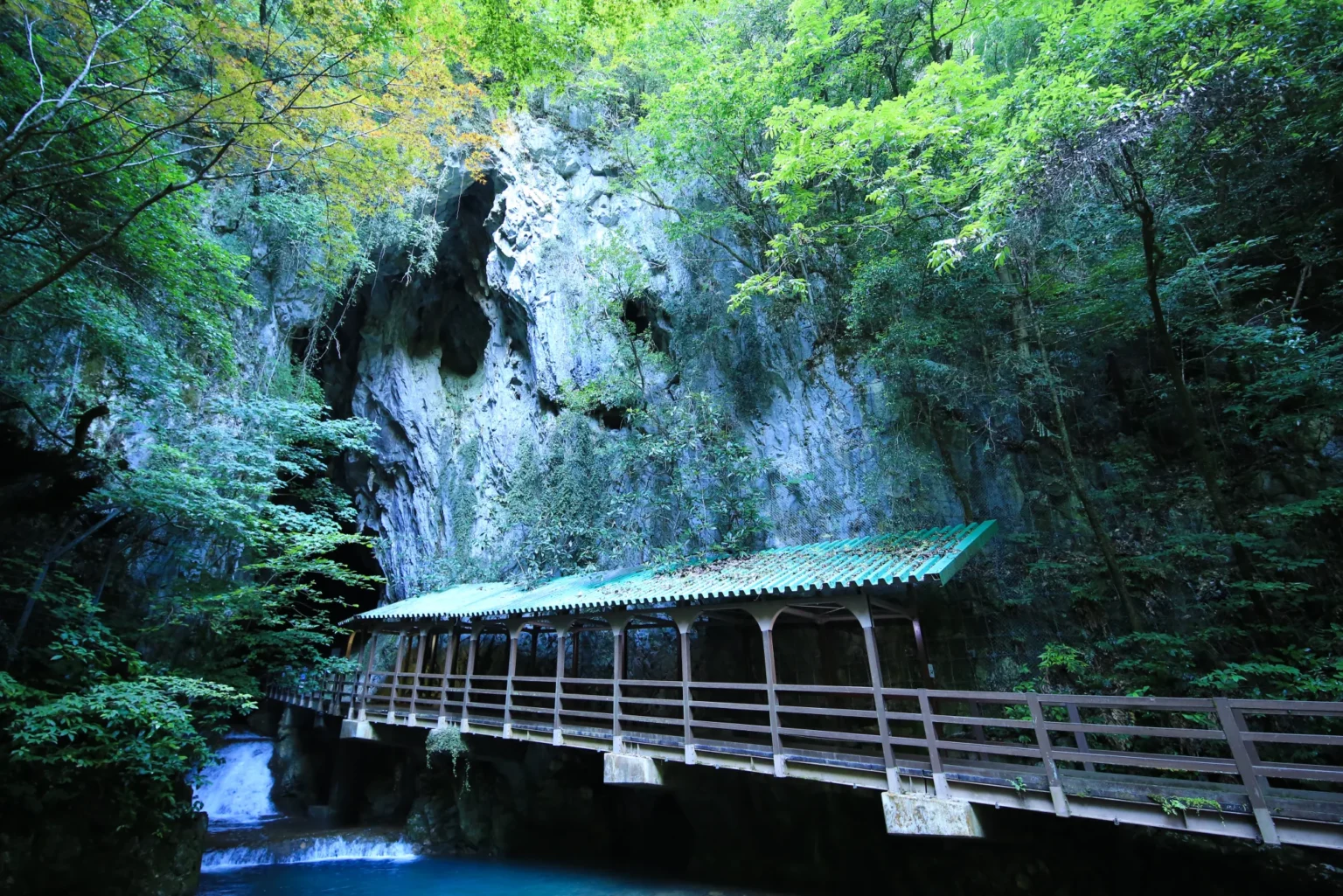
Akiyoshido is one of Japan’s largest limestone caves, carved beneath Akiyoshidai — Japan’s largest karst plateau — in Mine City, Yamaguchi. Inside, the air holds a steady 17°C all year, so on a 35°C August afternoon you step out of the heat and into a natural cold store. This is the guide I’d hand anyone routing a western-Japan summer around it: what to see underground, the plateau of white stone above, the 2026 fares and hours, and how to reach it with or without a car.
Akiyoshido Cave & Akiyoshidai: quick facts
What Akiyoshido actually is
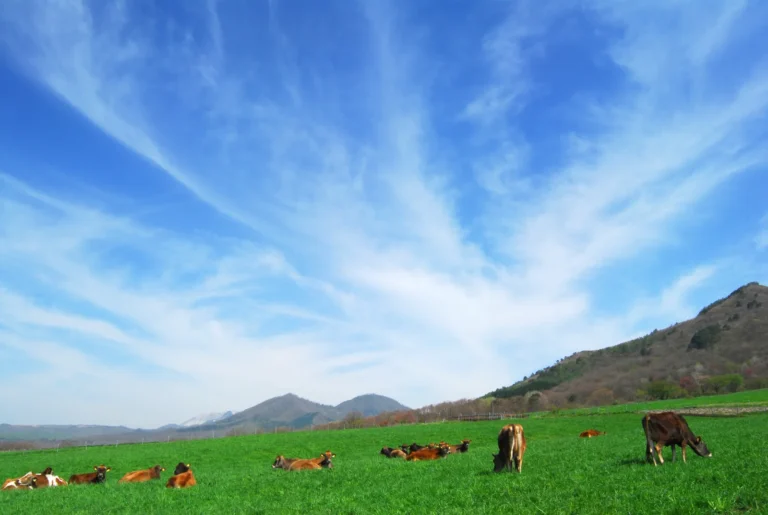
Two things stacked on top of each other. On the surface sits Akiyoshidai, a rolling green plateau studded with thousands of white limestone pinnacles — Japan’s largest karst plateau, about 54 km² between roughly 180 and 420 m elevation. Below it, 100–200 m down, water has hollowed out Akiyoshido, one of the country’s largest limestone caves — the biggest by scale, and second-longest by surveyed passage at more than 11 km. A one-kilometre stretch of that is lit and paved for visitors.
The stone is older than it has any right to be. Akiyoshidai began as a coral reef in a warm sea about 300 million years ago; the reef limestone was later lifted up and slowly dissolved by rainwater and groundwater, which is what shaped both the pinnacles on top and the cave underneath. Japan protects the cave as a Special Natural Monument (designated in 1952), and in 2026 the whole area was designated a UNESCO Global Geopark — the Mine-Akiyoshidai UNESCO Global Geopark.
How cool is Akiyoshido Cave in summer?
The cave stays at about 17°C every day of the year. Official Mine City and Yamaguchi tourism sources give that figure; the drop from a Yamaguchi summer is sharp enough that you’ll want a light layer even in August. The reason is simple physics: the thick limestone roof and the cave’s isolation from the surface keep the interior close to the local year-round average, no matter what the day above is doing. In winter the same 17°C feels warm instead. Only the zones right by the entrances swing a little with the seasons.
What to see inside: the cave’s signature sights
The lit route follows the underground river upstream from the main entrance, past a run of named formations. These five are the ones worth slowing down for.
Hyakumaizara 百枚皿 · “hundred plates”
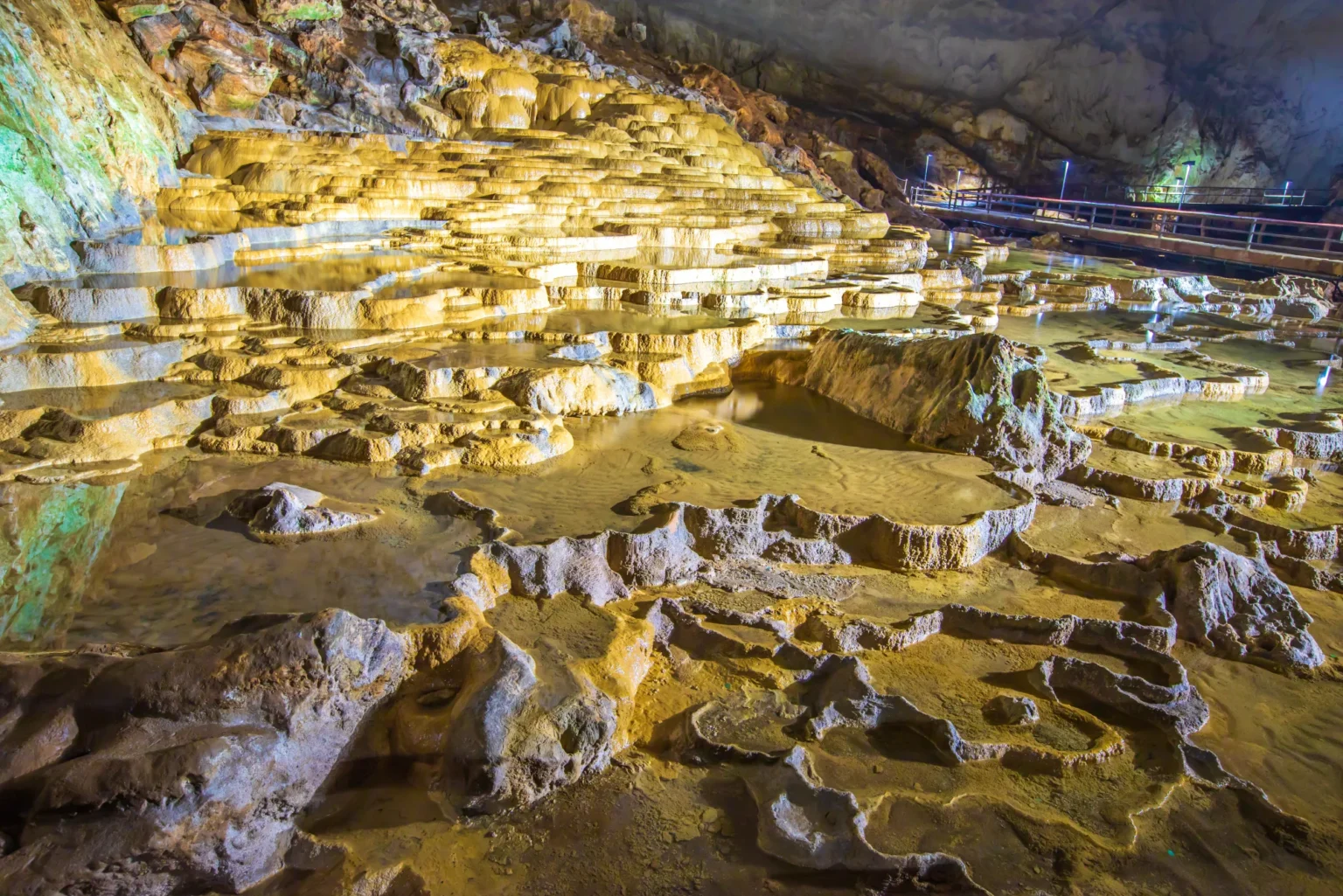
The cave’s most photographed sight: a hillside of shallow, terraced pools rimmed by ridges of dissolved limestone that the flowing water rebuilt drop by drop. It’s called “hundred plates,” but there are actually more than 500.
Kogane-bashira 黄金柱 · the Golden Pillar
The cave’s symbol — a golden-toned flowstone column about 15 m tall and 4 m thick, built up where mineral-rich water has sheeted down the wall for ages. It’s the image on most Akiyoshido postcards.
Kasa-zukushi 傘づくし · “the umbrellas”
A patch of ceiling hung with dozens of stalactites, named because they look like umbrellas crowded together in an old umbrella shop.
Donai-Fuji 洞内富士 · the underground Fuji
A broad, flowstone-draped mound whose gentle slope is said to resemble Mt. Fuji — a small underground mountain about five metres across.
Kotogafuchi & the Inegawa 琴ヶ淵・稲川
The Inegawa river runs the length of the cave and pours out at the main entrance; you walk beside its still, dark water for much of the route. Kotogafuchi, a large pool deeper in the system, is one landmark of that underground waterway.
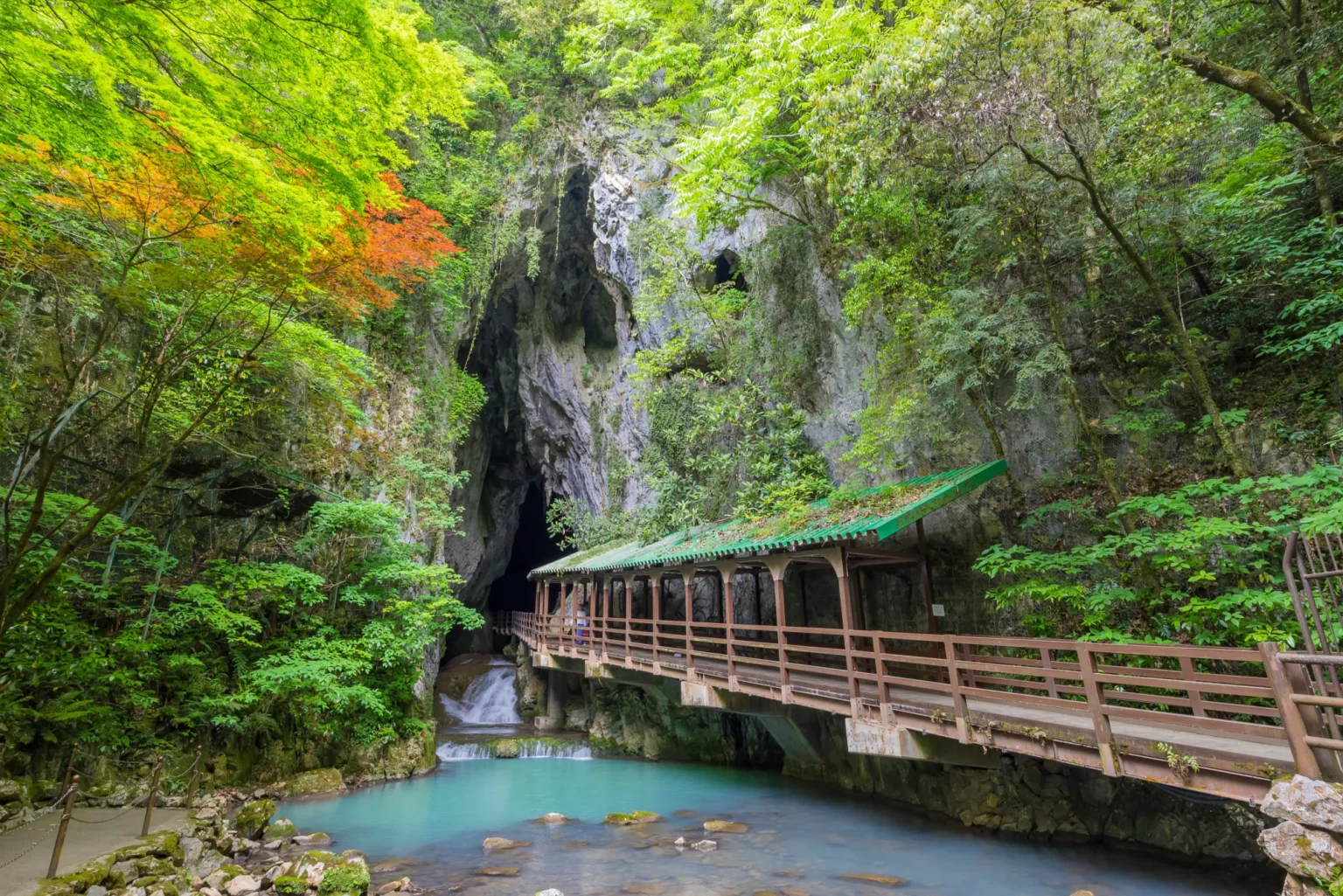
The three entrances, and how the cave connects to the plateau
Akiyoshido has three ways in, and understanding them saves you money and backtracking.
One cave, two levels, three doors
Front entrance (正面口) — at the valley mouth where the river flows out. This is the classic full walk-through and where the paid parking sits.
Kuroya entrance (黒谷口) — the upstream/far end of the lit route. Its car park is free. Enter here and you walk the course in reverse, downstream toward the main entrance.
Elevator entrance (エレベーター口) — a vertical shaft that drops from the Akiyoshidai plateau straight into the middle of the cave. It’s how you combine the cave below with the karst above in one visit; its car park is also free.
The one-kilometre show route links the main and Kuroya entrances, with the elevator surfacing at the mid-point. Most people walk in the main entrance, ride the elevator up to the plateau, and come back — or vice versa.
Akiyoshidai: the karst plateau above the cave
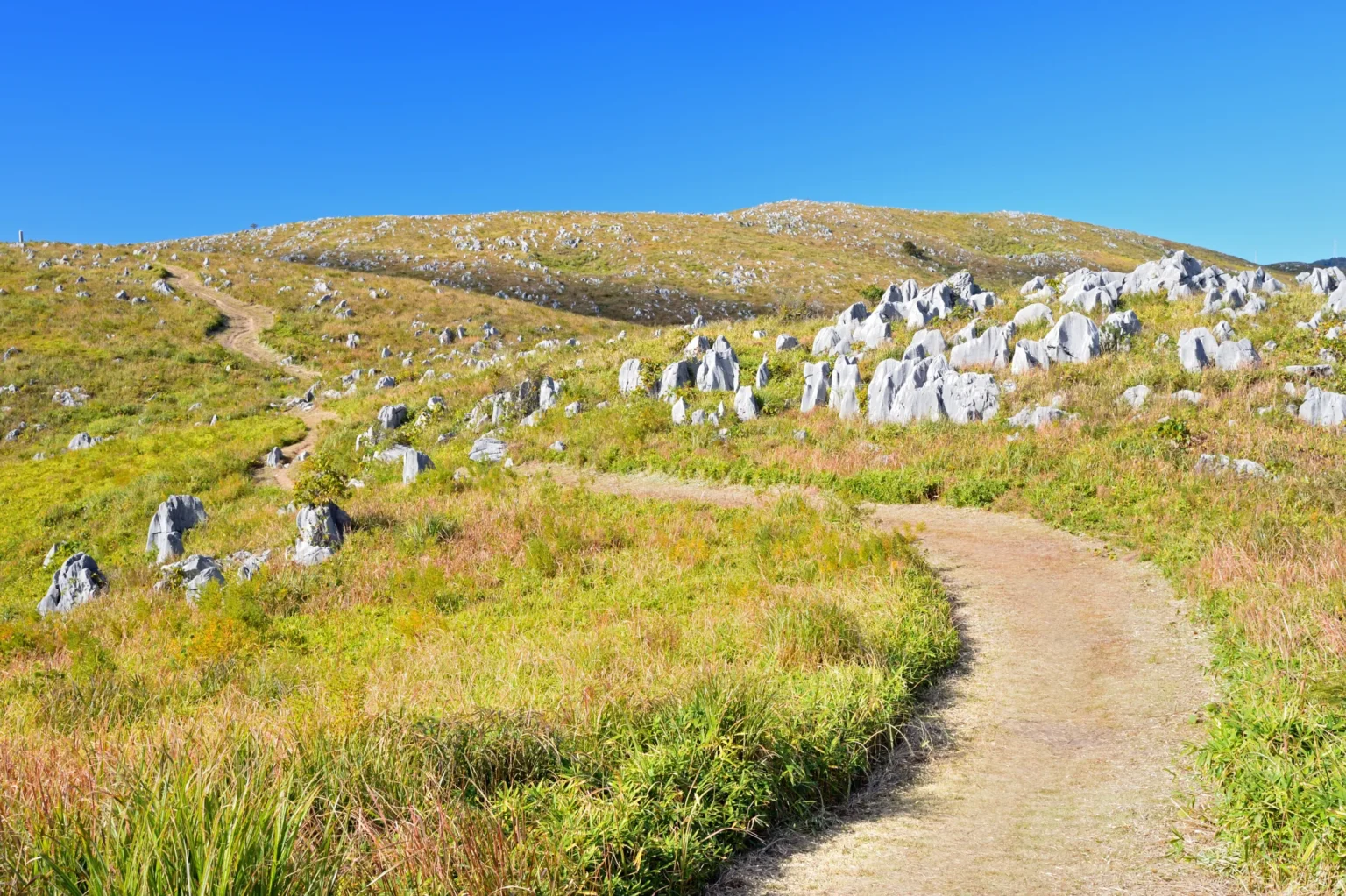
Don’t treat the cave as the whole trip — the surface is half of it. Akiyoshidai is Japan’s largest karst plateau, and its signature is the “sea of rocks”: thousands of pale limestone pinnacles poking through green summer grassland, scattered across the hills like a grazing flock. At up to about 420 m, it runs noticeably breezier than the lowland cities, and the openness is the point.
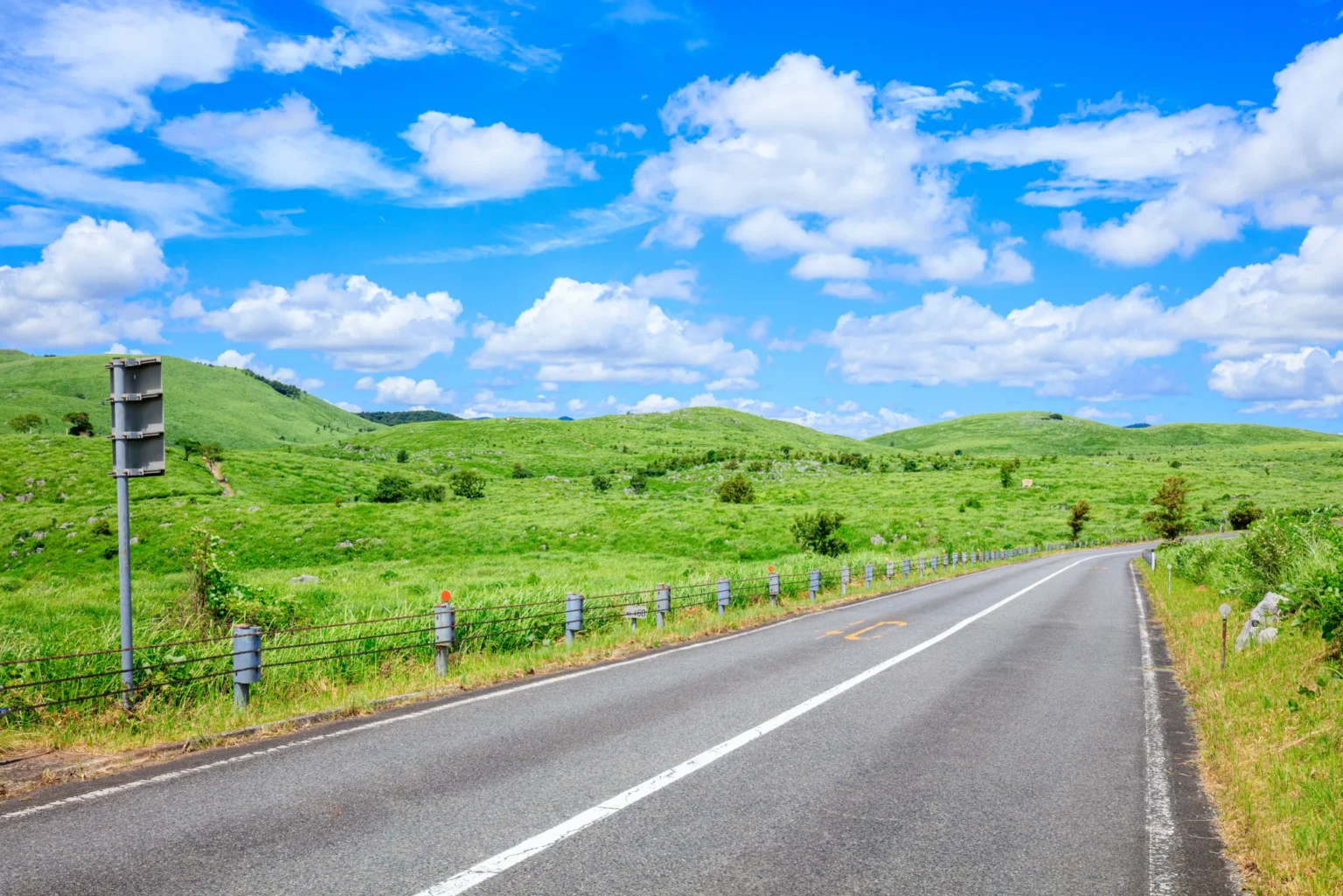
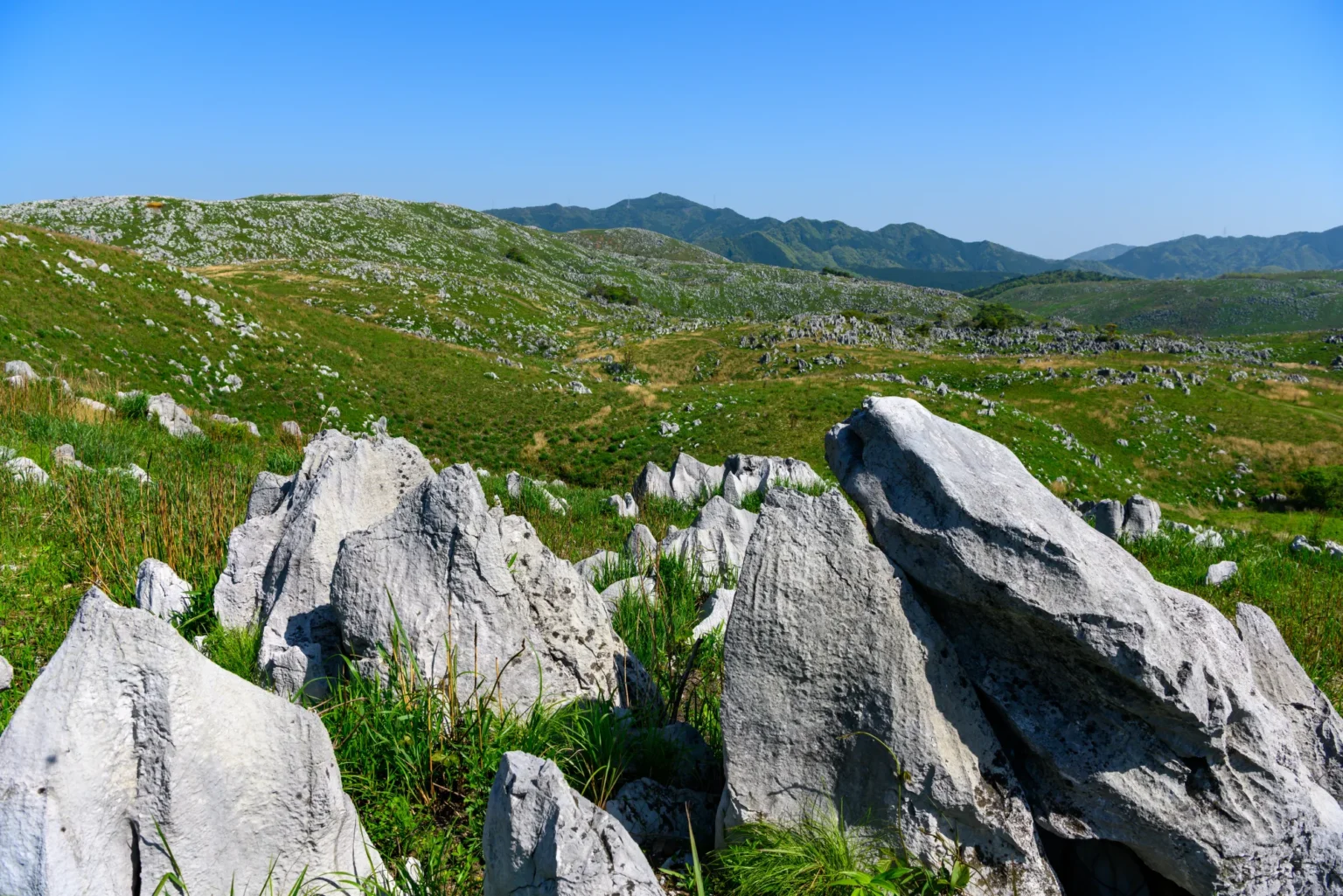
What to do on the plateau
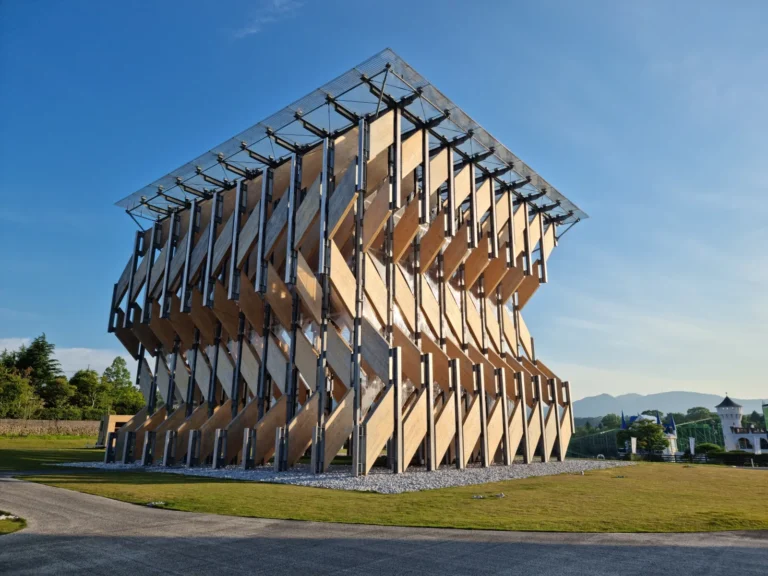
- Karst Observatory (秋吉台カルスト展望台): a free, open-air viewpoint with a circular rooftop deck for a 360° sweep over the plateau, beside the Karstar geopark centre (info, rest area, café; open 9:00–17:00). The Akiyoshidai Science Museum next door is also free.
- The Karst Road: the scenic drive that crosses the grassland past the standing stones — one of the best short drives in western Japan, and a favourite cycling route.
- Cycling: rentals near the cave bus centre and at Karstar; the signature loop, the “Akiyoshidai Mankitsu Course” along the Karst Road, runs about 28 km round trip (roughly 2 hours over rolling terrain).
- Walking trails: marked routes cross the plateau from near the observatory, from a short loop of about 1.5 km to longer trails of roughly 3.5 km and 6 km deeper into the karst — open, rolling, and cool in the plateau breeze.
One seasonal note for context: every February the plateau is deliberately burned in the yamayaki grass-fire that keeps the grassland open (the 2026 burn fell on a February day, shifted by snow). By summer that leaves only vivid green — you won’t see the burn, just the regrowth.
How do I get to Akiyoshido Cave?
This is one of the few western-Japan karst sights that genuinely works without a car — but a car opens up the plateau and the coast.
By train + bus (car-free)
- Take the Sanyo Shinkansen or JR line to Shin-Yamaguchi Station (from Hakata/Fukuoka it’s about 30–35 min by Shinkansen).
- From Shin-Yamaguchi, ride the Bocho Kotsu bus to the Akiyoshido Bus Terminal: about 40 minutes, ¥1,170 one way.
- Walk about 5–10 minutes to the cave’s main entrance and its shopping street.
By car
Exit at Akiyoshidai IC on the Ogori–Hagi Expressway (a toll-free expressway), then it’s only about 5–10 minutes to the cave. Parking is the one thing to get right: the two municipal lots at the main entrance (Lot 1 ~200 spaces, Lot 2 ~300) charge ¥500 per day, while the Kuroya and Elevator lots are free. If you don’t mind entering from the far end or the mid-cave elevator, park free.
Flying in
The nearest airport, Yamaguchi-Ube (UBJ), is domestic-only (essentially the Tokyo/Haneda route), about 45 minutes’ drive away. International and Southeast-Asian travelers realistically fly into Fukuoka (FUK) — Kyushu’s main hub, well served by regional and LCC routes — then take the Shinkansen to Shin-Yamaguchi (~30–35 min from Hakata) and the bus, or rent a car. Hiroshima Airport is a secondary gateway. Expect a gateway-plus-transfer, not a direct arrival.
Some links below are affiliate links — booking through them supports this site at no extra cost to you.
Plan an Akiyoshidai trip
When to visit, plus 2026 hours & fees
Summer is the point: the hotter the day above, the better the cave’s steady 17°C feels, and the plateau is at its greenest. Mornings are cooler on the plateau and quieter in the cave; the site is busiest through the midsummer holidays and Golden Week. The main-entrance section is paved and the easiest part, but the full route is damp with some slopes and steps, so wear shoes with grip; check the official accessible-area map if you need a step-free section.
| Season (2026) | Adult admission | Cave hours |
|---|---|---|
| Standard | ¥1,600 | 9:00–16:30 |
| Summer (Jul 1–Sep 30) | ¥1,900 (Jul 1–Aug 31) | 9:00–17:30 |
| Golden Week (peak days) | ¥1,900 | 8:30–17:30 |
| Winter (Dec 1–Feb 28) | ¥1,350 | 9:00–16:30 |
Junior-high students pay ¥1,300 and elementary students ¥850 (a little less in winter); groups of 20+ and disability-pass holders get a discount. Note the variable pricing — the ¥1,900 summer/Golden-Week rate is higher than the ¥1,600 standard fee, so it’s worth knowing before you’re at the window. Peak-season dates can shift slightly year to year, so confirm on the official Karusuto (Mine City) site for your exact date.
Where to stay & eat
The natural base is Yuda Onsen (湯田温泉), a historic hot-spring district on the edge of Yamaguchi city — about 20 minutes from Shin-Yamaguchi Station and 30 minutes from the cave. Local legend has it a wounded white fox healed its leg in the water, and the spring is prized for the soft, skin-kind (bihada) feel that reputation is built on; the district has plenty of ryokan and free public foot baths, and it doubles as a hub for Hagi and the Nagato coast. A handful of lodges sit up near the plateau itself, but choice is limited, so most travelers overnight at Yuda. Near the cave’s main entrance, a short shopping street handles lunch with local Yamaguchi dishes — kawara-soba, crisp-fried green-tea noodles served on a hot roof tile, is the regional specialty. Up on the plateau, the Karstar centre has a café for a coffee with a karst view.
Base at Yuda Onsen
Booking.com has the mainstream hotels around Yamaguchi and Yuda; Rakuten Travel is stronger for the traditional onsen ryokan in the district itself. Book the onsen town, then drive or bus out to the karst in the morning.
Make it a Yamaguchi drive
Akiyoshido is best as one stop on a one- or two-day western-Yamaguchi loop that pairs the inland karst with the coast. A common route from Shin-Yamaguchi: out to the pale-blue water and long bridge of Tsunoshima (about 1¼ hours), on to the tunnel of red gates at Motonosumi Inari (about 40 minutes more), then inland to Yuda Onsen for the night and Akiyoshidai and its cave the next morning (about 30 minutes from Yuda). If you’re building a whole cool-weather itinerary, Akiyoshido is one of the stops in my guide to Japan’s coolest summer drives, and it fits the wider 2026 coolcation idea of trading heat for altitude — or, here, for a cave.
Practical tips
- Bring a light layer. It’s a steady 17°C inside — chilly after a 35°C afternoon.
- Carry cash. The main-entrance parking is ¥500 and cash-based; rural machines are sparse.
- Wear grippy shoes. The paved path is lit but damp; it’s flat and doable for most, with the elevator as an alternative to stairs at the mid-point.
- Do both levels. Use the elevator to link the cave and the plateau rather than treating them as separate trips.
- Park free if you can. The Kuroya and Elevator lots cost nothing; only the main-entrance municipal lots charge ¥500.
Common questions
How cold is it inside Akiyoshido Cave?
About 17°C, all year round, per official Mine City and Yamaguchi tourism figures. That makes it refreshingly cool on a hot summer day (bring a light layer) and mild in winter. Only the areas nearest the entrances shift much with the seasons.
How much does Akiyoshido Cave cost in 2026?
It uses variable pricing. Adults pay ¥1,600 in the standard season, ¥1,900 in peak periods (summer Jul 1–Aug 31 and Golden Week), and ¥1,350 in winter (Dec 1–Feb 28). Junior-high students ¥1,300 and elementary ¥850. Parking at the main entrance is a separate ¥500, while the Kuroya and Elevator lots are free.
Can I visit Akiyoshido without a car?
Yes. Take the Shinkansen or JR to Shin-Yamaguchi Station, then a Bocho Kotsu bus to the Akiyoshido Bus Terminal — about 40 minutes, ¥1,170 one way. Daytime buses run roughly hourly, but check the day’s timetable and the last bus, as service thins early and late.
How long does the cave take to walk?
The lit show-cave route is about 1 km and takes roughly an hour to see (about 90 minutes round trip). Add time for the plateau above — the observatory, the Karst Road and a walk among the pinnacles — and Akiyoshido plus Akiyoshidai easily fills half a day.
What’s the difference between Akiyoshido and Akiyoshidai?
Akiyoshido (秋芳洞) is the cave below ground; Akiyoshidai (秋吉台) is the karst plateau on the surface above it. An elevator links the two, so you can do both in one visit.
When is the best time to visit?
Summer, if you want the cave’s 17°C to feel like relief and the plateau at its greenest — go on a weekday morning to beat both the heat and the crowds. Spring and autumn are milder above ground; winter is quietest and cheapest, and the cave feels warm rather than cold.
Plan the trip
Three doors into an Akiyoshidai visit. Book the onsen base first.
Keep reading
- Japan’s coolest summer drives 2026 — where Akiyoshido fits in a nationwide cool-weather list.
- Tsunoshima Bridge — the pale-blue coast to pair with the karst.
- Coolcation Japan 2026 — how I trade the summer heat for altitude.
Written by Nobu, hiddenjapan-gems.com. Last updated August 2026. Admission, hours, access and parking checked against official Mine City / Akiyoshidai tourism sources (Karusuto), Yamaguchi Prefecture tourism, and the Yamaguchi-Ube Airport site. Fares and seasonal peak dates can change — confirm the official Karusuto page for your travel date, and check the day’s Bocho Kotsu bus timetable if you’re going car-free.
Join travelers discovering Japan's hidden side
Weekly dispatches from off-the-beaten-path Japan — spots and stories you won't find in guidebooks.
No spam. Unsubscribe anytime.
Welcome aboard!
You're in. See you in your inbox soon.
![Tsunoshima Bridge 2026: 3 Views & Driving Guide [Photos]](https://hiddenjapan-gems.com/wp-content/uploads/2026/04/IMG_0545-768x432.webp)