
Hokkaido · Winter driving · 2026–27
Most visitors do not need a car for a whole winter trip in Hokkaido. The airport, Sapporo, Otaru and the big ski resorts are easier by train or bus. A car helps on a few rural days, such as daytime visits to the crane sites near Kushiro or a loop through eastern Hokkaido, but only if you hold the right licence documents, have recent experience on packed snow and ice, and can drive in daylight with a plan for bad weather. This guide goes route by route, then covers licences, tyres, tolls, insurance and what to do if things go wrong.
Should you rent a car in Hokkaido in winter?
Only rent if you can say yes to all five of these:
- Documents: you have a qualifying 1949 Geneva International Driving Permit and your passport (carry your home licence too), or an eligible licence with an approved Japanese translation and your passport. See the licence section.
- Experience: you have driven recently on packed snow and ice. A rental in Hokkaido is not the place to learn.
- Benefit: the car does something transit cannot on that day, such as reaching places with no bus at the times you need.
- Daylight: you can do the drive between sunrise and sunset, and you are not driving straight after a long flight.
- A fallback: if a blizzard is forecast, you will stay put or switch to a train, bus or tour, rather than drive because the trains have stopped.
| Route | Verdict | Without a car |
|---|---|---|
| New Chitose Airport–Sapporo | Take the train | JR, fastest 33 min, ¥1,230 |
| Sapporo–Otaru | Take the train | JR, ¥800 |
| Airport or Sapporo–Niseko | Coach for a resort stay; consider a car if your accommodation or ski areas lack a useful coach or shuttle | Reserved ski coaches from the airport and city hotels |
| Furano and Biei | Split: no car for Furano skiing; a car can help for rural Biei | Train or bus to Furano; a winter tour for Biei |
| Asahikawa–Asahiyama Zoo | Take the bus | Bus from Asahikawa Station, ¥670 |
| Abashiri and Shiretoko | Transit for Abashiri; transit or a tour for Utoro | Bus to the Aurora terminal; Shari Bus to Utoro, ¥1,650 |
| Kushiro–Tsurui (cranes) | A car helps, but not for a novice on snow | Akan Bus, Kushiro–Tsurumidai ¥1,020; or a tour |
| Tokachi | Bus for Obihiro and Tokachigawa Onsen; a car for rural Tokachi | Tokachi Bus route 45 to Tokachigawa Onsen |
If a car fits one part of your trip
DiscoverCars is a booking platform that compares rental companies; the company at the counter supplies the car. Before you pay, check with that company in writing that the car has studless winter tyres, whether 4WD is guaranteed or only requested, whether it rents ETC cards and the Hokkaido Expressway Pass, and what its CDW and NOC terms are.
If you want a winter discount in Hokkaido
TOCOO!, a Japanese rental booking site with an English version, lists two Hokkaido offers this winter. Its Nippon Rent-A-Car Winter Bargain gives 30% off the regular price in Hokkaido until 31 January 2027, except from 25 December 2026 to 2 January 2027. Its Nissan Bargain gives 50% off the X-Trail e-4ORCE (an e-POWER 4WD) and the Serena minivan in Hokkaido until 31 March 2027. TOCOO! has also given Hidden Japan Gems readers the code IJMEMZ, which it says takes ¥1,000 off a base rental fee of ¥10,000 or more (options excluded). TOCOO!’s written terms do not say whether the code can be combined with these offers, so check which discounts apply and confirm the final total before you book. Ask the same questions about tyres, 4WD, ETC and NOC as above.
Which Hokkaido winter routes are better by car?
Each route below gives the no-car option first. Do not assume a map app’s journey time allows for snow; allow extra time and plan to drive in daylight.
New Chitose Airport to Sapporo
Verdict: take the train. Airport trains reach Sapporo in as little as 33 minutes by Special Rapid or 37 minutes by Rapid (other departures take longer), for ¥1,230 (¥2,230 with a reserved seat). For a stay in central Sapporo, the train saves collecting a car after a long flight and paying to park in the city; if your trip continues into the countryside, rent in Sapporo on the day you leave.
Sapporo to Otaru
Verdict: take the train. JR costs ¥800 (¥1,800 with a reserved seat). Otaru’s canal area is a short walk from the station, so a car mainly adds a parking problem.
New Chitose or Sapporo to Niseko
Verdict: take a coach if you are staying at one resort. Reserved ski coaches run from the airport and from Sapporo hotels to Grand Hirafu, Niseko Village and Annupuri. There is no continuous expressway to Niseko: the expressway reached Niki in March 2025, and the extension on toward Kutchan is still under construction. Consider a car only if your accommodation is outside the coach and shuttle routes or you plan to ski areas without a useful connection, and only if you have recent snow-driving experience. Times, fares and child-seat rules for every coach are in Tokyo or Sapporo to Niseko.
Furano and Biei
Verdict: no car for skiing in Furano; a car can help in Biei. Furano’s ski areas can be reached by train and bus; see Furano ski resort for the buses and their last departures. Biei’s winter sights are spread out across farmland, which is where a car helps. If you are not an experienced snow driver, book a winter tour instead. Do not rent a car on the spot because you missed the last bus and then drive back in the dark.
Asahikawa to Asahiyama Zoo
Verdict: take the bus. Buses run from Asahikawa Station to the zoo; the current fare is ¥670 after the September 2026 revision. The operator’s winter timetable notice still showed last season’s dates when I checked, so check the return times on its site before you go.
Abashiri and Shiretoko (drift ice)
Verdict: transit for Abashiri; transit or a tour for Utoro. Buses run from Abashiri Station to the terminal of the Aurora drift-ice cruise ship. Shari Bus publishes a winter timetable for 1 November 2026 to 27 April 2027 to Utoro (Shiretoko-Shari to Utoro ¥1,650), and its Airport Liner runs from Memanbetsu Airport to Utoro from 16 January to 7 March 2027. The Shiretoko Pass (Route 334 between Utoro and Rausu, 23.8 km) closed on 4 November 2026 and is planned to reopen in late April 2027; Utoro itself can still be reached along the coast. Drift ice and cruises are never guaranteed.
Kushiro to Tsurui (red-crowned cranes)
Verdict: a car helps, but not for a novice winter driver. The viewing sites are spread out, and many visitors want to be there early in the morning; Hokkaido warns that deer are a particular risk around dawn and dusk. Akan Bus’s regular Tsurui line serves the area (Kushiro to Tsurumidai ¥1,020, to Tsurui ¥1,280), and the Ito Sanctuary is about a 15-minute walk from its bus stop. Check the current departures with Akan Bus, or take a tour.
Tokachi (Obihiro and beyond)
Verdict: bus for Obihiro and Tokachigawa Onsen; a car only for rural Tokachi. Tokachi Bus route 45 connects Obihiro and Tokachigawa Onsen; check its route and fare tables for times. Farms, lakes and small onsen further out are where a car helps.
Planning the whole trip? My 5-day Hokkaido winter itinerary uses trains and buses throughout, and Tokyo to Hokkaido compares flying with the Shinkansen.
Where to stay if you go without a car
On the routes where the verdict is the train or a coach, staying close to the station or the slope keeps the car out of the plan.
JR Tower Hotel Nikko Sapporo
For a Sapporo base close to the airport train. The hotel says it has direct access to JR Sapporo Station.
Asahikawa, near the station
For the zoo by bus. The zoo buses leave from Asahikawa Station, so a hotel within walking distance of the station keeps the day car-free.
Furano Natulux Hotel
For skiing Furano by train and bus. The hotel says it is 1 minute on foot from JR Furano Station.
AYA Niseko
For a Grand Hirafu base reached by ski coach. The resort lists it beside the Family lift, and the hotel describes its location as ski-in, ski-out.
Can you legally drive in Japan with your licence?
The rules depend on who issued your licence, not on your nationality. Japan’s National Police Agency (NPA) sets out two routes for visitors:
| Route | Who it is for | What to carry |
|---|---|---|
| International Driving Permit (IDP) | Licences from countries on the NPA’s 1949 Geneva Convention list, including the US, Australia, the UK, Canada, Singapore, Malaysia, the Philippines, Thailand, South Korea and Hong Kong | The 1949-format IDP and your passport; also carry your home licence (the US government tells US drivers to) |
| Japanese translation | Licences issued in Switzerland, Germany, France, Belgium, Monaco or Taiwan | Original licence, a Japanese translation from an approved organisation (such as JAF), and your passport |
| Neither | For example, licences from mainland China or Indonesia, or a Vietnamese IDP in the 1968 Vienna format | No visitor route; an online “international driver’s licence” does not help |
- Only the 1949 format counts. A permit issued under the 1968 Vienna Convention alone does not qualify; the NPA specifically warns that Vietnam’s Vienna-format IDP cannot be used in Japan.
- US drivers: the US government names AAA and the American Automobile Touring Alliance as the authorised issuers.
- How long: you can drive for up to one year from landing in Japan, or until your IDP or home licence expires, whichever comes first. An IDP is valid for one year from issue. People registered as residents of Japan who leave for less than three months do not restart this year.
- Entry stamp: rental counters may need to see your date of landing. JNTO advises asking for an entry stamp if you use the automated immigration gates.
Are winter tyres enough, or do you need 4WD?
| Company | Studless tyres | 4WD |
|---|---|---|
| Toyota Rent a Car | Standard in Hokkaido, generally 1 Nov–5 May (Obihiro from 31 Oct); seasonal rates apply, and the Sapporo franchise says it makes no separate tyre charge | Sapporo franchise: ¥1,650 per 24 hours to specify 4WD, subject to availability |
| Nippon Rent-A-Car | Standard 1 Nov 2026–20 Apr 2027; ¥660/day winter charge (charged for up to ten days on rentals of up to a month) | Standard in the same period |
| Times Car Rental | Standard 1 Nov 2026–15 Apr 2027; ¥660 per 24 hours, maximum ¥6,600 | ¥1,650 per 24 hours |
- 4WD helps you pull away; it does not help you stop. Braking on ice depends on tyres and speed.
- Chains: under a “chains required” restriction, studless tyres and 4WD are not exempt. MLIT’s list of chain-control sections includes none in Hokkaido, but live restrictions can still apply.
- At pickup: check that the tyres are marked studless, ask for a snow brush and scraper, and check the washer fluid.
What makes winter driving in Hokkaido dangerous?
| Hazard | Why it matters | What to do |
|---|---|---|
| Ice and packed snow | In a JAF test with the same car, ABS and studless tyres, braking took about twice as far on packed snow and seven times as far on ice as on a wet road | Slow down, leave at least twice your dry-road gap (Hokkaido Police) and avoid sudden braking, acceleration or steering |
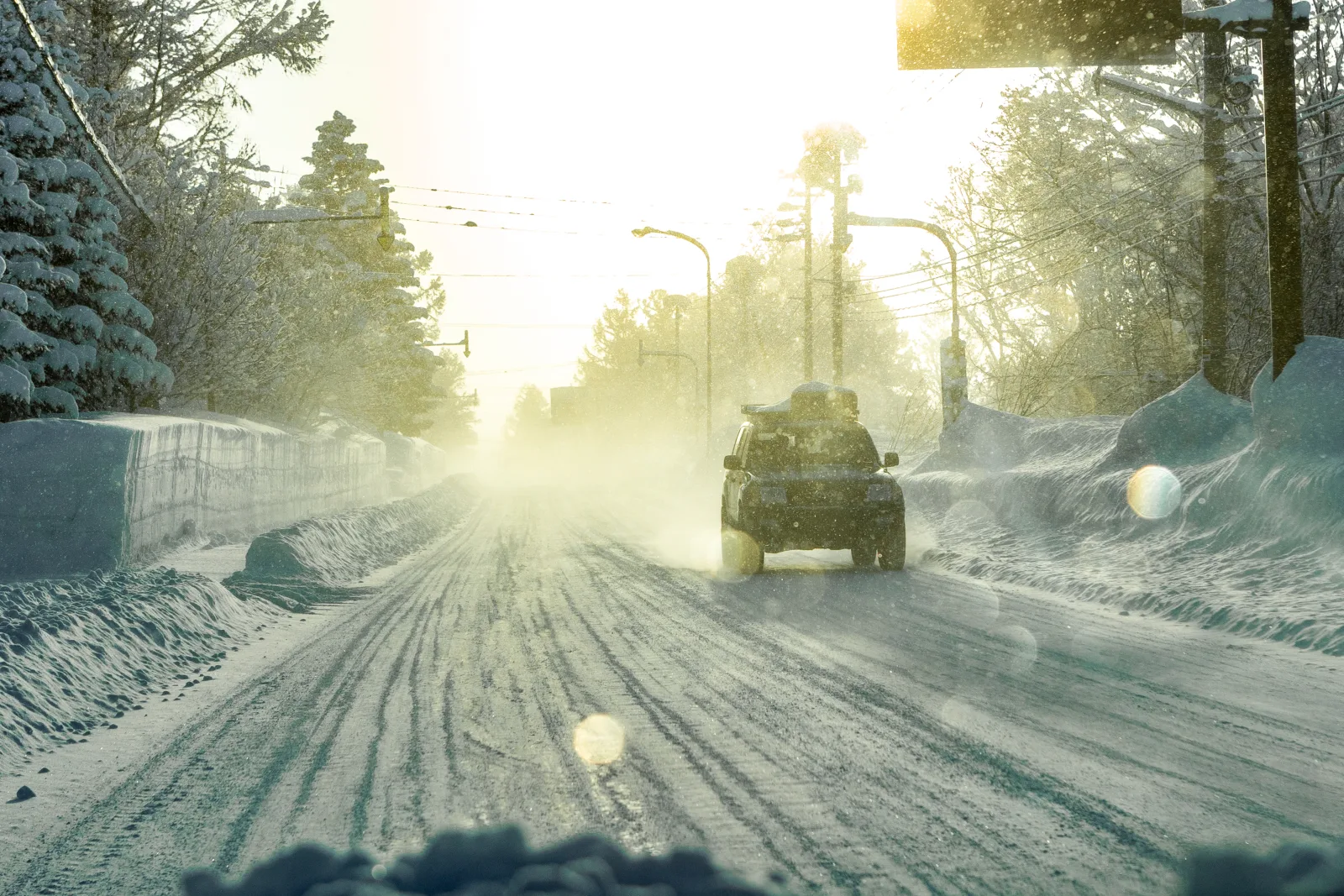
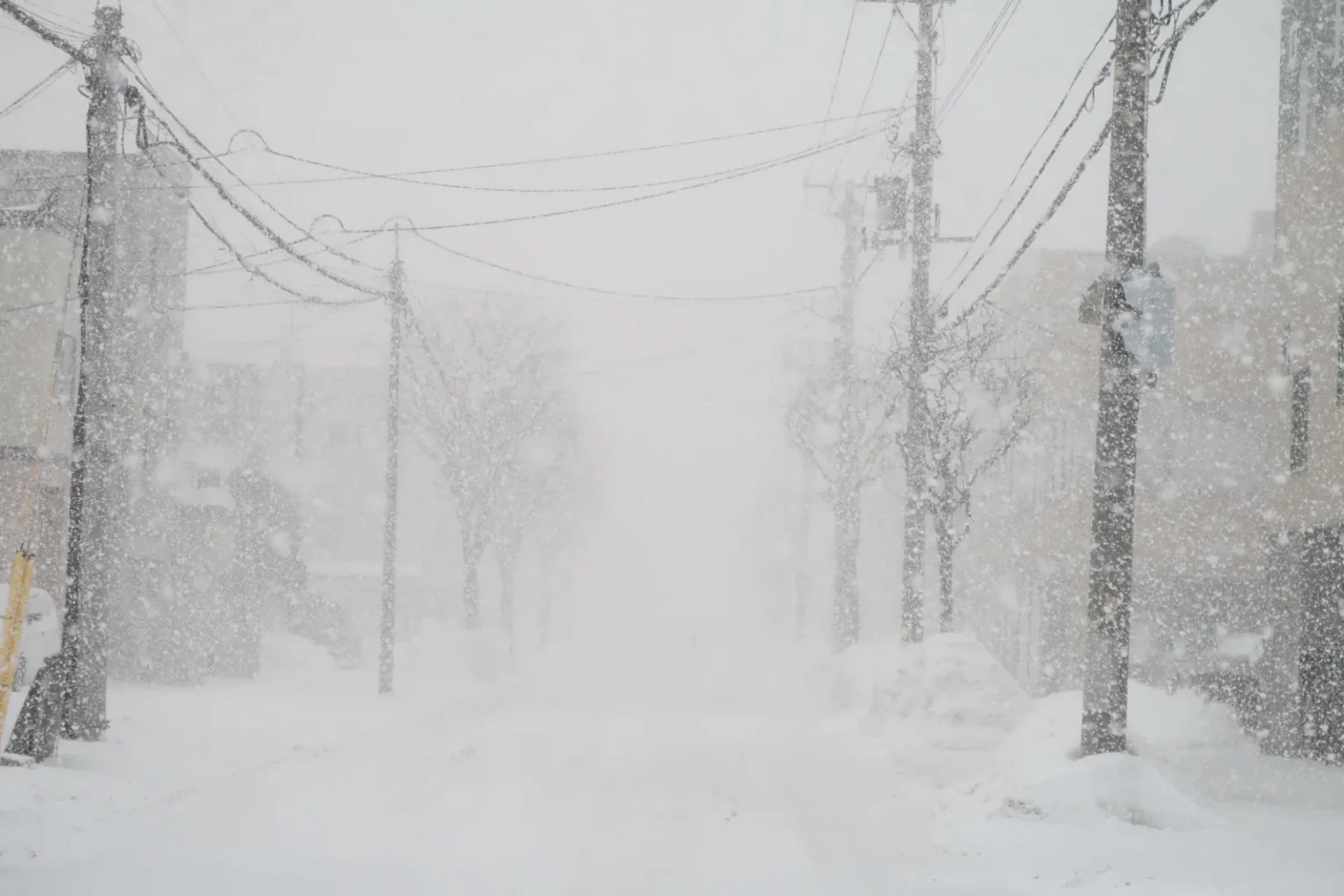
| Blizzards and whiteouts | Blowing snow can hide the road and the car in front | Do not set out when blizzards are forecast; if one starts, wait at a roadside station, shop or service station |
| Deer | Police recorded 6,705 deer-related accidents in Hokkaido in 2025, up from 5,460 in 2024 | Take extra care at dawn and dusk; deer move in groups, so another may follow the first |
| Short days | In Sapporo on 15 January 2027 the sun rises at 07:03 and sets at 16:24 | Plan to arrive before dark |
For trains and flights in heavy snow, see travelling in Japan in heavy snow.
How do you check weather and road closures?
- The day before: check the forecast and warnings from the Japan Meteorological Agency, and plan a version of the day without the car.
- On the morning: check Northern Road Navi (Hokkaido road and winter-road information), MLIT road information and, for expressways, NEXCO’s traffic site or JARTIC.
- Do not go if a blizzard is forecast on your route, a road on it is closed, or you would arrive after dark.
Which extra rental charges should you budget for?
- Seasonal charges: studless tyres and 4WD can be separate charges that add up: at Times’ normal rates, ¥660 for tyres plus ¥1,650 for 4WD is ¥2,310 per 24 hours before caps (see the table above).
- ETC card: most rental cars have an ETC reader, but the card is separate (Toyota charges ¥550 per rental).
- Hokkaido Expressway Pass (HEP): unlimited expressway use for 4–8 consecutive days, for foreign passport holders and Japanese nationals with permanent residency abroad, through a participating rental company with its ETC card. Ordinary car: 4 days ¥7,700, 5 days ¥9,600, 6 days ¥11,600, 7 days ¥13,500, 8 days ¥15,400.
- Tolls without a pass: Sapporo-Minami to Asahikawa-Takasu (133.2 km) costs ¥3,800 for an ordinary car.
- Not included above: the base rental rate, fuel, parking and any one-way drop-off charge. Confirm the base rate and any drop-off charge in your rental quote; budget separately for fuel and parking.
- Protection: CDW plus an NOC waiver adds about ¥1,650 per 24 hours on Toyota’s package, or ¥1,540–¥2,640 a day at Nippon (CDW plus ECO), depending on the car class (next section).
What do insurance, CDW and NOC cover?
| Layer | What it is | Typical amount |
|---|---|---|
| Included insurance | Compulsory insurance plus the company’s cover for injury, property and the car; property and car damage carry a deductible | Usually ¥50,000 deductible for property and for the car |
| CDW | Waives your deductible for covered damage (Nippon applies it to the first accident only if there are several in one rental) | Toyota usually ¥1,100 per 24 hours; Nippon ¥1,100–¥2,200 a day |
| NOC | A charge for the time the car is out of service after damage, even with CDW | ¥20,000 if the car is returned under its own power to the designated location; ¥50,000 otherwise |
| NOC waiver | An extra option that covers eligible NOC | Toyota’s CDW plus NOC package usually ¥1,650 per 24 hours; Nippon’s ECO ¥440 a day |
- Report every accident, even minor damage, to the police and the rental company; incidents you do not report may not be covered.
- DiscoverCars’ Full Coverage works differently: you pay the rental company’s charge first, then request reimbursement from DiscoverCars for eligible costs, with documents, within 90 days of drop-off, subject to its coverage limit and exclusions. It does not waive anything at the counter.
What should you do after a crash, breakdown or whiteout?
- First prevent a second crash: if you can, move the car out of traffic and switch on the hazard lights. On an expressway, warn traffic behind you (hazard lights, flares, a warning triangle), then, once you have checked for approaching traffic, move everyone to a safe place away from the lanes, such as outside the guardrail; NEXCO says it is not safe to wait in the car.
- Injury or fire: call 119. Police: call 110, for every accident.
- Tell the rental company straight away. Photograph the scene and the damage only from a safe place, never from the traffic lanes.
- Breakdown or stuck in snow: JAF road service on #8139 or 0570-00-8139, 24 hours; from an overseas mobile phone, call JAF’s Kanto call centre, which covers Hokkaido, on 03-5730-0111. JAF offers free phone interpreting. Road service is not automatically free because the car is a rental; check what your rental company covers.
- Stranded in snow: if snow builds up around the car, turn the engine off. Snow blocking the exhaust can cause fatal carbon-monoxide poisoning, and opening a window is not enough protection. If you must run the engine for warmth, keep clearing snow from around the exhaust. Call for help, and do not walk off into a blizzard.
- Carry: warm clothing, boots, gloves, a shovel, food, water and enough fuel.
Official sources behind the figures above, checked on 4 November 2026
- Licences: NPA, driving with a foreign licence; NPA Geneva Convention list; NPA IDP formats by country (Vietnam, p. 77); JAF translations; USAGov IDP; JNTO car FAQ; Nippon rental procedure
- Tyres and 4WD: Toyota studless table; Toyota Rent-a-Lease Sapporo notice; Nippon winter season; Times studless; MLIT chain controls
- Expressways: Hokkaido Expressway Pass; Toyota ETC card; NEXCO East toll search; Hokkaido Development Bureau, expressway to Niseko
- Roads: Northern Road Navi; MLIT road information; NEXCO traffic; Shiretoko Pass winter closure 2026–27
- Weather: Japan Meteorological Agency warnings
- Safety: JAF braking test; Hokkaido Police winter driving; Hokkaido Police deer accidents; Hokkaido Government deer guidance; Hokkaido Government blizzard precautions; JAF carbon monoxide; NAOJ Sapporo, January 2027
- Emergencies: JAF accident steps; JAF road service; NEXCO accident steps
- Insurance: Toyota terms; Nippon guide; Nippon ECO; MLIT compulsory insurance; DiscoverCars role; DiscoverCars Full Coverage claims
- Transit: JR Hokkaido fares; JR airport trains; Asahikawa Denkikidou zoo bus; Aurora access; Shari Bus; Shari Bus winter 2026–27; Airport Liner; Akan Bus fares; Akan Bus destinations; Tokachi Bus routes
Join travelers discovering Japan's hidden side
Weekly dispatches from off-the-beaten-path Japan — spots and stories you won't find in guidebooks.
No spam. Unsubscribe anytime.
Welcome aboard!
You're in. See you in your inbox soon.