Miyazaki · Aoshima · Shrine & Coast
Aoshima is a tiny subtropical island off Miyazaki City — small enough to walk around in well under an hour — given over entirely to a vermilion shrine set in a near-northernmost wild palm forest, and ringed by the wave-cut rock terraces locals call the “Devil’s Washboard.” You cross a footbridge to reach it, the grounds are free, and it has become Miyazaki’s most-loved spot for couples, tied to one of Japan’s oldest sea-god myths. Come at low tide, when the terraces are out of the water.
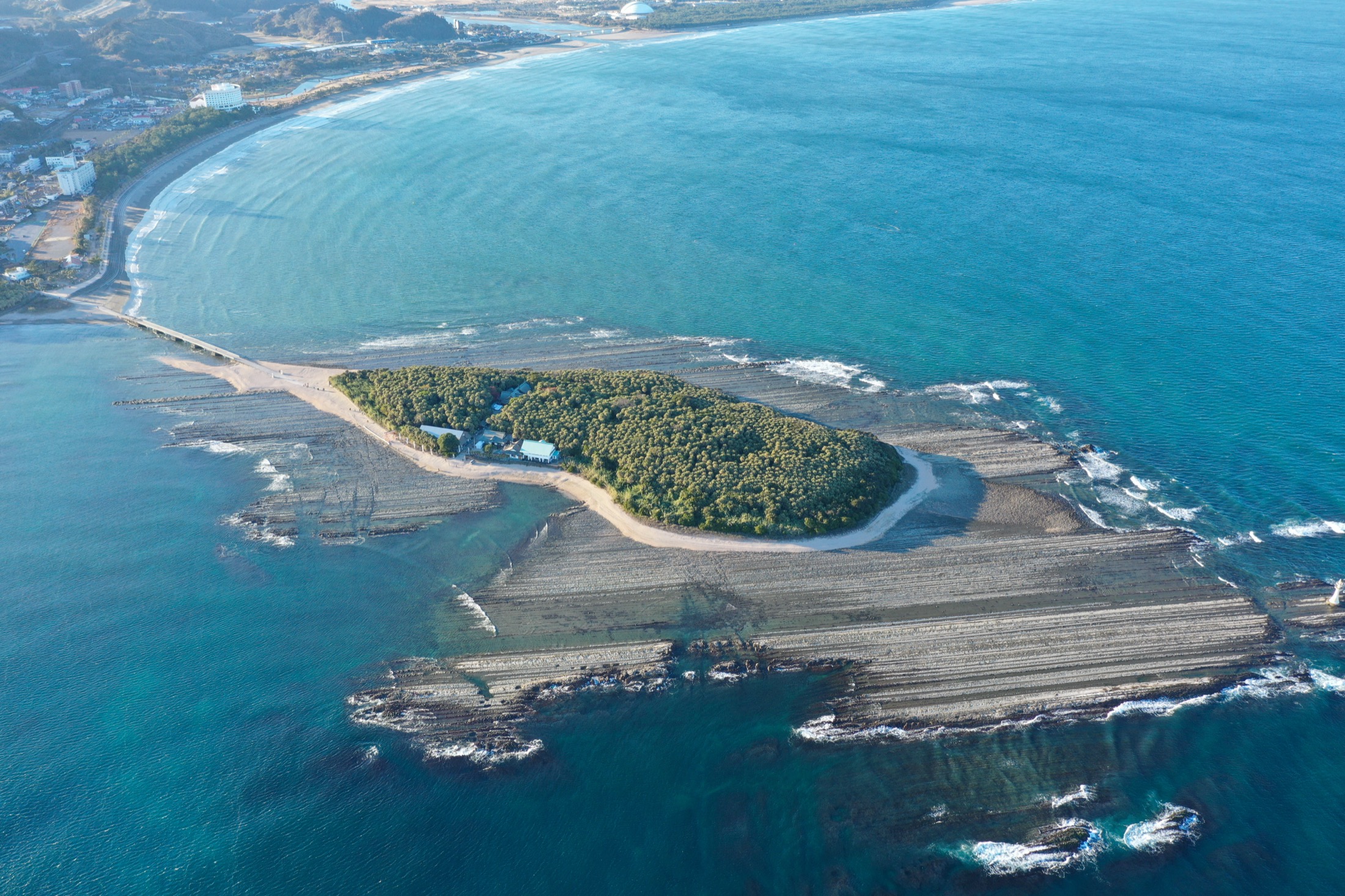
The island and the Devil’s Washboard
The first thing you see is the rock. Ringing Aoshima — and running for kilometres along the Nichinan coast — are long, regular ridges of stone that look exactly like an old scrubbing board, which is how they got the name oni no sentakuita, the Devil’s Washboard. They formed from tilted, alternating layers of harder sandstone and softer mudstone laid down on an ancient sea floor; the soft layers wore away and the hard ones were left standing as the waves cut across them. The formation was made a National Natural Monument back in 1934. It’s at its best at low tide — at high water most of it is submerged — so it’s worth checking tide times before you go.
The island itself is a small jungle. Its subtropical plant community — dense with biro fan palms (Livistona) and more than two hundred species in all — is a designated Special Natural Monument (a higher rank than the rocks), and one of the northernmost places these palms grow wild in the Northern Hemisphere. Walking from the bright, exposed beach into the green shade of the palms is half the experience.
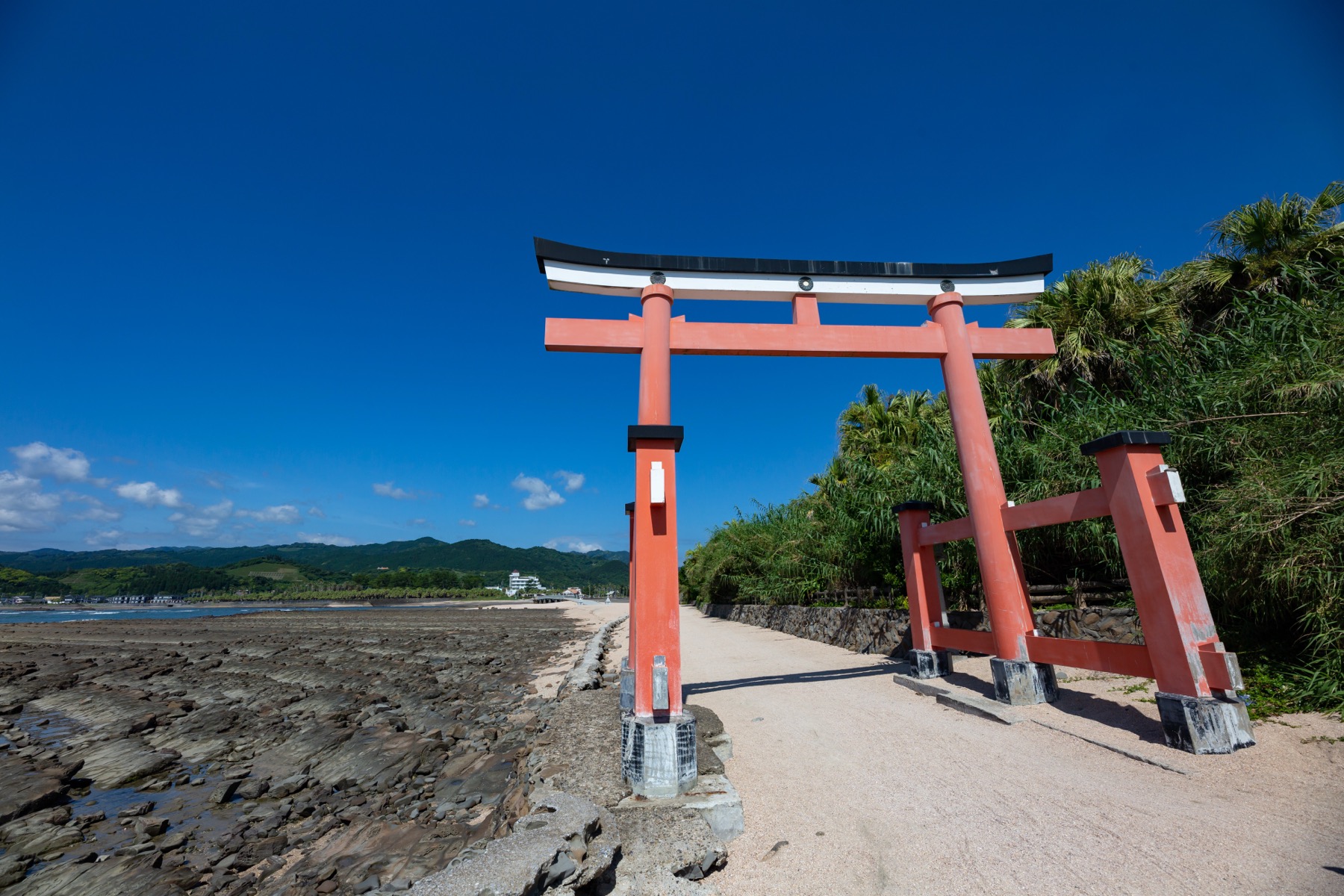
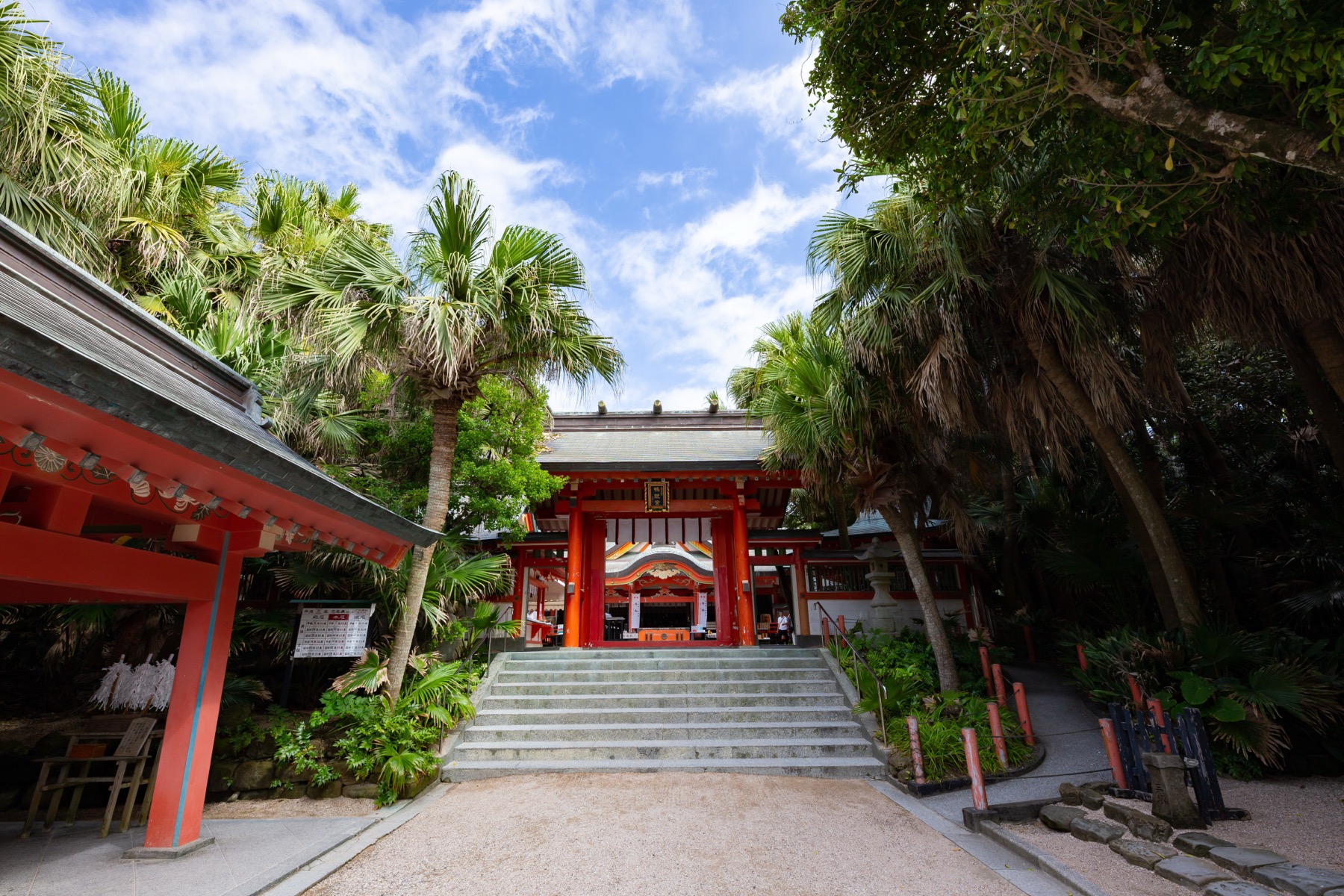
Aoshima Shrine
The whole island is the precinct of Aoshima Shrine, and its vermilion buildings sit right in the palm jungle. It enshrines Hikohohodemi — better known as Yamasachihiko, the “luck of the mountains” — together with his consort Toyotamahime and the deity Shiotsutsu-no-okami. The shrine is woven into the Umi-sachi / Yama-sachi myth of the Kojiki: this is where Yamasachihiko is said to have returned after his time in the palace of the sea god, having married the sea god’s daughter. That love story is why people come here to pray for en-musubi — good relationships and marriage — along with safe childbirth and safe voyages.
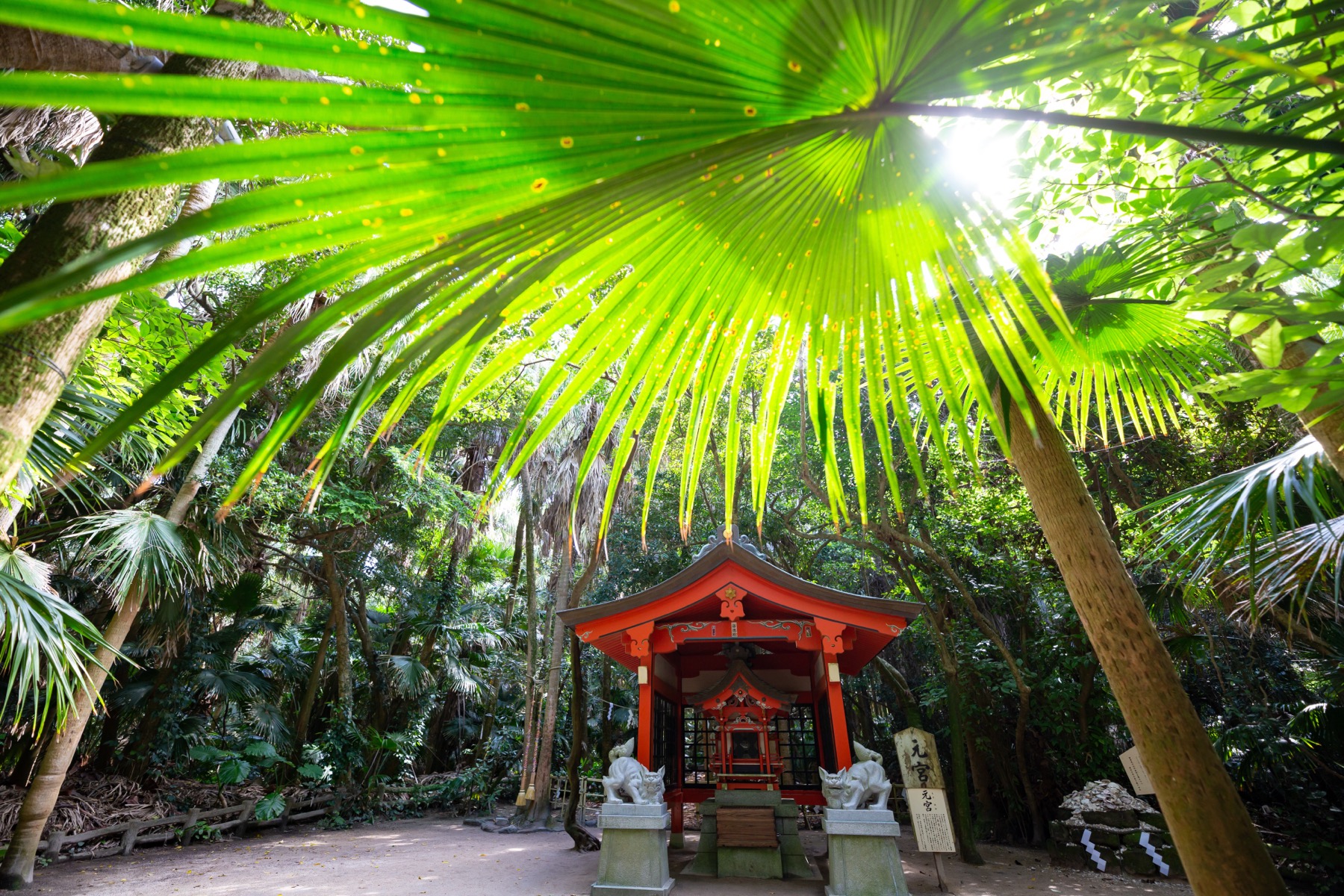
Don’t stop at the main hall. A path through the palms — the old “prayer road” — leads to the Motomiya, the original inner shrine deep in the forest, on the spot where Yayoi-period pottery and beads were dug up. It’s the quietest, most atmospheric corner of the island.
Little rituals to try
Throw a clay disc
At ama-no-hiraka-nage you toss small flat clay discs (¥200 each) toward a sacred spot; if one clears the rope, your wish is said to be granted.
Wish with a shell
In the masago-no-kaibumi custom you gather a cowrie shell from the beach and leave it with a wish at the wave-shaped rocks near the Motomiya.
Couple’s charms
This is an en-musubi shrine, so the amulets and ema lean to couples and relationships — a popular stop for two.
The myth museum
The Himuka Mythology Museum on the island tells the sea-god story with wax figures; it has its own admission, separate from the free shrine.
When & how to visit
The island and shrine grounds are free and open-air, from around 6:00 to sunset; the amulet and goshuin office keeps shorter hours (roughly 8:00–17:00). By train it’s the easy option: the JR Nichinan Line to Aoshima Station, about 30 minutes from Miyazaki Station, then a roughly 10-minute walk to the footbridge — no cars cross to the island, so everyone arrives on foot over the bridge. If you drive, note there’s no car park on the island; use the lots on the mainland (a short walk away) and check the current rate.
Staying near Aoshima
Aoshima has a cluster of seaside hotels and the area pairs well with a night in Miyazaki city. Booking has the widest spread along the coast; Rakuten Travel is good for the Japanese-run inns and onsen.
Good to know
What is the Devil’s Washboard?
Wave-cut rock terraces of tilted, alternating sandstone and mudstone that ring Aoshima and run along the Nichinan coast — a National Natural Monument since 1934. They look like a giant scrubbing board, and are best seen at low tide when they’re out of the water.
Is Aoshima Shrine free?
Yes — the island and shrine grounds are free and open-air, roughly 6:00 to sunset (the amulet office keeps shorter hours). You only pay for things like the clay-disc throwing (¥200), amulets, or the separate mythology museum.
What is Aoshima Shrine known for?
Romance. It enshrines the sea-god myth couple Yamasachihiko and Toyotamahime, so it’s a popular en-musubi (matchmaking) shrine for couples, also prayed to for safe childbirth and safe voyages. The vermilion buildings sit in a subtropical palm forest.
How do I get to Aoshima?
Take the JR Nichinan Line to Aoshima Station — about 30 minutes from Miyazaki Station — then walk roughly 10 minutes to the footbridge. No cars cross to the island; drivers park on the mainland.
How long do I need?
About 30–60 minutes for the shrine, longer if you walk the rock terraces, the beach and the Motomiya inner shrine. Most visitors spend around an hour.
When’s the best time to go?
A clear day at low tide. Low tide exposes the Devil’s Washboard; high tide largely covers it. The subtropical greenery looks good year-round.
Obi Castle & Castle Town
Down the coast: Obi’s preserved samurai streets and castle.
Udo Jingu
The cave shrine down the Nichinan coast — and the lucky-ball toss.
Cape Toi
Wild horses on the grassland at Miyazaki’s southern tip.
Takachiho Gorge
The boat to Manai Falls in Miyazaki’s myth country, up north.
Plan a Miyazaki Coast Trip
Aoshima sits on the Nichinan coast road. Three ways to build the day.
Join travelers discovering Japan's hidden side
Weekly dispatches from off-the-beaten-path Japan — spots and stories you won't find in guidebooks.
No spam. Unsubscribe anytime.
Welcome aboard!
You're in. See you in your inbox soon.