

Wellness travel · New luxury · 2026
Calmcation in Japan 2026: Why the Country That Invented Silence Is the New Luxury Frontier
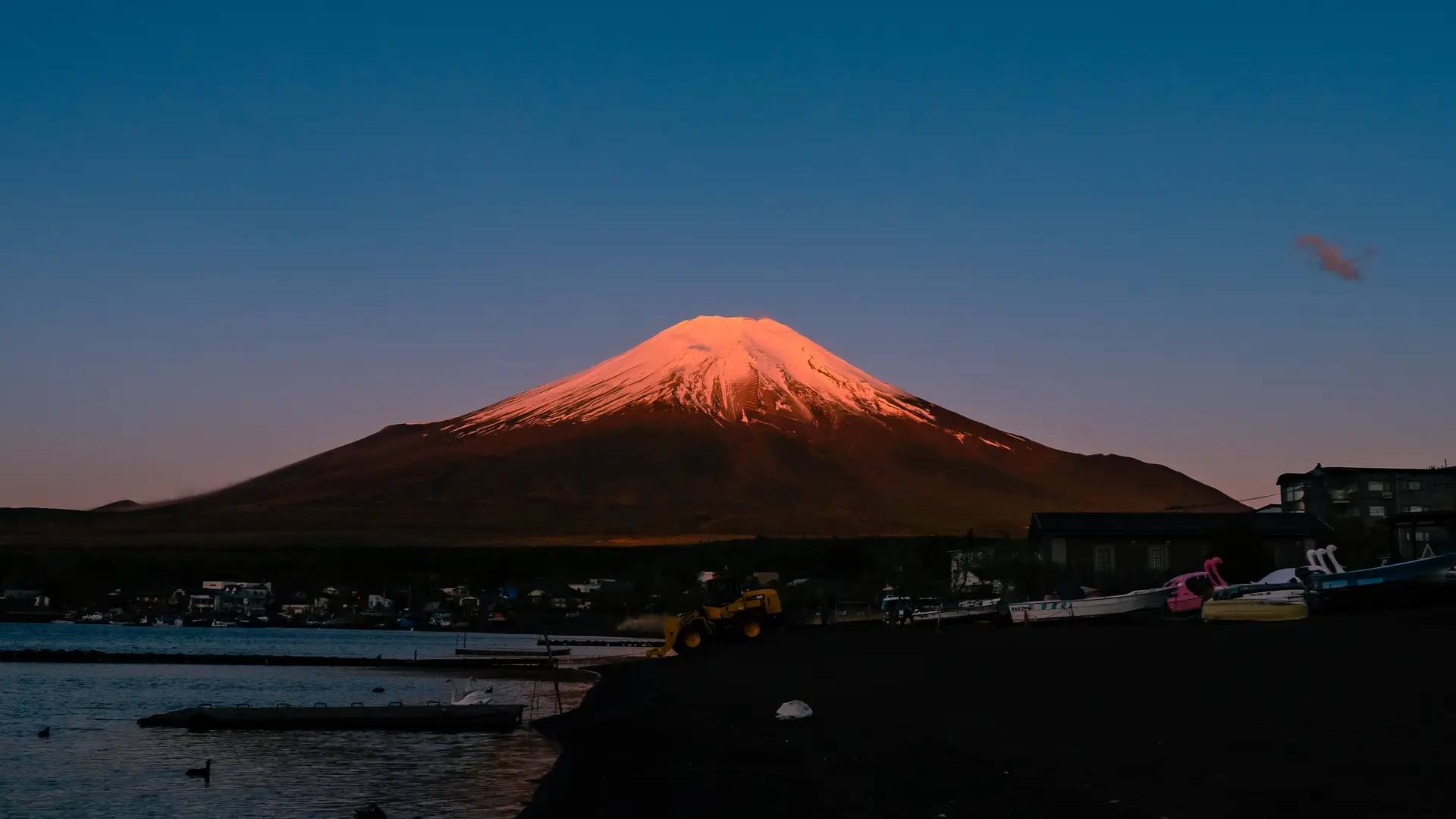
Aka-Fuji (紅富士) at Lake Yamanakako, four minutes before sunrise. The mountain glows for less than ten minutes a year. This is the kind of moment Western luxury travel is now learning to chase.
I am writing this from a 50-year-old wooden house at the foot of Mt. Fuji. The nearest convenience store is twelve minutes’ walk. The neighbour’s rooster wakes me at 4:30 every morning. I left a Tokyo design studio four years ago because I could not hear my own thoughts above the city. The thing I traded down to get here is, by every Western luxury metric, much smaller. The thing I traded up to get here is the only thing 2025-era European travel writers seem to want to talk about: silence. They have started calling it calmcation. Japan has been doing it for a thousand years. We just never thought to put a price tag on it.
The Shift Nobody Saw Coming
Read any travel coverage in ELLE, Condé Nast Traveler, or Vogue from the last eighteen months and the same word keeps appearing where “adventure” used to sit: recovery. Where editors used to commission stories about helicoptering into Patagonia or six-course tasting menus in Dubai, they are now commissioning stories about silent retreats in Sweden, dark-sky lodges in Iceland, and digital-detox cabins in Maine. The shorthand the industry settled on is calmcation — calm plus vacation — and what it points at is a complete inversion of what luxury travel meant for thirty years.
The old luxury equation was: How much stimulation can your money buy? Front-row Formula 1. Tasting menus with foams. The infinity pool with three sunset cocktails. Helicopters. Phones constantly buzzing with itinerary updates. The new equation reads: How much can your money buy you out of? Silence. Sleep. Walks without notifications. Forests without cell signal. Single-room ryokan with no TV. Architecture that frames stillness instead of stunning views. Tea ceremonies that take two hours and serve one cup.
The Global Wellness Institute now puts the wellness travel market at $830 billion within a $6.8 trillion broader wellness economy, with the mental-wellness segment growing fastest. The shift is not aspirational marketing. It is real spending. The reason boutique hotels with no Wi-Fi are commanding $1,500-a-night rates in Maine is that affluent Western travelers have stopped seeing notifications as a feature. They are buying their way out of them.
The new luxury question is not “What can your money let you do?” It is “What can your money let you stop doing?”
Why Japan Was Always the Answer
Here is the thing nobody at Vogue or Condé Nast seems to have noticed yet: Japan invented this product line about a thousand years ago. Just under different names.
Onsen were the original silent-immersion therapy, with strict rules against speaking loudly while bathing that go back centuries. Ryokan were the original analog-only luxury accommodation: tatami rooms with no television, futons rolled out and away each morning, communal bath downstairs, kaiseki dinner served in a private room by a single hostess. Zen temples built monastic compounds whose entire architectural premise is that the gravel paths, the rock gardens, the inner courtyards, and the long approach all collaborate to slow your nervous system down. Tea rooms were the original three-square-meter wellness pods, designed by sixteenth-century masters who wanted, explicitly, to give samurai and merchants a space where their phones — their swords, their letters, their politics — had to stay outside.
The Japanese term that maps closest to calmcation is “静寂を設計する文化” — the culture of designing silence. It runs through almost every traditional Japanese space: the size of the entry stones at a tea house (small, requiring you to step carefully, to slow down), the way fusuma sliding doors compress and release space, the moment of pause at a torii gate, the controlled emptiness of a sand garden. None of these were marketed as wellness. They were just the standard. The Japanese inhabitant of the year 1500 had something the Manhattan executive of 2026 will pay any amount to recover: an environment that, by default, did not assault the nervous system.
The problem — the genuinely interesting design problem — is that this stuff is so ambient in Japan that Japanese people have stopped seeing it as valuable. The ryokan owner in Naraijuku does not think of the silence on her main street at 9 PM as a product. To her it is just the village being the village. She does not understand why a German couple flew eleven hours to sleep in her grandmother’s shop. We undervalue the thing Western luxury is now scrambling to import.
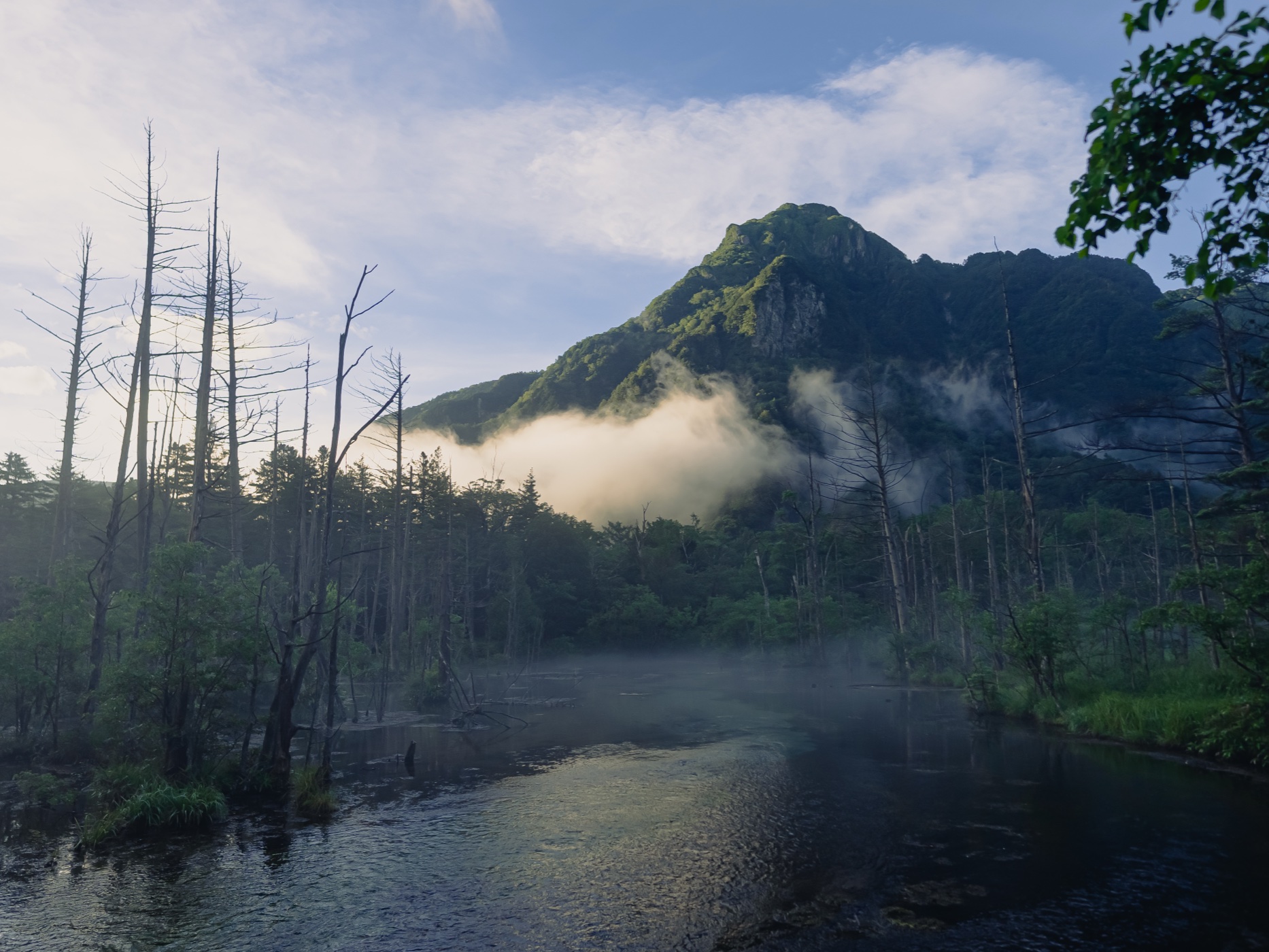
5:30 AM at Taisho Pond, Kamikochi. Volcanic eruption killed these trees in 1915; the cold pond water froze them in place. Five generations later, this is what neural rest looks like at scale.
Ten Places Built for Stillness
Below are ten Japanese places I would send a friend to if their request was, literally, “I need to recover.” They are not arranged by famousness. They are arranged by how completely they remove you from stimulation. Each links to a longer guide if you want the practical details.
Kagoshima · Yakushima Island
The Jomon-Sugi Forest
A 22-kilometre out-and-back walk to a single 7,000-year-old cedar tree. The path is mostly along an abandoned narrow-gauge logging railway, then up through cedar forest so deep that satellite signal disappears for hours. The hike takes 9 to 11 hours. Most people start in the dark and finish in the dark. The forest is a UNESCO World Heritage site precisely because the moss-cedar-rain ecosystem here has been doing what it does, undisturbed, since before agriculture. There is no part of any developed human society that resembles this place. That is the point.
Read the full Jomon-Sugi guide →Nagano · Kiso Valley
Naraijuku Post Town After Dark
An Edo-period post town frozen at 1843, one kilometre long, with no chain stores, no fluorescent signage, no traffic on the main street after 5 PM. The minshuku and ryokan inside the town turn off their outdoor lighting at 9 PM. Walk the street between 9:30 PM and 5 AM and the only sound is the Naraikawa river behind the houses. I stayed in a 200-year-old former merchant’s house here in November and slept eleven hours straight, the deepest sleep I had had in two years.
Read the Naraijuku walking guide →Nagano · Northern Alps
Kamikochi Alpine Valley at Dawn
A fifteen-kilometre valley at 1,500 metres elevation in Chubu Sangaku National Park, closed to private vehicles since 1975, with eight or nine traditional mountain hotels and almost nothing else. The valley shuts every November and reopens in April. Walk the Azusa River trail at 5 AM and you are alone in one of the most photographed alpine landscapes in Japan. Mist on Taisho Pond. Snow still on the Hotaka peaks. No traffic, no cell-tower coverage in much of the upper valley. This is what the Swiss Alps were like in 1962.
Read the Kamikochi walking guide →Kyoto · West Kyoto
Ryoanji Rock Garden Before 8 AM
The most famous dry-landscape garden in Japan: 25 metres long by 10 metres wide, fifteen rocks arranged so you can never see all fifteen from any single viewpoint. Most visitors come at midday in tour groups and take a phone photo and leave. Arrive at 8 AM when the temple opens, sit on the wooden veranda, and stay forty-five minutes. The gravel rakings are renewed each morning. The garden is older than the Sistine Chapel and it does the same thing the Sistine Chapel does, with one fifteenth of the visual information.
Read the Ryoanji guide →Yamanashi · Lake Saiko
Saiko Iyashi-no-Sato Nenba
A re-thatched-roof village rebuilt on the original footprint of a settlement that was buried by a typhoon-triggered landslide in 1966. Twenty kayabuki (thatched) houses spread over a hillside, most operating as small craft workshops or cafes. Mid-week visits get you fewer than fifty visitors across the whole site. The roof thickness alone — up to a metre in places — gives a kind of acoustic dampening you do not get in modern construction.
Read the Saiko Iyashi-no-Sato guide →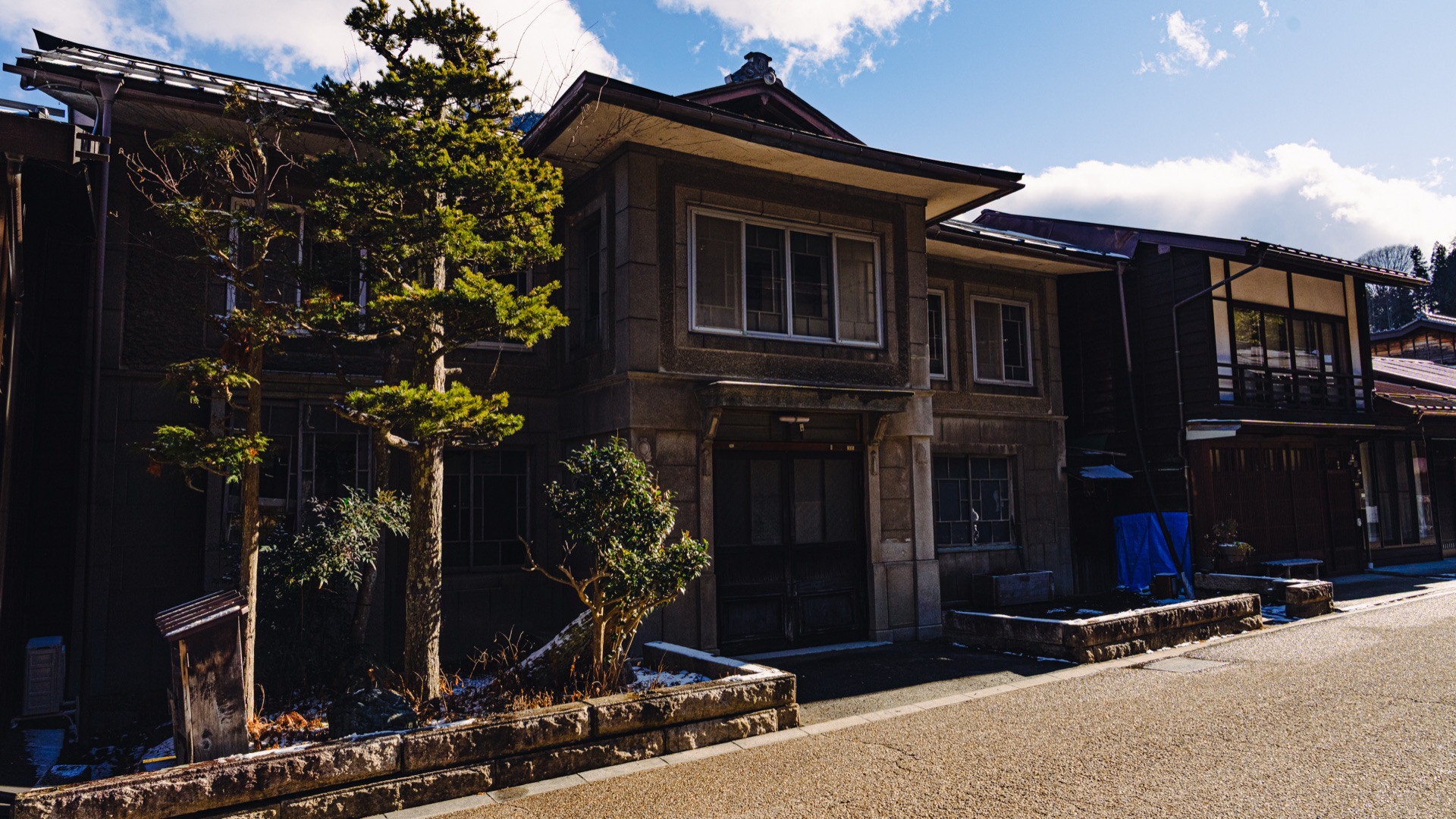
Naraijuku, mid-winter. The street goes dark at 9 PM. The river is louder than anything else. Most foreign visitors do not stay overnight, which is why the silence is still here.
Yamanashi · Mt. Fuji 3,400 m
One Night in a Mt. Fuji Mountain Hut
Sleep at the Eighth Station of the Yoshida Trail, 3,400 metres up the side of Japan’s tallest mountain. Lights out at 8:30 PM, futons in shared dormitory rows, curry-rice dinner at altitude, wake-up call at 1:00 AM for the summit push to catch sunrise. The huts are spartan by Western luxury standards and revelatory by every other measure. The night sky at 3,400 metres above sea level is the kind of dark you no longer see anywhere in lowland Japan, and the silence between the wind gusts is total.
Read the mountain hut guide →Kagoshima · Yakushima Island
The West Coast Drive Around Yakushima
An 87-kilometre coastal drive that loops the entire island, with the western half passing through Seibu Rindo — the only road in Japan that runs through a UNESCO core-zone forest. Yakuzaru macaques cross the road. Yakushika deer step out of the mist. Most of the western coast has zero cell-phone signal. The road takes about three hours of pure driving but most people take a full day, stopping at Ohko Falls (88 m), Yokogawa Valley, and the empty Inakahama Beach where loggerhead sea turtles nest in summer.
Read the Yakushima drive guide →Kyoto · Tamba region
Kameoka and the Quiet Side of Kyoto
A small town twenty-five minutes by JR Sagano Line from Kyoto Station, on the wrong side of the Hozugawa river gorge. Most foreign visitors never go there. Myoshuji Temple is a small Buddhist temple that runs morning meditation sittings open to the public; the priest will spend an hour with you afterwards if you are the only one there, which you usually are. The town sits inside the satoyama agricultural mosaic that European landscape architects keep flying out to study but rarely succeed in importing.
Read the Kameoka guide →Tottori · Hōki
The Shōji Ueda Museum & Mt. Daisen
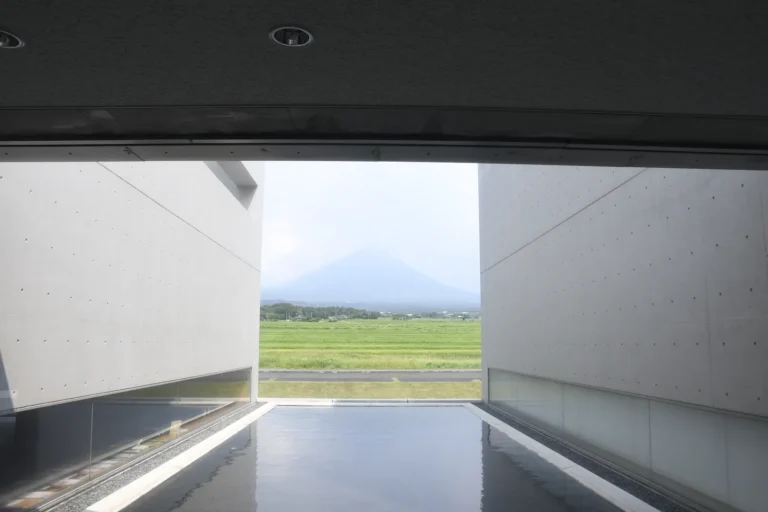
An architectural pilgrimage. Shin Takamatsu’s 1995 photography museum sits on a rural Tottori site in the village of Hōki, framing Mt. Daisen behind a still reflecting pool. The interior galleries rotate the work of Shōji Ueda — a Japanese photographer whose entire visual signature was figures placed in flat empty landscapes. The building, the photographer, and the mountain are doing the same thing: arranging stillness so that a viewer can see it. Ten museum visitors per hour on a weekday.
Read the Shōji Ueda Museum guide →Nagano · Kiso Valley
The Naraijuku-to-Tsumago Train Day
Spend a single day riding the JR Chuo Main Line through the Kiso Valley, from Naraijuku at the northern end down to Magome and Tsumago at the southern. The train passes through nine post towns, almost all of them Edo-period preserved. You can break the trip with a four-hour walk on the original Nakasendo trail between Magome and Tsumago. By 7 PM you are in a minshuku eating local mountain trout and sleeping in a 250-year-old room.
Read the Kiso Valley one-day guide →A Seven-Day Calmcation Across Japan
If you are flying in from North America, Europe, or Singapore for this kind of trip, the worst thing you can do is try to combine it with the standard Tokyo-Kyoto-Osaka golden route. The point of a calmcation is that you are not in motion. Below is a seven-day itinerary that uses three quiet bases and avoids the Shinkansen rush corridor entirely:
The total cost is — with mid-tier ryokan and JR Pass — roughly 30% of what an equivalent “luxury Japan” tour operator would charge, because the operator is bundling guides, drivers, and curated boutique stays you do not need. The real luxury here is fewer scheduled events, not more.
How to Book a Calmcation
The single move that changes everything is booking traditional Japanese inns rather than international hotel-chain properties. Western booking sites underrepresent ryokan and minshuku because the inventory is small, the language barrier is real, and most operate twelve to twenty rooms. The two booking paths I recommend:
Book ryokan + minshuku via Rakuten Travel; mainstream hotels via Booking
Rakuten Travel is a Japanese platform with the deepest inventory for traditional inns and small regional ryokan that international platforms simply do not list. Booking covers the modern hotels in Tokyo, Kyoto, and the Mt. Fuji area. Use both. For a calmcation specifically, weight 70–80% of nights toward Rakuten ryokan inventory.
Calmcation Booking Stack
What to Bring — And What to Leave
The rules I would give a friend planning their first calmcation, in priority order:
- Bring a real book. One only. The act of choosing one and committing to it is part of the recovery. Do not pre-load your Kindle with five.
- Bring a wristwatch. The phone-as-clock loop is one of the small loops you are trying to break.
- Bring headphones for the planes only. Once you are in Japan, you do not need them.
- Leave the work laptop. There is no halfway here. If you bring it, you will use it on day three.
- Leave the work email password. Set the auto-responder. Do not log in once.
- Set your phone to greyscale and turn off all notifications except text-from-spouse for the entire trip.
- Pack for one outfit per day. Choosing what to wear is a small drain you do not need.
- Walk for two hours every morning before checking anything. Anywhere — even just around the ryokan’s neighbourhood. This single rule reorganises the rest of the day.
Calmcation is not about adding a meditation app. It is about subtracting the things that made you need a meditation app.
When in 2026 to Go
Three windows for a 2026 calmcation, in order of preference:
Late October to early December
The classic answer. Autumn foliage at peak in the Kiso Valley and Yakushima, Mt. Fuji visibility runs at 60–86% depending on month, ryokan are at full operation, weather is dry and cool. The downside is that this is the highest-demand window for traditional inns — book six to eight months ahead.
Mid-January to late February
The contrarian answer. Snow on every roof in Naraijuku and the Kiso Valley. Onsen are at their best when the air is sub-zero. Ryokan rates drop 20–30% from autumn peaks. Mt. Fuji visibility is statistically the highest of the year (December clears 86% of mornings). The downside is that some routes — Kamikochi specifically — are closed.
Early June, before tsuyu
The hidden window. The first two weeks of June, before the rainy season officially declares, give you cool mornings, hydrangeas just starting in the Kamakura temple gardens, and almost no foreign tourists. Mt. Fuji visibility is poor (about 17%) but everything else — Shonan coast, Kyoto temple gardens, the Kiso Valley — is at its lushest.
FAQ
What is calmcation, exactly?
A travel-industry term coined around 2023–2024 to describe vacations specifically designed for nervous-system recovery rather than entertainment. The defining features: little to no schedule, low stimulation environments, intentional disconnection from notifications and digital media, and physical immersion in nature, silence, or contemplative architecture. The opposite of an itinerary-packed sightseeing tour.
Why is Japan considered ideal for calmcation?
Because Japan has been designing for nervous-system rest for roughly a thousand years — just under different cultural categories. Onsen, ryokan, zen temples, satoyama villages, tea ceremony, and traditional gardens are all forms of what the West has rebranded as “wellness travel.” The infrastructure already exists, runs at scale, and is woven into ordinary domestic travel rather than positioned as luxury.
How long should a calmcation be?
The minimum that produces real benefit is roughly five days, with seven to ten being ideal. Anything shorter and the first two days of any trip — jet lag, logistics, mental adjustment — eat the entire window. Some research on travel and stress recovery suggests it takes about three days for cortisol levels to genuinely shift downward.
Is a calmcation in Japan expensive?
It is much cheaper than the Western luxury wellness equivalent. A high-end ryokan in the Kiso Valley runs around ¥30,000–¥50,000 per person per night including dinner and breakfast. A boutique digital-detox retreat in Maine or Provence runs $800–$2,000 USD per person per night for less infrastructure. The seven-day itinerary above lands at roughly $2,000–$3,500 USD per person all-in, including JR Pass and meals.
Do I need to speak Japanese?
Not necessarily, but the calmcation experience is better with even a few phrases. Most ryokan in the destinations above have English-capable booking via Rakuten Travel or Booking, but in-person communication is much more limited. Apps that use the camera for menu translation cover the rest. The lack of small-talk-in-English is, ironically, part of the recovery.
What is the difference between calmcation and a wellness retreat?
A wellness retreat is usually a packaged programme — yoga schedule, dietary regimen, scheduled spa treatments, typically at a single fixed location. A calmcation is the opposite: deliberately unscheduled, location-fluid, no instructor or programme. The shape is closer to a long retreat in your own life — you walk, you read, you eat, you sleep, you bathe, in good environments.
Can I bring my partner / kids on a calmcation?
A partner, yes — calmcation often works better with one quiet companion than alone. Children, mostly no — the design depends on long stretches of unstructured low-stimulation time, which most under-12 children find unbearable. Older teens can work, especially if they are interested in photography, hiking, or temple architecture.
Where should I avoid in Japan if I am specifically trying to recover?
Central Tokyo, central Osaka, the Shinkansen rush corridor between them, the standard Kyoto temple loop on weekends, and the Universal Studios / Disney circuit. None of these are bad — they are just not what calmcation is for.
A Closing Thought
Four years into living at the foot of Mt. Fuji, I think the thing I traded for is more important than the thing I traded down on. The Western luxury travel market is, slowly, arriving at the same conclusion. Calmcation is the marketing word for it; the underlying realisation is that the most expensive thing in a noisy, notification-saturated economy is access to undisturbed time and space, and that the cultures that figured out how to design those things at scale are the ones whose tourist boards have been quietly sitting on the most valuable luxury inventory in the world for a thousand years.
If you are planning a Japan trip in 2026 and you want it to do something for your nervous system rather than your camera roll, the country has been waiting for you. You just have to skip the standard guidebook stops, pick three of the ten places above, and not check email once.
Sleep eleven hours. Walk in the morning. Drink the tea slowly. The rest is built in.
Booking Your Calmcation
Three doors. The single highest-leverage decision is to weight your nights toward traditional Japanese inns rather than international chains. Everything else follows.
Join 1,000+ travelers discovering Japan's hidden side
Weekly dispatches from off-the-beaten-path Japan — spots and stories you won't find in guidebooks.
No spam. Unsubscribe anytime.
Welcome aboard!
You're in. See you in your inbox soon.