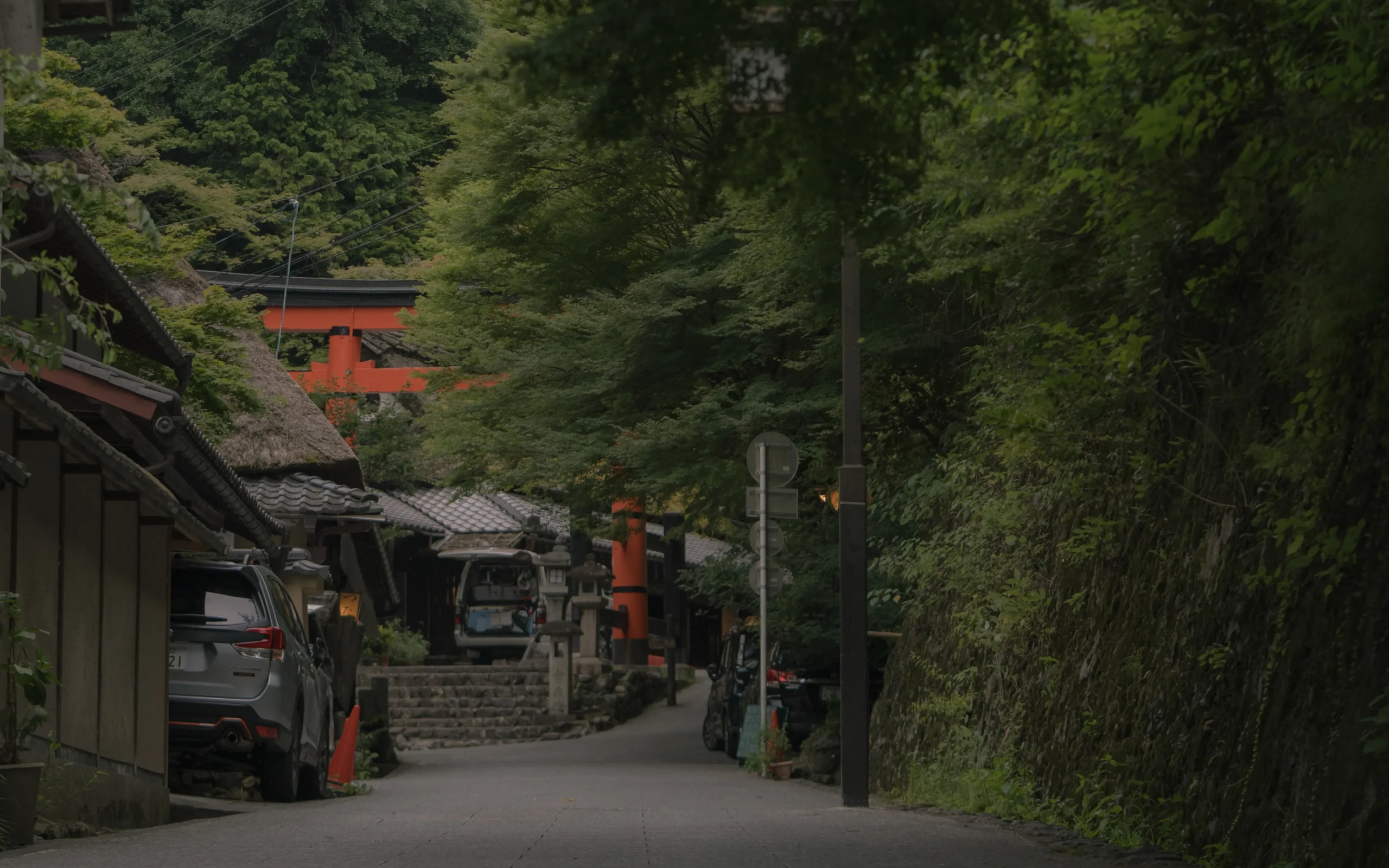

A 30-minute walk north of the bamboo grove crowds — past the last rickshaw, past the last souvenir shop — the road quiets, narrows, and changes. Thatched-roof tea houses appear. Vermilion shrine pillars rise between green cedars. No one is shouting into a tour guide microphone. This is Atago Kaido, the old pilgrimage road to Atago Shrine, and its preserved upper section — Saga Toriimoto (嵯峨鳥居本) — is one of only four historic districts in Kyoto protected under national cultural law. I am Nobu from Hidden Japan Gems, and this is the Kyoto street where the crowds do not go.
Table of Contents
Quick Facts
| Detail | Info |
| Name | Atago Kaido (愛宕街道) / Saga Toriimoto Preserved District (嵯峨鳥居本伝統的建造物群保存地区) |
| Location | Ukyo-ku, Kyoto City, northwest of Arashiyama |
| Status | One of 4 nationally-designated Important Preservation Districts in Kyoto |
| Length | ~600 meters of preserved townscape |
| Admission | Free (street walking) |
| Opening hours | 24/7 (street); Machinami Preservation Museum: 9:00 AM – 5:00 PM, closed Mondays |
| Best time | Early morning, late afternoon, or weekdays |
| Crowds | Very light even during peak Arashiyama season |
| From Arashiyama | 30-minute walk or 10-minute bus |
| Nearby | Adashino Nenbutsuji Temple, Otagi Nenbutsuji, Atago Shrine trail |
1. What Is Atago Kaido?
Atago Kaido — the “Atago Road” — is the historic pilgrimage route that leads from the Arashiyama area up to Atago Shrine (愛宕神社), a mountain shrine dedicated to the fire god Atago Gongen. For centuries, villagers, traders, and worshippers walked this road to make the climb up Mt. Atago (924m), which still takes about two hours on foot today.
The road passes through several distinct sections, but the most beautiful and best-preserved stretch is Saga Toriimoto (嵯峨鳥居本) — a 600-meter corridor of traditional buildings at the foot of the mountain, just before the shrine’s outer torii gate. This is the section designated as an Important Preservation District for Groups of Traditional Buildings in 1979.
2. What Makes Saga Toriimoto Special?
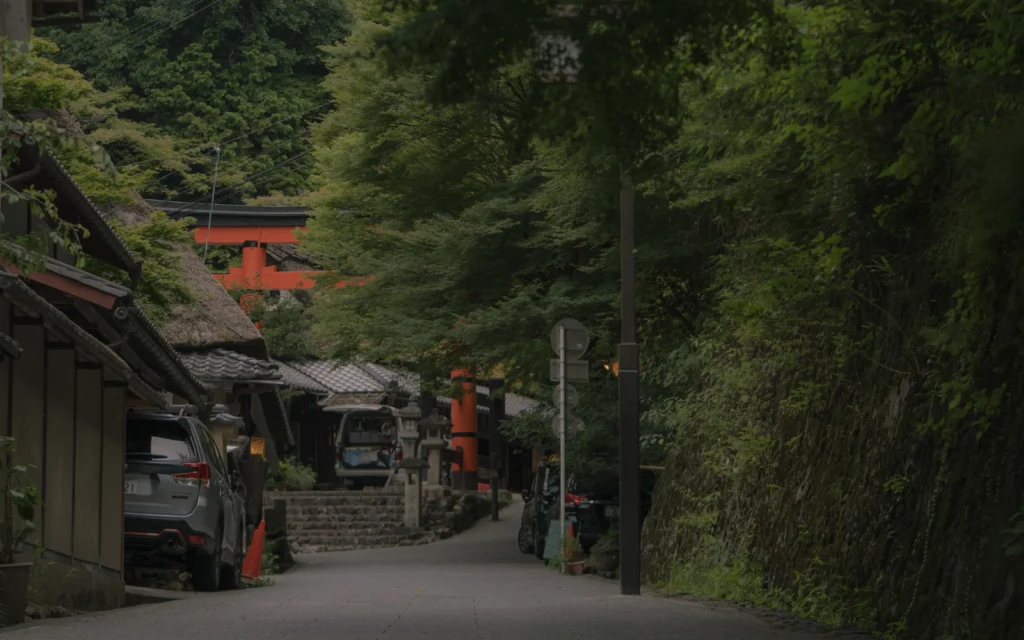
Two things set Saga Toriimoto apart from other Kyoto preserved districts:
1. Architectural diversity along the road.
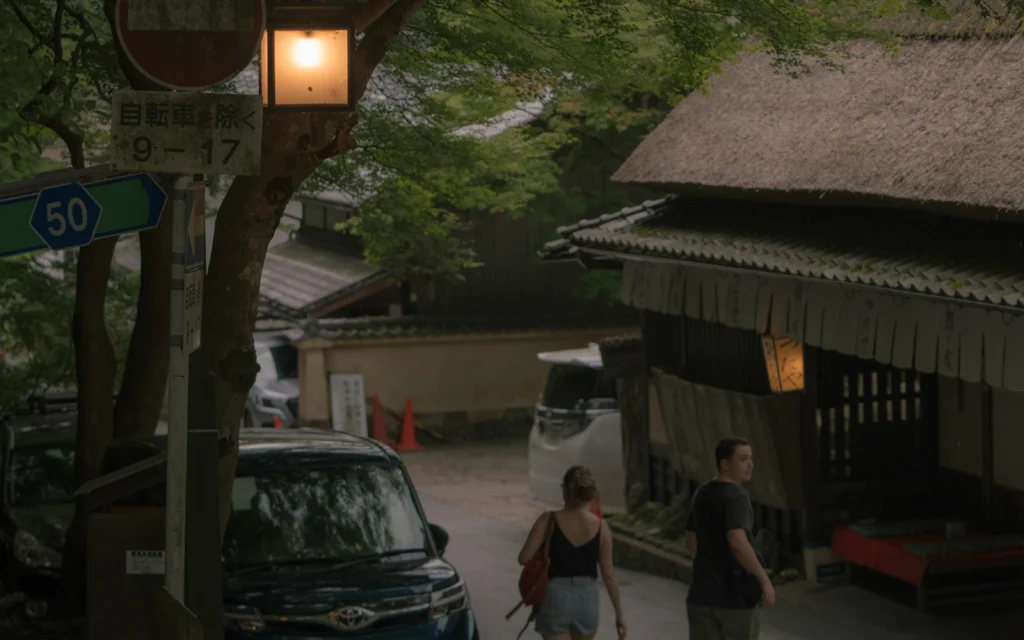
As you walk from the southern end toward the northern end, the architecture visibly shifts. The lower section features merchant-style machiya townhouses with tiled roofs. But as you climb toward the shrine, the buildings change to thatched-roof farmhouses (茅葺き農家). This transition from urban merchant Kyoto to rural mountain village happens within a few hundred meters.
2. The crowds are not here.
Arashiyama receives millions of visitors a year. Saga Toriimoto, despite being equally photogenic and historically significant, receives a fraction of that traffic. You can stand in the middle of the street, take a photo without strangers in the frame, and hear birds instead of tour groups.
3. What Will You See Walking the Street?
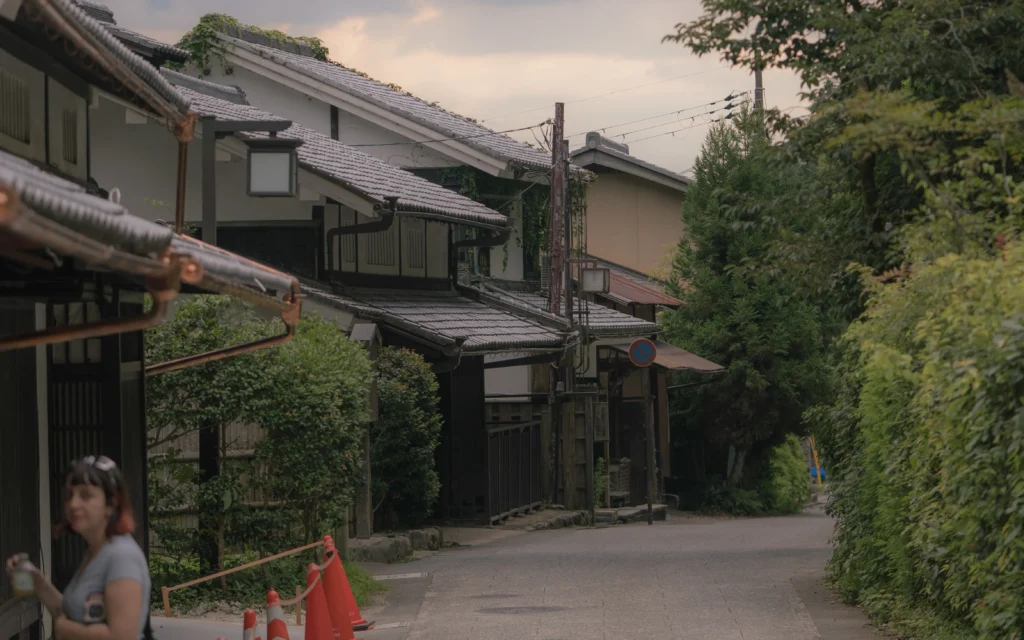
Starting from the southern end, the walk takes about 20–30 minutes at a slow pace.
The Merchant-Style Section (Lower Atago Kaido)
The first buildings you pass are machiya-style townhouses — wooden facades, tiled roofs, latticed windows, and hanging noren curtains. Many of these buildings are still residences.
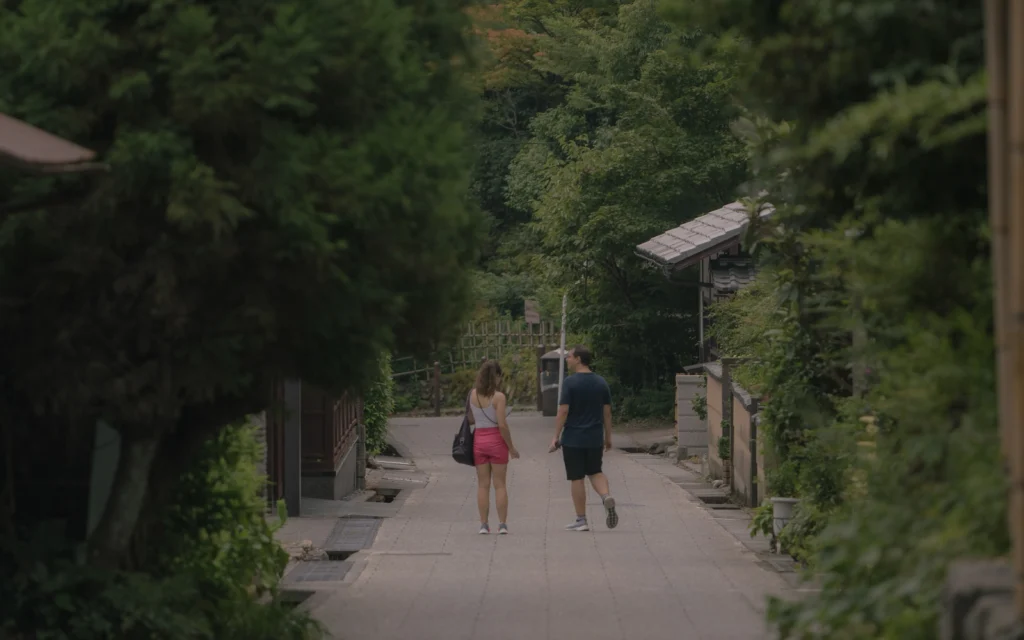
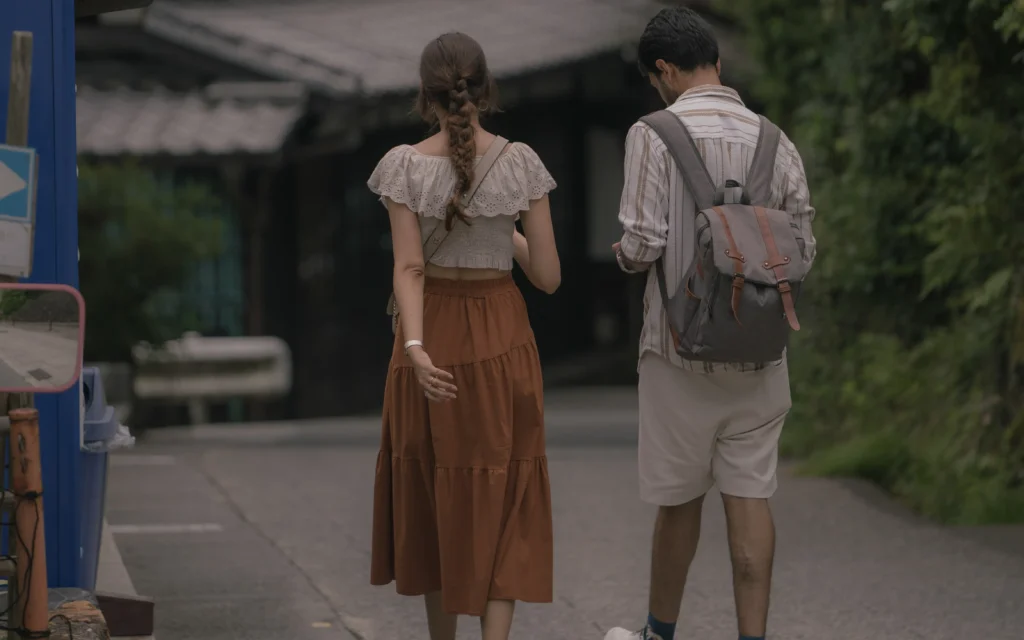
The Thatched-Roof Section (Upper Atago Kaido)
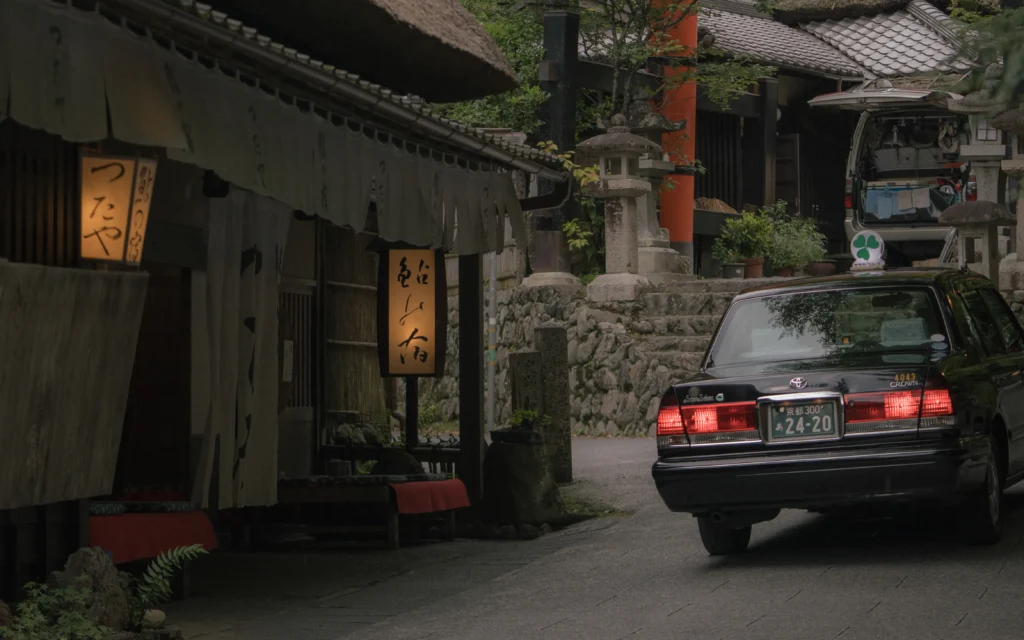
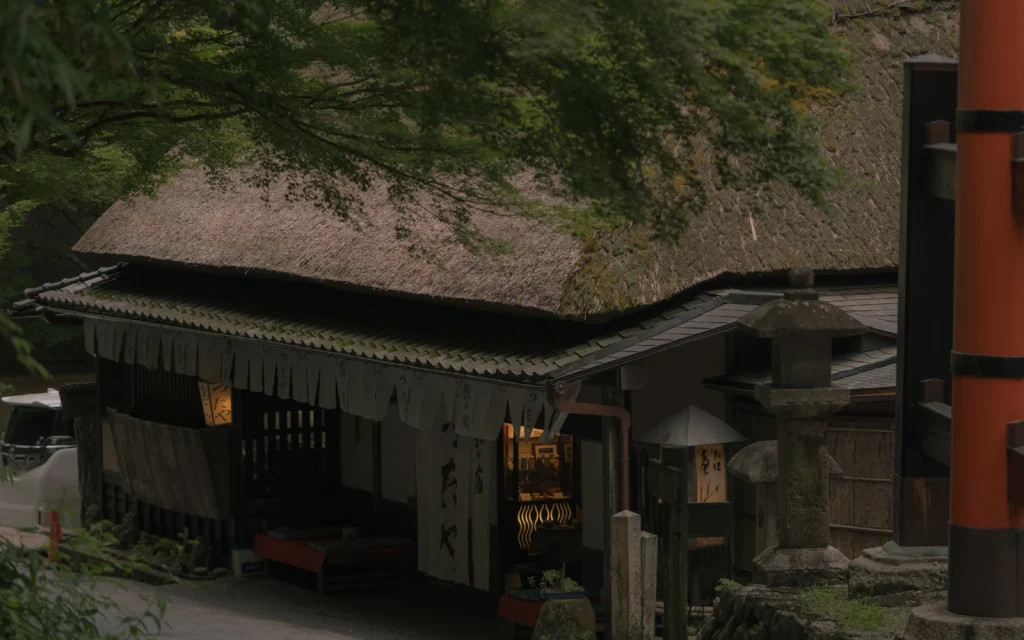
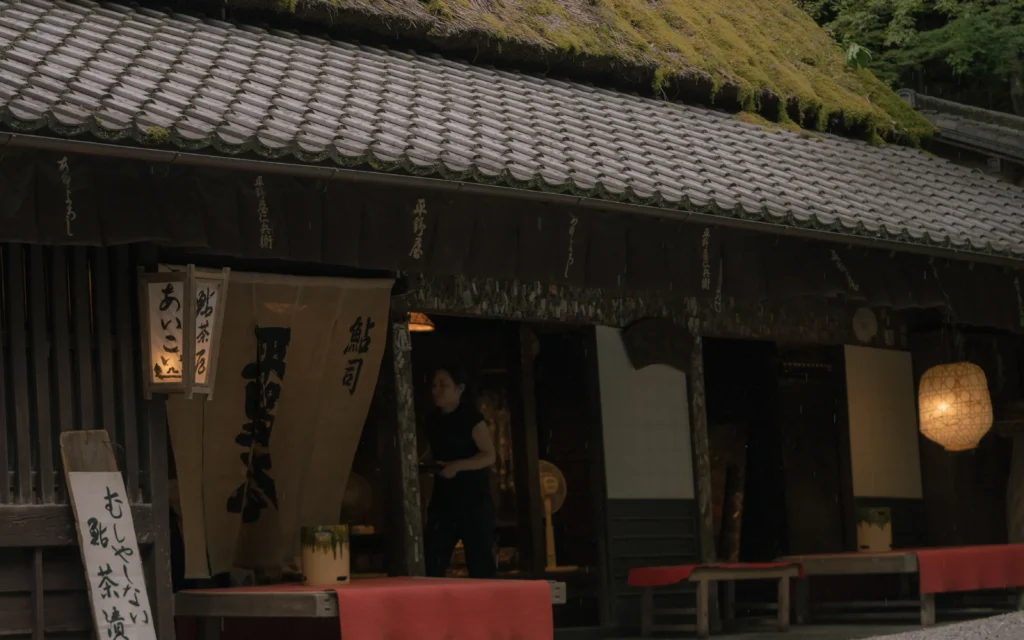
This is the iconic section. The road reaches the famous tea houses at the foot of Mt. Atago — buildings with thatched roofs, stone lanterns, and wooden facades that look almost unchanged from the Meiji period.
The First Torii of Atago Shrine
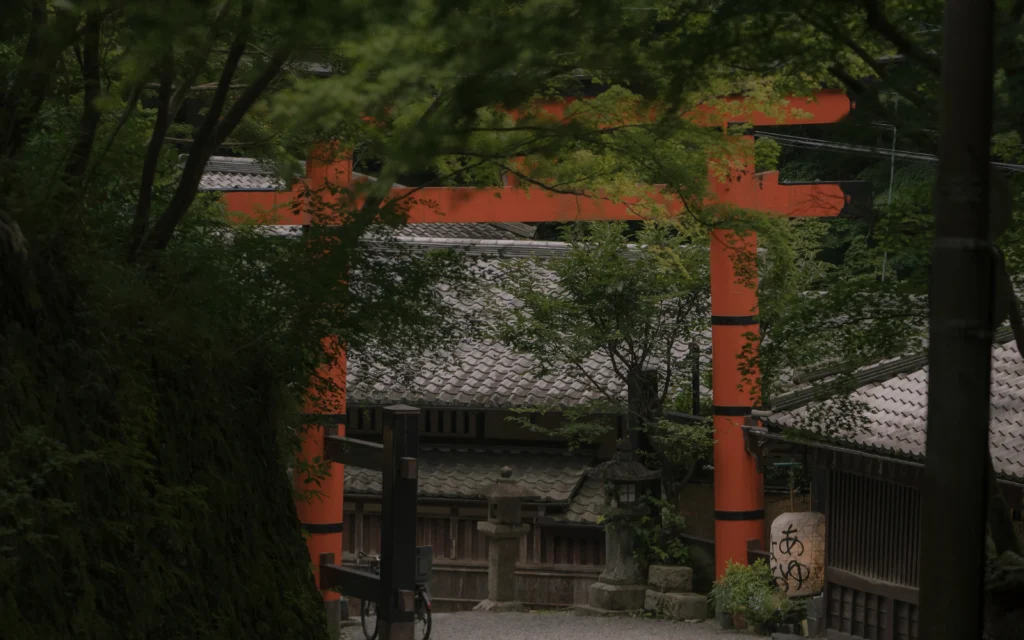
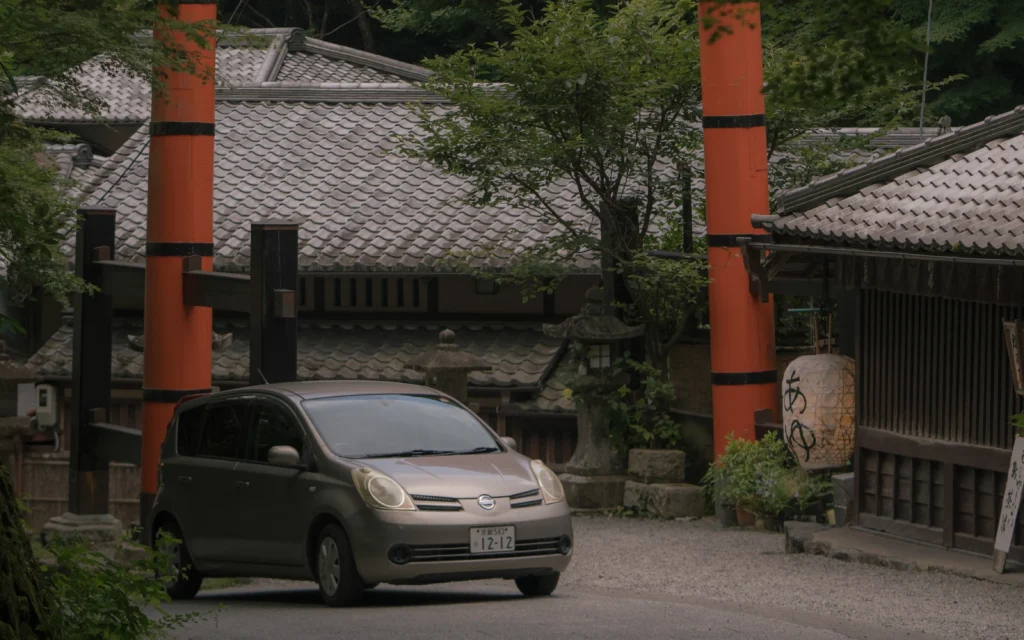
At the northern end, you reach the First Torii (一之鳥居) of Atago Shrine — a large vermilion gate marking where the pilgrimage road officially begins.
4. How Can You Experience the Historic Thatched Tea Houses?
The two thatched tea houses — Hiranoya (平野屋) and Tsutaya (つたや) — deserve their own section because they are the visual and culinary anchors of Saga Toriimoto.
Hiranoya has been operating for approximately 400 years. Inside, you can order a traditional multi-course meal featuring ayu (sweetfish), wild mountain vegetables, and shiso makizushi (sushi rolls wrapped in perilla leaf).
Tsutaya is the neighboring tea house, equally ancient, with a slightly more casual atmosphere. The shiso mochi (perilla-leaf mochi) and warabi mochi here are particularly noteworthy.
Prices to expect:
•Simple tea and mochi: ¥800–1,500
•Light meal (bento or grilled fish set): ¥3,000–5,000
•Full traditional kaiseki course: ¥8,000–15,000
Visiting for tea and mochi is an affordable way to experience the interior without committing to a full meal.
5. How Do You Get There from Arashiyama?
Saga Toriimoto sits at the far northwest end of the Arashiyama-Sagano area.
Option 1: Walk (recommended)
From Arashiyama Station or Togetsukyo Bridge, walk north through Sagano. The route passes:
•Nonomiya Shrine and the bamboo grove (~5 min)
•Tenryu-ji Temple (~10 min)
•Jojakkoji Temple (~20 min)
•Gio-ji Temple (~25 min)
•Saga Toriimoto (~30–35 min)
Option 2: Kyoto Bus
From Hankyu Arashiyama Station or JR Saga-Arashiyama Station, take the Kyoto Bus (京都バス) toward Kiyotaki. Get off at Toriimoto (鳥居本) bus stop. The ride is about 10 minutes.
Option 3: Taxi
From central Arashiyama, a taxi to Saga Toriimoto costs ~¥1,500 and takes about 10 minutes.
6. When Is the Best Time to Visit?
Best seasons:
•Spring (April) — Cherry blossoms bloom along the upper road.
•Early summer (May–June) — Fresh green maple leaves (aomomiji) create a lush corridor.
•Autumn (mid-November) — Peak maple foliage turns the street brilliant red and orange.
•Winter (December–February) — Quietest time. Occasional snow creates atmospheric scenes.
Best time of day:
•Early morning (7:00–9:00 AM) — No crowds anywhere, soft light.
•Late afternoon (4:00–5:30 PM) — Golden hour light on the tea houses.
•Avoid midday — Harsh overhead light flattens the textures.
7. How to Combine with Nearby Sites?
Saga Toriimoto is perfectly positioned for a half-day cultural walking route.
1. Adashino Nenbutsuji Temple (5 min walk)
At the end of Saga Toriimoto sits Adashino Nenbutsuji, a temple with 8,000 weathered stone Buddhist statues.
2. Otagi Nenbutsuji Temple (15 min walk up)
Famous for 1,200 whimsical rakan statues carved by amateur sculptors in the 1980s.
3. Gio-ji Temple (10 min walk down)
A small moss temple with a legendary connection to the Heike clan.
8. Practical Tips for Southeast Asian Travelers & More
•Flights & Access: Travelers from Southeast Asia can fly directly into Kansai International Airport (KIX). From KIX, take the Haruka Express directly to Kyoto Station, then transfer to the JR Sagano Line to Saga-Arashiyama Station.
•Weather & Clothing: In winter (December-February), Kyoto’s mountain areas like Saga Toriimoto can drop to 0°C (32°F) — significantly colder than Southeast Asia. Layer your clothing.
•Cash vs. Card: Small businesses and traditional tea houses here often do not accept cards. Bring ¥5,000–10,000 in small bills.
•Respect: This is a living, functioning neighborhood. People live in these houses. Keep voices low, especially in early morning or late afternoon.
9. FAQ
Q: How far is Saga Toriimoto from Arashiyama Station?
A: About 30–35 minutes on foot through scenic Sagano temples. By Kyoto Bus bound for Kiyotaki, it takes 10 minutes to the Toriimoto stop.
Q: Is Atago Kaido free to visit?
A: Yes. The preserved street is public with no entrance fee. The Saga Toriimoto Machinami Preservation Museum is also free. Only specific temples like Adashino Nenbutsuji at the north end require admission.
Q: What makes Saga Toriimoto different from Gion or Sannenzaka?
A: All four are Important Preservation Districts in Kyoto, but Saga Toriimoto is rural rather than urban, featuring thatched-roof farmhouses rather than merchant townhouses, and receives a tiny fraction of the visitors.
Q: Can I climb Atago Shrine from Saga Toriimoto?
A: Yes, the trailhead is at the northern end by the first torii gate. The hike is about 2 hours one way with 800 meters of elevation gain. It is a serious hike requiring proper shoes and water, not a casual walk.
Q: Are the thatched tea houses open to visitors?
A: Yes. Hiranoya and Tsutaya are functioning restaurants. You can reserve a meal or stop for tea and mochi. Hiranoya has served travelers for approximately 400 years.
Q: When is the best time to photograph Saga Toriimoto?
A: Early morning (7:00–9:00 AM) for empty streets and soft light, or late afternoon (4:00–5:30 PM) for golden hour. Spring cherry blossoms and autumn maple foliage add color, but the thatched tea houses are beautiful year-round.
Q: Is Saga Toriimoto accessible for visitors with mobility issues?
A: The lower section is relatively flat and accessible. The upper section involves a gentle slope. The narrow street has no dedicated wheelchair routes but is passable with assistance.
Q: Can I combine Saga Toriimoto with the Arashiyama bamboo grove?
A: Absolutely. The walk from the bamboo grove to Saga Toriimoto is 30 minutes through atmospheric temple grounds. Most visitors spend 2–3 hours total walking this entire corridor.
10. Final Thoughts
Arashiyama has a crowd problem. On any weekend in cherry blossom or autumn leaf season, the bamboo grove is a slow-moving queue of people photographing the same trees.
Thirty minutes’ walk north, Saga Toriimoto feels like a different century. Thatched roofs. Stone lanterns. The vermilion torii of Atago Shrine rising between green cedars. Actual locals walking their dogs on their way home.
It takes a small amount of effort to reach — and that effort is the filter that keeps it quiet. If you are willing to walk past the last souvenir shop, you will find a piece of Kyoto most visitors leave without ever seeing.
Related articles on Hidden Japan Gems:
•Adashino Nenbutsuji Temple: 8,000 Stone Buddhas at the End of Atago Kaido
•Early Morning and Late Night in Kyoto
Sources checked
ja.kyoto.travel (Kyoto City official tourism), kyoto-kankou.or.jp, Saga Toriimoto Machinami Preservation Museum, kanpai-japan.com

- A Perfect Kyoto Afternoon: Walking Higashiyama from the Yasaka Pagoda to Kiyomizudera at Golden Hour (2026 Guide)
- Adashino Nenbutsuji 2026: Kyoto’s Temple of 8,000 Stone Buddhas [With Map]
![Adashino Nenbutsuji 2026: Kyoto's Temple of 8,000 Stone Buddhas [With Map]](https://hiddenjapan-gems.com/wp-content/uploads/2026/04/DSC2083-2-2-1024x576.webp) Most visitors to Arashiyama sto… 続きを読む: Adashino Nenbutsuji 2026: Kyoto’s Temple of 8,000 Stone Buddhas [With Map]
Most visitors to Arashiyama sto… 続きを読む: Adashino Nenbutsuji 2026: Kyoto’s Temple of 8,000 Stone Buddhas [With Map] - Atago Kaido / Saga Toriimoto — Kyoto’s Preserved Street2026 Update: While Arashiyama c… 続きを読む: Atago Kaido / Saga Toriimoto — Kyoto’s Preserved Street
- A Night at Hoshinoya Kyoto: Boat Ride, Kaiseki & River Views [Stay Review]
![A Night at Hoshinoya Kyoto: Boat Ride, Kaiseki & River Views [Stay Review]](https://hiddenjapan-gems.com/wp-content/uploads/2026/04/IMG_4741-1024x576.webp) 2026 Update : Hoshinoya Kyoto c… 続きを読む: A Night at Hoshinoya Kyoto: Boat Ride, Kaiseki & River Views [Stay Review]
2026 Update : Hoshinoya Kyoto c… 続きを読む: A Night at Hoshinoya Kyoto: Boat Ride, Kaiseki & River Views [Stay Review] - 7 Days in Kansai: A Journey Beyond Kyoto to Hidden Temples & Sacred Trails
 As the founder of hiddenjapan-g… 続きを読む: 7 Days in Kansai: A Journey Beyond Kyoto to Hidden Temples & Sacred Trails
2026 cherry blossom cherry blossoms day trip from tokyo flower festival fuji five lakes fujiyoshida Fukuoka fushimi hanami hiking japan japanese culture japanese food japanese garden japan travel kamakura kawagoe kawaguchiko Kumamoto kyoto local food Mount Fuji mt fuji Nagano nature Nikko Oku-Nikko Onsen Ramen saitama sakura Shizuoka shrine sightseeing snow spring in japan Tochigi Tokyo travel travel guide travel planning winter winter travel Yamanashi
Join 1,000+ travelers discovering Japan's hidden side
Weekly dispatches from off-the-beaten-path Japan — spots and stories you won't find in guidebooks.
No spam. Unsubscribe anytime.
Welcome aboard!
You're in. See you in your inbox soon.