Bioluminescent plankton bloomed along Japan’s Pacific coast in late May 2026 (that bloom has since ended — see the update below), lighting up the surf in glowing blue from Suruga Bay through eastern Izu, west to Mikawa Bay near Nagoya, and — as of May 26 onward — explosively across the Shōnan and Kamakura coastline, with local media calling the Kamakura event the largest since May 2017. I drove out to Itō Usami on May 26 to see it for myself. Here is where the bloom was confirmed, what caused it, and what to know before you go. Sea sparkle is one of early summer’s best shows; for the wider season, see our Summer in Japan 2026 guide.
💤 The May 2026 bloom has ended
This page is now a record of the May 2026 bloom. After peaking on the night of May 26 — Kamakura’s largest event since 2017 — the bloom faded through early June, and Typhoon Jangmi (No. 6) churned the Pacific coast on June 2–3. By June 4 the local nightly trackers had gone quiet and most reports from Shōnan and Kamakura were of dark water. The odd late flash could still appear on a calm night, but the bloom’s reliable run had closed. Re-checked on June 19: still no glow along Shōnan or Kamakura — only scattered late sightings were reported on the Izu/Numazu coast and the Seto Inland Sea.
Past big blooms on this coast have come in late spring, but they are rare and the timing of the next one cannot be predicted. Bookmark this page — I’ll restart the nightly updates if the red tide comes back. In the meantime, the guide below explains where, when and how sea sparkle works, so you’ll be ready.
While you’re here: the Mt Fuji visibility forecast uses the same “is it happening tonight” idea for the mountain.
Daily live updates have ended; this page is no longer updated nightly. The guide below stays accurate year-round.
Quick facts
- What
- Sea sparkle — Noctiluca scintillans, a dinoflagellate plankton (夜光虫)
- When
- The May 2026 bloom (from ~May 17) is over. Past big blooms here came in late spring; the timing of the next one cannot be predicted
- Cost
- Free at all public beaches
- Confirmed (May 2026)
- Numazu / Toda / Nishiura, Itō Usami, Gamagori Harubi, Kugenuma & Katase (near Enoshima)
- Rarity
- Suruga Bay: first major event in 10+ years. Atsumi Bay: 4 years. Kugenuma: 9 years.
- Best time
- After full dark, calm nights, where waves break
- Daytime warning
- Same bloom appears as reddish-pink “red tide” (赤潮) during daylight — not toxic to humans but has a fishy smell along shore
What I saw at Usami on May 26
I had been watching the news reports for a week. Numazu first, around May 18. Then aerial helicopter footage of Suruga Bay glowing red in daylight — the daytime form of the same plankton — that ran on Shizuoka local TV on the 20th. Gamagori on the 22nd, with traffic chaos overflowing into the residential streets. Kugenuma near Enoshima on the 25th, the first sighting there in nine years. By the time the eastern Izu coast started lighting up, I had to go look.
I drove down to Itō Usami because it is one of the quieter eastern-Izu bays — a long crescent of sand with calmer waves than the more famous Shimoda beaches, and a wrap-around of town lights along the far shore that, on a moonless night, makes the dark water feel huge. Usami is also the easiest of the eastern-Izu beaches to reach by train, which mattered because I knew the moon was waxing and I wanted to be on the sand by 22:00.
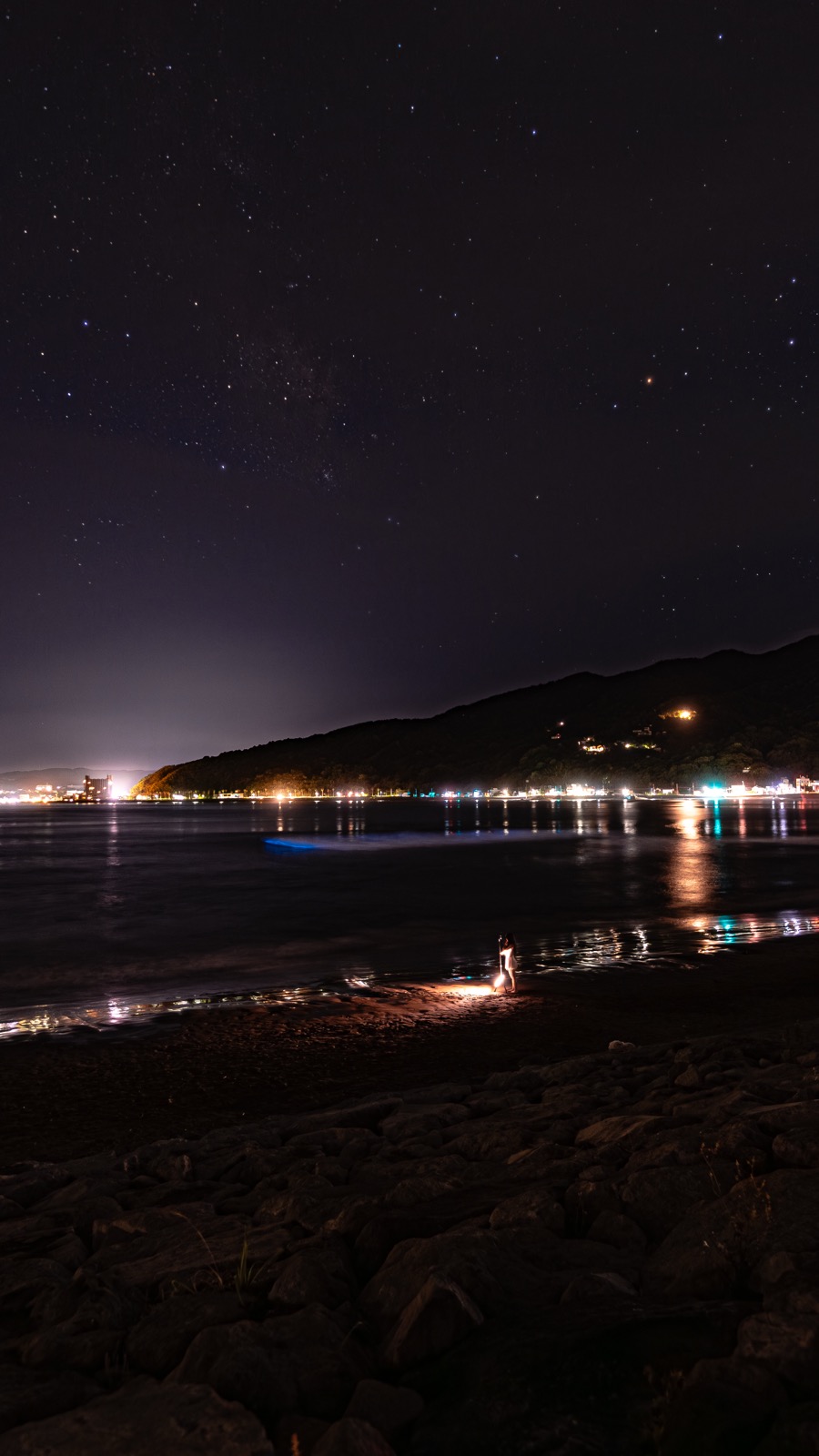
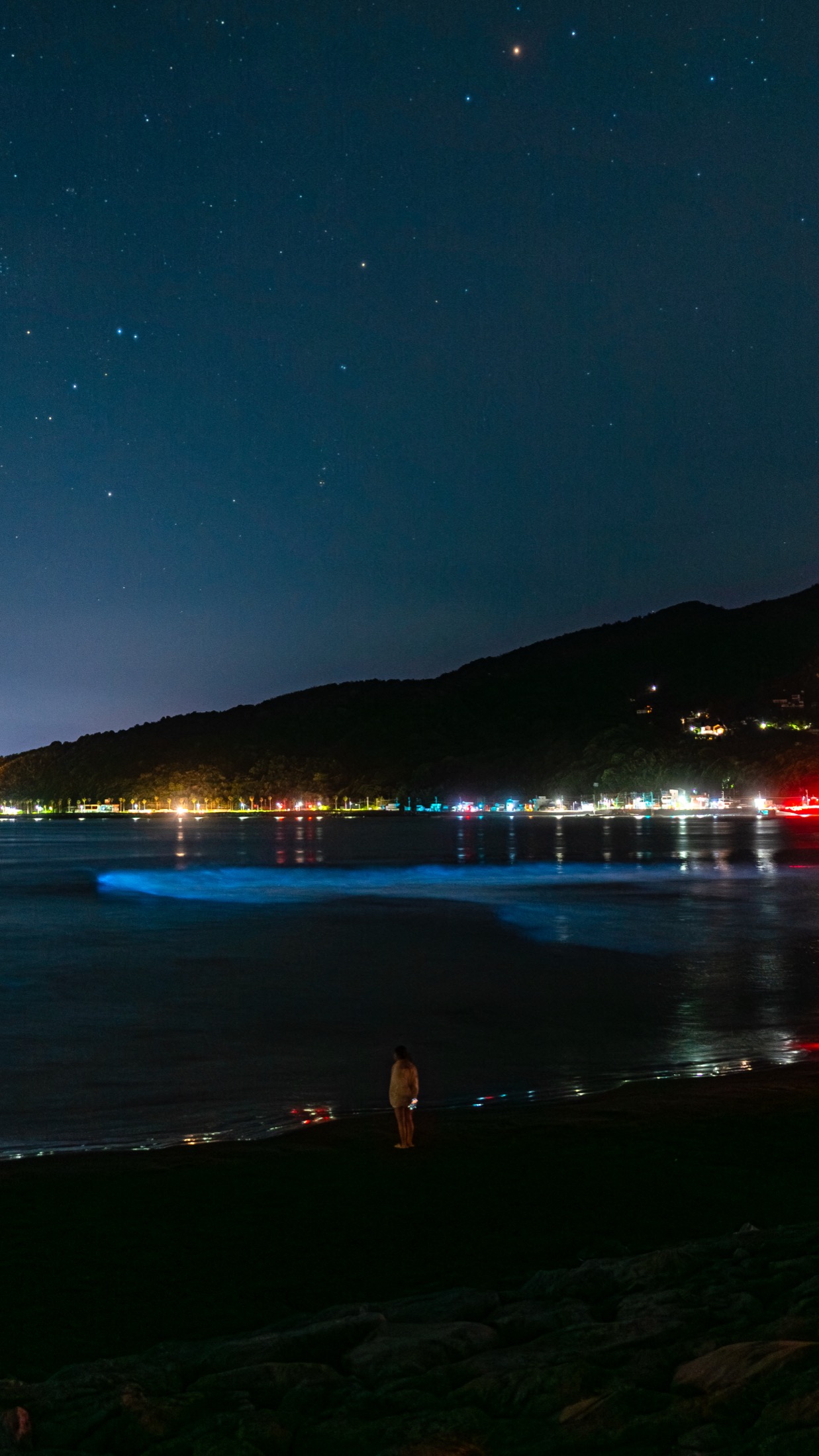
At first, walking down to the waterline, the bay just looked dark. Then a wave broke, and the foam edge lit up an electric cold blue — not the warm yellow-green of fireflies, not the steady glow of a phosphorescent screen. It looked like the surf had been outlined in cyan neon. Each next wave repeated it, and where the kids on the beach were stamping in the wet sand, their footprints flared briefly and faded.
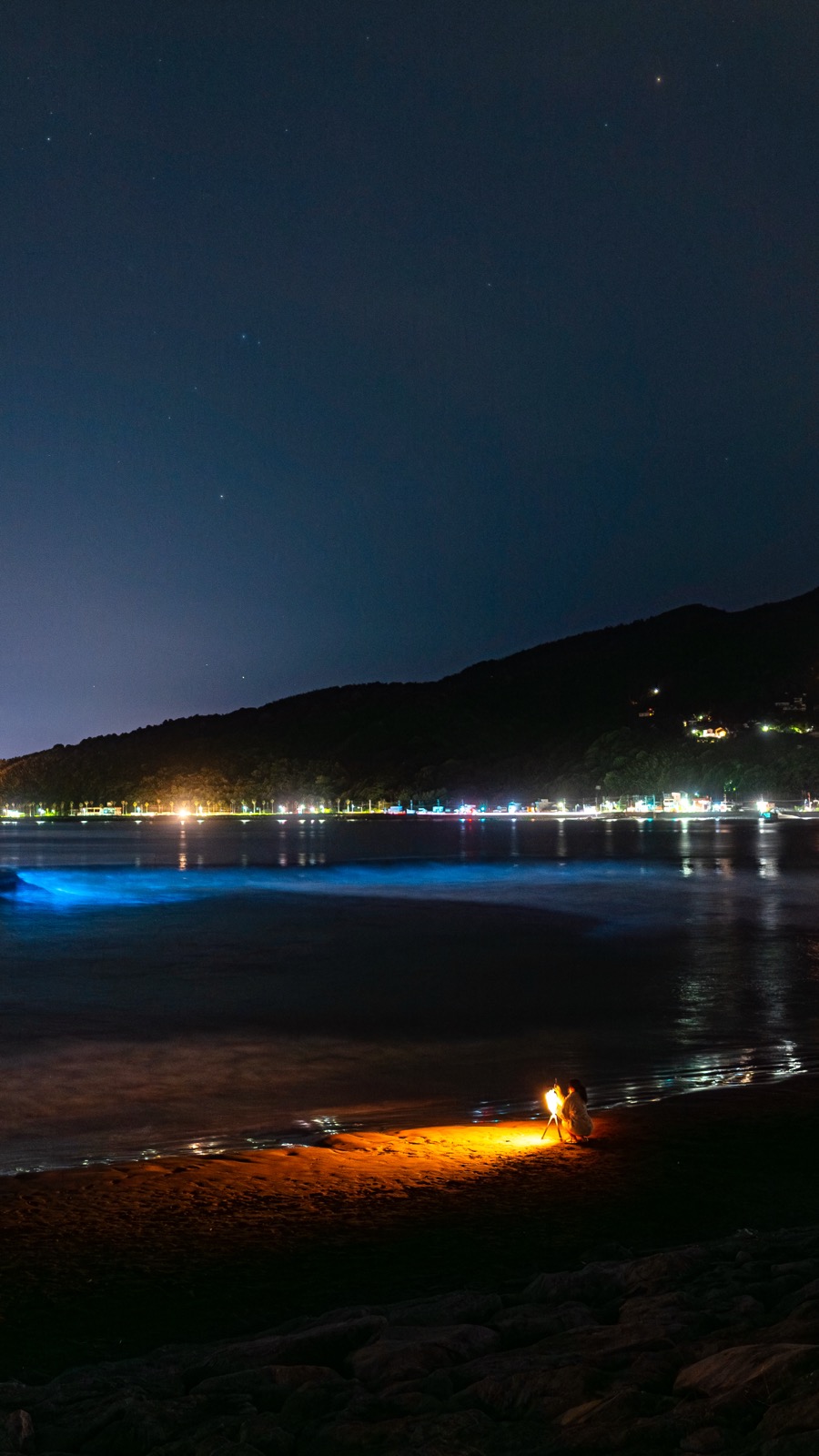
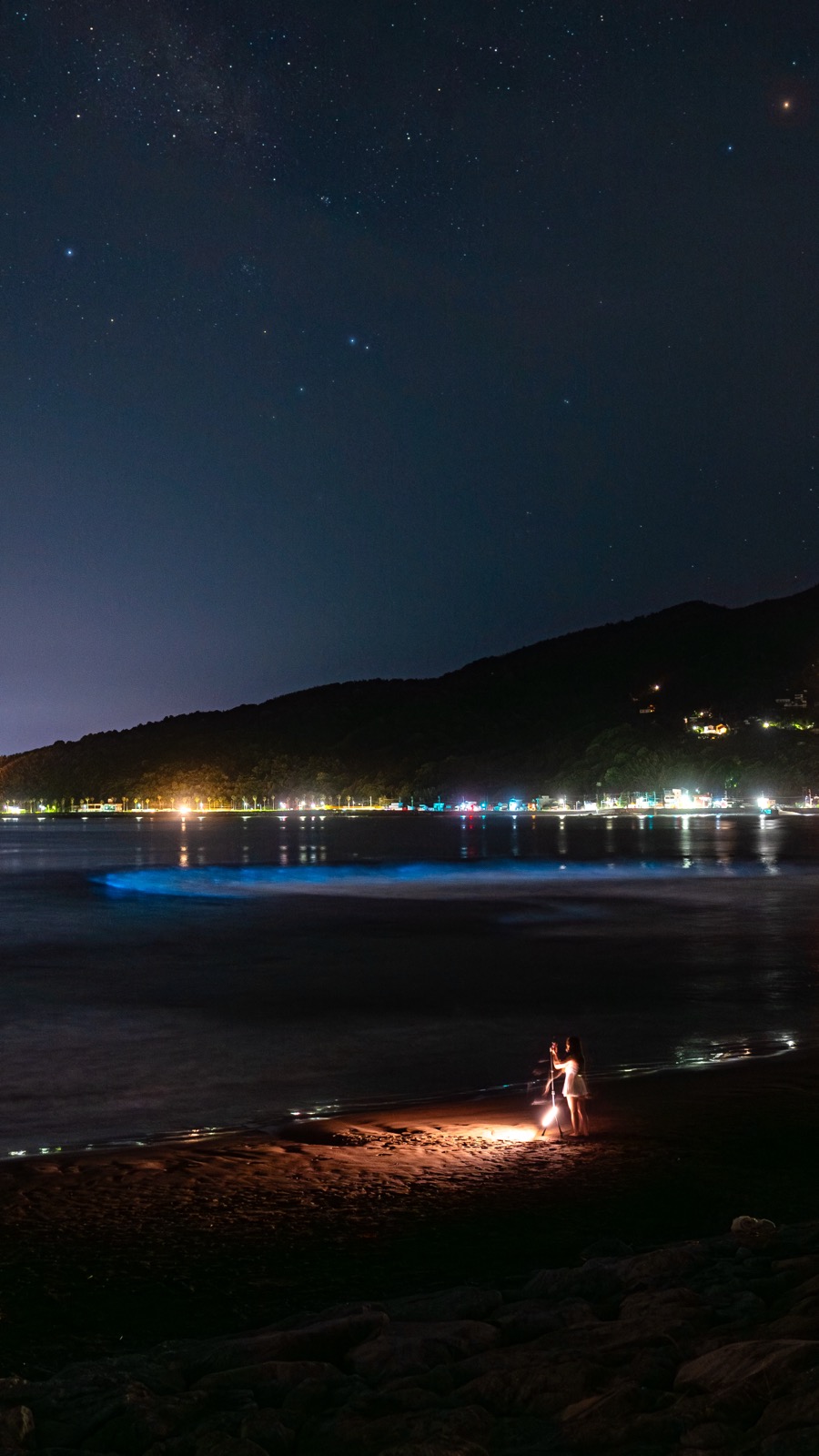
It was not the densest stretch the news had been showing — Toda had clearly been more dramatic the week before — but it was the entire length of the bay. A continuous blue line that came and went with the swell. Local people were out. A retired couple with a thermos. Two photographers further down the beach setting up tripods. A small group around a lantern. Nobody had expected eastern Izu to be hit this hard.
Where to see Japan’s bioluminescent beaches (2026 season) — verified sea-sparkle sightings
This is one of the most widespread sea-sparkle events Japan’s Pacific coast has seen in a decade — and as of May 26 onward, the Kanagawa coast has joined Suruga Bay and Mikawa Bay as a major active zone. Below are the locations where local news (TV Asahi ANN, tvk Yokohama, Kanagawa Shimbun), prefectural research bodies (Shizuoka Pref. Water & Marine Research Institute), Enoshima Aquarium, or directly-photographed reports have confirmed active blooms in late May – early June 2026. Anywhere unconfirmed has been intentionally left out.
Suruga Bay — Numazu, Toda, Nishiura
- Toda Mihama beach (戸田御浜) — observed May 18, “blue Milky Way” along the shore (Izu Shimbun)
- Numazu offshore + Nishiura coast — confirmed by SBS helicopter footage, May 20
- Shizuoka Prefecture Water & Marine Research Institute: largest Suruga Bay red tide of this scale in over a decade
- Best access: Numazu IC to Toda or Nishiura coast road; some areas need a car
Eastern Izu — Itō Usami
- Confirmed by me on May 26, 2026 (photographs above)
- Calmer surf than Shimoda, easier night-time logistics
- Access: JR Usami station (Itō line from Atami) — 15 minutes on foot to the beach
- Parking: 留田 (Tomeida) public lot adjacent to the beach — free outside the swimming season (July 19 – August 24)
Mikawa Bay — Gamagori Harubi
- Harubi Oura Beach (春日浦海岸) — active May 22–27 (Tokai TV aerial, first in 4 years)
- Park was at Katahara fishing port (形原漁港駐車場) — 10–15 min walk to the beach
- Status update: @gamagorikanko (Gamagori City Tourism) announced the red tide has receded and “夜光虫の幻想的な景色は、もう見られない” (the fantastical sea-sparkle view is no longer visible). The bloom lasted unusually long for this bay.
Shōnan — Fujisawa side
- Kugenuma Beach (鵠沼海岸) — observed May 25, first since May 2017
- Katase-Nishihama (片瀬海岸 西浜) — confirmed by Enoshima Aquarium & 夜景FANマガジン on May 25
- Bentenbashi (弁天橋) bridge area near Enoshima — multiple reports
- Chigasaki Southern Beach (サザンビーチ茅ヶ崎) — May 24–25 (Chigasaki port edge)
- Best access: Odakyu line to Katase-Enoshima station, walk west along the shore
Kamakura — Yuigahama, Zaimokuza, Shichirigahama
- Yuigahama (由比ヶ浜) — May 26 night, peak at ~22:00, settled by 22:30 (夜景FANマガジン)
- Zaimokuza (材木座) — May 26 night, blue-white surf line visible to the naked eye (Kanagawa Shimbun video)
- Shichirigahama (七里ヶ浜) — May 27 night (tvk Yokohama news report)
- Inamuragasaki (稲村ヶ崎) — May 27, smaller scale but visible
- Namekawa river mouth (滑川河口) — concentrated glow when active
- Lower-crowd tip: walk Zaimokuza toward Zushi Marina side
- Best access: JR/Enoden Kamakura station → Yuigahama 12 min walk
Miura Peninsula — Yokosuka, Hayama, Zushi
- Tateishi Beach (立石海岸, Yokosuka) — May 26 night ~20:00, live broadcast by TV Asahi (ANN)
- Akiya / Kuruwa (秋谷・久留和) — Miura Peninsula west coast, May 26 night
- Isshiki Beach (一色海岸, Hayama) — May 27 night confirmed via X (#夜光虫, “still beautiful at low tide”)
- Hayama (葉山) — small numbers reported throughout the late-May window
- Zushi (逗子) — sighting confirmed May 29
- Access: Keikyu line to Yokosuka-Chuo, bus to 立石 bus stop (Tateishi)
Other active zones — monitor on X
- Chigasaki Shiomidai (汐見台海岸, 茅ヶ崎) — offshore red tide visible per @bikazaidan (Kanagawa Coastal Foundation), whether it reaches the shore depends on wind
- Tokyo Bay east — 千葉県 市川漁港 / 行徳人工干潟 area, red tide observed (三番瀬フォーラム)
- Urabori Beach (浦富海岸, Tottori) — Iwami Town tourism account confirms it appears here on rare warm-water nights (different ocean, much less frequent)
- Itō Usami onwards — eastern Izu coast still had potential through early June
- These zones are not Kamakura-scale events — check X (Twitter) before going
Why this year is different — the Kuroshio shift
The scale of the 2026 bloom is unusually wide, and the reason is oceanographic. The Kuroshio (黒潮) — the warm Pacific current that runs north along Japan’s south coast — spent the years 2017 through 2025 on an unusual “great meander” track (黒潮大蛇行) that pushed it offshore from Honshu and left Suruga Bay and the Izu coast relatively cool. The meander ended in April 2025, and in spring 2026 the current was on its usual coast-hugging path. Suruga Bay and the eastern-Izu bays were sitting in warmer, nutrient-richer water than they had in nearly a decade — which is exactly what noctiluca needs to bloom in numbers.
This is why Shizuoka Prefecture’s research institute is calling it the first major bay-wide red tide in 10+ years, and why the Atsumi Bay bloom near Gamagori is the largest there in four. The Kanagawa sightings are following a similar pattern: warmer coastal water plus the right run of calm nights.
What is actually glowing — the science, briefly
The organism is Noctiluca scintillans, a single-celled dinoflagellate roughly 0.4 to 1.5 millimetres across — about the size of a grain of sand. During the day it floats invisibly throughout the upper water column. At night, when mechanical stress disturbs it — a wave breaking, a fish swimming through, a footstep — calcium ions release inside specialised organelles called scintillons, lowering pH, which triggers a luciferin–luciferase reaction that emits photons. Each cell flashes for less than a second. A dense bloom contains millions of cells per litre, and the cumulative effect is the steady-looking blue glow along the surf.
The same organism that glows blue at night is what colours the water reddish-pink during the day — that is the “red tide” (赤潮) the helicopter footage showed. Noctiluca itself is not toxic to humans, but that alone does not make a beach safe for swimming, so go by the beach’s own flags and notices. Dense blooms can also cause oxygen depletion in the water, which is why prefectural fisheries monitor aquaculture areas carefully.
Best conditions for seeing the glow
Five things that decide between “faint smudge” and “the surf is electric blue”
- Dark moon. In 2026 the new moon was May 17 and the full moon May 31. The best viewing window of that bloom was the week of May 17 to 24; by the last days of May the moon was brighter, but the bloom was dense enough to show. For a future bloom, aim for the nights around a new moon.
- Calm wind, gentle breaking waves. Glassy bays glow less because nothing disturbs the cells. Pounding surf overwhelms the visible light with foam. The sweet spot is mild rolling waves.
- A beach with mild surf. Long-arc bays like Usami, Kugenuma, Toda and Harubi all match this profile. Open Pacific surf beaches with heavy break (Shirahama, parts of Shōnan) are noisier.
- Patience and eye adjustment. Walk down to the water, sit, and wait 5 to 10 minutes for your eyes to dark-adapt. The first impression of “the water is just dark” almost always reverses.
- A red headlamp. Or no light at all. White light kills dark adaptation for everyone on the beach.
Photography notes from May 26
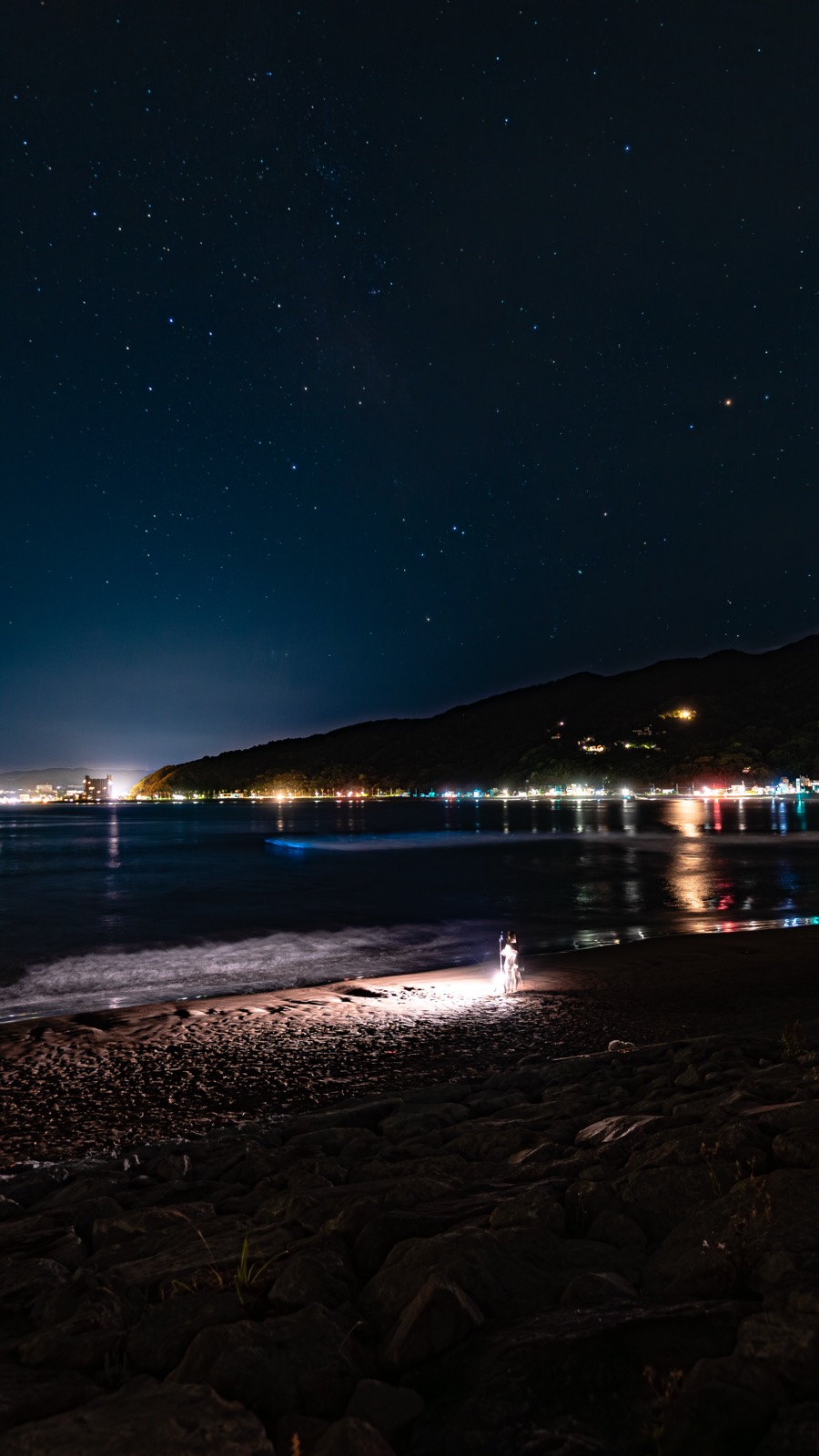
I shot the photos in this article on a Sony α-series body with the 24-70mm and an 18mm prime, locked on a tripod. If you want to capture the glow, this is what worked.
- Manual mode. Auto modes will brighten the sky and lose the blue.
- ISO 1600 to 3200. Lower if you have a recent full-frame body, higher if it is APS-C.
- 20 to 30 second exposures. Long enough to record the surf flow as a continuous blue band; short enough to keep stars as points.
- Wide aperture, f/2.8 to f/4. The bloom is not bright. You want to gather light.
- Manual focus on infinity. Autofocus will hunt and fail in the dark.
- Wide lens (14 to 24mm) to fit sky + surf in the same frame.
- Sturdy tripod. People walking on the beach create ground vibration that long exposures pick up.
Phone photos: a recent iPhone or Pixel will capture the bloom in Night mode but the colour balance tends to flatten the blue toward green. If you want the true cobalt, use a camera.
For a night on a dark beach
A glow hunt means standing on an unlit shore late at night. A few things make it safer and the photos better — and if you want the full settings, see how to photograph sea sparkle. All on Amazon Japan, so you can have it sent to your hotel first.
Flying in from the US or Canada? For a dark-beach shoot, these are worth having before you fly — on amazon.com: travel tripod, power bank, headlamp. Already in Japan? The Amazon Japan picks below deliver to your hotel.
Red-light headlamp
Hands free on rocks and steps in the dark, and red mode protects everyone’s view of the glow.
Travel tripod
The glow only shows in a long exposure, and that is impossible to hold steady by hand.
Insect repellent
Warm summer beaches at night mean mosquitoes. Spray before you settle in.
Power bank
Long exposures and a torch app drain a phone fast out there. Keep a charge in your pocket.
How long does a bloom last?
The honest answer is that nobody is sure. Noctiluca blooms typically run two to four weeks once they establish, and conditions can shift suddenly. In 2026 the Suruga Bay event was visible from at least May 18, the Atsumi event from around May 22, the Kanagawa sightings from May 25. With the Kuroshio back on a coast-hugging track and the spring water-temperature rise under way, I expected the bloom to persist through early June and possibly into mid-June (see the update at the top of this page for my June notes). Beyond that, summer warming usually collapses noctiluca populations as oxygen drops and competing species take over. When sightings start again, think in weeks, not months.
FAQ
Is it safe to swim in?
Noctiluca itself is not toxic to humans. The “red tide” (赤潮) the helicopter footage showed is the daytime form of the same bloom. The water may smell fishy along shore and is not pleasant for a long swim. The bloom does not tell you whether a beach is safe to swim, though: swim only at a beach that is open, follow its flags and lifeguards, and do not swim after dark. Local fisheries monitor blooms because dense ones can cause oxygen depletion that affects farmed fish.
Will my phone capture the blue?
Partly. A modern iPhone or Pixel in Night mode will record something, but the blue often shifts toward green or grey and the surf detail blurs. For accurate colour and the dramatic long-exposure look you see in news and travel photos, you need a camera with a manual mode, a wide-aperture lens, and a tripod.
Why is the daytime water red but nighttime blue?
Same organism, different mechanism. By day, dense concentrations of Noctiluca scintillans show as a reddish-pink or pinkish-orange tint on the water surface because of pigments in the cells — that is the “red tide” effect. At night, mechanical disturbance triggers each cell to flash blue via a luciferin–luciferase reaction. So a bay that looks pink at noon will glow blue at midnight, if the bloom is dense and the waves are breaking.
Can I see it from a train or boat?
From a moving boat at night through the bloom, yes — the wake will glow behind the hull. From the Tōkaidō Shinkansen at night, no; the train windows are tinted and you are passing the bays too fast. The Izu coast trains (Itō Line, Izukyu Line) run too far inland from most affected beaches and finish service before peak viewing time. Plan to be on the sand.
Is this an annual thing in Japan?
Noctiluca blooms happen most years somewhere along the Japanese coast, but the scale of the 2026 event is unusual — first in 10+ years for Suruga Bay, first in 4 years for Atsumi Bay, first in 9 years for Kugenuma. The combined trigger appears to be the Kuroshio current returning to its normal coast-hugging course after eight years of the “great meander” route. Years like this are rare.
What time of night is best?
Roughly 21:00 to 01:00. The bloom is visible from full dark onward, but the human eye needs 5 to 10 minutes of dark adaptation before the blue becomes obvious. Avoid arriving with a white phone screen on — it ruins the next 10 minutes of viewing for you and everyone around you.
Sources used for this article
- Personal observation, Usami Beach, Itō, May 26, 2026 (photographs in this article)
- Shizuoka Shimbun At-S — Suruga Bay red tide, first major event in 10+ years (May 21, 2026)
- Izu Shimbun Digital — Toda Mihama beach observation (May 20, 2026)
- Tokai TV via Yahoo News — Atsumi Bay first major bloom in 4 years (May 22, 2026)
- NewsDigest — Kugenuma Beach 9-year sighting (May 25, 2026)
- Gamagori community news — Harubi Oura traffic advisory (May 25, 2026)
- Ito Tourism Association — Usami Beach access and parking
- Wikipedia — Noctiluca scintillans — biology and luminescence mechanism
- Shizuoka Prefecture Water & Marine Technology Research Institute — referenced via Shizuoka Shimbun
- TV Asahi (ANN) via Yahoo News — Tateishi Beach, Yokosuka live broadcast (May 26-27, 2026)
- tvk Yokohama News — Shichirigahama report (May 28, 2026)
- Kanagawa Shimbun (Kanaloco) — Zaimokuza video (May 26, 2026)
- 夜景FANマガジン — Yuigahama 22:00 peak observation (May 26, 2026)
- 鎌倉スロートレイル — daily Shōnan/Kamakura status updates (May 27-28, 2026)
- 湘南人 — “largest since May 2017” Kamakura quote
- @kamakura_kyokai (Kamakura Tourism Association official X) — Shichirigahama / Yuigahama / Zaimokuza ongoing status
- @enosui_com (Enoshima Aquarium official X) — Katase-Nishihama May 25 first sighting
- @gamagorikanko (Gamagori City Tourism official X) — Harubi end-of-bloom announcement
- @bikazaidan (Kanagawa Coastal Foundation X) — Chigasaki Shiomidai offshore status
- @iwamikanko (Iwami Town Tourism, Tottori) — Urabori Beach occasional bloom
Planning for the next bloom — where to base yourself
Sea-sparkle viewing means staying on the coast and being on the beach after dark. Past blooms on this coast have come in late spring, but big ones are rare and hard to predict, so book once sightings are confirmed. These are the three booking paths I would use.
Join travelers discovering Japan's hidden side
Weekly dispatches from off-the-beaten-path Japan — spots and stories you won't find in guidebooks.
No spam. Unsubscribe anytime.
Welcome aboard!
You're in. See you in your inbox soon.