Kanagawa · Shonan · Enoshima Overnight
In shortEnoshima Island, 60 minutes from Shinjuku, is mostly written about as a Tokyo day trip. The night version — sunset over Sagami Bay, the lit-up Sea Candle observation tower, raw shirasu dinner at a Nakamise-dōri shop, and the Dragon-Palace-style Katase-Enoshima Station glowing red after 8 PM — only works if you stay overnight on or near the island. This article is the case for staying. Best stays: Enoshima Island Spa with rooms, Iwamotoro Honkan (the 1,200-year-old ryokan on the island), or Fujisawa-side hotels 12 minutes away.
The first time I tried Enoshima as a Tokyo day trip I arrived at 4 PM and immediately had to start cutting things. The sunset from the south cliff means you cannot also climb the Sea Candle at golden hour. Dinner at a raw-shirasu shop means you cannot also photograph the night station. The last Romance Car back to Shinjuku is around 21:30. The trip ends with you on a train at 21:00 thinking about the half of the evening you did not see. The second time I did it differently. I booked a room on the Shonan side, arrived at 14:00, and let the island unfold over twenty hours instead of five. This is a guide to that version.
Why You Cannot Fit This Into a Day Trip
The maths of a day trip
A Tokyo day-tripper has roughly 5 hours on the island. The evening alone needs 6.
The Sea Candle illumination peaks 18:30–19:30. The shrine pre-sunset walk takes 30 minutes. The south cliff sunset takes 45 minutes. The Sea Candle observation deck queue at sunset adds 30 minutes. Dinner is 60–90 minutes. The Katase-Enoshima Station night-light shot needs the lights fully up — not before 20:00. The last good Romance Car back to Shinjuku is the 21:30 departure, which means you must leave the Sea Candle area by 21:00.
If you arrived from Tokyo at 16:00 (the earliest reasonable Romance Car), you have five hours for an evening that genuinely needs six. Something gets cut every time — usually the station shot, sometimes the dinner. Staying overnight removes the deadline. That is the entire pitch.
Quick Facts
The Walk-Up Through Enoshima Shrine (Late Afternoon)
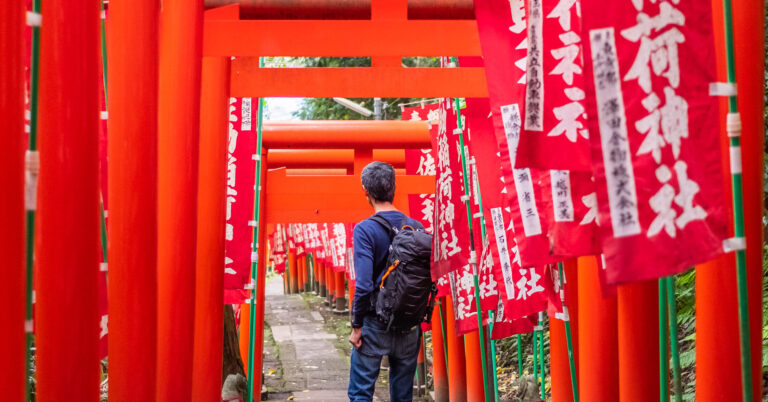
The Bentenbashi bridge to the south cliff is a 20-minute walk on flat-then-uphill terrain, and the centre of that walk runs through Enoshima Shrine. By 16:30 the day-tour groups are leaving and the path is the quietest it will be all day. The red torii at the bottom of the shrine staircase is photographed maybe 200 times per minute at 11 AM and maybe twice per minute at 16:45 — that is the version you want.
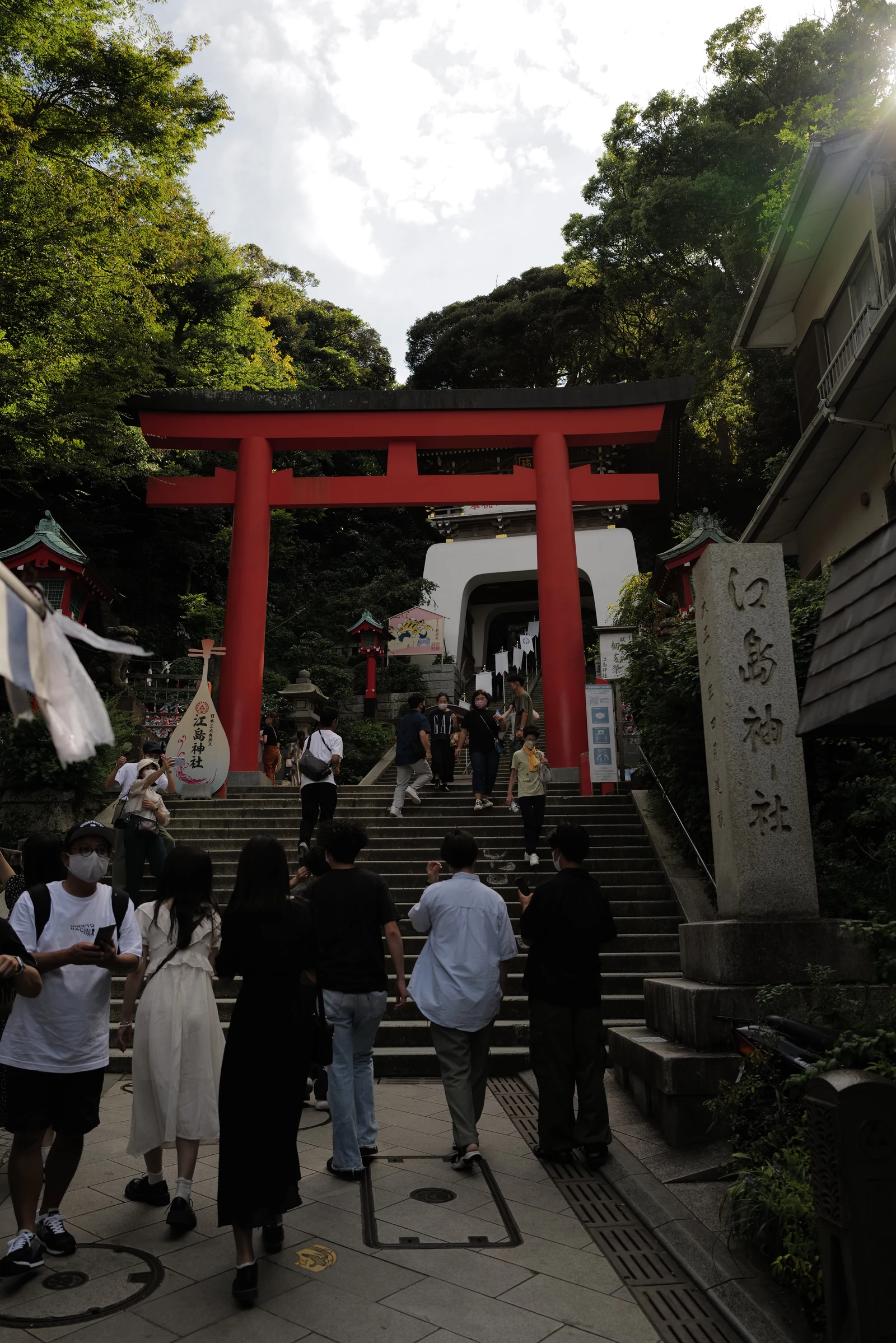
The Enoshima Shrine red torii at 16:45. Quietest hour of the day; golden light hits the gate cleanly. Pay the escalator fee (¥360) just past this point if you want to skip the staircase climb above the shrine.
Where to Stay (The Three Options)
There are essentially three places to sleep within walking distance of the island. Each makes the overnight calculus work differently:
Iwamotoro Honkan
The historical onsen ryokan on Enoshima itself — founded over 1,200 years ago, the place Minamoto no Yoshitsune is said to have stayed in. Rooms face the bay. The closest thing to sleeping inside the island. From around ¥25,000/night with dinner.
Find on Booking Fujisawa sideFujisawa boutique & business hotels
5–12 minutes by Odakyu or Enoden from the bridge. Wider selection (10+ properties), cheaper rate point (¥9,000–18,000), and Fujisawa Station gives you direct rail back to Tokyo when you leave. The default Shonan overnight base.
Compare on Agoda Kamakura sideKamakura ryokan & guesthouses
15–25 minutes by Enoden. Pairs the island sunset with a Kamakura morning (Great Buddha, Hasedera, Hokokuji bamboo grove). Rakuten Travel lists more traditional inns here than Booking does.
Browse on RakutenIf you only have one night and the priority is the island itself, sleep on the island (Iwamotoro). If the priority is flexibility and price, sleep in Fujisawa. If you want to bolt Kamakura on as a morning activity, sleep in Kamakura. There is no wrong answer; the pricing is what shifts.
The Sunset Window
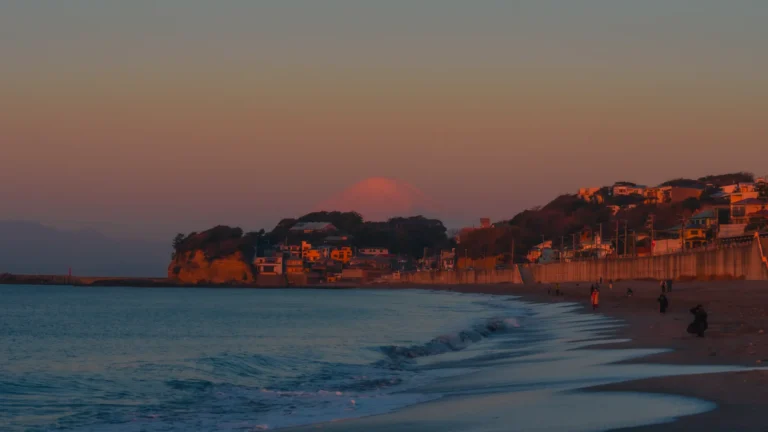
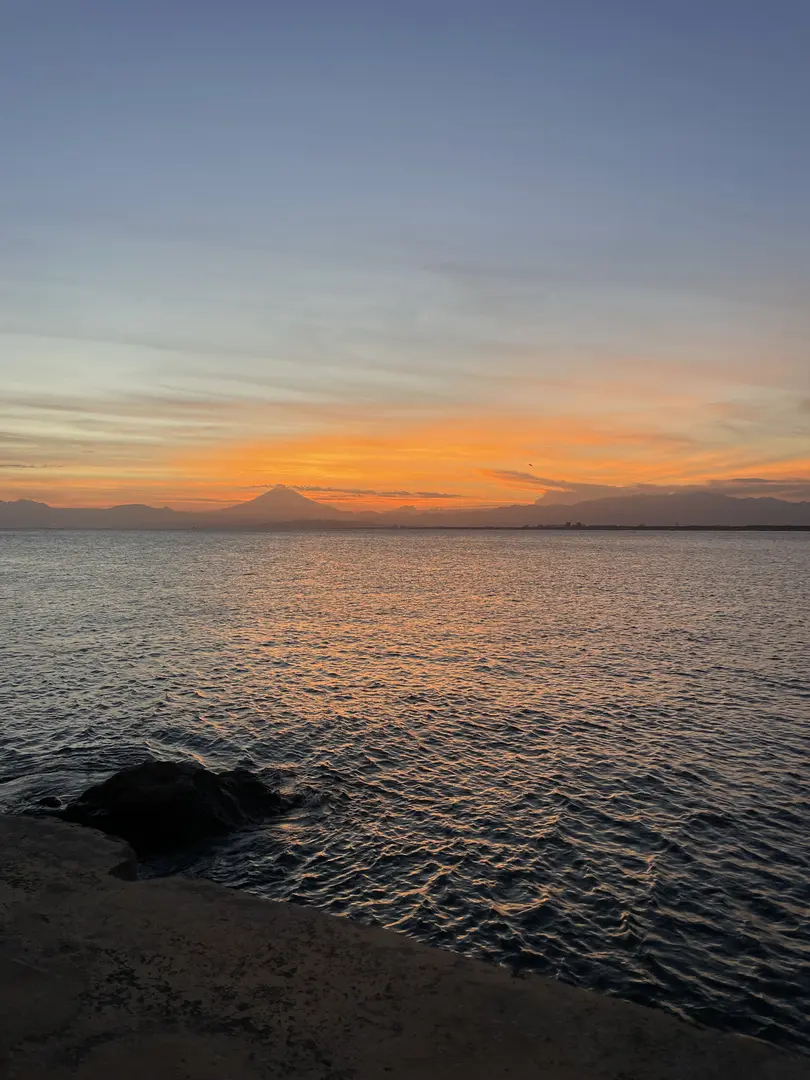
The geographic accident that makes Enoshima a sunset destination: the island sits at the western end of Sagami Bay, with the Miura Peninsula to the east and Mt. Fuji (or the Hakone range) on the western horizon. From late October through February the sun sets behind Mt. Fuji on certain calendar days — the so-called Diamond Fuji we covered in the Diamond Fuji guide — but every evening of the year the sun goes down over the Pacific from the south-west edge of the island, and from late March through early November the colour is reliably good.
Three angles from the same hour
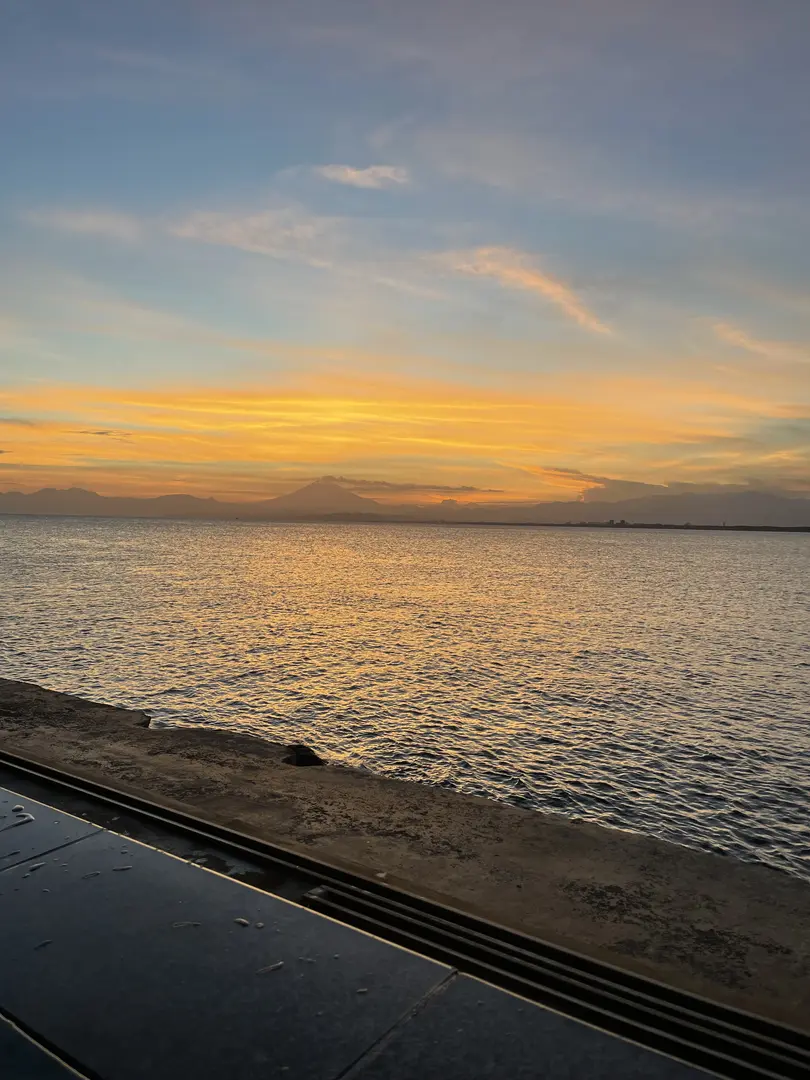
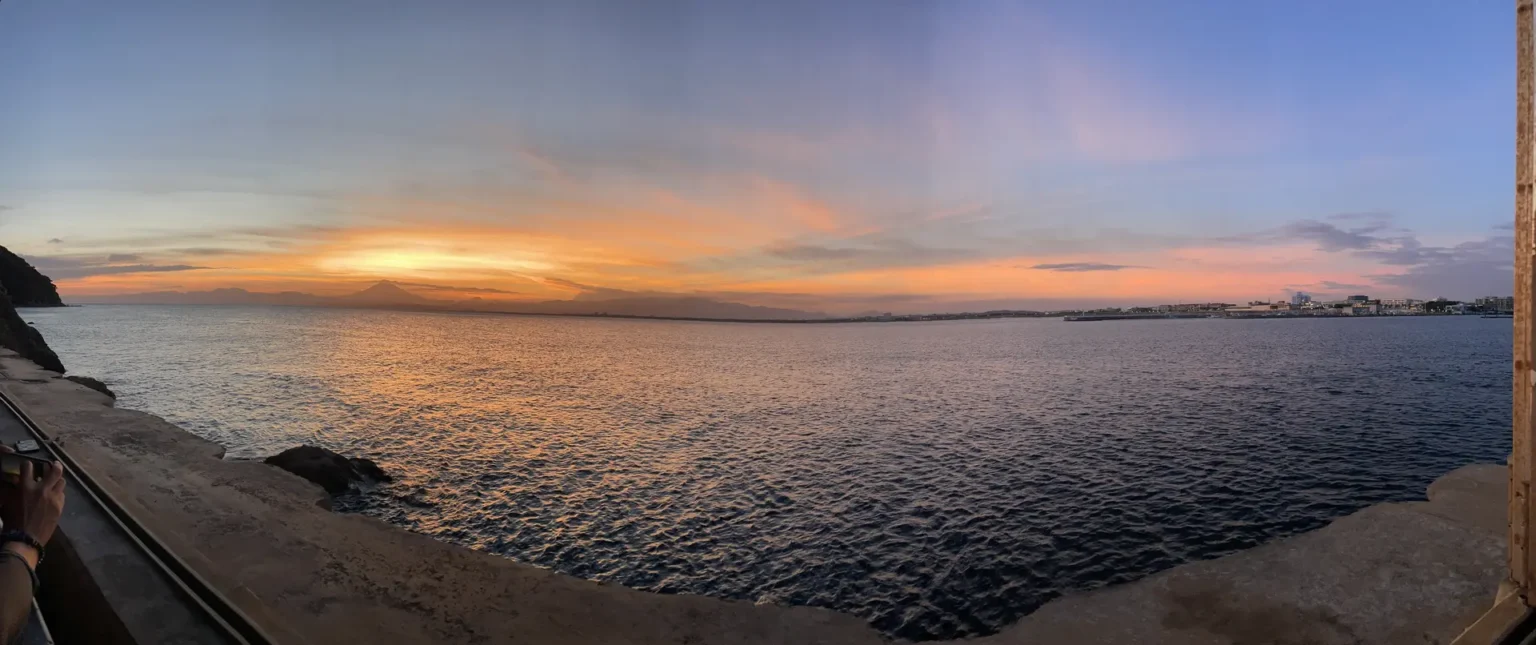
All three photographs below are from the same cliff edge below the Enoshima Island Spa, on the same evening, over about 25 minutes between 17:35 and 18:05. They are the same place, three framings — the Mt. Fuji silhouette wide shot, a panorama showing the curve of Sagami Bay, and the close-in vertical with the rocks below the deck. The Spa rooftop and seawall is open to anyone who buys a day-pass to the bathhouse; the access detail is below in “The Spa as a Sunset Spot.”
The four best vantages
From most distinctive to most reliable:
- Enoshima Island Spa (江の島アイランドスパ) — an onsen complex on the west cliff of the island with an open-air rooftop deck and seawall access overlooking the Pacific. This is where the photos above were taken. Day visitors pay a single admission (around ¥2,750–3,300 depending on day), get full bath and lounge access, and can use the deck as a sunset viewing platform with nothing between you and the western Pacific horizon. Cameras allowed on the deck (not inside the baths). Open until 20:00, so you can stay through full sunset and blue hour. Address: 2-1-6 Enoshima, Fujisawa, Kanagawa · 12 min walk from Bentenbashi bridge.
- Chigogafuchi (稚児ヶ淵) — the south-cliff plateau on the far side of the island. Free, open at all hours, about 20 minutes walk from the bridge. The Pacific opens up to 270 degrees here. The classic outdoor option.
- Sea Candle observation deck — the 60-metre lighthouse tower in Samuel Cocking Garden. Pay ¥500, climb up by 18:00 (in summer), get a 360-degree view of the bay with Mt. Fuji silhouetted in winter.
- Iwaya-dōri seawall — the lower path along the south coast leading toward the caves. Sea-level sunset, harder light, but the waves break against the rocks under the colour and it becomes the photographer’s shot.
Day-trippers walk Enoshima clockwise and head back across the bridge by 3 PM. Overnight visitors walk anti-clockwise — bridge first, caves later, Chigogafuchi or the Spa at golden hour, dinner after.
The Sea Candle & Samuel Cocking Garden
The Enoshima Sea Candle (江ノ島シーキャンドル) is a 60-metre observation tower at the centre of Samuel Cocking Garden — a botanical garden first laid out by a British merchant in the 1880s. The tower is recent (rebuilt 2003) but sits on the original Cocking foundation. Pay ¥500 separately from the garden admission and you get a fast elevator to a glass-floored observation deck.
The reasons to go after sunset (overnight visitors only):
- 360-degree view of Shonan with Mt. Fuji on clear winter nights — the tower silhouette plus distant snowy summit is the iconic frame.
- The garden directly below is illuminated at night during the Shonan no Houseki season (late November to mid-February) — the most photogenic winter event on the island.
- From inside, you can watch the city lights of Fujisawa, Hayama, Zushi, and on a clear winter night, Tokyo itself.
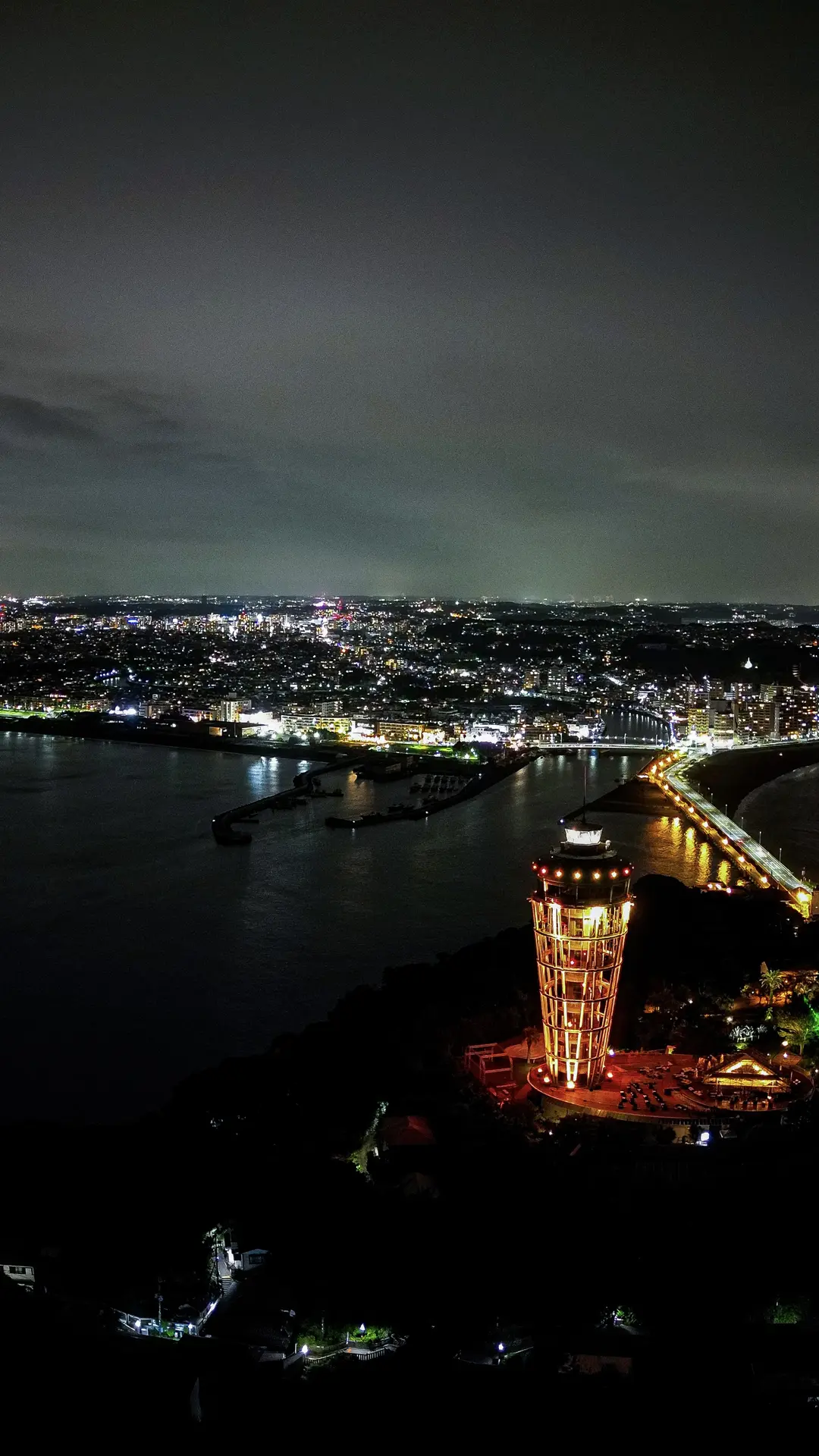
The Sea Candle at night from above. The bay behind is Fujisawa city; the dark stretch in the foreground is the upper island. Drone shot, 2022.
Raw Shirasu — The Local Pacific Whitebait
Two things to know about Shonan food before you order:
- Shirasu (whitebait, the larval-stage anchovy) is the local specialty. Sagami Bay’s underwater geography makes this stretch of Pacific the best shirasu fishing ground in Honshu. Almost every restaurant along Nakamise-dōri serves it.
- The fishing is closed January through mid-March for spawning protection. During those months, restaurants serve frozen or kama-age (boiled) only. Raw (nama) shirasu is impossible outside Mar 11 – Dec 31, and even within the season is dependent on the morning catch.
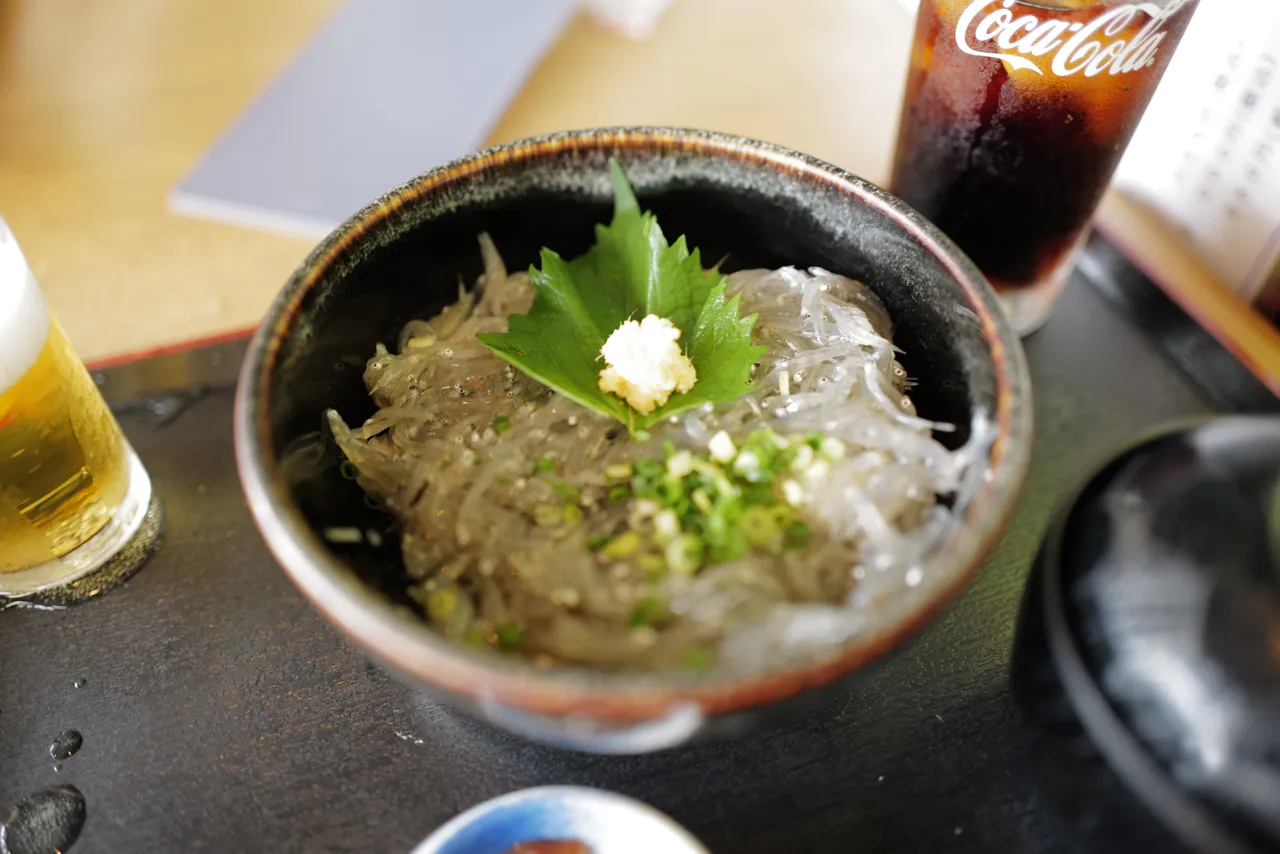
Raw shirasu (nama-shirasu) bowl — over warm rice, with shiso, ginger, scallion. The fish is silver-white and barely a centimetre long; the texture is more like a sea-vegetable than a sashimi.
How to order it right
The Shonan rule: ask for the three-way bowl (三色丼 / san-shoku-don) — raw, boiled (kama-age), and dried (chirimen) shirasu over the same bowl of rice. Costs ¥1,500–2,000 at most shops on the island. You taste all three textures in three bites: the raw is sea-vegetable-like and faintly sweet; the boiled is fluffy and white; the dried is the salt-cured form that travels well as a souvenir.
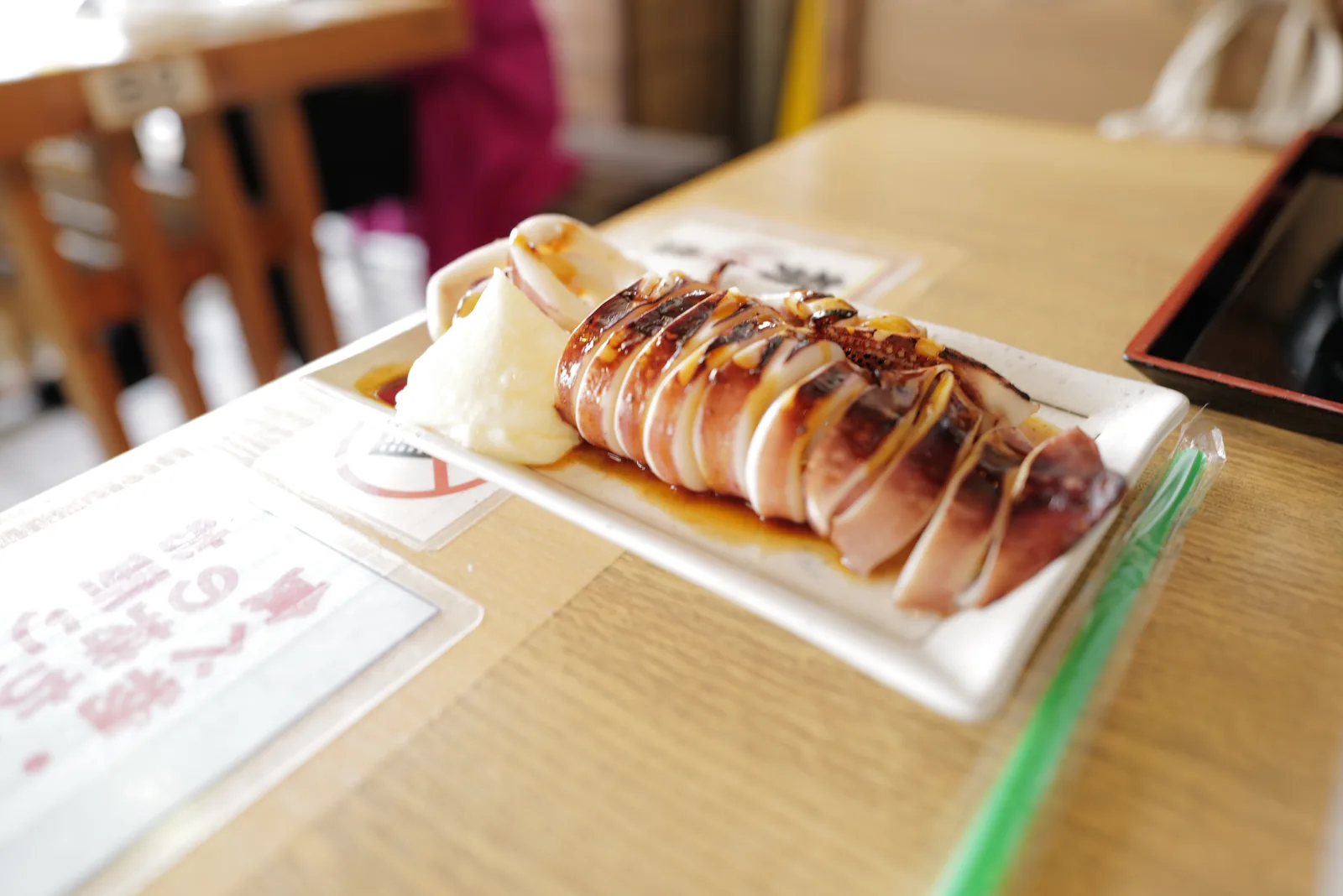
If the morning catch was poor and the raw shirasu is sold out (this happens), the back-up order is whole grilled squid (maru-yaki ika) — the smoke from the charcoal grills is one of the smells of Nakamise-dōri after 5 PM.
Where to eat:
- Toshimaya Honten — the most famous on the island. Opens 11:00–19:30. Lines in summer, walk-in possible after 6 PM.
- Bunjirō — quieter, on the bridge side. Cheaper. The kama-age is excellent.
- Kaikourou — on Nakamise-dōri, second-floor terrace, sunset view over the bridge. Pricier but the only place where you can eat shirasu while watching the sunset.
The Night Station — Katase-Enoshima (After 20:00)
One photograph you cannot get during the day — or as a Tokyo day-tripper: Katase-Enoshima Station, the Odakyu terminus, fully illuminated. The station is built in the style of Ryūgū-jō (Dragon Palace, the underwater palace of Japanese folklore) and during the day looks faintly themed-park-ish. At night, lit in red and gold, it becomes one of the most distinctive train stations in Greater Tokyo. The lights come fully on at sundown, but the photograph wants them at full intensity — usually 20:00 or later, depending on season.
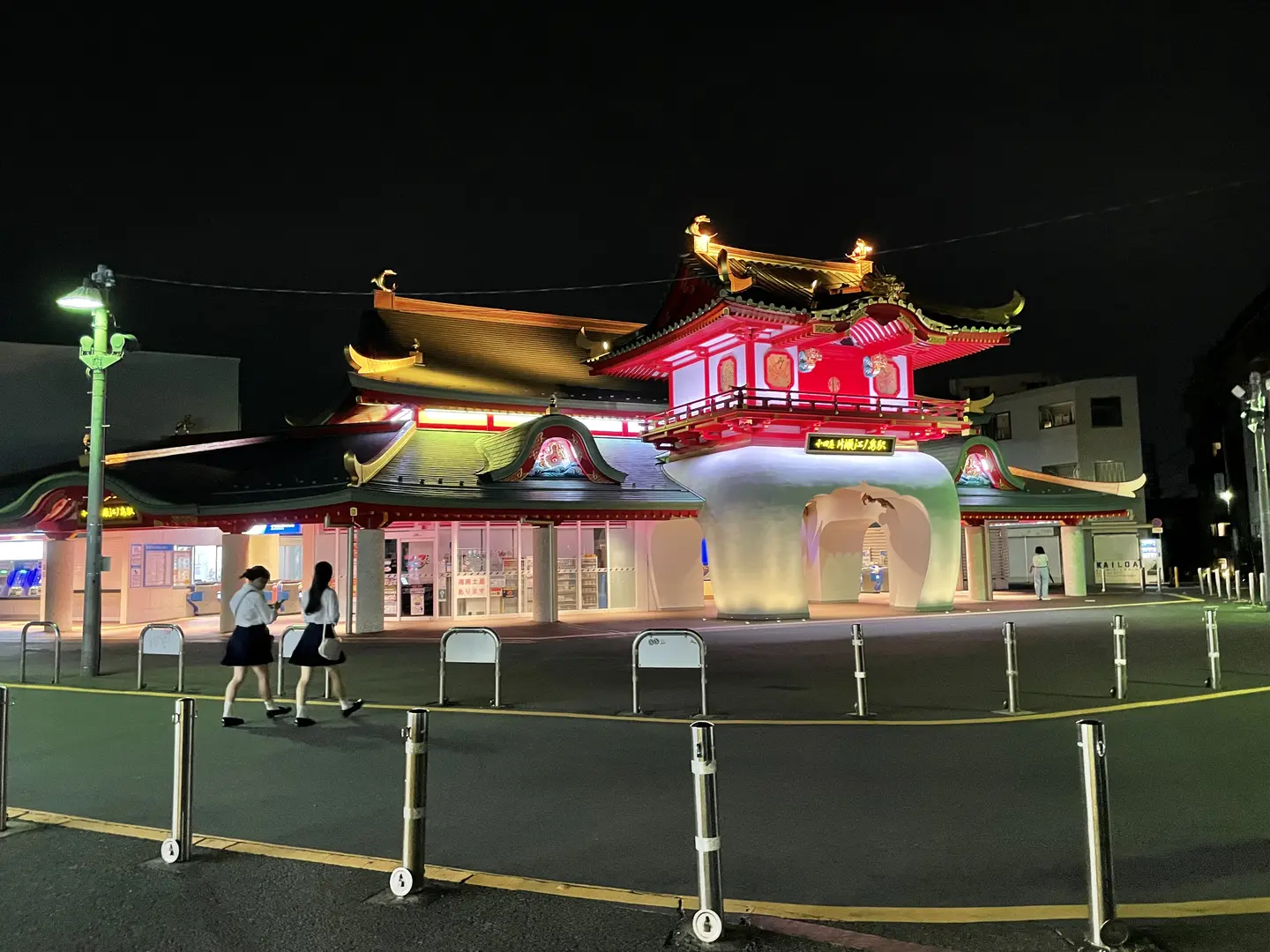
Katase-Enoshima Station after dark — the Ryūgūjō (Dragon Palace) design, fully lit. The station was rebuilt in 2020 for the Tokyo Olympics surfing event held off Enoshima.
Best photo time: 20:00–21:30, after the lights are at full intensity and most trains are spaced apart. Stand on the south-side plaza across from the station; the building fills the frame at 24mm equivalent. This is the moment a day-tripper has already left for Tokyo.
The Morning After (The Other Half Day-Trippers Miss)
Staying overnight gives you a second window the inbound rush also misses: the morning. The shrine path that had 30,000 day-trippers on it the previous afternoon is empty before 9 AM. The Iwaya caves open at 09:00. The Enoden trams run almost empty westbound at 08:00 toward Kamakura. If you stayed in Fujisawa, an hour’s walk along Katase-Higashihama Beach at sunrise (6 AM in summer, 6:40 AM in winter) gives you the Pacific in flat blue-grey light, surfers paddling out, and no one else for a kilometre in either direction — the cleanest version of the Shonan coast Tokyo people imagine and rarely get.
If you have time for one morning bolt-on, pair it with Shichirigahama (15 min Enoden west) for the famous Mt. Fuji-over-the-rails shot, or with the Slam Dunk crossing in Kamakura for the anime-pilgrimage version of the same coast.
An Overnight Itinerary: 14:00 Arrival → 09:00 Departure
Getting There
Three direct lines reach the island:
- Odakyu Enoshima Line from Shinjuku to Katase-Enoshima Station. Romance Car limited express 60 min, ¥1,260. Regular express 70 min, ¥620. The best line for overnight visits — arrives directly at the bridge side.
- JR Tokaido + Enoden — Tokyo→Fujisawa (50 min, JR Pass eligible), then Enoden 8 minutes to Enoshima Station. Slightly more walking on arrival but useful if you are based in a JR-served area or using the JR Pass.
- Shonan Monorail — suspended monorail from JR Ofuna. Novelty option for a return trip; 14 minutes from Ofuna to Shonan-Enoshima Station, then a 5-minute walk.
From the airport: Narita is 2–2.5 hours via the JR Narita Express to Shinjuku, then Odakyu. Haneda is faster at 90 minutes via Keikyu + JR Yokosuka + Enoden.
Plan an Overnight on Enoshima
Plan This Trip
Practical Tips
FAQ
Is staying overnight on Enoshima actually worth it?
If your goal is just to see the island and the shrine, no — a day trip from Tokyo is enough. If your goal includes the sunset, the Sea Candle illumination, a proper raw-shirasu dinner, and the Katase-Enoshima Station night-light photograph, the day-trip math fails by about an hour. Either you cut two of those four, or you stay overnight. The hotel cost (¥10,000–15,000 Fujisawa side) is essentially the price of those two photographs and the unhurried dinner.
Where should I sleep — the island or Fujisawa?
Iwamotoro Honkan on the island itself is the most distinctive option (and the most expensive, around ¥25,000+/night with dinner). Fujisawa-side boutique and business hotels are the default — cheaper, wider selection, 5–12 minutes back to the bridge. Kamakura makes sense if you want to add a Great-Buddha morning to the trip. For most overseas travelers staying one night, Fujisawa is the right answer; for couples on a slow trip, the on-island ryokan is the experience.
Where is the sunset photo on this page taken from? Is it open to the public?
From the open-air rooftop deck and seawall edge below Enoshima Island Spa (江の島アイランドスパ), an onsen complex on the west cliff of the island, 12 minutes walk from the Bentenbashi bridge. Yes, it is open to day visitors — the admission (around ¥2,750–3,300 depending on day and season) covers full use of indoor baths, outdoor pools, lounges, and the rooftop “Sky Spa” deck overlooking the Pacific. Cameras are allowed on the deck (not inside the baths). It is the only enclosed-sunset vantage on the island and is materially less crowded than Chigogafuchi cliff on weekend evenings.
How is this article different from the walking guide?
The existing Walker’s Guide to Enoshima Island covers the daytime route: bridge, shrines, Sea Candle, caves, lighthouse, in that order, optimised for arriving at 10 AM. This article is the case for staying overnight on the Shonan side — the sunset, the Sea Candle illumination, raw shirasu dinner, and the night station, on the unhurried schedule that requires a hotel. Different itinerary, different sights, complementary trips.
Can I see Mt. Fuji from Enoshima at sunset?
Yes, on clear winter days from the Spa rooftop, Chigogafuchi cliff, and the Sea Candle observation deck. October through February has the highest visibility. The Diamond Fuji event (sun setting behind the summit) happens on specific dates — see our Diamond Fuji 2026-2027 Calendar for exact days.
Is raw shirasu (nama-shirasu) safe to eat?
Yes if you eat it from a licensed shop within hours of the morning catch — which is how Shonan restaurants serve it. The fishing is closed January through mid-March, so any “raw” shirasu sold outside the season is frozen and lower-quality. Pregnant travelers and people with allergic reactions to fresh seafood should default to the boiled (kama-age) version.
How much money should I budget for the overnight version?
Approximate: ¥1,800 round-trip Odakyu from Shinjuku, ¥10,000–15,000 hotel night Fujisawa-side, ¥360 escalator pass, ¥2,750–3,300 Spa admission (optional), ¥500 Sea Candle, ¥1,500–2,500 shirasu dinner, ¥1,500–2,500 breakfast/morning + miscellaneous = roughly ¥18,000–25,000 per person all-in. The same trip as a day trip is about ¥6,000 less but with two evening stops cut.
Can I combine Enoshima with Kamakura in one overnight?
Yes — the natural pairing is Enoshima sunset/night/dinner, sleep in Fujisawa or Kamakura, and Kamakura the next morning (Great Buddha, Hasedera, Hokokuji). The Enoden connects them in 25 minutes. See our Shichirigahama dawn walk for the very early version of the route in reverse.
Enoshima as a day trip is the version every Tokyo travel page already covers. It is fine as a day trip. It is not the version that produces the photos — the sunset over Sagami Bay with Mt. Fuji on the horizon, the Sea Candle at full intensity, the Dragon Palace station at 21:00 — that make people want to come at all.
To get those photographs, you need an extra ninety minutes you do not have if you are catching the last Romance Car back. The fix is to stop catching it. Sleep on the Shonan side. Walk the island anti-clockwise — bridge first, shrine slowly, Spa for sunset, dinner unhurried, station at full light, hotel by 22:00. Sunrise the next morning if you want it. Tokyo is still 70 minutes away when you decide to leave.
The island stays open all night. The day-trippers do not.
Booking the Overnight
Three doors. Iwamotoro on the island for the experience, Fujisawa for the price, Kamakura if you want a morning bolt-on.
Join travelers discovering Japan's hidden side
Weekly dispatches from off-the-beaten-path Japan — spots and stories you won't find in guidebooks.
No spam. Unsubscribe anytime.
Welcome aboard!
You're in. See you in your inbox soon.