Ibaraki · Kita-Ibaraki · June 2026
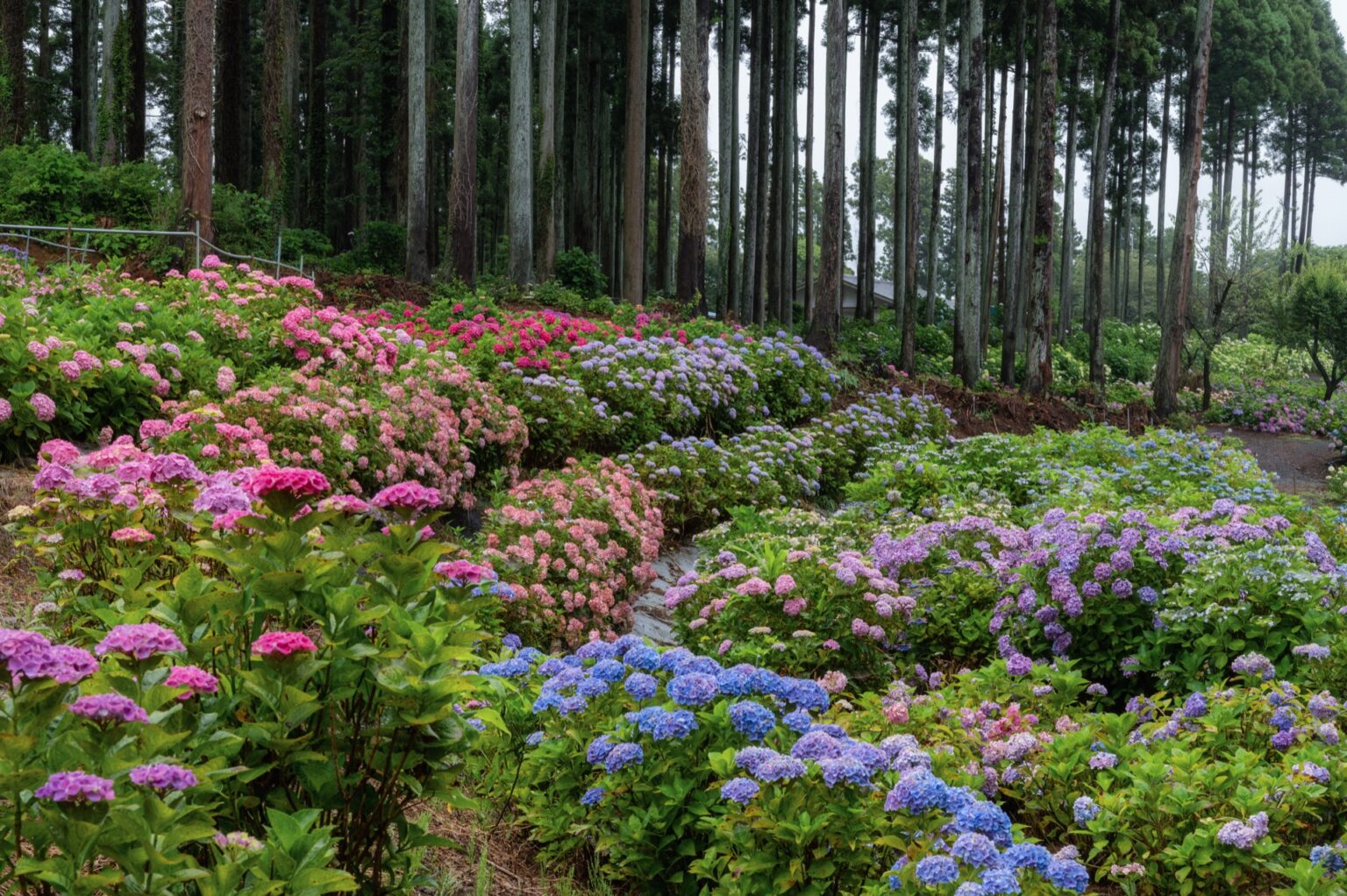
Ajisai no Mori in Kita-Ibaraki holds about 1,500 hydrangea varieties across 30,000 square meters of cedar-forest hillside — the largest variety count of any single hydrangea garden in Japan, founded in 2004 by collector Yamagata-san on the access road to Hanazono Gorge. Admission is ¥500, peak is late June through mid July, and on a Tuesday afternoon at peak you might share the entire forest with a dozen other people.
I drove up from Mito on a humid Tuesday morning in late June, an hour and a half along Route 6 and then a single mountain road into Kewagawa-cho. The garden is not signposted aggressively. You almost miss the entrance. Then you park, pay ¥500, walk past a wooden gatehouse, and the trail begins — and what unfolds over the next two hours is, by plant variety count, the largest hydrangea collection in Japan. Meigetsu-in in Kamakura has one variety. Kamakura Hasedera has 40. The four “tested” spots in our Japan Tsuyu 2026 guide have between 10 and 80. Ajisai no Mori has 1,500. That number is not marketing — it is one private collector’s twenty-year obsession, planted variety by variety into the slope behind a soba restaurant.
30-second summary
What it is: A 30,000 m² private hydrangea collection on a cedar-forest hillside in Kita-Ibaraki, with about 1,500 varieties in two staggered peaks (320 mountain/yama-ajisai mid–late June, then 600 mophead/lacecap mid June–mid July).
Why it is unusual: No temple, no festival booth, no train station. One man’s collection, opened to the public from 2004. Adult admission ¥500.
Best time: Weekday morning, late June. The site is too remote to crowd even at peak.
Quick Facts
Location
Kewagawa-cho Azukibata 1138, Kita-Ibaraki City, Ibaraki. Mountain road off Route 6, near the trailhead to Hanazono Gorge.
Scale
~1,500 varieties across 30,000 m² (3 hectares). Largest variety count of any Japanese hydrangea garden.
Peak Bloom 2026
Mid June – mid July. Yama-ajisai/Ezo-ajisai peak mid–late June (320 varieties). Mophead/lacecap peak mid June – mid July (600 varieties).
Admission
Adults ¥500. Junior-high and younger ¥300. Charged once the garden reaches 50% bloom; free outside that window.
Founded
2004, by hydrangea collector Yamagata-san on his family’s mountain land. Originally a regional-revitalisation project, now a destination.
Access
No nearby train station. Drive: ~90 min from Mito Station, ~2.5 hr from Tokyo. Phone: 0293-43-1148.
What 1,500 Varieties Actually Looks Like
The single most useful thing to know about Ajisai no Mori is that it does not look like other Japanese hydrangea gardens. Most Japanese gardens — Meigetsu-in, Kamakura Hasedera, Hakone — plant a small number of mophead varieties densely, for visual mass. Yamagata-san planted his collection variety by variety in clumps of two or three, mixing yama-ajisai (mountain hydrangea, small flowers, native to Japan) with European hybrids, lacecaps with mopheads, blues with magentas, paniculatas with serratas. The result is closer to a botanic garden than a temple grounds — a slow walk past 1,500 small experiments rather than a single sea of colour.
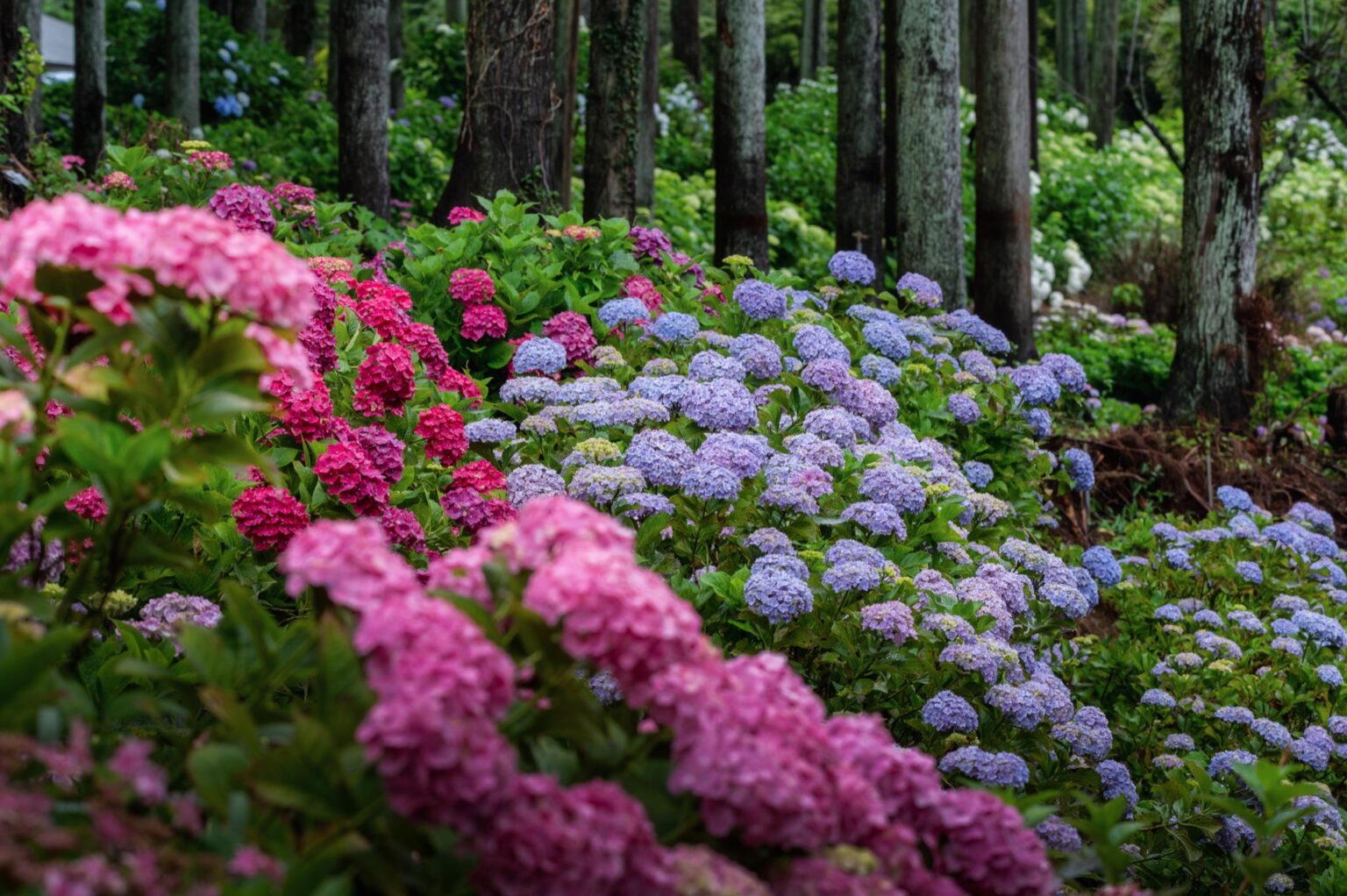
Two specific things to notice, if you have a photographer’s eye:
First, the yama-ajisai section in the upper third of the garden. These are native Japanese mountain hydrangeas with small, flat lacecap flowers in indigo, white, and violet. They are about 90% absent from foreign hydrangea expectations because the European varieties Westerners know (Annabelle, Endless Summer, Limelight) are all derived from the larger H. macrophylla. Yama-ajisai are different — older in cultivation, smaller in flower, often grown as a single specimen in a pot rather than mass-planted. Ajisai no Mori has 320 of them peaking together. That number does not exist anywhere else in Japan.
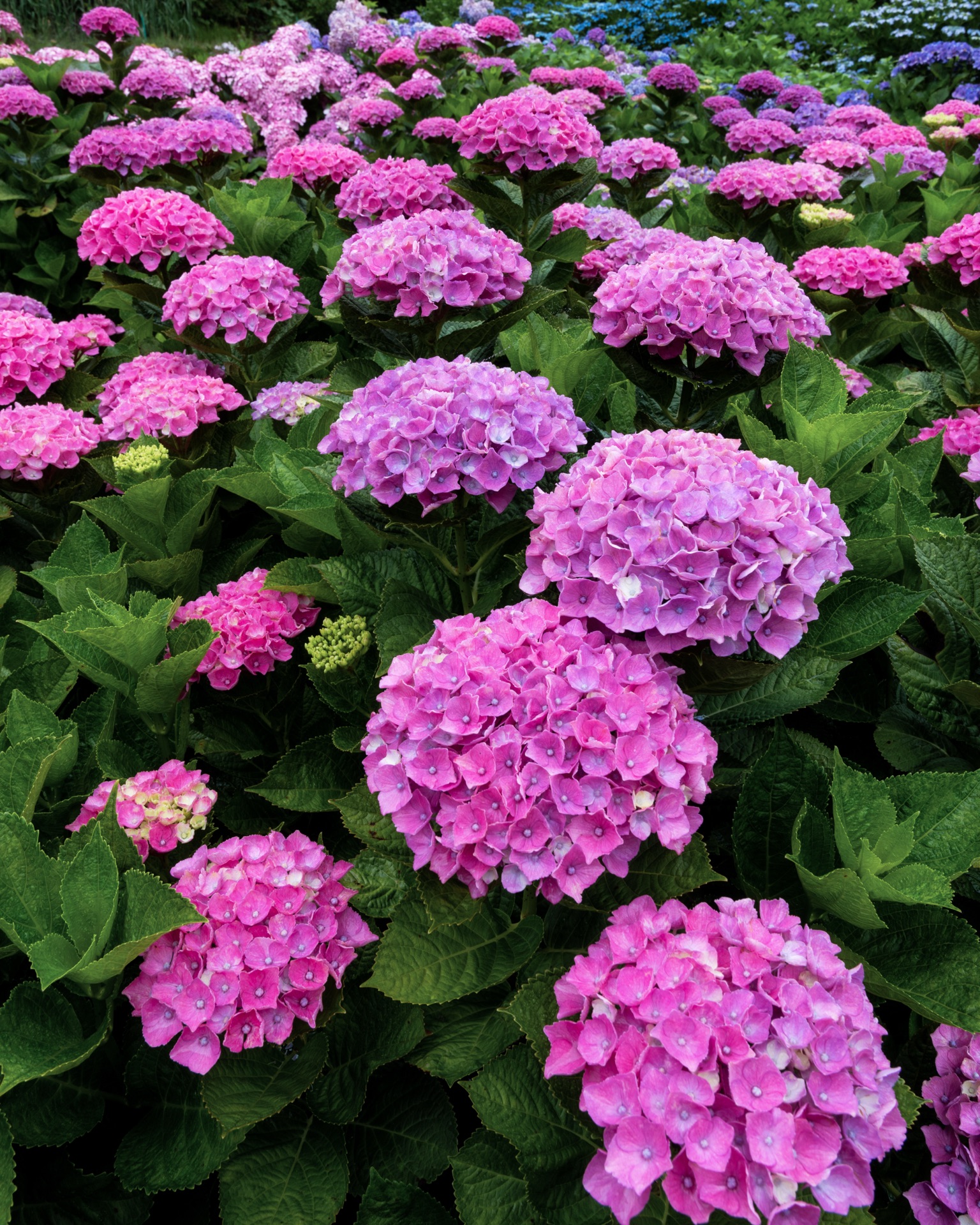
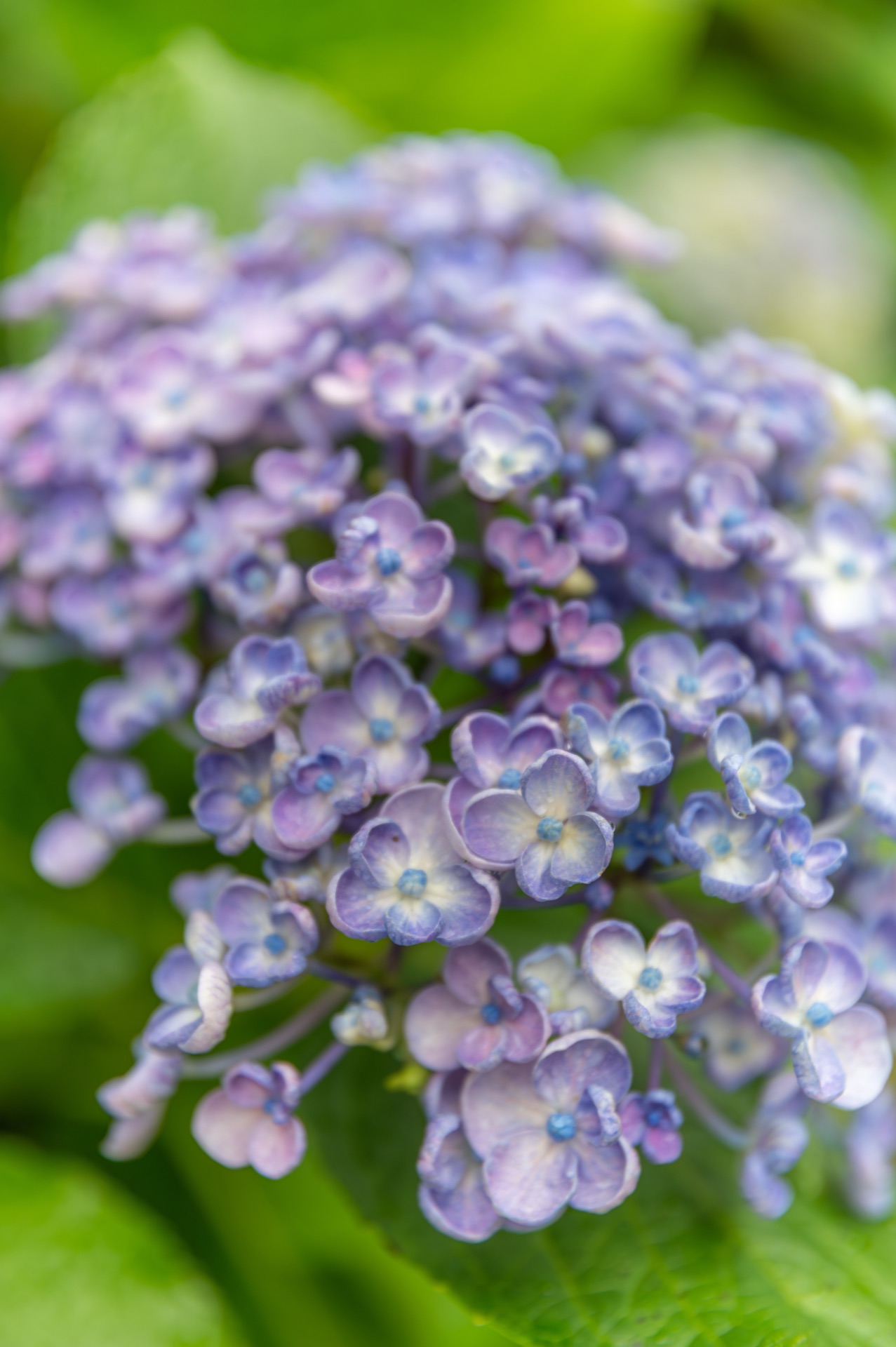
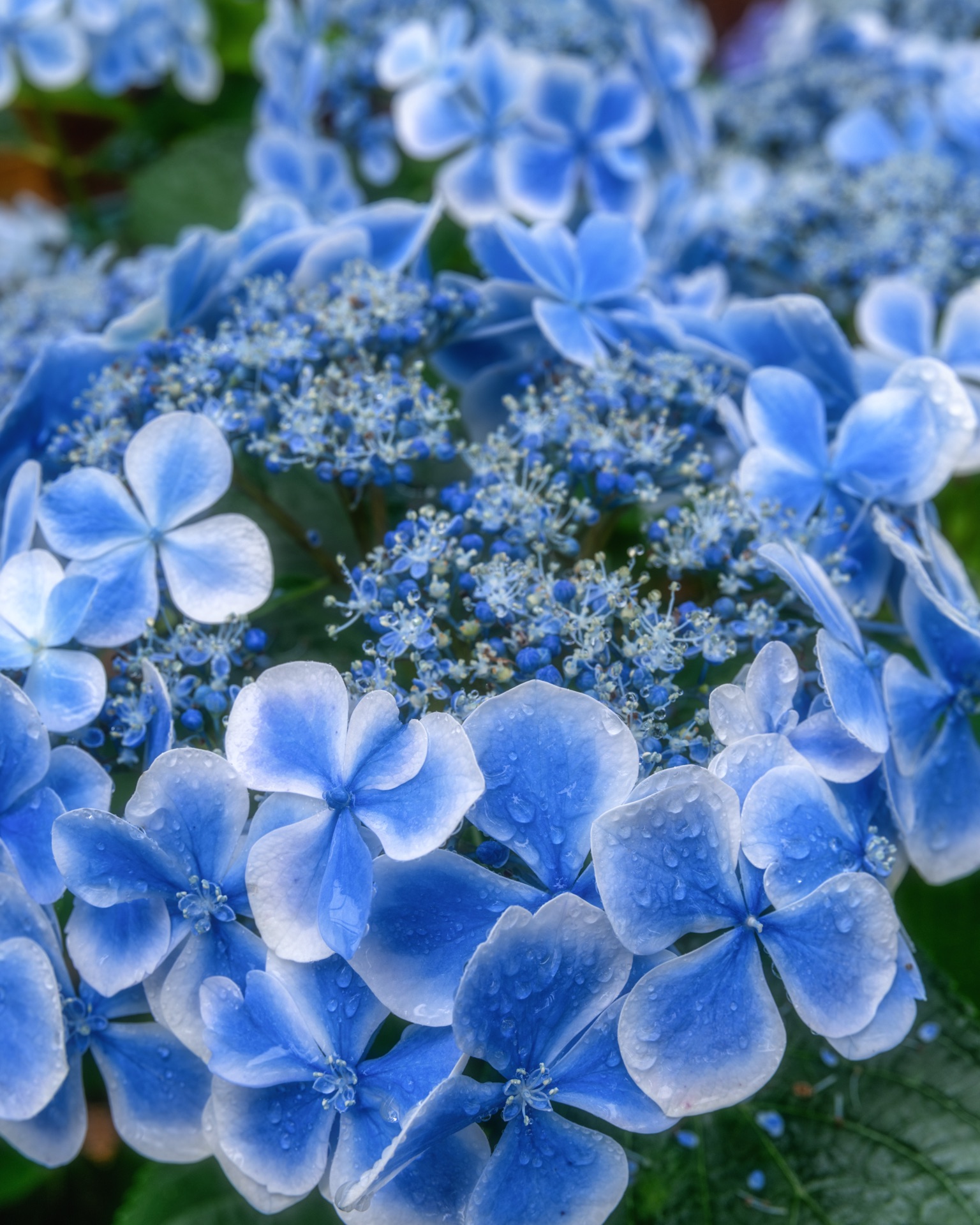
Second, the blue lacecap concentration in the lower path. Soil acidity at Ajisai no Mori is naturally low enough that aluminium uptake produces some of the deepest blues I have seen on a hydrangea — almost cobalt rather than the pale washed-out blue you get on alkaline-soil sites. Bring a camera with macro range; the petal-level detail is the photograph here, not the wide shot.
The Two-Peak Calendar
Unlike single-variety gardens that peak in one tight window and decline, Ajisai no Mori has two overlapping peaks because of the variety mix.
Bloom windows 2026 (based on 2024–2025 observation)
Plan a visit between June 22 and July 5 if you want both peaks at once. The single window of overlapping full bloom is about ten days; outside it you get one or the other in full force, plus the second in bud or in decline.
Compared with the Kanto temple peaks I cover in Two Hasedera, Two Hydrangea Weeks: Ajisai no Mori sits about two weeks behind Kamakura’s June 5–18 peak, and roughly aligned with the start of Nara Hasedera. If you are travelling for the entire Japanese hydrangea calendar, this is your last anchor before the season ends.
“One man’s twenty-year collection became the largest variety count of any hydrangea garden in Japan.”
How to Get There (Honest Version)
Ajisai no Mori has no train station, no taxi rank, and no bus during ajisai season — you need a car or a rental. This is the single biggest barrier to entry and the reason it remains uncrowded. Anyone unwilling to drive a mountain road will not be there.
| Route | From | Time / Distance | Notes |
|---|---|---|---|
| By car (most realistic) | Tokyo Station | ~2h 30min / ~190 km | Joban Expressway → Kita-Ibaraki IC → Route 6 → mountain road. Last 20 minutes is single-lane. |
| By car | Mito Station | ~1h 30min / ~75 km | Route 6 north all the way. Easiest base if you don’t want to drive from Tokyo. |
| By car | Iwaki (Fukushima) | ~50min / ~40 km | Route 6 south. Pair with a Tomioka or Yotsukura visit. |
| By train + taxi | Tokyo | ~3h total + ¥4,000 taxi | JR Joban Line to Isohara Station, then taxi 25 min to the garden. Possible but expensive. |
| By tour bus | Iwaki / Mito | Half-day | JK Information runs ajisai tours from Iwaki in June. The easiest English-friendly option. |
If you are doing this as a Tokyo day trip, leave by 7:00 AM, expect to arrive 9:30–10:00, walk the garden 2–3 hours, lunch on the soba next door, and be back in Tokyo by 17:00. That is a long day but workable. Better is one night in Mito or Iwaki and a slower morning approach.
Parking
Free parking is available at the gatehouse. Capacity is roughly 40 cars. On peak weekends it can fill by 10:00; overflow is grass roadside parking with no formal markings. Arrive before 10:30 on a weekend or come on a weekday.
What to Pair It With
Ajisai no Mori does not justify a Tokyo day-trip on its own for most travellers. It justifies a two-day Northern Ibaraki loop. Three pairings that actually work:
Same-day: Hanazono Gorge (花園渓谷)
The road past the garden continues into Hanazono Gorge, the most photographed autumn-foliage canyon in Ibaraki. In June it is not yet at peak foliage but it is dense, cool, and quiet. A 90-minute river-side walk after the hydrangeas is a good cool-down. The cedar canopy is the same ecology as the garden — the forest does not stop at the gate.
Overnight: Tomioka, Fukushima (45 min north)
Tomioka is one of the towns that was inside the 2011 nuclear evacuation zone and has gradually reopened. The Yo-no-Mori Cherry-Lined Tunnel and the rebuilt seaside promenade are worth a slow morning. June 2026 marks fifteen years since the disaster, and what the region looks like now is a meaningful counterpoint to the cedars-and-hydrangeas peace half an hour south.
Overnight: Mito, Kairakuen (90 min south)
Mito’s Kairakuen is one of the Three Great Gardens of Japan, but its famous plum-blossom season is February–March, not June. In June the garden is green and largely empty; the appeal is the historic teahouse Kobuntei and a quiet morning walk. Better as a stopover for travellers who care about garden history than as a destination. If you are heading south towards Mito, Hitachi Seaside Park offers different seasonal displays, from nemophila flowers in spring to red kochia foliage in October.
Plan This Trip
Plan This Trip
For Southeast Asian Visitors
Ibaraki is not on most first-trip itineraries — most travellers from Singapore, Bangkok, KL or Jakarta fly into Narita and head straight for Tokyo or Kyoto. That is the point. Ajisai no Mori in late June is roughly 25°C and 80% humidity, almost identical to Singapore-rainy-season weather but in cooler air. The garden is shaded by cedars, so heat exposure is minimal. The bigger practical note for SEA visitors is that this is genuinely rural Japan — credit-card acceptance is patchy in the area, ATMs are limited (a single 7-Eleven 8 minutes’ drive away), and English signage is absent. Bring cash for admission and meals, screenshot your route before you lose mobile signal in the mountain section, and budget an extra 30 minutes for navigation. Pocket Wi-Fi is more reliable than docomo SIM in the upper road.
FAQ
Is Ajisai no Mori worth visiting if I already plan to see Kamakura?
If you are a casual flower viewer, no — Kamakura is closer to Tokyo and the famous setting carries the experience. If you are a serious hydrangea enthusiast, photographer, or botanist, yes — the variety count is something Kamakura cannot match, and the crowd difference (1,800 people at Kamakura Hasedera versus maybe 80 at Ajisai no Mori on the same Saturday) changes the visit entirely.
Can I really see all 1,500 varieties in one visit?
No, and the garden does not expect you to. The two-peak structure means roughly 900 varieties are in good condition at any given time (320 yama-ajisai mid–late June, or 600 mophead/lacecap late June–mid July, with a 10-day overlap in late June where both groups bloom). Even within those, the trail covers the highlights — getting to every plant requires walking off-path which is not encouraged.
Is there food at the garden?
Yes. A soba restaurant operates inside the gatehouse complex, with handmade soba and tempura at standard rural Japan prices (¥1,200–1,800 for a full meal). Outside the soba shop there is a small kiosk selling drinks and ice cream. Bring cash. No vegetarian options are marked, though plain zaru-soba with vegetable tempura works in practice.
What about disability access?
The site is honest about being a hillside forest garden. The lower 30% of the trail is roughly level on packed gravel and accessible to most walkers, including those using canes or pushing strollers. The upper 70% involves stairs and uneven paths — not navigable in a wheelchair, and difficult with significant mobility constraints. The view from the lower trail is still substantial; if mobility is a concern, plan to see only the lower section and skip the yama-ajisai upper zone.
How does this compare to Mimuroto-ji in Uji, the most famous Kansai hydrangea temple?
Mimuroto-ji is 10,000 plants of 50 varieties on a relatively flat temple grounds. Ajisai no Mori is roughly 6,000 plants of 1,500 varieties on a forested hillside. Mimuroto-ji is the better visual mass experience; Ajisai no Mori is the better botanical experience. Different priorities. If you care about photographing many flowers in one frame, go to Mimuroto-ji. If you care about seeing varieties you cannot see elsewhere, come here.
Is there an English-language guide on site?
No formal one. The variety nameplates are in Japanese (often only in Latin botanical names alongside, so a botanist can still identify cultivars). The trail map at the gatehouse is Japanese-only. If you read Latin plant names you will manage. If you do not, the visit is still rewarding visually but you will lose the variety-by-variety experience.
Can I see the gorge and the garden in one half-day?
Yes if you keep moving. Arrive at the garden at 9:00 when it opens, walk for two hours, eat lunch at the soba shop, then drive 5 minutes further up the mountain road and walk the lower Hanazono Gorge trail for an hour. Back to your car by 14:00. Pairing them in one half-day means the gorge is the cool-down rather than the destination — that is the right calibration for June.
Booking the Trip
Booking the Trip
Three practical doors into a Northern Ibaraki hydrangea trip. The car is the load-bearing piece.
Related Reading
- Two Hasedera, Two Hydrangea Weeks: Kamakura and Nara Twin Temples (June 2026) — Temple ajisai counterweight to Ajisai no Mori. Both worth visiting if your trip spans the season.
- Japan Tsuyu 2026: Regional Calendar + 4 Tested Hydrangea Spots — Where Ajisai no Mori fits in the wider Japanese rainy-season picture.
- Japan in June 2026: Hydrangeas, Fireflies and the Cheapest Week of the Year — Month-wide June planning hub.
Join travelers discovering Japan's hidden side
Weekly dispatches from off-the-beaten-path Japan — spots and stories you won't find in guidebooks.
No spam. Unsubscribe anytime.
Welcome aboard!
You're in. See you in your inbox soon.