

Fukuoka · Sasaguri · Temple
Nanzoin Reclining Buddha 2026: World’s Largest Bronze Buddha, Just 25 Minutes from Hakata
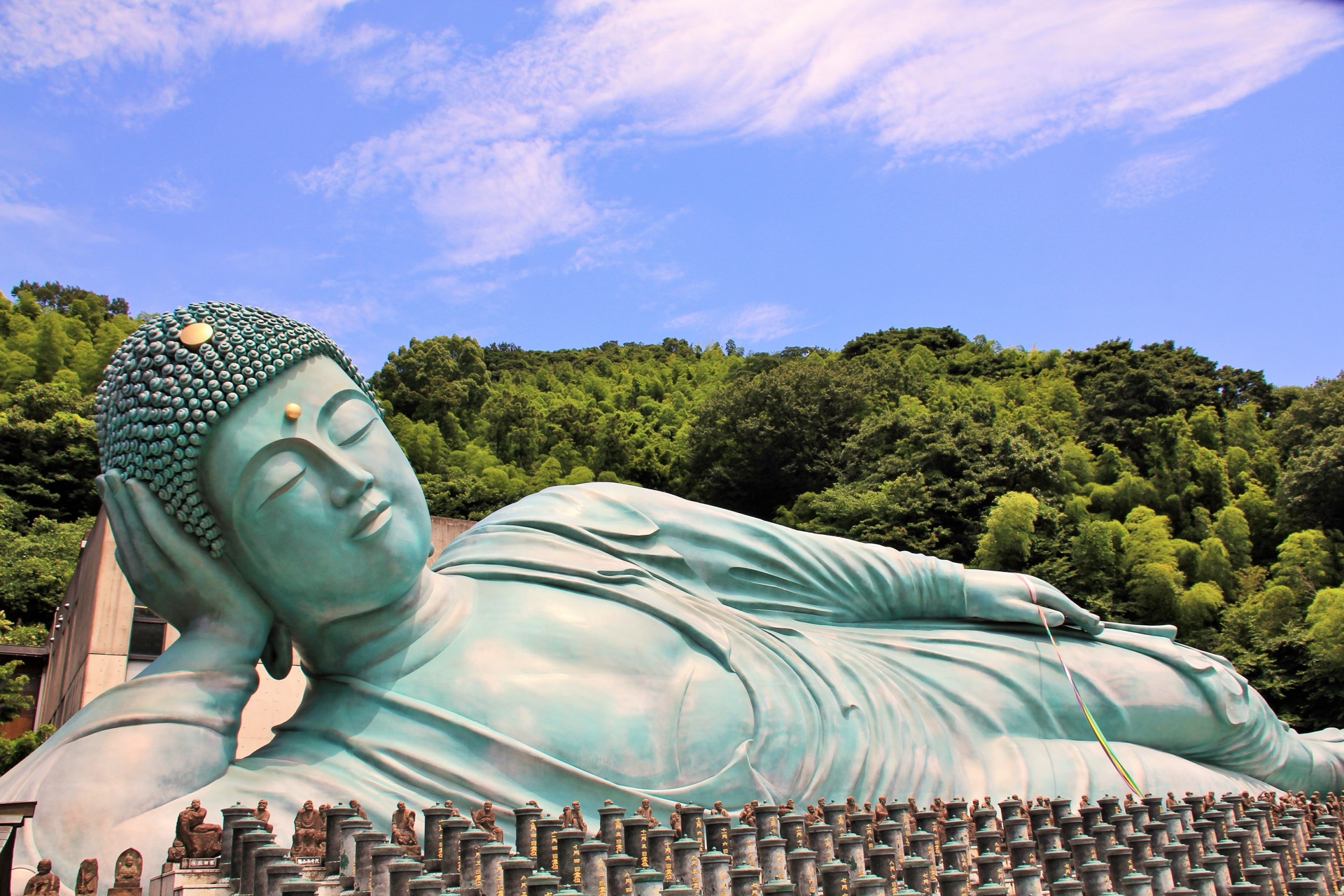
The Reclining Buddha at Nanzoin in summer. Bronze patina, eyes closed, the cloud line moving across the Sasaguri hills behind.
I took the Sasaguri Line south from Hakata on a clear summer morning. Twenty-five minutes later I stepped off at Kido-Nanzoin-mae station, walked three minutes uphill, and the giant sleeping Buddha came into view across the temple grounds. It is 41 meters long and made of bronze — the largest bronze Reclining Buddha in the world. The road to it is short, the entry is straightforward, and almost no one outside the country has heard of it.
Quick Facts
What You Actually See
The Reclining Buddha is the obvious headline. It sits on a raised plinth surrounded by hundreds of small standing Buddha statues — the sentaibutsu — and the contrast in scale is part of the point. The big Buddha is enormous; the small ones are about waist-high; together they make the whole valley feel populated.
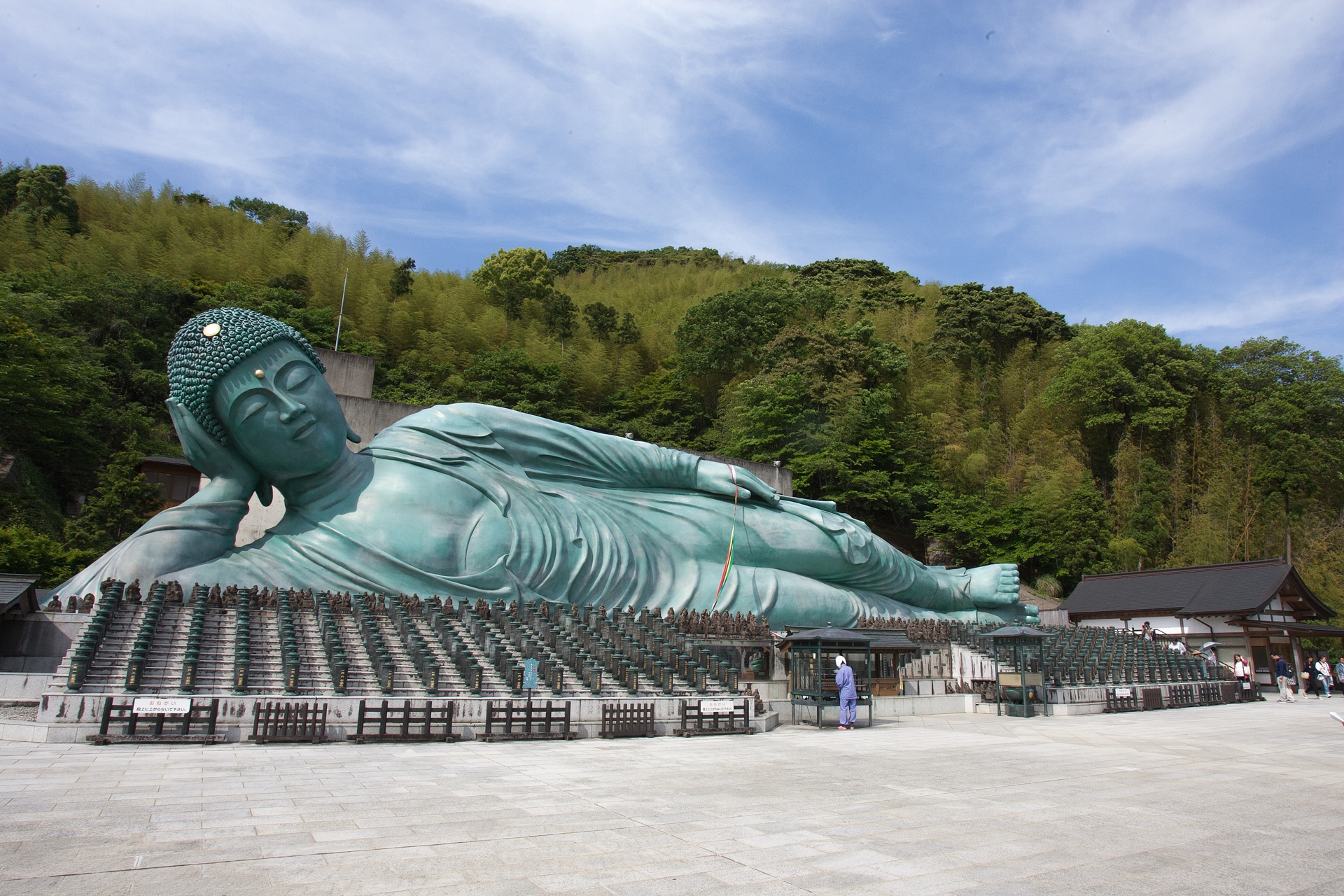
The full scene from the front. The small statues lined up below give you a sense of how big the main figure actually is.
What surprised me, standing close, was the surface. From a distance the Buddha reads as a single smooth sculpture. Up close the bronze has weathered into a soft blue-green patina, and the texture under that patina is full of tiny hammer marks. It was cast in pieces and welded together — you can find seam lines if you look. None of that is visible in photos.
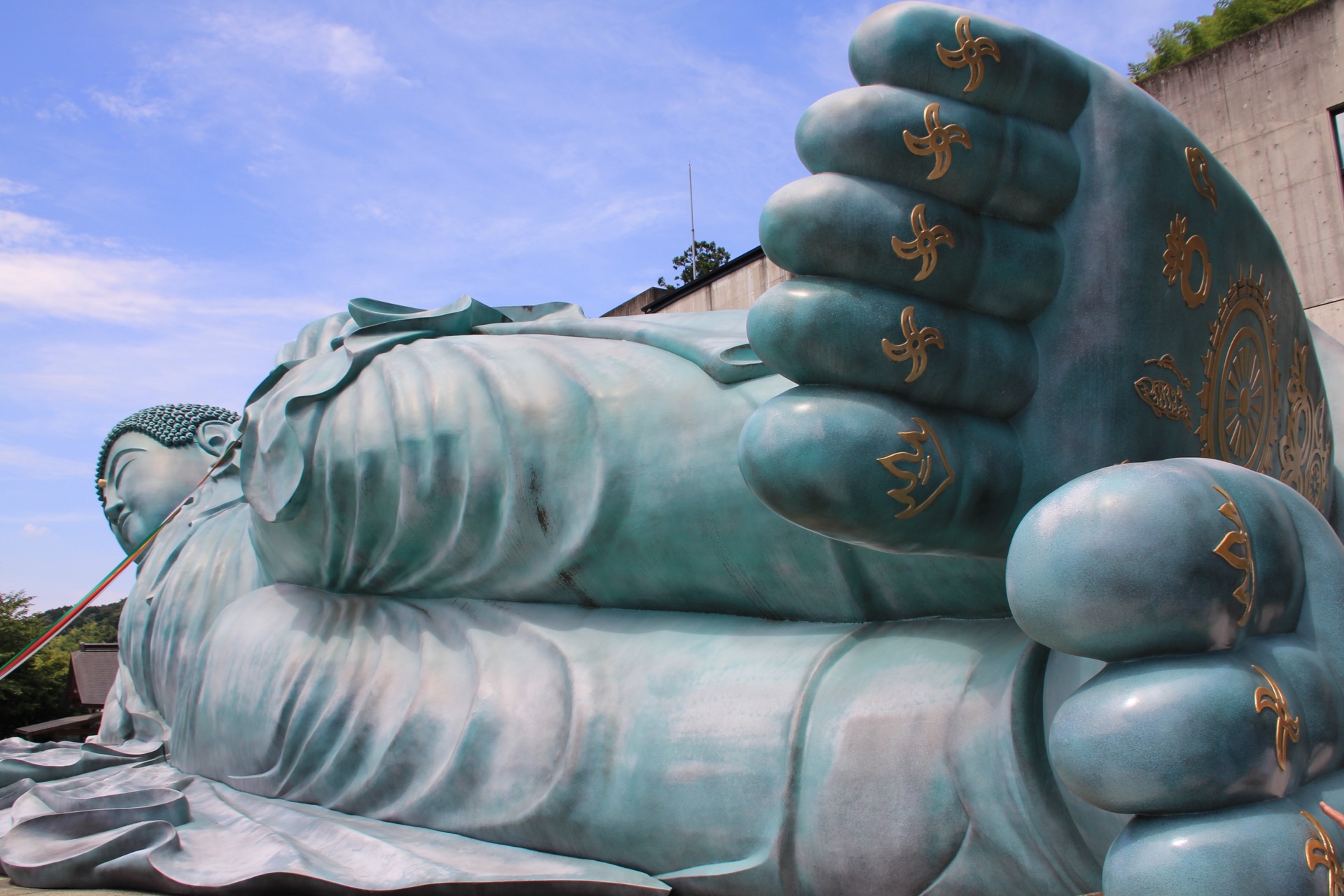
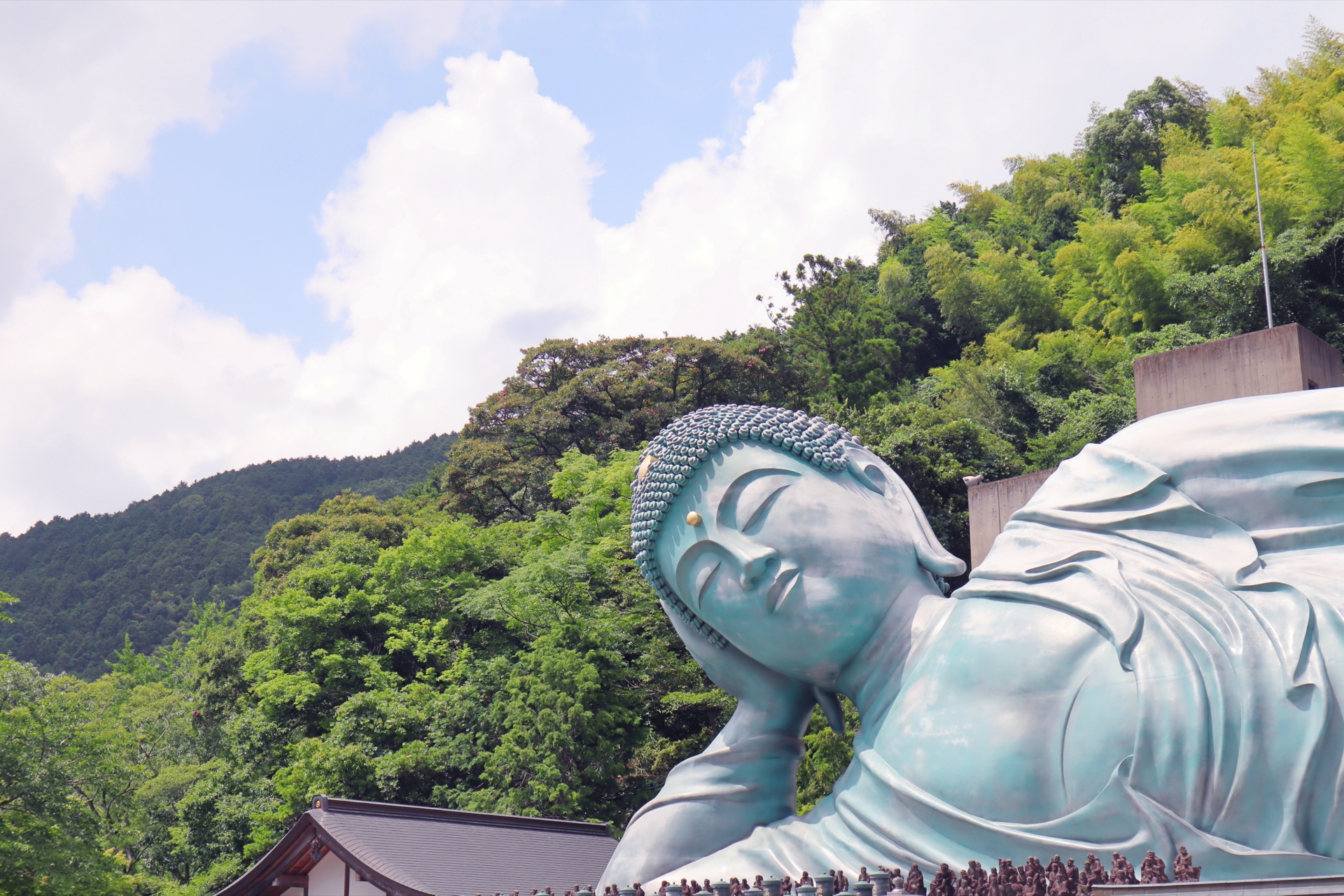
The soles of the feet hold gold-painted spiral patterns, a wheel of dharma, and Sanskrit characters — symbols of the teaching and the path. The face, when you walk to the head end, lies eyes-closed at near eye-level, with the green hill rising directly behind it. There is a way the figure and the mountain merge that you don’t see in photos.
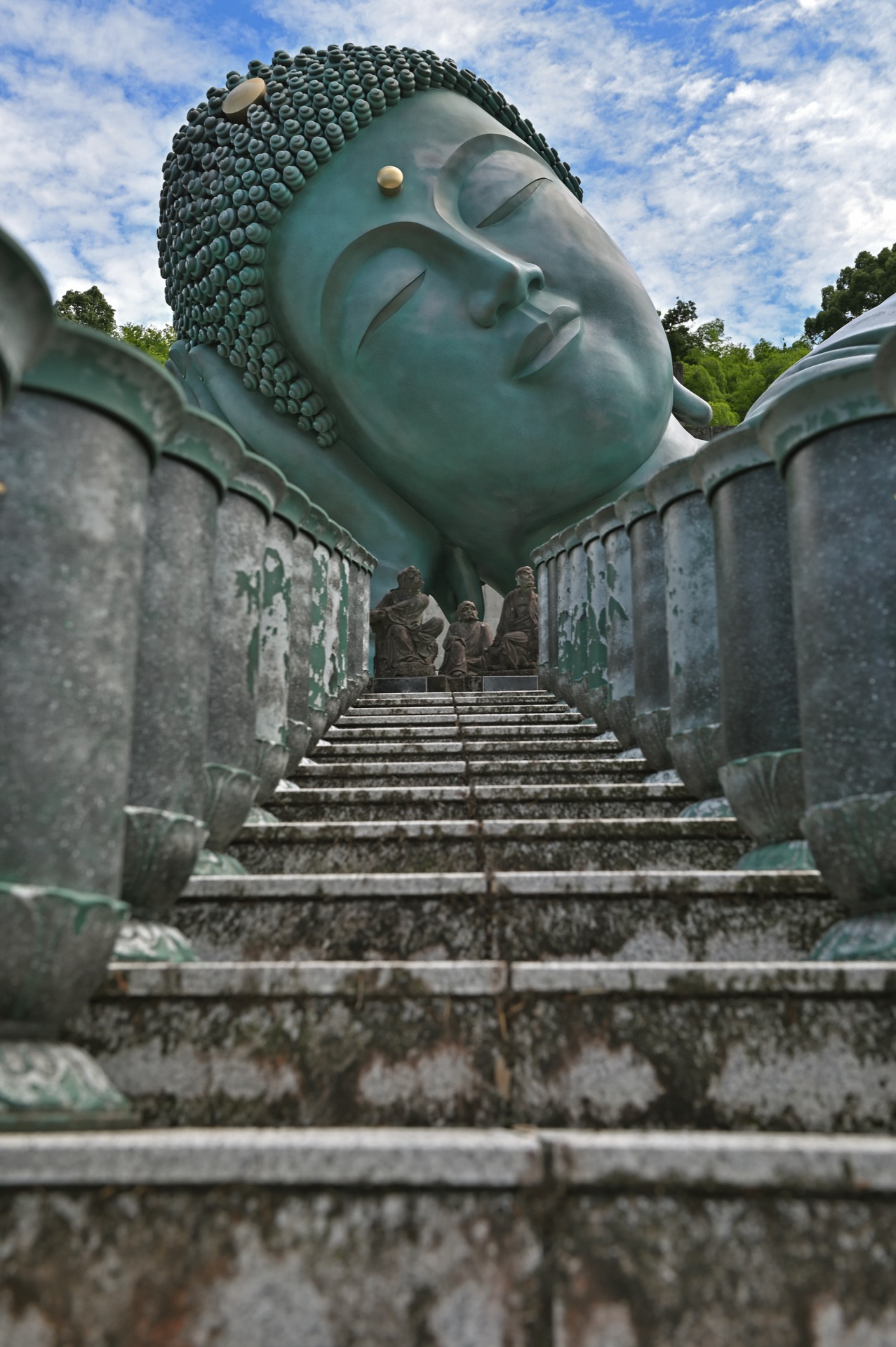
The view up the back stairs. Two of the Buddha’s attendant figures sit at the top of the climb, half-shaded by the head.
The Story Behind It
1995 · Heisei 7
Why Sasaguri, of all places
Nanzoin is the head temple of the Sasaguri 88-temple pilgrimage — a smaller, locally walked version of the famous Shikoku pilgrimage. People have been walking this circuit through the hills around Sasaguri for over 130 years.
The Reclining Buddha was completed in 1995, dedicated as a place to pray for global peace and a memorial to the children of Myanmar, Nepal, and India. It is the largest bronze reclining Buddha statue in the world by published records.
What you should know walking up: this is not a tourist attraction first. It’s an active temple. The pilgrimage circuit is still walked by white-robed pilgrims year-round, the priests run real services daily, and the Buddha is a religious image — not a photo backdrop.
Visitor Rules: What You Need to Know Before You Go
Nanzoin enforces its rules carefully because the temple is treated as a place of worship, not a sightseeing park. The rules themselves are not unusual for a Japanese temple — but Nanzoin actually applies them, and visitors who arrive in the wrong clothing get turned back at the gate. Read this before you take the train.
Dress Code
The official guidance: cover your shoulders, your stomach, and your knees.
- Not allowed: hot pants, shorts, mini skirts, camisoles, anything that exposes shoulders or above-the-knee leg
- Tattoos: visible tattoos must be covered. Long sleeves, leggings, or medical-style bandages all work
- Practical sense: long pants or a long skirt + a shirt that covers the shoulders. Same as visiting any active Japanese Buddhist temple
- If you arrive in clothing that violates the rule, the temple may give you a blue cloth to cover up. Repeat warnings result in being asked to leave
If summer heat is an issue, plan for it — bring a light long-sleeve over-shirt and trousers in your day bag and change into them before you reach the gate. The rule is consistent and will not be relaxed for foreign visitors.
The Camera Rule
Personal photos for memory are fine. The official rule is more specific:
- Photo-trip-style visits — visiting primarily to shoot the temple — require advance permission
- Selfie sticks, tripods, gimbals are not allowed
- Drone photography is not permitted
- Casual handheld shots are accepted by everyone I saw on my visit, but be quick and don’t stage scenes
If you are working on a serious photo or video project, contact the temple in advance.
Other Things to Know
- No eating or drinking while walking inside the grounds
- No smoking, no alcohol
- Keep your voice down — the place is genuinely quiet most of the day
- Group visits of 10 or more people require advance phone or fax permission
The reason these rules exist is the same reason the place is worth visiting. Nanzoin has held its own quiet center despite hosting one of the largest Buddhist sculptures on the planet. The dress code is part of how it stays a temple.
Getting There
The easiest route is the train. Nanzoin sits one block from the station — almost unheard of for a major temple in Japan.
RecommendedTrain from Hakata
Take the JR Sasaguri Line (Fukuhoku Yutaka Line) from Hakata Station to Kido-Nanzoin-mae. Express trains do this run in about 25 minutes. Local trains take ~35 minutes.
The temple entrance is a flat 3-minute walk from the station. There are signs in English.
Round-trip ticket is around ¥1,000 from Hakata. The line runs every 15–30 minutes most of the day.
AlternativeBus from Hakata
Nishitetsu buses run from Hakata Bus Center to Sasaguri (~50 minutes). Slower than the train and not recommended unless you have a JR Pass that doesn’t cover this segment.
By carFrom central Fukuoka
Roughly 30 minutes via the Fukuoka Urban Expressway and Route 201. The temple has free parking on the grounds, but the lots fill up by mid-morning on weekends.
No tour buses are permitted on temple parking — including small and micro buses. Group tours must arrange separate parking.
Combined tripHalf-day from Hakata
If you want to do it as a half-day round trip from your hotel: leave Hakata by 9:00, arrive by 9:30, spend 90 minutes, head back, eat a late lunch in Hakata. This is what I did.
Best Time to Visit
After Nanzoin: Where to Eat in Fukuoka
Nanzoin doesn’t have meaningful food options nearby. The pattern that works is to do the temple as a morning trip and head back to Hakata for lunch. Fukuoka is one of the great food cities of Japan and the train will put you back in the middle of it within half an hour.
Staying in Fukuoka for the night? Hakata-area hotels are easy to find and the Sasaguri Line runs straight to the temple in the morning.
Browse Hakata Hotels →Two More Sasaguri Stops
If you have a full day, Sasaguri has two more places worth seeing. The town is small and the JR line connects everything.
Frequently Asked Questions
How much does it cost to enter Nanzoin?
¥500 per person for the main Reclining Buddha viewing area. Children under 19 enter free. Group rates (¥200 per person) apply for groups of 10 or more, but require advance permission from the temple by phone or fax.
Is Nanzoin really the world’s largest reclining Buddha?
It is the world’s largest bronze reclining Buddha, completed in 1995. There are larger reclining Buddha statues in other countries (Wat Pho in Bangkok, Win Sein Taw Ya in Myanmar) but those are made of plaster, brick, or other materials. By weight (300 tons of bronze), Nanzoin’s holds the bronze-cast record.
What is the dress code at Nanzoin?
Cover your shoulders, your stomach, and your knees. Hot pants, shorts, mini skirts, camisoles, and visible tattoos are not allowed. The temple will turn back visitors who do not comply, or hand out a blue cloth as a temporary cover. Plan to wear long pants and a shirt with sleeves regardless of season.
Can I take photos at Nanzoin?
Casual personal photos are accepted in practice. The official policy requires advance permission for visits whose primary purpose is photography or videography. Selfie sticks, tripods, gimbals, and drones are not allowed. Be quick, be respectful, and don’t stage scenes.
How long does a visit take?
Most visitors spend 60 to 90 minutes inside the grounds. If you walk around the back of the Buddha, climb the stairs to the head, and visit the main hall and the smaller shrines, plan for 2 to 2.5 hours. Add 1 hour each way for the Hakata train.
How do I get to Nanzoin from Hakata?
Take the JR Sasaguri Line (Fukuhoku Yutaka Line) from Hakata Station to Kido-Nanzoin-mae station. Express trains take 25 minutes; locals take 35 minutes. From the station, the temple entrance is a flat 3-minute walk. Round-trip ticket is around ¥1,000.
Is Nanzoin good for kids?
Yes. The grounds are flat in the main area, the Buddha is genuinely impressive in person, and admission is free for under 19s. Strollers can navigate most paths but the back stairs to the Buddha’s head are steep.
Final Thoughts
What I liked about Nanzoin is how short the trip from Hakata is and how unfamous it is internationally. Most visitors walking the temple are local Japanese day-trippers and pilgrims on the Sasaguri 88 circuit. The Reclining Buddha is large enough to feel mythological in person — the photos do not communicate the scale — and the temple grounds keep enough quiet that it doesn’t feel like an attraction.
Wear long pants, take the Sasaguri Line, get off at Kido-Nanzoin-mae, and walk uphill. That’s the entire trip. Then go back to Hakata and eat ramen.
Join 1,000+ travelers discovering Japan's hidden side
Weekly dispatches from off-the-beaten-path Japan — spots and stories you won't find in guidebooks.
No spam. Unsubscribe anytime.
Welcome aboard!
You're in. See you in your inbox soon.