

Aso · Takamori · Folk Architecture
Takamori Tree House: A Hand-Built Wooden Castle Around a 400-Year-Old Cedar (And Why You Can Only View It From Outside in 2026)
I drove out of Aso town on a clear May morning, took the back road south through Takamori, and rounded a bend to find the single most extraordinary piece of folk architecture I have ever seen in Kyushu — quietly being reclaimed by the forest.
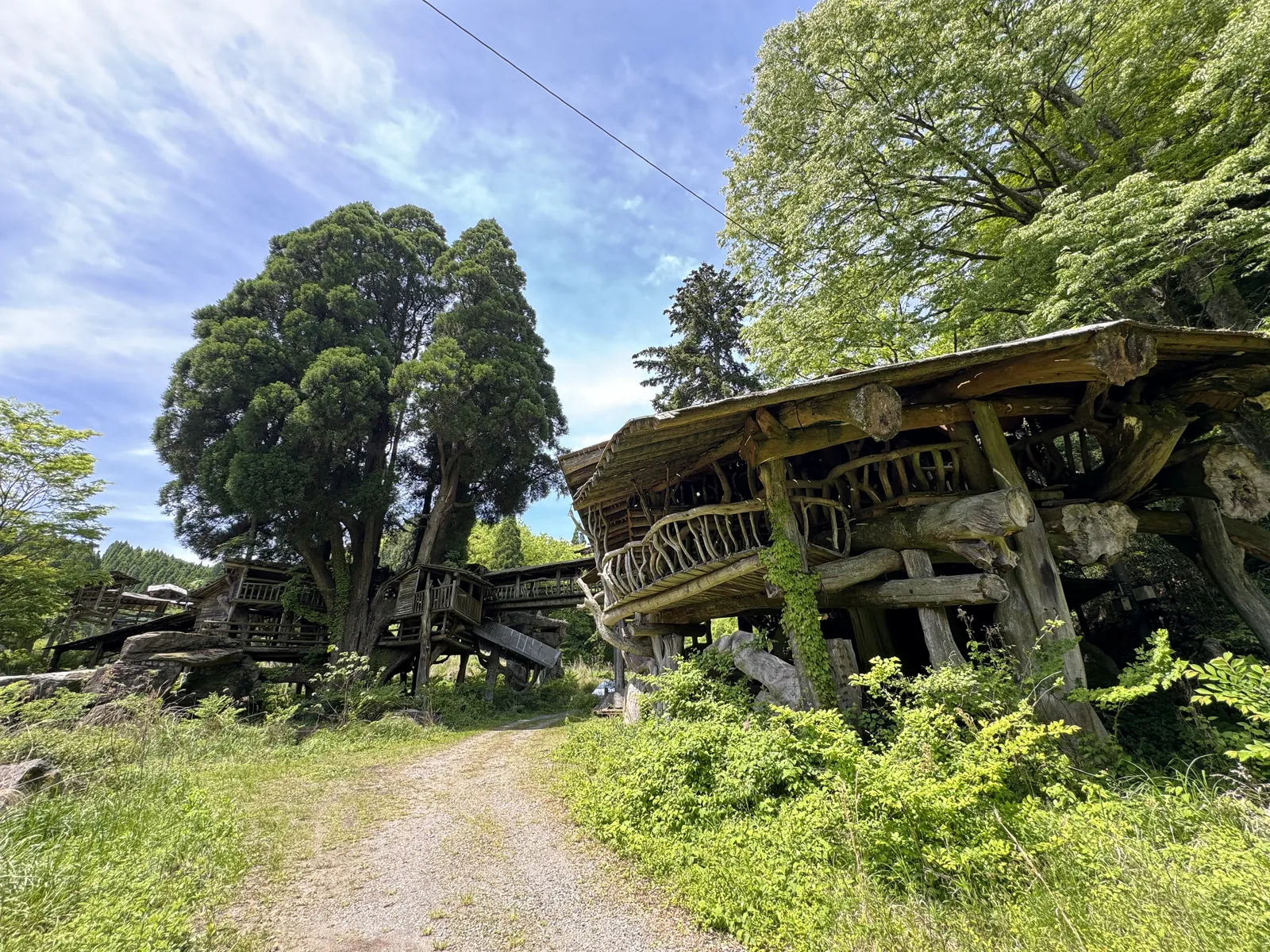
The Takamori Tree House is closed to entry. Interior staircases have partially collapsed and the platforms are no longer safe to walk on. You can still walk the surrounding open ground and view the structure from outside; this is what most recent visitors do.
There is no staff, no admission fee, no signage, and no facilities (toilets, vending, cell signal can be patchy). Confirm current condition via a recent Google Maps review within a week of your visit.
There is a kind of place that exists nowhere else in Japan: a multi-storey wooden castle, built by hand, around a single 400-year-old cedar venerated as a water deity. Takamori Tree House (高森ツリーハウス) sits on a back road in the Aso highlands of Kumamoto, on private agricultural land owned by Maruyama Farm. It is no longer a tourist attraction in any modern sense — there is no ticket booth and no opening hours — but it is still standing. The hand-bent branches still hold the platforms in place. The cedar at the centre is still alive. And for travellers willing to detour off the standard Aso route, it is one of the most quietly affecting stops in inner Kyushu.
What it is — and the cedar at the centre of it
The tree at the centre is the Kami-Tamarai no Ōsugi (上玉来の大杉) — a single Japanese cedar (sugi) with a trunk circumference of roughly 7.5 metres and an estimated age of 400+ years. Some local sources say up to 600. There is no formal dendrochronology record. Locally, it is venerated as a suijin-boku (水神木) — a water-god tree — the kind of designation given to old cedars in farming villages where water sources matter.
According to a published account by haradaoffice.biz, the cedar was damaged by a typhoon some years before the structure was built. A local agricultural operation called Maruyama Farm (丸山農園) purchased the property and constructed the wooden tree house around the cedar around the year 2000 — partly to physically support and shelter the tree, partly as an act of preservation, partly (it seems clear when you stand in front of it) as a labour of love.
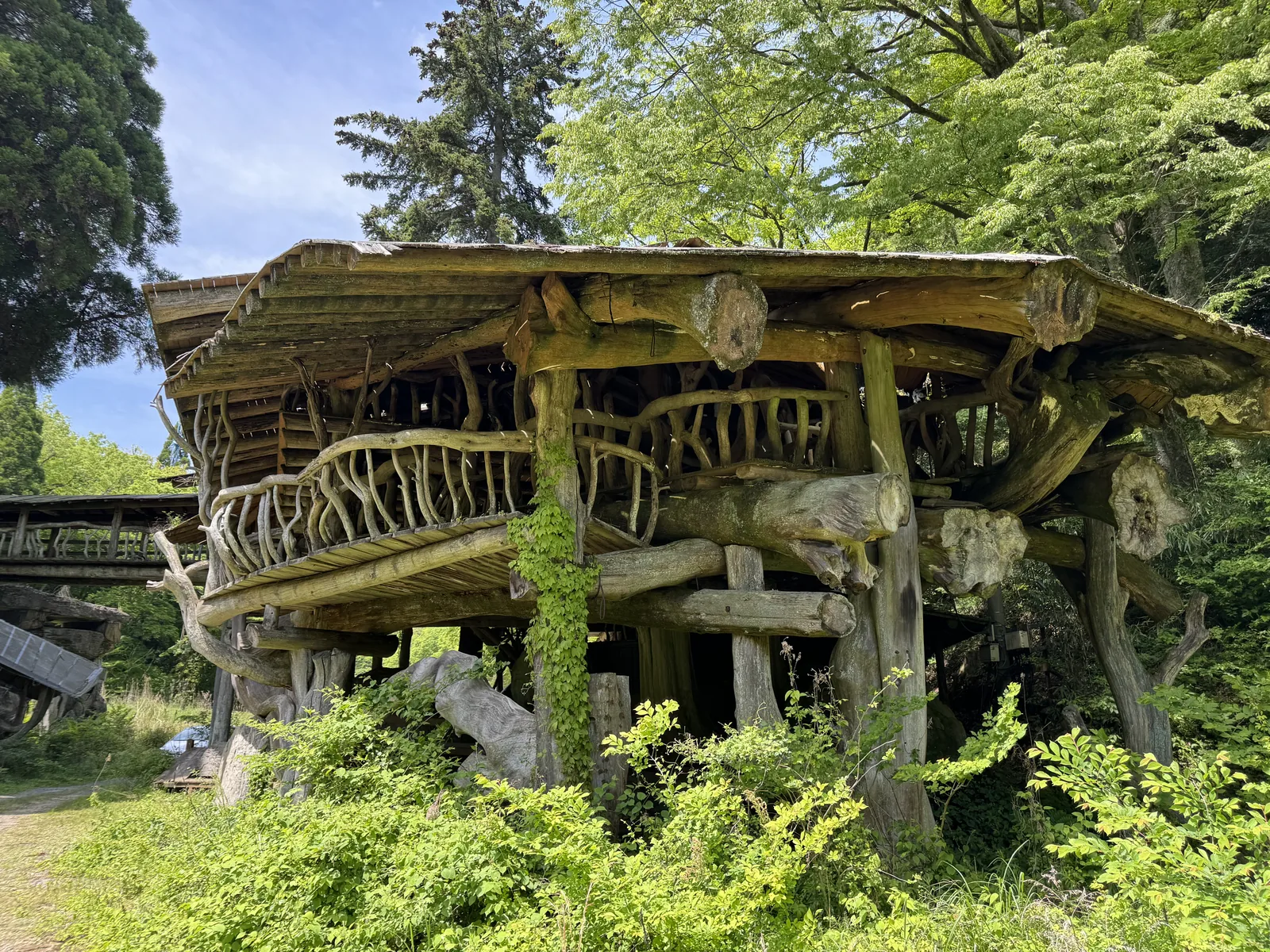
The result is unusual even by Kyushu’s standards for vernacular building. Multi-storey. Large enough to walk around inside, when it was open. Built almost entirely from raw, unmilled wood: branches, slab cuts, hand-cut posts, woven bamboo for ceilings and dividers. There is no architectural plan visible in the structure. It accumulated.
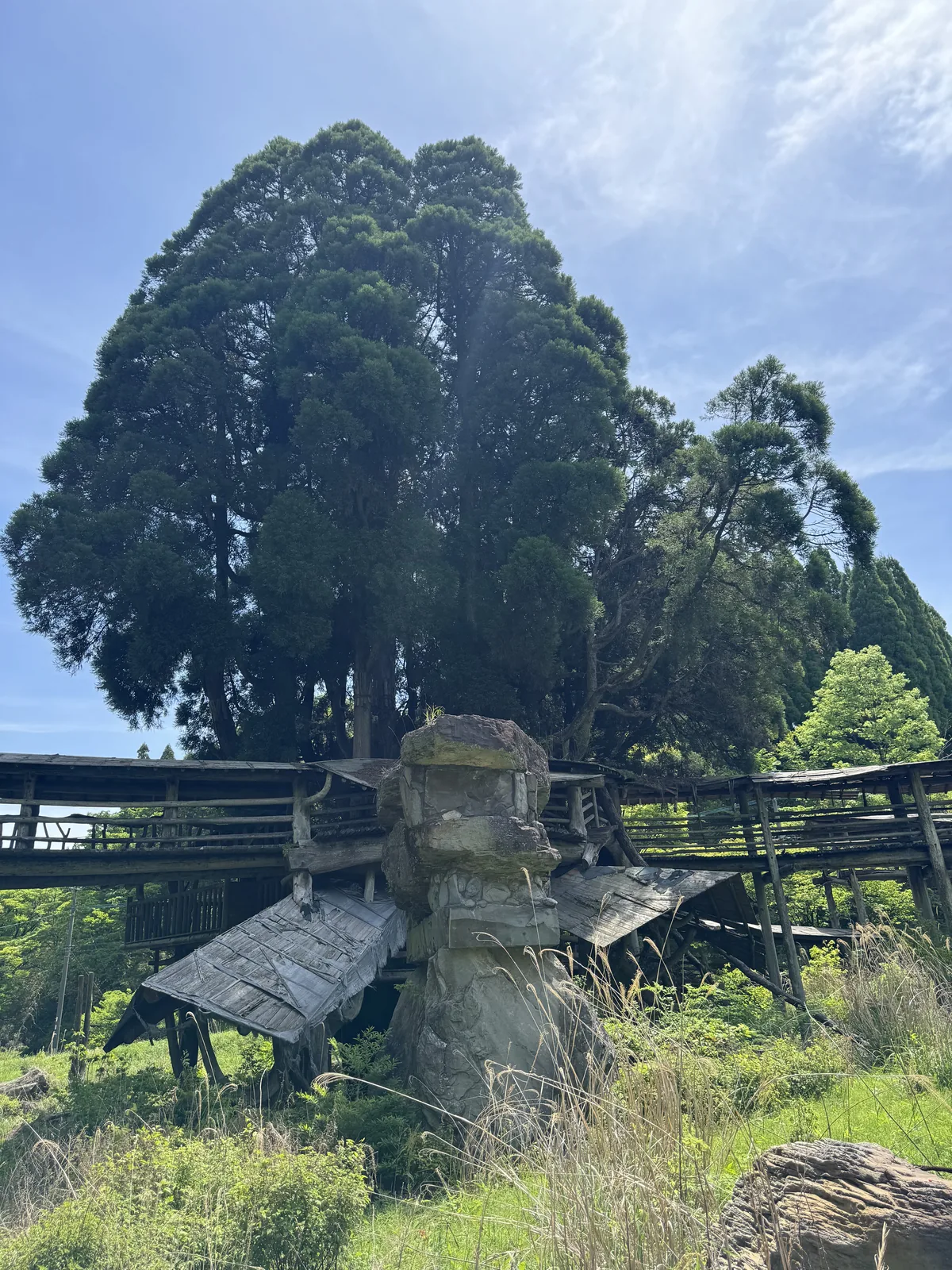
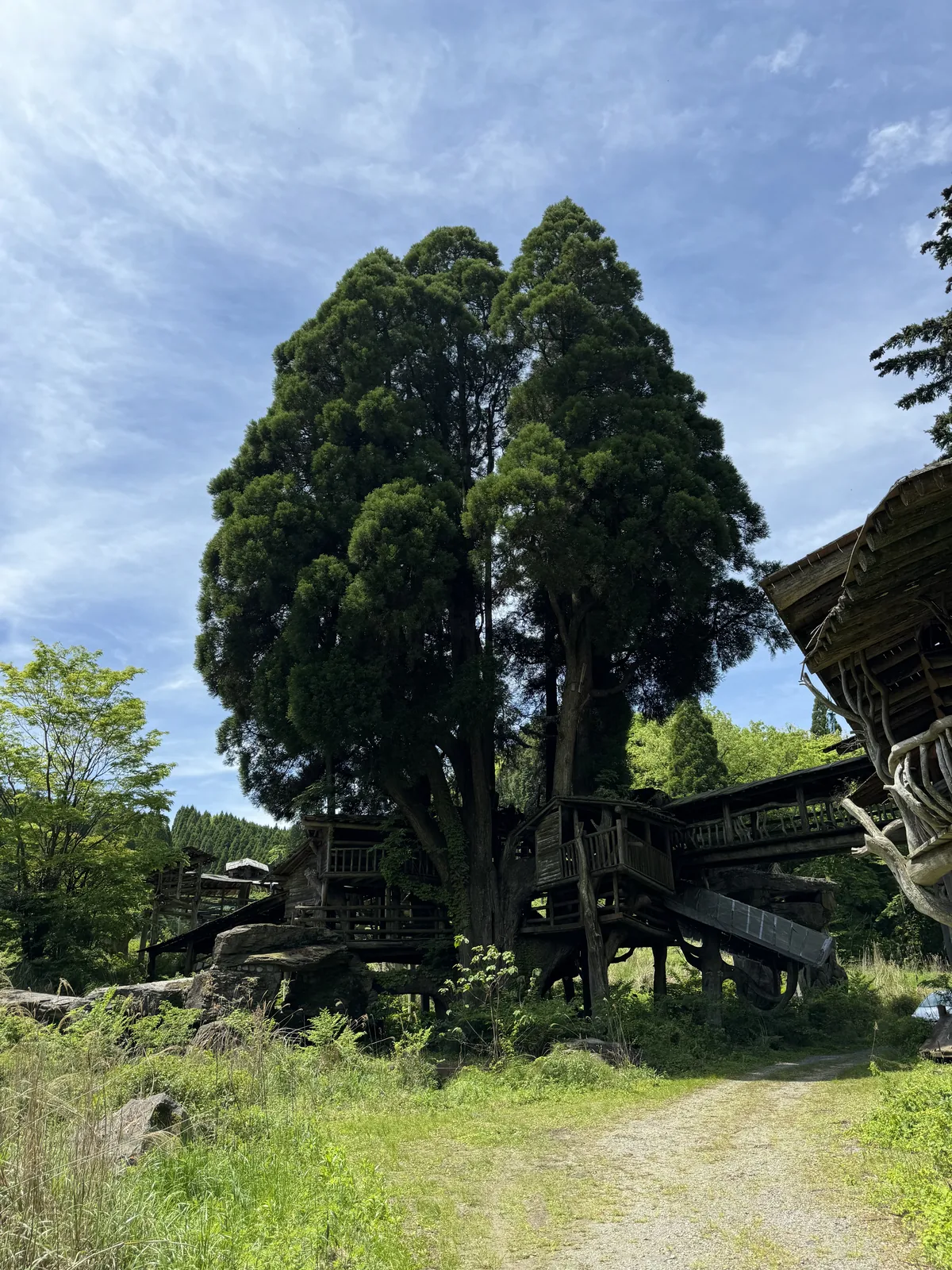
The architecture — folk craft you don’t see anywhere else
What’s striking up close is the logic of the construction. Whoever built it understood timber. The vertical posts are massive single tree trunks, sunk directly into the rocky ground. The horizontal beams are mostly slab cuts, but the rails and ornamental sections are made from bent branches — twisted, organic shapes that feel grown rather than carpentered.
The railings on the upper-level platforms are entire small trees, debarked, with the side branches kept short to form natural balusters. Nothing is straight. Everything follows the original line of the wood it came from. From a distance the impression is of a wooden castle. Up close it’s closer to a cathedral — a slow, accreted thing built by hands that knew the material.
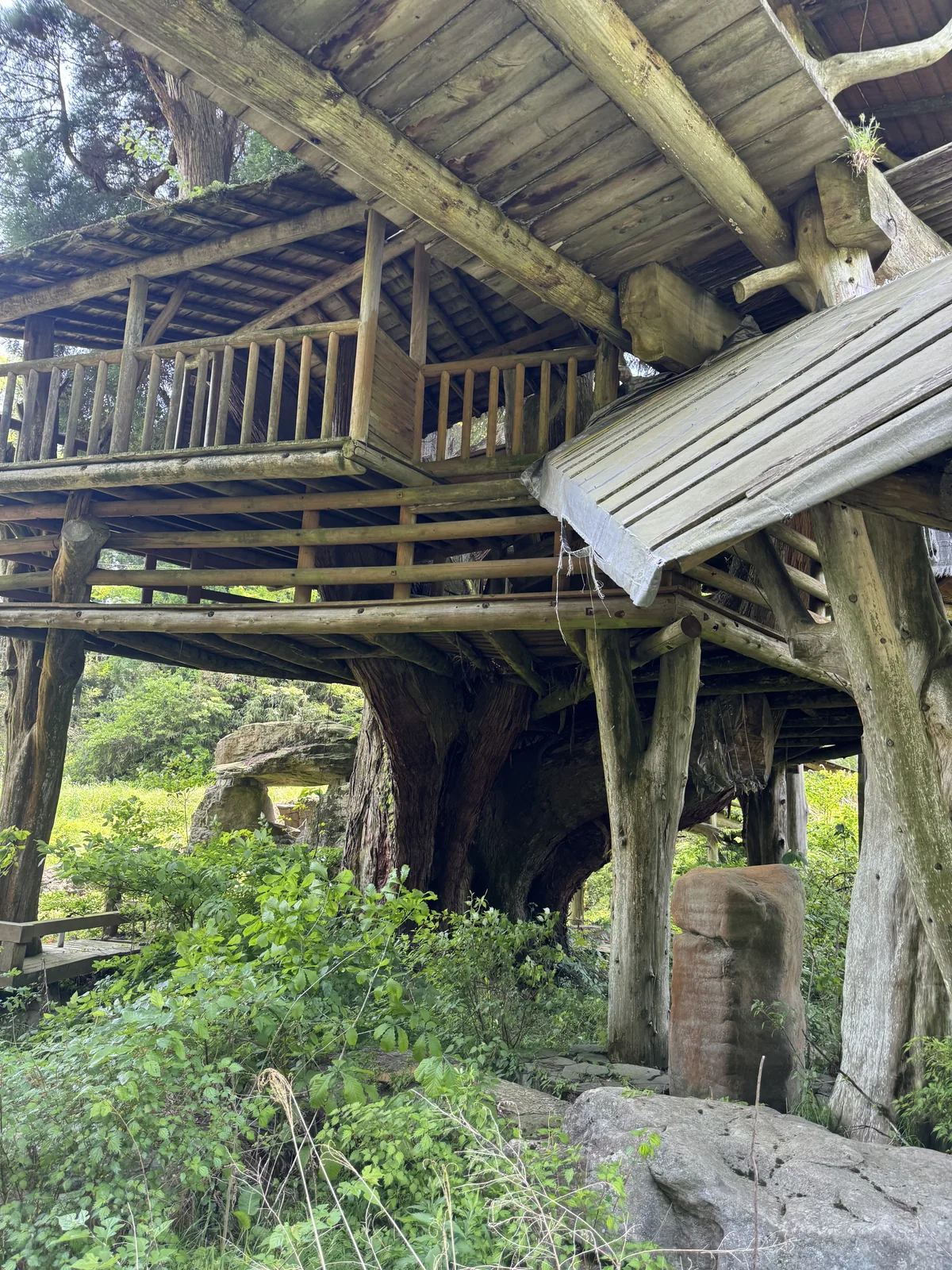
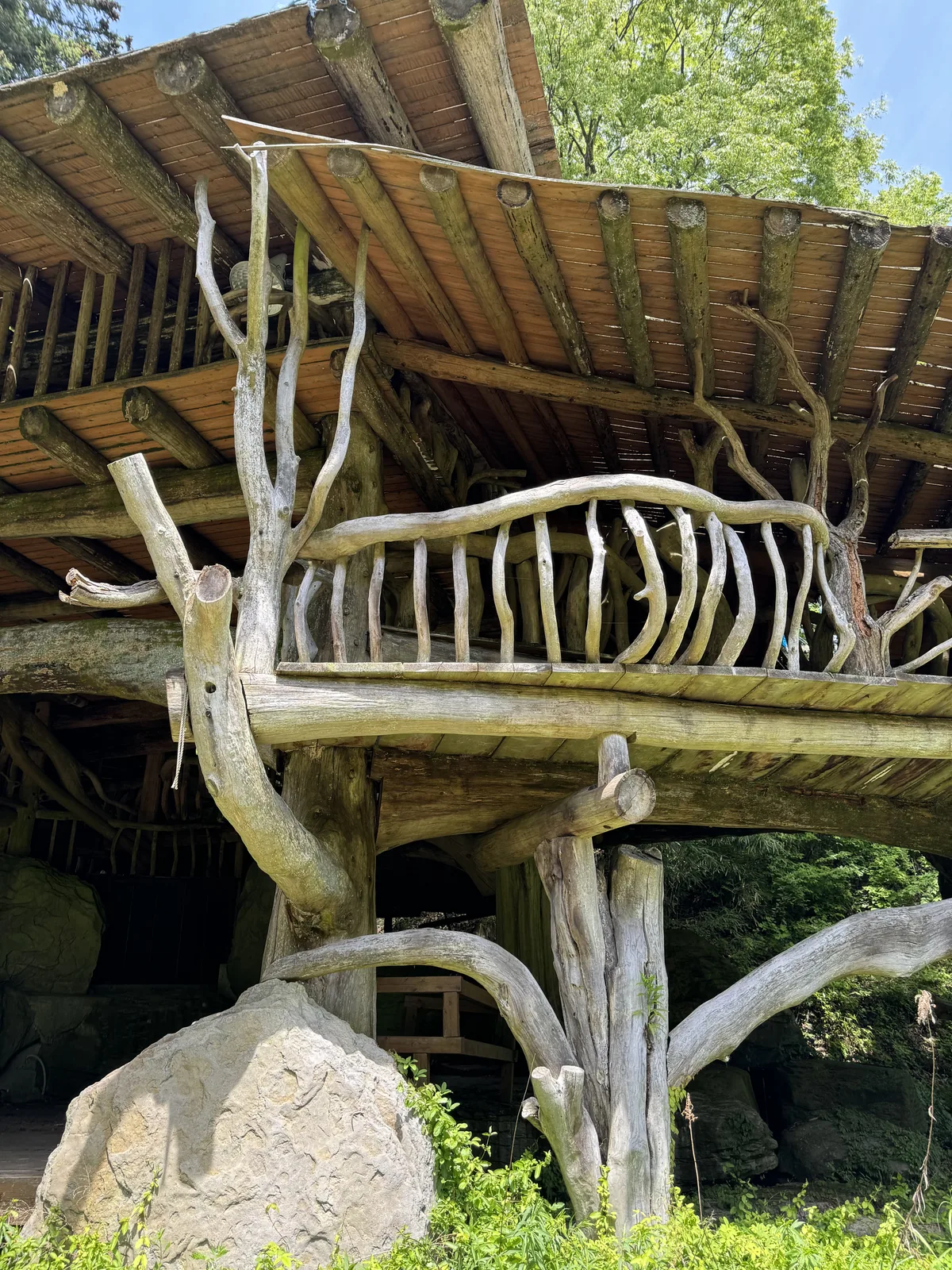
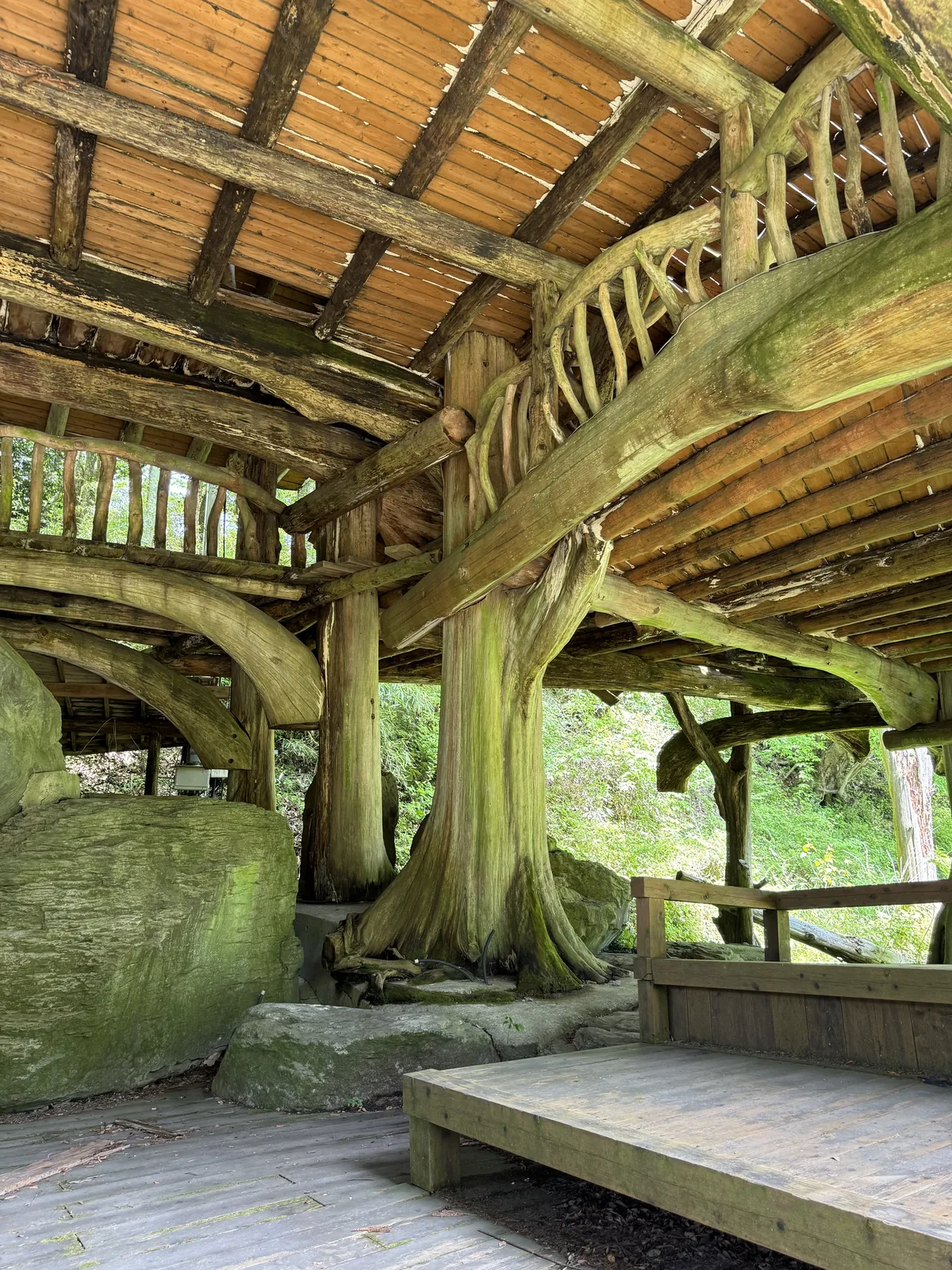
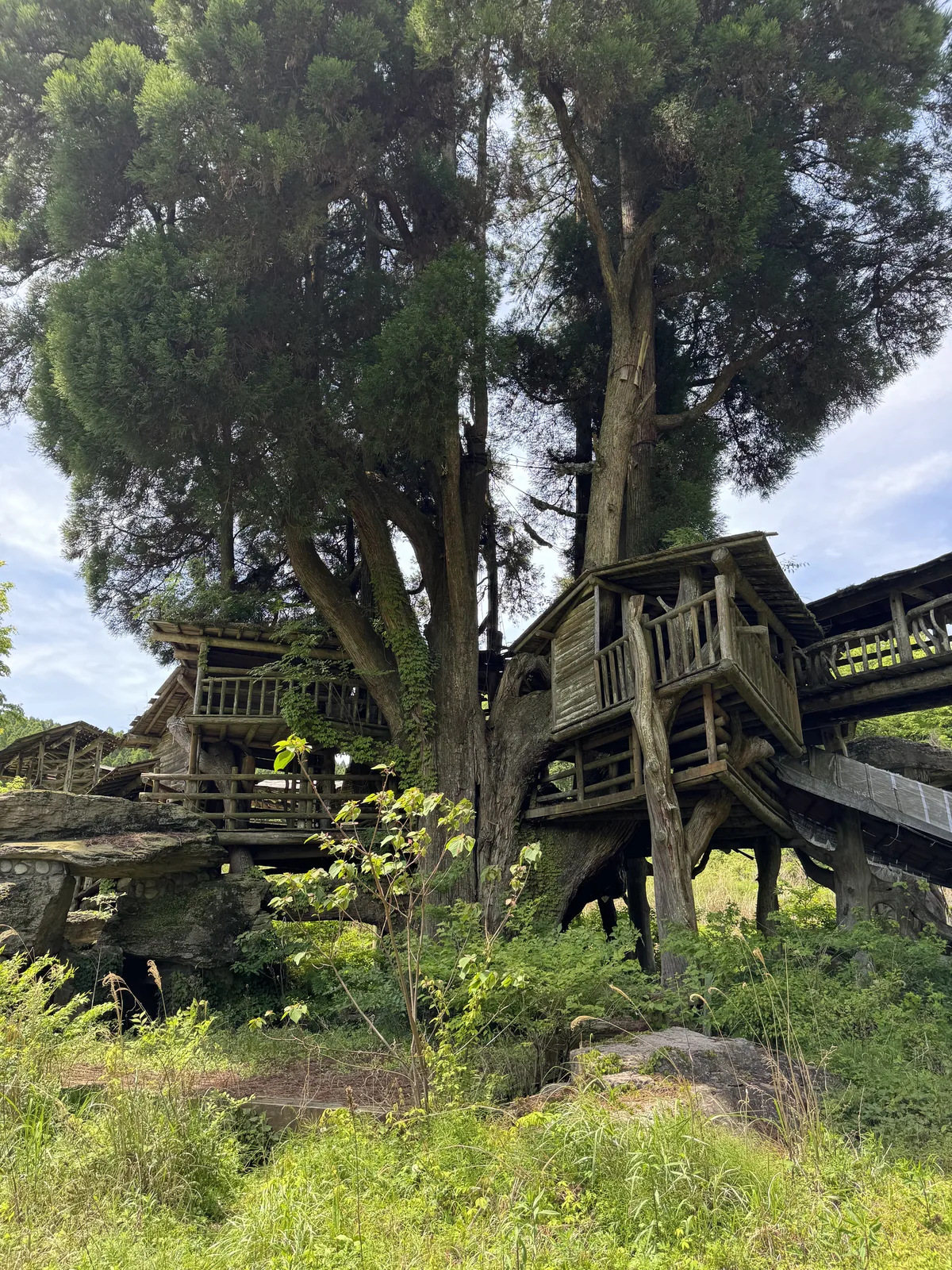
Four details: the platform underside, the branch railing, the cedar passing through the floor, and the trunk-and-platform integration from the ground.
The lowest platforms sit directly on large boulders. The builders integrated the existing rocks rather than excavating them, so each post lands on a slightly different level. From under the structure you can see daylight through gaps; the design is open rather than enclosed. The whole thing breathes.
“It is closer to a cathedral than a tree house — a slow, accreted thing built by hands that knew the material.”
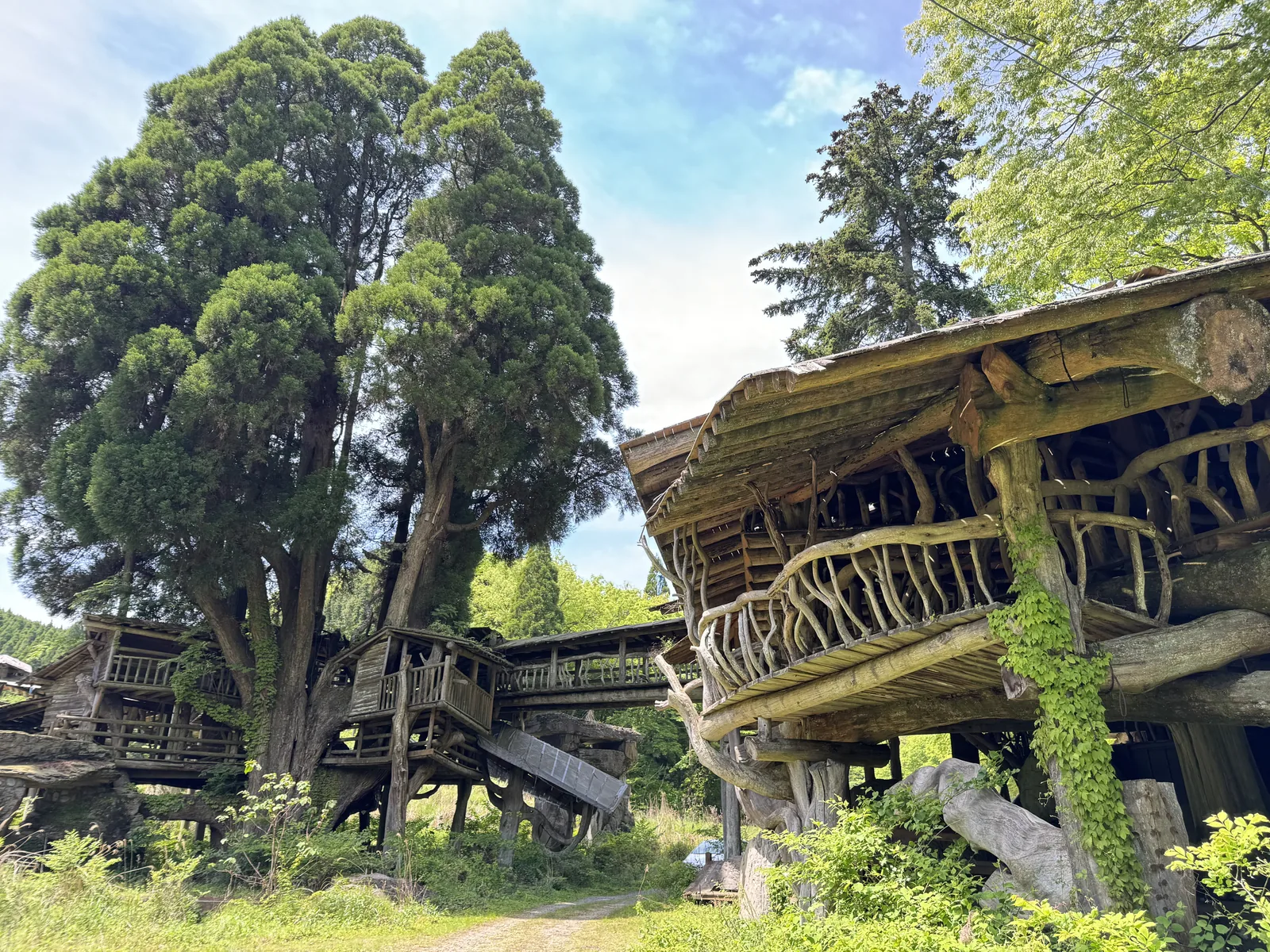
Why it closed
Two reasons, both visible if you walk the perimeter.
First, the 2016 Kumamoto earthquakes caused ground subsidence in many parts of Aso District. Multiple structures around Takamori shifted on their foundations. The tree house’s posts moved on bedrock — the design was forgiving of small movement — but the cumulative damage is visible: some platforms are slightly twisted, the upper-level stairs are out of plumb.
Second, the structure is wood, exposed to twenty-plus years of Aso weather, much of it built without modern fasteners. Some interior staircases have collapsed. Bamboo ceiling sections have rotted through in places. From outside it still looks intact; up close (and the documented accounts agree) it isn’t safe to walk on anymore. Interior access has been prohibited since around 2018-2019.
Whether the structure will be restored, allowed to continue weathering, or eventually dismantled — that’s not something I have a verified answer for. There are unconfirmed online speculations about future demolition; nothing official I can cite. Treat any visit as potentially the last time you’ll see it.
The local lore around the cedar
The cedar itself — not the tree house — is the locally significant element. Three folk beliefs are still observed:
- Women are traditionally not supposed to climb the tree or touch the trunk. The reasoning given in local sources connects to the water-deity association.
- Branches and leaves should not be removed from the tree or the surrounding ground. Local belief holds that taking part of the cedar home brings illness or misfortune.
- Fallen branches must not be burned. They are left where they fell.
You don’t need to believe in the curse to follow the rule. The cedar stands on privately owned land in a small farming community. Treat it the way you’d treat a 400-year-old tree in any culture — at a respectful distance, no fragments leaving the site.
Getting there (car-only, realistically)
The Minamiaso Railway fully reopened on July 15, 2023 after seven years of partial closure following the 2016 earthquakes — Tateno through to Takamori is one ride again, with through-running JR Hōhi Line trains via Higo-Ōzu — but Takamori Station is several kilometres from the tree house and there is no public bus along the Kawara forest road. Public transit gets you to the town. It doesn’t get you to the cedar.
| From | Time | Notes |
|---|---|---|
| Aso town (caldera centre) | ~30 min | South via Route 265 / 高森峠, then turning onto farm roads. |
| Kumamoto City | ~1 h 40 min | Route 57 east, then up into Takamori. Or Kyusanko “Rapid Takamori” express bus from Kumamoto Station (~3 h, 4 daily) drops you in Takamori town centre — taxi or rental for the last few km. |
| Kumamoto Airport (KMJ) | ~1 h 15 min | Most direct car route from arrival. |
| Fukuoka | 2.5 – 3 h | Kyushu Expressway → Kumamoto IC → Route 57. Doable as a long day trip; an overnight in Kurokawa Onsen or Aso is better. |
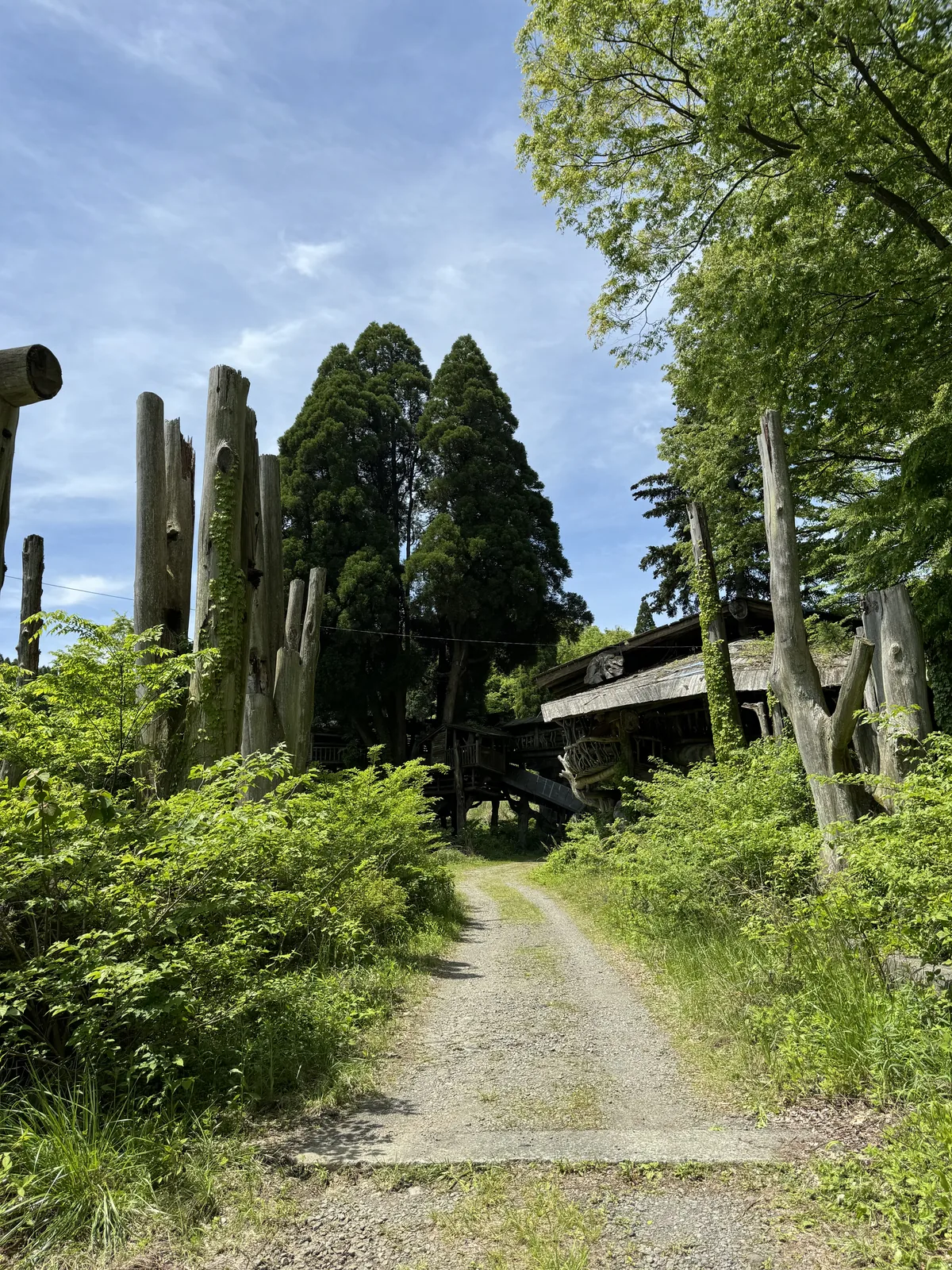
The approach itself is part of what makes it. There is no formal gate or signboard — just a wooden post arrangement that marks the threshold, the gravel turning slightly uphill, and the structure suddenly visible through the cedars. If you’ve followed Google Maps you’ll arrive at it without warning.
Address: 熊本県阿蘇郡高森町河原 2138 / Aso-gun, Takamori-cho, Kawara 2138.
Coordinates: 32.870325, 131.214134.
Parking: An open patch of unpaved ground near the property. Avoid blocking the farm road or stopping on the asphalt — this is a working agricultural area and tractors use the road regularly.
Pair with: nearby Aso destinations
Coming all the way to Takamori for a 30-minute external viewing isn’t a whole-day trip. The good news: this corner of Aso is dense with worthwhile stops. A reasonable half-day plan around the tree house:
- Imakin Shokudo — the legendary akaushi (Japanese brown beef) bowl in central Aso. Plan lunch around it; expect a queue, especially weekends.
- Kamishikimi Kumano-imasu Shrine (上色見熊野座神社) — moss-covered stone lanterns leading up to a small shrine, with the giant Ugeto-iwa rock window above. The pilgrimage site for fans of the anime Hotarubi no Mori e. About 15 minutes’ drive from the tree house.
- Takamori Dengaku-no-Sato (高森田楽の里) — irori-charcoal hearth restaurant serving the local 700-year-old dengaku (skewered taro, mountain vegetables and trout grilled over charcoal). Central Takamori.
- Takamori Yusui Tunnel Park (高森湧水トンネル公園) — a former rail tunnel converted into an illuminated water feature, especially worth it during the summer Tanabata season.
- Aso Shrine (阿蘇神社) in Ichinomiya — the iconic Rōmon (tower gate) was destroyed by the 2016 earthquakes and finally re-dedicated in December 2023. The rebuilt gate is the obvious counterpoint to the tree house’s quiet decline. ~30–40 minutes north.
- Nabegataki Falls — about an hour north of Takamori, the waterfall you can physically walk behind. One of the more memorable stops in inner Kumamoto.
- Kusasenri grasslands (草千里) — 30 minutes from Takamori, the high plain below Mt. Aso where horses graze freely. Note: Nakadake crater road access is intermittently restricted by SO₂ levels — check JMA same-day before driving up.
For a longer Kyushu loop that incorporates this area, our Ruby Route 7-day Kyushu volcanic itinerary threads Aso into a wider Kumamoto–Yufuin–Beppu route.
Where to stay nearby
The natural overnight base for an Aso-Takamori day is Kurokawa Onsen (about 50 minutes north), or one of the inns in Aso town itself.
Practical tips for visiting
- Best time of year: late April to early June. The light is strong, the surrounding pasture is green, and the cedar’s foliage is full. Autumn (October–November) likely also works for the surrounding scenery. Avoid December through February — forest roads in this part of Aso ice over and a non-4WD rental without snow tires becomes risky.
- Best time of day: morning, before about 10:00. The cedar’s east side gets soft side-lit light; mid-day is high contrast and the wood looks flat in photos.
- Photography: completely fine from the open ground. Wide-angle (24mm or wider) for the whole structure; 50mm or longer for the architectural details. A polariser helps cut sky reflection on the upper platforms.
- Drone: probably not appropriate. This is private agricultural land; drone photography over private property without consent is increasingly restricted in Japan, and there’s no contact point to ask.
- Bring: water (no facilities on site), insect spray (working farm in summer), a charged phone (cell signal is patchy in the immediate area for some carriers).
- Don’t: enter the structure, climb on the platforms, touch the cedar’s trunk, take leaves or branches. The “no touch” rule for women specifically reflects local belief; the broader “don’t take souvenirs” rule applies to everyone.
FAQ
Can I go inside the Takamori Tree House in 2026?
No. Interior access has been prohibited since around 2018-2019 because of structural deterioration and ground subsidence following the 2016 Kumamoto earthquakes. You can view the structure from the surrounding open ground, walk the perimeter, and photograph it freely.
Is there an admission fee or operating hours?
No staffed entrance, no posted fee, and no posted hours. The site is essentially an unsupervised piece of private property that visitors are allowed to view from outside. Treat it accordingly — no littering, no climbing.
How old is the cedar tree?
Estimated at 400+ years; sources don’t agree on the exact age, with some saying up to 600. There is no formal dendrochronology record. The tree is locally known as the Kami-Tamarai no Ōsugi (上玉来の大杉) and venerated as a water-god tree (suijin-boku). Trunk circumference is roughly 7.5 metres.
Can I get there without a car?
Difficult. Takamori Station on the Minamiaso Railway is the closest public-transit point (the line fully reopened in July 2023), but the tree house is several kilometres away and there is no bus that closes the gap. A taxi from Takamori Station is feasible if you arrange the pickup time in advance.
Is it worth a detour from Kumamoto City?
If you’re already in the Aso area and you’re interested in folk architecture, vernacular building, or the slow disappearance of unmaintained Japanese rural craft — yes. If you’re driving from Kumamoto City for this alone, probably not. Pair it with Imakin Shokudo, Kamishikimi shrine, and the Kusasenri grasslands and you have a full day worth doing.
Is the structure safe to be near?
The exterior viewing area is well clear of any falling-debris risk. Don’t go directly under the upper platforms or stand on any of the broken stairs — there is no maintenance and parts of the structure are visibly decaying. Photograph from the open ground in front and you’ll be fine.
Last updated April 28, 2026. Photos taken on site May 11, 2024.
Join 1,000+ travelers discovering Japan's hidden side
Weekly dispatches from off-the-beaten-path Japan — spots and stories you won't find in guidebooks.
No spam. Unsubscribe anytime.
Welcome aboard!
You're in. See you in your inbox soon.