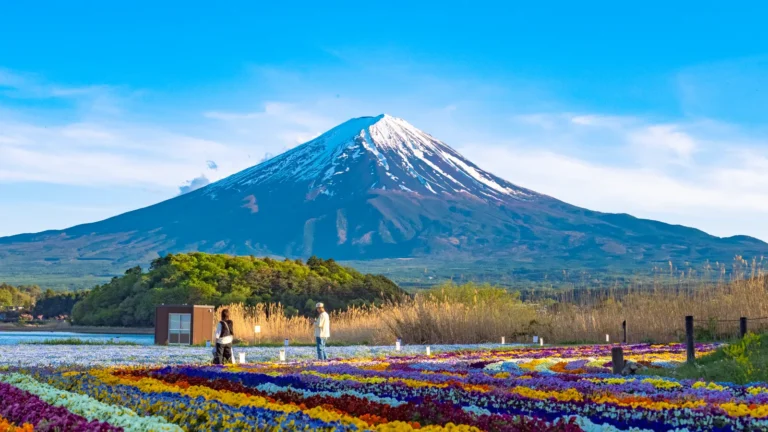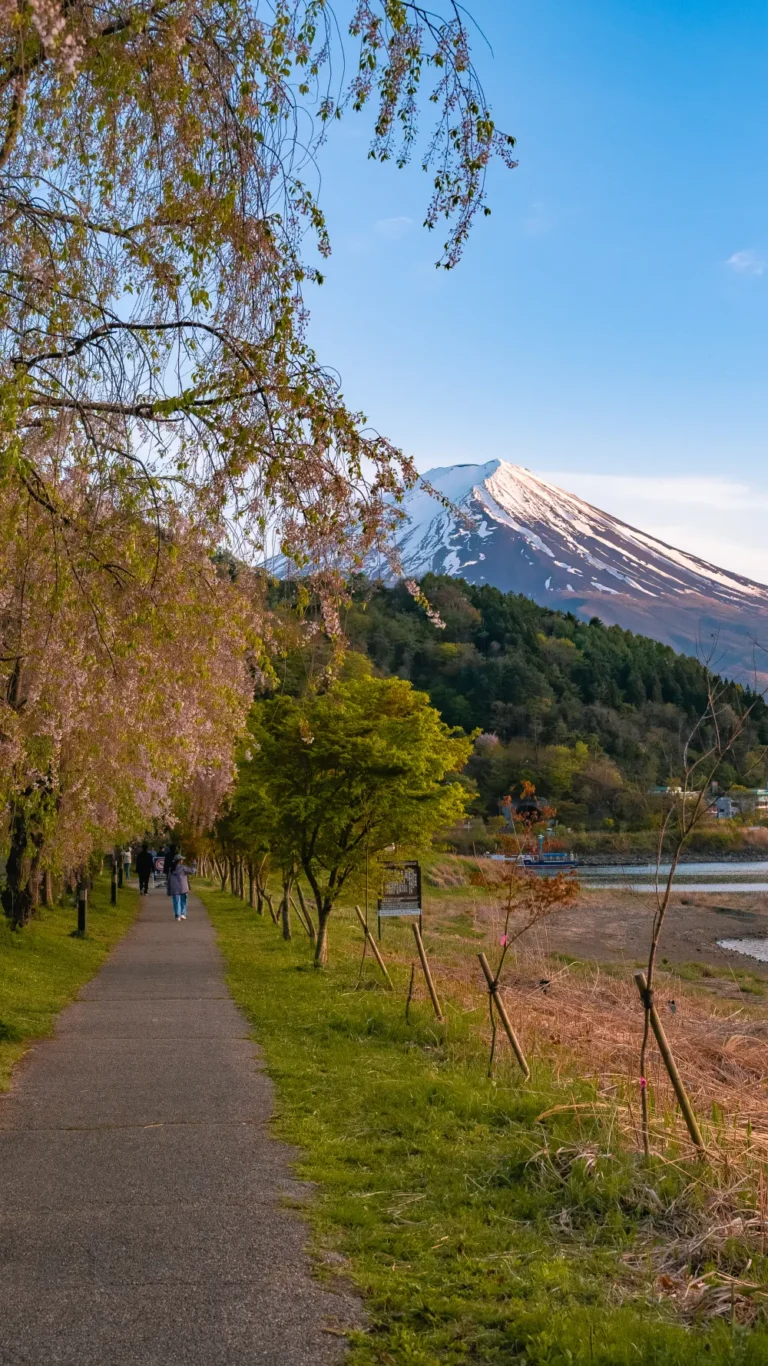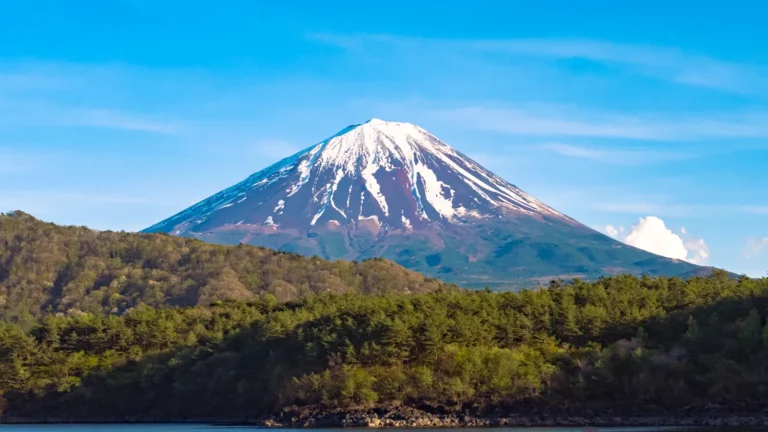


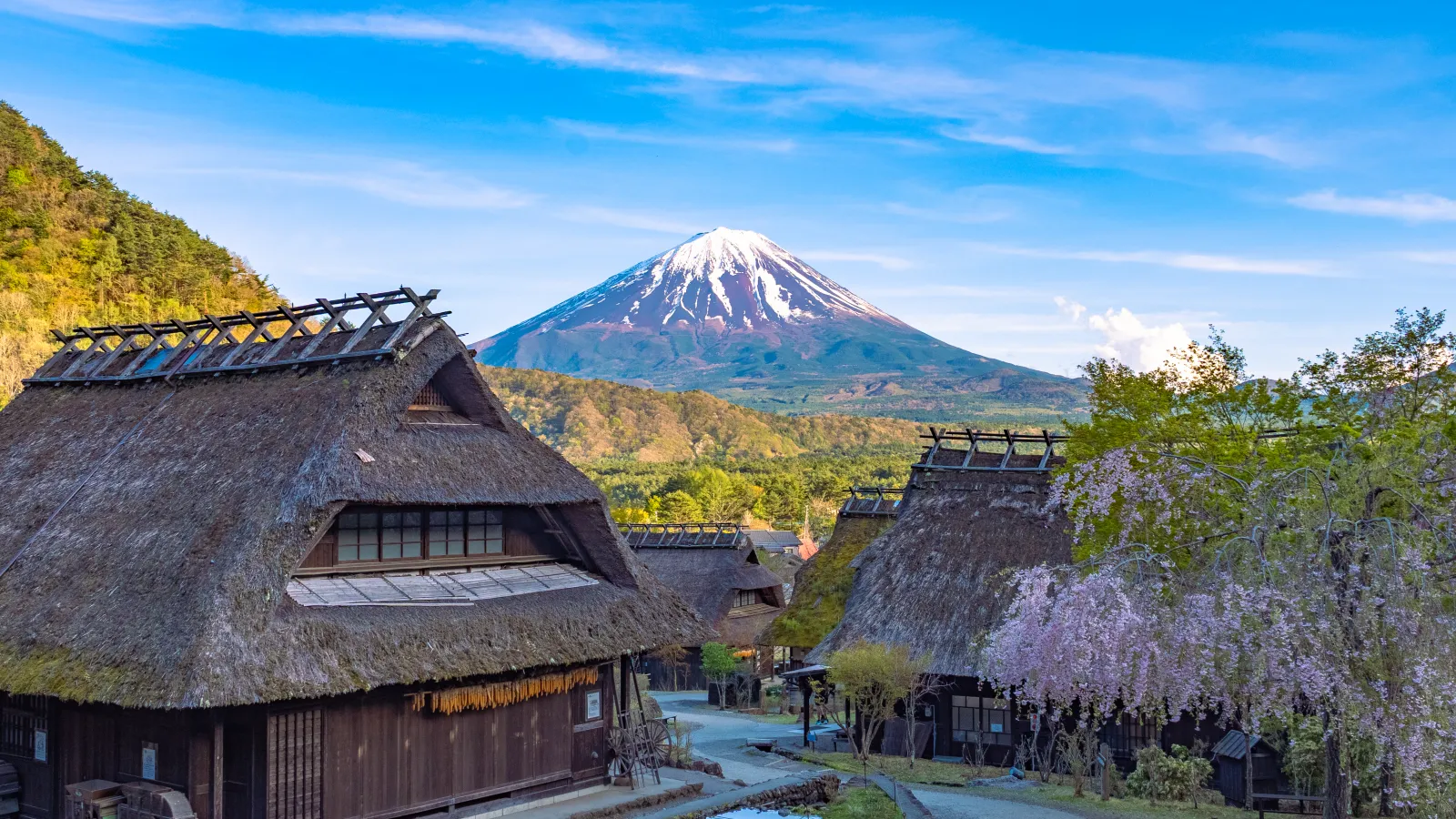
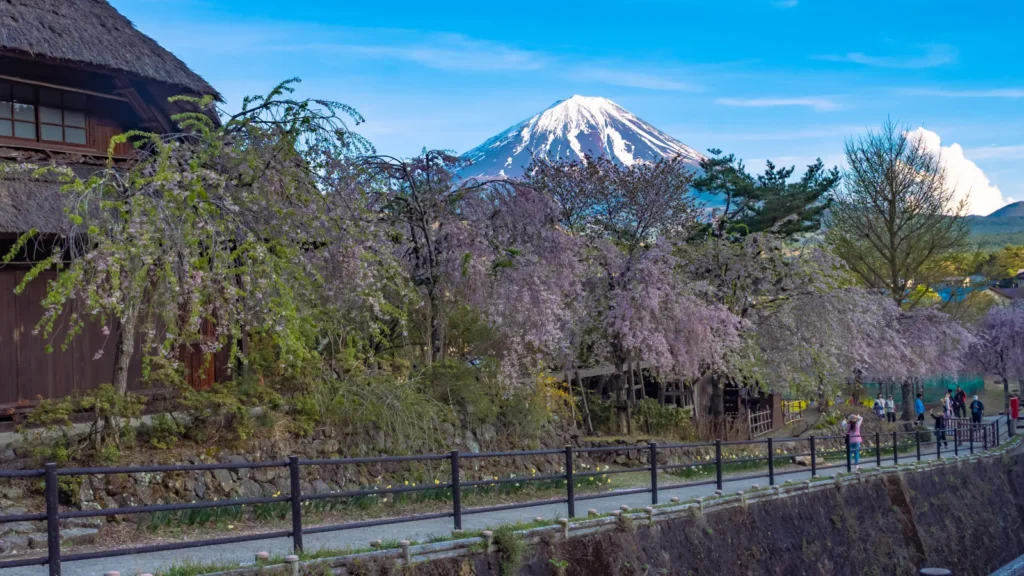
There’s a moment on the approach — after the bus turns off the lake road, after the parking lot, after you hand over ¥500 at the ticket window — where you look up and realize the thing you’re about to walk through is a village that shouldn’t exist. Two dozen thatched-roof houses arranged in a valley with Mt. Fuji floating behind them. Weeping cherries dragging their branches into a narrow canal. A waterwheel turning. An old soba restaurant with the sliding door half-open.
It looks like something out of a film set. Which, in a way, is what it is.
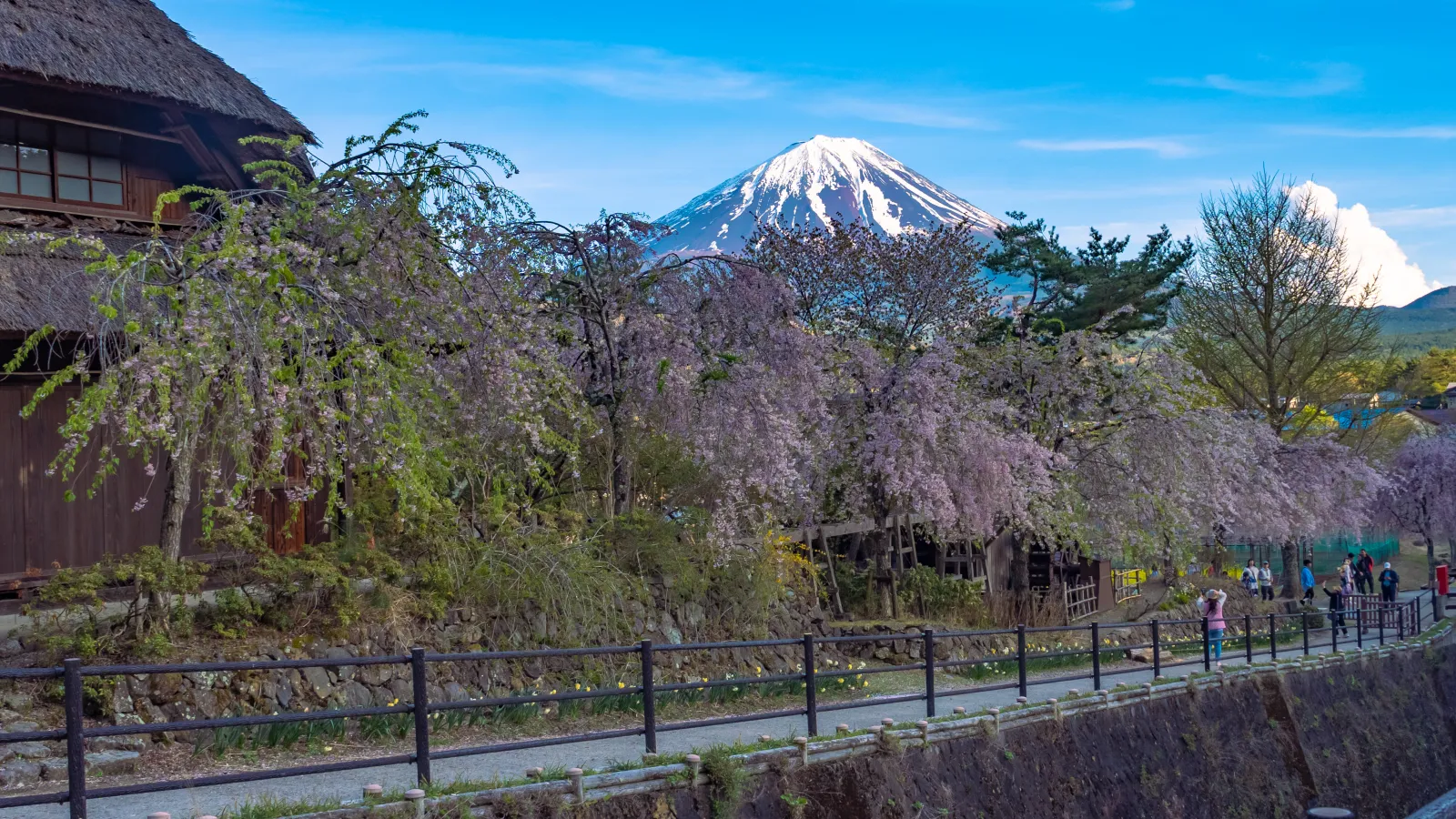
The village you’re walking through isn’t ancient. The original Nenba (根場) hamlet was destroyed overnight on September 25, 1966, when a typhoon triggered a landslide that killed 94 people and swept away 37 of the 41 houses. What you see today was rebuilt — beginning in 2006 — as a tourist village with reconstructed thatched homes on the original site.
Table of Contents
What You Actually Pay For
Nenba is one of the Mt. Fuji area’s cheaper “hidden” attractions. Here’s the math, with parking included:
(high school and up)
middle school
(120 cars, 20 buses)
Groups of 20+ drop to ¥450 adult / ¥200 student. No hidden charges; individual workshops and rentals (kimono, pottery, etc.) cost extra if you do them.
Quick Facts
| Address | 2710 Saiko Nenba, Fujikawaguchiko, Yamanashi 〒401-0332 |
| Phone | 0555-20-4677 |
| Hours | Mar–Nov: 9:00–17:00 (last entry 16:30) · Dec–Feb: 9:30–16:30 (last entry 16:00) |
| Closed | Open year-round (occasional typhoon/ice closures) |
| How long | 90 min to 2.5 hours depending on whether you do a workshop or eat lunch |
| Access | 40 min by Saiko Shuyu retro bus from Kawaguchiko Station, or 25 min by car from Kawaguchiko IC |
| Official | saikoiyashinosatonenba.jp |
Why People Come
Two reasons, mostly.
One: the composition. On a clear day Mt. Fuji lines up perfectly behind the village, and the reconstructed kabuto-zukuri houses (helmet-shape thatched roofs, designed with second-floor dormer windows for silk farming) give you a foreground that Kawaguchiko’s lakeside hotels can’t match. Shirakawa-go has bigger roofs, but no Fuji. Kawaguchiko has Fuji but no thatched roofs. Nenba is the only place that reliably gets both in one frame.
Two: it’s not crowded. Shirakawa-go gets half a million visitors a year. Nenba gets a fraction of that, and most of them come between 11:00 AM and 2:00 PM. Arrive at 9:00 opening and the first hour you’ll share the village with maybe twenty other people.
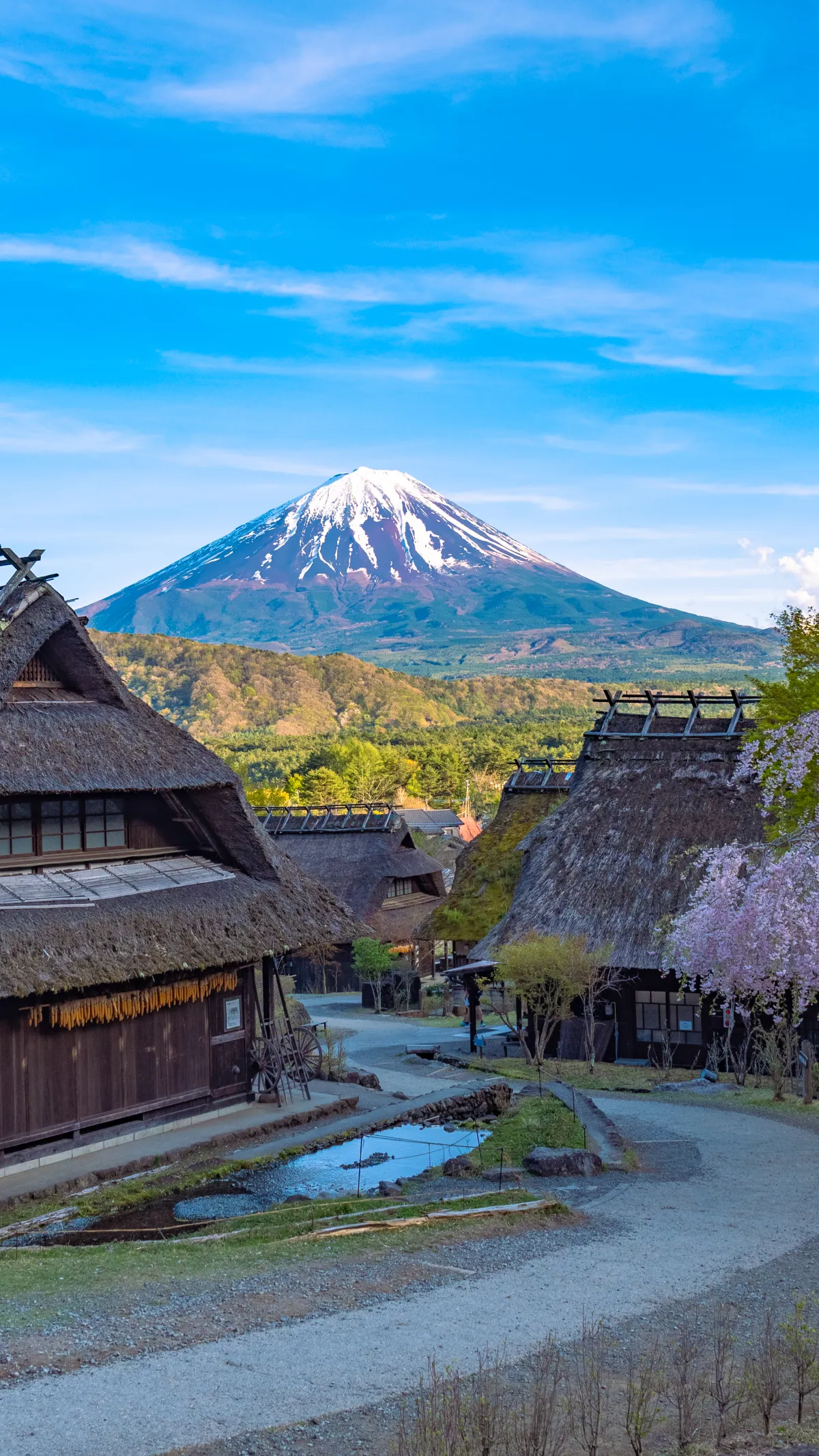
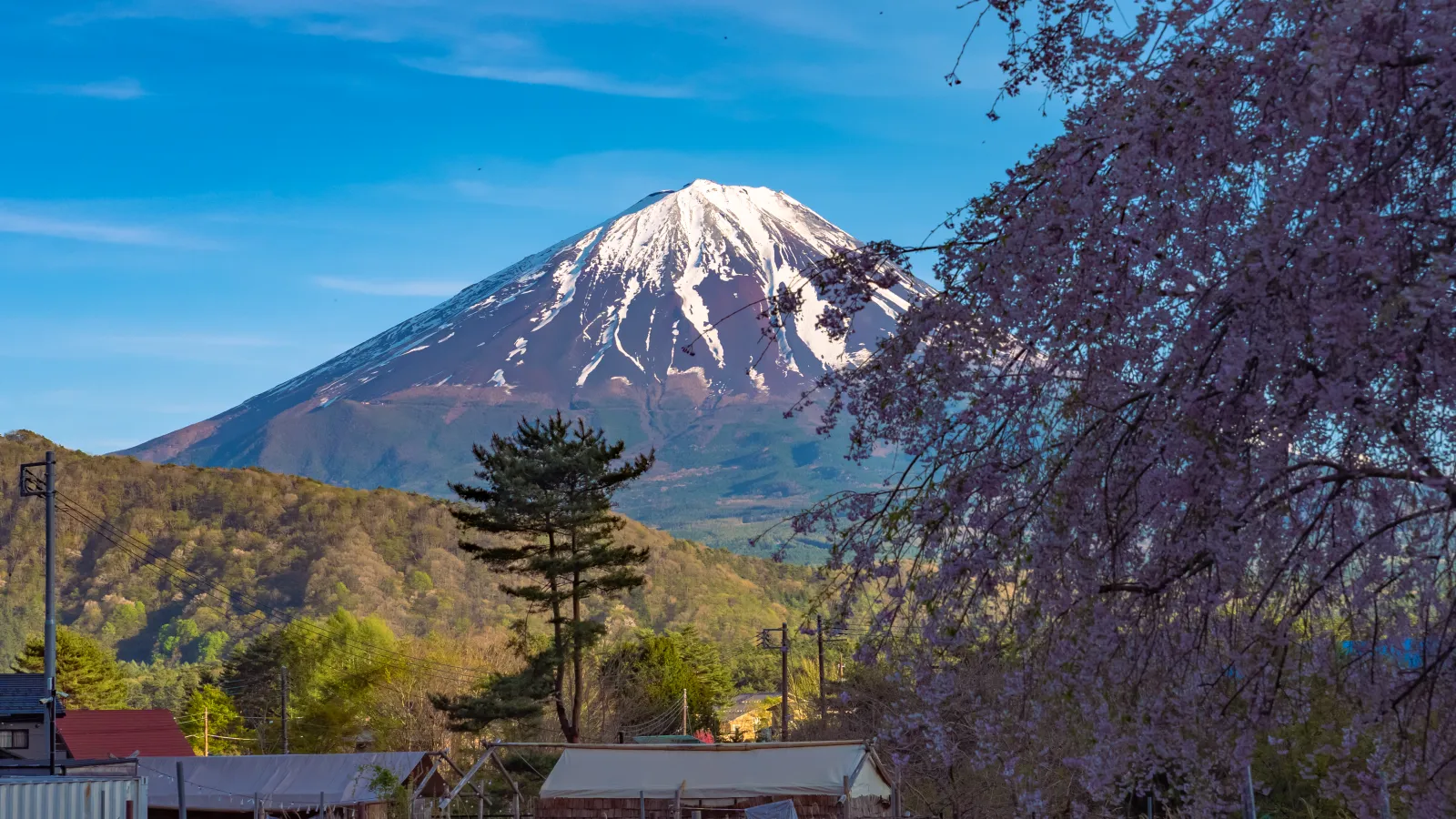
The village sits at about 900 meters elevation on the south shore of Lake Saiko. Mt. Fuji is directly south-southwest, about 15 kilometers away as the crow flies. The alignment is better than coincidence — when the reconstruction planners chose the rebuild layout in the early 2000s, the Fuji sightline was preserved intentionally.
The mountain shows up cleanly from most of the village. It’s blocked from a couple of specific corners (behind the tallest houses on the western edge), but 70% of the site has a direct view. Spring and autumn mornings tend to be the clearest; summer haze softens the outline by mid-morning.
The Cherry Blossom Situation (Mid to Late April)
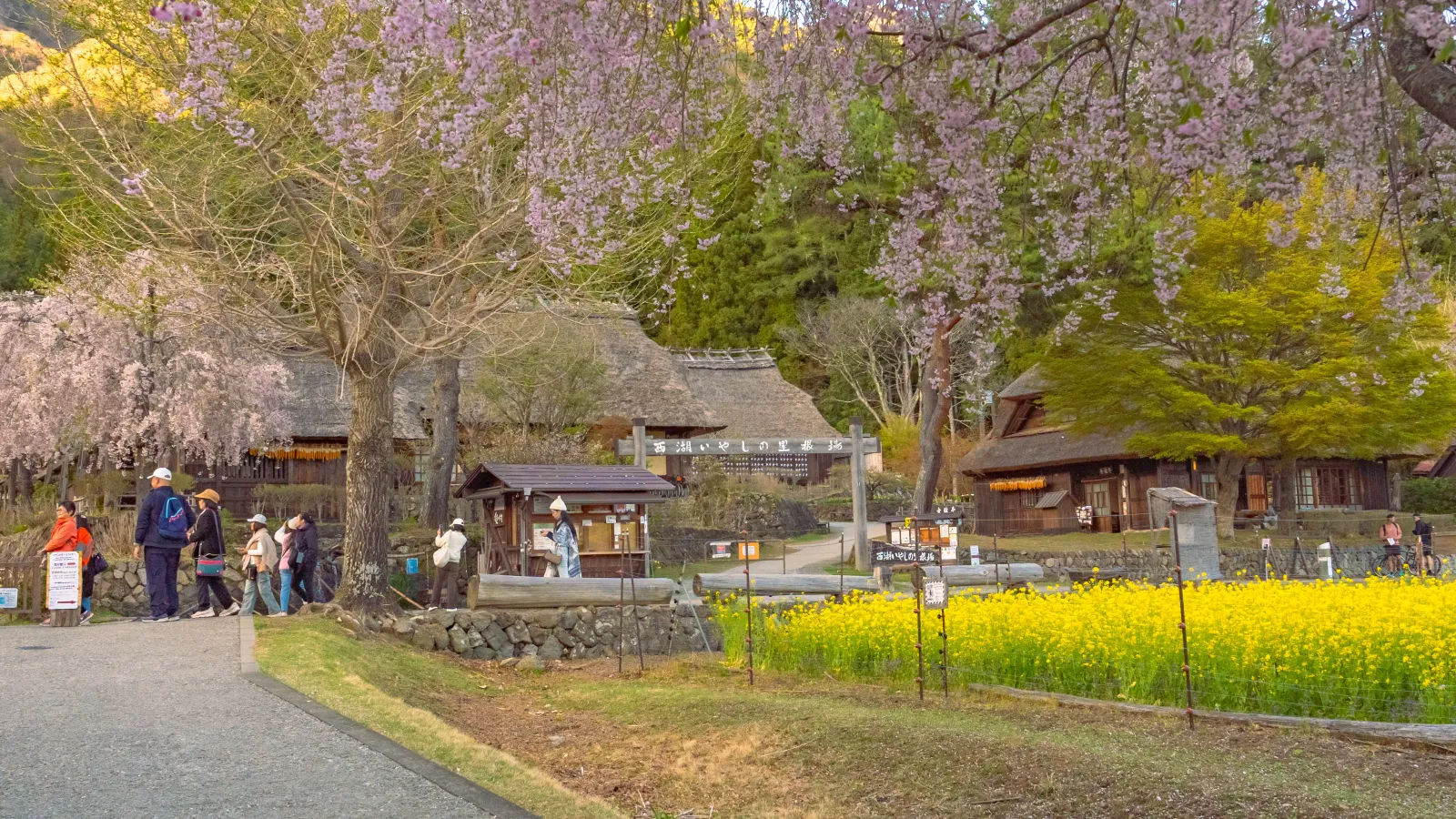
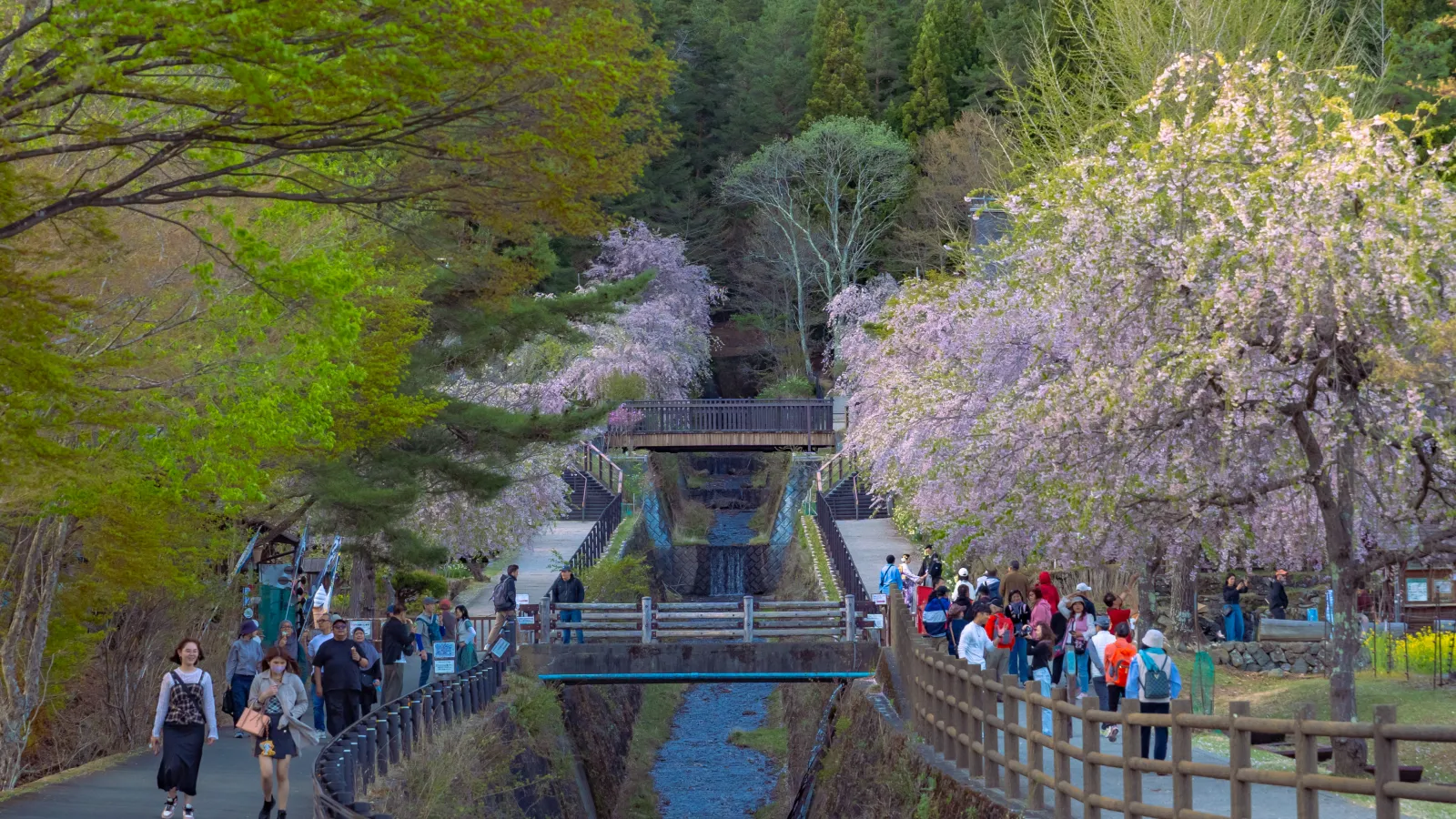
The village is known among Yamanashi regulars for its shidare-zakura — the weeping cherries that line the narrow canal running through the center. The altitude puts the bloom two to three weeks later than Tokyo, which means you can catch them here after you’ve missed every other cherry blossom in central Japan.
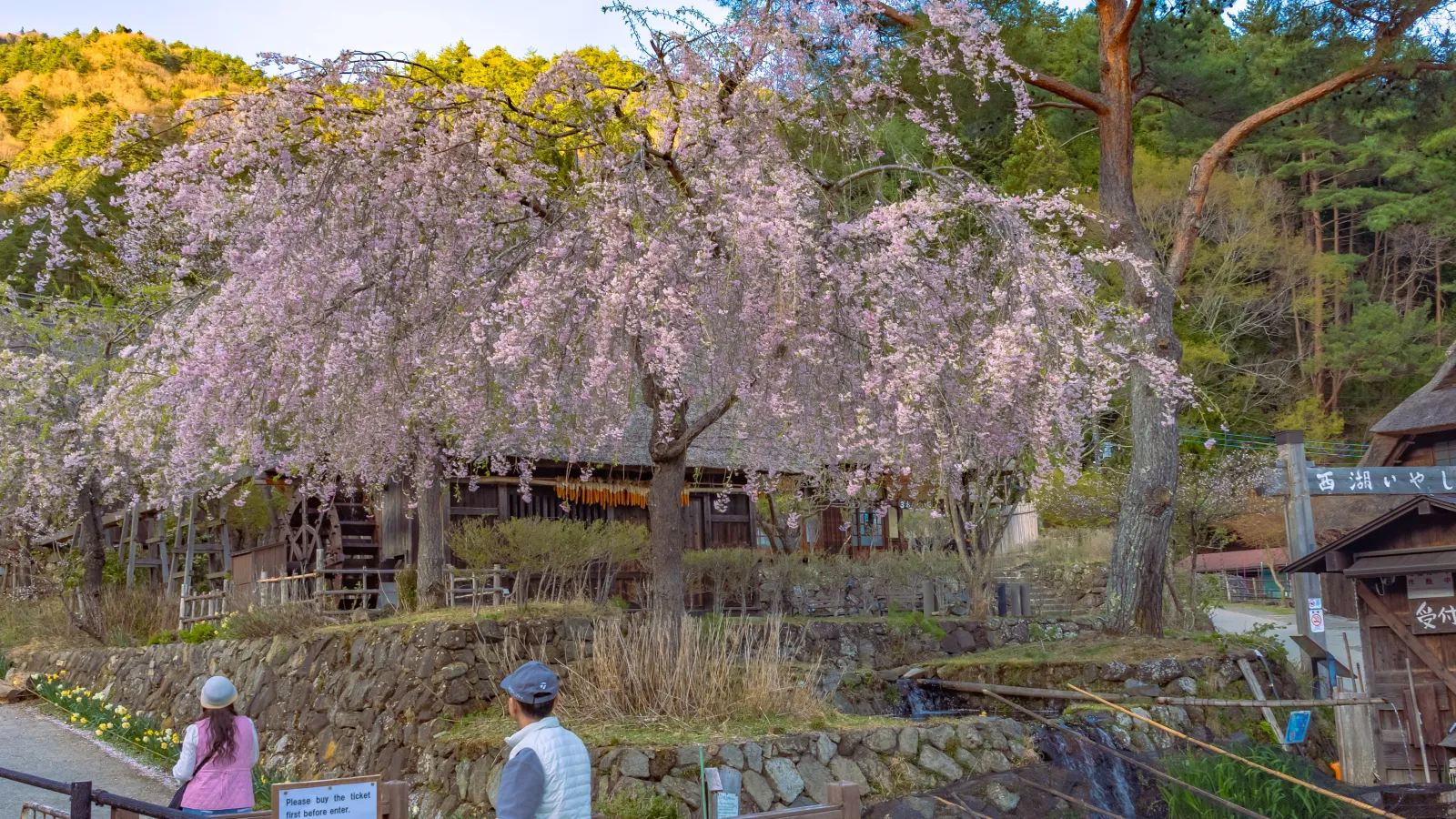
On April 21, 2026 — when we visited — the weeping cherries were still holding. Peak had been roughly April 14-17 this year; by the time we walked in, it was the slow tail end, maybe 60% of blossoms still on the branches, petals starting to carpet the ground. Bloom timing varies year-to-year; check the park’s social feed in early April for the current status.
What to Actually Do On-Site
Walking the village takes about 45 minutes at a slow pace. The canal runs north-south down the center; two parallel paths flank it. Cross one of the small bridges to get between them. A proper loop of everything takes 90 minutes.
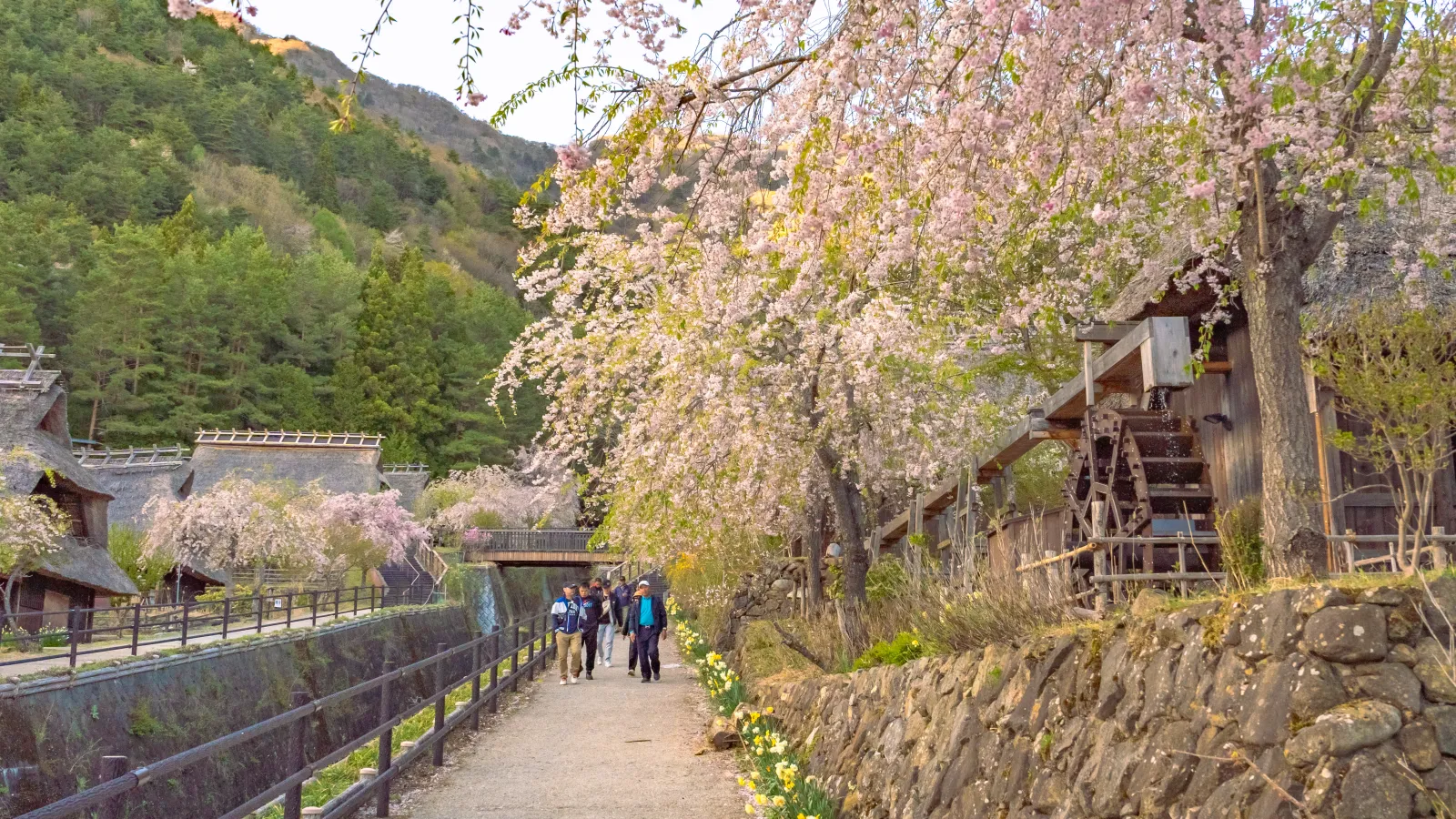
Inside the 20 restored houses, most hold a specific function:
- Workshops. Pottery, silk weaving, candle-making, incense-making, glasswork, needlework. Each costs ¥500–¥3,000 on top of the entry fee; reservations are recommended for the longer ones on weekends.
- Kimono rental. Rental fees start around ¥1,500 for 30 minutes — long enough to walk the village and take a few photos. Dressing is done on-site.
- Food. Two small restaurants inside the village serve handmade soba and the Yamanashi specialty hoto (thick noodles in miso broth with vegetables). Expect ¥1,200–¥1,800 for lunch.
- Shops. Local jams, miso, craft goods, fresh mochi — priced similar to Kawaguchiko’s tourist shops but less gouging.
- Sabo Museum (砂防資料館). A small, free museum inside one of the houses with photographs and survivor accounts from the 1966 landslide. Easy to skip, but worth the 15 minutes.
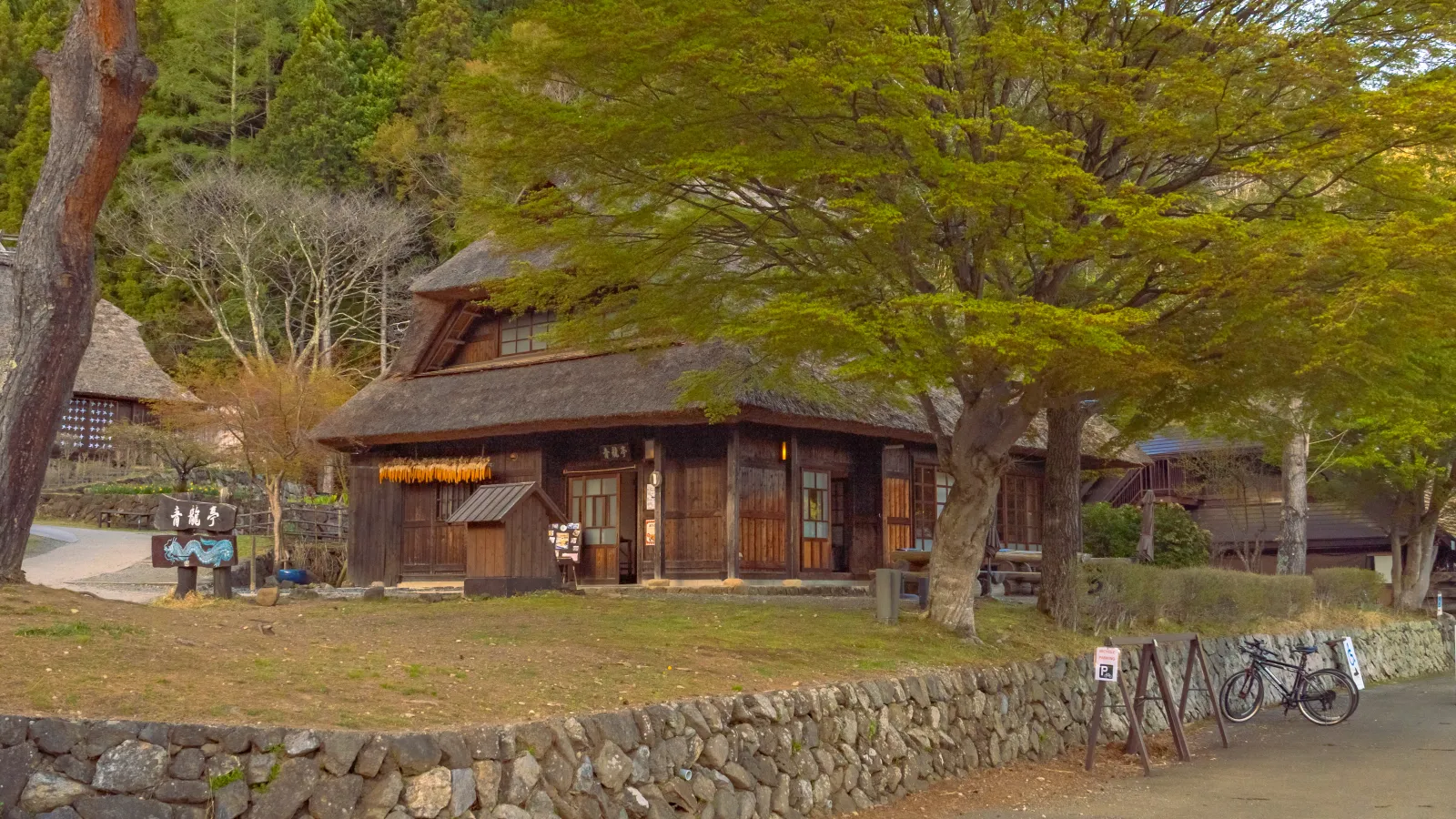
The Watanabe House
One of the houses — the Watanabe Residence main building — is registered as a Tangible Cultural Property of Japan (designated 2011). It was rebuilt using traditional joinery and straw-thatch techniques, with the original 1960s-era beams where they could be salvaged. Worth stepping into for the ceiling work alone.
The Photography Zones
If you’re coming for the photograph, a few spots matter more than others:
Approach and Access
By car
25 minutes from Kawaguchiko IC (Chuo Expressway exit) along Route 21 around the lake. Free parking on-site. The lot rarely fills except on peak cherry weekends. If you’re combining with Kawaguchiko or Mt. Fuji area, car is the clear winner — bus connections eat half a day.
Compare rentals at DiscoverCars — Kawaguchiko Station has Toyota Rent-a-Car, Nippon, and Nissan branches within walking distance.
By public transit
From Kawaguchiko Station, take the Saiko Shuyu Retro Bus — Line #5, the western loop that runs to Saiko. About 40 minutes to the “Saiko Iyashi no Sato Nenba” stop. Buses run every 30-45 minutes in peak season, less frequently in winter. A one-day bus pass is ¥1,700 for unlimited rides covering Kawaguchiko, Saiko, and Motosu lakes — worth it if you’re also stopping at the Lake Saiko bat cave or the Motosu viewpoints.
Is It Worth the ¥500?
Short answer: yes, if you can time the cherries or the clear Fuji days.
A longer answer. ¥500 is cheaper than any comparable thatched village in Japan. Shirakawa-go Gassho-zukuri Village is free to walk but the bus there from Takayama is ¥5,000 round-trip; Gokayama runs on a donation box. Nenba costs a five-dollar bill and is an hour closer to Tokyo than either.
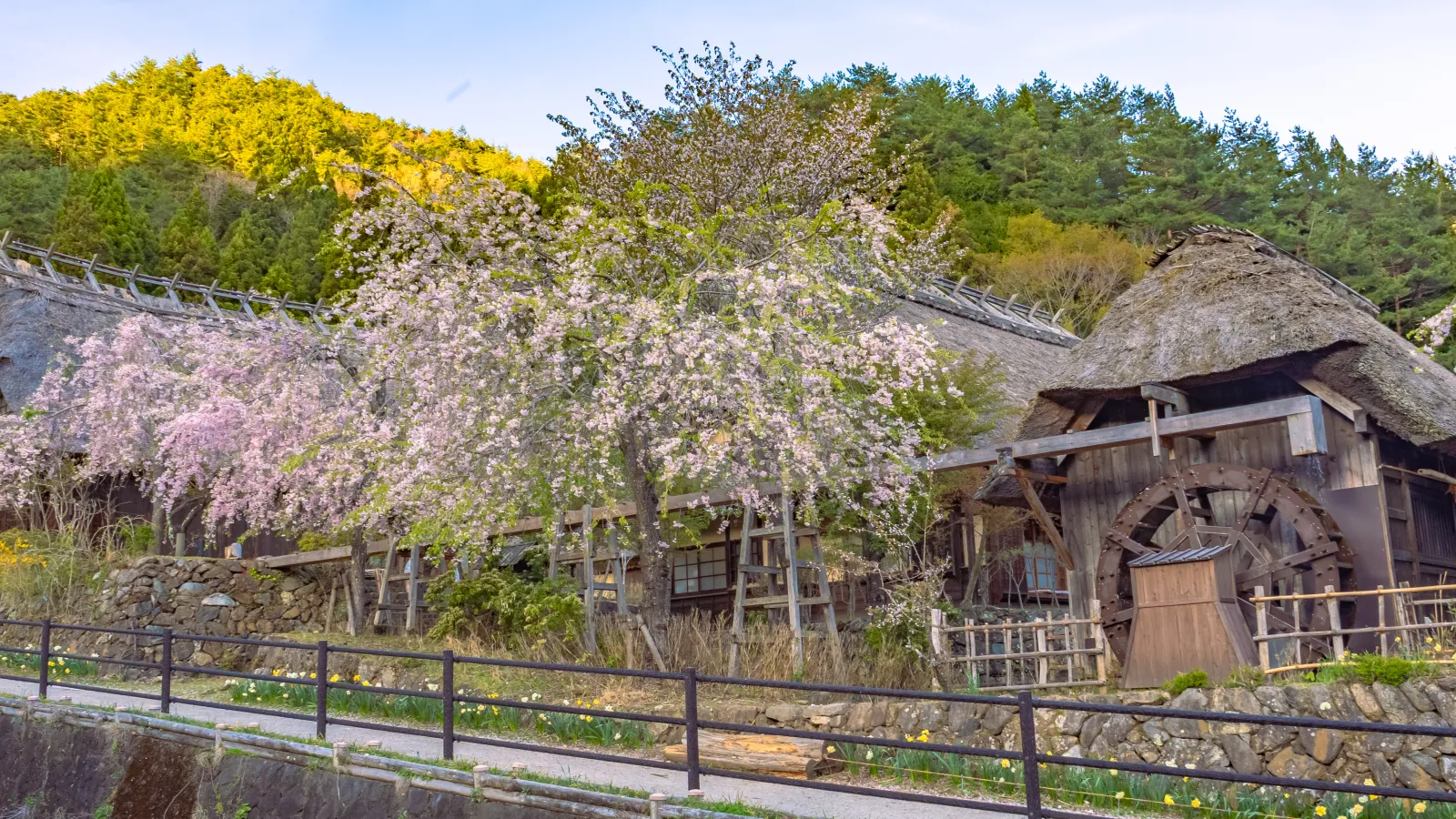
The trade-off is honesty: this is a rebuilt village, not a preserved one. If authenticity matters to you above everything, Shirakawa-go or Ouchi-juku in Fukushima are the genuine articles. If the image of the thatched village with Mt. Fuji behind it is what you came to Japan for, Nenba is the only place that reliably delivers it.
Pair It With
- Lake Saiko Bat Cave (西湖コウモリ穴). 5 minutes by car. A lava tube on the shore of Lake Saiko; hard hats provided. ¥350.
- Fugaku Wind Cave (富岳風穴) and Narusawa Ice Cave. 10 minutes by car. Natural lava caves inside the Aokigahara forest.
- Chureito Pagoda. 35 minutes by car. The five-story pagoda with the canonical Fuji backdrop. See our Chureito access guide.
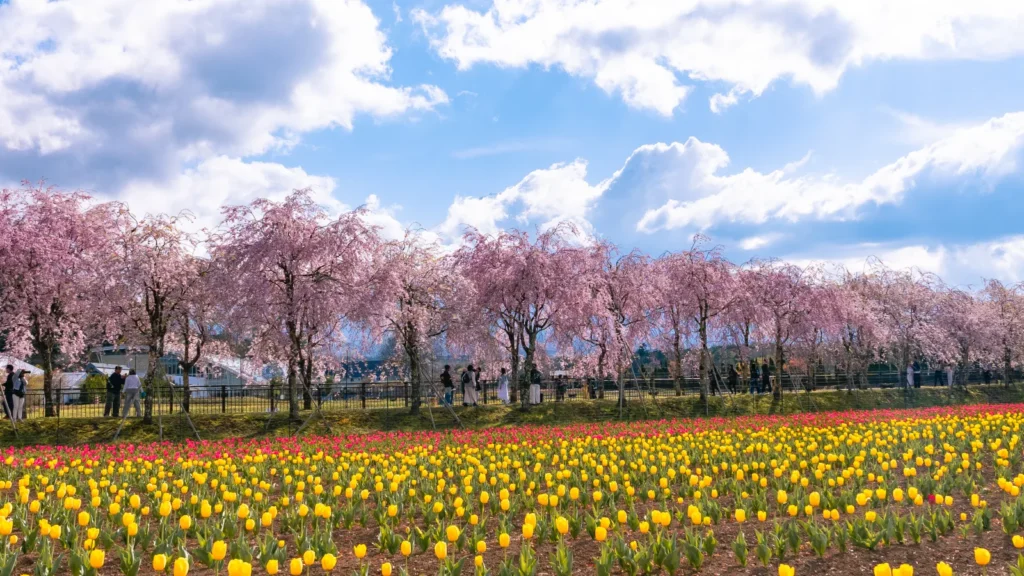
- Hana no Miyako Koen. 30 minutes by car. Tulip and shidare cherry fields — a complementary spring visit. See our Hana no Miyako piece.
Where to Stay
Nenba is a day-trip, not an overnight destination. The closest proper lodging is on Lake Saiko or Lake Kawaguchi:
- Minshuku around Lake Saiko. Small family-run places; ¥7,000–¥12,000 per person with two meals. Book by phone, mostly.
- Hotels around Kawaguchiko. More range, more price options. See our Mt. Fuji stay picks (Kukuna, Fufu, La Vista, Kozantei Ubuya, Hoshinoya Fuji).
Compare rates on Agoda, Booking.com, or Expedia.
Frequently Asked Questions
How long do I need at Nenba?
90 minutes for a walking visit with photos. Add 45 minutes for lunch, 30–60 minutes if you want to do a craft workshop. Most visitors stay 2 to 2.5 hours total.
Is the ¥500 fee worth it?
Yes, especially in the shidare cherry window (mid-to-late April) and on clear Fuji days. Outside those, it’s still fair value — cheaper than a Kawaguchiko cable car, and the village is photographically distinct.
Is the village original?
No. The original Nenba hamlet was destroyed by a 1966 landslide. The current village opened in 2006 as a tourism/cultural project with 20 reconstructed houses on the original site. The reconstruction used traditional thatch and timber techniques; one house (the Watanabe Residence) is a registered Cultural Property.
Can I see Mt. Fuji from the village?
From roughly 70% of the site, yes, in clear weather. The best angle is the upper east-side path where the mountain frames between two thatched roofs. Morning usually beats afternoon for haze.
When do the shidare cherries bloom?
Typically mid-April to early May at this altitude (900 m). Peak is usually the third week of April. In 2026, peak was around April 14–17; blossoms were still on the branches as of April 21.
Are there English-speaking staff?
Basic English at the ticket window and in the main restaurant. Workshop instructions are in Japanese; simpler crafts (pottery, candles) work fine with gestures. Kimono rental staff typically have enough English to get you dressed and out the door.
Can I bring my dog?
Leashed dogs are generally allowed in the outdoor areas of the village. Individual shops and restaurants set their own rules — ask before entering. The paths are gentle enough for small dogs; older dogs will manage the 45-minute loop fine.
Final Take
Nenba is an odd place. It’s a rebuilt village pretending, in the best way, to be an old one. It’s a ¥500 ticket that delivers a photograph most of Japan’s more famous thatched villages can’t. And it sits right on the spot where a hillside came down in the middle of the night in 1966 and killed the village that was there before.
Come in the third week of April and you’ll catch the cherries and a Fuji view. Come on any clear morning outside Golden Week and you’ll have the place mostly to yourself. Either way, the best hour to arrive is 9:00 AM, ticket in hand, before the first tour bus comes up the lake road.
Last updated: April 2026. Admission, hours, and access verified against the official site and Yamanashi Prefecture Tourism. Cherry bloom timing varies year-to-year — confirm current status before a trip planned specifically around the shidare.

- Oishi Park — The Kawaguchiko Flower Park with a Different Bloom Every Month
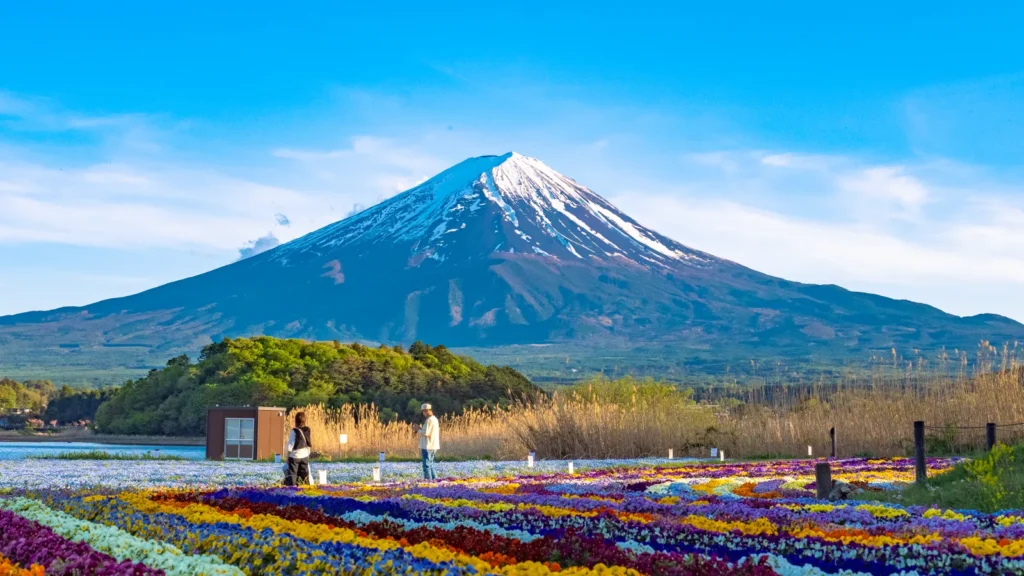 A free lakeside park on Lake Kawaguchiko where shibazakura, nemophila, lavender, and kochia each take turns in front of Mt. Fuji through the year.
 - The Kawaguchiko Walking Trail’s Hidden Shidare-Zakura Row: A 300-Meter Stretch Nobody Writes About
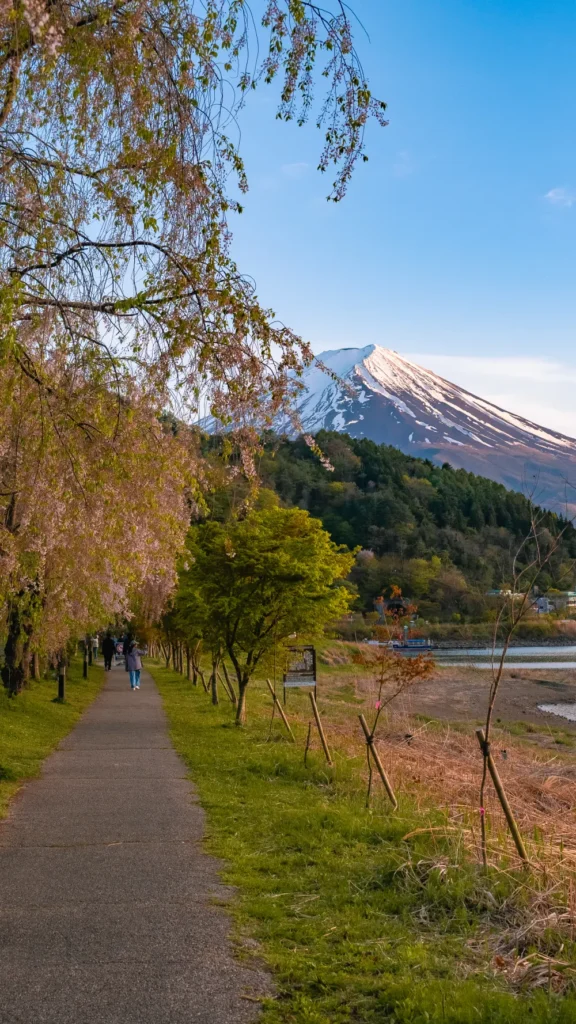 There is a stretch of the Kawa… 続きを読む: The Kawaguchiko Walking Trail’s Hidden Shidare-Zakura Row: A 300-Meter Stretch Nobody Writes About
 - Lake Saiko 2026: The Quiet Fuji Lake, Four Campgrounds, and the Fish That Came Back From Extinction
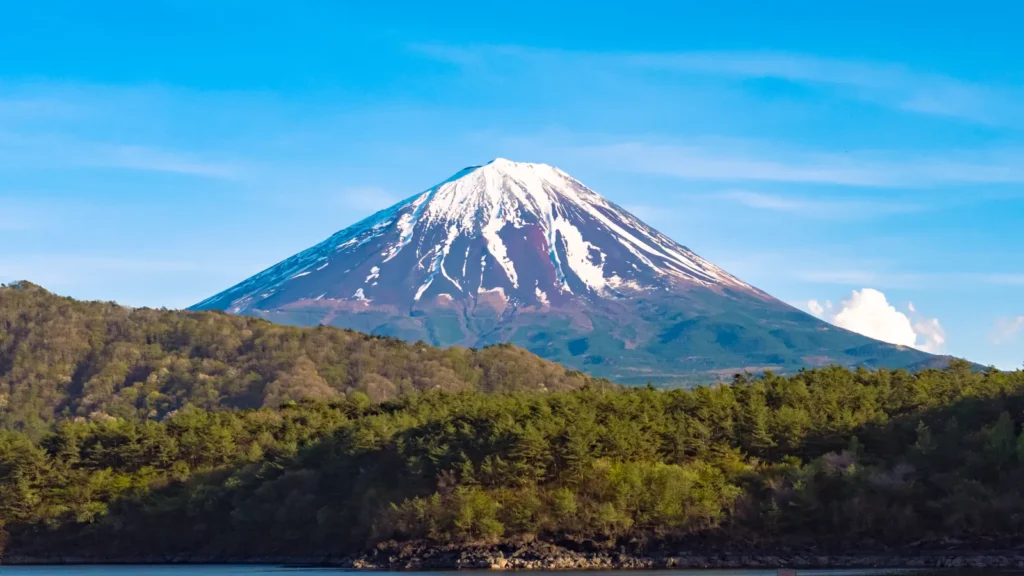 Lake Saiko is the quiet middle… 続きを読む: Lake Saiko 2026: The Quiet Fuji Lake, Four Campgrounds, and the Fish That Came Back From Extinction
 - Saiko Iyashi no Sato Nenba: What ¥500 Buys You at Yamanashi’s Rebuilt Thatched-Roof Village
 There’s a moment on the … 続きを読む: Saiko Iyashi no Sato Nenba: What ¥500 Buys You at Yamanashi’s Rebuilt Thatched-Roof Village
 - Hana no Miyako Koen 2026: Yamanakako’s Flower Park When the Sakura and Tulips Actually Overlap
 Hana no Miyako Koen (花の都公園) si… 続きを読む: Hana no Miyako Koen 2026: Yamanakako’s Flower Park When the Sakura and Tulips Actually Overlap
2026 cherry blossom cherry blossoms day trip from tokyo flower festival fuji five lakes fujiyoshida Fukuoka fushimi hanami hiking japan japanese culture japanese food japanese garden japan travel kamakura kawagoe kawaguchiko Kumamoto kyoto local food Mount Fuji mt fuji Nagano nature Nikko Oku-Nikko Onsen Ramen saitama sakura Shizuoka shrine sightseeing snow spring spring in japan Tokyo travel travel guide travel planning winter winter travel Yamanashi
Join 1,000+ travelers discovering Japan's hidden side
Weekly dispatches from off-the-beaten-path Japan — spots and stories you won't find in guidebooks.
No spam. Unsubscribe anytime.
Welcome aboard!
You're in. See you in your inbox soon.