
![Wisteria in Japan 2026: 10 Stunning Spots Beyond Ashikaga [With Map]](https://hiddenjapan-gems.com/wp-content/uploads/2026/04/藤花-scaled.webp)

Wisteria (fuji in Japanese) blooms right after cherry blossoms fade — making it the perfect reason to extend a spring trip to Japan. While most international visitors flock to the famous Ashikaga Flower Park, the reality is that late April and early May bring incredible purple cascades to gardens, shrines, and hidden temples all across the country.
As the founder of hiddenjapan-gems.com, I’ve spent years tracking the wisteria front as it moves from Kyushu up to Tohoku. I’ve been shoulder-to-shoulder with the Golden Week crowds at Ashikaga, but I’ve also found myself completely alone under a 1,000-year-old wisteria tree in a quiet Hyogo mountain town. That contrast is what this guide is about.
If you are planning a trip to see wisteria in Japan in 2026, this guide will show you exactly when to go, what to expect at the famous spots, and — most importantly — 10 incredible hidden locations where you can enjoy the blooms without the crushing crowds. Seven of these hidden spots are completely free to enter.
Table of Contents
Quick Facts: Wisteria Season in Japan 2026
Wisteria season in Japan runs from mid-April through mid-June, moving from south to north over roughly two months. Use this quick reference table to match your travel dates with the right region.
| Region | Typical Peak Bloom | Notes for 2026 |
| Kyushu (Fukuoka) | Mid-April – Early May | Earliest major blooms on the mainland. |
| Kansai (Kyoto, Osaka, Hyogo) | Late April – Mid-May | Perfect for Golden Week travelers. |
| Chubu (Aichi, Nagoya area) | Late April – Early May | Easy access from Nagoya. |
| Kanto (Tokyo, Tochigi, Saitama) | Mid-April – Mid-May | Ashikaga peaks late April to early May. |
| North Kanto (Ibaraki) | Early May – Mid-May | Later bloom, post-GW calm. |
| Tohoku (Akita, Aomori) | Mid-May – Late May | Great for avoiding Golden Week entirely. |
| Hokkaido | Late May – Mid-June | Blooms more than a month after Tokyo. |
General rule: If you can see cherry blossoms at a location, wisteria will follow roughly two weeks later at the same spot.
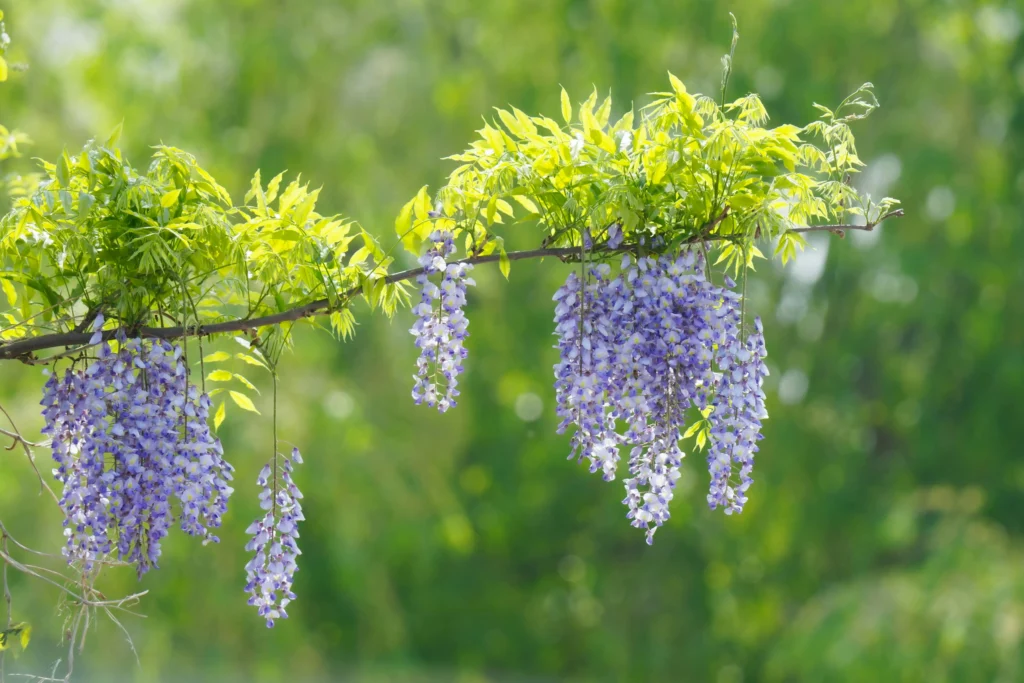
The Famous Spots: Ashikaga, Kawachi, and Kameido
Before we get into the hidden gems, here is a quick overview of the three most famous wisteria destinations. These are the spots you have likely seen on Instagram or CNN’s travel lists — and they are genuinely stunning, but expect serious crowds.
Ashikaga Flower Park (Tochigi)
Ashikaga is the undisputed king of wisteria in Japan. The 2026 Great Wisteria Festival runs from April 11 to May 20, with extended hours (7:00–21:00) during peak bloom and Golden Week. The park features a massive 160-year-old tree that covers a 600-tatami mat trellis, plus an 80-meter white wisteria tunnel. It was named one of CNN’s “Top 10 Dream Destinations” in 2014. The reality? It is spectacularly beautiful, but entry costs up to ¥2,300 during peak bloom, and the crowds during Golden Week can feel overwhelming.
Kawachi Fujien (Kitakyushu, Fukuoka)
Famous for its incredible gradient wisteria tunnels (110m and 80m long), this private garden requires advance timed-entry tickets (April 18 – May 6, 2026). Entry is ¥1,600 total (¥600 pre-paid + ¥500–1,000 on-site adjustment). Children under 18 enter free. It is a photographer’s dream, though tripods and drones are strictly prohibited.
Kameido Tenjin Shrine (Tokyo)
If you want to see wisteria without leaving Tokyo, this is the classic choice. The 2026 festival runs from April 5 to April 30. Over 50 wisteria vines drape over vermilion bridges, with Tokyo Skytree visible in the background. Entry is completely free. The artist Hiroshige immortalized this exact scene in his famous ukiyo-e woodblock prints during the Edo period.
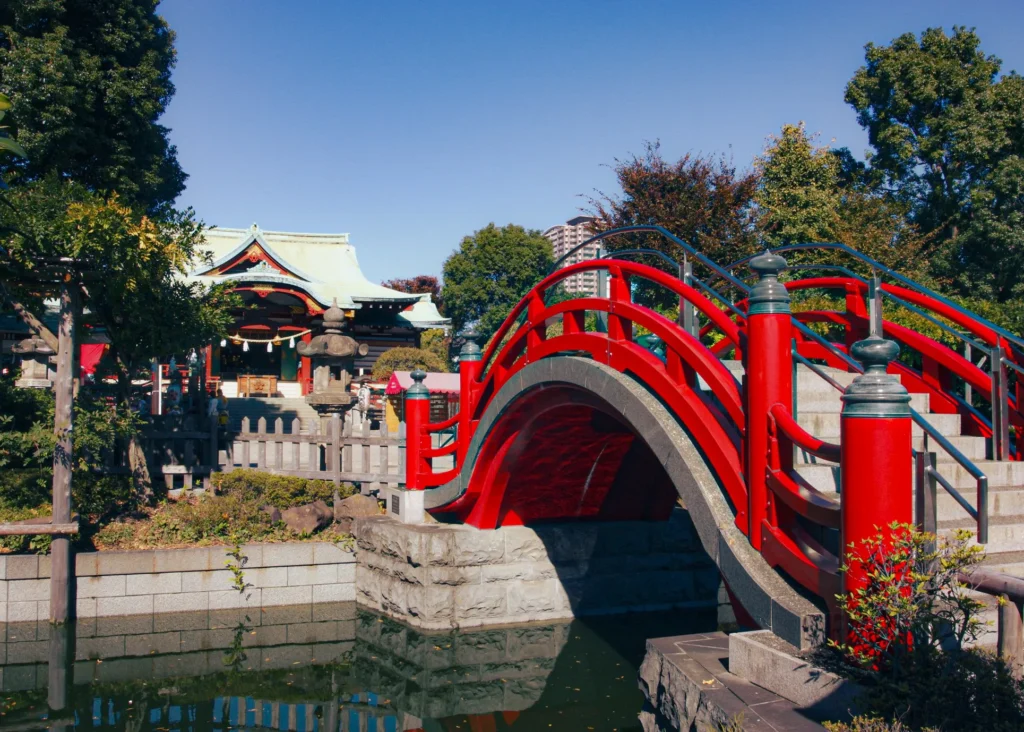
10 Hidden Wisteria Spots in Japan for 2026
While Ashikaga is stunning, the real magic happens when you find a spectacular wisteria trellis without the theme-park crowds. Here are 10 of my favorite lesser-known spots, grouped by region. Seven of these are completely free.
Hidden Spots Near Tokyo (Kanto Region)
1. Ushijima no Fuji (Saitama)
Just an hour from Tokyo, this intimate garden houses a designated Special Natural Monument: a wisteria tree over 1,200 years old. The cascades here can reach an astonishing 2 meters in length. It opens from April 11 to May 3, 2026 (8:00–17:00, ¥1,200 adults / ¥600 children). Access is a 10-minute walk from Fuji-no-Ushijima Station on the Tobu Urban Park Line. It offers a much more peaceful experience than Ashikaga despite being equally ancient.
2. Kokuryo Shrine — “Thousand-Year Wisteria” (Tokyo)
Known as the “Sennen no Fuji” (Thousand-Year Wisteria), this single massive tree covers nearly 4,000 square meters of trellis in a quiet Chofu neighborhood. The 2026 festival is April 18–19, and entry is completely free. It is a 5-minute walk from Fuda Station on the Keio Line. It makes an easy add-on if you are visiting Jindaiji Temple for soba noodles.
3. Kasama Inari Shrine (Ibaraki)
This is one of Japan’s three great Inari shrines and features two 400-year-old sacred wisteria trees designated as prefectural natural monuments. The best part? It blooms later than Tokyo (early to mid-May), making it a perfect post-Golden Week destination when the crowds have dispersed. Entry is free. It is a 20-minute walk from Kasama Station on the JR Mito Line. Consider combining it with a trip to the Nakaminato Fish Market for the freshest seafood in Ibaraki.
Hidden Spots in Central Japan (Chubu/Aichi)
4. Tennogawa Park (Tsushima, Aichi)
Easily accessible from Nagoya, this park features over 5,000 square meters of trellis — one of the largest in Japan — with 112 trees across 12 different varieties. The Maruike Pond creates stunning mirror reflections of the purple blooms, and a red bridge adds a perfect compositional element for photographers. The 2026 festival runs April 15–29, with night illuminations from 18:30 to 21:00. Entry is entirely free. It is a 15-minute walk from Tsushima Station (Meitetsu Line, 30 minutes from Nagoya).
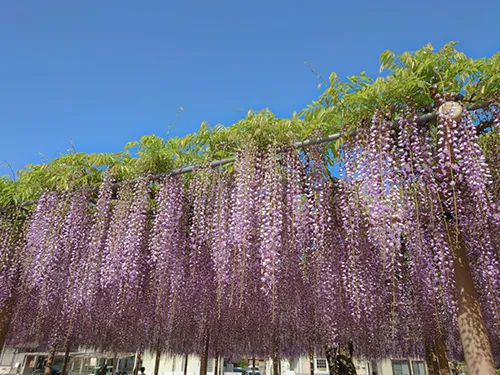
5. Mandaraji Park (Konan, Aichi)
Located next to the 14th-century Mandara-ji Temple, this free park boasts 60 trees of 12 different varieties (purple, red, and white). The 2026 festival runs from April 17 to May 3. The combination of ancient temple architecture and wisteria creates a deeply traditional atmosphere that feels worlds away from the commercial flower parks. It is a 10-minute bus ride from Konan Station on the Meitetsu Inuyama Line. Peony viewing runs concurrently, so you get two flower experiences in one visit.
Hidden Spots in Kansai (Kyoto, Osaka, Hyogo)
6. Shindachijuku Kajimoto Wisteria (Sennan, Osaka)
This is perhaps the most unique spot on the list: a private residence located on the historic Kumano Kodo pilgrimage route. A single tree produces roughly 40,000 flower clusters, and the homeowner has built an observation platform so visitors can view the blooms from above. It opens to the public for just one week per year (April 19–26, 2026) and is free to enter. It is an 8-minute walk from Izumi Sunagawa Station on the Nankai Line.
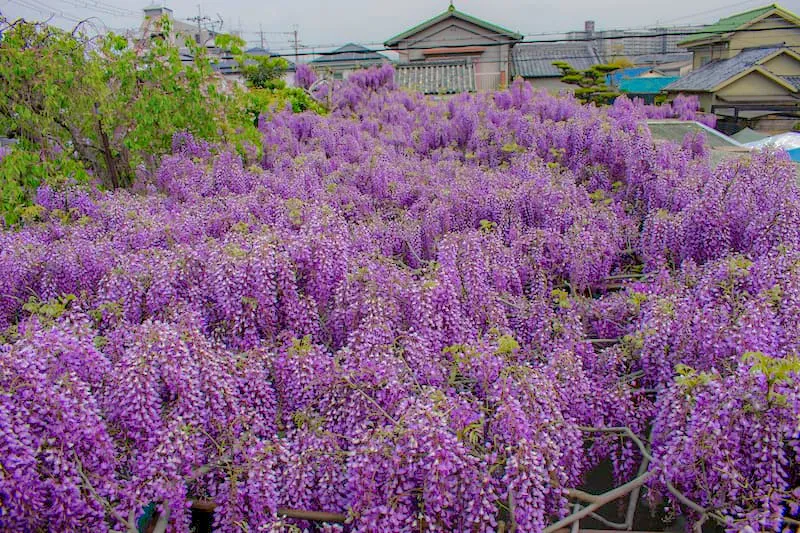
7. Toba Water Environment Center (Kyoto)
This is the most genuinely hidden spot on the entire list. It is a working water treatment facility in southern Kyoto that opens its doors for exactly three days a year (April 17–19, 2026). Inside, you will find a 120-meter wisteria pergola alongside 4,900 azaleas. A free shuttle runs from Takeda Station (Kintetsu/Subway, 10 minutes). Known locally as “Toba Fuji,” it is free to enter. For more off-the-beaten-path Kyoto experiences, see our complete Kyoto guide.
8. Byakugoji Temple (Tamba, Hyogo)
While gaining popularity, Byakugoji is still far less crowded than Kyoto’s famous temples. It is famous for its “Kyushaku Fuji” — the name literally means “nine-shaku wisteria,” referring to the extraordinary length of each cluster, which can reach 150 to 180cm. The 2026 festival runs April 27 to May 6 (¥300 entry), with illuminations until 21:00. The 120-meter trellis creates a purple canopy that is genuinely breathtaking.
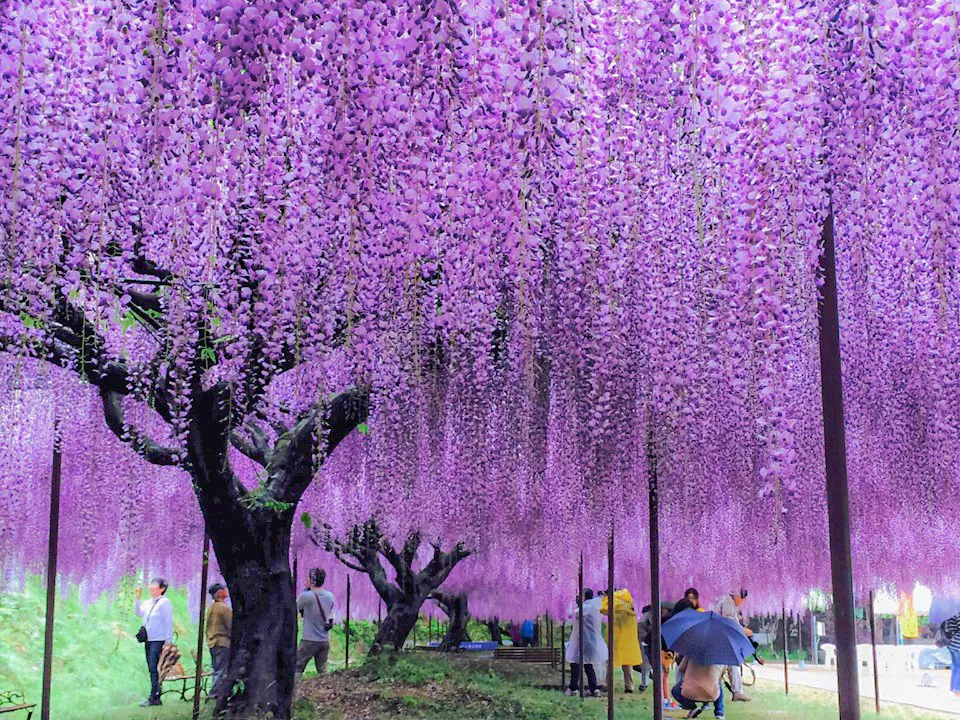
9. Otoshi Shrine (Shiso, Hyogo)
You will need a car to reach this deep mountain shrine (5 minutes from Yamasaki IC), but it is absolutely worth the effort. The 1,000-year-old tree here covers 420 square meters and is designated as one of Japan’s “100 Scent Landscapes” (Kaori Fukei 100-sen). The fragrance is legendary — you can smell it before you see it. Because there is virtually no tourism infrastructure, you might have the place entirely to yourself. Free entry.
Hidden Spot in Kyushu
10. Nakayama Kumano Shrine (Yanagawa, Fukuoka)
This 300-year-old wisteria tree in Yanagawa produces a stunning 1,700 square meters of bloom. A stone bridge creates a natural arch framed by cascading purple flowers. It blooms from mid to late April, making it one of the earliest spots on this list. Combine your visit with Yanagawa’s famous punting boat tours (kawakudari) through the city’s canal network — it is one of the most charming day trips in Kyushu. Entry to the shrine grounds is free.
Wisteria Varieties: What You Will See
Not all wisteria looks the same. Understanding the two main types will help you appreciate what you are seeing at each location.
| Type | Scientific Name | Vine Direction | Cluster Length | Where to See |
| Noda Fuji (野田藤) | W. floribunda | Left-twining | 30–60cm (up to 1m+) | Ashikaga, Byakugoji, most parks |
| Yama Fuji (山藤) | W. brachybotrys | Right-twining | 10–20cm | Mountain shrines, wild settings |
Beyond the classic purple, look for white wisteria (Ashikaga’s 80m tunnel), pink varieties, the rare “Lipstick Wisteria” (kuchibeni fuji) with pink-tipped petals, and the extraordinary Double-flower Black Dragon (yae kokuryū) with dense, dark purple clusters.
Wisteria Food and Seasonal Sweets
No Japanese flower festival is complete without themed food. When visiting these spots, keep an eye out for these seasonal treats.
Fuji Soft Cream is a pale purple, wisteria-flavored soft serve ice cream available at Ashikaga Flower Park (¥500) and several other festival venues. It has a delicate floral taste — subtle rather than overpowering — and is incredibly photogenic.
Fuji Dango by Kiyome Mochi Honten in Nagoya features five colored mochi rings designed to look like wisteria clusters. Each color represents a different flavor.
Fuji no Hana Higashi by Hougetsu-do in Kagawa is a wasanbon sugar confection shaped like wisteria blossoms (approximately ¥110 each). These make excellent souvenirs.
For the highest-end option, look for fuji nerikiri — upper-grade wagashi (traditional Japanese sweets) sculpted into wisteria form, often served with matcha at temple tea houses near the viewing spots.

Practical Tips for Wisteria Viewing in Japan
Best time of day:
Early morning (7:00–9:00) offers the softest light and fewest crowds. Golden hour (16:00–18:00) is ideal for warm-toned photography. Night illuminations (typically 18:30–21:00) create a completely different, almost magical atmosphere.
Best weather:
Overcast skies are actually ideal for wisteria photography — no harsh shadows, and the purple tones appear richer and more true-to-life. After rain, the glistening petals are especially beautiful.
What to wear:
Comfortable walking shoes are essential. Many wisteria spots involve gravel paths or uneven temple grounds. In late April, temperatures in central Japan are typically 15–22°C (59–72°F). If you are arriving from Southeast Asia — where temperatures average 28–32°C — bring a light jacket. Early mornings and evenings can feel cool.
Payment:
Most major parks (Ashikaga, Kawachi) accept credit cards and IC cards. However, smaller shrines and temple grounds are cash-only. Carry at least ¥3,000 in coins and small bills.
Halal and dietary options:
At larger festival venues, food stalls are generally not halal-certified. Your best option is to pick up onigiri, sandwiches, or bento from a nearby convenience store (7-Eleven, FamilyMart, Lawson) before visiting. Vegetarian options at festival stalls are limited but available — look for yakisoba (confirm no meat), dango, and taiyaki.
Photography Tips for Wisteria
Recommended angles: Shoot from below looking up through the cascades (wide-angle 16–35mm works best). For tunnels, position yourself at the entrance and shoot straight through for maximum depth. At spots with ponds (Tennogawa Park, Kameido Tenjin), capture the mirror reflections.
Tripods: Prohibited at Kawachi Fujien. Generally allowed at other spots, but be considerate of other visitors during peak times.
How to Plan a Multi-Spot Wisteria Trip
The Shinkansen network makes it possible to visit wisteria spots across multiple regions in a single trip. Here is a suggested 5-day route:
Day 1: Tokyo → Kameido Tenjin (free, morning) → Kokuryo Shrine (free, afternoon)
Day 2: Tokyo → Ushijima no Fuji (Saitama, half day) → return to Tokyo
Day 3: Shinkansen to Nagoya → Tennogawa Park (free, afternoon/evening illumination)
Day 4: Nagoya → Shinkansen to Shin-Kobe → Byakugoji Temple (Hyogo, afternoon/evening illumination)
Day 5: Kyoto → Toba Water Center (if open) or Byodoin Temple (Uji)
Klook.com
A JR Pass is highly recommended if you plan to visit three or more regions. The 7-day pass pays for itself with just one Tokyo–Nagoya–Kyoto round trip.
For travelers from Southeast Asia: Direct flights to Tokyo (Narita/Haneda) and Osaka (Kansai) are available from Singapore (Scoot, ANA), Bangkok (AirAsia X, Thai Airways), Kuala Lumpur (AirAsia X, MAS), and Jakarta (Garuda, AirAsia X). Budget carriers often have sales in January–February for April–May travel. If you are arriving at Kansai Airport, the Kansai-region hidden spots (Shindachijuku, Toba, Byakugoji) are all within 1–2 hours.
Strategic FAQ Section
Q: When do wisteria bloom in Japan?
Wisteria typically blooms right after the cherry blossoms fade. The season starts in mid-April in Kyushu and moves north, reaching Tokyo by late April and Hokkaido by late May. In 2026, the bloom is predicted to be 3–5 days earlier than average due to a warmer winter.
Q: Where can I see wisteria in Japan besides Ashikaga?
There are incredible hidden spots nationwide. Near Tokyo, visit the 1,200-year-old tree at Ushijima no Fuji in Saitama. In Aichi, Tennogawa Park offers over 5,000 square meters of free trellises. In Kansai, Byakugoji Temple in Hyogo and the Shindachijuku private residence in Osaka are spectacular alternatives with far fewer crowds.
Q: What is the best time to see wisteria in Japan 2026?
For the Kanto (Tokyo) and Kansai (Kyoto/Osaka) regions, the absolute best window in 2026 will be from April 20 to May 5. If you arrive later in May, head north to Tohoku or visit later-blooming spots like Kasama Inari Shrine in Ibaraki, which peaks in early to mid-May.
Q: Are there any free wisteria gardens in Japan?
Yes, many stunning locations are completely free. Tennogawa Park (Aichi), Kokuryo Shrine (Tokyo), Kameido Tenjin Shrine (Tokyo), Shindachijuku (Osaka), Mandaraji Park (Aichi), Kasama Inari Shrine (Ibaraki), and the Toba Water Environment Center (Kyoto) all offer incredible wisteria viewing without an admission fee.
Q: Can I see wisteria during Golden Week in Japan?
Yes, Golden Week (late April to early May) perfectly aligns with peak wisteria bloom in central Japan. However, famous spots like Ashikaga Flower Park will be extremely crowded. Visit lesser-known spots or arrive right at opening time. For a full guide to navigating Japan’s busiest holiday, see our Golden Week survival guide.
Q: What is the difference between wisteria and cherry blossoms in Japan?
Cherry blossoms (sakura) peak in late March to mid-April and last about one week per location. Wisteria (fuji) follows immediately after, peaking from mid-April to mid-May, and individual blooms last 10–14 days — giving you a longer viewing window. While sakura is pale pink and grows on trees, wisteria is purple (or white/pink) and cascades downward from trellises, creating dramatic curtain-like displays.
Conclusion: Extend Your Spring Trip for Wisteria
If you are coming to Japan for the cherry blossoms, consider extending your trip by a week or two. The wisteria season offers a completely different experience — deeply fragrant, richly purple, and far less crowded than sakura season at the hidden spots listed here. The Fuji Shibazakura Festival near Mt. Fuji runs during the same period, making it easy to combine pink moss phlox and purple wisteria in a single trip.
Start with the free spots. Kameido Tenjin in Tokyo, Tennogawa Park in Aichi, and Shindachijuku in Osaka cost nothing and deliver experiences that rival the famous parks. If you only have time for one hidden spot, make it Byakugoji Temple — the 180cm cascades of the kyushaku fuji are something you will remember for years.
Sources checked
•Ashikaga Flower Park Official 2026: https://www.ashikaga.co.jp/fujinohana_special2026/en/
•Kawachi Fujien via TravelClassroom
•Rakuten Travel Wisteria 2026
•MATCHA Wisteria Guide
•Moocota 2026 Forecast
•Nagoya Is Not Boring — Aichi Wisteria Spots

- Minobusan Kuonji 2026: A 750-Year-Old Temple with Japan’s Best Weeping Cherry Trees
 2026 Update: Morning prayer is now held at a fixed time of 5:30 AM year-round (previously varied by season). The five-story pagoda, reconstructed in 2009, remains one of the most photographed structures on the grounds. If you are looking for a genuine spiritual experience in Japan — far from the crowds of Kyoto — you… Read more: Minobusan Kuonji 2026: A 750-Year-Old Temple with Japan’s Best Weeping Cherry Trees
 - Wisteria in Japan 2026: 10 Stunning Spots Beyond Ashikaga [With Map]Wisteria (fuji in Japanese) blooms right after cherry blossoms fade — making it the perfect reason to extend a spring trip to Japan. While most international visitors flock to the famous Ashikaga Flower Park, the reality is that late April and early May bring incredible purple cascades to gardens, shrines, and hidden temples all across… Read more: Wisteria in Japan 2026: 10 Stunning Spots Beyond Ashikaga [With Map]
- Golden Week Japan 2026: What’s Open, Closed & How to Survive
 Golden Week is one of only three periods each year — alongside New Year and Obon — when much of Japan goes on vacation at the same time. If you’re planning a trip to Japan in late April or early May 2026, you’re about to step into the country’s biggest national holiday. I’ve navigated Golden… Read more: Golden Week Japan 2026: What’s Open, Closed & How to Survive
 - 7 Days in Kansai: A Journey Beyond Kyoto to Hidden Temples & Sacred Trails
 As the founder of hiddenjapan-gems.com, I’ve walked countless temple paths and hiked ancient trails across Japan. While Kyoto’s golden pavilions and bamboo forests are undeniably captivating, I’ve always been drawn to the quieter, more profound spiritual energy found just beyond the well-trodden tourist routes. This 7-day Kansai itinerary is born from that passion. It’s a… Read more: 7 Days in Kansai: A Journey Beyond Kyoto to Hidden Temples & Sacred Trails
 - Japan Sakura Forecast 2026: Latest Cherry Blossom Dates for Tokyo, Kyoto & More
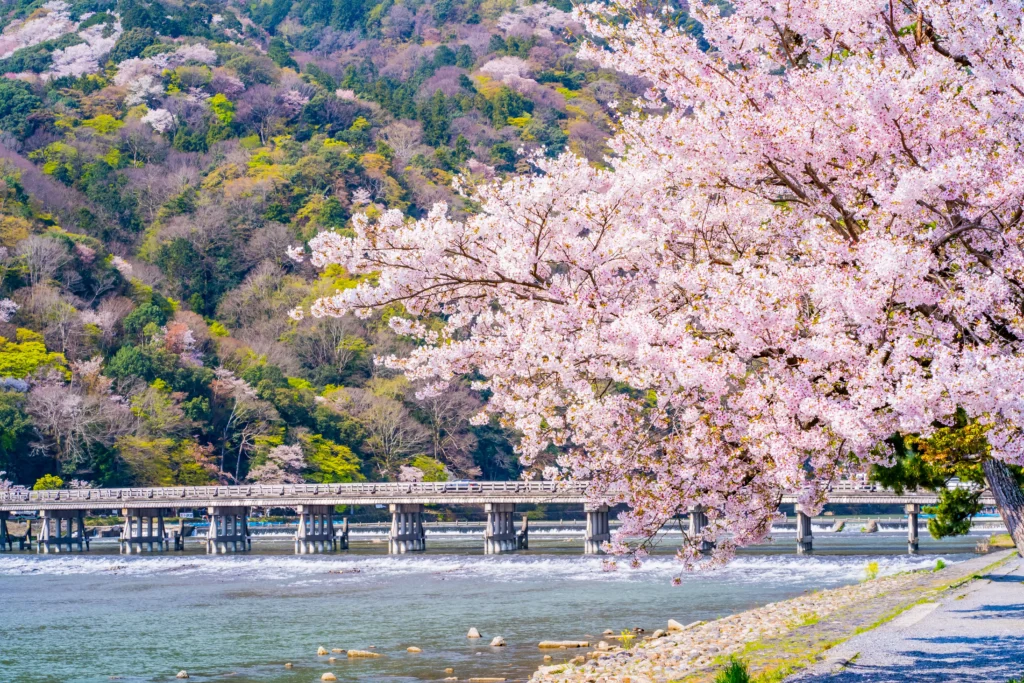 Planning a trip to Japan to witness the magical cherry blossom season is a dream for many. But timing is everything. The blossoms, or sakura, grace the country for only a fleeting few weeks, moving northward in a delicate wave. To help you plan the perfect trip, you need a reliable forecast. As the founder… Read more: Japan Sakura Forecast 2026: Latest Cherry Blossom Dates for Tokyo, Kyoto & More
cherry blossom cherry blossoms day trip from tokyo flower festival fuji five lakes fujiyoshida Fukuoka fushimi hanami hiking japan japanese culture japanese food japanese garden japan travel kamakura kawagoe kawaguchiko Kumamoto kyoto local food Mount Fuji mt fuji Nagano nature Nikko Oku-Nikko Onsen Ramen Saga saitama sakura Shizuoka shrine sightseeing snow spring in japan Tochigi Tokyo travel travel guide travel planning winter winter travel Yamanashi
![Kitain Temple Kawagoe 2026: Edo Castle Rooms & 538 Rakan [With Map]](https://hiddenjapan-gems.com/wp-content/uploads/2026/04/DSC4602-768x432.webp)