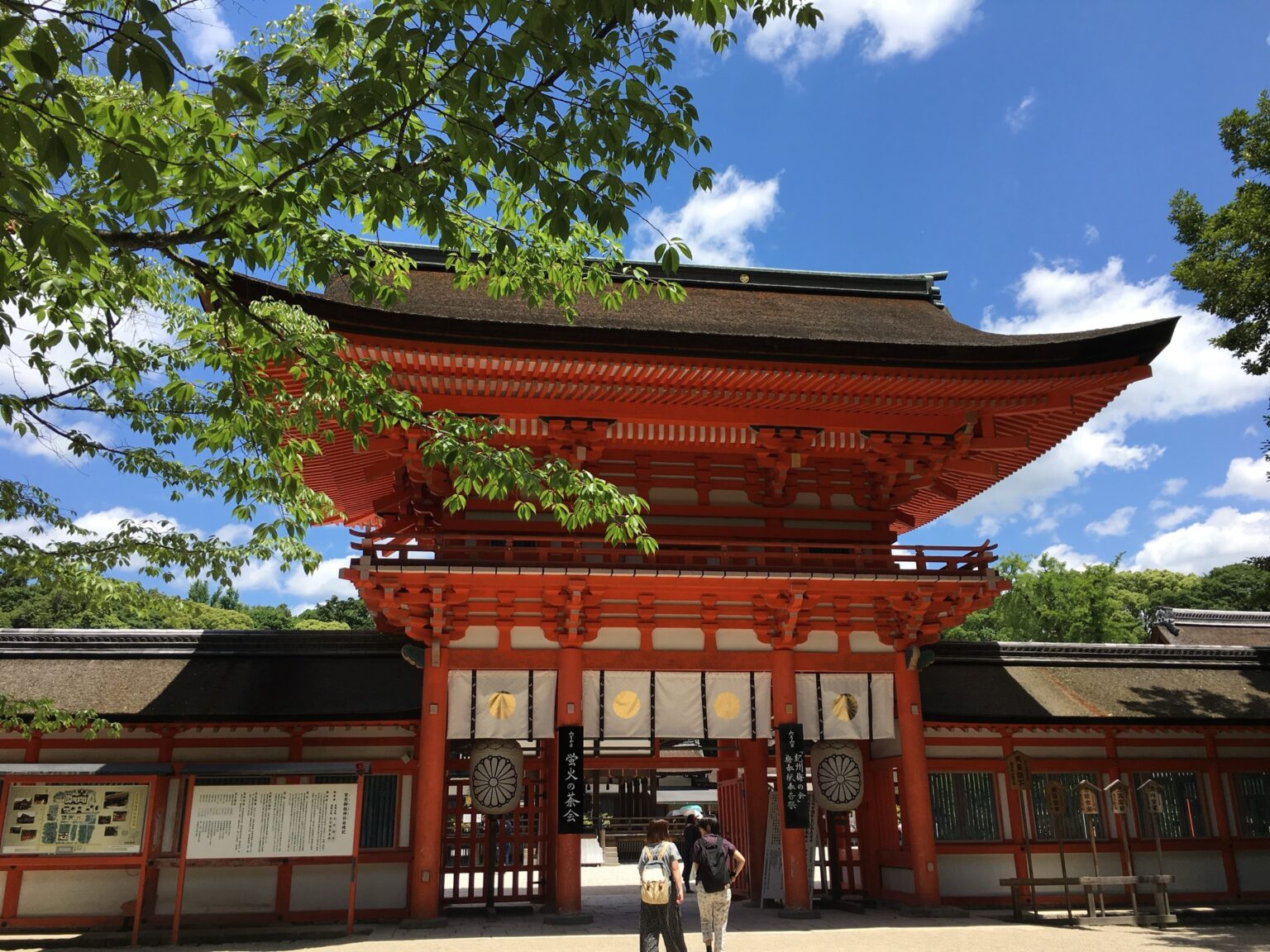
Shimogamo Shrine — formally Kamomioya Jinja — sits inside a 124,000 m² primeval forest called Tadasu no Mori, one of the few patches of Kyoto’s original woodland preserved in the modern city. The two main pavilions and the vermillion Romon gate were rebuilt in 1601, but the shrine itself is recorded in 8th-century chronicles and likely much older. UNESCO World Heritage 1994. Best visited in June, when the forest canopy is its fullest green just before the rainy season closes in.
Last updated: 2026-05-28 · Visited June 2024 · Author: Nobutoshi (Kyoto-based)
Quick facts
- Formal name
- 賀茂御祖神社 (Kamomioya Jinja)
- UNESCO listing
- 1994 (Historic Monuments of Ancient Kyoto)
- Forest area
- 124,000 m² (Tadasu no Mori 糺の森)
- Romon gate
- Rebuilt 1601, Important Cultural Property
- Open
- 06:30 – 17:00 (free entry to grounds)
- Best season
- June — canopy peak, before tsuyu
- Access
- Keihan “Demachiyanagi” station, 12 min walk
- Closest food
- Mitarashi dango — invented here, sold beside the shrine
The June visit — why I came back to this shrine
June is the right month at Shimogamo because the Tadasu no Mori canopy reaches its peak green just before the tsuyu rainy season closes the forest in — and crowds are far lighter than the May Aoi Matsuri or November koyo windows.
I had been to Shimogamo Shrine three times before, but never in June. The first two times were in the dead heat of August (a mistake — Kyoto in August is a sauna), and the third was the Aoi Matsuri procession in May, which is spectacular but draws so many people that the shrine itself becomes the backdrop, not the experience.
The June visit fixed all of that. Mid-afternoon on a weekday, I walked into Tadasu no Mori from the southern entrance. The forest is mostly hardwood — keyaki, mukunoki, enoki — and in June the leaves are still soft and pale, still expanding. The light coming through is filtered green, and the temperature drops three or four degrees the moment you step under the canopy. The gravel path is maybe four metres wide and runs about 500 metres to the main shrine. You walk it for ten minutes. By the time you reach the Romon, you’ve forgotten you’re in central Kyoto.
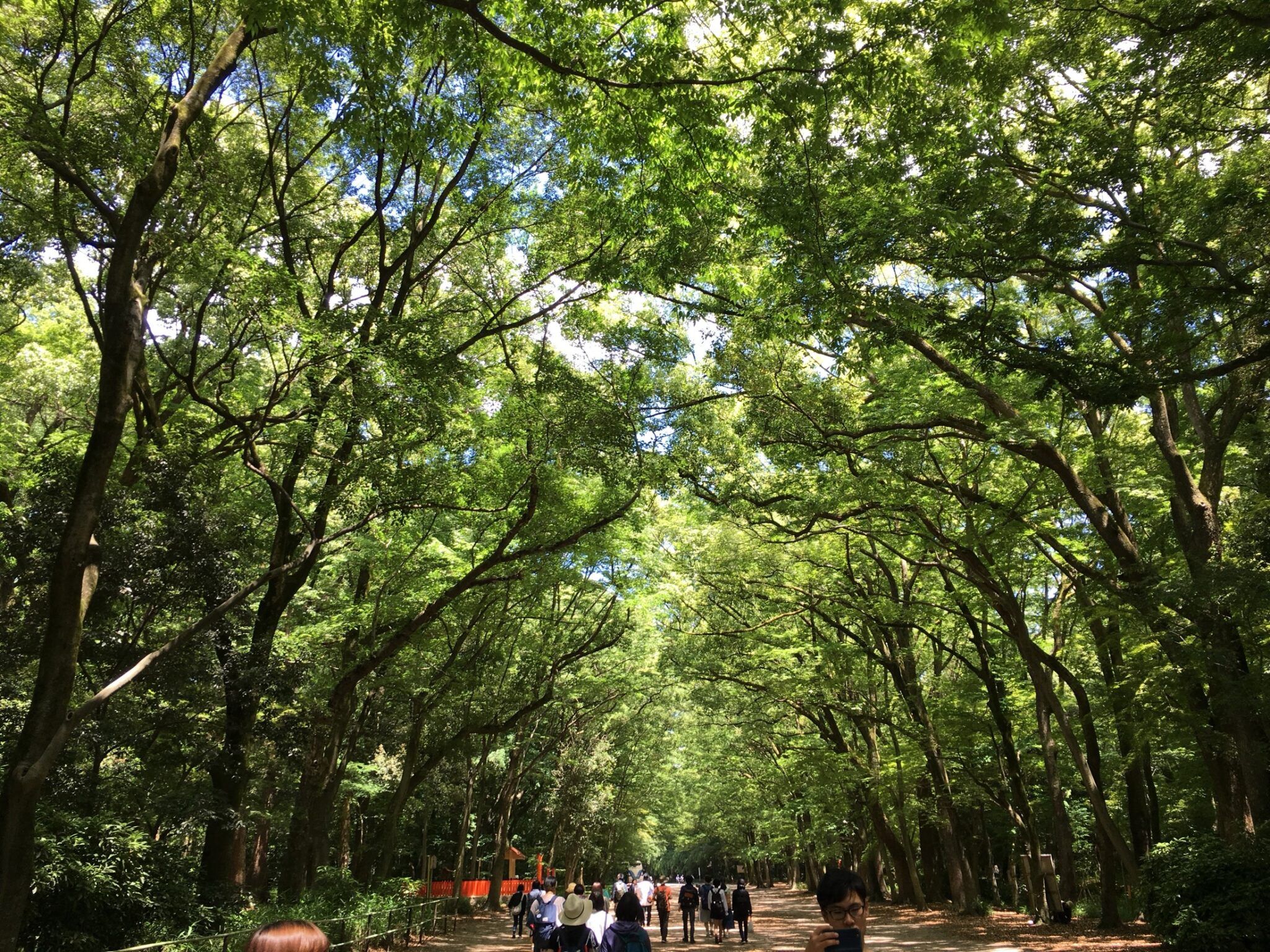
What’s on the grounds — a map in words
The Shimogamo grounds run in a single line of seven landmarks along a 500 m gravel approach path that crosses Tadasu no Mori from the southern torii to the inner Honden. Walking it slowly takes about an hour.
The shrine layout is straightforward once you know what’s where. From the southern entrance walking north toward the main shrine, the points of interest are these:
Walking order — south entrance to main shrine
The full walk including all stops takes about an hour. If you skip the side shrines and just visit the Romon and Honden, 30 minutes is enough.
Mitarashi dango — invented here
Mitarashi dango — the grilled rice dumplings glazed with sweet soy that you find at every Japanese sweet shop — was invented at Shimogamo. The five-dumpling shape mimics the bubbles rising from the Mitarashi pond next to the inner shrine.
One detail that gets glossed over in shrine guides: mitarashi dango, the grilled sweet-soy-glazed rice dumplings sold across Japan, were invented at Shimogamo. The story is that the bubbles rising from the Mitarashi pond inspired the shape — five dumplings on a stick, four close together and one pulled slightly apart, mimicking the bubbles rising in a sequence.
Whether the legend is literal or apocryphal, the dumplings are sold at a shop called Kamo Mitarashi Chaya a five-minute walk from the south entrance of the shrine — the same recipe, made by the same family since 1922. Three sticks costs around ¥500. Eat them sitting on the bench outside before going into the forest, or after coming out. They are noticeably less sweet than the supermarket version because the glaze is still made by hand. (Shimogamo’s slow, forest-immersive pacing is also one of the better picks for the calmcation approach to Japan — quiet places, no rush, no hit-list itinerary.)
Shimogamo vs Kamigamo — the sister shrines
If you only have time for one Kamo shrine, choose Shimogamo. The forest approach is the differentiator. Kamigamo is open and river-side; Shimogamo is canopy-immersive. They share a parent deity and a UNESCO listing, but the experiences are not interchangeable.
Most travel guides treat the two Kamo shrines as a pair, which is technically right but practically misleading. They share a parent deity (Kamotaketsunumi-no-mikoto), they were once a single religious organisation, and they’re both UNESCO listed. But the experience of visiting them is quite different.
Which Kamo shrine should you visit?
Set inside a 124,000 m² forest. Approach is the experience — the 500 m gravel path under the canopy is what brings most visitors back. UNESCO. National Treasure honden. 12 min walk from Demachiyanagi station. Best in June.
4 km north. Open river-side setting with the Nara-no-Ogawa stream running through the grounds. Famous for its sand cones (tatesuna) and the older Aoi Matsuri tradition. Less canopy, more open sky. Best on a summer afternoon when the river is in shade.
If you only have time for one, go to Shimogamo. The forest is the differentiator. If you have a full day, walk between them along the Kamogawa river — 4 km, about an hour at a normal pace, lined with cafes. For a different kind of Kyoto shrine experience that complements Shimogamo’s forest, the rock-garden quiet of Ryoanji on the west side of the city makes a good pair for a single day.
When to visit — seasonal table
| Month | What’s happening | Crowd level | Verdict |
|---|---|---|---|
| Jan – Feb | Hatsumode (Jan 1-3) is huge; Feb is quiet and cold | Jan 1-3 extreme · rest quiet | Quiet Feb is underrated |
| Mar – Apr | Cherry blossoms inside Tadasu no Mori | Moderate | Good — sakura without the Maruyama crowds |
| May 15 | Aoi Matsuri — Heian-period procession | Extreme on procession day | Go for the procession or avoid May 15 entirely |
| June | Canopy peak, kakitsubata iris near the pond, no crowds | Light | Best — what this article is about |
| July | Mitarashi-sai festival around July 20 | Moderate on festival nights | Festival is worth seeing, otherwise hot |
| Aug | Hot and humid; canopy gives shade but base temp is brutal | Light (no one wants to be here) | Skip — Kyoto August is the wrong time anywhere |
| Sep – Oct | Cool air returns; forest still fully green | Light | Excellent — second-best window after June |
| Nov | Koyo (autumn colour) in Tadasu no Mori mid-late November | Heavy on weekends | Peak photo season; come on a weekday |
| Dec | Bare branches, quiet, cold; first plum blossom late Dec | Quiet | Atmospheric; bring a coat |
How to get there — three routes from Kyoto Station
Shimogamo Shrine (Kamomioya Jinja) — drop a pin from any Kyoto base. The south entrance to Tadasu no Mori is on the lower edge of the marked area.
| Route | Steps | Time | Cost |
|---|---|---|---|
| Bus 4 or 205 | Kyoto Stn → Shimogamo-jinja-mae | ~30 min | ¥230 |
| Train + walk | JR Nara Line to Tofukuji → Keihan to Demachiyanagi → 12 min walk | ~35 min | ¥420 |
| Cab | Direct | ~15 min (no traffic) | ¥1,600 – 2,200 |
The bus is cheapest but Kyoto’s buses sit in traffic, especially after 10 AM. The train route is more reliable and lets you walk through Demachiyanagi (a pleasant local neighbourhood with old cafes and the famous Demachi Futaba sweets shop). A cab from Kyoto Station is the right call if you have luggage or are short on time. If you’re using Kyoto Station as a base for the day, the 15 destinations under 90 minutes guide covers the access patterns for combining Shimogamo with Higashiyama, Arashiyama, or Lake Biwa.
Photography & etiquette inside the shrine
Six things to know before you photograph
- Photographs of the Romon and the courtyard are fine. Most visitors photograph the gate from the front.
- No photographs past the inner gate behind the Maidono. The Honden area is restricted; signs are clear.
- No tripods or large camera rigs on weekends or festival days — staff will ask you to put them away.
- Bow at the torii. Both entering and leaving the precinct. A small bow is enough; you’ll see Japanese visitors do it.
- Wash at the temizuya before the Romon. Left hand, right hand, mouth (with water in left hand), then left hand again. Then bow.
- The two coins, two bows, two claps, one bow ritual is for the Honden. At the small Kotosha you can simplify to one bow, two claps, one bow.
Tips for visitors from Singapore, Bangkok, KL & Jakarta
Practical notes for SEA travellers
Most direct flights to Kansai International (KIX) put you a 75-minute Haruka express ride from Kyoto Station. The Shimogamo visit fits any of the standard 5–7 day Japan itineraries.
- From SIN/KUL/BKK/CGK: Scoot, AirAsia X, Jetstar Asia, Cebu Pacific, JAL/SQ run direct KIX flights. KIX → Kyoto Station: 75 min via JR Haruka Limited Express (¥3,440 with IC card).
- Halal & vegetarian: Akafuku and Demachi Futaba sweets are vegetarian (red bean + mochi, no animal products). Demachiyanagi-area cafes around the station are increasingly halal-aware; ask before ordering noodles, as dashi often contains bonito.
- Climate vs SEA: June Kyoto averages 23-26°C, 80% humidity — almost identical to a Singapore afternoon. Pack a small umbrella, the tsuyu rain can be sudden. February-March (5-10°C) is much colder than anywhere in SEA — pack a coat.
- Cash: Shimogamo grounds are free. The dango shop and many Demachiyanagi cafes are cash-only. Carry ¥10,000 minimum for the day.
- Prayer / wudu: Kyoto Station has prayer rooms on the 8F (north building). Plan ahead — no wudu facilities at the shrine itself.
FAQ
How long does a Shimogamo visit take?
Allow about 90 minutes from arriving at the south entrance to leaving from the same point — that includes walking in through Tadasu no Mori, visiting the Honden, finding your zodiac at the Kotosha, and walking back. If you want to also stop for mitarashi dango or sit in the forest for a while, plan two hours.
Is Shimogamo Shrine free?
Yes. Entry to the grounds, the forest, and the main courtyard is free. The Honden interior (visible briefly during shoki-tairei special viewings) has a small fee when open. Special exhibitions inside the treasure hall cost around ¥500.
Can you walk to Kamigamo Shrine from Shimogamo?
Yes. The walk along the Kamogawa river from Shimogamo to Kamigamo is about 4 km and takes about an hour at a normal pace. It’s pleasant in all seasons except August (heat) and February (cold wind off the river). You’ll pass several Demachiyanagi-area cafes and the old Aoi-no-Mori grove.
When is the Aoi Matsuri?
May 15 every year. The procession leaves the Imperial Palace at 10:30, reaches Shimogamo Shrine at 11:40, and arrives at Kamigamo Shrine at around 15:30. The participants wear Heian-period costumes — about 500 people in total — and the whole event is one of the three great festivals of Kyoto. If you go, claim a spot along the procession route by 10:00; viewing inside the shrine is paid reserved seating.
What is the Mitarashi-sai festival?
A summer purification ritual held around the doyo-no-ushi (土用の丑) day in July — the specific date shifts year to year and is announced by the shrine in late spring; check the official site for current-year dates. Visitors walk barefoot through the cold mitarashi pond carrying a candle. The water is sacred spring water from the same source that legend credits with inspiring mitarashi dango. The atmosphere is unlike anything else in Kyoto.
Where do I find the mitarashi dango shop?
Kamo Mitarashi Chaya — five-minute walk south of the shrine’s south entrance, on Mikage-dori. Address: 53 Sakurabashi Higashi-iru, Shimogamo. Open 09:30 – 18:00, closed Wednesdays. Three sticks for about ¥500. They also sell a take-home box if you want to bring some back to your hotel.
Sources used for this article
- Shimogamo Shrine official site — shimogamo-jinja.or.jp
- UNESCO “Historic Monuments of Ancient Kyoto” (1994 listing)
- Kyoto City Tourism Association — kyoto.travel
- Kamo Mitarashi Chaya — confirmed in person on the June visit (photographs in this article)
- Personal observation, June 2024 visit
Plan a Kyoto stay around the visit
Three booking paths for the Demachiyanagi / Shimogamo area:
Join travelers discovering Japan's hidden side
Weekly dispatches from off-the-beaten-path Japan — spots and stories you won't find in guidebooks.
No spam. Unsubscribe anytime.
Welcome aboard!
You're in. See you in your inbox soon.