

Tanegashima is the only inhabited island in Japan where you can stand on the beach where Portuguese sailors landed in 1543 — delivering the matchlock firearms that ended Japan’s Sengoku era — and an hour’s drive south, watch JAXA prepare an H3 rocket for orbit. The next launch is June 10, 2026, 09:53 JST. If you can time a Kagoshima trip around it, this is the island to fly to instead of Yakushima.
The first time I came down here I made the same mistake most first-time visitors make. I flew into Tanegashima Airport, drove ten minutes to the rental car counter, then pointed south and assumed I’d be at the Space Center in twenty minutes. The island is eighty-six kilometers long. The airport sits roughly in the middle. The Space Center is on the southern tip. From the airport, you are about fifty minutes of two-lane road from the launch complex, and ninety minutes from the matchlock museum in the opposite direction. Plan the drive before you plan the lunch.
| Why come | Two reasons: the 1543 musket museum and the only operational orbital launch site in Japan. Same small island, opposite ends. |
|---|---|
| Best timing | Around a confirmed JAXA launch. As of May 2026: H3 F6 on June 10; HTV-X2 in July; MMX (Mars moons probe) in Nov–Dec. |
| Length of stay | 2 days minimum if you want both ends of the island. 1 day works only if you skip the museum. |
| Access | JAL Kagoshima → Tanegashima (~35 min, ~¥15,000 round trip) or Toppy/Rocket jetfoil from Kagoshima Port (1h35m, ¥8,800 one-way). |
| Car rental | Essential. No useful train; community bus runs ~3 times/day on most routes. |
| When to skip | Launch delay periods. The Space Center closes, viewing parks empty out, and the bus tour pauses without notice. |
How a misplaced Chinese junk in 1543 ended the Sengoku era
On the 25th day of the 8th month of Tenbun 12 — late September 1543 by the Gregorian calendar — a Chinese trading junk with three Portuguese aboard ran into bad weather and beached at Kadokura Cape (門倉岬), the southernmost point of Tanegashima. It is not in Nishinoomote, where the museum sits today. It is sixty kilometers further south, on a windswept headland that still has nothing on it but a monument, a small shrine, and an observation deck shaped like a Portuguese galleon. If you drive there now, you can stand on the cliff where the boat came in and see no other people for an hour.
The lord of the island, Tanegashima Tokitaka (種子島時尭), was fifteen years old. He bought two of the matchlocks the Portuguese carried and ordered the village swordsmith, Yaita Kinbei, to copy them. The story most Japanese textbooks tell — that Tokitaka paid 2,000 ryō in gold — is almost certainly a Meiji-era embellishment. The primary historical source, the Teppōki compiled in 1606, just says the price was “high and difficult to meet.” Mendes Pinto’s Peregrinação records the figure as 1,000 taels of silver. Neither equals 2,000 ryō. I include the legend in this article because every museum panel still mentions it, but you should know it is legend.
What is not legend is what came next. Yaita could copy the barrel, the trigger, and the matchcord mechanism. He could not solve the screw at the breech end — the obisen-neji — that seals the back of the barrel so the gunpowder doesn’t blow back into the shooter’s face. The technique was unknown in Japan. He spent a year stuck on it. The Portuguese came back in 1544 and a gunsmith showed him how to cut a male and female thread on a hand-forged iron core. Within two years of that visit, merchants in Sakai and warrior-monks at Negoro-ji in Kii were producing matchlocks at scale. By the Battle of Nagashino in 1575, Oda Nobunaga fielded a reported three thousand of them and erased a famed cavalry charge in an afternoon. The Sengoku Era effectively ended on a Tanegashima beach thirty years earlier than the textbooks date it.
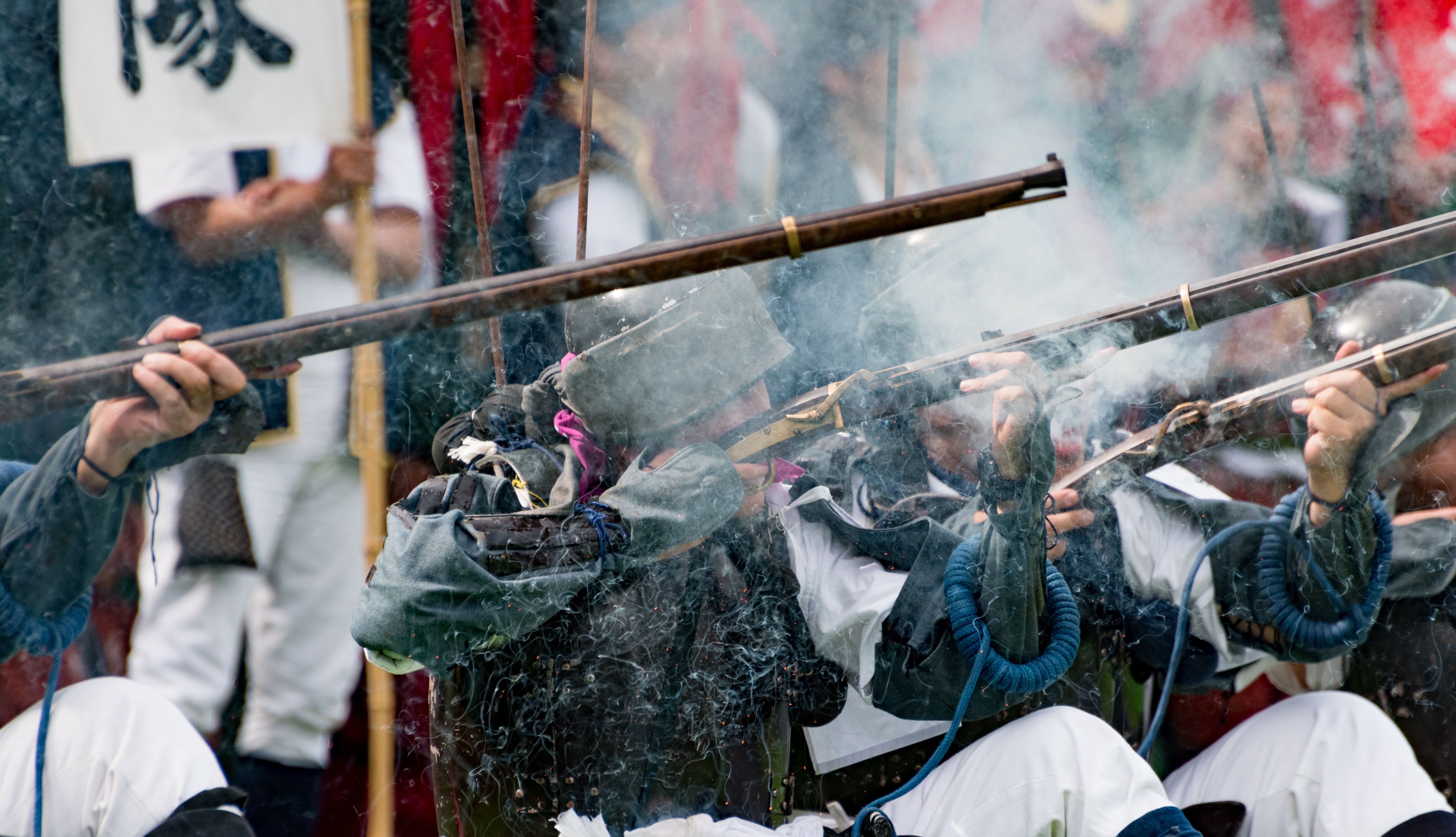
The Tanegashima Teppō-Tai (火縄銃保存会) firing in formation. The sound is louder than any modern firearm I have heard — closer to a small artillery piece than a rifle.
I have watched the Tanegashima Teppō-Tai (火縄銃保存会) fire in formation twice. Both times I stood about thirty meters from the line. Both times my ears rang for ninety minutes after, even with foam plugs. A modern centerfire rifle gives you a sharp crack. A line of matchlocks firing in unison gives you a low, full-body slam, followed by the smell of black powder for about a minute. The reenactors load real powder; only the projectile is omitted. They wear white robes with crimson trim and the same simple hachimaki the original militiamen wore. If your trip lands on a demonstration day, do not skip it.
What’s actually inside the Matchlock Museum (鉄砲館)
The Tanegashima Matchlock Museum — formally the Tanegashima Development Cultural Center (種子島開発総合センター) — sits in Nishinoomote at the north end of the island, a fifteen-minute drive from the high-speed ferry port. The building is shaped like a Portuguese galleon; you can’t miss it. Inside, about one hundred antique firearms are arranged across the main hall, alongside dioramas of the 1543 landing, fragments of original gunpowder horns, and the surviving documents that establish the dates.
| Address | 鹿児島県西之表市西之表7585 |
|---|---|
| Hours | 8:30 – 17:00 (last admission 16:30) |
| Closed | 25th of each month (except July, August, Sundays); Dec 30 – Jan 2 |
| Admission | Adult ¥440 · High school ¥280 · Elementary/JHS ¥140 · Preschool free |
| Phone | 0997-23-3215 |
| From port/airport | Nishinoomote Port ~15 min by car · Tanegashima Airport ~30 min by car |
Two things to manage your expectations on. First, the museum often describes its headline pieces as “the original 1543 matchlocks.” Some scholarship treats these as Tokitaka-era guns from the 1540s–50s rather than confirmed examples from the day of the landing. The provenance is debated. Second, photography rules vary by gallery — the front desk will tell you which cases allow it. English signage exists but is thin; a translation app helps for the document fragments.
The popular story is that Yaita Kinbei’s daughter Wakasa “traded marriage with a Portuguese gunsmith for the screw secret.” The single piece of contemporary documentation is the Yaita family genealogy, which records that she married a man called Mural Shukusha (a transliteration of Francisco) in the eighth month of 1543, sailed abroad with him, returned a year later on a Portuguese ship, and died of illness shortly afterward. The “marriage-for-the-screw” framing is oral tradition added later. Both versions appear on Tanegashima signage. The genealogy version is what’s actually written down.
The Tanegashima Teppō Matsuri — late August, once a year
If you want to see live matchlock firing without booking a private demonstration, the Tanegashima Teppō Matsuri (種子島鉄砲まつり) is the one event worth flying in for. It runs each year on a Sunday close to August 25 — the anniversary date in the lunar calendar — at Nippo Minato Park (日ポみなと公園) in Nishinoomote, walking distance from the port. The 2025 festival was on August 24. The 2026 date was not yet officially published when I last checked the Nishinoomote city site in May, but historically it has been the last Sunday of August or the nearest weekend to the 25th. Call 0997-22-1111 to confirm closer to the date.
The program runs from late morning to about 21:20. The Nanban procession reenacts the Portuguese arrival in 16th-century costume. The matchlock corps fires several times across the day. The finale is roughly fifteen thousand fireworks over the harbor — disproportionate for the population of the town and exactly the point. If the August festival doesn’t align with your trip, there is a smaller tetsuhō dentai kinen shikiten commemoration ceremony at the museum in September with live firing, plus an annual stele festival at Kadokura Cape.
Why JAXA put its rocket complex on this beach
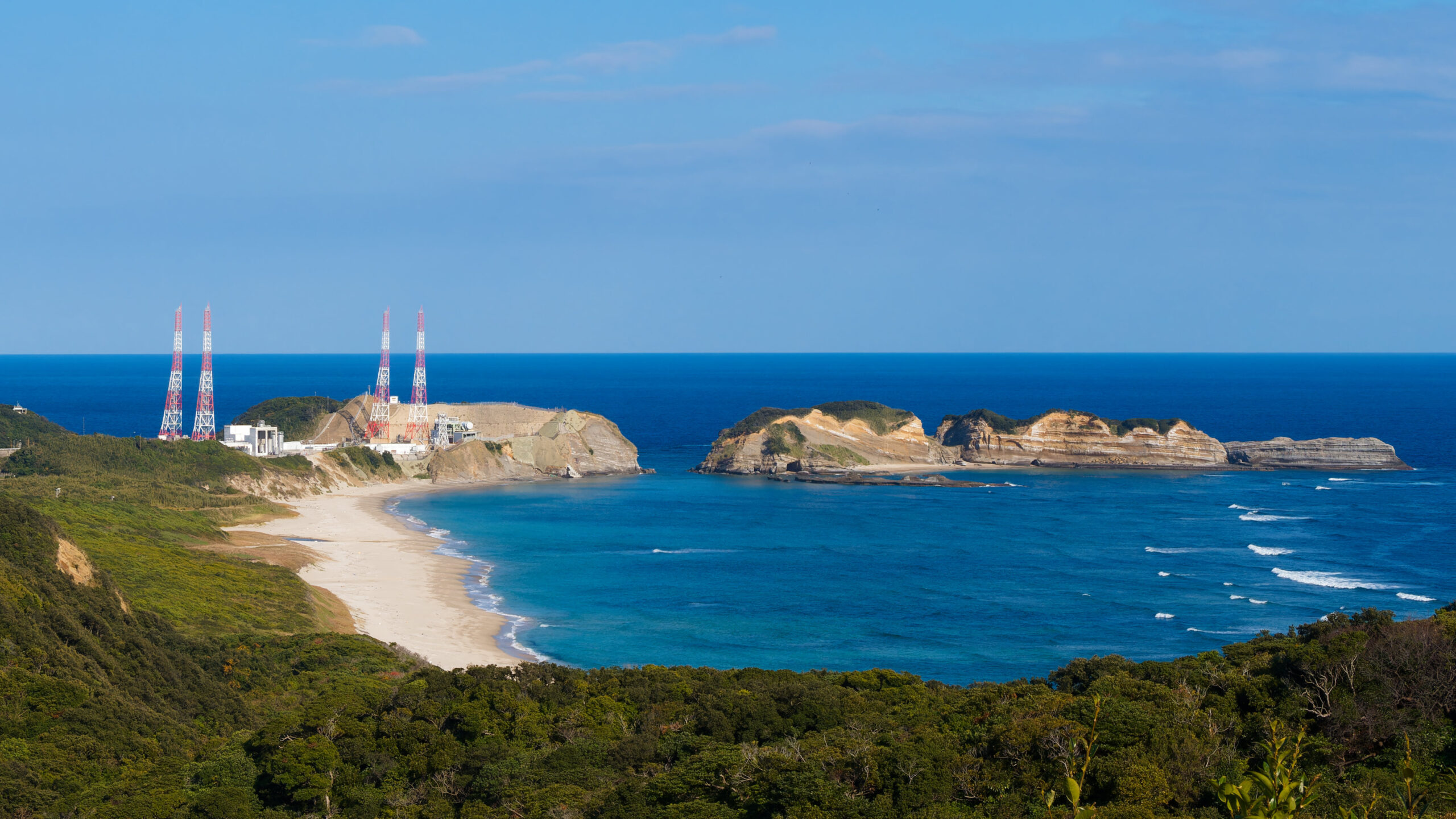
The Tanegashima Space Center sits on the southeast tip of the island, on the headland between Roketto-no-Oka (Rocket Hill) and the Pacific. There are three reasons it is here rather than near a major Japanese city. First, latitude — at 30°N, it is the closest piece of Japanese-administered land to the equator that was available when the site was chosen in the 1960s, and a lower-latitude launch makes a meaningful difference in payload to geostationary orbit. Second, downrange clearance — the entire eastern arc faces open Pacific, so a failure during ascent doesn’t drop debris on a populated area. Third, the surrounding land was already lightly populated farmland and forest, and Minamitane town wanted the economic anchor.
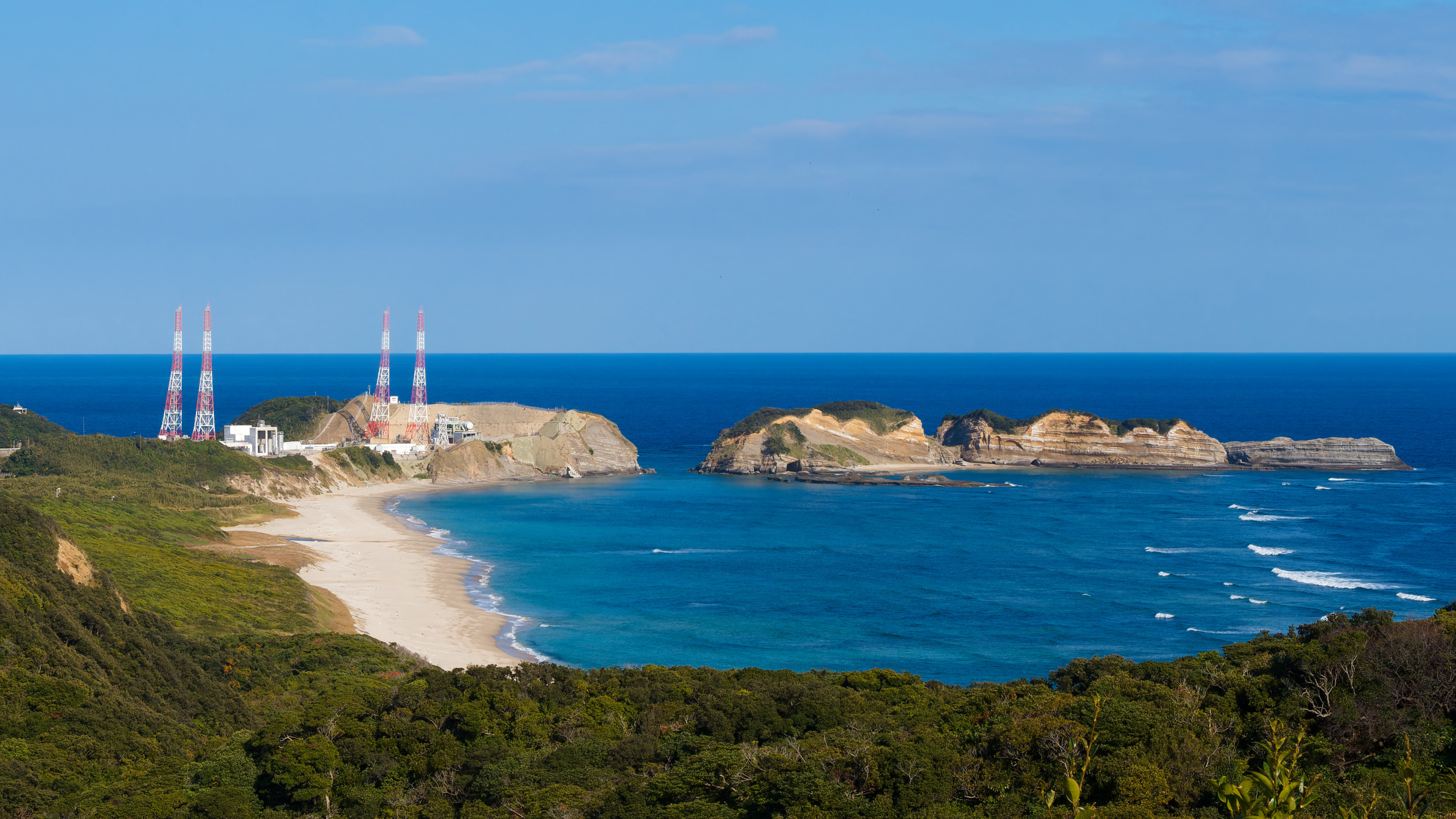
The Yoshinobu Launch Complex from the public ridge. The white tower on the left is the H3 fixed service structure; the red-and-white twin gantries are the older H-IIA pair, kept for historical contingency. Beach in the foreground is closed during launch periods.
You can visit the Space Science and Technology Museum (宇宙科学技術館) on the grounds without booking anything. Admission is free. Hours are 9:30 to 16:30. It is closed Mondays — or Tuesday if Monday is a national holiday — plus the first and fifth Monday of August (other August Mondays are open), Dec 29 – Jan 1, and any day a launch is in countdown. The interior is roughly two-thirds full-scale rocket and satellite models, one-third interactive exhibits, with a Hayabusa capsule replica and a Kibō module mockup as the two pieces most worth lingering at. Two hours covers it comfortably.
2026 launches you can actually time a trip to
JAXA does not over-publish launch dates, and slips of two to six weeks happen. As of mid-May 2026, this is the schedule. Confirm immediately before travel via the JAXA press release page or via the Visit Kagoshima launch viewing portal.
H3 F6 — June 10, 2026
Window 09:53:59 – 11:52:46 JST. Reserve period to June 30. Payload VEP-5 plus six piggyback satellites. Yoshinobu Launch Complex.
HTV-X2 — NET July 2026
Second flight of the new ISS cargo vehicle, replacing the retired HTV “Kounotori.” No date confirmed at time of writing.
MMX — Nov–Dec 2026
Martian Moons Exploration probe. Mission to land on Phobos and return a sample. Launch window opens around late November.
H3 F9 / Michibiki-7 — TBD
Originally February 2026. Postponed pending the H3 F8 investigation. No new date.
Where to watch a launch — and which spot needs a lottery
On launch day the Space Center itself and a three-kilometer radius around the pad are sealed. You watch from one of four designated public viewpoints. Only one of them requires advance application.
Closest public spot. Advance lottery required since December 2021. Application opens on the Minamitane town site about three weeks before each launch. Phone 0997-26-1111. JAXA countdown audio is broadcast on site, so you hear the final ten seconds.
No lottery. Public, free, accessible from the night before. Furthest from the pad among the open spots but the cleanest panorama. Arrive 90 minutes early on any launch where Ebinoe was oversubscribed.
No lottery. Attached campground; some launch nights you can stay on site. Closer to the town than Hase, so easier with kids if you don’t want to drive at 03:00.
No lottery. The least-crowded of the four. View partially blocked by trees on the south margin; pick the north slope.
The free bus tour most tourists miss
JAXA runs a guided bus tour of the launch site that almost nobody books from outside Japan. It is free. It is one hour fifteen minutes. It stops at the First Rocket Assembly Building (where the H-II display rocket lives), passes the Yoshinobu Launch Complex at close range from inside the perimeter, and includes the Range Control Center on the loop. The bus also pulls up at Roketto-no-Oka for a photo stop, which is the closest you can legally get to the active launch pad on a non-launch day.
Reservation is mandatory. Call 0997-26-9244 up to three months in advance. Three sessions per day in peak season (10:30, 13:00, 15:00). Two sessions per day on weekdays from December to February. Same-day spots sometimes open thirty minutes before start if there’s been a cancellation — worth a try if you didn’t pre-book. Blackouts: Golden Week, July–August peak, any launch day, and any post-delay reset period. If a launch slips into the window of your reservation, the tour is cancelled without much advance notice.
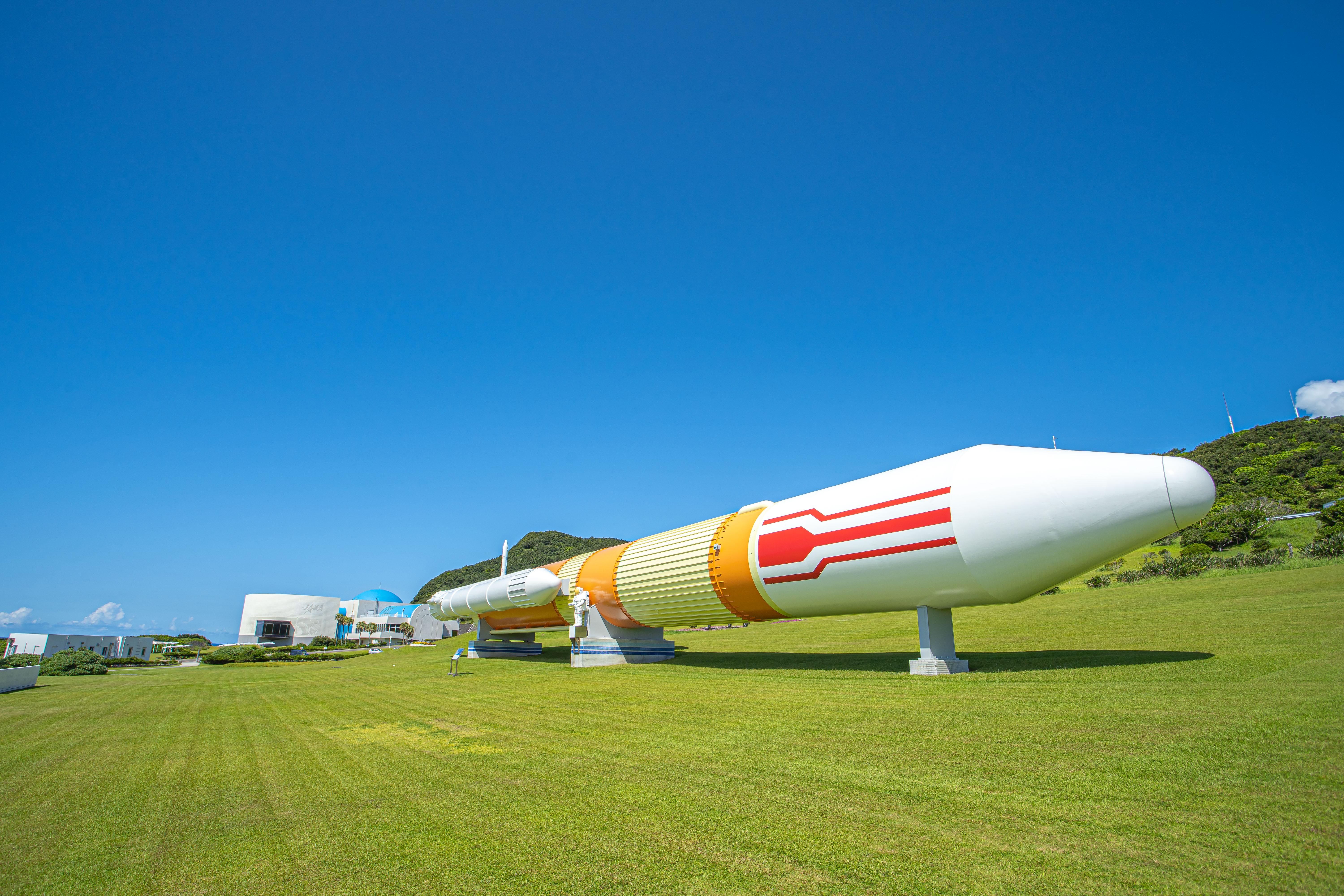
The H-II display rocket at the Space Center. Lying horizontal makes the scale legible in a way the vertical Yoshinobu gantries don’t. The bus tour stops here for about ten minutes.
Getting here, getting around, where to stay
JAL is the only carrier on the Kagoshima–Tanegashima route. Roughly seven flights a day. Round-trip from about ¥15,000 if you book a couple of weeks ahead, more on launch weeks. The ferry option — the Toppy and Rocket high-speed jetfoils — runs from Kagoshima Port’s North Pier in 1 hour 35 minutes, one-way ¥8,800. Toppy makes more sense if you are also visiting Yakushima, since some departures call at both islands.
From Tanegashima Airport to the Space Center it is about 40 to 50 minutes by car. A taxi runs ¥15,000–18,000. There is a reservation shared-taxi service to Minamitane town office, then a community bus to the Space Center, but the bus runs only about three times a day — possible for a one-day visit if you’ve memorized the timetable, impossible if you arrive after 14:00. From Nishinoomote Port to the Space Center it is about 49 km, 1 hour 19 minutes by car via Route 58 south, left turn onto Prefectural Route 586 at Kaminaka.
Plan This Trip
Flight
JAL Kagoshima → Tanegashima
Only carrier on this route. About 35 minutes flying time, ¥15,000+ round-trip.
Drive
Rental car on the island
The island is 86 km long. Without a car you cannot do both ends in a day.
Stay
Nishinoomote hotels
Best lodging selection. Walking distance to the museum and the August festival.
Stay/Ryokan
Minamitane minshuku
Smaller inns near the Space Center. Useful the night before an early launch.
Where you sleep depends on which end of the island you anchor your trip to. Nishinoomote (north) has the most hotel inventory, the museum, the ferry port, and all the August festival action. Minamitane (south) has fewer beds but puts you fifteen minutes from the Space Center and from Kadokura Cape — useful for early launches and for the museum sunrise at Maenohama beach. For a 2-day trip, I sleep north the first night and south the second.
One day vs two days — what fits
If you have one full day on Tanegashima — fly in 09:30, fly out 19:00 — your realistic plan is: airport → museum (Nishinoomote, 30 min drive) → 90 minutes inside → drive 90 minutes south → Space Center Museum and grounds → ロケットの丘 viewpoint if you booked the bus tour → drive back to airport. You will not see the festival, and you will not stop at Kadokura Cape. It is a stretch but it works.
If you have two days, you can split the island properly. Day one: airport → museum → Kadokura Cape (south, where the Portuguese landed — the drive itself is part of the value) → check in Minamitane. Day two: Space Center bus tour at 10:30 → Space Center museum after lunch → coastal stops at Chikura-no-iwaya sea cave → fly out. If your trip lines up with a launch, your day two becomes “drive to your assigned viewing park before 06:00, watch the launch, sleep before flying.”
Find a hotel close to where you’re sleeping
Nishinoomote has the wider hotel selection — mostly business-class hotels within walking distance of the port and the museum. For Minamitane, the inventory shifts to small minshuku and family-run ryokan, which Rakuten Travel indexes better than Booking does.
FAQ
Can I see a rocket launch from Tanegashima without applying for the lottery?
Is the JAXA bus tour worth booking even on a non-launch day?
How long does the matchlock museum visit take?
When is the next Teppō Matsuri festival in 2026?
Should I combine Tanegashima with Yakushima?
Is the price the Portuguese demanded — 2,000 ryō in gold — historically accurate?
Booking the Trip
Three doors into a Tanegashima visit. If a launch date is locked, book the hotel first.
Stay
Hotels in Nishinoomote & Minamitane
Search both ends of the island. Sleep north the first night, south the second.
Search on Booking →
Flight
Kagoshima → Tanegashima
JAL is the only operator. ~35 minutes, ¥15,000+ round trip if you book ahead.
Find flights →
Drive
Rental car for the island
Reserve from Tanegashima Airport. The Space Center is 50 minutes south.
Compare cars →
Related reading
- Kagoshima Outer Islands 2026: A Master Guide to Yakushima, Amami, Yoron and the Archipelago — the parent piece
- Yakushima 3-Day Itinerary 2026 — pair Tanegashima with Yakushima for a four-day plan
- How to Get to Yakushima 2026 — Toppy, Ferry, or Flight — most of the routing also covers Tanegashima
Join 1,000+ travelers discovering Japan's hidden side
Weekly dispatches from off-the-beaten-path Japan — spots and stories you won't find in guidebooks.
No spam. Unsubscribe anytime.
Welcome aboard!
You're in. See you in your inbox soon.