
Ibaraki · Hitachinaka · Year-Round Flower Calendar
In shortHitachi Seaside Park (国営ひたち海浜公園) is a 200-hectare flower park in Hitachinaka, Ibaraki, 90 min by train from Tokyo. Blue Nemophila peaks mid-April to early May, red Kochia peaks around mid-October, with tulips in mid-to-late April, sunflower plots in mid-July and mid-August, cosmos through October and pampas grass in late August–September. The Kochia turns green-to-pink-to-red over six weeks — in early October, expect a mix of green and red; the park’s forecast dated 2 October 2026 puts the start of peak red colour around 10 October.
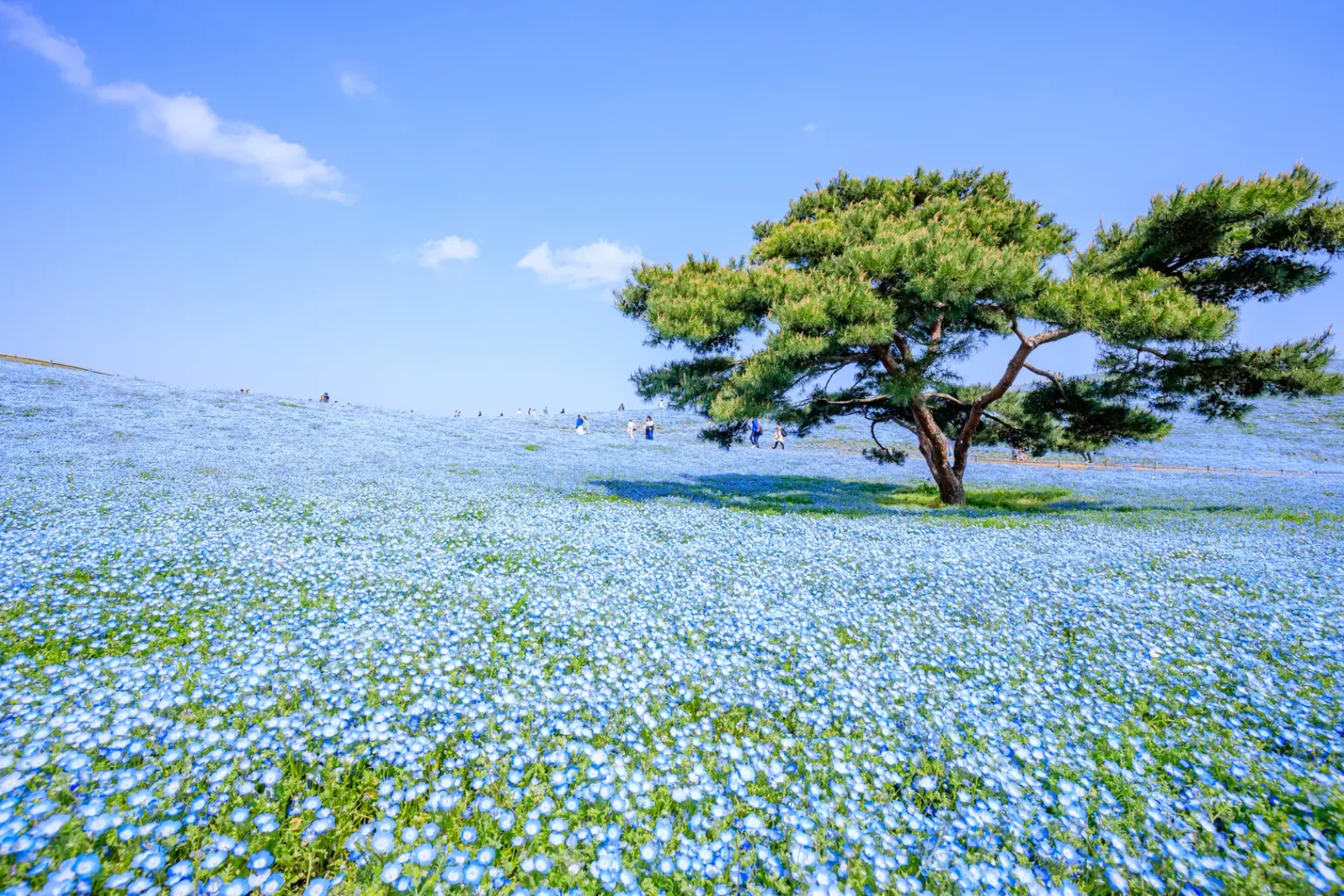
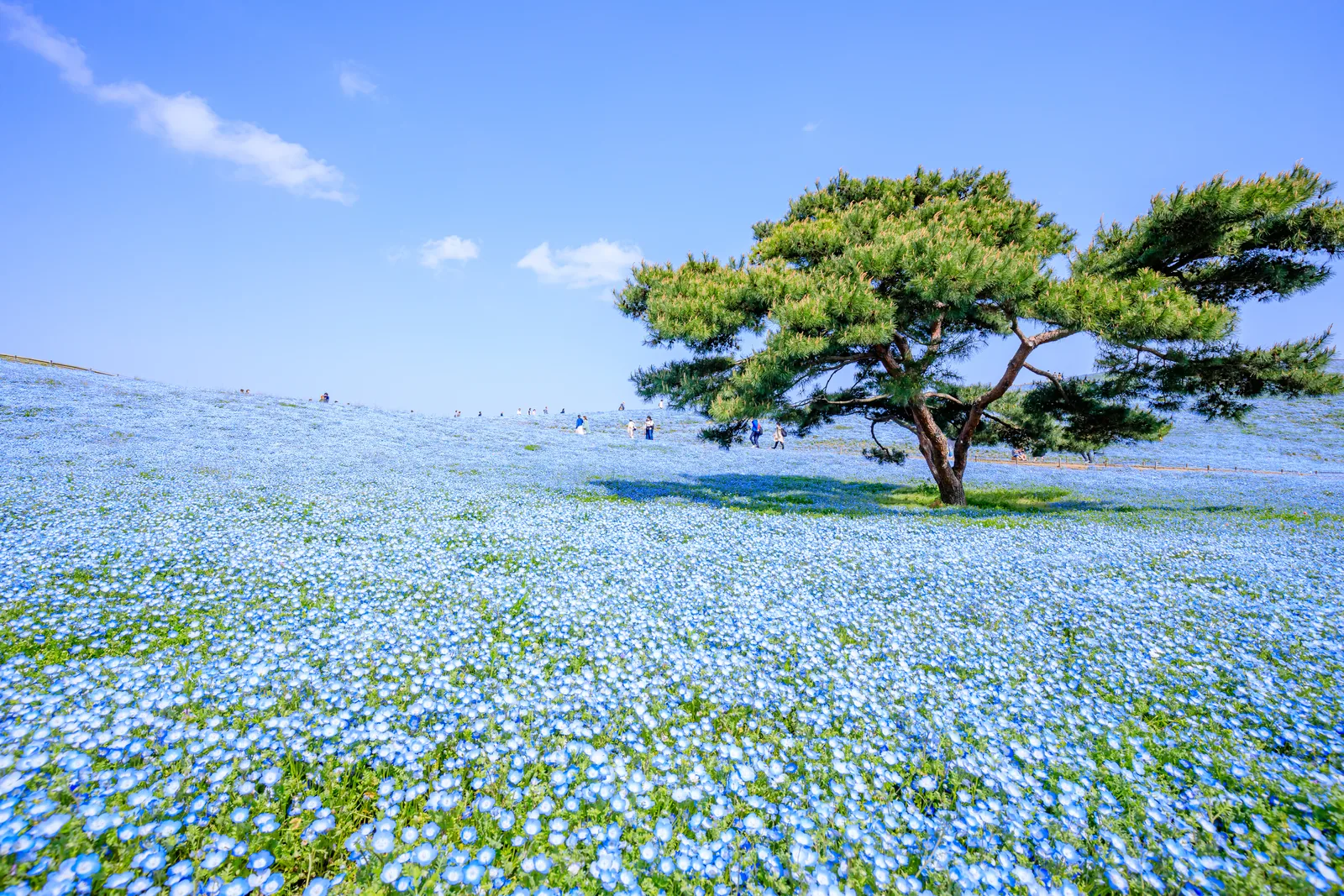
For two weeks every spring, Hitachi Seaside Park becomes the most photographed hill in Japan. About 5.3 million Nemophila seedlings (the park’s 2026 figure) flower at once on Miharashi-no-Oka and the trains from Tokyo run double frequency to keep up. Then the bloom ends, the social-media wave moves on, and visitors arrive in October expecting an equally famous red Kochia hill — and find a green one. The Kochia season is real, but it has a much narrower red-peak window than people realise. This is a guide built around that calendar.
Year-at-a-Glance Calendar
Twelve flagship and supporting blooms across the year. Solid bars are peak weeks. Striped bars are the fade-out (still flowering, but past prime).
2026 bloom calendar · Hitachi Seaside Park
The Kochia Color Trap (Why People Come and See a Green Hill)
The most-asked question we get
“I came for the red Kochia hill and it was green. What happened?”
The Kochia (summer-cypress, broom cypress) plant changes colour gradually over six weeks. It is green from mid-July to late September (the park’s guide map), begins changing colour in late September and shows a mix of green and red in early October. In its forecast as of 2 October 2026, the park expects peak viewing around 10 October, rather than the 15 October date in its earlier forecast, and reports that colouring across the hill began around 30 September. When checked on 4 October 2026, the park’s live flower report described the mix as roughly 70% green and 30% red. The park says the peak usually lasts a week to ten days. It also notes that prolonged cool or rainy weather may bring the colour earlier than usual, and that the forecast may change with the weather. Then it fades to burnt-orange and falls. Most international visitors plan around “mid-October” in general. If peak viewing starts around 10 October and lasts the usual week to ten days, I estimate it could end around 17–20 October. The first week of October is expected to bring a mix of green and red; late October typically brings red-brown and then golden colours, after the red peak.
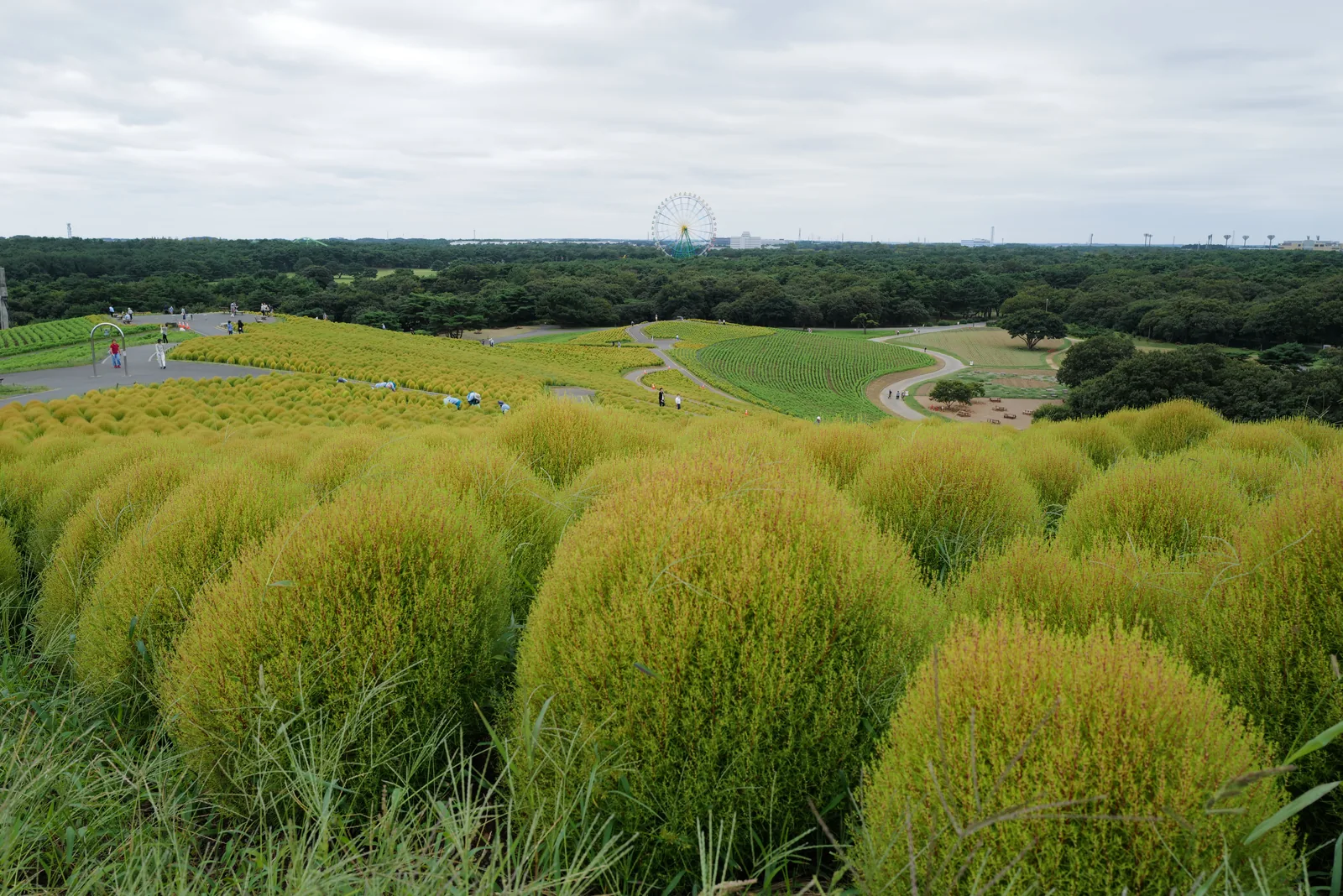 Summer – Late September
Green Kochia
Mid-July → late Sep (first blush from late Sep)
The kochia is fully grown and rounded but still photosynthesising in summer mode. The hill looks like a sea of green Christmas-bauble bushes. Photogenic, but not what you came for.
This is the photo above — September. The ferris wheel is visible; the hill is green; you would not post it on Instagram and label it Kochia.
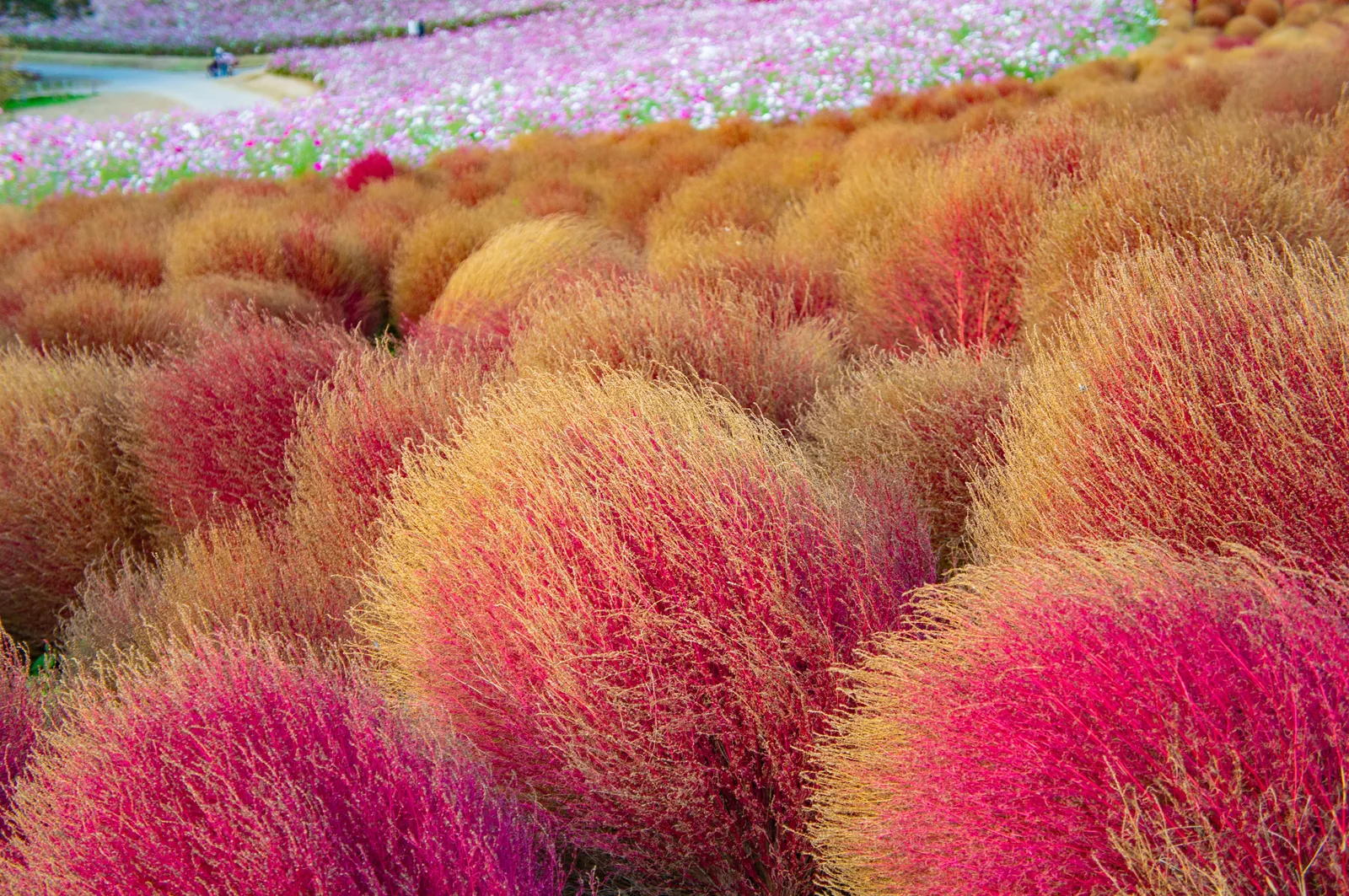 Peak from ~Oct 10
Red Kochia (the postcard)
Peak red: the park’s forecast as of 2 October 2026 puts peak viewing near 10 October, five days earlier than its earlier forecast
The park says the red peak usually lasts a week to ten days. In 2021–2025 it lasted 6 to 11 days. About 40,000 bushes across Miharashi-no-Oka and, new for 2026, Miharashi-no-Sato at its foot. The exact peak shifts year to year based on temperature drops in early October. The park publishes daily colour updates from late September onwards.
Same hill. Same plants. Different week. In 2026 the hill’s yellow cosmos bloom at the same time.
Colour transition (the park’s forecast as of 2 October 2026)
The park’s kochia page adds a golden stage in late October–early November. Past peaks lasted 6 days (2021), 7 (2022), 7 (2023), 9 (2024) and 11 (2025).
If you are flying in from abroad, the park’s forecast peak from about 10 October is the window to aim at. If you are local and can be flexible: watch the park’s official live-bloom page from October 1 onward and go the day after they post “peak red.”
The Kochia is the same plant every week. You are not buying a flower; you are buying a date range. Get the date wrong and you have flown to Ibaraki for a green hill.
The Four Flagship Windows (Worth a Trip from Tokyo)
Making the trip from Tokyo
If you stay over, Mito itself can earn the next morning — the natto town is a genuine day trip of its own, and pairing the two changes the maths of coming this far for one park.
Hitachi Seaside Park has flowers eleven months of the year, but only four windows justify a deliberate trip from Tokyo. These are them.
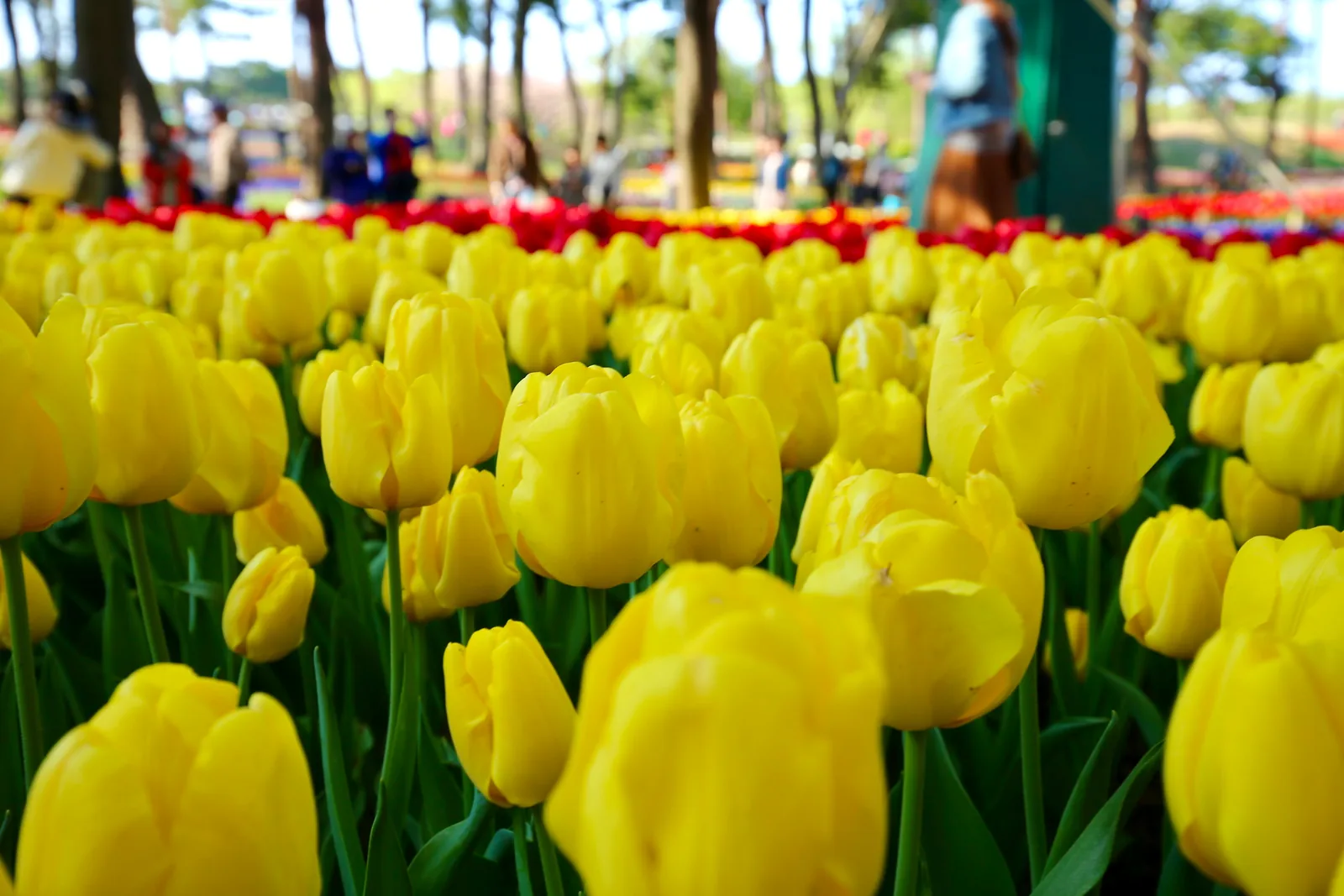
Tulips & Narcissus — mid-April
PEAK: mid-to-late April
About 280,000 tulips planted across the Tamago-no-Mori Flower Garden in roughly 250 varieties, with the narcissus field (around 1 million bulbs) overlapping at the front edge of the season. This is two weeks BEFORE the Nemophila peak, so day-trippers can sometimes do both in a single visit if timed right — tulips in the morning, walk twenty minutes north to the Nemophila hill in the afternoon.
The tulip rows are colour-coordinated rather than mixed, so the photo is the same kind of bold colour block as the Nemophila hill, just smaller scale and with sharper lines.
Photo TipTulips are tight, low, and uniform — shoot at the row level (knee height, looking along a single colour row toward the horizon) for the strongest compression effect.Nemophila (Baby Blue Eyes) — late April
PEAK: mid-April to early May — in 2026 the park announced best viewing April 11–May 1, peaking April 16–26
The signature event. About 5.3 million Nemophila ‘Insignis Blue’ planted on Miharashi-no-Oka, a 58-metre-elevation hill that lets the blue meld into the sky behind it on clear days. Bloom peaks roughly the last week of April through the first week of May, which means Golden Week (April 29–May 5) is the busiest period of the entire year at the park.
Strategy: arrive at park opening (9:30 AM) on a weekday, NOT on a Golden Week public holiday. Weekend crowds during Golden Week routinely exceed 30,000/day; weekday early arrival gives you the same hill with maybe a quarter of the people.
Photo TipShoot looking up the slope toward the sky from the lower path — the blue-on-blue (flower / sky) merge is the iconic shot. Cloudy days kill the effect; check the forecast.Two practical notes for the Nemophila window: rooms in Mito and Katsuta sell out weeks ahead of Golden Week — compare Mito and Katsuta hotels early — and seasonal day tours from Tokyo appear on Klook each spring if you would rather not manage the trains on the busiest days.
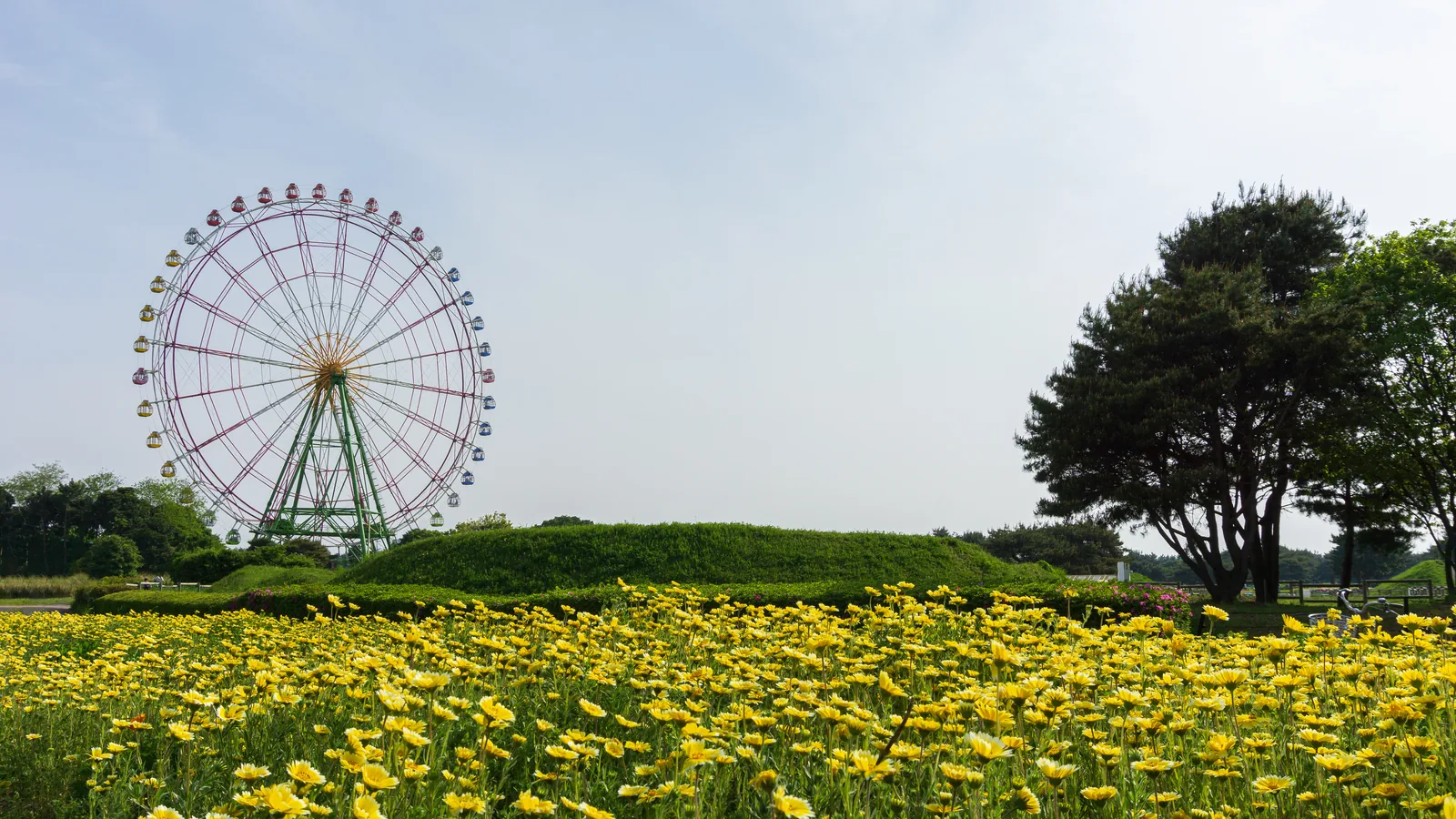
Sunflowers, Zinnia & Summer Yellow — late July to mid-August
PEAK: two plots in 2026 — mid-to-late July (Terrace House field) and mid-August (BMX-course field)
Less photographed but materially quieter. In 2026 the sunflowers grow in two smaller plots — a compact field by the Terrace House peaking mid-to-late July, and a five-variety field by the BMX course peaking in mid-August — rather than one giant planting. The sea breeze off the Pacific (the park is 1 km from the coast) keeps summer days milder than central Tokyo, and the Ferris wheel and amusement-park section gives families a non-flower reason to come.
Midsummer also layers several smaller plantings at once — zinnia, marigolds and the first cosmos coming in — so the quiet season has more colour than its reputation suggests.
Photo TipThe Ferris wheel is the visual signature of this season — include it in the frame. Mornings are clear; afternoons get hazy summer light.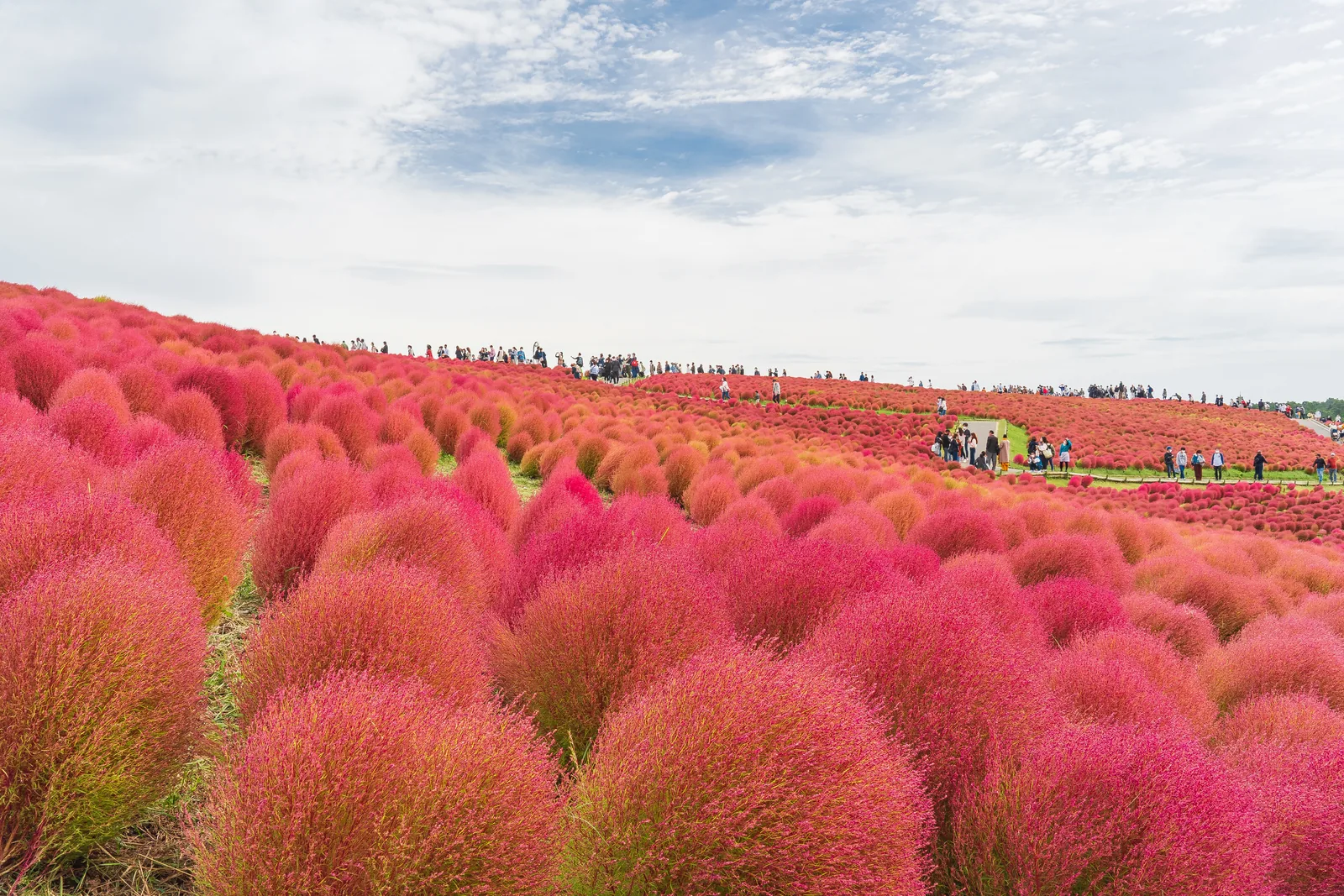
Kochia (Peak Red) — mid-October
PEAK: the park’s forecast as of 2 October 2026 gives colouring from ~30 September and peak viewing from ~10 October — still worth re-checking the live bloom page before you fix a date
The second-most-photographed event at the park, and arguably the most photogenic. About 40,000 Kochia bushes (2026) turn the same Miharashi hill brilliant red, pink, and orange in a red-peak window the park says usually lasts a week to ten days. The bushes are spherical, knee-high, and absurdly textured up close.
The Kochia season is materially less crowded than Nemophila — same hill, same number of plants but no Golden Week effect. Pair it with this year’s yellow cosmos: in 2026 about 2.7 million yellow cosmos (two varieties) share Miharashi-no-Oka with the kochia, in bloom from mid-September to late October. The Grassland Flower Garden also has about 220,000 cosmos, but they peak in September. See the “Kochia Color Trap” section above for the park’s stage-by-stage colour chart.
Photo TipThe signature shot is the ridge path with people walking across it from low angle — gives scale. Close-up texture shots reward a 70-200mm lens. Avoid noon flat light; mornings or 16:00–sunset are warmer.Month-by-Month Detail (with Crowd Forecast)
For travellers who want the granular picture — when each flower is at the start, peak, or tail of its window, and how crowded the park will be that month.
For the Kochia window, the clean play is a Tokyo base and an early train — Tokyo hotels on Agoda hold their rates better in October than the tiny pool of rooms near the park — or a rental car if you want the 9:30 gate opening on a weekday.
The Underrated Late-Autumn Window (Golden Kochia & Late Cosmos)
One of the park’s genuine secrets is the late-October-into-early-November window after the red peak: the Kochia fades from russet to a golden straw colour, the late cosmos hold on, and the crowds are gone. (Pampas grass at the Pyonpyon Circle and other plots peaks earlier, from late August to late September; for 2026 the park also lists about 500 plants around the Grassland at their best in late October–early November.)
Golden Kochia & Late Cosmos — late October – early November
Golden-kochia window: late October into early November; in 2026 the park lists the Grassland pampas at its best in late October–early November too
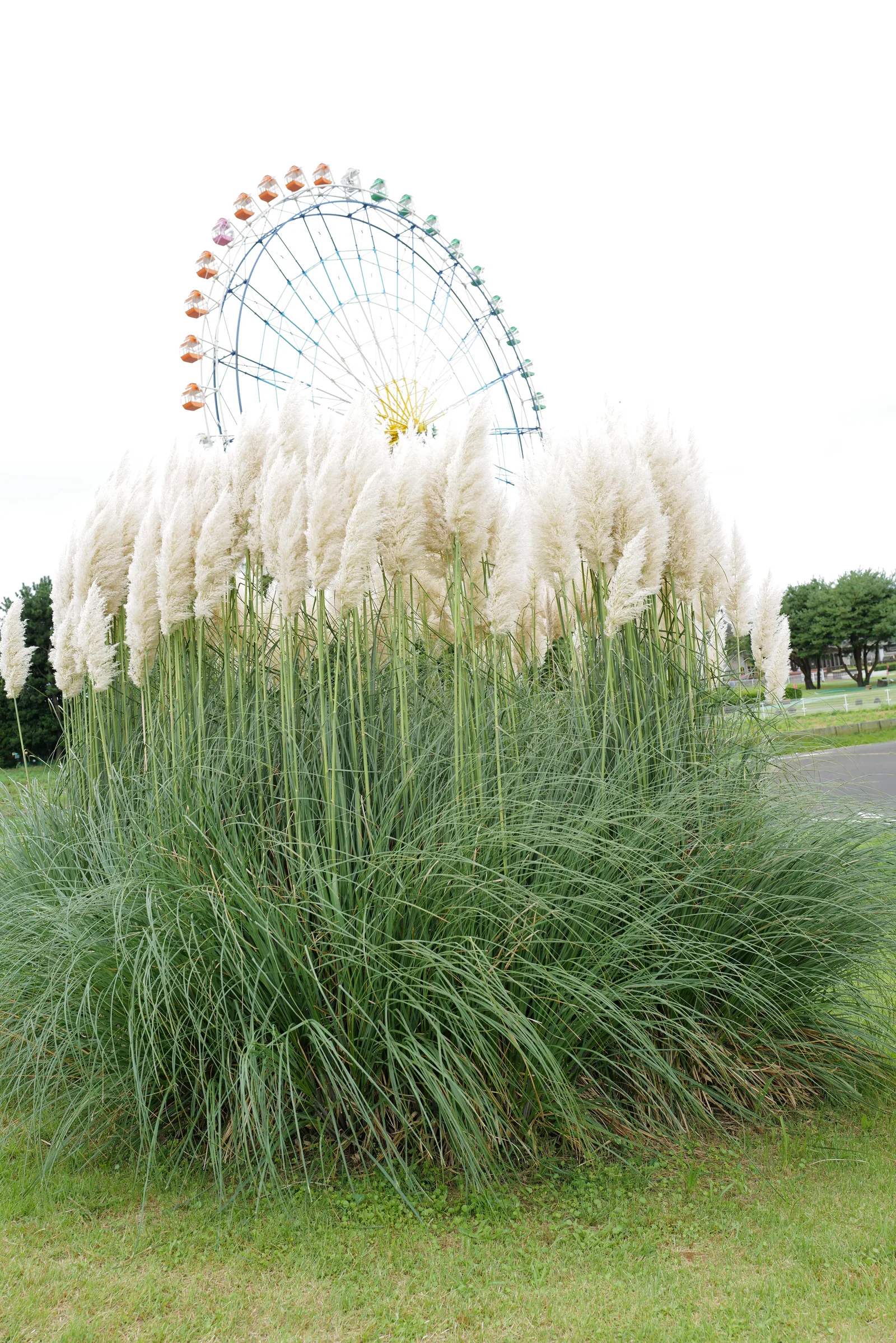
The pampas plumes catch the low autumn light and frame the Ferris wheel, while the Kochia hill glows straw-gold instead of red. This is the November Hitachi photo nobody else has on their Instagram — the crowds have left and the park has visibly shifted to a quieter, more contemplative mood.
Photo TipBack-lit pampas at 15:30–16:30 is the ideal. The plumes glow against the still-green pine trees on the far side of the wheel.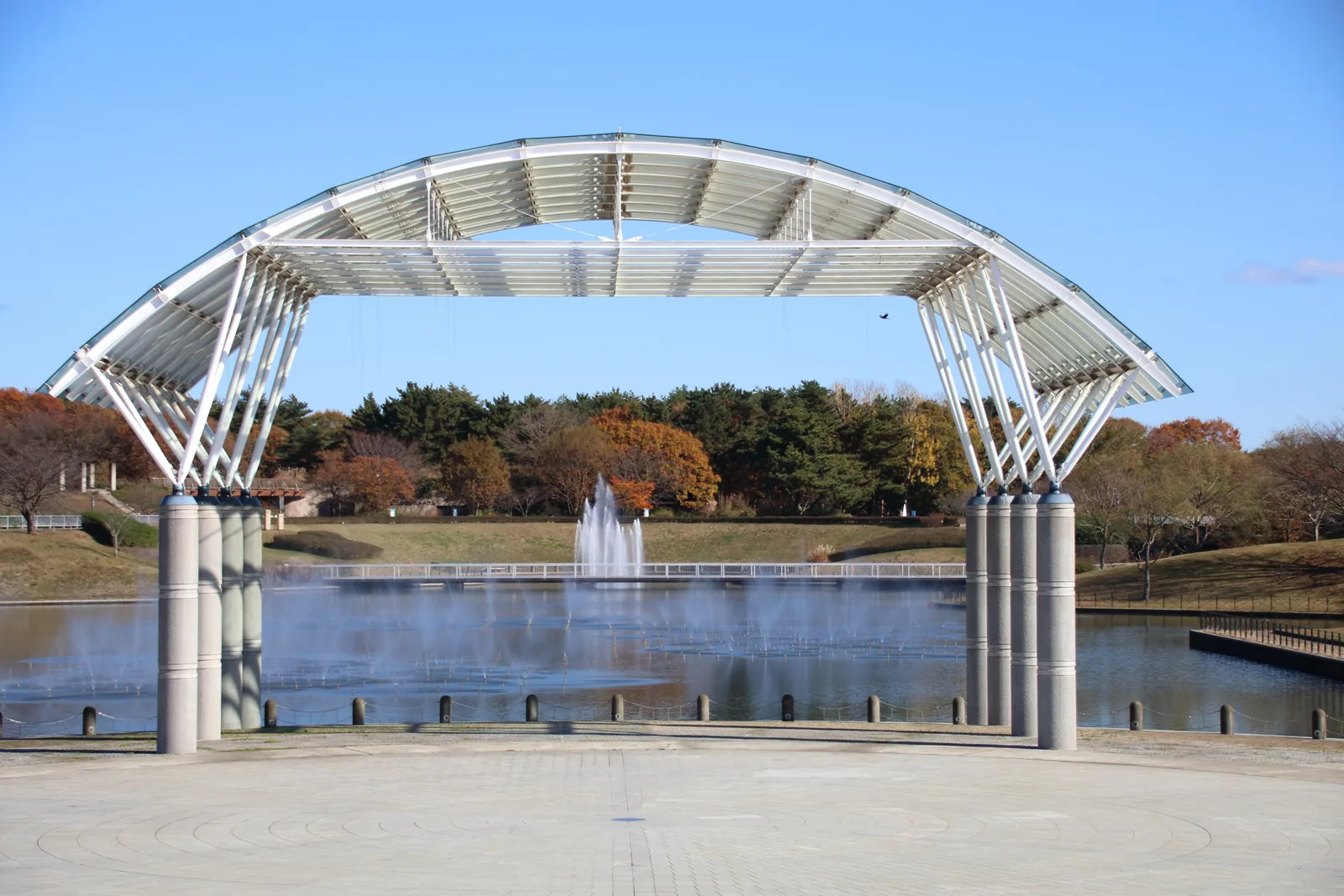
The Park Layout — Where Each Flower Lives
The park is large — about 200 open hectares of a 350-hectare site. Five named zones; the flower geography matters for planning:
- Miharashi Area (West-Central) — the photogenic hill. Nemophila in April, Kochia in October (with yellow cosmos in 2026), sunflowers in summer. This is the one zone every visitor must include. Closest entry: West Gate.
- Tamago-no-Mori (Egg Forest) Flower Garden — the tulip and narcissus zone in spring, the poppy zone in early summer.
- West Area — rose garden, the amusement park (Ferris wheel), Pleasure Garden, pampas grass.
- Tree Zone (Central) — walking trails year-round, fountain plaza.
- South Area & Sand Dunes Zone — the Pacific-coast section, less developed, good for a quiet walk away from the main flower hills.
Bicycle rental at the main gate (¥600 for 3 hours, ¥900 with electric assist) is the single best decision you can make if you have more than 2 hours. Walking the full park takes 4–5 hours; cycling cuts it to 2. The flower hills are not all close together — the tulip garden and the Nemophila hill are 20 minutes apart on foot.
How To Get There
Hitachi Seaside Park is accessible from Tokyo in 90 minutes, faster than Hakone or Kawaguchiko:
- JR + bus (most common) — JR Jōban Line Limited Express “Hitachi” or “Tokiwa” from Shinagawa/Tokyo/Ueno to Katsuta Station (~85 min from Tokyo Station). Then the regular bus from Katsuta East Exit, stop 2, to Kaihin-Kōen Nishi-guchi (West Gate), about 15 min, ¥450. From 3 October to 3 November 2026 a non-stop temporary bus also runs from East Exit stop 4 to the West Gate: ¥600, about 20 minutes, no timetable (buses leave as they fill, from about 9:00); a ¥1,200 day ticket covers unlimited Katsuta–park rides (Ibaraki Kotsu notice, 18 September 2026). Roughly ¥4,300 each way with the limited express, varying by seat and station.
- Highway bus — the old direct Tokyo–park bus was discontinued at the end of September 2025. The bus option now is the Mito-go from Tokyo Station Yaesu South Exit to Mito Station (~2 hours), then JR to Katsuta and the local bus — cheaper, but slower than the train all the way.
- By car — the direct route is the Kita-Kanto Expressway onto the Hitachinaka toll road to Hitachi-Kaihin-Koen IC, right at the park (Hitachi-Minami-Ota IC on the Joban Expressway also works, ~15 min out). Three car parks (West, South, Kaihin-guchi) hold about 4,350 cars at ¥600. Tokyo→park is roughly 2 hours without traffic, 3–4 hours during Golden Week peak.
Plan a Trip Around the Flagship Seasons
Plan This Trip
Practical Tips
The park-day kit
Two hundred hectares means real walking and almost no shade on the hill itself. This is what earns its place in the daypack — all of it deliverable to your hotel before you go.
Picnic sheet
The lawns between flower zones are the best lunch spots in the park, and benches run out fast at peak bloom.
Japanese gel sunscreen
Miharashi hill has zero shade. Spring sun off the sea is stronger than it feels.
Handheld fan
For the July–August sunflower windows — the sea breeze helps, but the queues are in full sun.
Insulated bottle
Fountains exist but are far apart; on the cycling loop you will want water with you.
FAQ
When does the Kochia turn red in 2026?
The park’s own forecast, as of 2 October 2026, puts the start of colouring around 30 September and peak viewing from around 10 October, with the peak typically running seven to ten days. That is five days earlier than its earlier forecast of 15 October. The park notes that prolonged cool or rainy weather may bring the colour earlier than usual, and that the forecast may change with the weather. The sequence: green to late September → green-to-red gradation to about 9 October → peak red from about 10 October → red-brown, then golden into early November. The park publishes daily live photos from October 1 onwards; check before travelling.
Why is the Kochia green when I visited? Did I come in the wrong year?
Almost certainly you arrived too early. The Kochia is green from mid-July to late September (the park’s guide map) and shows a green-to-red gradation through early October — the same plant, same hill, just before its full autumn colour. The park says the red peak usually lasts a week to ten days. In 2021–2025 it lasted 6 to 11 days. Visitors aiming for mid-October who arrive in the first week of October will see a green-to-red gradation, not the all-red hill.
When is the absolute peak of Nemophila in 2026?
Statistically, the peak falls from mid-April into early May, shifting year to year with spring temperatures — in 2026 the park’s own announcement put best viewing at April 11–May 1, with the peak April 16–26. The park publishes live bloom updates daily on its official site during the season.
Is Hitachi Seaside Park worth visiting outside the Nemophila and Kochia seasons?
For Japan locals or anyone in the Tokyo area: yes, the tulip (mid-April), poppy (May), sunflower (two plots in 2026: mid-to-late July and mid-August), cosmos (September–October) and pampas grass (late August–late September at the Pyonpyon Circle and other plots, into early October on the park’s guide map; in 2026 the park also lists about 500 plants around the Grassland at their best in late October–early November) seasons are all materially good and far less crowded. For international travelers flying in specifically for this park: align your trip with either Nemophila (late April) or Kochia (mid-October).
How crowded is Nemophila peak?
Very. Golden Week (April 29–May 5) weekend days routinely see 30,000+ visitors. Train cars on the Joban Line run standing-room-only. Strategy: weekday before Golden Week (April 24–28) or right after (May 6–8) gives you the same flowers with materially fewer people.
How do I check live bloom status before I travel?
The park’s official site (hitachikaihin.jp) publishes daily “flowering status” photographs from each major bloom area — Nemophila, Kochia, tulip, rose, cosmos. For Nemophila, check from early April. For Kochia, check from late September. The page is bilingual on the English side, and the photos make the colour state unmistakable even if you cannot read the captions.
Can I see Mt. Fuji from Hitachi Seaside Park?
No. The park faces the Pacific. Mt. Fuji is 220 km southwest, blocked by terrain. The visual reward is the Pacific horizon from Miharashi-no-Oka.
How long do I need at the park?
Minimum 3 hours focused on one or two zones. A full visit including cycling around all five zones, lunch, and the amusement park is 5–6 hours. For Golden Week / peak season, plan for one full day.
Is the park stroller- and wheelchair-friendly?
Yes — paved paths throughout, gentle inclines, and accessible toilets. The Miharashi hill itself has paved viewing platforms at multiple elevations.
The Nemophila week is on every Japan-spring listicle for a reason — it really is the photo. But planning a year of Japan travel around the Hitachi Seaside Park calendar gives you four legitimate trips: tulips in mid-to-late April, Nemophila from mid-April, sunflower plots in July and August, Kochia in mid-October. Two of those (Kochia, summer flowers) are materially less crowded than the famous one. The Kochia, in particular, is arguably the better photo — if you get the date right.
The Kochia date matters more than people think. The plant is the same plant every week. You are not buying a flower; you are buying a calendar window. Aim at the park’s forecast peak from about 10 October if you are flying in from abroad. Watch the park’s live bloom page from October 1 if you are flexible. In 2026, the first week of October is expected to show a mix of green and red, with peak red colour forecast from around 10 October.
The park is 90 minutes from Tokyo. You can be there at 11 AM and back in central Tokyo for dinner. There are very few day trips in Japan that justify themselves three or four times in the same year — this is one of them.
Planning the Visit
Three doors. Tokyo-base + day-trip is the cleanest plan; the JR Pass covers the Joban Line, and the highway bus is the cheap alternative.
Join travelers discovering Japan's hidden side
Weekly dispatches from off-the-beaten-path Japan — spots and stories you won't find in guidebooks.
No spam. Unsubscribe anytime.
Welcome aboard!
You're in. See you in your inbox soon.