

Kyoto · Higashiyama · 2026
Minamiza 2026: Kyoto’s 400-Year-Old Kabuki Theatre, Walked by a Kyoto-Born Local
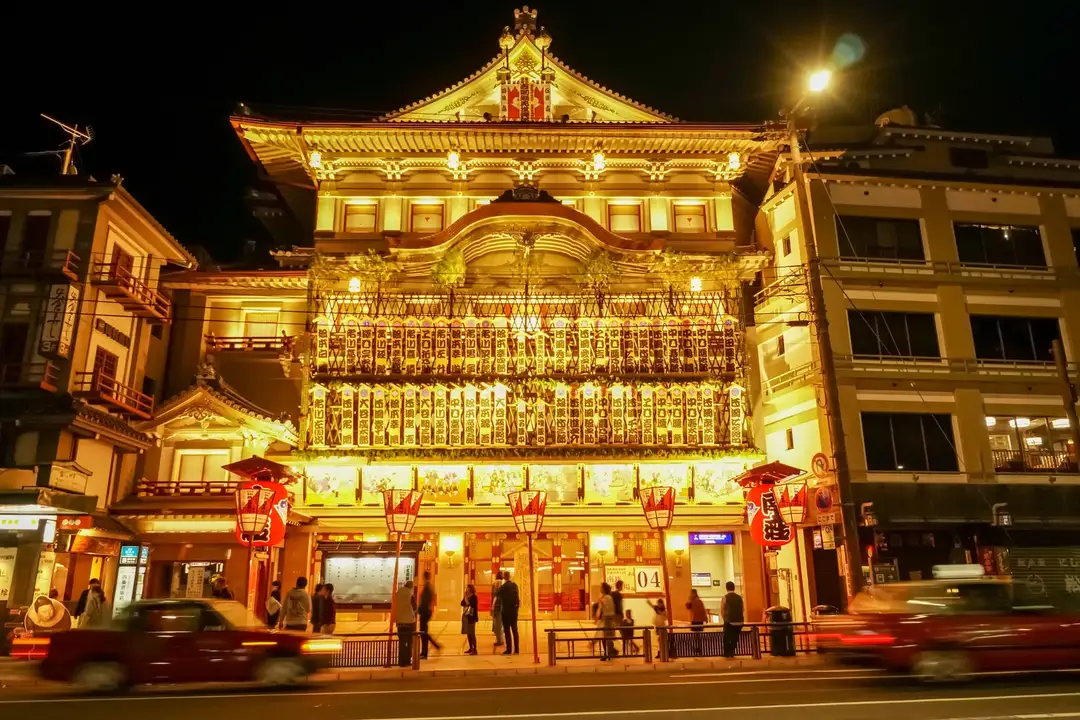
Minamiza after dark — the 1929 Momoyama-style facade lit up at the east end of Shijō-ōhashi Bridge.
I grew up in Kyoto. I have walked past Minamiza on the Shijō Bridge thousands of times — on the way to Yasaka Shrine for Hatsumōde, on summer evenings looking down at the Kamogawa river, in the early hours when the only sound is delivery trucks. But the first time I actually went inside was October 2025, for an Ichikawa Danjurō XIII special show. I stayed in seat 1F-Row 11-Seat 28 for four hours, used the English earphone guide for half of it, and ate Yatsuhashi sweets between acts. This is the article I wish I’d had before that night.
Quick Facts
Why Minamiza Still Matters
Kabuki was born in Kyoto, on this exact bend of the Kamogawa river, around 1603. A woman named Izumo no Okuni performed religious dance routines on the dry riverbed and the form caught fire. By the early Edo period, seven licensed theatres were lined up along the east bank of Shijō. Minamiza is the only one still standing — the others closed centuries ago. The current building dates from 1929, when the previous wooden structure was rebuilt in a Momoyama-period gabled style and given the lavish gold-and-vermillion facade you see today. It earned Registered Tangible Cultural Property status in 1996, then closed for an earthquake-proofing reconstruction in 2016 and reopened in 2018, marking 400 years on the same patch of land.
Other kabuki theatres are bigger or more famous internationally. None of them has a 400-year unbroken stretch of stages on the same site. That continuity is the whole point of Minamiza.
Plan a Kabuki Night in Kyoto
Plan This Trip
Outside the Theatre
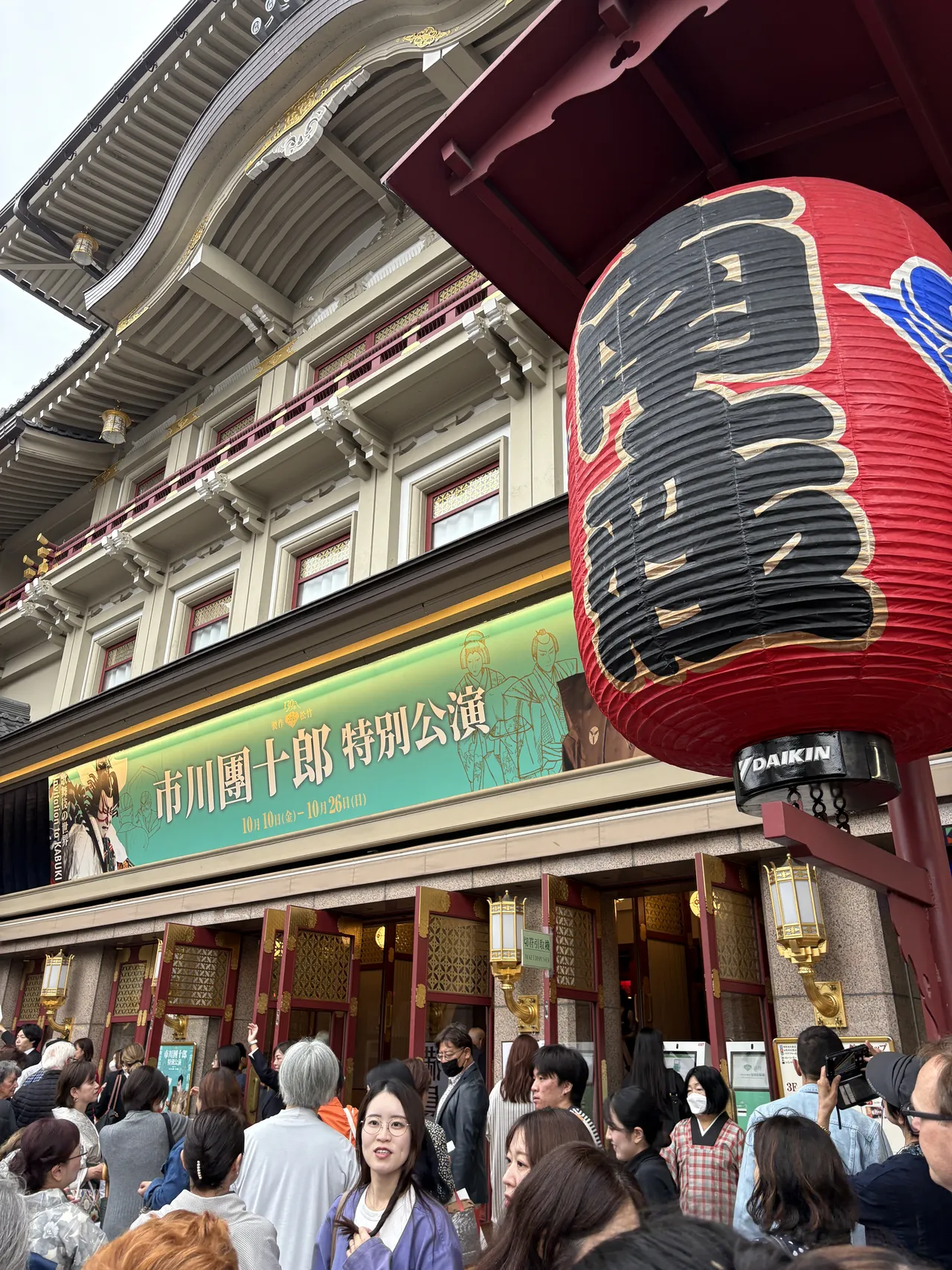
The Minamiza front faces north onto Shijō Street, with the Kamogawa river behind it and the Yasaka pagoda visible up the slope through the alleys. The first thing you notice walking up is the building itself — that vermillion facade, the deep eaves, the gilded carvings under the gable. The second thing is the giant red maneki banners over the entrance announcing each month’s performers. Photographing the facade is allowed and encouraged. There’s a clean line of sight from across Shijō Street that gives you the building plus the bridge in one frame.
Inside the Auditorium
The auditorium is smaller than I expected. About 1,000 seats spread across three levels — the orchestra (1F), the dress circle (2F), and the upper balcony (3F). The first thing that hits you is the ceiling: a coffered grid lined with rows of red bonbori paper lanterns that come on softly before each act. The proscenium is framed by gold-leaf carvings. The stage itself uses the traditional jo-shiki-maku — the black, persimmon-orange, and dark-green vertical-striped curtain that you see in every kabuki print — and behind that, when it lifts, the set design changes for every act, sometimes a temple courtyard, sometimes a riverbed, sometimes a daimyō’s mansion in cross-section.
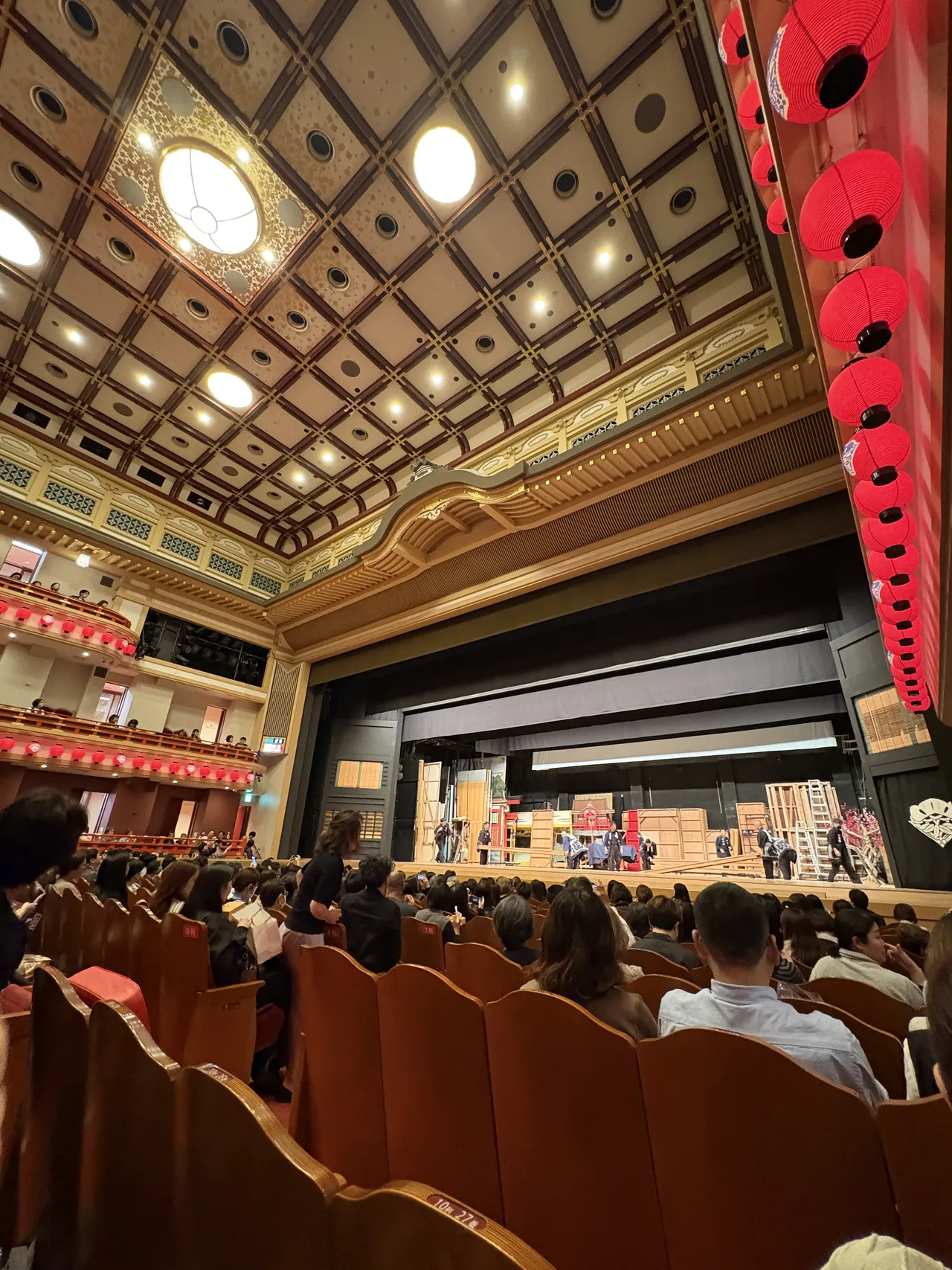
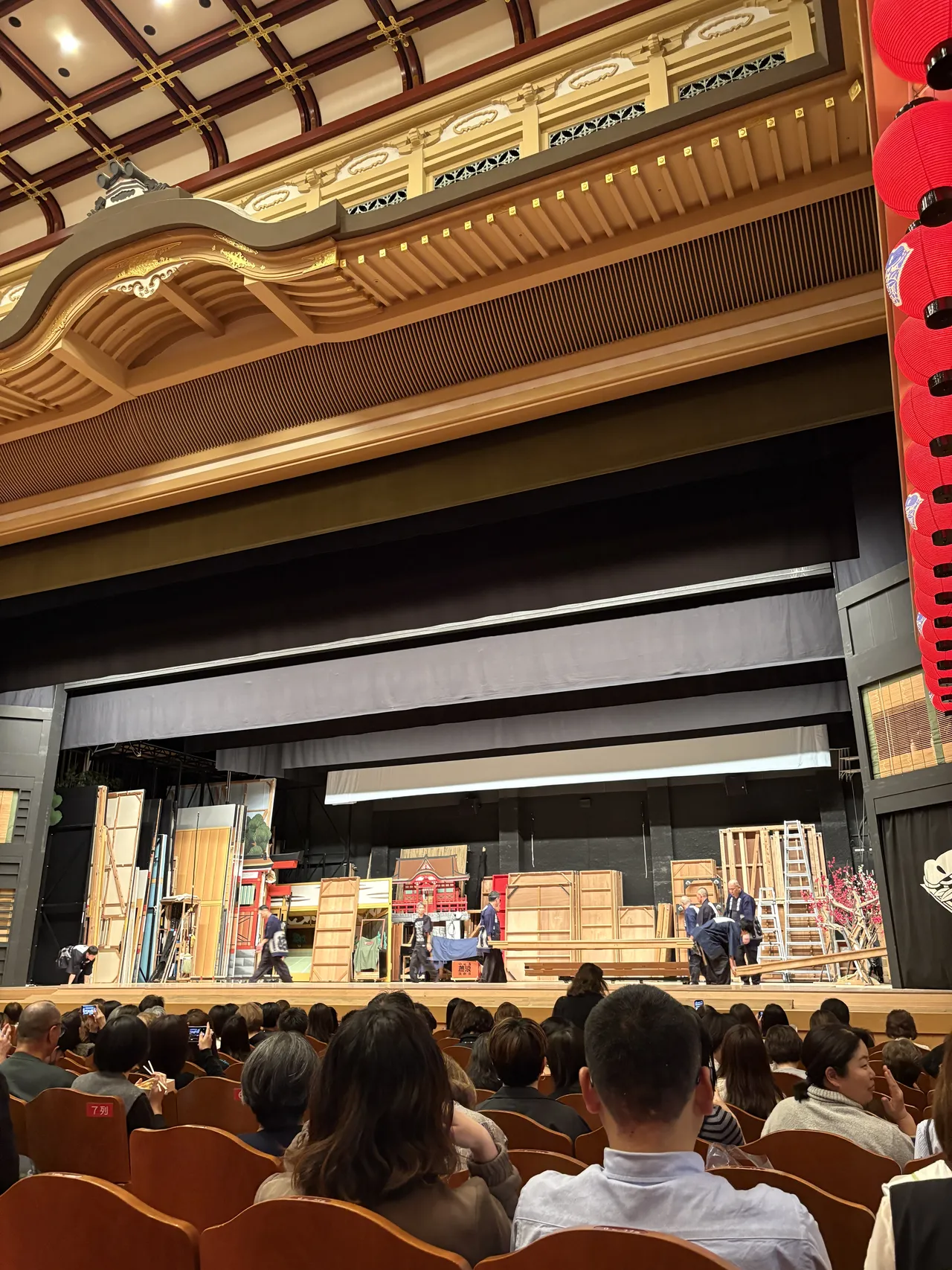
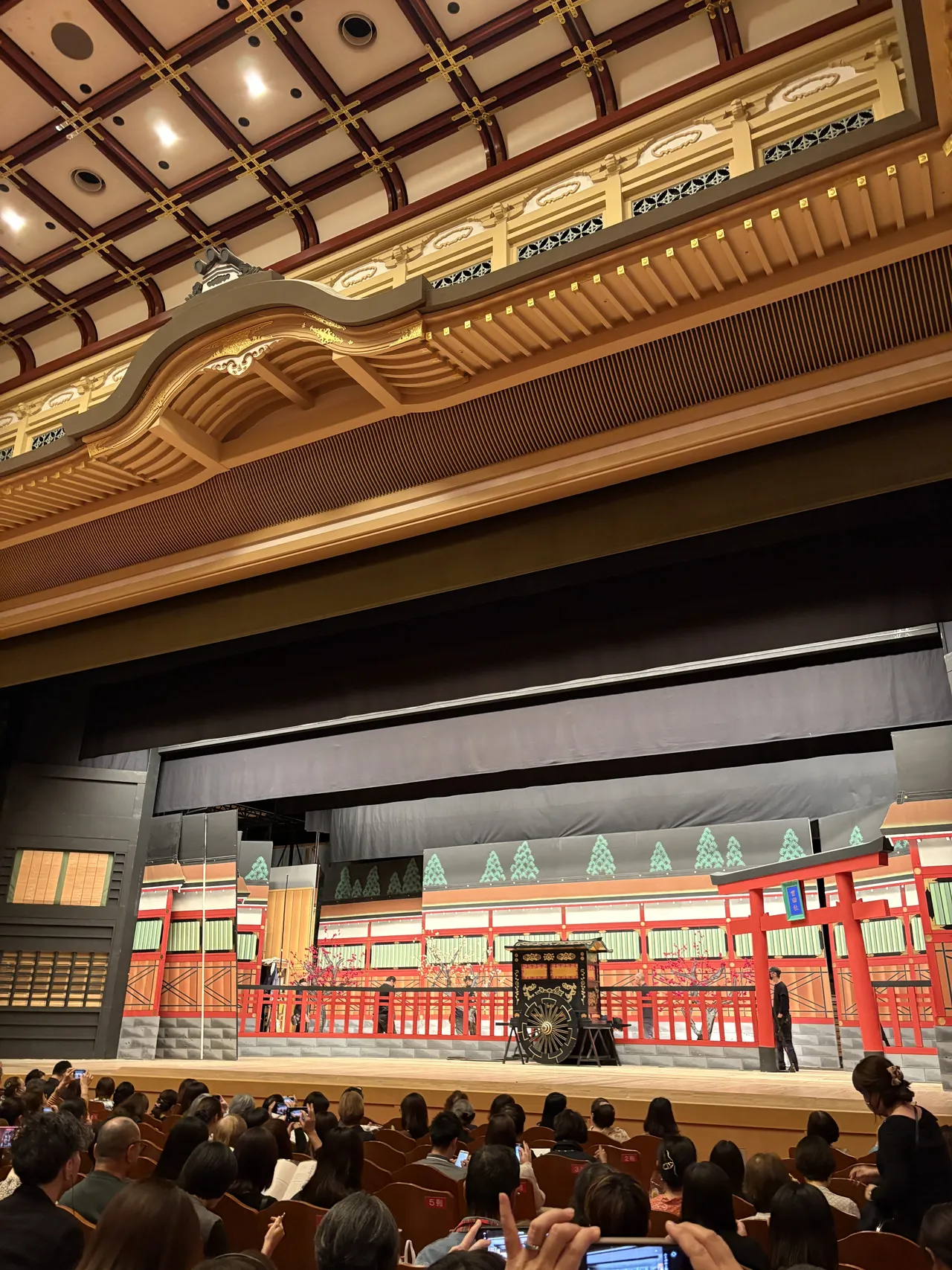
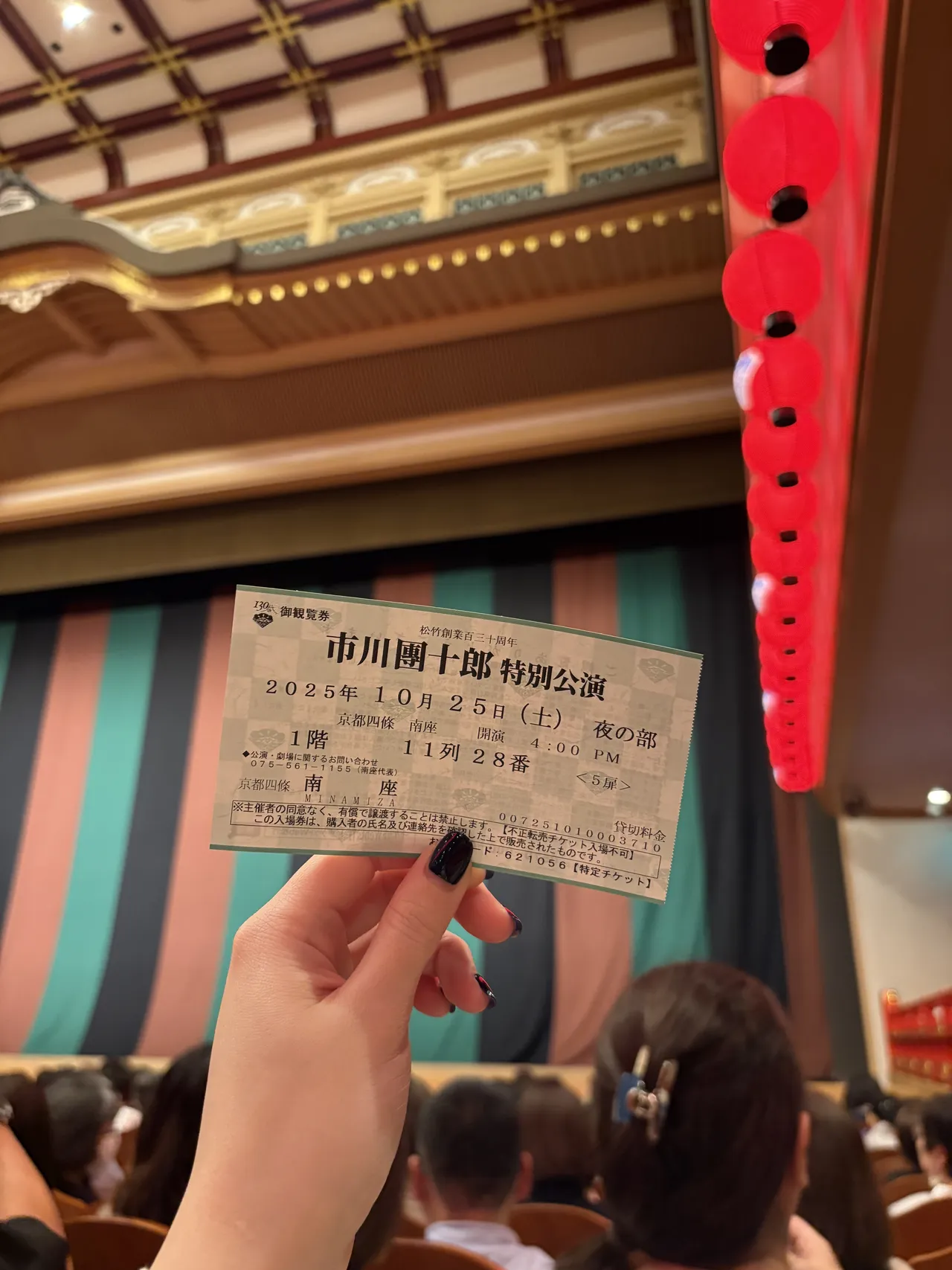
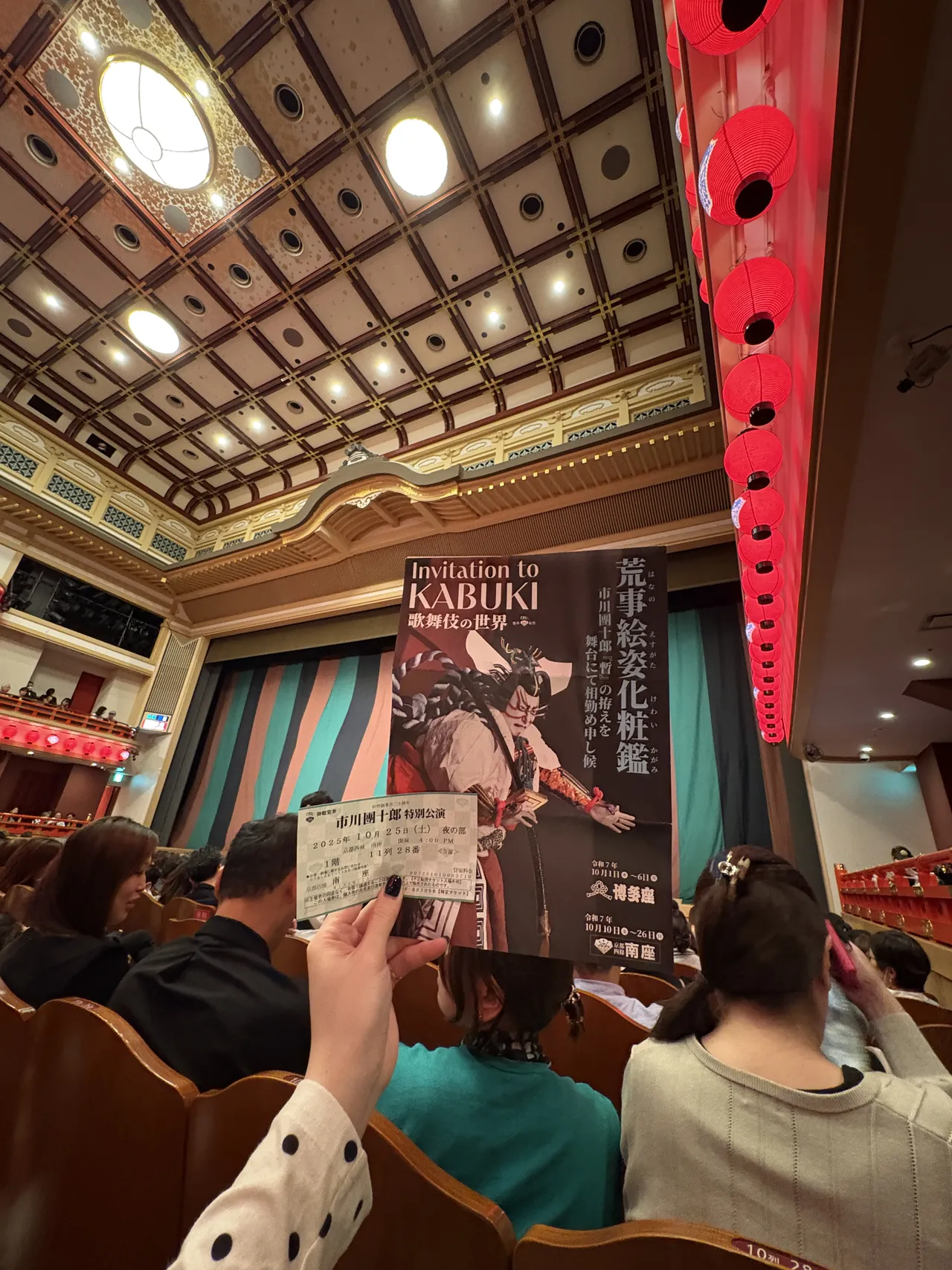
Photography of the stage during the performance is strictly prohibited. Photos of your seat, the lobby, the ceiling lanterns when the lights are on, and the printed program are fine.
The English Earphone Guide — Why It Matters
If you do not speak Japanese, the audio guide is the difference between four hours of beautifully costumed mumbling and four hours of something you actually follow. It is a small wired earpiece (or wireless on newer days) that plays simultaneous English commentary — not a translation of every line, but explanations of plot, character relationships, what to look for in the next scene, and why the audience is shouting “Naritaya!” at certain moments. It costs ¥1,000, cash only, picked up at a counter in the main lobby before the show. They take a refundable deposit on top.
Important: it is described as “simplified” because the commentary is a synopsis, not a word-by-word translation. If you have studied kabuki before, you may find it light. If this is your first time, it is essential.
2026 Performance Calendar
Minamiza is not a daily theatre — it runs roughly six to eight programs a year, each lasting two to three weeks. The two confirmed runs for 2026 so far:
The May 2026 Kabuki for Beginners program is the easiest entry point if you are new to it — shorter run-time, all seats at ¥4,000, designed for international and first-time audiences with extra context built into the program itself.
Ticket Pricing & Where to Sit
Where I sat: 1F-Row 11-Seat 28. About two-thirds back, slightly stage-right. Comfortable distance, good sound, and you can still see the makeup detail when actors approach the hanamichi. If you are willing to spend ¥12,000 once, sit here.
Tickets are sold on the official Shōchiku ticket website (English available), at convenience-store machines (Lawson, 7-Eleven), or at the Minamiza box office for any unsold seats. Buy two to three months ahead for December’s Kaomise, two to three weeks ahead for the rest. Same-day rush tickets are not a thing here unlike at Tokyo’s Kabukiza.
Where to Stay Around Minamiza
The whole point of seeing kabuki at Minamiza is the location. Stay within a 10-minute walk and you can take a bath at your hotel between intermissions if you really want to. The cluster of hotels in Higashiyama-ku south of Shijō Street is the prime zone — close to Yasaka, Gion, the Kamogawa river, and walkable to Kiyomizu in the morning.
Find a hotel within walking distance
Booking has the widest selection of mainstream hotels in Higashiyama-ku and Pontochō. Rakuten Travel has the better inventory for traditional machiya townhouses and small ryokan inside Gion that international platforms underrepresent.
Where to Eat Before & After the Show
You can eat inside Minamiza too — the second-floor restaurant Nadaman (a venerable Osaka kaiseki house) takes show-day reservations and you can eat between acts. There is also a counter selling Izutsu Yatsuhashi (Kyoto’s signature cinnamon mochi) and a Toraya cáfé for tea. Eating at your seat during intermission is officially encouraged.
Outside, within a five-minute walk:
Practical Tips
Map & Access
The theatre sits at the east end of Shijō Bridge, on the south side of Shijō Street. From Keihan Gion-Shijō station Exit 6, you walk up the stairs and the entrance is one minute on your right. From Hankyu Kyoto Kawaramachi Exit 1, three minutes east across the bridge. From Kyoto Station, taxi takes 12–15 minutes (~¥1,500) or bus 100/206 to Gion stop.
FAQ
Is Minamiza in Kyoto worth visiting if I do not speak Japanese?
Yes, but get the English earphone guide (¥1,000 at the lobby) before the show starts. Without it you will follow the visuals and music but miss the plot. With it, you will follow the story alongside everyone else. Better still, book the May 2026 Kabuki for Beginners run, which is built for international audiences with shorter program length and extra context.
How long is a kabuki performance at Minamiza?
Standard programs run 3.5 to 4.5 hours including two intermissions of 25 to 30 minutes each. The May beginners program is shorter at about 2 hours.
Can I get same-day or makumi (single-act) tickets at Minamiza?
Minamiza does not regularly sell single-act makumi tickets the way Tokyo’s Kabukiza does. Same-day unsold seats are released at the box office on the morning of the show, but availability is unpredictable. Better to book in advance via the Shōchiku ticket site.
What month is the best time to see kabuki at Minamiza?
December’s Kaomise is the most prestigious — all top actors, the lobby gets the giant maneki sign-boards with each star’s name in calligraphy. But it sells out fastest. March, May, and September are all excellent and easier to get into. The May beginners run is the best entry point.
How early should I arrive at Minamiza?
Twenty minutes before showtime at minimum. The lobby is part of the experience — the maneki signboards, the souvenir counters, the printed programs (worth buying for ¥1,500). Arrive 30 to 40 minutes ahead if you want to look around and get the audio guide without queuing.
Is Minamiza accessible for wheelchair users?
The 2018 reconstruction added an elevator and wheelchair-accessible seating on 1F. Notify the box office when booking and request the accessible row. Toilets on 1F and B1 are barrier-free.
What is the difference between Minamiza and Kabukiza in Tokyo?
Kabukiza in Ginza is bigger (about 1,800 seats vs Minamiza’s 1,000), runs daily, and has a much wider makumi single-act program. Minamiza is smaller, runs only six to eight programs a year, and has the historical claim — kabuki was born about 50 meters from where the building stands. Both are worth seeing for different reasons.
Final Thoughts
Walking out of Minamiza after the Danjurō show, the bridge was wet from a light rain and the lanterns of the theatre were reflecting in the puddles on Shijō Street. The audience around me was a complete mix — older Kyoto regulars in formal wear, a few foreign visitors who had clearly used the audio guide, school kids on a class trip. That mix is the point. Kabuki here has not become a museum exhibit. People still come because the show is good, not because it is a heritage building.
If you only go to one kabuki performance in your life, see it here. It is smaller, older, and quieter than Tokyo’s Kabukiza, and the bridge outside has been the front of a kabuki theatre for 400 years. Get the ¥1,000 audio guide. Sit on the 1F. Eat the Yatsuhashi between acts.
Booking the Trip
Three doors into a Minamiza visit. Book the hotel first — Higashiyama sells out fastest for cherry blossom and autumn weeks.
Join 1,000+ travelers discovering Japan's hidden side
Weekly dispatches from off-the-beaten-path Japan — spots and stories you won't find in guidebooks.
No spam. Unsubscribe anytime.
Welcome aboard!
You're in. See you in your inbox soon.