

Japan · June 2026 · Festival & Travel Calendar
Japan in June 2026: a day-by-day calendar of hydrangeas, fireflies, and the only month with no public holiday.
June is the only month in the Japanese calendar without a public holiday. The rains arrive across most of the country in the first week, hydrangea hits its peak in the second, and Tokyo’s grandest biennial festival fills the streets in mid-month. Done right, June is one of the cheapest, calmest, most quietly beautiful weeks of the entire year. Done wrong, you spend it inside watching the radar. Below is the calendar I use to do it right.
Weather
22°C avg Tokyo
17°C Sapporo · 27°C Naha
Crowds
Low
Cheapest tourist month after May 11–25
Costs
Low
Hotels 25–35% off vs March/April peak
Best for
Hydrangea & Sanno Matsuri
2026 is a Hon-Matsuri year for Hie Shrine
Tsuyu (rainy season) reality check first
Before the calendar: the rainy season starts during June across most of the country. The phrase mistranslates badly into English — tsuyu does not mean it rains all day every day, it means the daily probability of rain is high and the air is humid. Tokyo records around 10–14 wet days out of 30 in June, mostly as morning showers or evening downpours rather than full-day rain. A single travel day usually offers one solid sightseeing window and one indoor window if you watch the radar in the morning.
Tokyo daily rain probability, June 2026 (climatological reference)
Approximate climatological probability based on JMA Tokyo rainfall records. Real day-to-day forecasts shift with year-specific weather patterns — check JMA’s page or Yahoo! Weather Japan two days before any specific date.
Read the gauge as planning information, not a forecast. The pattern across years: dry first week, peak rain mid-month, slight relief late in the month before tsuyu fully ends in mid-July. Hokkaido is the only major region without a tsuyu season, which makes early June the best window of the year for travel north of the Tsugaru Strait.
The June 2026 calendar at a glance
Confirmed festival and event slots, plus the days that simply matter (summer solstice, Father’s Day, Sanno Matsuri main parade). Region codes: TOK=Tokyo, NAG=Nagoya, SAP=Sapporo, KMK=Kamakura/Kanagawa, HKN=Hakone.
The month in five weeks
June has more variation week-to-week than people give it credit for. The first week is sometimes still pre-rainy-season; the third week is the peak of both Sanno Matsuri and the rains; late June is hydrangea last-call.
Week 1
Jun 1 – 7
Pre-tsuyu window
Last clear week before the rainy season. YOSAKOI Soran in Sapporo. Atsuta in Nagoya. Sanno opens in Tokyo on Sun the 7th.
Week 2
Jun 8 – 14
Tsuyu hits + festivals
Rainy season starts across most of Honshu. Sanno parades continue. Hotaru viewing begins in Tokyo’s western suburbs.
Week 3
Jun 15 – 21
The biggest week
Sanno Matsuri Grand Parade Jun 15. Kamakura ajisai peak. Father’s Day + summer solstice both fall on Sunday Jun 21.
Week 4
Jun 22 – 28
Late hydrangea + hotaru
Kansai temples (Mimuroto-ji, Yoshimine-dera) hit peak. Firefly festivals across Tokyo’s western suburbs.
Week 5
Jun 29 – 30
Nagoshi-no-Harae
Many shrines hold the chinowa-kuguri purification ring on Jun 30 — a quiet, photogenic Shinto ritual most travellers never see.
Five festivals worth flying in for
If you’re building a trip around a specific event, these are the heavy hitters. Sanno is the headline because 2026 is a Hon-Matsuri year — the full festival is held only in even-numbered years.
Sanno Matsuri
山王祭 — Hie Shrine’s grand festival
One of Tokyo’s three great festivals, held at full scale only in even-numbered years — 2026 is a Hon-Matsuri year. The Shinkō-sai Grand Parade on June 15 starts at Hie Shrine in Akasaka and processes through 8 km of central Tokyo with around 500 people in Heian-period costume, mikoshi, and oxen-drawn carts. Lineage traces to the Edo period when the Tokugawa shoguns came to watch the parade enter the inner palace.
YOSAKOI Soran Festival
YOSAKOI ソーラン祭り — the energetic dance festival
300+ teams perform a fusion of soran-bushi folk songs and contemporary yosakoi choreography across Odori Park and Susukino. Costumes are loud, the energy is louder, and Sapporo is in early summer at its best (no tsuyu in Hokkaido). Combine with a side trip to Otaru or Furano for a long weekend.
Atsuta Matsuri
熱田祭 — Atsuta Shrine’s annual festival
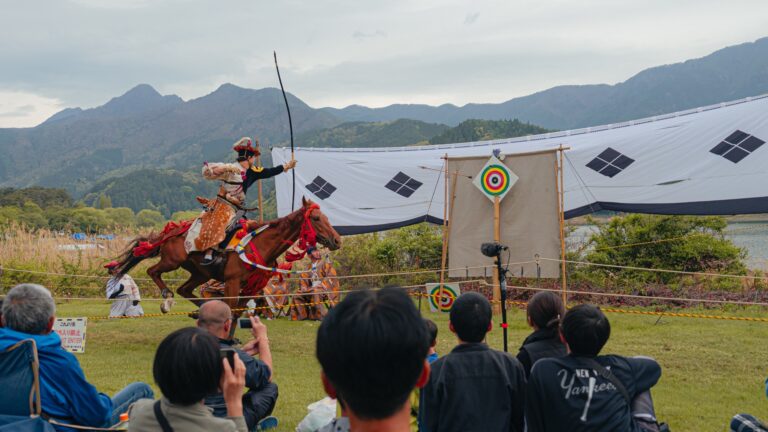
The largest annual festival of Nagoya’s most important shrine. Daytime: martial arts demonstrations, kyudo (archery), kemari (court football). Evening: 365 lanterns lit on three festival floats, fireworks over Jingu Park. Quieter than Sanno but earlier in the season — tsuyu hasn’t arrived in Tokai yet on June 5.
Nagoshi-no-Harae
夏越の祓 — the half-year purification
A roughly 1,300-year-old Shinto ritual held at most shrines on June 30. A large straw ring (chinowa) is set up at the entrance; visitors walk through it three times in a figure-eight to wash away the impurities of the first half of the year. Best at major shrines (Meiji Jingu, Hie, Kasuga Taisha) where the ceremony is formal — but visible at neighbourhood shrines too. Most travellers miss this entirely.
Hotaru (firefly) viewings
蛍観 — small evening events at clean rivers
Tokyo: Fussa, Akigawa, Mt Takao foothills. Kyoto: Kibune, Kurama, Saga-Arashiyama. Niigata: Yahiko. Numbers depend on rainfall and water cleanliness in the prior month. Arrive 30 minutes before sunset and stay until full dark for the best chance of seeing them — flash photography is forbidden at every official viewing site.
Where to see hydrangeas, peak by region
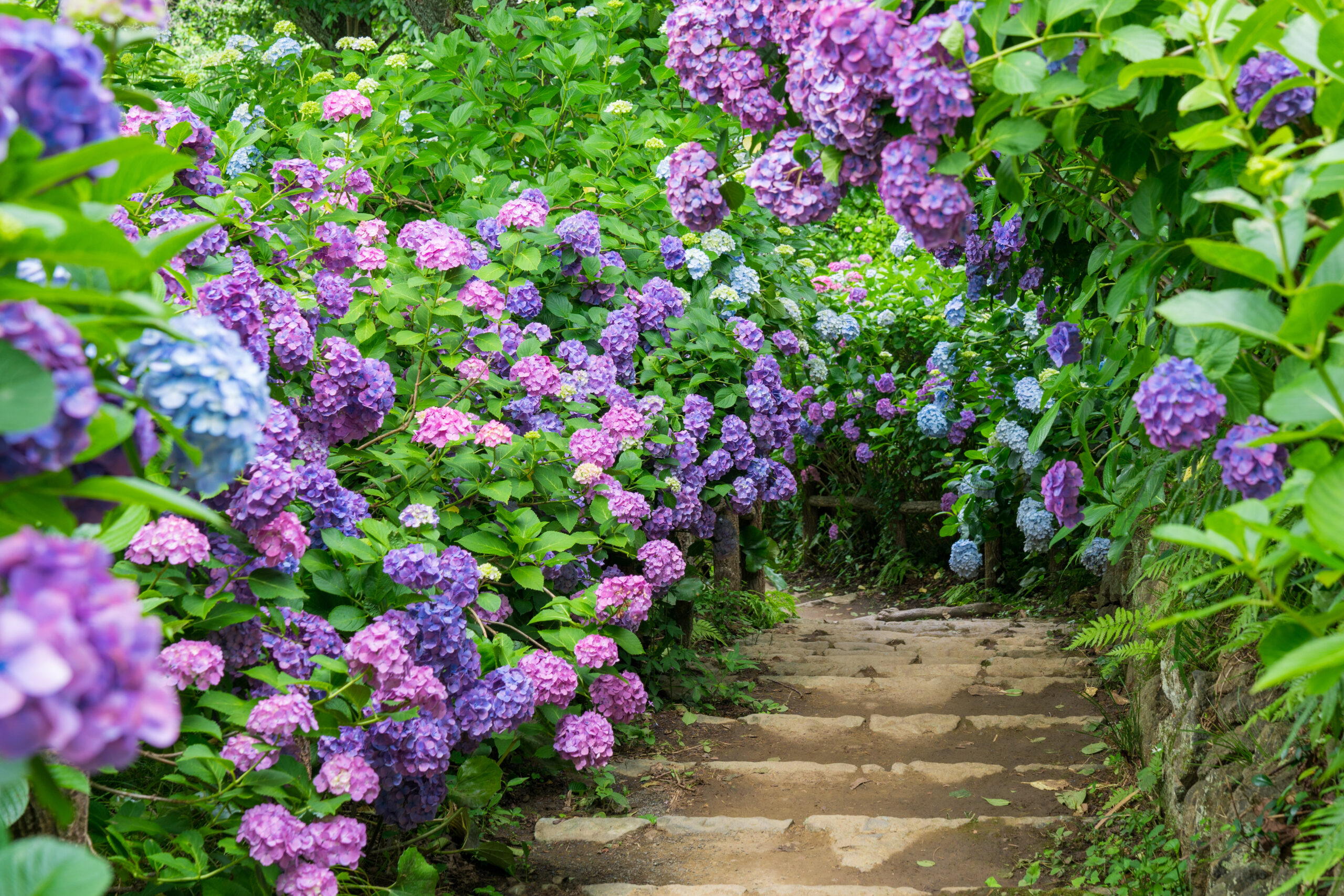
Hydrangea (ajisai 紫陽花) is to June what cherry blossom is to April. The bloom timing tracks the rain front almost exactly — the same humidity that makes tsuyu what it is also brings the flowers to peak.
Kanagawa
Meigetsu-in (Kamakura)
Peak: Jun 13–20
The Ajisai-dera. Around 2,500 plants, almost all Hime-ajisai variety in a single deep blue. Arrive at opening to avoid the queue.
Kanagawa
Hasedera (Kamakura)
Peak: Jun 13–20
Thousands of plants line the hillside path behind the main hall. More variety in colour than Meigetsu-in. Sea view from the top.
Kanagawa
Hakone Tozan Railway
Peak: Jun 15–Jul 5
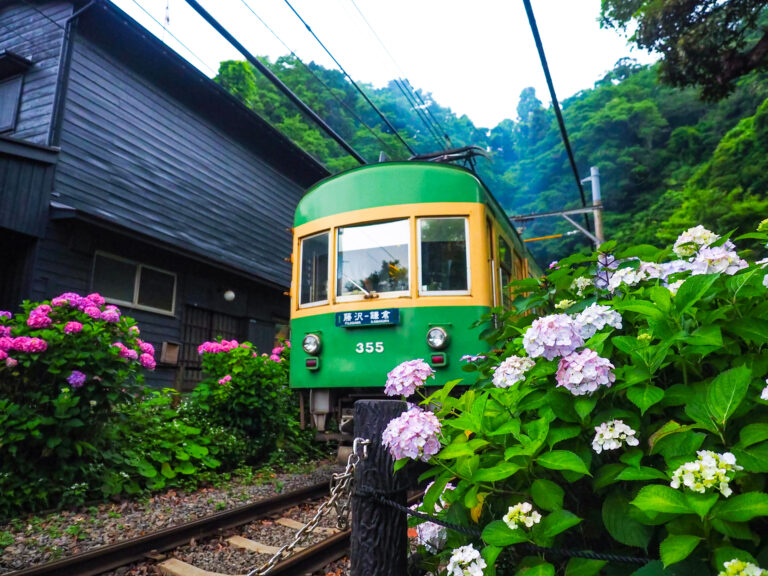
The mountain railway between Hakone-Yumoto and Gora is lined with hydrangeas. Special evening “Hydrangea Train” service in late June.
Kyoto
Mimuroto-ji (Uji)
Peak: Jun 15–Jul 7
The largest hydrangea collection in Kansai — around 10,000 plants on the temple’s terraced hillside. Less crowded than Kamakura’s main spots.
Tokyo
Hakusan Shrine (Bunkyo)
Peak: Jun 8–18
About 3,000 plants across the shrine and adjacent Hakusan Park. Festival weekend in mid-June with food stalls. Best Tokyo option.
Shizuoka
Shimoda Park (Izu)
Peak: Jun 5–15
The largest hydrangea garden by sheer count in Japan: roughly 150,000 plants on a hillside above Shimoda Bay. Pair with an Izu hot spring stay.
For a deeper look at hydrangea-tsuyu timing, the four sites Nobu has personally photographed, and indoor backup plans for when the rain becomes serious, see the dedicated Japan Tsuyu 2026 guide.
Where to be, region by region
Tokyo & Kanto
The strongest June region. Sanno Matsuri at Hie Shrine (mid-month), Hakusan Shrine hydrangea, the iris garden at Meiji Jingu (Imperial-era plantings, peak around June 5–15), and easy day trips out to Kamakura for Meigetsu-in and Hasedera. Hotel rates fall noticeably mid-month as Japanese domestic travel pauses for the rain. Use this.
Kyoto & Kansai
Quieter than Kanto for events but stronger for late-June flowers. Mimuroto-ji in Uji is the headline hydrangea destination. Yoshimine-dera in west Kyoto and Muro-ji in eastern Nara peak slightly later than Kamakura because of elevation. The Kibune valley north of Kyoto is one of Japan’s best firefly viewings — book a kawadoko (river-bed dining) reservation late June for the combination.
Hokkaido
The only region with no tsuyu. Early June here is what late May feels like in Tokyo — clear, cool, and one of the best windows of the year for travel north. YOSAKOI Soran fills Sapporo June 4–7, lavender starts appearing in Furano late in the month, and the Daisetsuzan mountain range opens for hiking. Air-conditioning bills disappear — nights drop into the low teens.
Kyushu & Okinawa
Tsuyu arrives earliest in Okinawa (around mid-May) and ends earliest (around June 21). If you can land in Naha during the last week of June, the rains are usually ending and the islands are quietly into summer before the rest of Japan. Kyushu (Fukuoka, Kumamoto, Kagoshima) sits under tsuyu for most of June, but Yakushima rainforest is at its most impossibly green in this window — an underrated June trip.
Tohoku
Tsuyu arrives latest in Tohoku (around June 12–15). Early June is dry, cool, and quiet here — Hirosaki, Aomori, and the Oirase gorge are at their best. The Soma Nomaoi horseback samurai festival in Fukushima moved to late July in 2027 onwards but the local lead-up events run through June. Pair with the Sanriku coast for fresh sea urchin at peak season.
Why mid-June is statistically the best week (despite the rain)
The math against intuition: hotel rates in central Tokyo, Kyoto, and Osaka in mid-June run around 25–35% lower than April peak. Crowds at major sights are noticeably thinner. The two biggest weather-vulnerable activities — sakura viewing and beach trips — are out of season anyway, so a “rainy” trip in June isn’t replacing a sunny activity, it’s replacing a different kind of June activity. Hydrangea is at its absolute peak. Sanno Matsuri occurs only in even-numbered years, and 2026 is one of them. The cost of admission is one waterproof jacket and an attentive eye on the radar.
Practical: weather, packing, payment
Weather
Tokyo June average: 22°C high, 18°C low. Roughly 10–14 wet days out of 30. Humidity climbs to 75%+ by mid-month and stays there. Sapporo runs 22/14°C with no tsuyu. Naha runs 30/24°C and is essentially summer by mid-June.
Packing
- One genuinely waterproof jacket (Goretex or equivalent) with a hood
- Waterproof or water-resistant footwear — trainers with rubber outsoles work; avoid suede
- Two pairs of synthetic or wool socks
- One small folding umbrella; konbini sell ¥600 transparent umbrellas if you forget
- A merino base layer for Hokkaido or Tohoku — nights drop fast
- A Ziploc or dry bag for phone and passport during sudden showers
Payment & budget
June is one of the cheapest months of the Japanese tourism year. Hotel rates in Tokyo, Kyoto, and Osaka run 25–35% lower than April peak. Restaurant pricing is unaffected (it’s mostly a function of category, not season). Build a budget around the lower hotel rates — you can spend the savings on one good kaiseki meal or a Hakone ryokan night without going over your April-trip budget. For payment mechanics see our Japan Cash vs Card guide.
FAQ
Should I avoid Japan in June because of the rain?
No, unless you are specifically chasing wide-open mountain scenery (Hokkaido excepted) or beach holidays (Okinawa from late June onwards is fine). For city sightseeing, temples, food, hot springs, festivals, and any cultural travel, June is one of the cheapest, calmest, most rewarding months of the year. The trade-off is humidity, not relentless rain.
Is Sanno Matsuri actually in 2026?
Yes. Sanno Matsuri runs at full scale only in even-numbered years, and 2026 is one. The festival period runs roughly June 7–17 with the main Shinkō-sai Grand Parade on Sunday June 15. The 2027 festival will be a smaller “Kage-Matsuri” without the parade.
When exactly does the rainy season start?
JMA’s 1991–2020 normal puts tsuyu onset at around June 7 in Kanto/Tokyo, June 6 in Kansai/Tokai, June 4 in Kyushu, and June 12–15 in Tohoku. Hokkaido has no tsuyu season at all. The dates shift ±7 days year to year — JMA’s official onset announcement comes out about a week after the rains actually start.
Which week in June is the cheapest for hotels?
Roughly Jun 18–25 in central Tokyo, Kyoto, and Osaka — after the Sanno Matsuri tourism bump and before the early-summer school-trip rush. Mid-month (Jun 8–14) is also strong on price but slightly more expensive in Tokyo because of Sanno. Hokkaido is opposite — Jun 1–7 is the YOSAKOI peak and rates climb.
What about typhoons in June?
Possible but uncommon. JMA’s 1991–2020 normal shows around 1.7 tropical cyclones forming in the Northwest Pacific in June, with most still tracking away from Japan. Direct hits on the main islands in June are roughly one every two to three years — a real but small risk. For a deeper look see our Japan typhoon season 2026 guide.
The cheapest, quietest week to be in Tokyo this year is Jun 18–25.
Sanno Matsuri is over, the school-trip rush hasn’t started, hydrangea is still in bloom in Kamakura, and hotel rates are at their annual low. Plan around it, and June stops being a rainy-season compromise — it becomes the best-value travel window of the calendar.
Tsuyu deep-dive guide Full year festival calendarJoin 1,000+ travelers discovering Japan's hidden side
Weekly dispatches from off-the-beaten-path Japan — spots and stories you won't find in guidebooks.
No spam. Unsubscribe anytime.
Welcome aboard!
You're in. See you in your inbox soon.