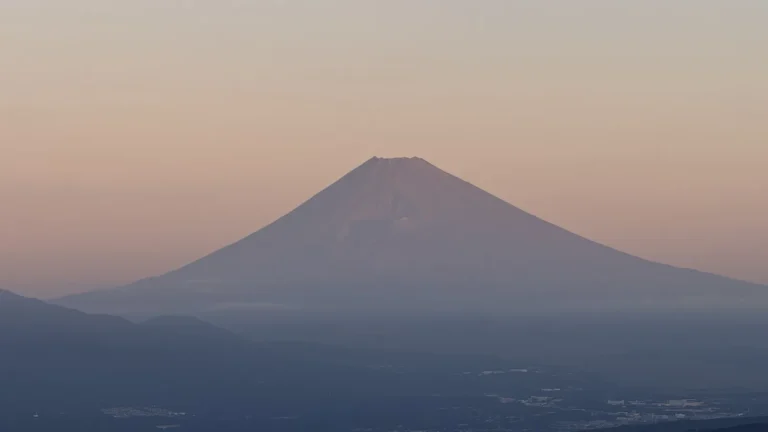
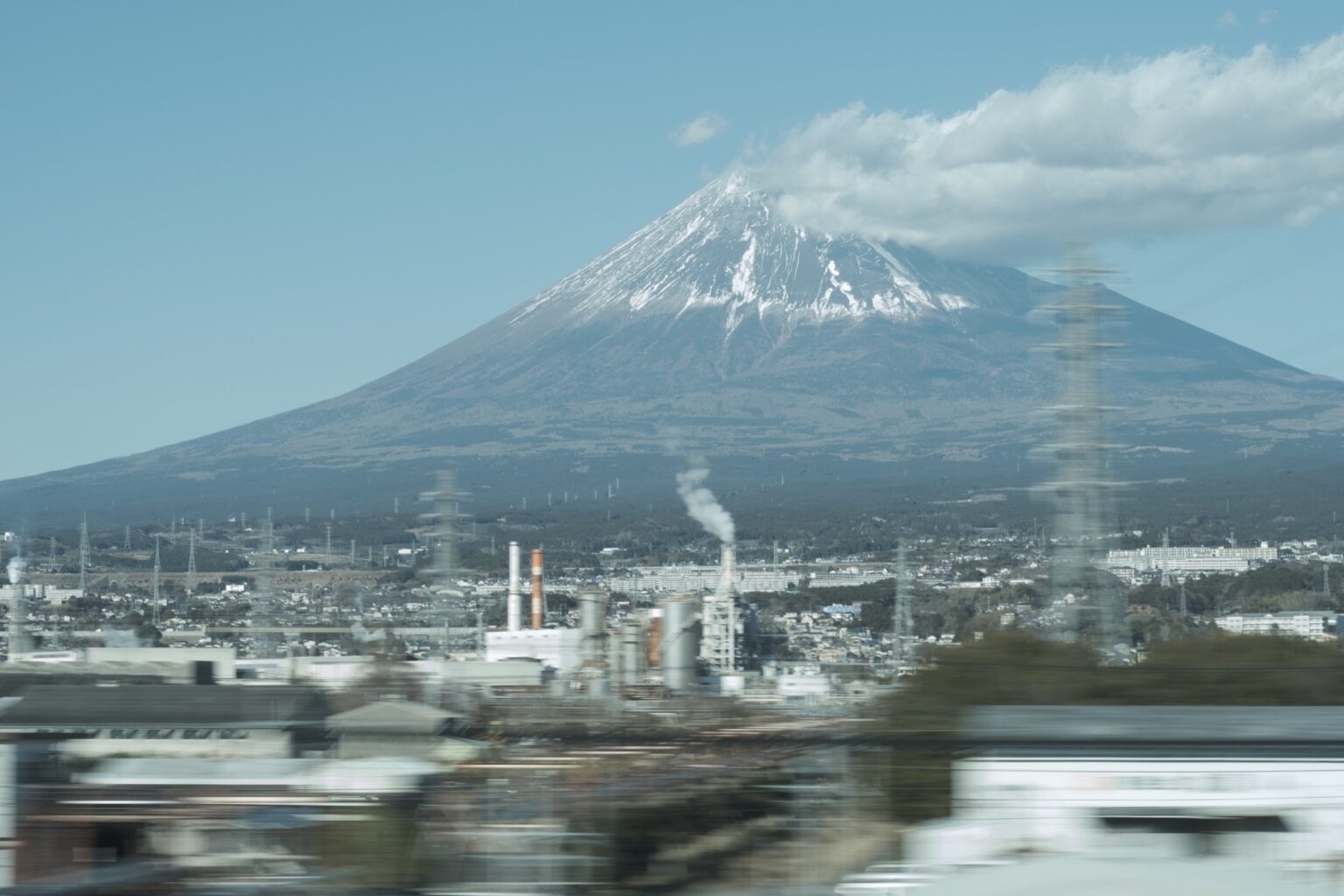
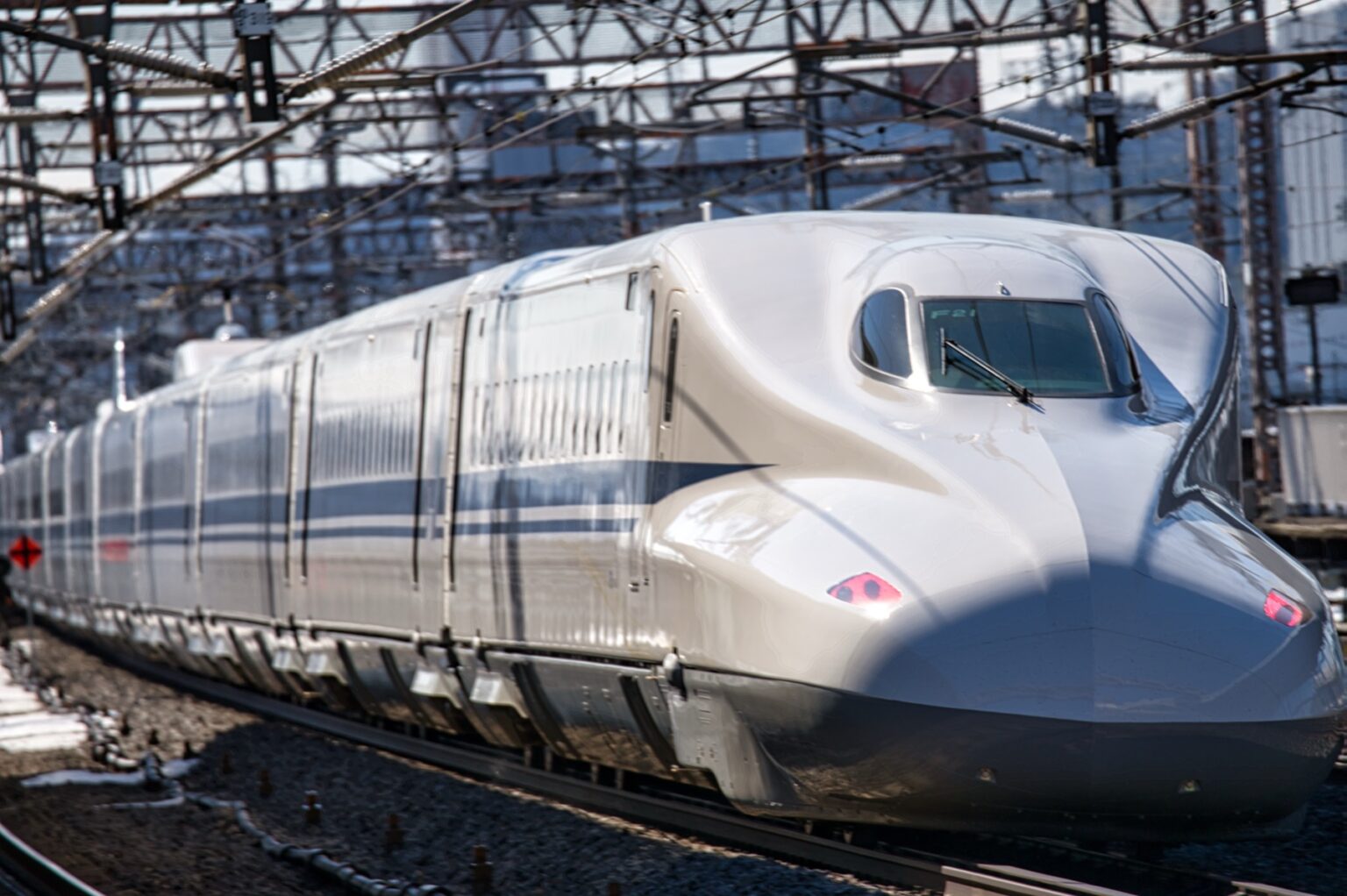
On the Tokaido Shinkansen, Seat E is on the Mt. Fuji side in both directions. Tokyo to Osaka, Mt. Fuji is on your right — and Seat E is the right-side window. Osaka to Tokyo, Mt. Fuji is on your left — and Seat E is now the left-side window. Same physical seat, same mountain, because Shinkansen trains do not turn around. Green Car passengers want Seat D. Views come and go between buildings and tunnels, and JR Central’s tour arm picks out about three minutes around Shin-Fuji as the best moment for photos, so the seat decision matters more than the timing.
The one-line answer
Book Seat E in a standard car, or Seat D in a Green Car. Same letter, both directions.
The seat letter is fixed to the train. The mountain doesn’t move. Travel direction reverses, but the geometry stays.
Part of the full Mt. Fuji travel guide.
Why Seat E works in both directions
The Tokaido Shinkansen runs roughly east–west between Tokyo and Shin-Osaka. Mt. Fuji sits on the north side of the line — specifically, just north of the Mishima–Shizuoka stretch. The train doesn’t physically flip when it reverses direction. So whichever physical side of the train is north stays the north side, regardless of which way the carriage is moving.
In a standard car (3+2 seating), the letters from left to right when facing the Shin-Osaka direction are A · B · C · aisle · D · E (facing Tokyo, E · D · aisle · C · B · A). Seat E sits against the north-facing window. That side of the train is the Mt. Fuji side for almost the whole route.
Standard car (普通車) — seat E is Fuji-side for the main viewing sections
Tokyo → Shin-Osaka
Shin-Osaka → Tokyo
Same seat letter. Same mountain. Different relative side because the train’s direction of travel reversed, while the physical train (and the mountain) stayed in place.
Three things people confuse
- Seat A is not the Mt. Fuji side. Seat A faces the Pacific Ocean and the Izu Peninsula — the south side of the train. There is one short exception between Shizuoka and Kakegawa (covered below), but otherwise A is the wrong side for Fuji.
- Green Car is different. Green Car uses 2+2 seating, so the layout is A · B · aisle · C · D. Seat D is the Fuji-side window in Green Car.
- The seat letter doesn’t change between Nozomi, Hikari, and Kodama. Same convention across all three. The only choice that matters is the seat letter — the rest is about how much time you get past the mountain.
Where exactly Mt. Fuji appears on the route
There are two prime stretches, plus one less-known section where the south-side A seats briefly get a look.
| Section | Seat | Quality |
|---|---|---|
| Shin-Yokohama → Odawara | Seat E | Distant; cap visible on very clear days |
| Mishima → Shin-Fuji | Seat E | Peak — closest approach, full mountain visible |
| Shin-Fuji → Shizuoka (Fujikawa bridge) | Seat E | Peak — bridge crosses Fuji River, mountain framed |
| Shizuoka – Kakegawa section | Seat A (either direction) | Possible “left Fuji” glimpse where the line runs north–south, on very clear days |
Elapsed times depend on the train and its stopping pattern — see the service-specific examples in the FAQ below.
The full viewing arc from Mishima to Shizuoka is roughly 35–50 km on the ground, which a Nozomi covers in about 10 minutes. Even on a clear day the view is intermittent — buildings, trees and tunnels cut in — and the framing matters: the iconic shot is the Fujikawa railway bridge, about 1.4 km long (1,373 m), with the mountain beyond the river; at around 270 km/h the crossing takes roughly 18 seconds.
Which train type — Nozomi, Hikari, or Kodama
The seat letter doesn’t change, but the time you have past Mt. Fuji does.
Nozomi (のぞみ)
Fine for casual viewing
The fastest service. Doesn’t stop at Shin-Fuji, so you blow past the closest approach at 270 km/h. You still get the views, just at full speed. Note that the nationwide JR Pass does not cover Nozomi on its own: holders need a separate Nozomi ticket bought before boarding (¥4,960 Tokyo–Shin-Osaka, one way).
Hikari (ひかり)
Covered by the JR Pass
Does not stop at Shin-Fuji — only the Kodama does — though some Hikari stop at Mishima or Shizuoka. Tokyo–Shin-Osaka takes about 3 hours, against about 2½ on a Nozomi, and the nationwide JR Pass covers it with no extra ticket.
Kodama (こだま)
Best for photos
Stops at every station including Shin-Fuji and Mishima. You can get off at Shin-Fuji and frame Mt. Fuji from the platform — from behind the safety line, following signs and staff. Tokyo–Shin-Osaka takes about 4 hours, roughly 90 minutes more than a Nozomi, but turns the journey into the photo trip.
The best season — and the cruelest one
The visibility statistics that decide whether your reserved Seat E delivers the postcard or just a wall of haze:
- December – February: Highest probability. Cold continental air is dry; the snow cap is full; the contrast between white peak and blue sky is sharpest. Per the City of Fuji’s 35-year 8 a.m. record (1991–2025), the mountain is at least partly visible on 85% of December mornings, and wholly visible on 62%.
- March – April: Snow cap still visible but air gets hazier. Visibility around 58–61% (36–41% for the whole mountain). Cherry blossom season brings travellers; not their best time for the Fuji shot.
- May: Snow line retreating. Visibility 51% of mornings (30% for the whole mountain). The mountain looks darker — patchy snow on bare rock.
- June – July: Tsuyu (rainy season) plus high humidity. Visibility drops to 25% in July (10% for the whole mountain). Even when “clear,” the air is opaque white. This is the worst time.
- August: Climbing season — Mt. Fuji is usually largely snow-free and reddish-brown. Visibility 36% (15% for the whole mountain). Better than July but still hard.
- September – October: The pivot. The first snow cap usually appears around early October (JMA’s average date for the first snow-cap sighting is 2 October). October typhoons clear the air dramatically when they pass.
- November: Snow cap re-forms. Air dries. Visibility climbs to 79% (54% for the whole mountain). The shoulder before the winter peak.
If you are choosing between a morning and an afternoon train: morning every time. Daytime heating tends to build cloud over the summit as the day goes on, sooner in summer. The mountain’s microclimate is brutal to afternoon photographers.
Photography from a 270 km/h window
Five things that actually work
- Lean forward to the glass. Eye to within 5 cm of the window. This eliminates reflections of the cabin lighting behind you.
- Shutter speed 1/1000 second or faster. At 270 km/h, anything slower than that produces motion blur on foreground elements. The mountain (kilometres away) stays sharp, but trackside elements smear.
- Burst mode on your phone. Most recent phones have a burst or similar mode (on newer iPhones you swipe the shutter button to the left; check your phone’s camera settings). You want several frames while the view is clear so you can throw out the ones with overhead wires or signal poles.
- Pre-aim before the bridge. Have your camera ready around Shin-Fuji and shoot whenever the river and mountain view opens.
- Go easy on zoom. Heavy digital zoom degrades quality and magnifies shake; an optical telephoto lens is fine. Wide is fine — Mt. Fuji is big enough in the frame at native focal length.
The Seat A exception
Generally, Seat A faces the Pacific Ocean. But JR Central notes that between Shizuoka and Kakegawa the line runs north–south in places, so A-side passengers may catch a “left Fuji” (hidari-Fuji) in either direction — only in good conditions, such as a clear winter day.
It is a bonus for people already on the wrong side who happen to be looking at the right moment. Don’t plan around it. Book Seat E.
Booking the right seat — practical notes
- Online seat selection via the JR Central smartEX app lets you pick the specific seat from a seat map — choose “E”. (The JR East Eki-net seat map does not cover the Tokaido Shinkansen.)
- JR Pass holders who bought the pass on the official JAPAN RAIL PASS Reservation site can book seats there; everyone else books at a reserved-seat ticket machine or a staffed ticket office (Midori-no-Madoguchi) after picking up the pass. When the agent confirms the seat letter, ask for “E (Fuji-side)” — they will understand.
- Unreserved cars (自由席) on the Tokaido Shinkansen are normally cars 1–2 on Nozomi and cars 1–5 on most Hikari (check your train). You can walk to the E-side window seats if available. At peak periods — in 2026 Golden Week, Obon, Silver Week, the Sports Day and Labour Thanksgiving holiday weekends, New Year and a few others — Nozomi turns cars 1–2 into reserved cars and has no unreserved seats at all.
- Last-minute: a reserved ticket is for your own seat, so don’t simply move to an empty E seat — if you want the Fuji side, change the reservation or ask the conductor.
- Private rooms: some N700S trains now carry a Supreme Class Cabin. The two JR Central pages we checked on 11 October 2026 do not say which side its window faces, so the seat advice on this page is for ordinary and Green Car seats only; prices and booking are in our Shinkansen private room guide.
FAQ
Which side of the Shinkansen is Mt. Fuji on?
Mt. Fuji is on the north side of the Tokaido Shinkansen track. Travelling Tokyo to Shin-Osaka, that’s the right side of the train. Travelling Shin-Osaka to Tokyo, it’s the left side. In both cases, Seat E (standard car) or Seat D (Green Car) is the window seat against the Mt. Fuji side.
How long can you see Mt. Fuji from the Shinkansen?
On a clear day you get views on and off between Shin-Yokohama and Odawara and, closest, between Mishima and Shin-Fuji; JR Central’s tour arm picks out about three minutes around Shin-Fuji as the best time for photos. Buildings, trees and tunnels interrupt the view, so expect several short framings rather than one long look.
How many minutes after Tokyo Station does Mt. Fuji appear?
On a clear day it can show as early as the Shin-Yokohama–Odawara stretch, so start watching after Shin-Yokohama. The main close view is between Mishima and Shin-Fuji — about 50 minutes and an hour from Tokyo on a Kodama, by JR Central’s figures, and sooner on faster trains.
From Shin-Osaka to Tokyo, when does Mt. Fuji appear?
It depends on the train. JR Central gives about 2 hours 50 minutes from Shin-Osaka to Shin-Fuji by Kodama, and about 1 hour 50 minutes to Shizuoka or 2 hours 10 minutes to Mishima on the Hikari that stop there; a Nozomi gets there sooner. Start watching around Shizuoka; views come and go until the train nears Atami.
Is the Mt. Fuji view visible from the Sanyo Shinkansen (Osaka to Hakata)?
No. The Sanyo Shinkansen runs from Shin-Osaka west toward Hiroshima, Kokura, and Hakata. Mt. Fuji is more than 350 km east of Shin-Osaka. The Mt. Fuji view is only on the Tokaido Shinkansen segment between Tokyo and Shin-Osaka.
Should I take the Nozomi, Hikari, or Kodama for the Mt. Fuji view?
The seat matters more than the train. Nozomi and Hikari both pass Shin-Fuji at speed — only the Kodama stops there. JR Pass holders can ride Hikari and Kodama on the pass alone but need an extra ticket for Nozomi. Kodama is the photo-trip choice if you want to actually get off at Shin-Fuji or Mishima for a longer look at the platform. For most travellers, the fastest train their ticket covers is fine — just book Seat E.
What if Mt. Fuji is hidden by cloud the day I take the train?
It happens. In the City of Fuji’s 35-year 8 a.m. record, the mountain is at least partly visible on only 25% of July mornings and 34% of June mornings (wholly visible on 10% and 12%). Check our Mt. Fuji visibility page the morning before your trip — it combines a JMA-based forecast with a verified photographic check from Fujiyoshida. Clear signals improve your odds but can’t guarantee a view from the train, which passes the mountain’s south side later in the day. If they disagree, the ride is still worthwhile — and the sea between Odawara and Atami is on the A side.
Sources used for this article
- JR Central official guide: 新幹線から富士山を見る座席 — recommend.jr-central.co.jp
- City of Fuji official 35-year visibility observation record (1991–2025) — City of Fuji
- Tokutabi Railway: 新幹線富士山ガイド (Japanese) — railway-toku.jp
- JR Pass blog: Mt. Fuji from the Shinkansen — jrpass.com
- Personal observation — multiple Tokaido Shinkansen runs 2024–2026, photographs in this article
Plan the journey — tickets and where to base
If catching Mt. Fuji from the window is on your list, three practical bookings:
Related: More special rides: our 2026 guide to JR’s sightseeing trains
Join travelers discovering Japan's hidden side
Weekly dispatches from off-the-beaten-path Japan — spots and stories you won't find in guidebooks.
No spam. Unsubscribe anytime.
Welcome aboard!
You're in. See you in your inbox soon.