
Mt. Fuji Sunrise 2026: Hour-by-Hour Goraiko Guide [9 Photos]
2026 Update: In 2026, the mandatory ¥4,000 entry fee applies to all trails, and strict gate closures (2:00 PM on the Yoshida Trail) mean you cannot climb overnight without a confirmed mountain hut reservation. Plan your sunrise timing based on your specific hut location.
Standing at 3,776 meters in the dark, surrounded by strangers who climbed through the night — and then the horizon cracks open in gold. Goraiko, the Mt. Fuji sunrise, is one of those experiences that changes how you see Japan. But timing it right, knowing exactly where to stand, and understanding the light phases from pre-dawn blue hour to the rare Shadow Fuji phenomenon — that separates a forgettable climb from a once-in-a-lifetime morning. I’m Nobutoshi from hiddenjapan-gems.com, and this is the hour-by-hour breakdown I wish I had before my first summit sunrise.
Table of Contents
Quick Facts
| Detail | Info |
| What | Goraiko (御来光) — sunrise viewed from Mt. Fuji’s summit |
| When | July 1 – September 10, 2026 (climbing season) |
| Sunrise time | 4:30 AM (early July) → 5:15 AM (late August) |
| Best months | Late July – early August for cloud sea; early September for clearest skies |
| Shadow Fuji | Visible 5–20 minutes after sunrise, facing west from summit |
| Entry fee | ¥4,000 mandatory (all trails, 2026) |
| Mountain hut wake-up | Typically 1:00–2:00 AM for summit push |
| Summit temperature | 0–5°C even in August; wind chill can push below freezing |
| Recommended trail | Yoshida Trail (most huts, best sunrise angle) |
| What to bring | Headlamp, warm layers, camera with charged battery, tripod (optional) |
What Is Goraiko? Understanding Mt. Fuji’s Sunrise Tradition
Goraiko (御来光) literally means “the arrival of light.” It’s not just any sunrise — it’s a spiritual event rooted in Shinto and Buddhist tradition, where watching the first light from Japan’s highest peak is believed to bring divine blessings for the year ahead.
Every summer, roughly 300,000 climbers attempt to reach the summit before dawn. The experience of watching the sun emerge from a sea of clouds at 3,776 meters — with the entire Kanto Plain invisible beneath you — is what makes the grueling overnight climb worth every step.
But goraiko is only part of the show. The full sunrise sequence at Mt. Fuji unfolds over roughly four hours, from the first glow on the eastern horizon to the dramatic appearance of Shadow Fuji on the western side. Most guides only mention the sunrise itself. This guide covers everything.
Sunrise Times by Month (2026 Season)
The exact minute matters when you’re deciding what time to leave the mountain hut.
| Date | Sunrise at Summit | Recommended departure from 8th station hut |
| July 1 | ~4:30 AM | 1:00 AM |
| July 15 | ~4:40 AM | 1:15 AM |
| August 1 | ~4:50 AM | 1:30 AM |
| August 15 | ~5:00 AM | 1:45 AM |
| August 30 | ~5:15 AM | 2:00 AM |
| September 10 | ~5:25 AM | 2:15 AM |
These times are approximate and shift by a few minutes depending on cloud cover and atmospheric conditions. The summit is high enough that you see the sun roughly 3–5 minutes before ground-level sunrise charts indicate.
Pro tip from Nobu: Don’t aim to arrive at sunrise. Arrive 20–30 minutes early. The pre-dawn color show — the blue hour transitioning to orange — is arguably more photogenic than the sunrise itself.
Hour-by-Hour: What the Sky Looks Like from 2:00 AM to 6:00 AM
This is the sequence I documented during my climb, and it’s consistent across mid-July to mid-August climbs.
2:00 AM – The Night City Lights
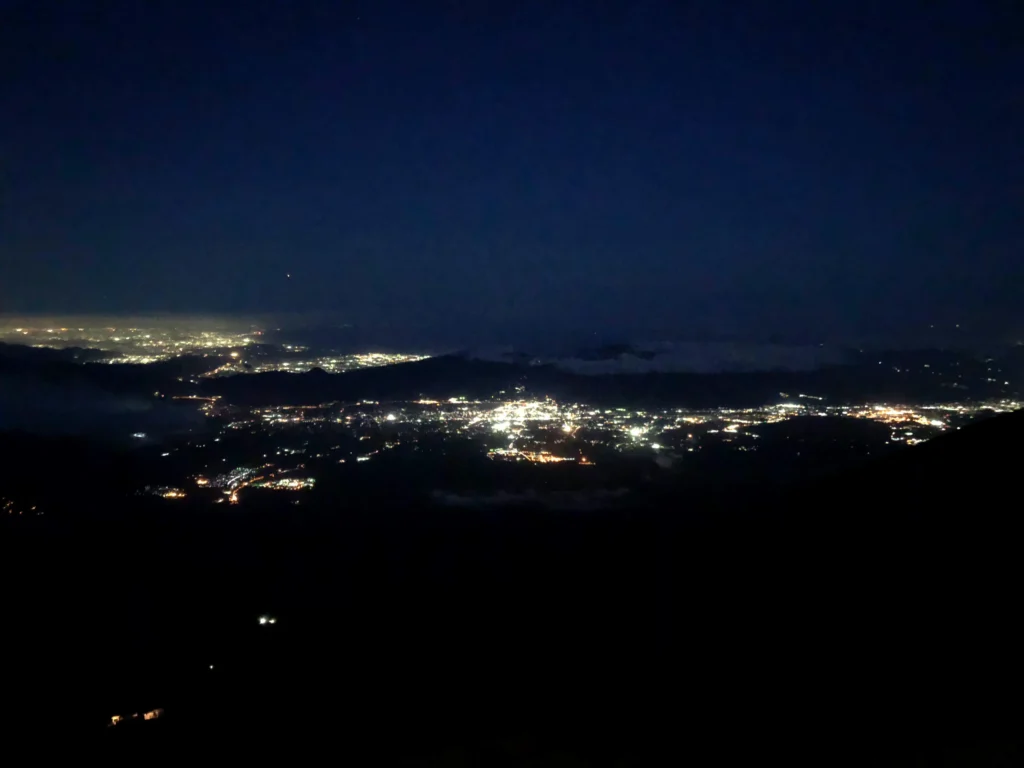
When you step out of the mountain hut into the freezing darkness, the first thing you notice isn’t the sky — it’s the ground below. The cities around Mt. Fuji — Fujiyoshida, Gotemba, and the Fuji Five Lakes area — glow like a circuit board. On clear nights, you can see the lights stretching all the way to the coast.
This is a view most climbers forget to photograph. They’re focused on getting to the top. But this is the only time you’ll ever see Japan’s lights from this altitude without being in an airplane.
3:30 AM – The First Glow (Twilight)
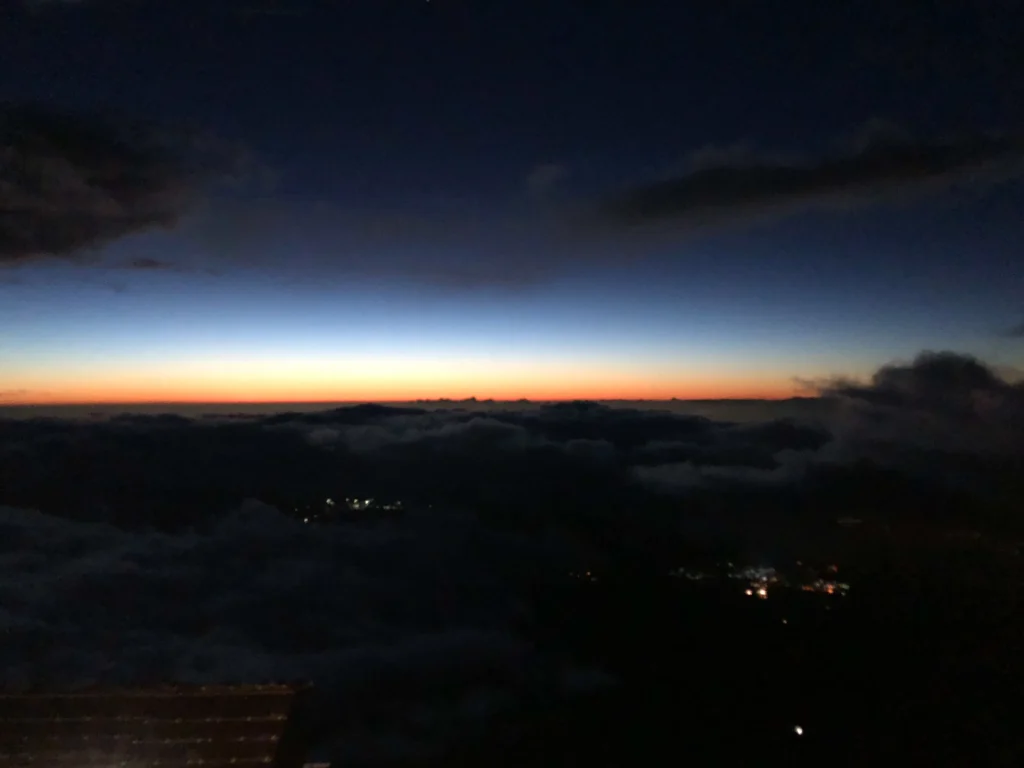
About 60–90 minutes before sunrise, the eastern horizon begins to shift. A thin band of warm orange appears beneath the deep navy sky. The clouds below catch this light from underneath, creating an effect that looks almost like a sunset in reverse.
At this point, you’re likely still climbing. The trail is lit by a chain of headlamps stretching above and below you. The temperature is at its lowest — often hovering around 0°C with wind chill.
4:00 AM – Blue Hour Above the Clouds
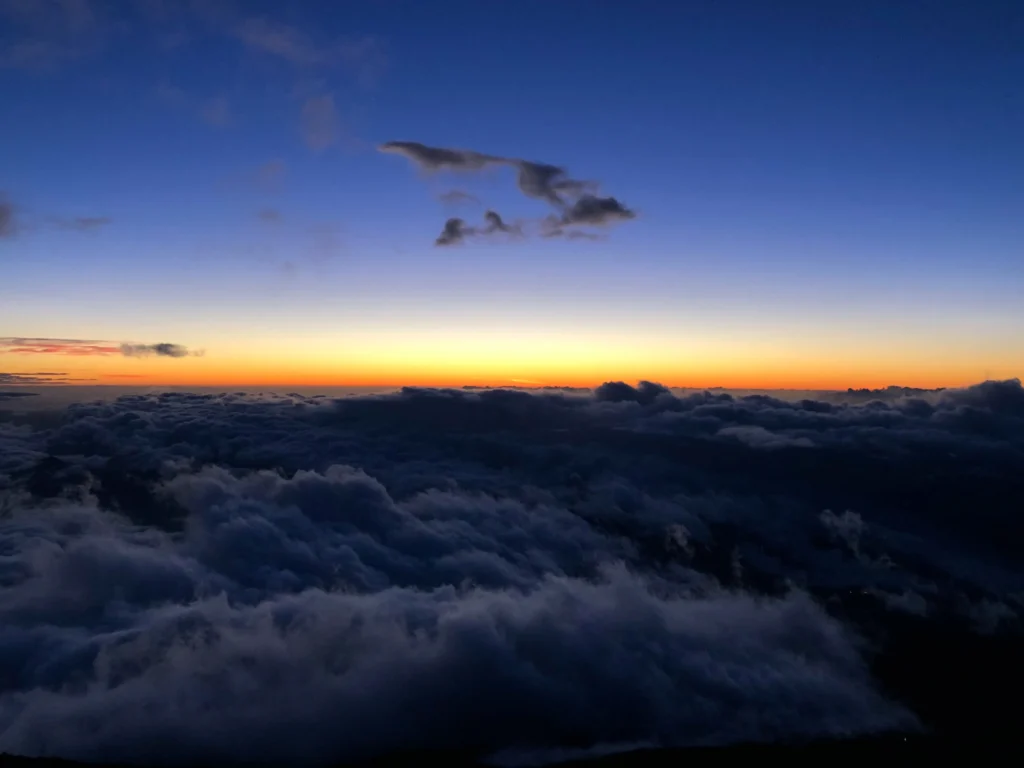
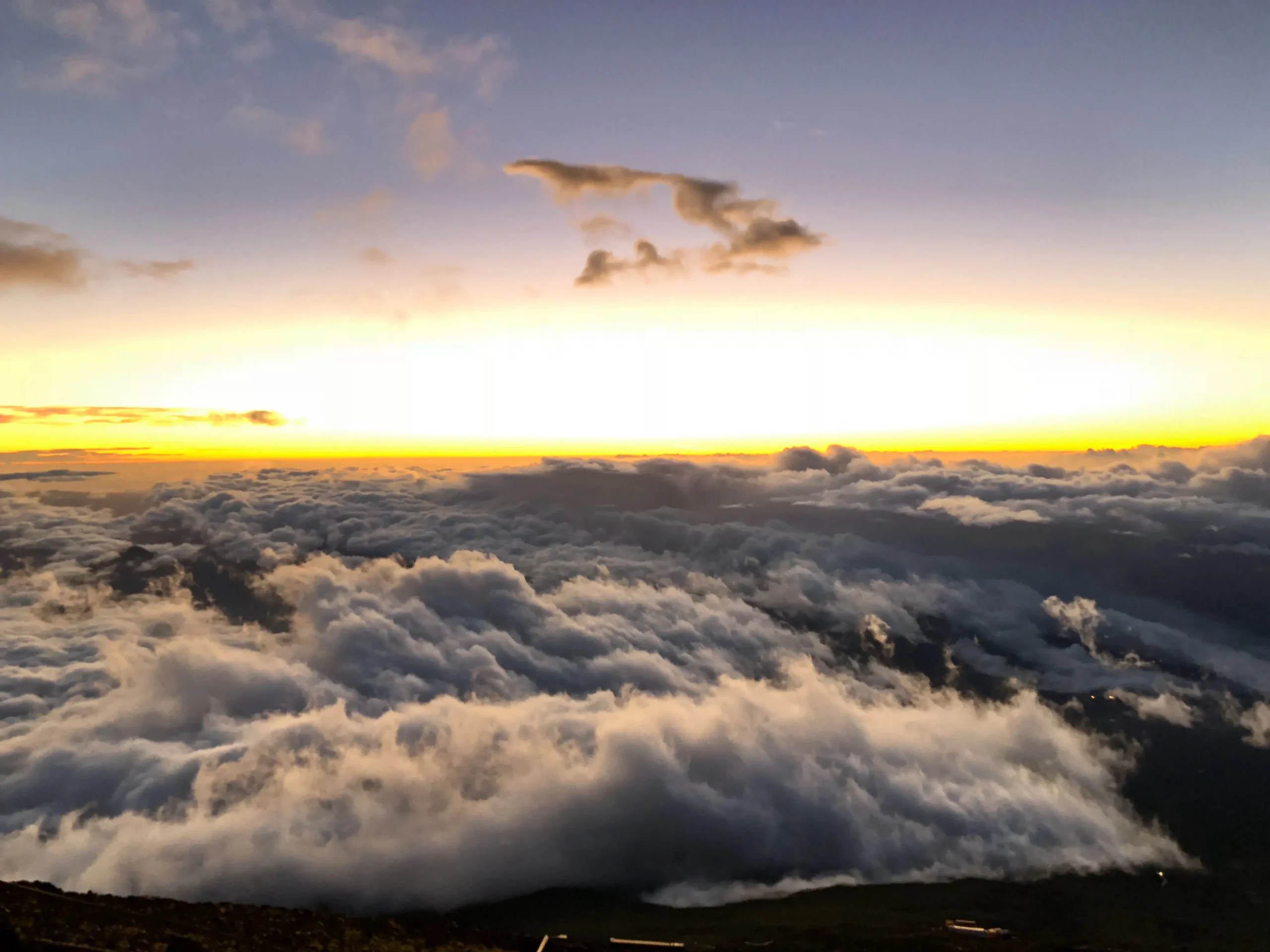
This is the moment photographers wait for. The sky transitions from deep blue to a gradient of cobalt, violet, and gold. The cloud sea below becomes visible as a vast white plain stretching to the horizon.
If you’re shooting photos, this is the time to set up. The light changes rapidly — every 2–3 minutes, the colors shift noticeably. Use manual exposure and bracket your shots.
4:20 AM – Golden Hour Begins
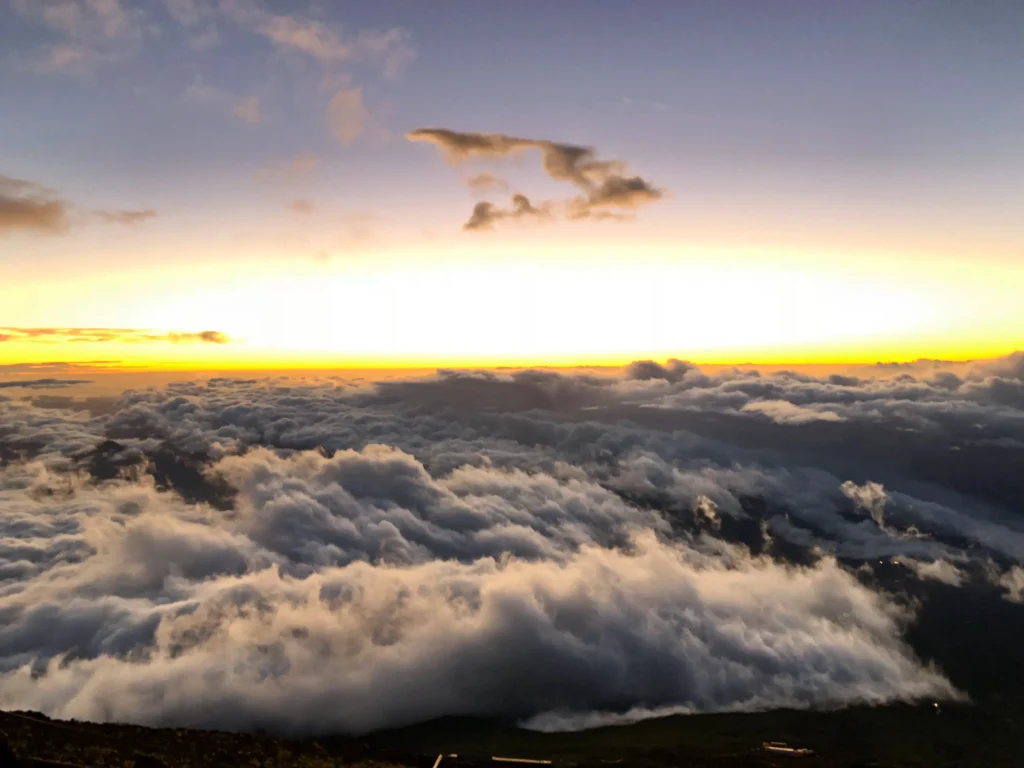
The orange band on the horizon expands. The clouds below begin to glow golden from the edges. You can start to see the outlines of other mountain ranges — the Southern Alps, Hakone — emerging from the cloud layer like islands.
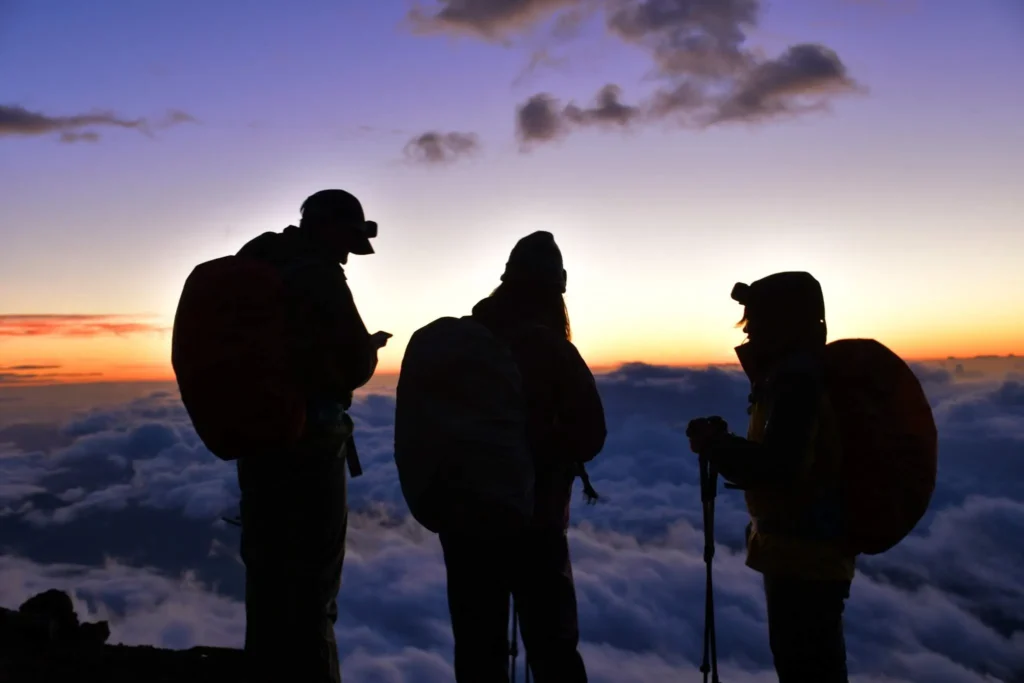
The crowd at the summit is now packed. Everyone is facing east, cameras and phones raised. There’s a collective quiet that falls over the group. Strangers stand shoulder to shoulder.
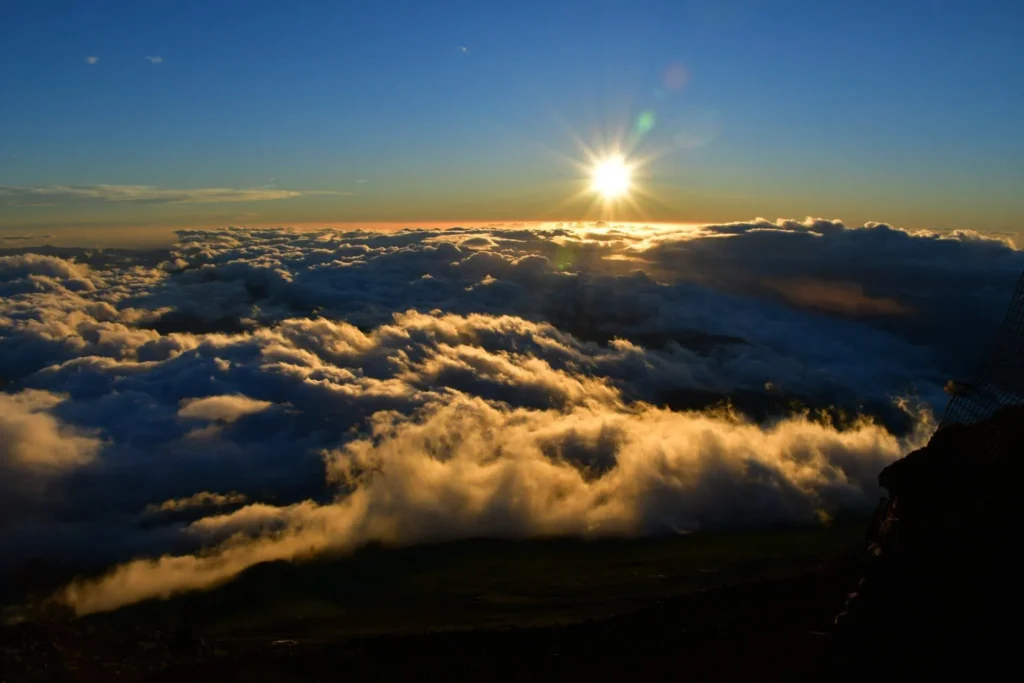
4:30–4:50 AM – Goraiko (The Sunrise)
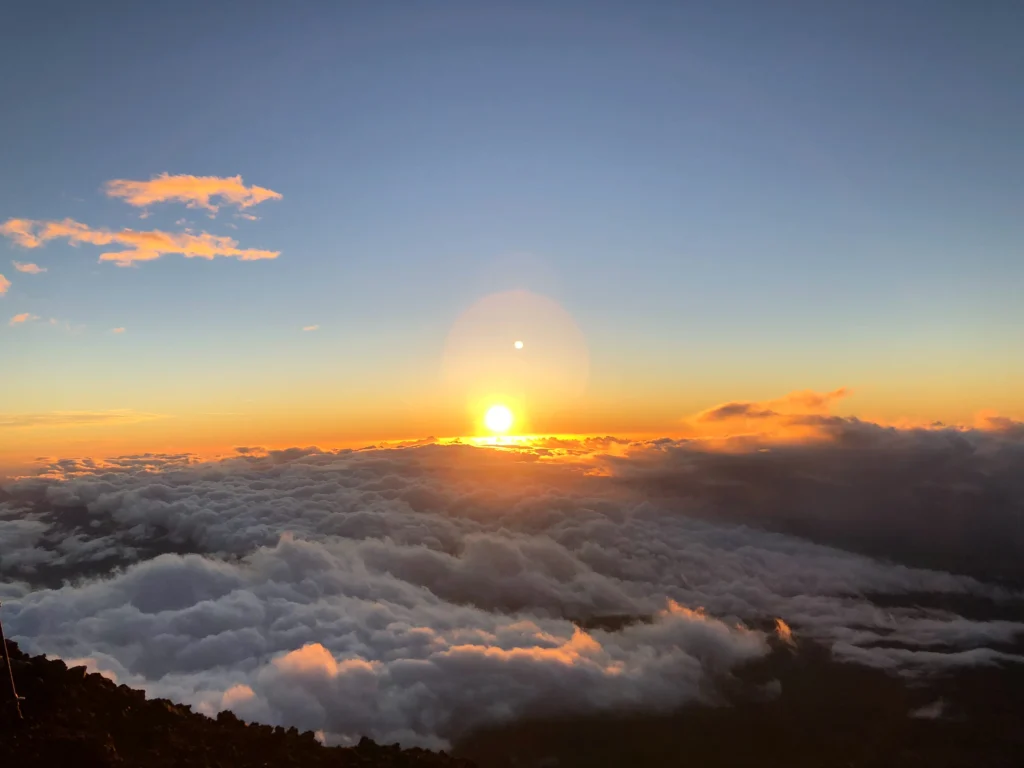
The moment the sun breaks the horizon. At Mt. Fuji’s summit, you’re watching it rise from below you — the sun appears to emerge from within the cloud sea itself, casting long golden rays across the white surface.
The cheers, the clapping, the tears — it happens every single morning during climbing season. There’s no cynicism at 3,776 meters.
5:00–5:20 AM – Shadow Fuji Appears (Face West!)
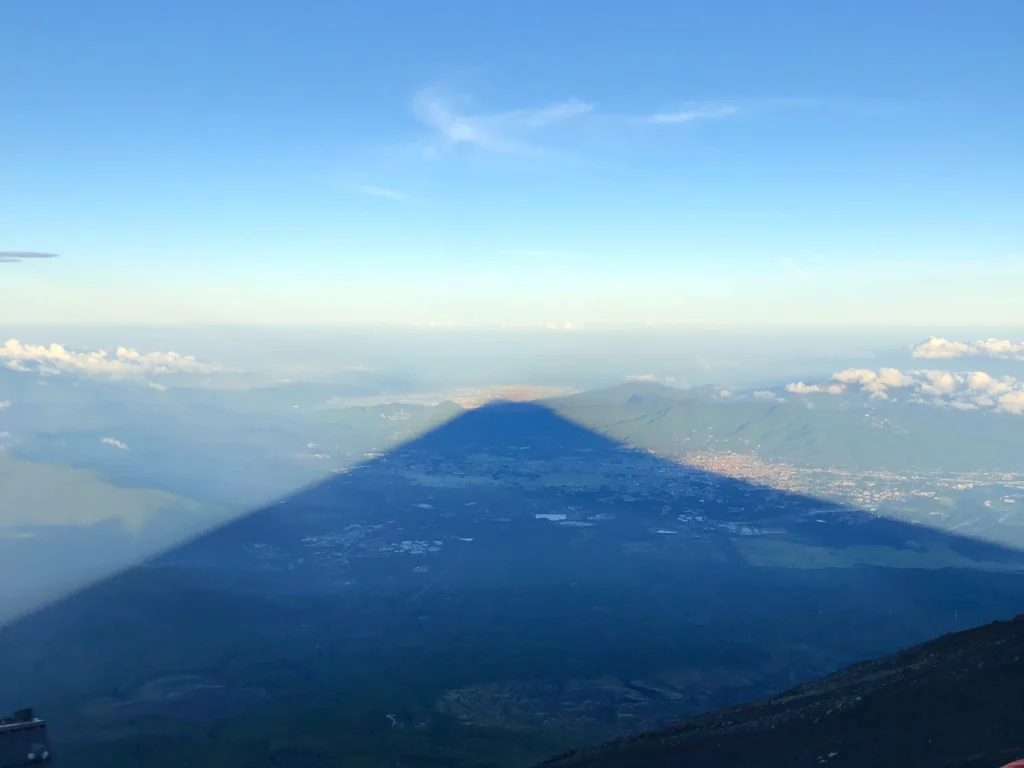
This is the moment 90% of climbers miss. While everyone faces east watching the risen sun, turn around. Look west.
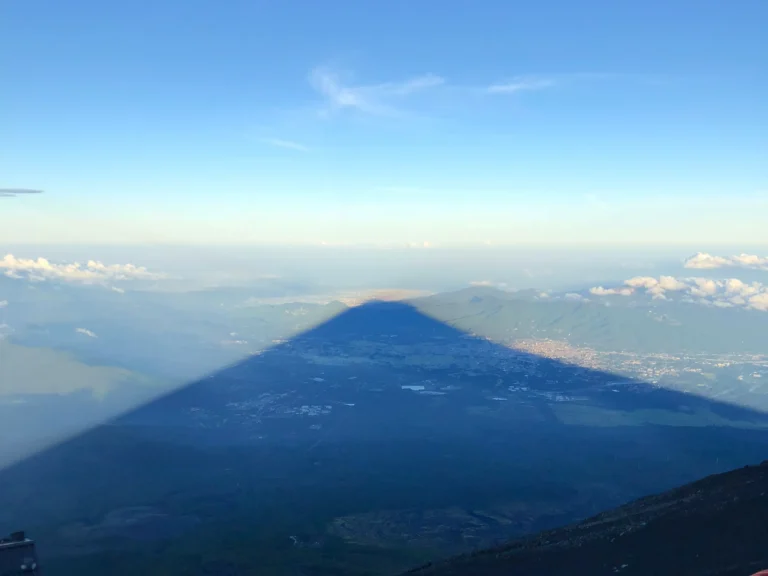
Mt. Fuji’s shadow — a perfect dark triangle — stretches across the landscape below, reaching for kilometers across towns, fields, and cloud layers. This is Kage-Fuji (影富士), or Shadow Fuji, and it only appears for 15–20 minutes after sunrise when the sun is low enough to cast the mountain’s full silhouette.
The shadow is sharpest in the first 5 minutes. As the sun climbs, the triangle shortens and fades. By 5:30 AM on most mornings, it’s gone.
Why do most people miss it? Because every summit guide says “face east for sunrise.” Nobody tells you to turn around immediately after.
5:30 AM – Morning Light on Volcanic Earth
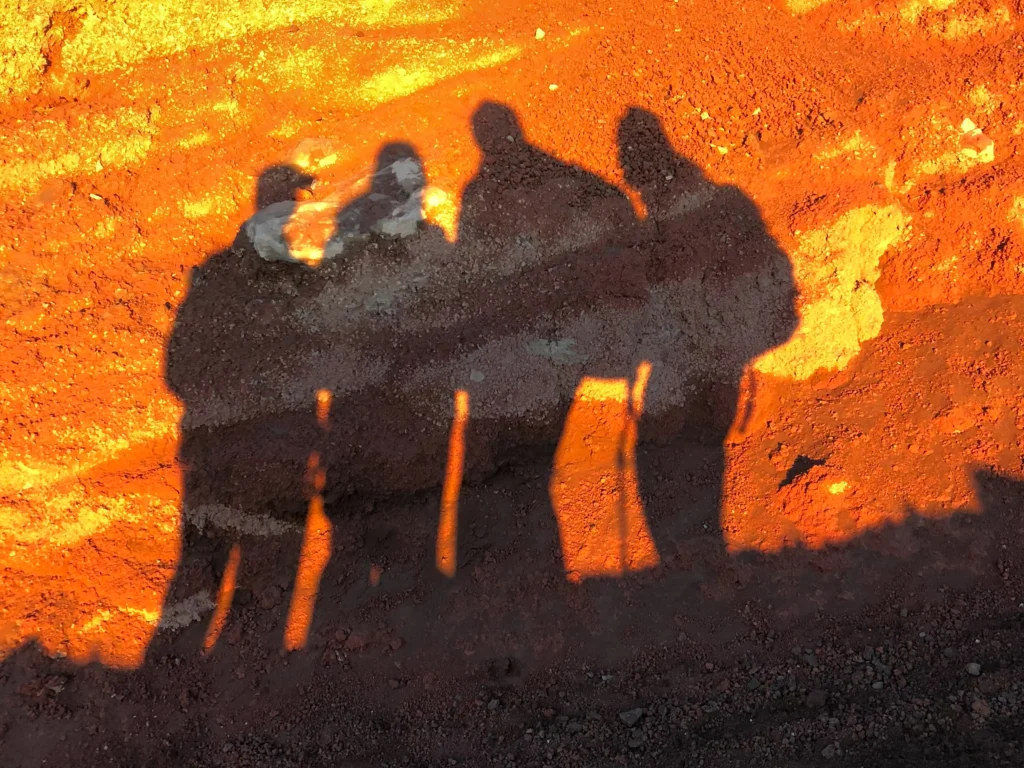
As the sun rises higher, the volcanic ground around the summit turns deep orange-red. The low angle of light creates dramatic shadows — your own silhouette stretches 10 meters across the rust-colored earth.
This is one of the most striking photo opportunities of the entire climb, and it happens when most people are already heading back down. The combination of volcanic red soil, golden light, and long human shadows is something you don’t see on any other mountain in Japan.
Shadow Fuji (Kage-Fuji): The Phenomenon Most Climbers Miss
Shadow Fuji deserves its own section because it’s genuinely one of Japan’s most underrated natural phenomena.
What it is: The shadow of Mt. Fuji’s cone projected across the landscape by the rising sun. Because Fuji is an almost perfectly symmetrical stratovolcano, the shadow forms a nearly perfect triangle — a mirror image of the mountain itself.
When to see it:
•Time: 5–20 minutes after sunrise (the lower the sun, the longer the shadow)
•Direction: Face west from the summit
•Season: Visible throughout the climbing season, but clearest in early September when atmospheric haze is lowest
•Conditions: Requires clear skies to the west. Cloud sea to the west actually enhances the effect, as the shadow falls on the white surface
Where to stand: The western rim of the summit crater (Kengamine side) offers the clearest view. If you do the Ohachi-meguri (crater rim walk), you’ll pass through the best viewpoints.
Photography settings:
•Wide-angle lens (24mm or wider)
•Expose for the shadow, not the bright sky
•Include the mountain’s slope in the foreground for scale
•Shoot quickly — the shadow changes shape every minute
Best Spots to Watch Goraiko
Not all summit positions are equal for sunrise viewing.
1. Summit Torii Gate (Yoshida Trail arrival point)
The most crowded spot, but iconic. The torii gate frames the sunrise perfectly. Arrive 40+ minutes early to secure a front-row position.
2. Kengamine Peak (3,776m — the true summit)
The highest point in Japan. Slightly offset from the direct eastern view, but offers 360-degree panoramas including the crater. Best for Shadow Fuji.
3. Crater Rim (Ohachi-meguri path)
If you walk the crater rim, you’ll find less crowded viewpoints with unique angles. The eastern rim offers unobstructed sunrise views without the crowd.
4. 8th Station Mountain Huts
If you don’t summit, watching from the 8th station area still gives you goraiko above the cloud sea. The sunrise is equally beautiful — you’re just 400 meters lower. Some climbers prefer this because it means more sleep and less crowd stress.
Photography Tips for Mt. Fuji Sunrise
Based on real shooting conditions at the summit:
Gear:
•Smartphone cameras work surprisingly well in 2026. The latest iPhone and Pixel models handle the dynamic range of sunrise effectively.
•A lightweight tripod or gorillapod helps for the blue hour (low light, slow shutter speeds).
•Lens wipes — humidity from the cloud sea creates condensation on lenses.
Settings (for camera users):
•Pre-dawn/blue hour: ISO 800–1600, f/2.8–4, 1–4 second exposures
•Sunrise moment: ISO 200–400, f/8, 1/250–1/500s
•Shadow Fuji: ISO 100–200, f/8–11, 1/125s (expose for the shadow)
Composition tips:
•Include human silhouettes for scale — this is what makes Mt. Fuji sunrise photos feel different from any other mountain
•Use the volcanic terrain (red/black rocks) as foreground interest
•For Shadow Fuji, include the mountain’s slope in the frame to show the connection between the real mountain and its shadow
•During blue hour, the cloud sea is the star — go wide and horizontal
What to Wear for the Pre-Dawn Summit Push
The single biggest mistake climbers make is underestimating the cold.
| Time | Approx. Temperature | What you need |
| 2:00 AM (departure) | 2–5°C | Base layer + fleece + wind shell, gloves, beanie |
| 3:00–4:00 AM (climbing) | 0–3°C | Same, but you’ll warm up from exertion — layering is key |
| 4:30 AM (summit, standing still) | -2–2°C with wind chill | Add down jacket over everything. Standing still = rapid heat loss |
| 6:00 AM (sun up) | 3–8°C | Start removing layers as sun warms |
Critical items:
•Down jacket or heavy fleece (for standing at summit — you’ll be stationary for 30+ minutes)
•Windproof gloves (your hands will go numb trying to operate a camera without them)
•Headlamp with fresh batteries
•Hand warmers (cheap and effective — available at any Japanese convenience store)
Practical Tips for International Travelers
If you’re visiting from Southeast Asia or regions without alpine environments, the cold at the summit can be shocking. For context, while Tokyo or Singapore might be 30°C+ (86°F+) in August, the Mt. Fuji summit at 4:00 AM is typically 0°C (32°F). You must bring winter gear.
•Hand Warmers (Kairo): Buy “kairo” (使い捨てカイロ) at any convenience store before heading to the mountain. Stick them inside your gloves or pockets.
•Toilets: ¥100–200 coin-operated at the summit. Bring 100-yen coins — no change available at 4 AM.
•Crowds: The Yoshida Trail summit area gets extremely crowded 20–30 minutes before sunrise. The crater rim walk is less packed.
•Altitude sickness: Headaches and nausea are common above 3,000m. Hydrate aggressively the day before. Climb slowly. Diamox (acetazolamide) is available at Japanese pharmacies with a prescription.
•Connectivity: Cell signal (Docomo, au) is available at the summit. You can livestream your sunrise if battery allows.
•Ohachi-meguri (crater rim walk): Takes 60–90 minutes. Starts from the summit arrival point and loops around the crater. Best done after sunrise when you can see the volcanic landscape clearly.
•Return route: The Yoshida descent route (bulldozer path) is separate from the ascent. Loose gravel — wear gaiters if you have them.
Suggested Timeline: Summit Sunrise Plan
For climbers staying at an 8th Station mountain hut (Yoshida Trail), targeting an August 1 sunrise (4:50 AM):
| Time | Activity |
| Previous day 10:00 AM | Depart Shinjuku Highway Bus Terminal → Fuji Subaru Line 5th Station |
| 1:00 PM | Begin ascent from 5th Station |
| 5:00–6:00 PM | Arrive at 8th Station hut, check in |
| 6:00 PM | Dinner at hut (curry rice, miso soup) |
| 7:00 PM | Watch sunset from hut — golden light on cloud sea |
| 8:00 PM | Sleep (or try to — earplugs recommended) |
| 1:30 AM | Wake up, layer up, depart hut |
| 1:30–4:00 AM | Climb from 8th Station to summit (2.5 hours with rest stops) |
| 4:00 AM | Arrive summit, find position facing east |
| 4:20 AM | Blue hour begins — start shooting |
| 4:50 AM | Goraiko — sunrise |
| 5:00 AM | Turn west — Shadow Fuji visible |
| 5:20 AM | Shadow fades. Walk to Kengamine (true summit) if desired |
| 5:30–6:30 AM | Ohachi-meguri (crater rim walk) — optional |
| 7:00 AM | Begin descent via bulldozer route |
| 10:00–11:00 AM | Arrive 5th Station, bus back to Tokyo |
FAQ
Q: Can I see goraiko without reaching the summit?
A: Yes. The sunrise is visible from any point above the cloud line, which typically sits between the 7th and 8th stations (2,700–3,400m). Mountain hut staff often wake guests in time for sunrise from the hut’s terrace. The view is still spectacular — you’re just slightly lower.
Q: What time should I leave the mountain hut?
A: From the 8th station, allow 2–3 hours to reach the summit. In mid-July (sunrise ~4:35 AM), depart by 1:30 AM. In late August (sunrise ~5:15 AM), 2:00–2:30 AM is sufficient. Factor in crowds — the trail near the summit becomes a slow single-file line.
Q: Is Shadow Fuji visible every morning?
A: No. It requires clear skies to the west. Cloud cover or fog on the western side blocks the shadow. Roughly 40–50% of climbing-season mornings have conditions clear enough to see it. Early September has the highest success rate.
Q: Do I need a tripod for sunrise photos?
A: For the sunrise itself, no — there’s enough light for handheld shots. For the pre-dawn blue hour (3:30–4:15 AM), a tripod dramatically improves image quality. A compact gorillapod is the best compromise between weight and stability.
Q: How cold is it at the summit before sunrise?
A: Expect 0–5°C with wind chill potentially pushing it below freezing. Wind is the real enemy — even a light breeze at the summit feels bitter when you’re standing still. A windproof outer layer and gloves are non-negotiable.
Q: Can I do the Ohachi-meguri (crater rim walk) before sunrise?
A: It’s possible but not recommended in the dark. The path is uneven and partially exposed. Wait until after sunrise when you can see the volcanic landscape clearly. The walk takes 60–90 minutes.
Q: What’s the difference between sunrise from Yoshida vs. Fujinomiya summit?
A: Both converge near the same summit area, so the sunrise view is nearly identical. The key difference is approach angle: Yoshida Trail arrives at the eastern side (direct sunrise view from arrival point), while Fujinomiya arrives at the southern side (short walk to the best sunrise viewpoint). For Shadow Fuji, both offer similar western views.
Q: Is the sunrise worth the suffering of the overnight climb?
A: This is subjective, but from Nobutoshi at hiddenjapan-gems.com — yes, without hesitation. The combination of physical effort, altitude, cold, sleep deprivation, and then the explosive beauty of the sunrise creates an emotional response that a comfortable viewpoint simply can’t replicate. It’s earned beauty.
Final Thoughts
The Mt. Fuji sunrise isn’t just a view — it’s a ritual. The Japanese have been climbing this mountain before dawn for centuries, and the emotional weight of goraiko hasn’t diminished with time.
What surprised me most wasn’t the sunrise itself. It was the 20 minutes after — when I turned west and saw Mt. Fuji’s own shadow stretching across the sleeping landscape below. That perfect dark triangle, cast by the mountain I was standing on, disappearing as the sun climbed higher. That’s the image I think about most.
Plan your timing, dress warm, bring a charged battery, and don’t forget to turn around.
Related articles on Hidden Japan Gems:
•Climbing Mt. Fuji 2026: 4 Trails, New Rules & Costs
•Lake Motosu: Chasing the Fuji on the 1,000 Yen Bill
•Fuji Shibazakura Festival Guide
•Kawaguchiko Ohashi Bridge: Mt. Fuji View Guide
•Arakurayama Sengen Shrine Guide
•Mt. Fuji & Cherry Blossoms 2026
Sources checked
fujisan-climb.jp (official), toriiso.com (mountain hut operator), fujisanpo.com, Japan Meteorological Agency

- MT. FUJI SUNRISE (GORAIKO) PHOTO GUIDEMt. Fuji Sunrise 2026: Hour-by-Hour Goraiko Guide [9 Photos] 2026 Update: In 2026, the mandatory ¥4,000 entry fee applies to all trails, and strict gate closures (2:00 PM on the Yoshida… Read more: MT. FUJI SUNRISE (GORAIKO) PHOTO GUIDE
- Climbing Mt. Fuji 2026: 4 Trails, New Rules & Costs
 Last Updated: April 2026 2026 Update: In 2026, you cannot simply show up at Mt. Fuji and start climbing. Every trail now requires a mandatory ¥4,000 entry fee. On the popular… Read more: Climbing Mt. Fuji 2026: 4 Trails, New Rules & Costs
 - Kuonji’s 5 AM Bell: A Traveler’s Guide to Morning Prayers at Minobusan
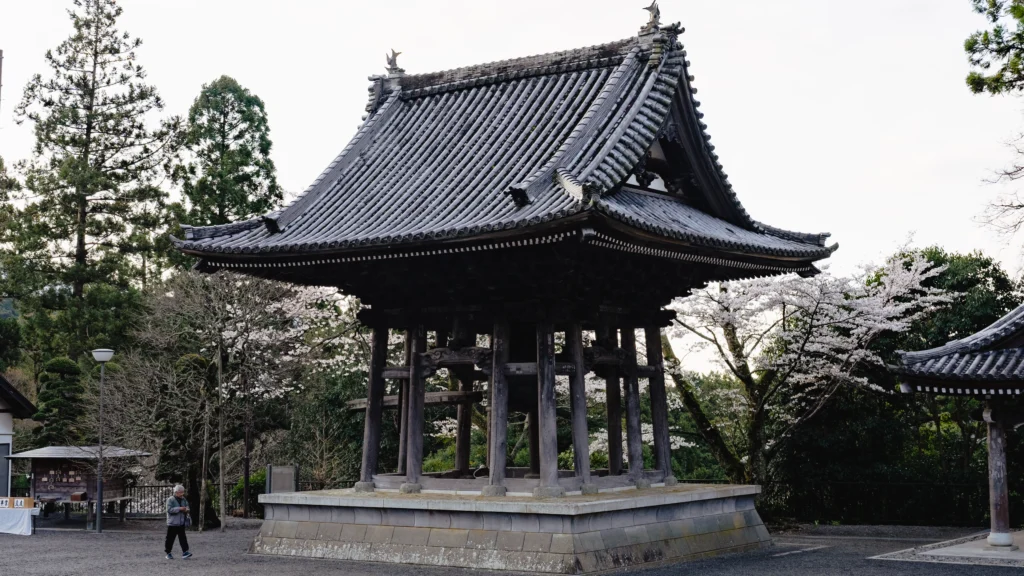 2026 Update: As of October 2024, the morning prayer time has been standardized to 5:30 AM year-round. Previously, the schedule changed with the seasons, and many third-party websites still show outdated… Read more: Kuonji’s 5 AM Bell: A Traveler’s Guide to Morning Prayers at Minobusan
 - Minobusan Kuonji 2026: A 750-Year-Old Temple with Japan’s Best Weeping Cherry Trees
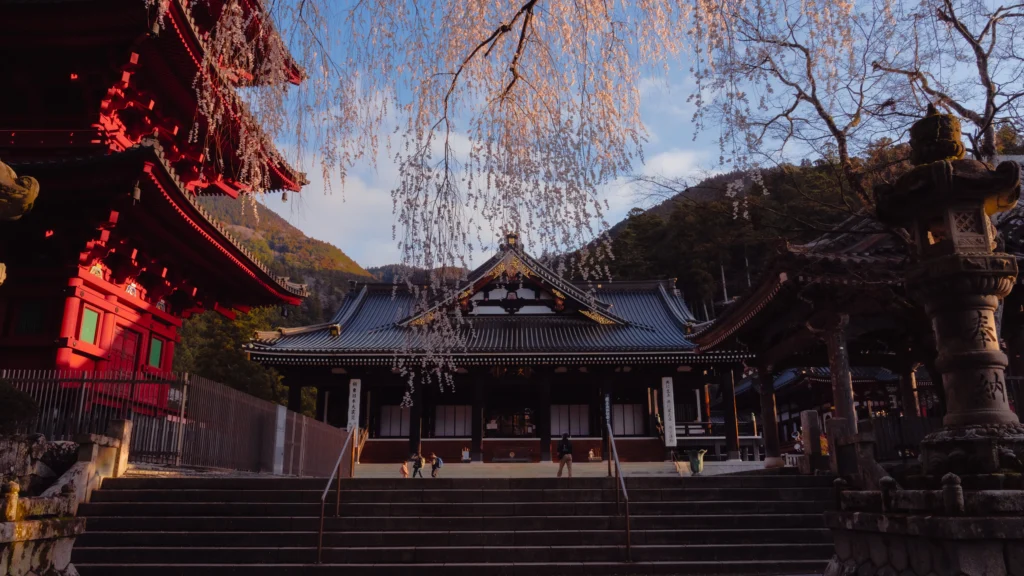 2026 Update: Morning prayer is now held at a fixed time of 5:30 AM year-round (previously varied by season). The five-story pagoda, reconstructed in 2009, remains one of the most photographed… Read more: Minobusan Kuonji 2026: A 750-Year-Old Temple with Japan’s Best Weeping Cherry Trees
 - Lake Motosu: Chasing the Fuji on the 1,000 Yen Bill
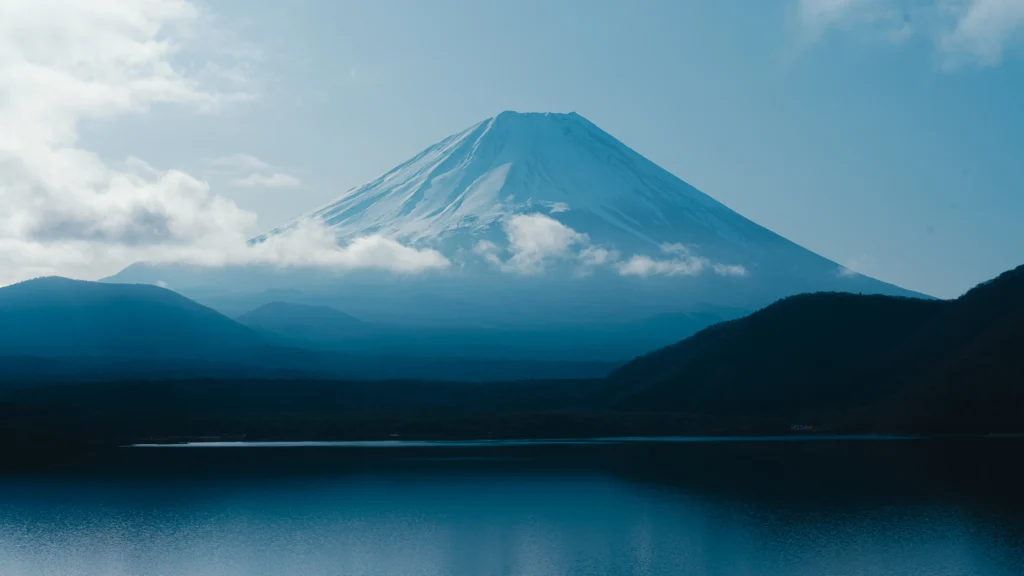 Have you ever pulled a 1,000 yen bill from your wallet, looked at the majestic image of Mount Fuji reflected on a lake, and wondered, “Is this place real?” I can… Read more: Lake Motosu: Chasing the Fuji on the 1,000 Yen Bill
2026 cherry blossom cherry blossoms day trip from tokyo flower festival fuji five lakes fujiyoshida Fukuoka fushimi hanami hiking japan japanese culture japanese food japanese garden japan travel kamakura kawagoe kawaguchiko Kumamoto kyoto local food Mount Fuji mt fuji Nagano nature Nikko Oku-Nikko Onsen Ramen saitama sakura Shizuoka shrine sightseeing snow spring in japan Tochigi Tokyo travel travel guide travel planning winter winter travel Yamanashi
![Hiroshima Food Guide 2026: Okonomiyaki, Oysters & Seto Sushi [Local's Picks]](https://hiddenjapan-gems.com/wp-content/uploads/2026/04/29856F07-18E2-4769-897E-F3CA8EC4F8AE-768x576.webp)