
Amami’s mangrove kayak tours run on the Yakugachi River (役勝川) in Sumiyo on Amami Oshima — Japan’s second-largest mangrove forest, about 71 hectares, behind only Iriomote. Tours operate at high tide only, when water levels lift kayaks high enough to slip under the canopy tunnels. The standard 60-minute tour costs ¥3,000; longer river descents go up to about three hours and ¥7,000. The whole area sits inside Amami Gunto National Park, designated 2017.
I had the trip wrong the first time, too. I assumed mangrove canoeing was the kind of thing you book the morning of and show up. It is, sometimes. But the tour times are set by the tide, not the operator, and on a low-tide afternoon you can drive an hour from Naze to discover that the river has dropped to mudflat and the day’s only outing left at 06:30. The schedule is dictated by the moon. Book around the moon.
| Where | Kuroshio-no-Mori Mangrove Park (黒潮の森マングローブパーク), 鹿児島県奄美市住用町石原478 |
|---|---|
| Phone | 0997-56-3355 · info@mangrovepark.com |
| Park hours | 9:00 – 18:00 (Mar–Oct) · 9:00 – 17:30 (Nov–Feb). Last admission 30 min before close. Closed Jan 1–3. |
| Park entry | Free. Ground golf and canoe tours are paid separately. |
| From Naze | ~50 minutes by car south along Route 58. No useful bus. |
| From Amami Airport | ~70 minutes by car. Rental car essential. |
| Skill required | None. Calm tidal water, no current to fight, no waves. Operators report >90% beginners. |
Why the river runs on a tide and not a clock
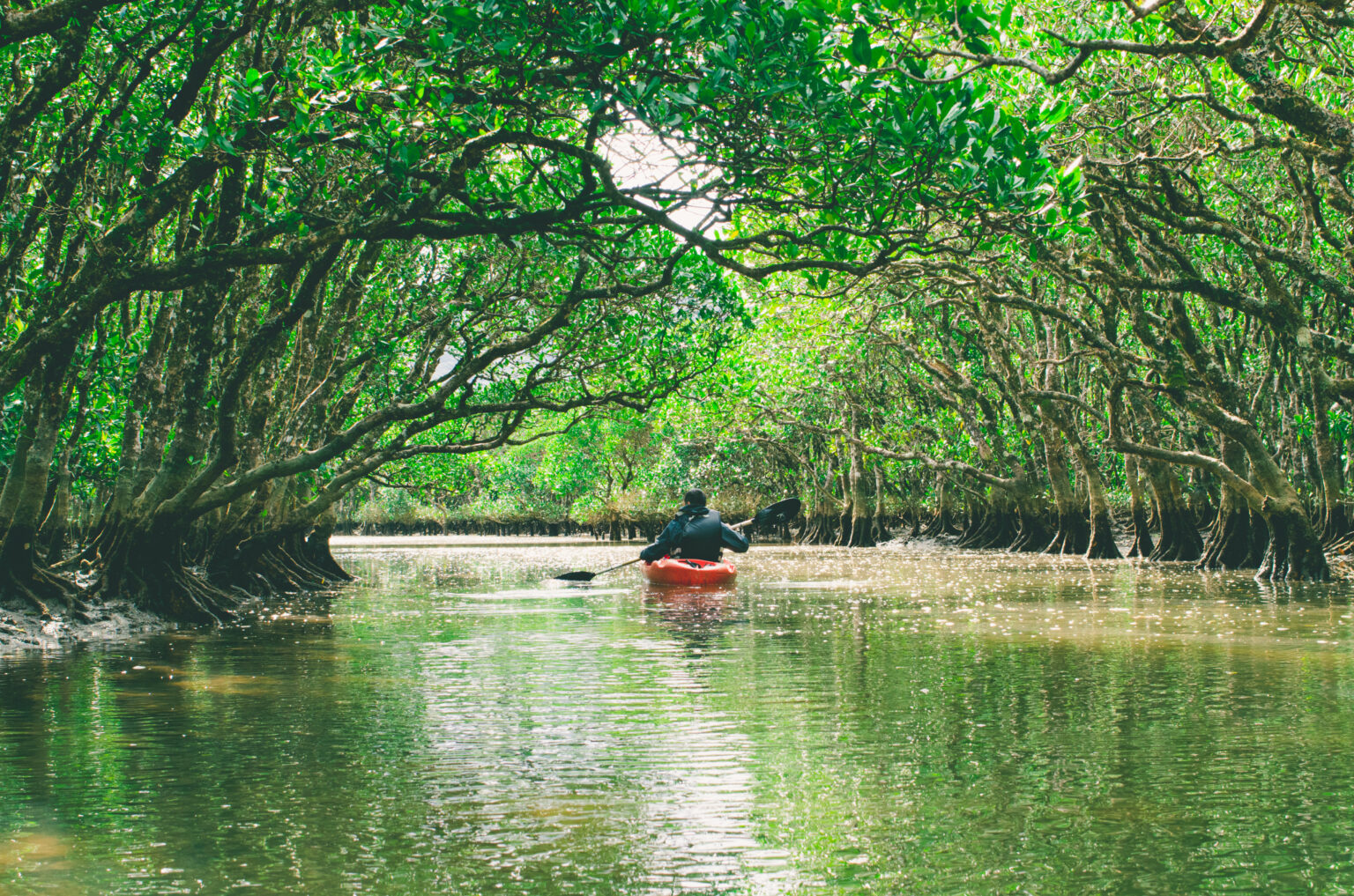
The Yakugachi River drains east into Sumiyo Bay through the mangrove forest. The mangrove tunnel — the iconic green-arched paddle the photos sell you — only exists at high tide. The difference between low and high tide in this estuary is about 1.5 meters. At low tide, the channels under the canopy are mudflat, exposed roots, and crab holes; kayaks can’t enter. At high tide, the water lifts under the canopy and the channels become navigable. Operators run their longest tours at the daily peak and shoulder slots and switch to mudflat walking tours when the tide drops.
Look up Naze high tides for your visit dates on the JMA tide table (station QJ) — same source the Heart Rock guide uses. Pick a high tide that falls in daylight. Call your chosen operator with that timestamp. They will quote the tour slot they’re running that day. Most operators publish two or three start times per day; the one closest to your high tide is the right slot.
Operator and pricing comparison (2026)
Several operators run kayak tours that put in at or near Mangrove Park. Prices and durations differ; the table below is the current published rate sheet as of May 2026. All accept first-time paddlers. All include life jacket and paddle; none typically supply dry bags — bring your own if your camera matters to you.
| Operator | Tour | Duration | Adult | Notes |
|---|---|---|---|---|
| Mangrove Park | Canoe trial | 60 min | ¥3,000 | Same-day OK by phone. Child ¥2,000, under 3 free. |
| Mangrove Park | Combo course (canoe + park) | 90 min | ¥4,000 | Requires booking by prior day. |
| Mangrove Chaya (マングローブ茶屋) | “Nonbiri” relaxed | 60–90 min | ¥2,000 | Open year-round including holidays. Child ¥1,500. Same-day OK. |
| Mangrove Chaya | 3 km Yakugachi descent | ~3 hrs | ¥7,000 | Longest available river tour. Child ¥4,000. |
| Mangrove Chaya | Night / stargazing | 2–3 hrs | ¥7,560 | Minimum 2 paddlers. Child ¥4,000. |
| Slow Guide Amami | Mangrove canoe | ~1.5 hrs | ¥4,400 | Daytime base rate. Morning/evening slots ¥5,500. Max 6 per tour. Insurance included. |
| Slow Guide Amami | Same, family rate | ~1.5 hrs | ¥3,300+ | Child rate. Infant ¥550. |
For most travellers the right choice is Mangrove Park’s own 60-minute trial on the first attempt — ¥3,000 adult, same-day booking by phone usually works on weekdays. If you want a longer, more remote paddle and don’t mind the price, Mangrove Chaya’s 3 km descent at ¥7,000 takes you below the canopied core into the wider estuary. Slow Guide Amami runs a tighter, more guided experience at the middle price point with insurance and a smaller group cap.
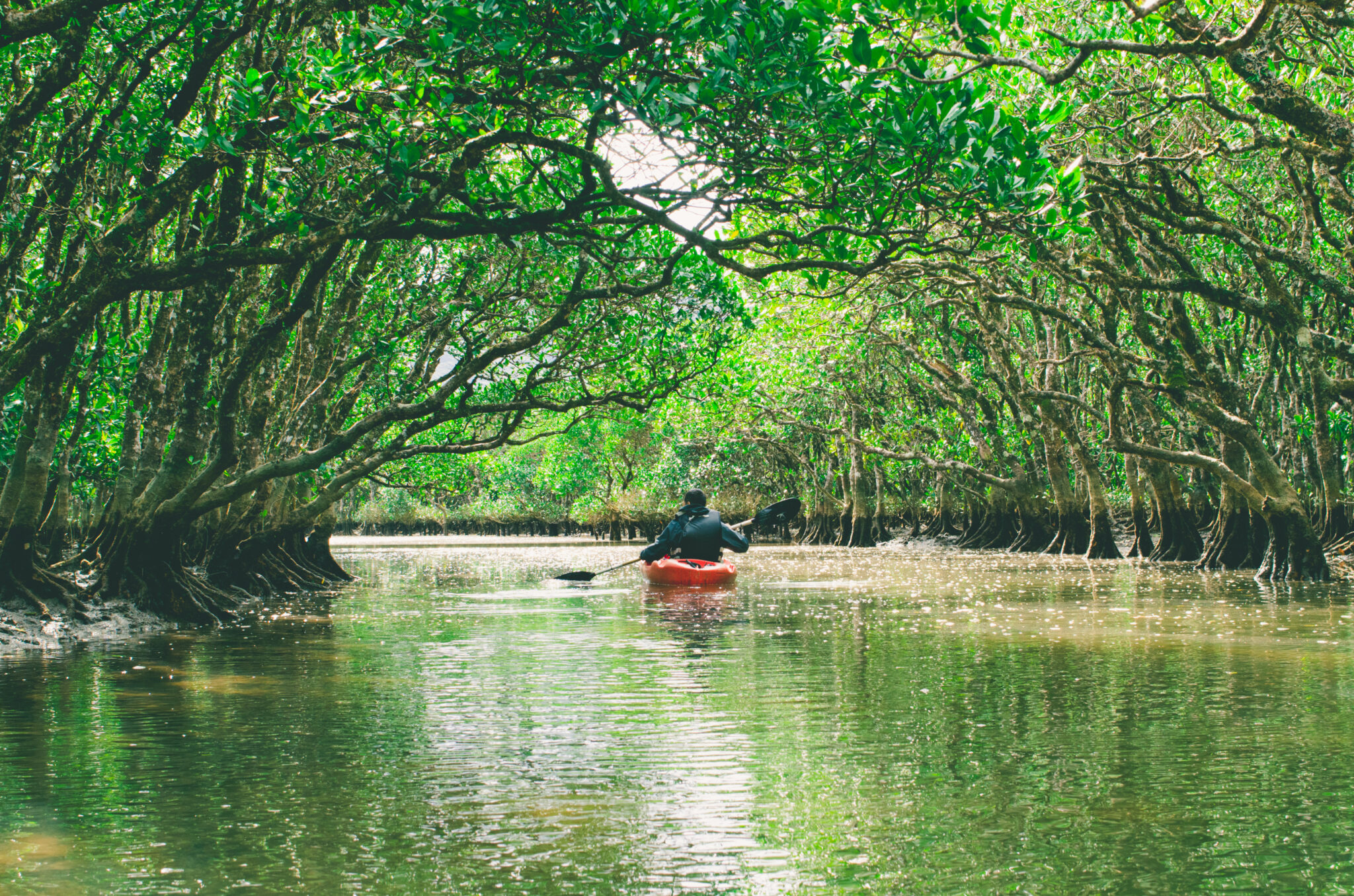
The Yakugachi River under high-tide canopy. The reflection makes the canopy look closed; in person there’s enough headroom for a paddler. Photo taken about ninety minutes after the high-tide peak.
When in the year to go — and the mosquito question
Mangroves are evergreen in this latitude, so there is no “best green” month in the way there is for deciduous canopies. The forest looks the same in January as it does in August. What changes is comfort, weather risk, and tide-time alignment with daylight. Most operators recommend March through October. April, May, and the end of June (just before the rains lift) are the most reliable comfort windows. Typhoon season runs roughly July through October, peaking in August and September, and individual tour days do get cancelled on storm forecasts.
Tourism sources consistently say mosquitoes are rare on the water itself, because the mangrove is tidal and saltwater-mixed rather than stagnant freshwater. I cannot independently verify that claim against an entomology source, only repeat what the operators and the city tourism page say. In practice, on three separate visits I did not use repellent on the water and was not bitten. On land — the parking area and the boardwalk through the park — repellent helps in summer. Bring a small bottle and apply before leaving the car.
- Want a calm, low-skill paddle through a landscape you can’t see anywhere else in mainland Japan
- Have one full day on Amami and want a half-day with structure
- Are willing to plan around the tide table
- Don’t mind getting your feet and lower legs wet
- Get seasick easily — even calm tidal water can trigger it for some
- Are travelling in peak typhoon weeks and need lockable plans
- Were imagining a wildlife-rich rainforest experience — this is a tidal estuary; fauna is present but quiet
- Have limited mobility on rocking platforms — the launch is from a low pontoon
What to wear and bring
Sandals with heel straps, or aqua shoes. Avoid flip-flops — they float away. Operators provide rubber boots for muddy launches if asked.
Quick-dry shorts and a t-shirt. Lower half gets splashed from the paddle. A light long-sleeve top blocks the sun and the occasional insect.
Wide-brim hat with a chin strap (mangrove branches catch loose hats). Sunscreen and polarised sunglasses — the water glare under partial canopy is harsh.
Neck strap or dry bag. Phones get dropped and splashed. Operators do not typically supply waterproof cases — bring your own.
A full change in the car for after the tour, including underwear. There are basic shower and changing facilities at Mangrove Park.
On land, not on water. Apply once at the parking lot and again before walking the boardwalk if you do the combo course.
Mangrove Park itself — what else is here
The park is more than a kayak launch. Admission to the grounds is free; tours and ground-golf (a Japanese kind of mini-golf on grass) are paid extras. The main facility has a small viewing tower with a panorama across the canopy — worth the climb if you have ten minutes before or after the paddle. The boardwalk through a small section of mangrove is a flat 15-minute loop, suitable for visitors not joining a tour. There’s a café-restaurant on site with simple meals and Amami specialty drinks (passion fruit, brown-sugar shochu samples).
Park hours run 9:00 to 18:00 from March through October and 9:00 to 17:30 from November through February, with last admission thirty minutes before close. Closed January 1 through 3. The park is also the operating base for tour staff, so even if you’ve booked an outside operator, your tour likely meets here.
Pairing the mangroves with the rest of Amami
Amami is 712 km² and three to four nights is the right length to do it without rushing. A common two-day skeleton: day one anchors in the north (Cape Ayamaru, Heart Rock at Tatsugo if the tide allows, Naze city in the evening); day two heads south to the mangroves in the morning and continues to Honohoshi Beach and Yadori Beach in the afternoon, the round coastline of the south coast being one of the loveliest two-hour drives in Japan. The Heart Rock guide covers the north-coast morning; this article covers the south-coast morning. Pair them, plus one afternoon on either coast, and you’ve covered the headline activities.
Plan This Trip
Flight
Kagoshima or Tokyo → Amami
JAL, Solaseed, Skymark. 1 hour from Kagoshima, 2.5 hours from Haneda.
Drive
Rental car from Amami Airport
No useful bus to the mangroves. Pick up the car at the airport on arrival.
Stay
Hotels in Naze
Best restaurant choice. ~50 min from Mangrove Park, manageable on a tide-based start.
Tours
Other Amami activities
Snorkel and diving operators, brown-sugar distillery tasting tours, sunset SUP.
FAQ
Do I need to book in advance?
Can I just paddle myself without a guide?
What if my visit day has no good high tide?
Is the mangrove suitable for young children?
How does this compare to the Iriomote mangrove tours in Okinawa?
Are the mangroves bitten by mosquitoes the way other tropical mangroves are?
Sleep in Naze for the food, the south coast for the early start
Most Amami visitors anchor in Naze (奄美市) for the restaurant choice and the ferry port — about 50 minutes from Mangrove Park. If your tour starts on a high tide before 09:00, an inn closer to Sumiyo cuts your drive in half. The selection is small but specific.
Booking the Trip
Three doors into an Amami visit. The mangroves are the main south-coast activity — anchor the day around the high tide.
Stay
Hotels in Naze
Largest selection on Amami. Restaurants, the ferry port, and the rental car desks all in one walkable area.
Search on Booking →
Flight
Flights to Amami Airport
JAL from Kagoshima or Tokyo Haneda. Solaseed and Skymark also serve the route.
Find flights →
Drive
Rental car for the island
Pick up at Amami Airport. The mangroves are 70 minutes south; Heart Rock is 13 minutes north.
Compare cars →
Related reading
- Kagoshima Outer Islands 2026: A Master Guide to Yakushima, Amami, Yoron and the Archipelago — the parent piece
- Amami Heart Rock 2026: The 40-Minute Tide Window — the north-coast morning to pair with the mangrove afternoon
- Tanegashima 2026: 1543 Muskets and a June 10 Rocket Launch — the other island in this Kagoshima cluster
Join travelers discovering Japan's hidden side
Weekly dispatches from off-the-beaten-path Japan — spots and stories you won't find in guidebooks.
No spam. Unsubscribe anytime.
Welcome aboard!
You're in. See you in your inbox soon.