

Travel weather · June 2026
Japan Tsuyu 2026: Regional Calendar, Hydrangea Spots, and Indoor Backups
The Japanese rainy season — tsuyu, written 梅雨 and pronounced “tsoo-yoo” — rolls north from Okinawa in early May to Tohoku in mid-June, then withdraws over six weeks. It does not actually rain every day, the temples and trains keep working, and one specific flower turns the otherwise flat green landscape into the most photographed weeks of the Japanese year. Here is the regional calendar, the hydrangea spots actually worth a detour, and the indoor list for when the sky finally opens up.
The 30-second summary
If you are travelling in June, the rain is real but manageable: most days you will get one good window for sightseeing and one window for an indoor coffee. Hydrangea peak in Kamakura is mid-June, in Kanto/Kansai cities late June, in Tohoku early July. Pack one good rain jacket, one merino layer, and waterproof shoes — that is the entire packing change from a normal trip. Hokkaido is the only region that doesn’t have tsuyu at all.
Quick Facts
| What it is | Tsuyu (梅雨) or baiu — a roughly six-week stationary front bringing increased rainfall and reduced sunshine across Japan from May to July. |
|---|---|
| Where it skips | Hokkaido — the only major region without a tsuyu season. |
| Earliest start (Okinawa) | ~May 10 onset, ~June 21 withdrawal (1991–2020 normal) |
| Tokyo / Kanto·Koshin | ~June 7 onset, ~July 19 withdrawal |
| Latest start (Tohoku North) | ~June 15 onset, ~July 28 withdrawal |
| Best hydrangea peak (Kamakura) | Mid to late June |
| Average rain days at peak | 10–14 of 30 in Tokyo June, around half the days — not all-day events |
| Forecasting authority | Japan Meteorological Agency (JMA), which announces onset and withdrawal regionally each year |
Regional calendar: when each part of Japan gets wet
The single most useful chart for travel planning. JMA publishes the 1991–2020 normal start and end dates for the rainy season across 12 regions. Bars below show roughly when the rain belt is sitting over each region. Hokkaido is intentionally not on the list — it does not have a tsuyu season at all.
Tsuyu period by region (1991–2020 normal)
Source: Japan Meteorological Agency, normal dates of baiu onset and withdrawal, 1991–2020 average.
A practical reading of the chart: by late June, the entire stretch from Kyushu to Tohoku-South is in the rain. By mid-July, Kyushu is already drying out. By late July, only the northern tip of Honshu is still under the front. If your itinerary spans two regions, the south is usually a week ahead of the north on both onset and withdrawal — useful for travelling north as the season ends.
How wet is “rainy season” really?
The phrase mistranslates badly into English. Tsuyu does not mean it rains all day every day — it means the daily probability of rain is high and the air is humid. Tokyo records around 10 to 14 wet days out of 30 in June. Many of those are short morning showers or evening downpours rather than full-day rain. A travel day inside the rainy season usually offers one solid sightseeing window and one indoor window if you watch the radar in the morning.
The hydrangea-tsuyu calendar
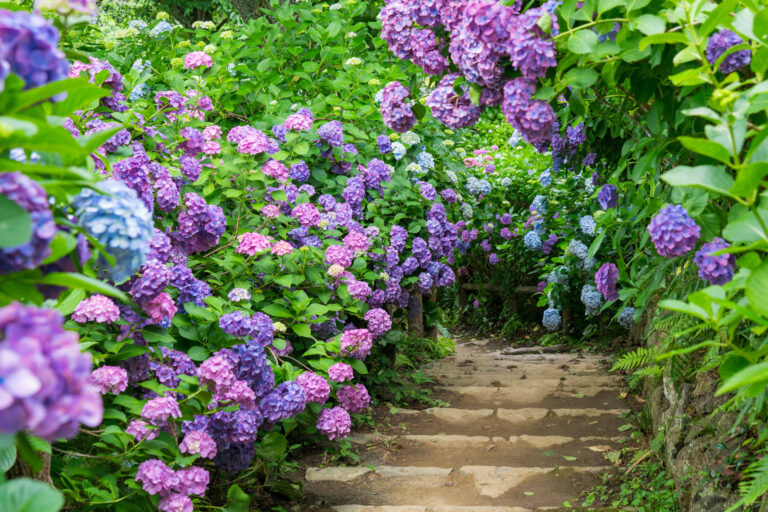
Hydrangea (ajisai 紫陽花) is the flower that absorbed tsuyu’s reputation. The bloom timing tracks the weather front almost exactly — the same humidity that makes the rainy season what it is also makes hydrangea peak. Plant the chart in your head and you will know where to be in mid-June for the best week.
| Region | Hydrangea peak | Notes |
|---|---|---|
| Okinawa & Amami | May to mid-June | The rainy front arrives first — hydrangea fields in Motobu (Northern Okinawa) bloom early. |
| Kanagawa (Kamakura, Hakone) | Mid to late June | The most photographed peak in Japan. Meigetsu-in, Hasedera, the Hakone Tozan railway, and the Goryo Shrine crossing all peak in roughly the same 10-day window. |
| Tokyo | Mid to late June | Hakusan Shrine, Takahata Fudoson, Tamagawadai Park. Less crowded than Kamakura. |
| Kansai (Nara, Kyoto) | Mid June to early July | Mountain temples (Mimuroto-ji in Uji, Yoshimine-dera in west Kyoto, Muro-ji in Nara) tend to peak slightly later than coastal Kamakura. |
| Tohoku | Late June into early July | Coincides with the front’s arrival in the north. Quietest window of the four regions. |
Four hydrangea spots tested
From visits across 2022, 2023, 2024 and 2025. Each spot is included because it does something the others don’t — a different framing, a different flower density, a different journey. The first two are in Kamakura, less than two hours from Tokyo Station. The third is a Nara mountain temple. The fourth is the largest hydrangea garden by sheer count anywhere in the country.
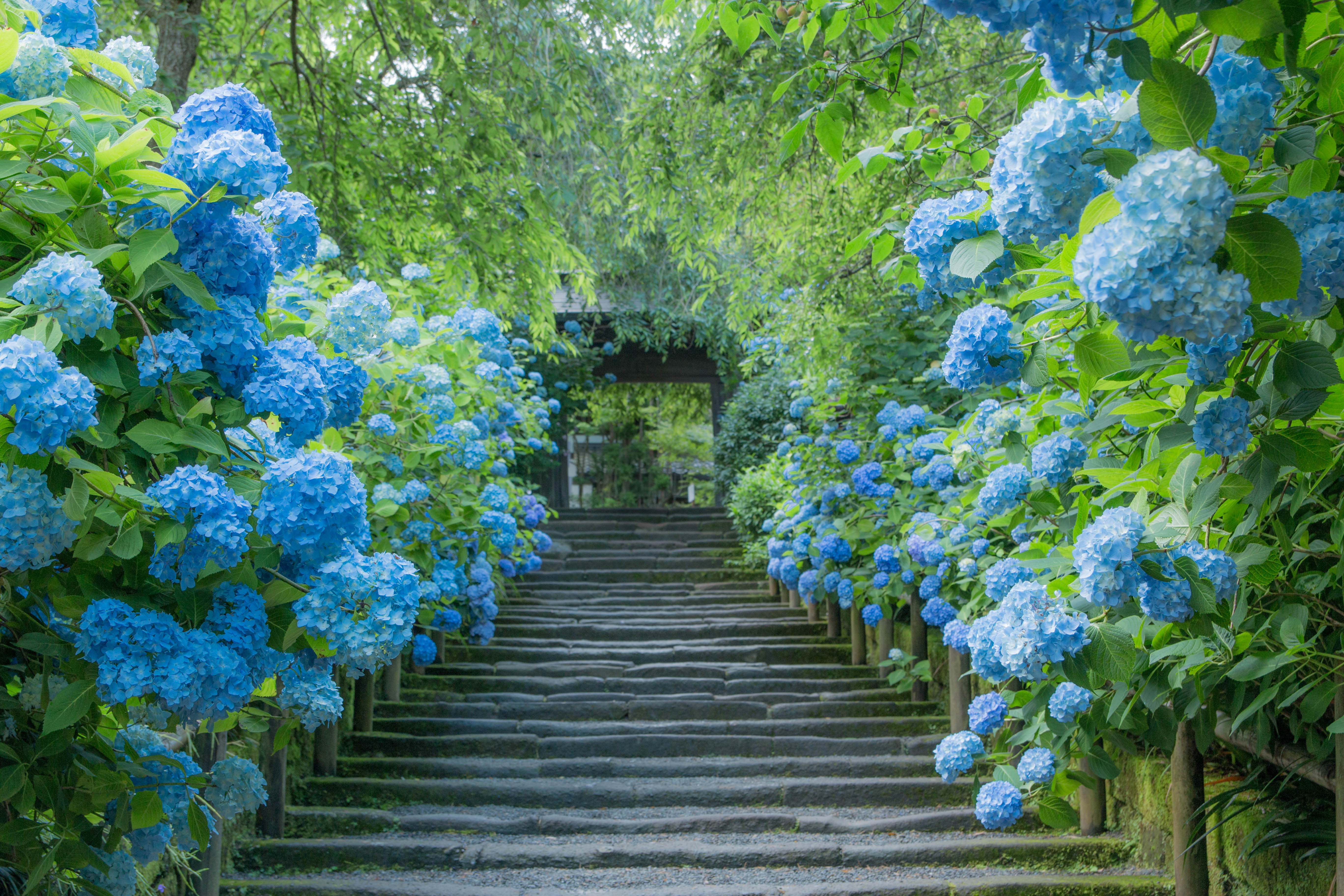
Kamakura
Meigetsu-in — the Ajisai-dera
The roughly 2,500 hydrangeas at Meigetsu-in are almost entirely a single variety — Hime-ajisai — which produces a uniform deep blue across the temple grounds rather than the colour mix you see elsewhere. Locals call this colour “Meigetsu-in blue.” Arrive at opening (8:30 in June, 8:00 on weekdays during peak) or you queue at the main gate. The round window in the back hall is the one you have seen on travel posters.
Combine with Engakuji or Tokei-ji — both within walking distance of the same station — if you want a half-day rather than a single-temple visit.
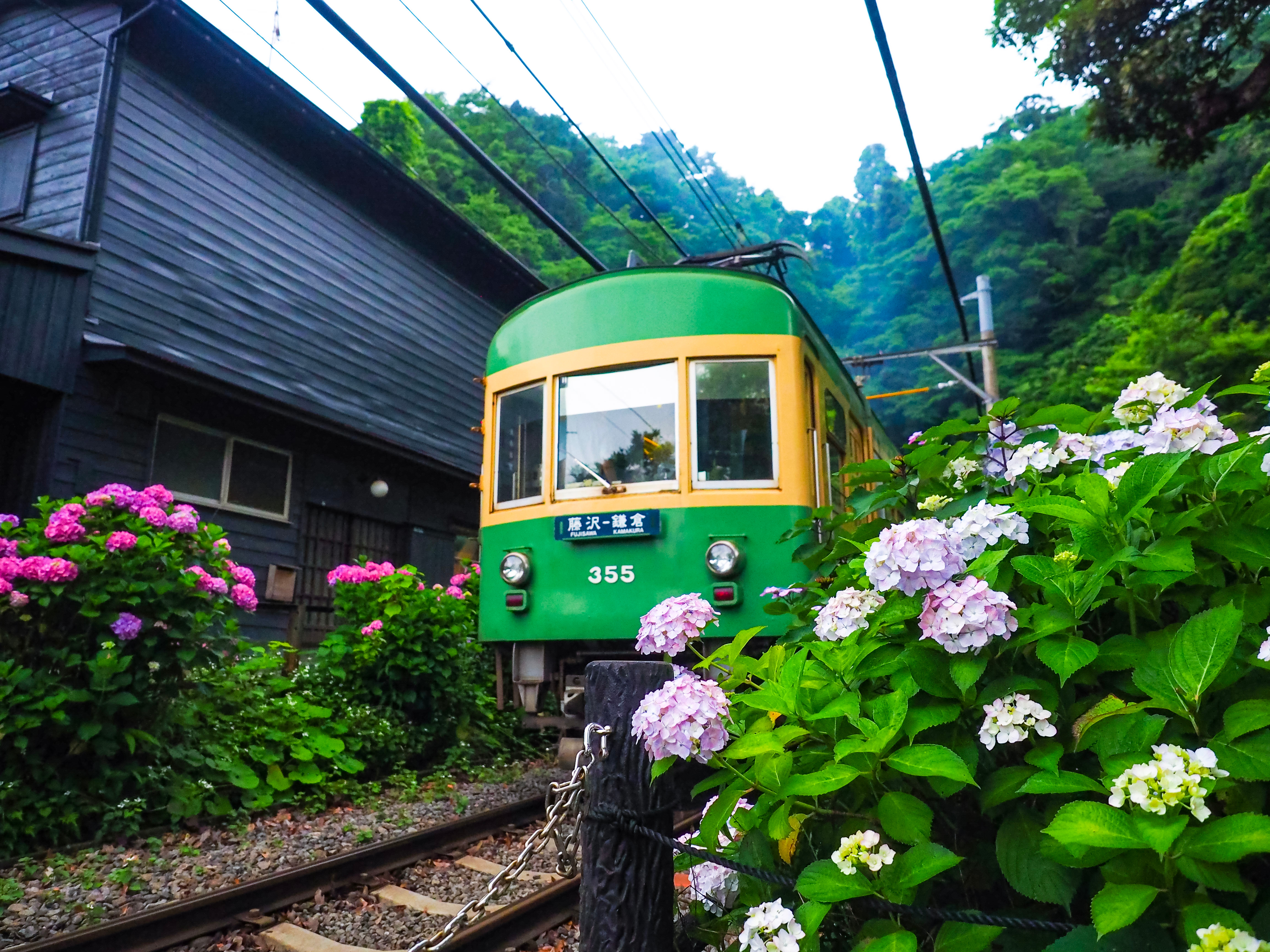
Kamakura
Goryo Shrine — the Enoden crossing
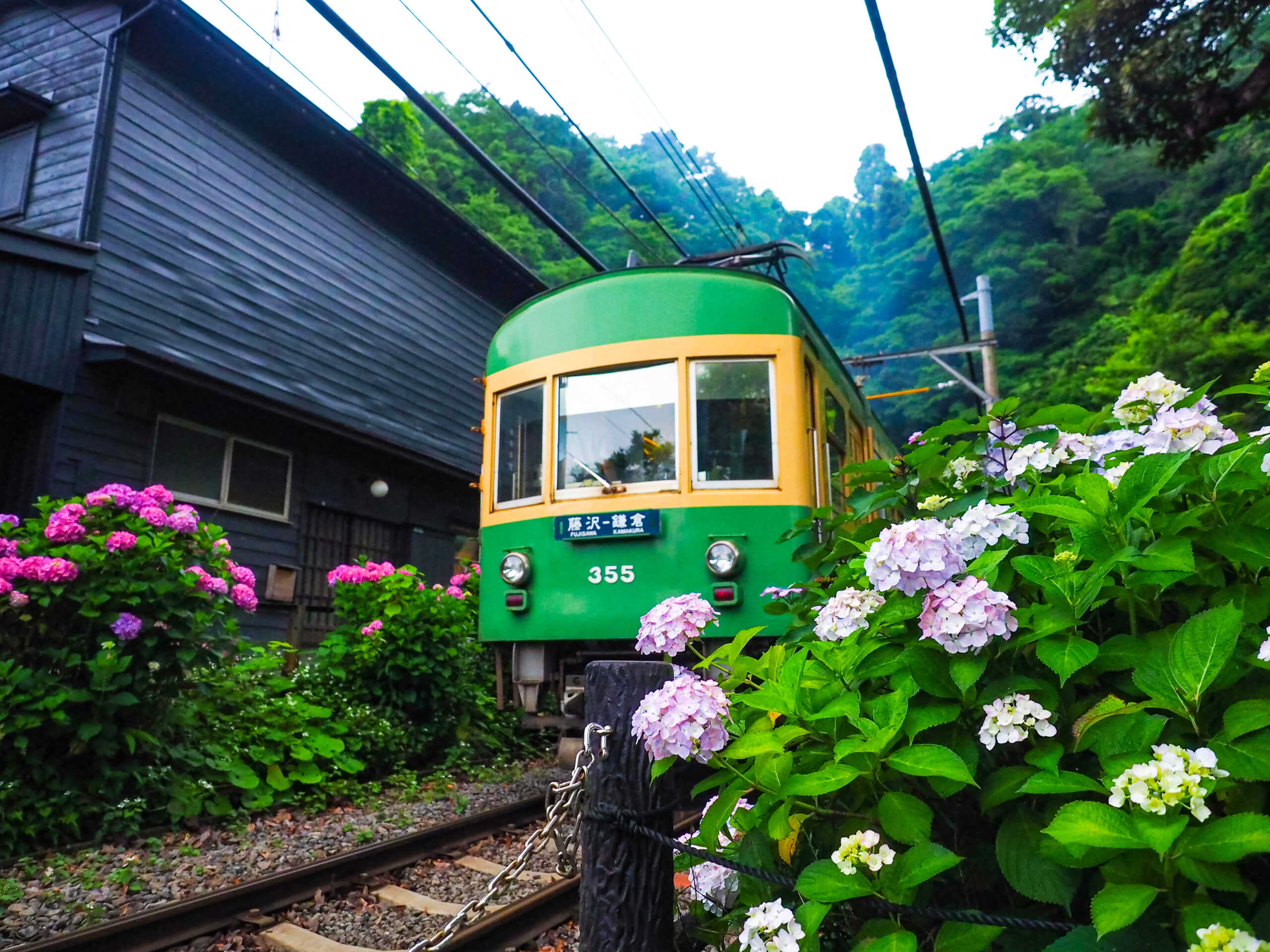
The reason most photographers actually come to Kamakura. The pedestrian crossing in front of Goryo Shrine sits inches from the Enoden line — the small green-and-cream tram that runs along the coast — and the crossing is fringed with hydrangeas. When the train passes, you get the colours of the flowers, the wooden torii of the shrine, and a vintage train all in one frame.
This crossing is residential. Photographers in 2024 and 2025 pushed local patience past its limits, and the city posted signage about not blocking the road. Stand on the path side, wait politely for trains, and do not step onto the rails — the framing works fine from the safe side. Two trains an hour each direction.
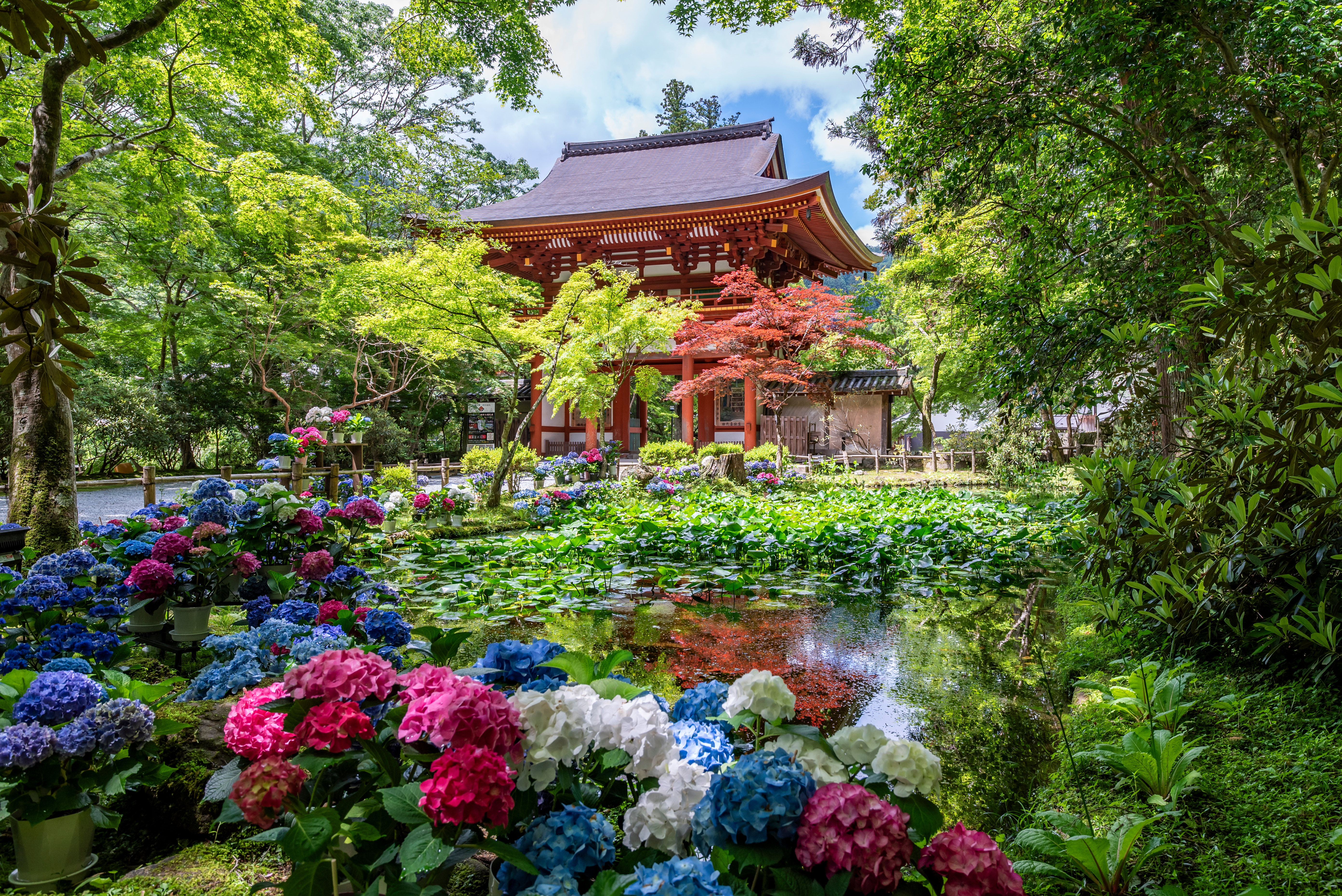
Nara
Muro-ji — the women’s Koya-san
If Kamakura’s crowds are not what you want, Muro-ji is the answer. The temple sits in a forested valley in Uda, eastern Nara, and was historically the only Shingon temple in the area where women were permitted to study — hence its nickname Nyonin Koya, “the women’s Koya-san.” The hydrangeas line the path between the Nio gate and Banji pond, where the dark wood of the gate and the still water amplify the blue-pink mix.
The peak runs about a week behind Kamakura because of the elevation. If you missed the Kanto window, Muro-ji is the catch-up shot. Pair with the Murouji·Akameyon-no-Taki area for a full day out of Nara — or a hot spring stop at Akame Onsen.
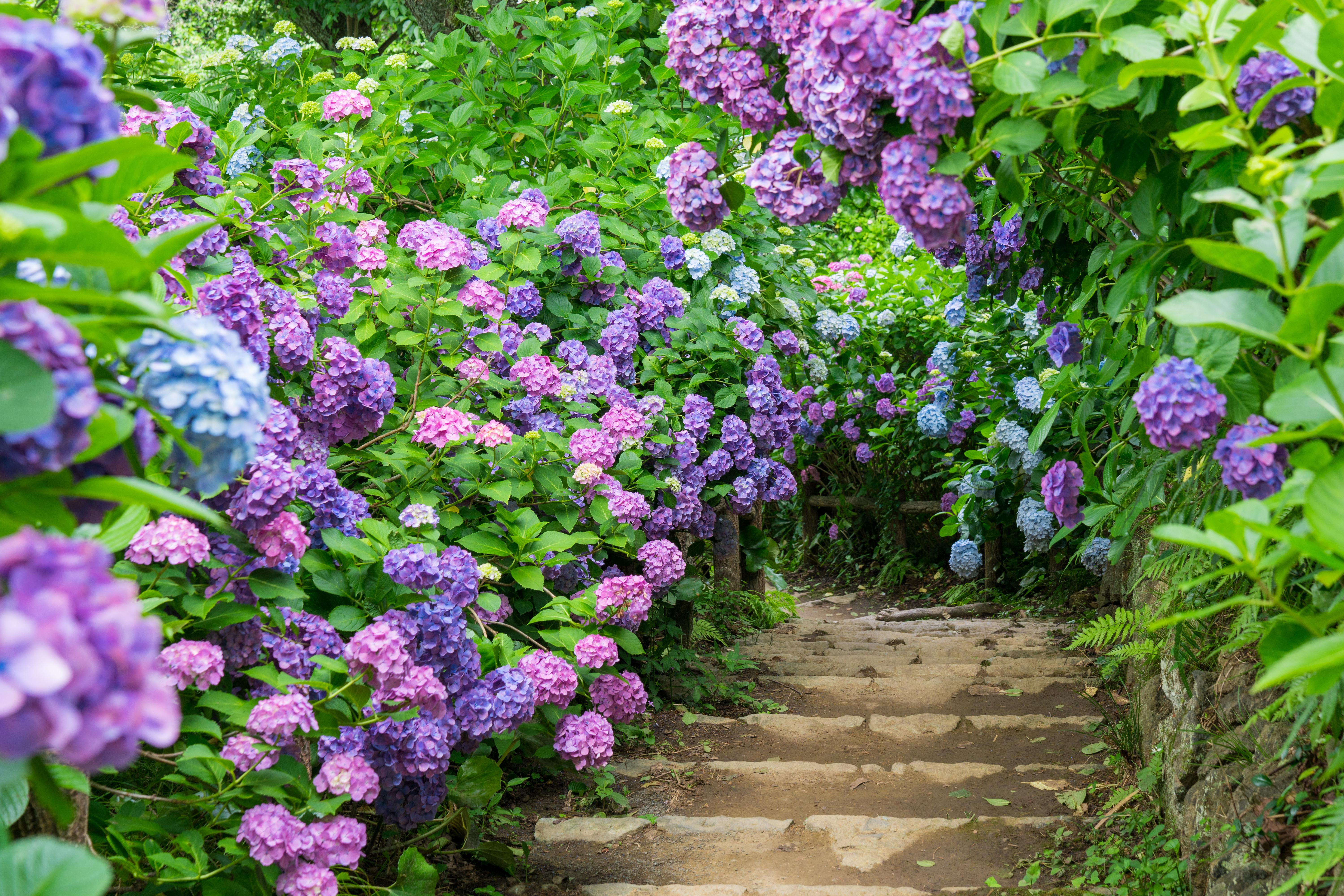
Izu, Shizuoka
Shimoda Park — the largest hydrangea garden by count
The number printed at the festival gate is around 150,000 hydrangea plants spread across a hillside park overlooking Shimoda Bay. It is the largest count in any single Japanese hydrangea garden. The terrain is what makes it work — you walk uphill through hydrangeas at eye level, then down through them, with sea views opening between the bushes. The park is also the site of the historic 1854 Treaty of Peace and Amity between Japan and the United States, marked with a small plaque most visitors miss.
Worth the detour if you are already heading down the Izu peninsula for a hot spring trip or a Tokaido Shinkansen jump — pair it with a night in Atami or Ito on the way back to Tokyo.
Indoor backup plans for when the sky finally opens
The honest part of tsuyu travel: roughly one travel day in three will be unsalvageable for outdoor plans, with afternoon downpours that don’t relent. Pre-load a list of indoor places before the trip and the day stops feeling lost. Below is a working set of what handles a serious downpour, organised by city.
Tokyo
teamLab Borderless · Azabudai Hills
Indoor, atmosphere-driven, photography-friendly, and works equally well at noon or evening. Three-hour minimum visit.
Tokyo
Edo-Tokyo Museum · Ryogoku
Closed for renovation through 2026, but its temporary annex space and the adjoining Sumida Hokusai Museum together cover a half-day in heavy rain.
Tokyo
Tsutaya Books Daikanyama
Three pavilions of books, music, magazines, and a generous cafe layer. Good for a half-day when you want a quiet seat and a flat white more than a tourist agenda.
Kyoto
Kyoto National Museum · Higashiyama
The Heisei Chishinkan building (Yoshio Taniguchi) holds the permanent collection and rotates strong special exhibitions. Two to three hours.
Kyoto
Nishiki Market
The covered shopping arcade running 400m through central Kyoto. Tasting your way through is a legitimate rainy afternoon. Slow down at the mid-section near Daimaru.
Osaka
Osaka Castle Museum
The keep is rebuilt in concrete, which the architecture community treats with mild disdain — but the museum inside is well-curated, the lift saves your knees, and the city view from the top still works in rain.
Naoshima
Chichu Art Museum · Tadao Ando
Indoor by design, Monet’s Water Lilies in a custom-built room, and entirely unaffected by weather. Reserve in advance — entry is timed.
Hiroshima
Hiroshima Peace Memorial Museum
Two to three hours, indoors throughout, deeply worth the time. Pair with the rainy walk through the Peace Memorial Park if you have an umbrella.
What to actually pack
The whole packing change for a tsuyu trip versus a normal Japan trip is two to three items. Less is more — you do not need full waterproofs, gaiters or hiking ponchos for what is mostly an urban traveller’s experience.
Tsuyu-specific additions to a normal packing list
- One genuinely waterproof jacket — light shell rather than a heavy raincoat. Goretex or equivalent, hood included
- Waterproof or water-resistant footwear — trainers with rubber outsoles work. Avoid suede
- Quick-dry socks (synthetic or wool) — two pairs minimum if you’ll walk through wet streets
- One small folding umbrella — konbini sell ¥600 transparent umbrellas if you forget; quality folding umbrellas at Tokyu Hands beat anything you’d pack from home
- One merino base layer — humidity makes the air feel cooler than the temperature
- A Ziploc or dry bag for phone and passport during a sudden shower
Two notes about Japan-specific tsuyu gear that travellers often miss. First: hotels and convenience stores have umbrella stands and umbrella locks at every entrance, and bringing a wet umbrella into a shop is normal — they expect it. Second: every train station provides a plastic-bag dispenser at the entrance during rain, designed to slip your wet umbrella inside. Use it. Dripping umbrellas on train carpet is a soft rule, not a hard one, but Japanese commuters notice.
FAQ
Should I avoid Japan in June because of the rain?
No, unless you are specifically chasing wide-open mountain scenery (Hokkaido, the Japan Alps). Cities, temples, food and onsen are unaffected. Hotels are 20–30% cheaper than April or July, and crowds at major sights are noticeably thinner. The hydrangea peak is genuinely one of the best photographic windows of the Japanese year. The trade-off is humidity, not constant rain.
Will my flights or trains get cancelled?
Almost never because of tsuyu alone. The risk profile is more like “delayed by 20 minutes” than “cancelled.” Heavy rain warnings can briefly suspend specific lines — the Tokaido and Yokosuka lines along the coast are the most weather-sensitive — but tsuyu disruption is meaningfully smaller than typhoon or snow disruption. The bigger risk to a June trip is an early typhoon, not the rainy season itself.
How do I check the daily forecast?
The JMA website (jma.go.jp/bosai/forecast/) is the official source. For travel planning, Yahoo! Weather Japan and the AccuWeather app both pull JMA data into more readable interfaces. Look for the hourly view rather than the daily — tsuyu forecasts tell you when the rain will fall, which is more useful than knowing it will rain.
Is it worth chasing the hydrangea peak specifically?
If you have flexibility, yes — the Kamakura window in mid to late June is the single most photographed week of the Japanese floral year, and the peak is shorter than sakura (about 10 days versus sakura’s two-week window). Book Kamakura accommodation 4–6 weeks ahead if you want to be on-site at sunrise rather than commuting in.
Where can I see hydrangeas without the Kamakura crowds?
Three quieter alternatives: Muro-ji in Nara (covered above), Hakusan Shrine in Tokyo’s Bunkyo ward, and the Hakone Tozan railway between Hakone-Yumoto and Gora — the train tracks themselves are lined with hydrangeas, and you watch them from a train window rather than competing for foot space. The Hakone option is also indoors-when-you-need-it, since the train is covered.
Join 1,000+ travelers discovering Japan's hidden side
Weekly dispatches from off-the-beaten-path Japan — spots and stories you won't find in guidebooks.
No spam. Unsubscribe anytime.
Welcome aboard!
You're in. See you in your inbox soon.