

Shizuoka · Roadside Station · Field Report
The roadside station where locals eat lunch with Mt. Fuji out the window.
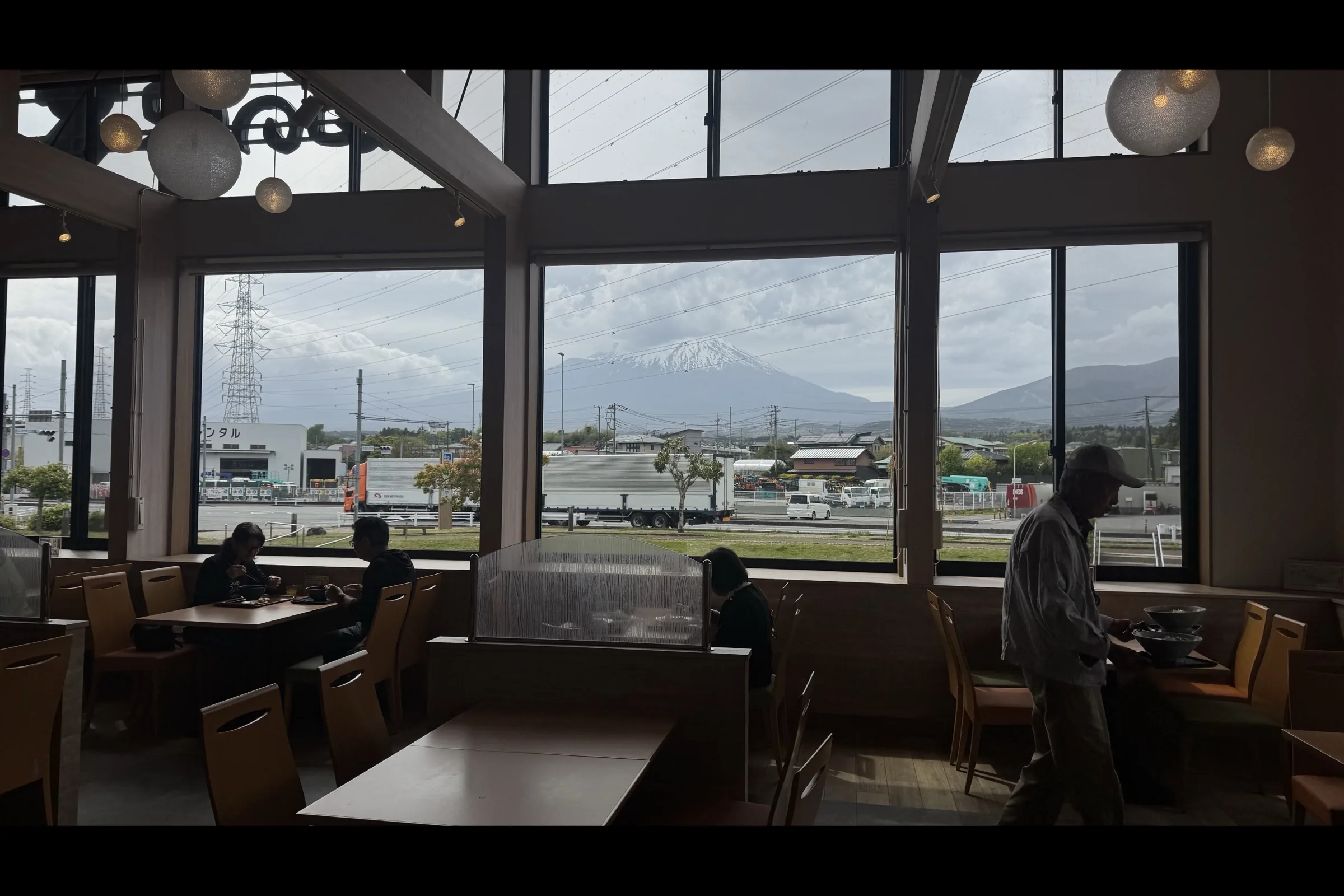
Michi-no-Eki Fujioyama is not pretty from the outside. It’s a low concrete box wedged against a logistics yard in Shizuoka. I walked in on a Tuesday, sat by the glass wall, and looked up from my motsu-nikomi to see Fuji holding up the sky. Then I bought a daikon the length of my forearm and left.
Lunch cost
¥700–1,300
teishoku sets; all under ¥1,500
Time needed
60–90 min
lunch plus produce browse
Best for
Rental-car travellers
Tokyo → Fuji / Hakone / Izu
Fuji visible?
Yes, from inside
clear days; winter & early spring best
First: what is a michi-no-eki, exactly?
If you’ve never driven in Japan before, a michi-no-eki (道の駅) isn’t quite anything you have in your own country. The closest translation is “roadside station,” but that undersells it. Think: a public rest stop combined with a farmers’ market combined with a local restaurant that takes itself seriously.
There are over 1,200 michi-no-eki across Japan. The system started in 1993 as a government initiative to help rural towns sell what they make directly to drivers. Every michi-no-eki has three things by law:
- Free parking and 24-hour public toilets
- A tourist information desk for the surrounding area
- Something uniquely local — produce, crafts, a restaurant, a small museum
What makes them actually interesting is the third one. In a small town in Akita, the michi-no-eki sells rice harvested in the back field. In Oyama, on the south side of Mt. Fuji, they sell hand-braided straw slippers, Shizuoka strawberries, a local sparkling wine, and a motsu-nikomi so good I’d drive forty-five minutes for it again.
Michi-no-eki don’t charge admission. You park, you walk in, and you leave with whatever you want. They are one of the highest signal-to-noise ratios in Japanese travel — nowhere else do you get local food, local produce, and a clean bathroom under one roof without a single tour bus in the parking lot.
Why this particular one (and not the ten others near Fuji)
There are roughly a dozen michi-no-eki within an hour’s drive of Mt. Fuji. I’ve been to most of them. Fujioyama’s pitch is simple: it’s on Route 246, the old back road between Tokyo and Numazu, which most tourists don’t take because the Tomei Expressway is faster. So you get a michi-no-eki that mostly serves locals driving home from work, farmers dropping off morning-picked vegetables, and retirees coming in for a cheap lunch with a view.
It’s not the prettiest. It’s not the most photogenic. But if you want to see what rural Japan actually eats on a Tuesday, this is a better answer than a Starbucks in Kawaguchiko.
Getting there
Michi-no-eki are, almost by definition, inconvenient without a car. Fujioyama is no exception.
- By rental car: From central Tokyo, about 90 minutes via the Tomei Expressway (Gotemba interchange) or 2 hours via Route 246. Compare rental cars on Klook — most pickups are at Haneda or Shinjuku. I drive Toyota Rent-A-Car personally; the English setup is painless.
- By train + taxi: Possible but awkward. JR Gotemba Line to Suruga-Oyama station, then a 7-minute taxi ride. Buses from Gotemba Station exist but are infrequent on weekends.
- As a detour: This is what most foreign visitors will realistically do. If you’re driving the Fuji Five Lakes loop, add Fujioyama on the way out as a lunch stop on your way back to Tokyo. Gotemba Premium Outlets is ten minutes up the road if you combine them.
Restaurant Fujioyama — where the magic actually is
Restaurant Fujioyama is inside the michi-no-eki building, on the far side past the produce stalls. The dining hall has full-height windows facing north-west. On a clear day, Fuji fills the middle half of the glass. You sit down, and it’s just there.
Ordering (don’t overthink this)
You order at a self-service ticket machine the moment you walk in. Put coins or a bill in, tap the dish you want on the screen, take the printed ticket to the counter, and wait for your number. The machine has an English mode — it’s the button at the top. I’ve seen it tested by an American family in front of me; they didn’t need anyone’s help.
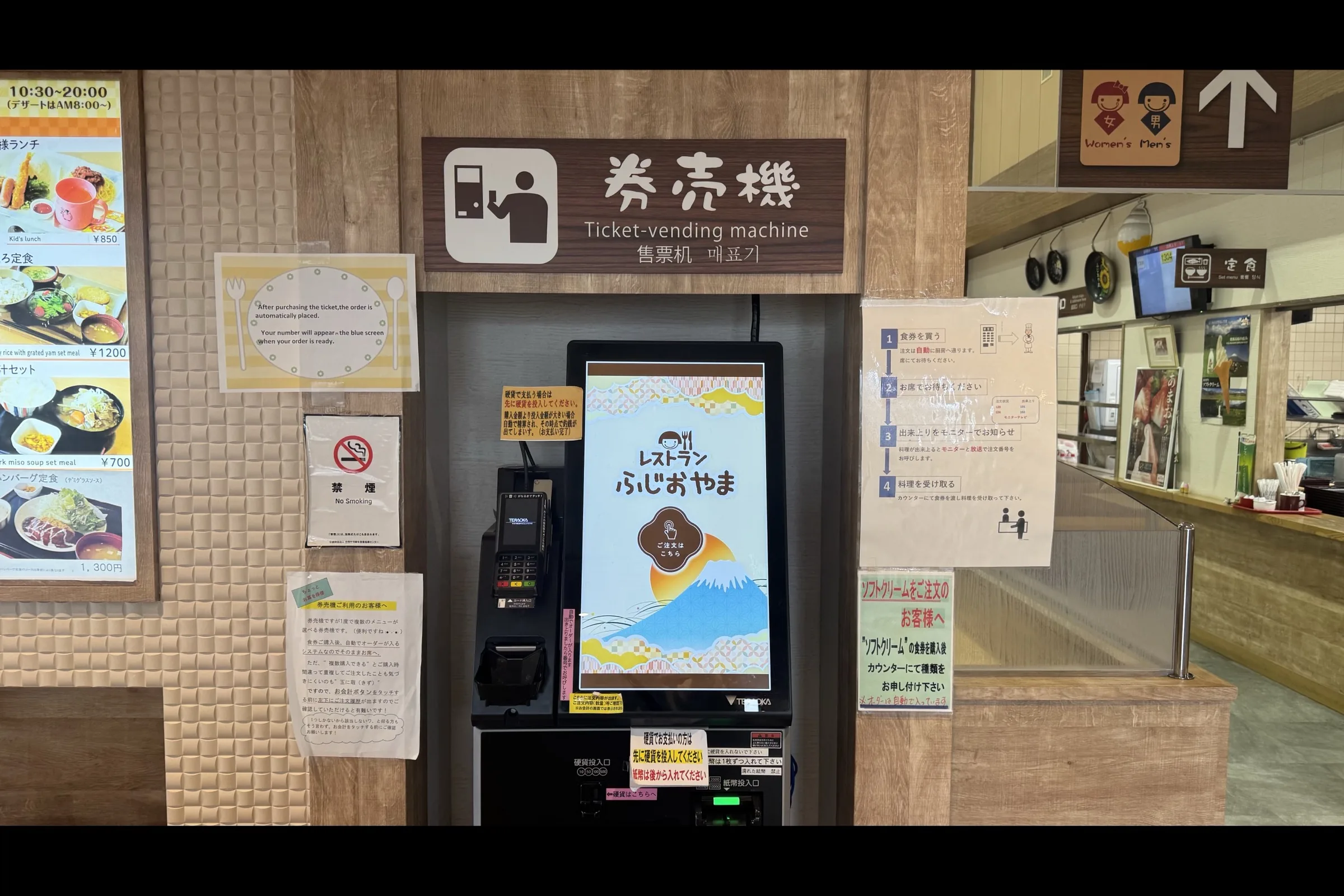
Menu prices are photo-labelled. These are what I paid in April 2026:
What I ordered
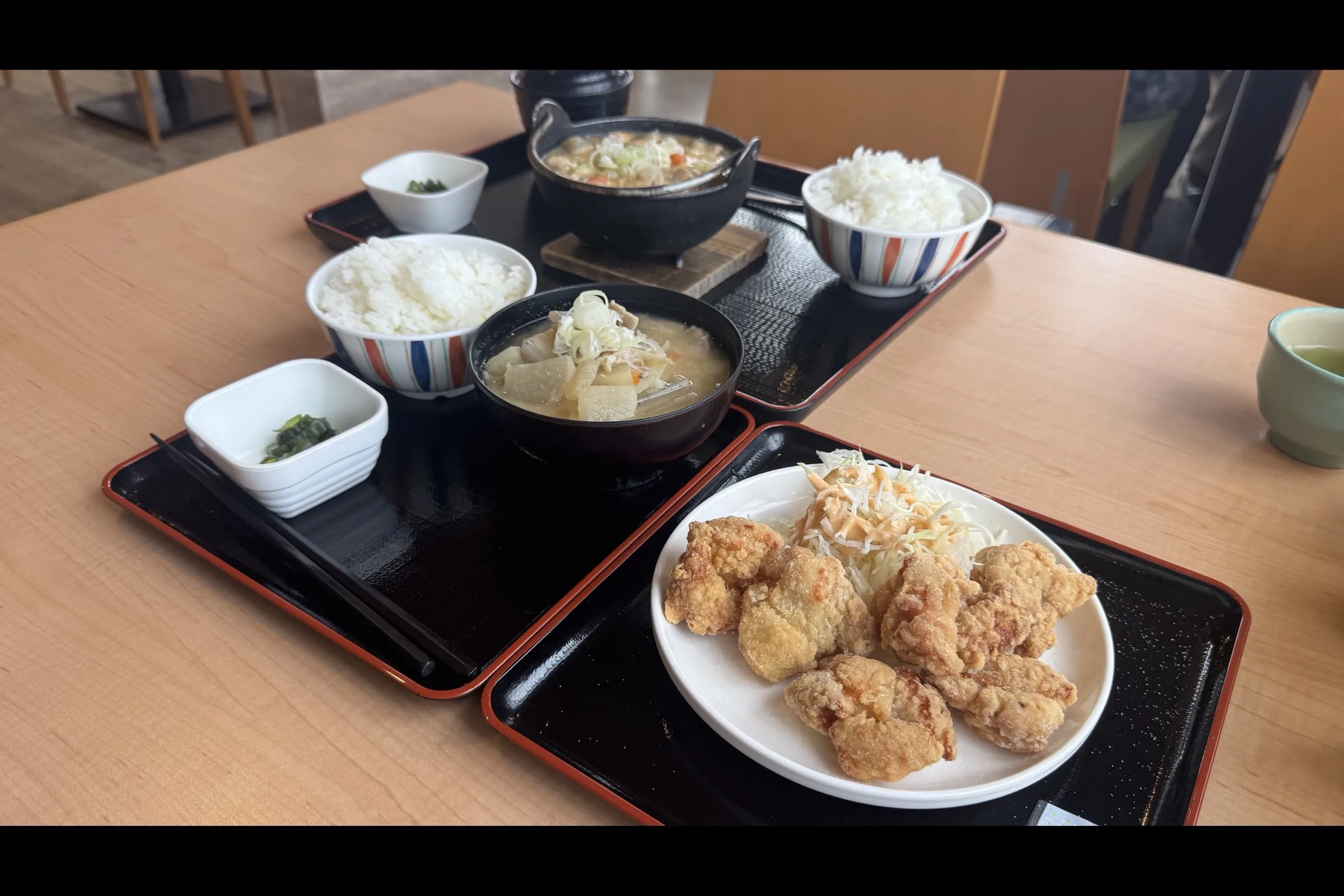
The motsu-nikomi is the reason I’m writing this
Motsu (もつ) means beef or pork offal — tripe, intestine, tendon — slow-simmered until it gives up and turns into something no other cut of meat can do. At Restaurant Fujioyama it arrives in a small cast-iron pot on a wooden trivet, still bubbling, with a mound of shredded scallion on top. The broth is miso-based, thick enough that your spoon leaves a trail.
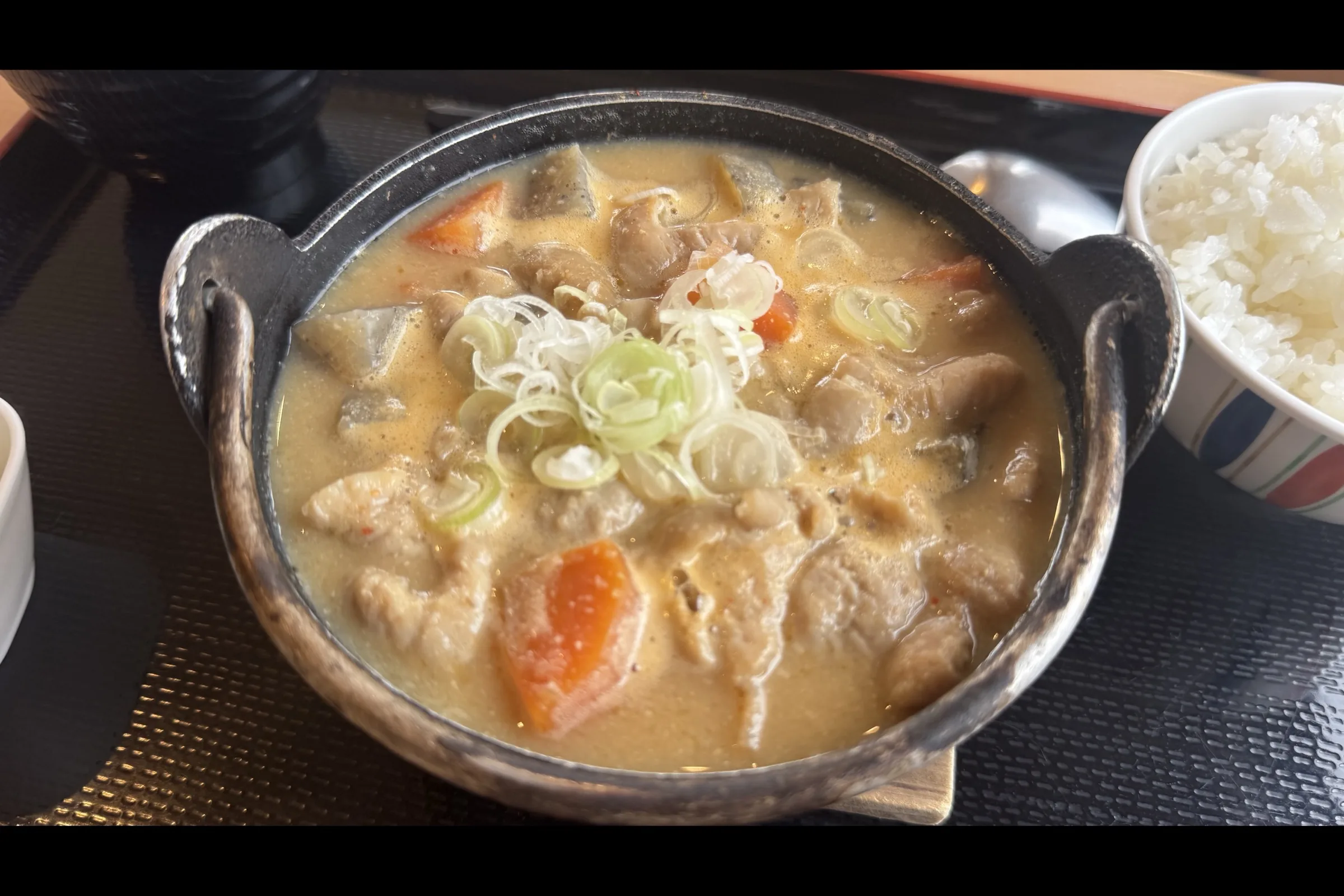
I’ve had motsu-nikomi in Fukuoka (where they’ve turned it into an art form), in Tokyo izakaya (where they add ginger for brightness), and in convenience-store pouches (surprisingly not bad, to be fair). Fujioyama’s version is closer to the Shizuoka style — heavier on daikon and carrot, less sweet than the Kyushu style, miso-forward rather than soy-forward. The offal is cleaned properly: no musky aftertaste, texture that gives. It arrives hot enough to scald if you’re impatient.
Unless you’re a strict vegetarian, this is the single dish worth stopping for.
Tonjiru set — the quiet winner
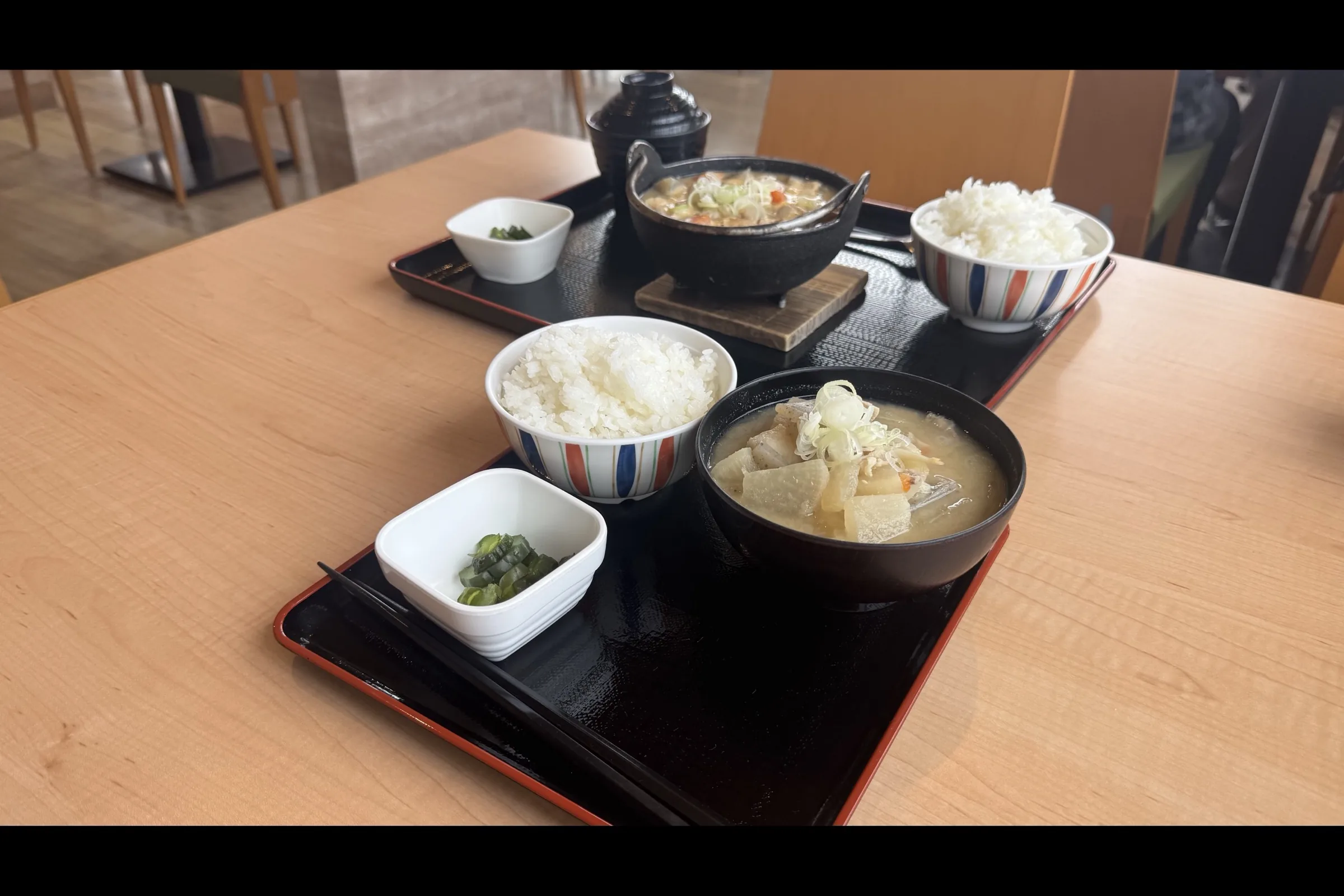
If motsu is too confronting, order the tonjiru set (¥700). Tonjiru is a pork-and-root-vegetable miso soup — daikon, carrot, gobo, a lot of thinly sliced pork belly, topped with the same scallion. It’s the kind of soup Japanese salarymen will detour five kilometres for on a cold day.
The set adds a bowl of rice, a tiny dish of pickled greens, and unlimited hot tea. Seven hundred yen. That’s less than the airport latte you had on the way in.
Karaage as a side
The karaage single plate (¥550) arrives with seven golf-ball-sized pieces, fried right before serving, served with shredded cabbage and no sauce. It doesn’t need sauce. The oil is clean, the marinade has ginger and soy, and the cabbage is there specifically so you can eat all seven without feeling like you’ve done anything wrong. Share it between two; order two if you’re hungry.
Things I didn’t order but saw on other tables and now regret not trying: the hamburg teishoku with grated yam (¥1,200), the zaru-soba as a lighter option, and the kid’s lunch which is full-sized, apparently. Next time.
The produce market — why I left with flowers
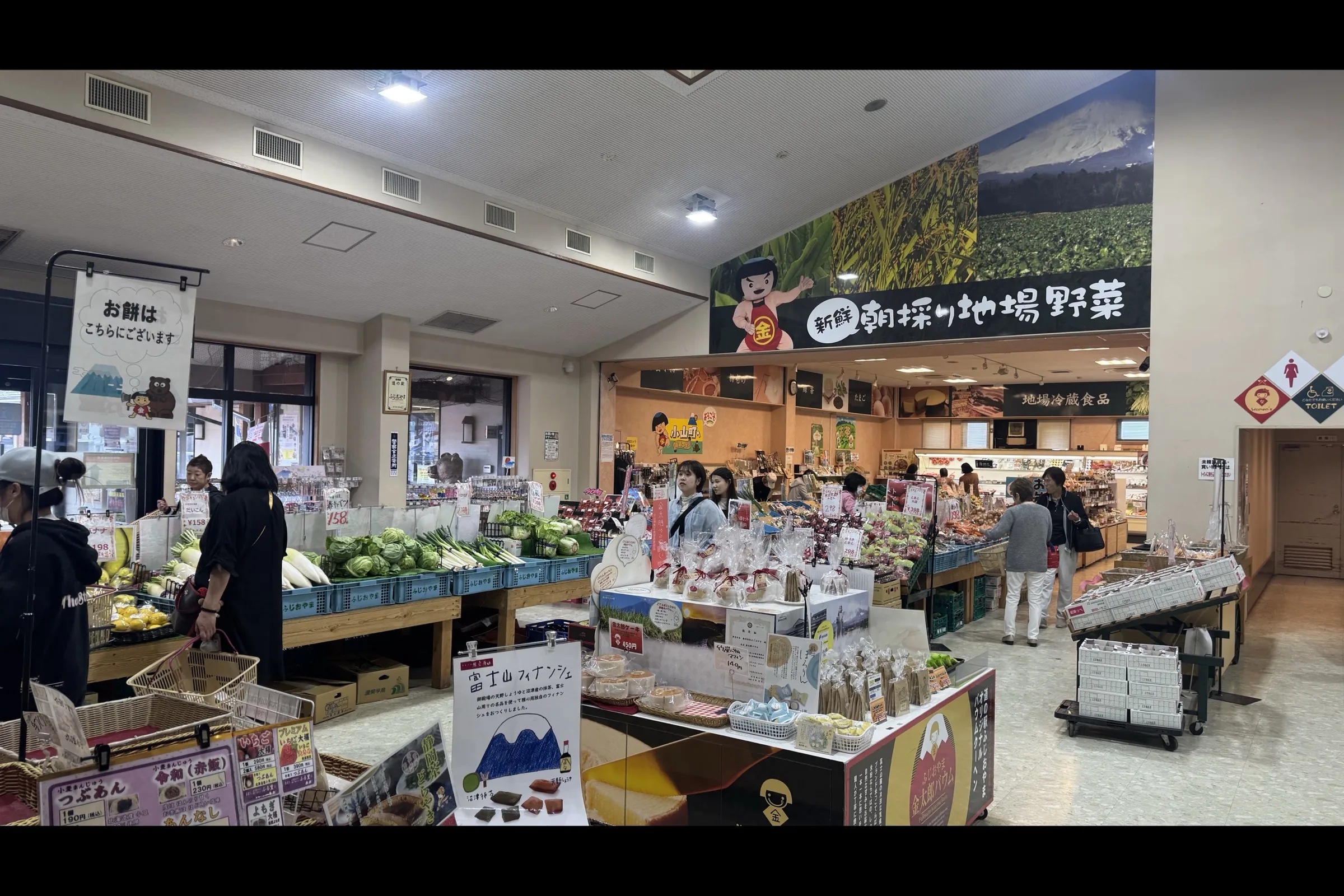
Past the restaurant, you enter the produce floor. This is where every michi-no-eki actually earns its licence.
Most of what’s on the shelves was harvested that morning by farmers who live within twenty kilometres. Each piece of produce is labelled with the farmer’s name and village — not as a marketing gimmick, as a matter of pride. If you buy a slightly misshapen daikon for ¥180, a man named Sakamoto pulled it out of the ground before breakfast.
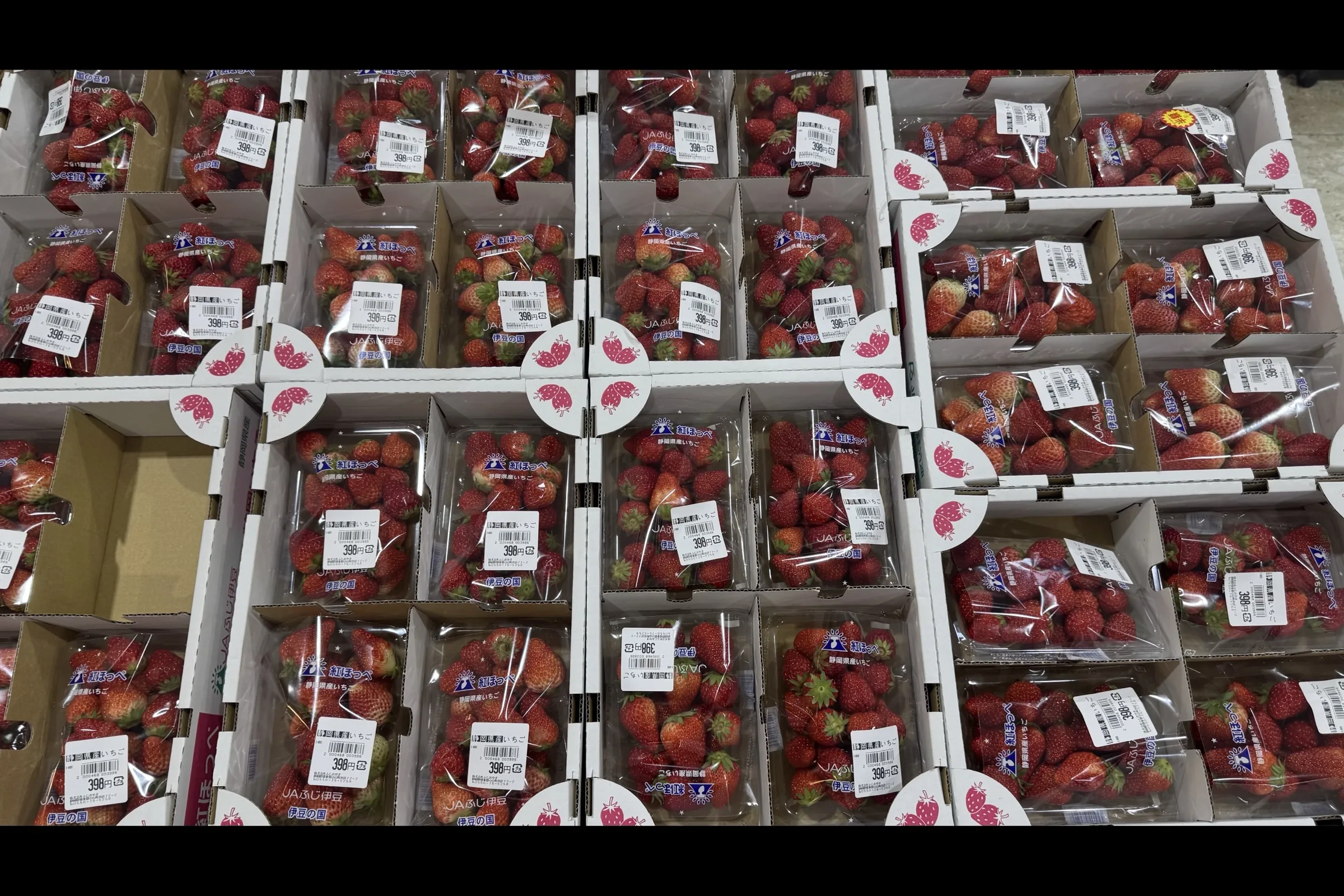
What was notable the day I visited:
- Strawberries (ichigo) at ¥280–380 per punnet. In department-store basements in Tokyo the same fruit is ¥1,200.
- Fruit tomatoes at ¥298 per bag — the small, intensely sweet variety that tastes more like stone fruit than a vegetable.
- Daikon radishes the length of a toddler, for ¥150.
- Local sake and “Fujiclair” sparkling wine made from grapes grown on Mt. Fuji’s south slope. I hadn’t heard of it. It’s very drinkable and ¥2,400 a bottle.
- Handcrafted straw slippers wrapped in tenugui cotton, ¥1,200. A grandmother in a nearby village weaves them by hand.
- Cut flowers from a florist cooperative, ¥450–700 per bouquet. Good enough to make me buy hydrangea I had no plan for.
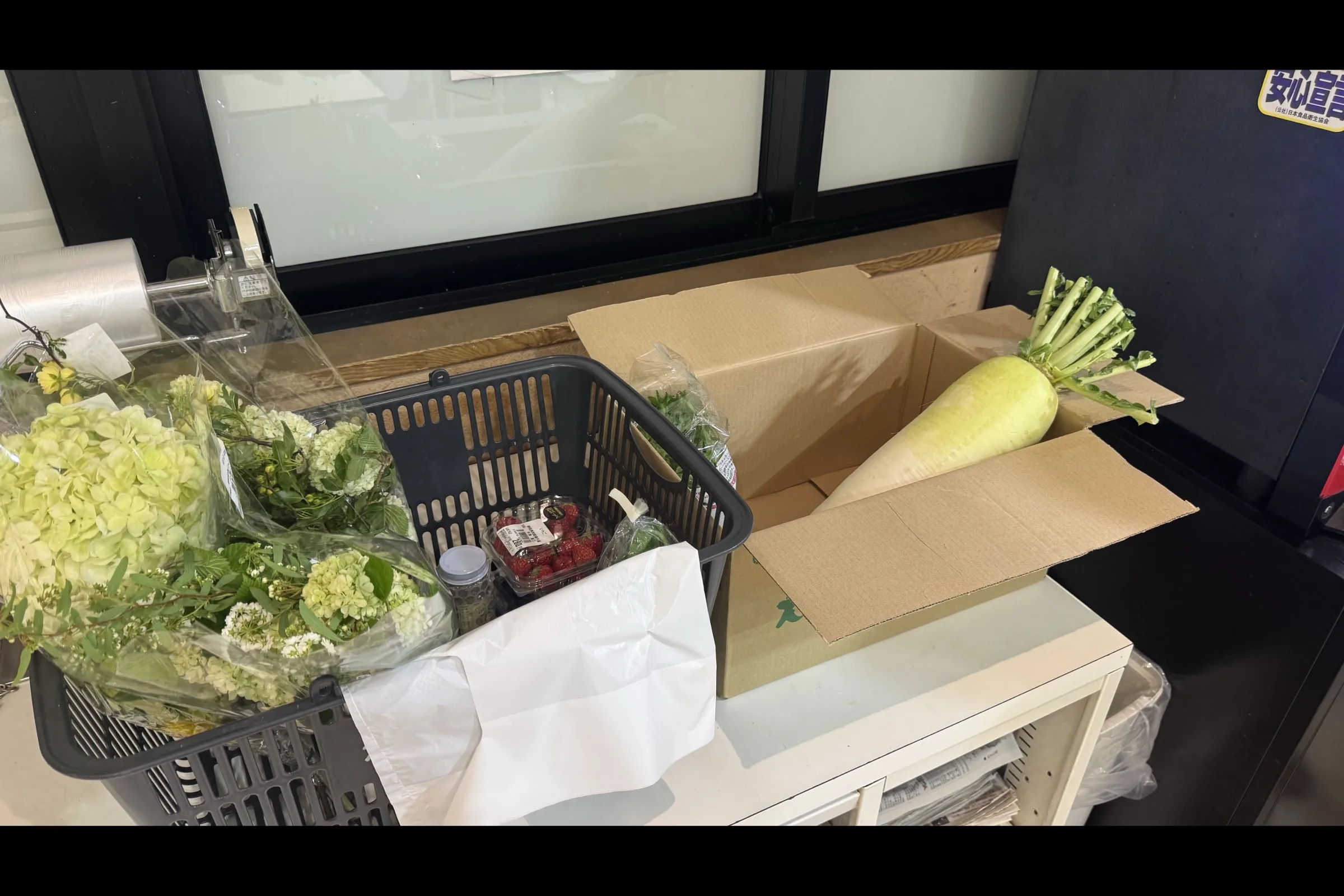
Shopping tip: bring your own tote bag or buy one of theirs for ¥50. The baskets are courtesy, not take-home. Payment is credit card (major brands accepted), IC card (Suica/PASMO/ICOCA), or cash. There’s a self-checkout with an English mode; there’s also a staffed counter if you’d rather not puzzle through it.
Who this is for (and who should skip it)
Michi-no-Eki Fujioyama is for you if:
- You’re renting a car anyway and driving between Tokyo and the Fuji / Hakone / Izu side of Honshu.
- You care more about real food than pretty dining rooms.
- You want to see how Japanese grandmothers actually shop for produce.
- You’re looking for a lunch stop under ¥1,500 a head that doesn’t feel like a capitulation.
It’s not for you if:
- You’re relying on trains and JR-Pass logic. The nearest JR station is 3 km away and the buses don’t run often.
- You expect English-language ambience and service theatre. The staff speak enough to get by, not to perform.
- You want a manicured view of Mt. Fuji. This is Fuji framed by trucks and power lines. That’s honestly part of the charm, but it’s not a postcard.
Practical details
- Address: 2160-1 Fujitaka, Oyama-cho, Sunto-gun, Shizuoka
- Website: fujioyama.co.jp
- Produce market hours: 09:00–18:00 daily
- Restaurant Fujioyama hours: 10:30–20:00 (dessert counter opens 08:00)
- Payment: cash, credit, IC card all accepted
- Parking: free, ~120 spaces, bus parking separate
- English support: English menu + ticket-machine mode + English instructions at the counter
- Accessibility: all ground-floor, wheelchair-friendly, accessible toilets
- Wi-fi: free, no registration
Combine it with
- Gotemba Premium Outlets — 10 minutes by car. Mt. Fuji views, 210 international and Japanese brands, tax-free shopping. A natural morning-before or afternoon-after pairing.
- Oshino Hakkai — 40 minutes by car. Eight pristine spring-water ponds below Fuji; one of the clearest-water places in Honshu.
- Mt. Fuji 5th Station — 60 minutes in summer (closed in winter). See our Mt. Fuji hub for the live status and climbing-season rules.
- Hakone onsen — 50 minutes over the pass. Pair with a ryokan stay.
FAQ
Is Michi-no-Eki Fujioyama worth going out of my way for?
Only if you’re already driving in the area. It’s a brilliant lunch stop on a Fuji loop, but it’s not a destination in itself. The food is excellent and honestly priced, but there’s no single exhibit or viewpoint that justifies a 90-minute drive each way. Pair it with Gotemba or Oshino Hakkai to make the detour earn its keep.
Can I go without speaking Japanese?
Yes. The ticket machine has an English mode, menus are photo-labelled, and the staff at both the restaurant and the market counter are used to international visitors. Google Translate’s camera mode handles the labels on produce if you’re curious about something specific.
How much should I budget for two people?
Lunch for two plus a reasonable produce haul: roughly ¥4,000–6,000 total. We paid ¥2,350 for lunch and another ¥2,800 for produce, strawberries, and the hydrangea bouquet.
Is Mt. Fuji really visible from inside?
On clear days, yes — framed squarely by the dining hall’s windows. Winter and early spring have the clearest air; summer haze obscures it on many afternoons. Check a live Fuji cam before driving over if the view is your main reason for coming.
What’s the best day / time to go?
Weekday lunches (11:30–13:30) are the quietest. Weekend mornings are the busiest because local families pair it with outlet shopping or a Fuji drive. If the dining hall is full, the produce market is still walkable; come back after browsing.
Can I buy produce to cook in my accommodation?
If you’re staying somewhere with kitchen access — yes, absolutely. Everything is washed, labelled, and travels well for a day or two. A rental Airbnb in the Fuji Five Lakes area is the ideal pairing for this. Browse options on Agoda.
If you’re renting a car to see Fuji, don’t skip this stop.
A forty-five-minute detour for a ¥700 tonjiru set, a view of Mt. Fuji from inside, and a daikon the length of your forearm. That’s a pretty good afternoon.
Open the Mt. Fuji hub → Compare rental cars →Join 1,000+ travelers discovering Japan's hidden side
Weekly dispatches from off-the-beaten-path Japan — spots and stories you won't find in guidebooks.
No spam. Unsubscribe anytime.
Welcome aboard!
You're in. See you in your inbox soon.