

Tottori · Hōki · 2026
Shōji Ueda Museum 2026: The Concrete Building That Frames Mt. Daisen Like One of His Photographs
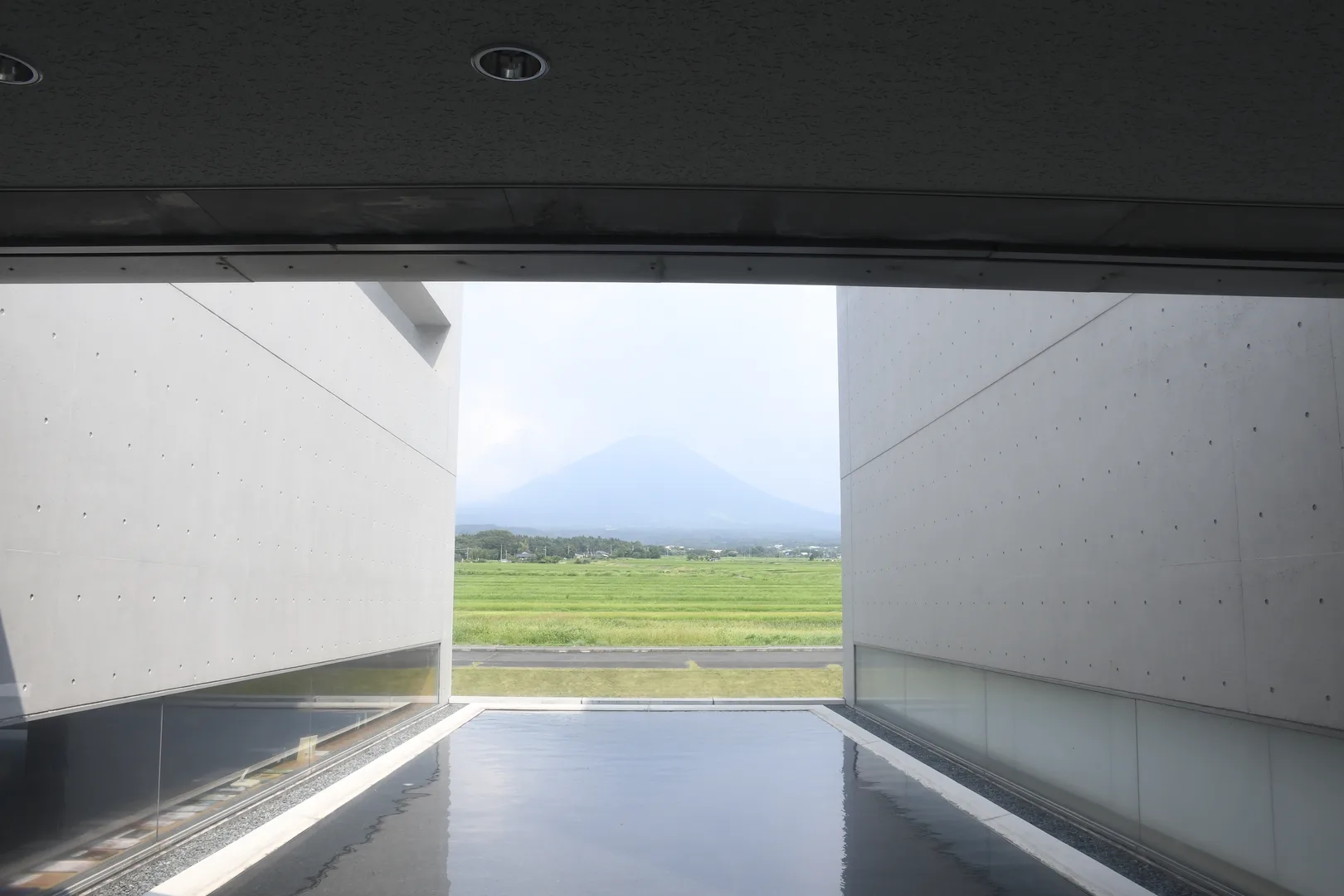
The view that defines the museum — a concrete frame, a reflecting pool, and Mt. Daisen behind a rice paddy. The building is itself a Shōji Ueda composition.
I went to the Shōji Ueda Museum of Photography because Ueda is one of the few Japanese photographers I copy unconsciously when I shoot — the small figure in a wide empty landscape, the deliberate placement of an object against a flat sky, the willingness to stop and arrange before the shutter falls. The museum is in his hometown of Hōki, halfway between Yonago and the foot of Mt. Daisen, in a region where almost no foreign visitor goes. Architect Shin Takamatsu built the museum as four bare-concrete cubes facing the mountain that Ueda spent his life photographing. The reflecting pool out front turns the building into a Ueda composition you can walk inside.
Quick Facts
Who Was Shōji Ueda — And Why a Museum Out Here
Shōji Ueda (1913–2000) ran a small camera shop in Yonago his entire working life. He never moved to Tokyo. He never quit the day job. And from those Tottori sand dunes ten kilometers from his shop, he built a body of photography that is now in MoMA, the Centre Pompidou, and the V&A. His signature work is what European critics later called the “Ueda-chō” or Ueda style — small figures arranged like still-life objects on the dunes, the horizon line cutting the frame in half, everything slightly off-center, slightly surreal, deeply formal. His best-known series, Children the Year Round and Sand Dunes, use his own family as models.
The museum is built in his hometown of Hōki rather than in Tokyo or Yonago for two reasons: he photographed Mt. Daisen all his life, and the architect, Shin Takamatsu, is also from Tottori. The site is positioned so the main viewing window in the central building frames Daisen exactly — on a clear day, the mountain sits centered between two concrete walls with the reflecting pool below. It is an architectural quote of Ueda’s compositions.
The building is a four-cube reading of Ueda’s photographs. The framing is the photograph. The mountain is the subject. The pool is the dune.
Plan This Visit
Plan This Trip
The Architecture — Reading Shin Takamatsu
The exterior is the easy part. From the parking lot you walk up a low slope to a wide concrete approach, and the building reveals itself in stages: first the long flat retaining wall, then the four cubes rising behind it, then the entrance staircase. Bare concrete, tied lightly with stainless steel, almost nothing painted. The cubes look identical from the outside but they are not — they are different sizes, slightly rotated against each other, with the gaps between them flooded by a shallow reflecting pool that turns black on overcast days and silver in afternoon light.
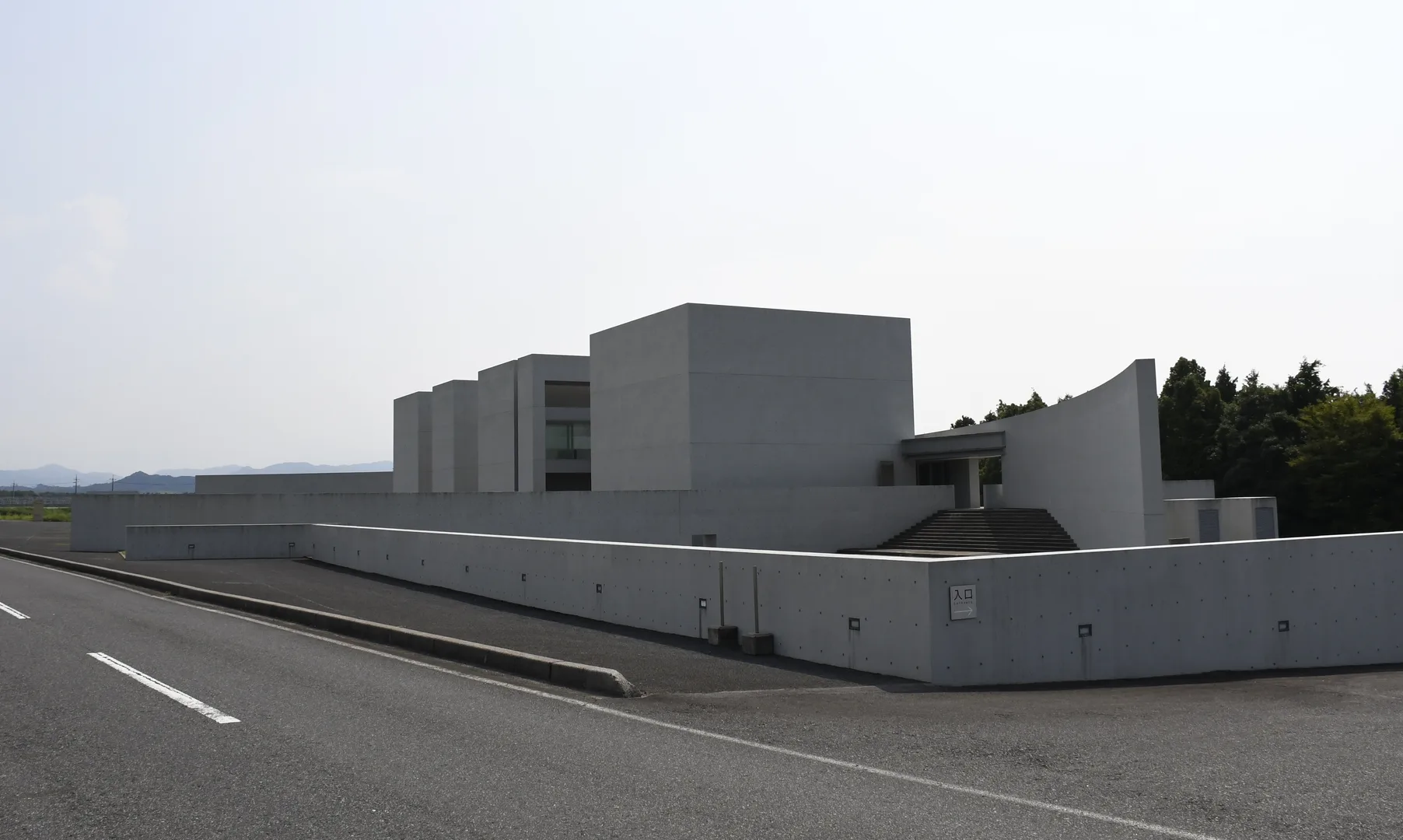
The four-cube exterior. Takamatsu designed it as a quartet of independent volumes joined only by the underground gallery floor.
The clever move is the central gap. From the entrance hall you walk straight through the building — concrete walls on either side, ceiling open to the sky, your footsteps echoing — and arrive at the framing window. There the wall opens, the pool extends out, and the mountain sits in the middle distance. The building is essentially a viewfinder.
The Reflecting Pool & The Mountain
The framing view is the photograph everyone takes. It works because Takamatsu built the proportions specifically: the concrete frame is just wide enough to contain Daisen’s silhouette without cropping the sloping shoulders, and the pool depth is calibrated so that on still days you get a near-perfect mirror reflection of the mountain.
What you see depends entirely on the weather. Daisen sits at 1,729 meters and pulls cloud constantly — on cloudy days the mountain disappears and the frame holds a flat white sky over green rice paddies, which is also a kind of Ueda composition. On clear days the reflection is so still that visitors stand at the threshold of the indoor lounge and just stare for ten minutes without moving.
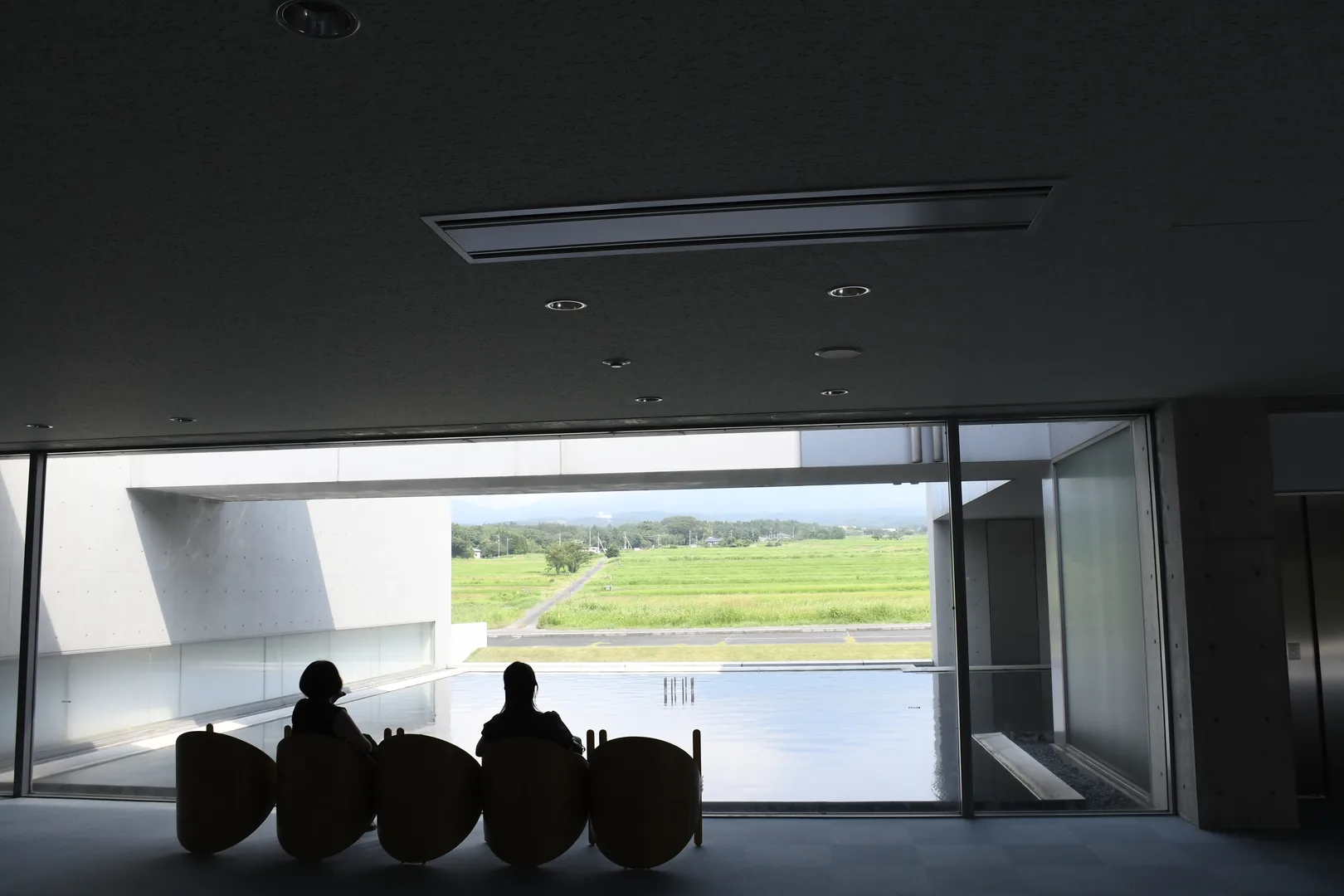
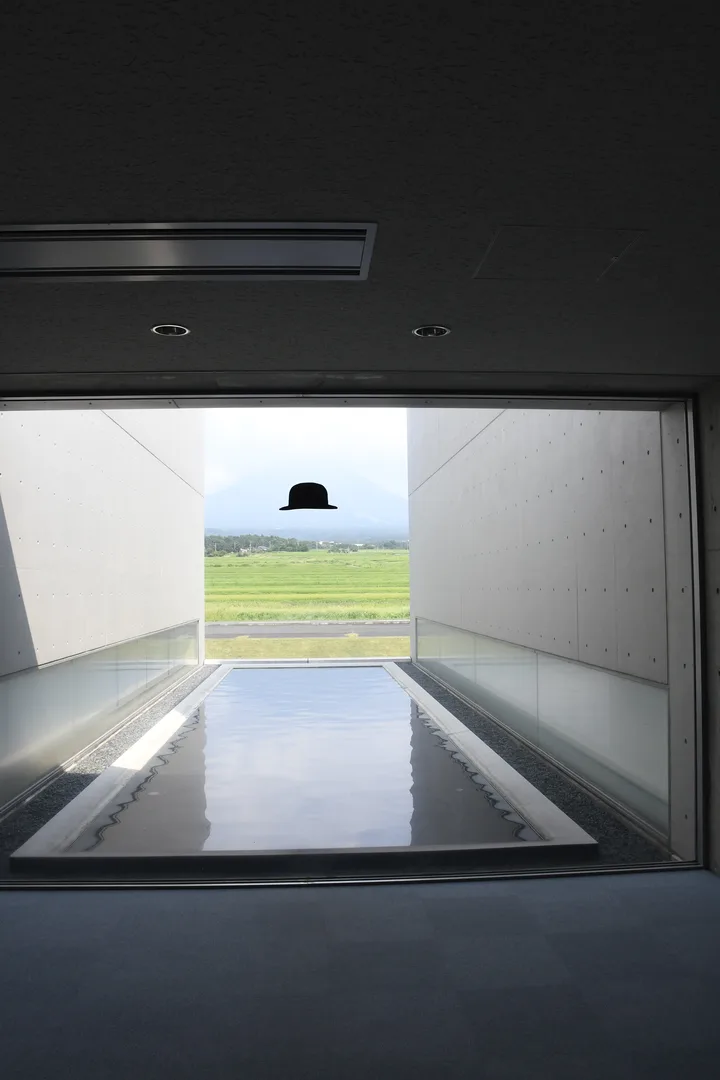
Left: the indoor lounge facing the framed view, with Takamatsu’s egg-shaped pod chairs. Right: the outdoor passage with a floating bowler-hat installation — a homage to Ueda’s signature Sand Dune Mode fashion shoots.
Two practical notes on photographing the framing view: tripods are not permitted in the public viewing area; phone or hand-held shots are fine. The light is best from late morning through early afternoon — before then the building blocks the sun, after the mountain backlights and gets hazy.
The Collection
The permanent collection rotates because the museum holds over 12,000 Ueda works. A typical visit shows you 100–150 prints arranged in rough chronological and thematic groupings. The sections you can expect to see across visits:
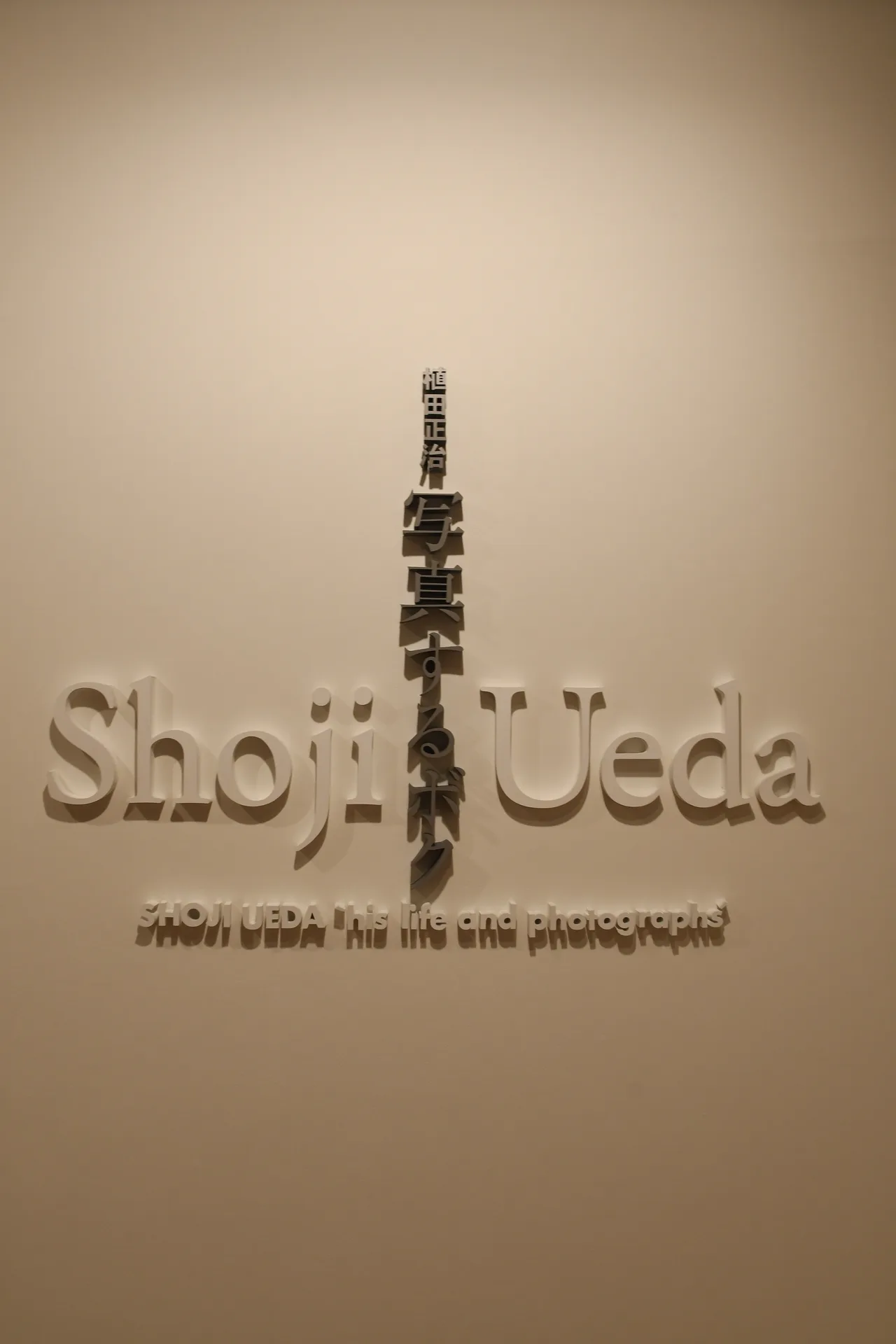
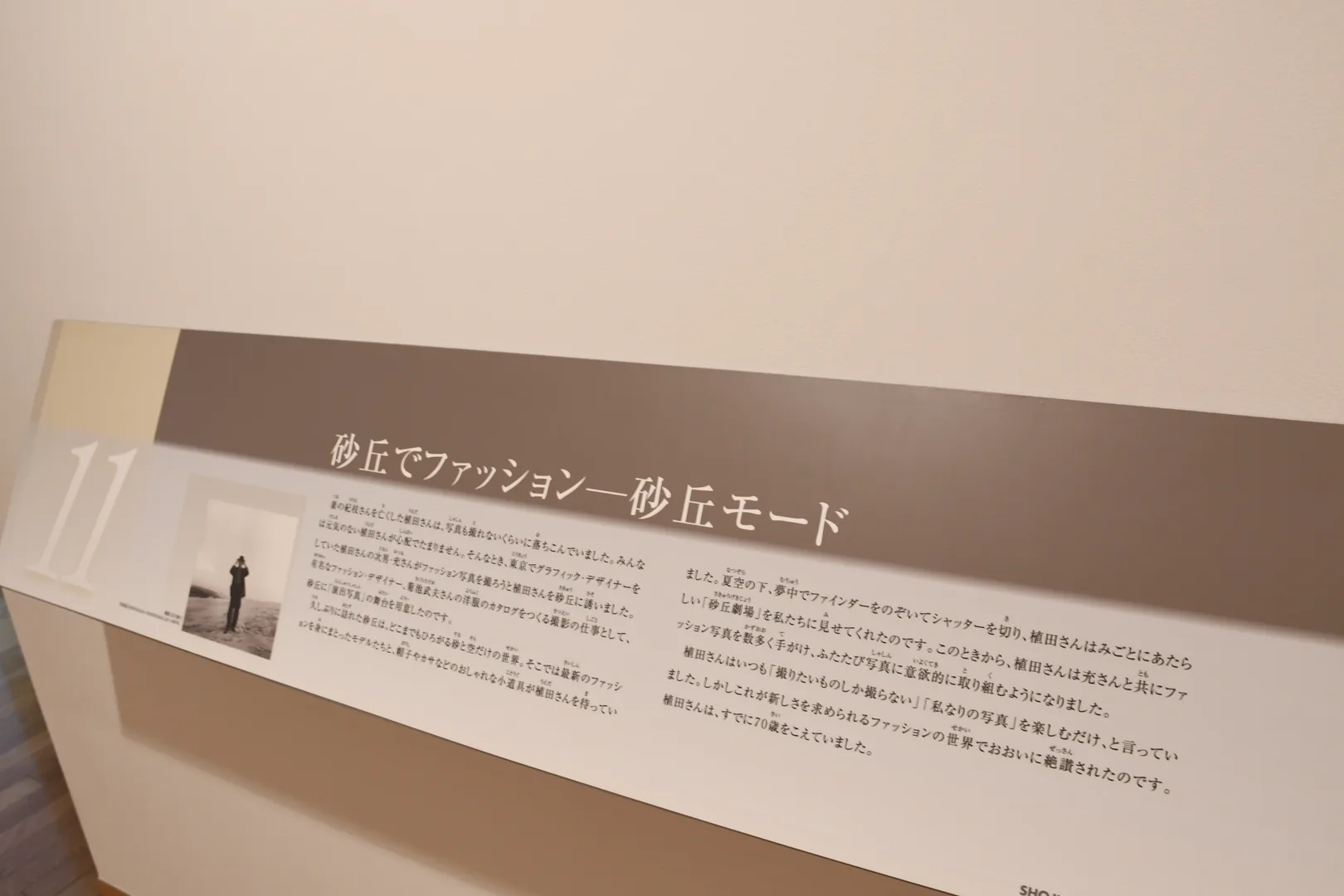
Left: the gallery title wall. Right: an exhibition panel from the Sand Dune Mode section — his fashion-shoot collaborations from the 1980s.
Where to Stay
The museum is rural enough that staying overnight nearby gives you a chance to also do the morning Mt. Daisen view from the Daisen Park area or an onsen the night before. Two practical bases:
Stay in Yonago, Kaike Onsen, or Daisen
Yonago city and Kaike Onsen (a seafront onsen district 15 min from Yonago Station) are the practical hotel zones — mainstream business hotels and onsen ryokan with sea views. Booking covers the modern hotels well; Rakuten Travel is stronger on the local Kaike Onsen ryokan and small inns nearer the museum.
How to Get There
The museum is genuinely rural. Three realistic options:
By rental car (recommended)
Pick up a car at Yonago Station or Yonago-Kitaro Airport. The drive to the museum is 25 minutes from Yonago Station or 45 minutes from the airport. Free parking on-site for 100 cars. A car also opens up the Tottori cluster — sand dunes, sand museum, and Mt. Daisen are all within an hour. Compare rental car prices on DiscoverCars or on Rakuten Travel.
By train + taxi
From the Sanin Main Line, get off at JR Kishimoto Station (the closest stop). Taxi from there is 5 minutes (around ¥1,500). From JR Yonago Station, taxi is 25 minutes (~¥5,000). The taxi will wait at the museum if you ask — there is no taxi rank to call from.
By demand bus
From Kishimoto Station there is a “Hoki Demand Bus” (要予約 demand bus) that goes to the museum in 10 minutes for ¥200, but you must reserve at least one day in advance by phone (Japanese only). Most international visitors skip this and take the taxi.
From Tokyo or Osaka
The fastest option is to fly — ANA and JAL run multiple daily flights from Haneda (HND) to Yonago Kitaro Airport (YGJ), about 80 minutes flying time. By train, take the Shinkansen to Okayama then transfer to the JR Yakumo limited express to Yonago (about 2.5 hours from Okayama). A 7-day JR Pass covers everything except the airport flight. Buy a JR Pass via Klook.
Map & Surrounding Area
Combine With the Tottori Cluster
Almost no one travels all the way to Tottori for the Ueda Museum alone. Pair it with two or three of these on a 2–3 day western Sanin loop — all are within 90 minutes by car:
Suggested 2-day loop: Day 1 fly into Yonago, drive to Daisen Park area for Mt. Daisen viewpoints, sleep at Kaike Onsen. Day 2 morning at Shōji Ueda Museum, lunch in Yonago, afternoon at Tottori Sand Dunes + Sand Museum, sleep in Tottori City. Day 3 optional GREENable Hiruzen on the way back to Okayama.
Practical Tips
FAQ
Is the Shōji Ueda Museum worth visiting if I do not know his work?
Yes — honestly, it works on two layers. As an architecture pilgrimage (Shin Takamatsu’s most important public building, with the framing view of Mt. Daisen) it is worth the detour even with no photography knowledge. As a photographer’s museum, it is one of the best monographic museums in Japan. Most first-time visitors come for one and leave caring about both.
Can I see Mt. Daisen from the museum reliably?
Daisen is cloud-prone. On about 60% of clear-sky days you get the iconic framed view; on overcast days the frame holds a flat white sky and rice fields, which is also striking. Late April, October, and early November are statistically the clearest months. Rainy season (mid-June to mid-July) is the worst.
How long do I need to see the Shōji Ueda Museum?
Allow 90 minutes minimum, two hours is comfortable. If you want to use the camera obscura room and sit at the framing view, allow 2.5 hours.
Is the museum open in winter?
No. Closed every year from December 11 to the end of February. Tottori winters get heavy snow at this elevation and the rural roads to the museum are not always cleared. Plan a March–November visit.
Can I get to the Shōji Ueda Museum without a car?
Yes but it requires planning: take the JR Sanin Main Line to Kishimoto Station, then a 5-minute taxi (~¥1,500). The Hōki demand bus is cheaper but requires Japanese-language phone reservation a day ahead. Renting a car at Yonago Station or Yonago Airport is the realistic answer for most international visitors.
What is the closest airport to the Shōji Ueda Museum?
Yonago Kitaro Airport (YGJ), about 45 minutes by car. ANA and JAL run multiple daily flights from Tokyo Haneda (about 80 minutes flying time). The airport is named after manga artist Shigeru Mizuki who was born in nearby Sakaiminato.
Is there a connection between Shōji Ueda and the Tottori Sand Dunes?
Yes — the dunes are about 90 km east of his Yonago shop, but Ueda used the smaller dunes near his hometown of Hōki for many of his most famous photographs. His “Sand Dunes” series and the later “Sand Dune Mode” fashion work both used Tottori dunes. The 90-min drive between the museum and the main Tottori Sand Dunes makes a natural same-day pairing.
Who is the architect Shin Takamatsu?
Shin Takamatsu (born 1948 in Shimane, near Tottori) is one of the most prolific Japanese architects of his generation, known for industrial-machine-aesthetic buildings in the 1980s, then a shift toward more contemplative concrete forms. The Ueda Museum (1995) is his most internationally recognized public building. He is also based in Kyoto and has built significantly more in Japan than abroad.
Final Thoughts
The Shōji Ueda Museum is the kind of place I tell people about and they say “where?” The combination of factors that make it special — major Japanese photographer, major Japanese architect, the framed mountain view, the rural location, the rotating collection — never line up for international travel writers because Tottori has no big-name destination beside it. So it stays quiet.
That quiet is half the experience. I sat at the framing view for nearly thirty minutes the day I went and saw maybe five other visitors pass through. Daisen came and went behind cloud, the pool turned silver and then black again. That kind of unhurried looking is what Ueda did with a camera his whole life, and it is what the building asks you to do for an afternoon.
If you are putting together a Tottori or Sanin trip, build a day around the museum. Drive there. Stay nearby. Bring a real camera if you have one. Look slowly.
Booking the Trip
Three doors into a Shōji Ueda Museum visit. Most international travelers underbook the rental car — do that first.
Join 1,000+ travelers discovering Japan's hidden side
Weekly dispatches from off-the-beaten-path Japan — spots and stories you won't find in guidebooks.
No spam. Unsubscribe anytime.
Welcome aboard!
You're in. See you in your inbox soon.