

Shiga · Lake Biwa Western Shore · One Day
One day in Takashima: Lake Biwa’s quiet western shore, an hour from Kyoto.
Kyoto runs out of corners after a few days. The next thing most travellers reach for is Nara or Osaka. Here is the better answer if you have already done those: Takashima — the western lake shore of Biwa, an hour north of Kyoto by local train, with a torii standing in the water, a four-kilometre cherry road no one queues for, and stone walls that have held back lake storms since the seventeenth century.
From Kyoto
~60 min
JR Kosei Line, ~¥1,170
Time on the ground
7–9 hours
5 stops, lunch, lake breaks
Crowds
Low
except early-April sakura week
Best done by
Rental car
trains exist but spacing is large
Why Takashima, and why almost nobody talks about it
Takashima sits on the western shore of Lake Biwa, the largest lake in Japan. Most international visitors hear “Lake Biwa” and either go to Hikone on the eastern shore (for the castle) or skip the lake entirely. The west shore is quieter on every visible metric: fewer hotels, fewer English signs, fewer Korean and Mandarin tour buses.
What you get on this side of the lake is the part of pre-Kyoto Japan that didn’t become a tourist district. Fishing villages with three-hundred-year-old stone walls built to absorb winter lake storms. A four-kilometre row of cherry trees along the lake edge that reaches peak bloom about a week later than Kyoto. A 2.4 km Metasequoia avenue that turns colour with the season. And one of the most photographed shrines in Japan, Shirahige, which still feels weirdly empty the moment a tour bus pulls away.
This is the route I take when a friend has already done Kyoto and asks for “something nearby that isn’t Nara.”
Getting there from Kyoto
Three realistic options, in order of how I’d actually do it:
- Rental car (best). Pick up at Kyoto Station, drive Route 161 north along the lake. Takes about 50–70 minutes to the southernmost stop (Shirahige Shrine), longer to Kaizu at the top. The full one-day loop only really works with a car — bus connections between the spots are sparse and slow. Compare rental cars on Klook.
- JR Kosei Line. From Kyoto Station, the Kosei Line runs along the western lake shore to Ōmi-Takashima (~40 min), Makino (~60 min), and beyond. Local trains, infrequent at midday. Fare to Makino around ¥1,170 one-way. This is the realistic option if you only want one or two stops and don’t want to drive in Japan.
- Day-trip tour from Kyoto. Honestly — I haven’t taken one of these in person, so I can’t recommend a specific operator. There aren’t many English-language Takashima day tours, which is part of why this region stays quiet.
The route, in one sentence
Shirahige Shrine (south) → Metasequoia Avenue (mid-Makino) → Kaizu-Osaki cherry road (lake’s northern tip) → Kaizu fishing village & stone walls → Takashima old townscape on the way home. Five stops, all on the lake’s western shore, all reachable in a single full day if you start from Kyoto by 9am.
Stop 1 · Shirahige Shrine — the floating torii
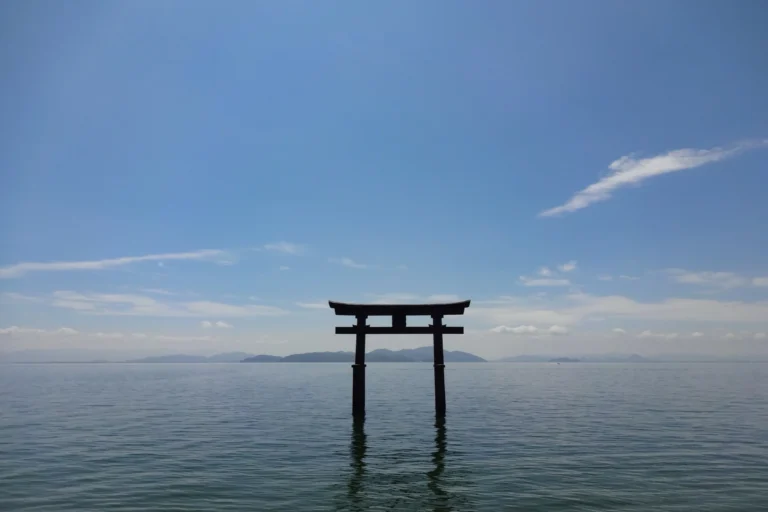
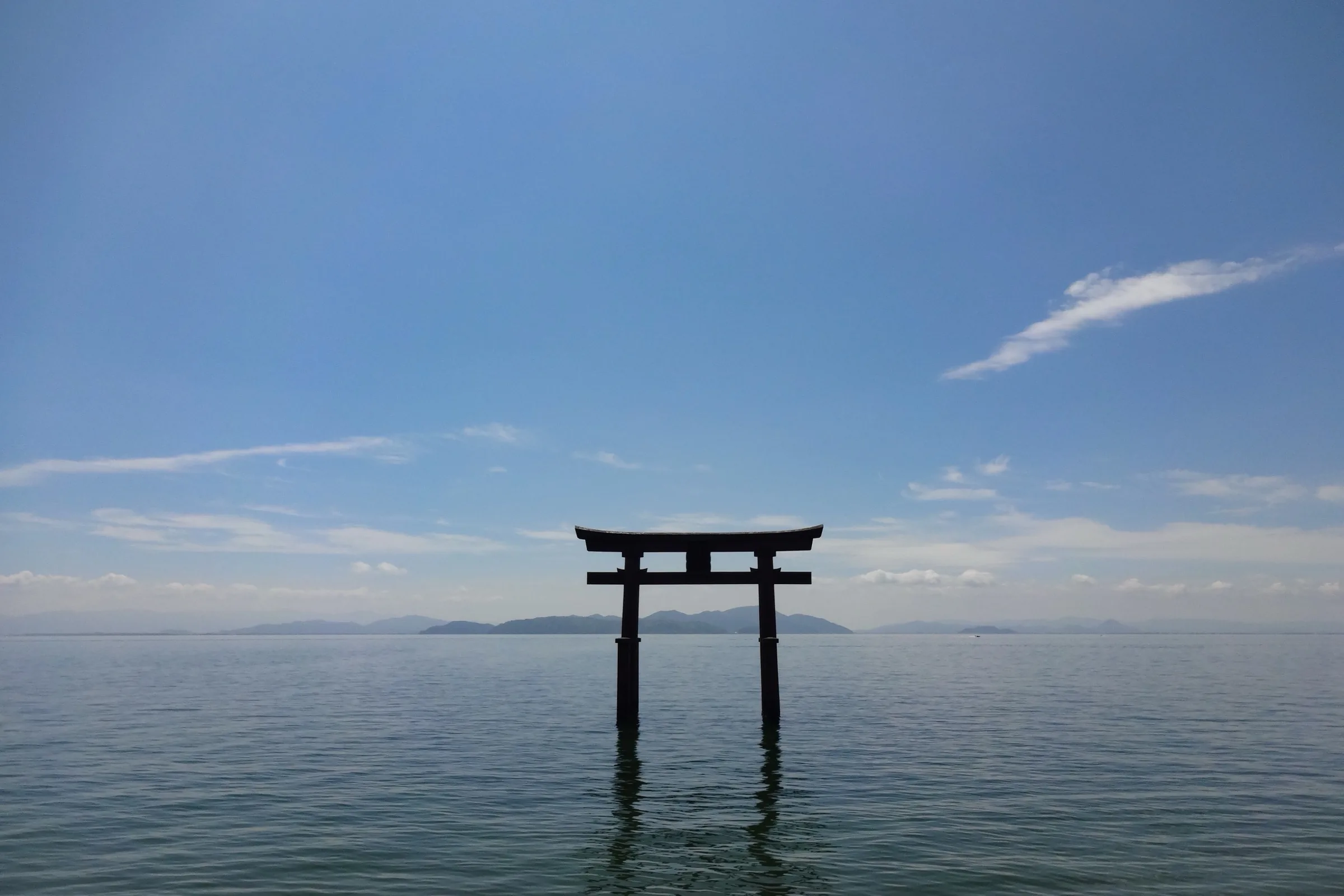
A vermillion torii standing in Lake Biwa, with mountains across the water
Shirahige Jinja (白鬚神社) is the southernmost stop on this route, in a hamlet called Ukawa. The shrine itself is small. The reason you’re here is the great torii standing in the lake, about thirty metres offshore, vermillion against the water. It’s sometimes called “the Itsukushima of Ōmi” because the composition rhymes with the famous Hiroshima shrine, although Shirahige is far older — the shrine grounds claim founding traditions reaching back to the time of Emperor Suinin.
The shrine itself sits inland, across busy Route 161. Watch the road — the two crossings to the lakeside torii are unmarked and cars come through fast. There is a small reflective walkway, but you’ll want to time your gap between traffic.
Practical: shrine grounds are open during daylight, free to enter. Free parking on-site, plus a larger lot just south, total around 80 spaces. The closest train station is JR Ōmi-Takashima (about 3 km south); shrine itself isn’t walking distance from the station — allow a taxi (~5 min, ~¥1,200) or hire a bike at the station.
For a full standalone deep-dive on this shrine alone, see our dedicated Shirahige guide.
Stop 2 · Metasequoia Avenue — a 2.4 km green tunnel
Drive a tree-lined road that changes character every season
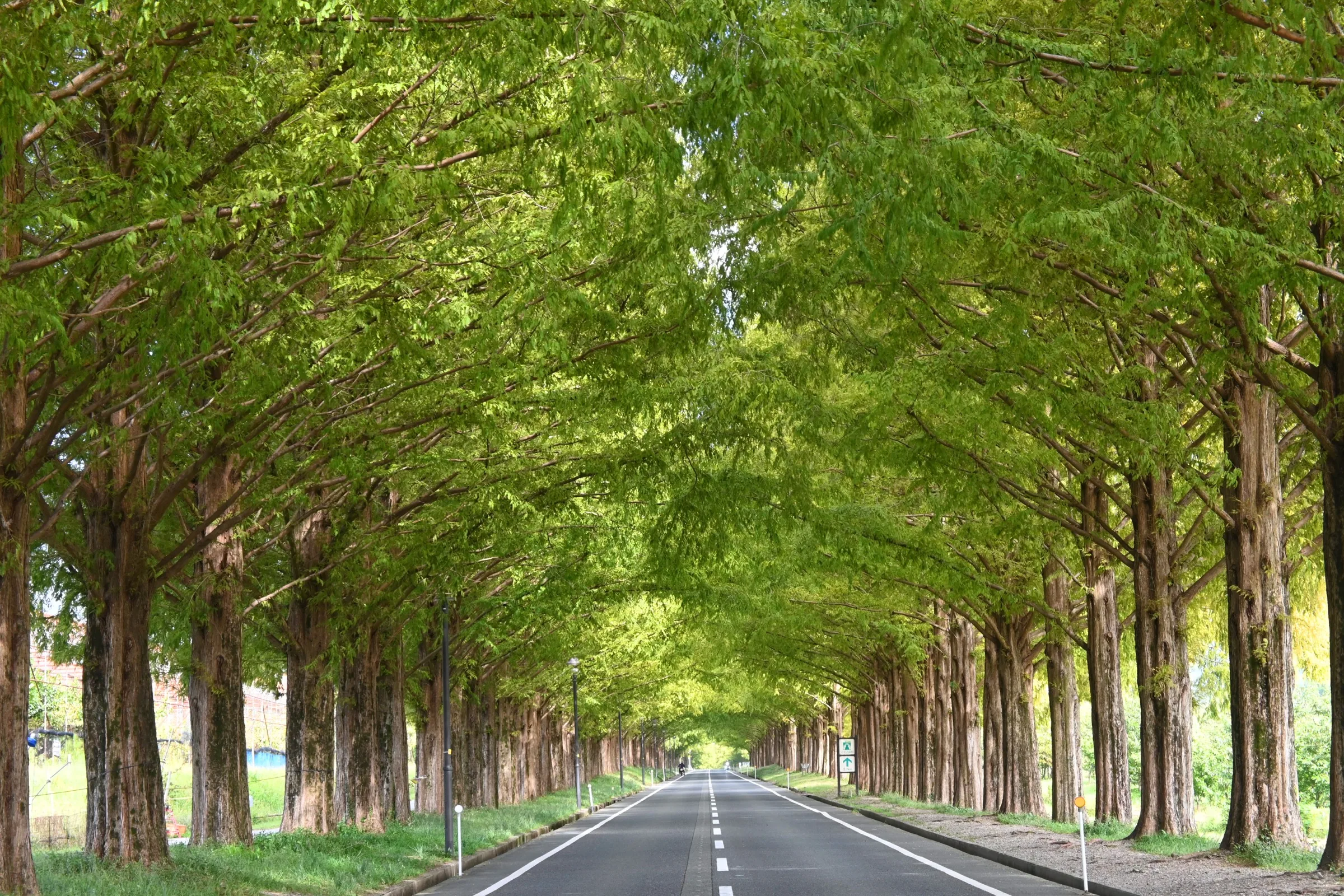
About forty minutes north of Shirahige (by car) you reach Makino-cho in upper Takashima. From here a perfectly straight country road runs east toward the foothills for 2.4 kilometres, lined on both sides by approximately 500 Metasequoia trees. The trees are mature, the canopy meets overhead, and the road is open to public traffic.
What makes this place worth a stop is that it works in every season:
- Late April to early May: tender spring green, the freshest light of the year (this is when the photo below was taken)
- Mid-summer: dense dark green canopy
- Late November to early December: red-orange autumn colours; this is the most photographed season
- January to February: bare branches against snow, on the rare days the snow holds
Park at Makino Pickland, a small farm-shop and rest stop right at the trailhead of the avenue. Parking is free, and the shop sells local fruit, ice cream, and reasonable lunch.
Stop 3 · Kaizu-Osaki — the four-kilometre cherry road
800 cherry trees curving along Lake Biwa’s northernmost cape
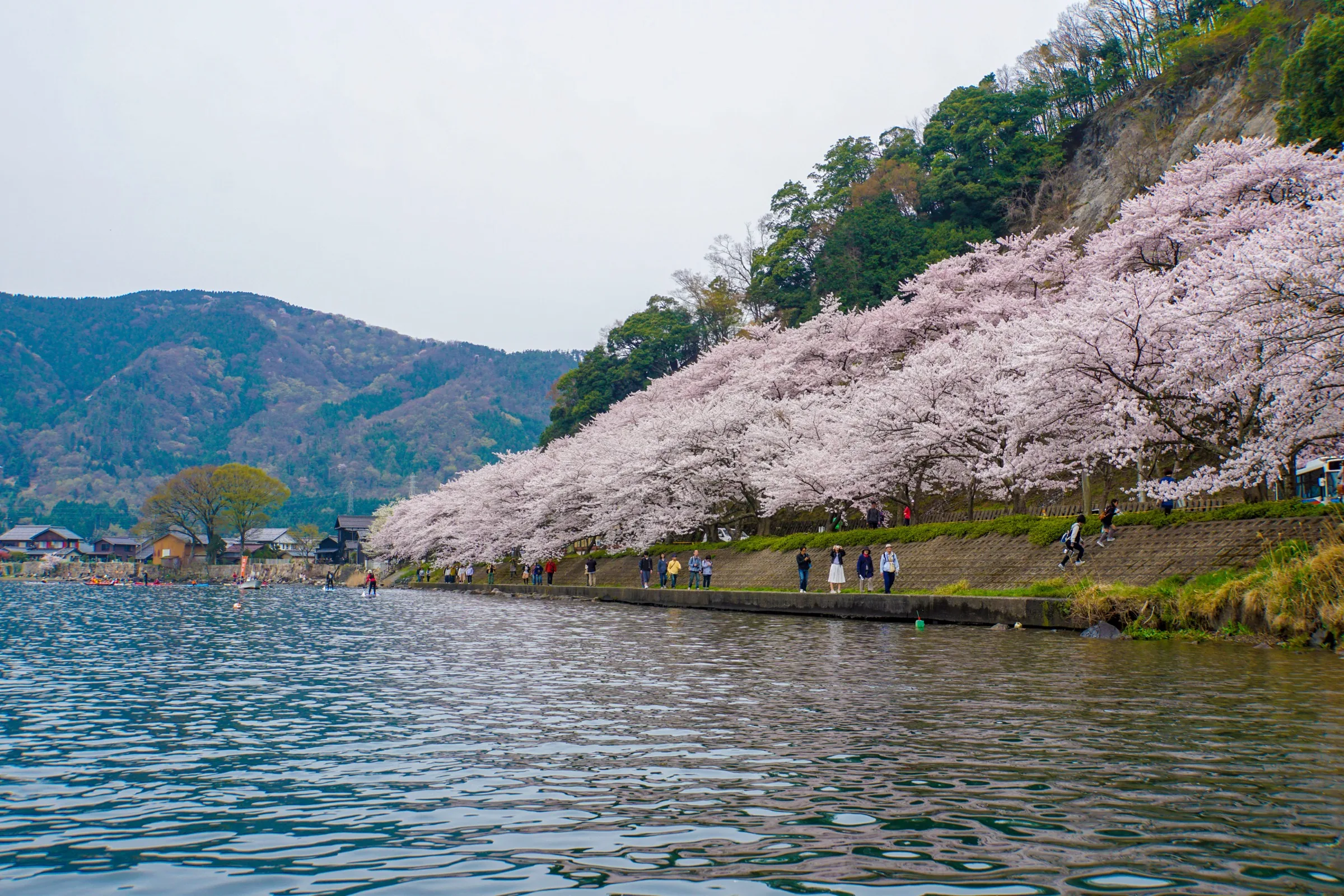
Drive 15 minutes east from Metasequoia and you reach the lake’s northernmost tip: Kaizu-Osaki. A two-lane road follows the cape for about 4 kilometres, lined on the lake side with roughly 800 cherry trees, including some over eighty years old. It is on Japan’s official “100 famous cherry blossom spots” list and is one of the latest-blooming sakura locations in Kansai — typically peaking around the second week of April, after Kyoto has finished. The shot at the top of this article is from there.
If you arrive outside cherry season, the same road is one of the most photogenic shoreline drives in Kansai — quiet, curved, lake on one side, low forest on the other. Worth coming for in any month.
Stop 4 · Kaizu fishing village & stone walls
17th-century lakeside engineering, walked at human pace
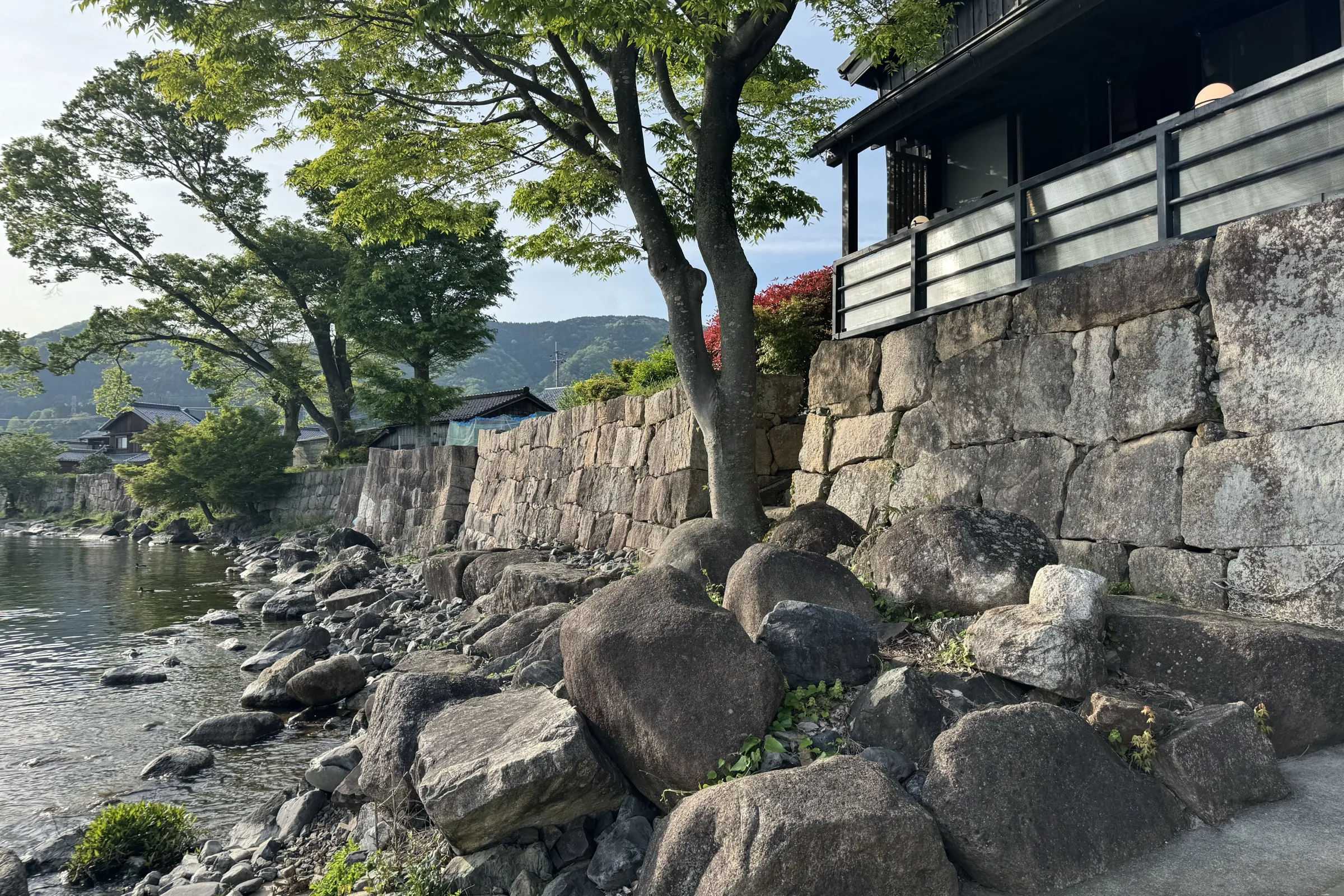
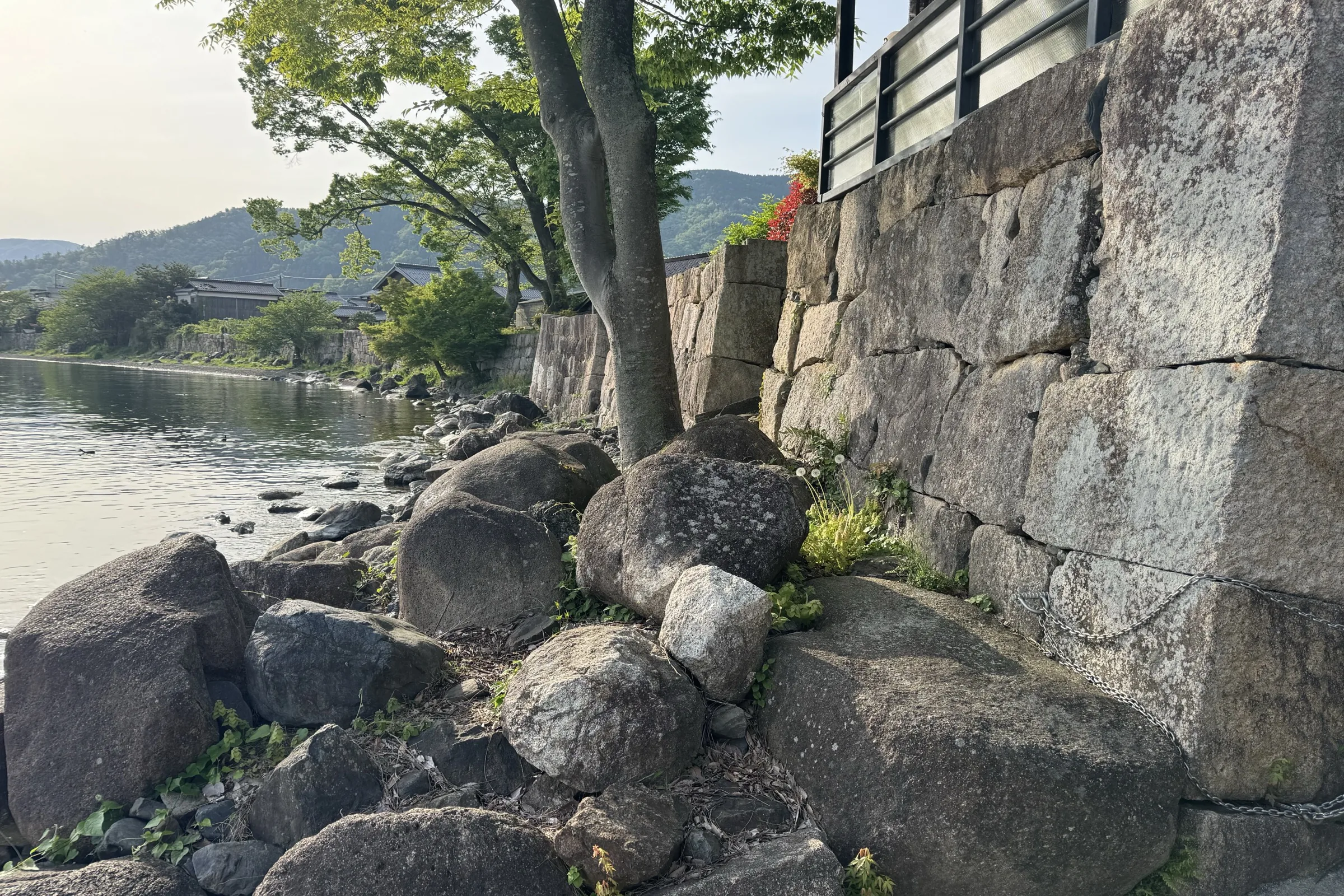
Right next to the cherry road sits Kaizu (海津), an old fishing village whose lakeside houses are protected by a continuous stone wall (ishigaki) along the shore. The wall was built in the seventeenth century to break the force of winter waves and ice that get pushed across the lake from the north on stormy days. Today the area is designated a national Important Cultural Landscape together with neighbouring Nishihama and Chinai — one of relatively few cultural-landscape designations in Japan that protects an entire working shoreline rather than a single building.
Walk down behind the houses to the lakeshore. The stones are massive, irregular, individually quarried — you can see the marks of hand tools on them. There is no admission, no museum, no interpreter; the village is a still-functioning settlement. Walk respectfully. Some lanes are private.
Stop 5 · Old Takashima townscape on the way home
A side-street loop through one of Takashima’s preserved old neighbourhoods
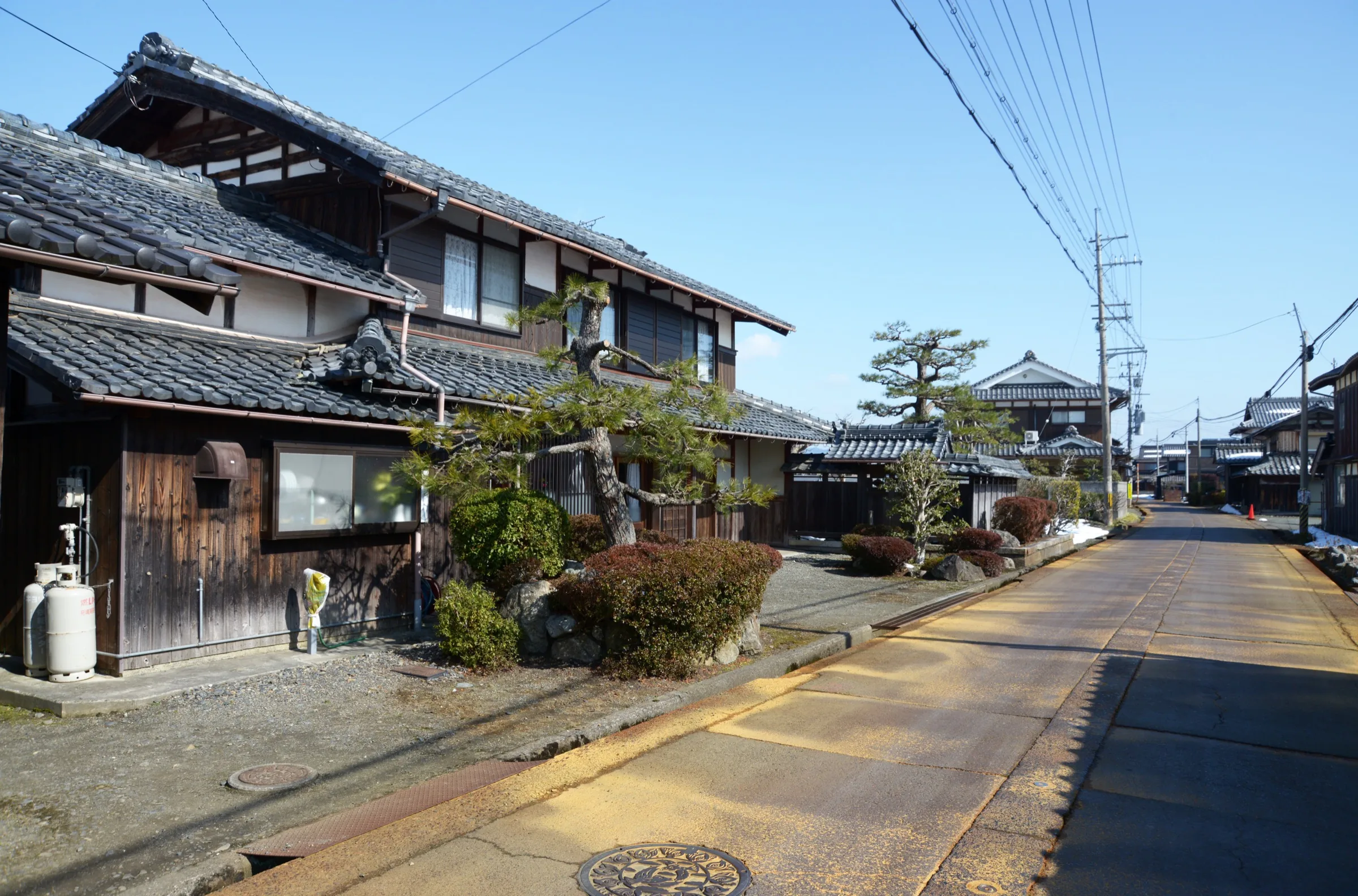
Heading back south toward Kyoto, take a fifteen-minute detour off Route 161 into one of Takashima’s old townscape areas. Two of the best-known are Omizo (the former castle town founded by Oda Nobuzumi in 1578) and the Harie water-village near Ōmi-Takashima station, which is famous for its inner-house freshwater channels (kabata).
The lake itself, between stops
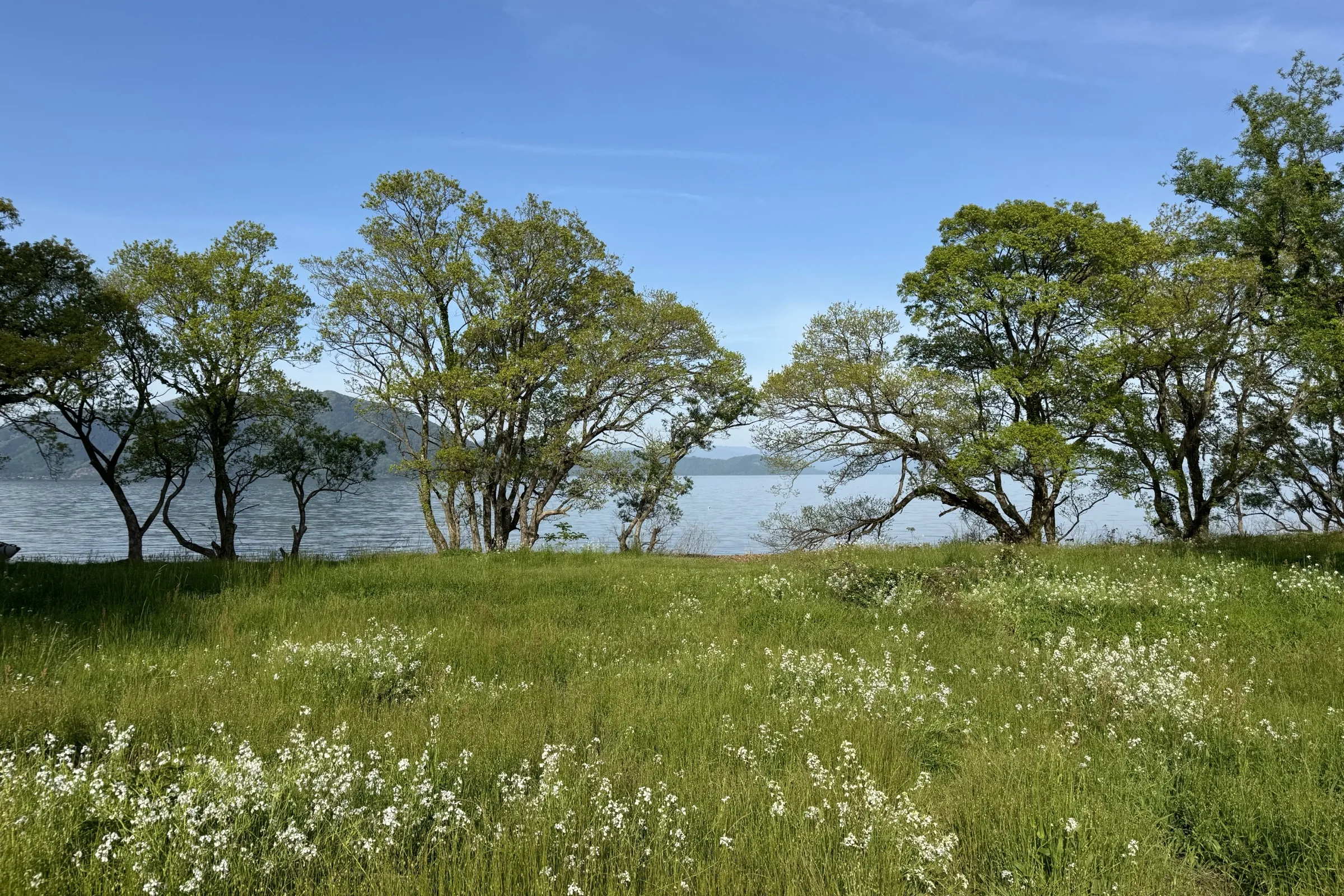
Between any two of the stops above you will pass quiet stretches of lakeside meadow and reed beds. Pull over. Sit on the grass for ten minutes. Lake Biwa from this side is empty in a way the Kyoto side isn’t.
Practical: cost, food, payment, language
| Item | Notes | Cost |
|---|---|---|
| Train Kyoto ↔ Makino (return) | JR Kosei Line, Ōmi-Takashima or Makino | ~¥2,340 |
| Rental car day rate | Compact class, return to Kyoto | ~¥6,500–9,000 |
| Highway tolls (return) | Negligible if you take Route 161 (free road) | ¥0 |
| Shrine and stone walls | All free admission | ¥0 |
| Lunch at Makino Pickland | Pasta, soba, curry plates | ¥900–1,400 |
| Coffee / ice cream stop | Local stop near Metasequoia | ¥500 |
| Per-person total (with car) | For two people sharing a car | ~¥5,500–7,000 |
Payment
Smaller shops in this region are cash-friendlier than Kyoto. Carry ¥5,000–10,000 cash. Major chains and the rental car company take card; village restaurants often don’t. For the full payment landscape see our Japan cash vs card 2026 guide.
English
Almost no English signage outside Shirahige Shrine. Google Translate’s camera mode handles menus and notices. The few people you’ll meet at counters are kind and patient with gestures. None of this is hard if you’ve already been to Kyoto for a few days.
Restrooms and food
Public restrooms are reliable: Shirahige Shrine, Makino Pickland, Kaizu Sakura Park (during sakura season), and any of the train stations. Convenience stores are common along Route 161 every 5–10 km. The lake side of the road has fewer options; pack water if you stop for a long lakeside walk.
What to skip
Two notes on what NOT to spend a Takashima day on, in my opinion:
- Boat tours on Lake Biwa from Otsu (the southern lake city) — great if you’re basing in Otsu, but they don’t cover the western shore I’m describing here.
- Hikone Castle — iconic, but it’s on the eastern shore, the opposite side of the lake, and adds 90 minutes of driving in each direction. It’s a separate day trip.
FAQ
Is one day in Takashima enough, or should I stay overnight?
One day is enough for the route in this article if you start from Kyoto by 9am with a car. Stay overnight if (a) you want to shoot Shirahige Shrine at sunrise or (b) you want to combine Takashima with a hike in the Hira mountains the next morning. There are a small number of ryokan in Makino and around Ōmi-Takashima station; book ahead during sakura week.
Is the cherry blossom season the only good time to come?
No. Cherry season (early April) is the most photogenic week, but Metasequoia Avenue’s autumn red is arguably more striking, and the same road is photogenic in mid-spring green and winter snow. Shirahige Shrine works year-round. Stone walls don’t care about seasons. The single quiet month I’d skip is late June — rainy season, hazy lake, biting bugs.
Can I do this trip without a rental car?
You can do parts of it. JR Kosei Line gets you to Shirahige Shrine (Omi-Takashima station + 5-min taxi), and to Makino station for Metasequoia Avenue. Combining all five stops in one day without a car is impractical — the bus connections aren’t timed for tourists, and the gaps between spots are 15–30 km. If you must train it, pick two stops and accept that.
Is Takashima a good day trip if I’ve already done Nara and Hikone?
Yes — this is exactly when Takashima earns its place. Nara delivers temples and deer; Hikone delivers a castle. Takashima delivers something different: lakeside slowness, fishing-village engineering, and a torii in water. It’s the “extra day from Kyoto” for someone who has used up the obvious choices.
Are the cherry road one-way restrictions in 2026 strict?
Yes. The Takashima city office has confirmed that the Kaizu-Osaki road becomes one-way east-bound during peak hours on April 4–5, 2026 (Sat–Sun, 9:30–17:00). Police officers are stationed at both ends of the cape. Plan your driving route, or arrive midweek before/after that weekend if your dates are flexible. Verify on the official Takashima City website closer to your trip in case dates shift.
Where should I have lunch?
Honestly the safest answer is Makino Pickland, the rest stop at Metasequoia Avenue. It’s a local farm-shop with a sit-down restaurant, soft-serve made from local fruit, and clean restrooms. Around Kaizu there are smaller family-run cafes which I haven’t personally tried in 2026, so I won’t recommend specifically — ask at any local shop and someone will point you to that day’s open kitchen.
Add a day to your Kyoto trip.
Most travellers come to Kyoto and add Nara, then go home. Add Takashima instead, or in addition. A single day on the western lake shore changes how you remember the trip.
See the 7-day Japan itinerary → Take the 60-second quiz →Join 1,000+ travelers discovering Japan's hidden side
Weekly dispatches from off-the-beaten-path Japan — spots and stories you won't find in guidebooks.
No spam. Unsubscribe anytime.
Welcome aboard!
You're in. See you in your inbox soon.