

I picked THE HOTEL YAKUSHIMA Ocean and Forest specifically because I didn’t want to be in Anbo. Most Yakushima travel writing assumes you’ll stay in Anbo or Miyanoura — the two ferry-port towns where the standard mid-range hotels cluster. Those are practical choices. They are not where the island looks like itself.
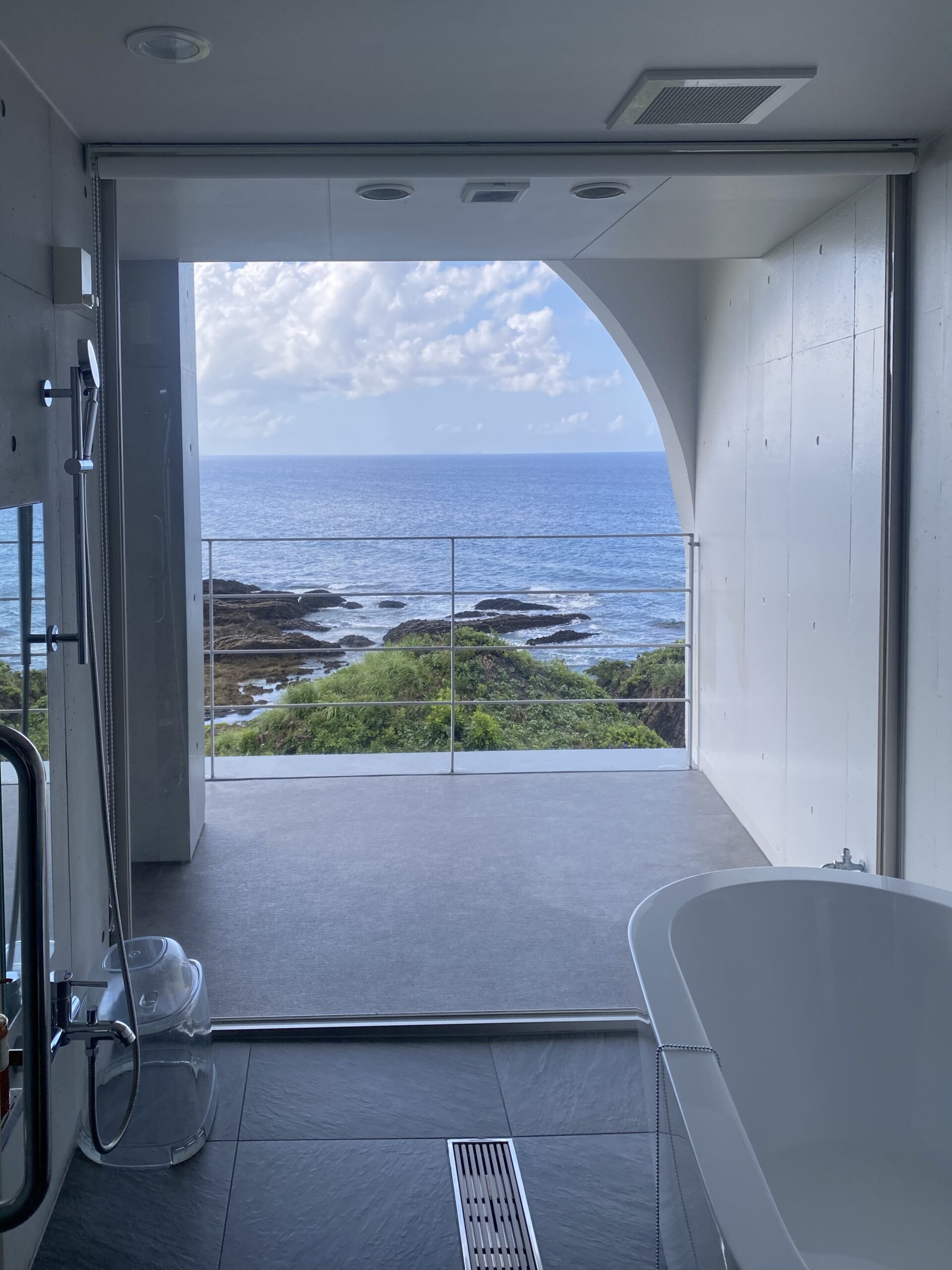
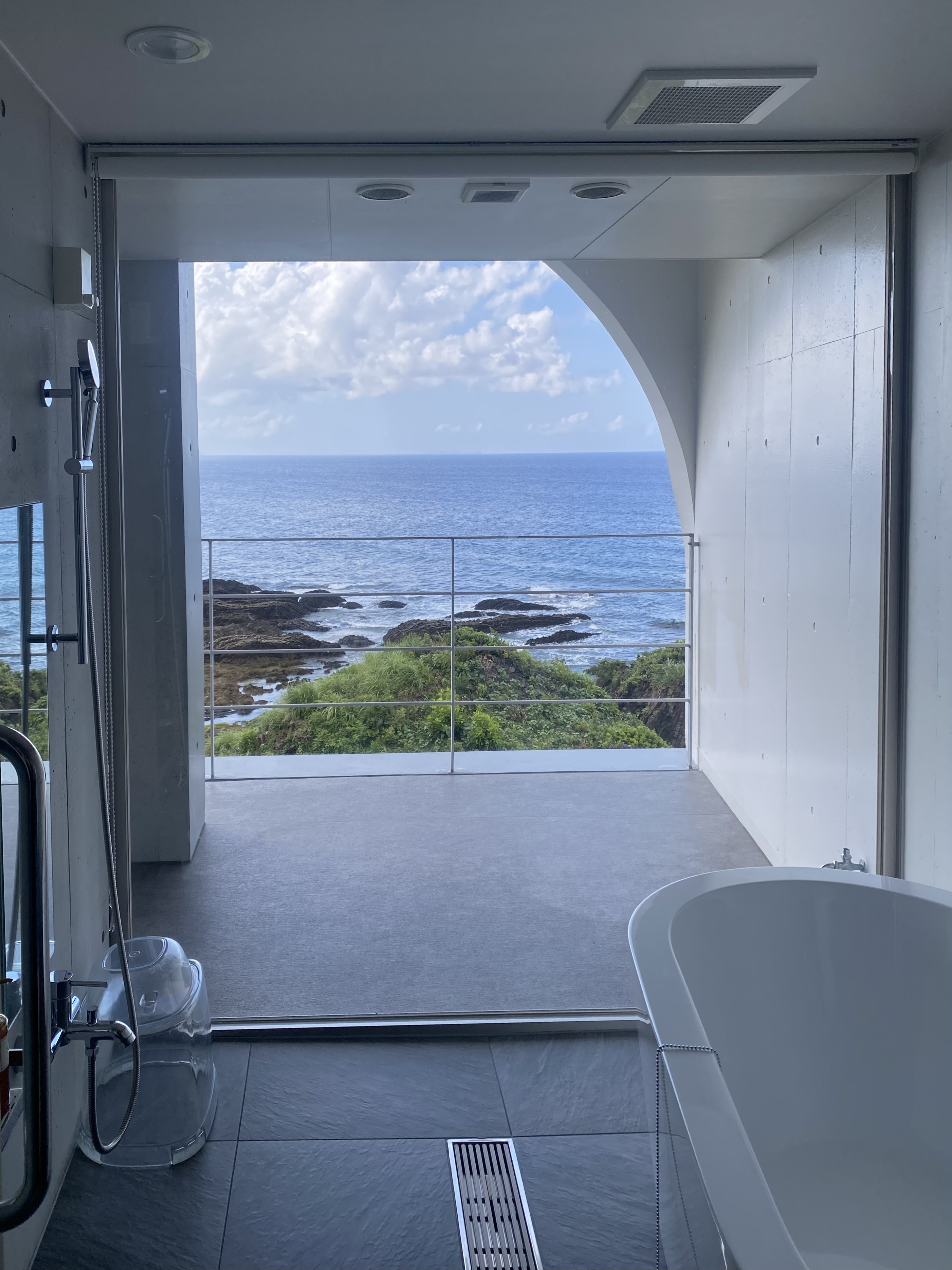
This place is in Miyanoura, a short walk uphill from the ferry port, on a small headland where the cliffs drop straight to the East China Sea. It’s a 48-room hotel split across several wings, but the part everyone photographs is the Namioto-biyori villa annex — ocean-facing twin rooms with private balconies and the full-height bath that opens to the sea through a concrete arch. We stayed in the villa wing.
I stayed two nights in August 2024, between my Jomon Sugi trek and the west-coast drive. This is what I noticed about the place — what works, what is harder than the photos suggest, and who I’d actually recommend it for.
Quick Facts · 2026
| Where | Miyanoura, Yakushima (a short walk uphill from the ferry port) |
|---|---|
| Style | Architect-led property · concrete + wood + glass · multiple room categories incl. a villa annex |
| Rooms | About 48 rooms across categories. The Namioto-biyori villa annex has the ocean-facing rooms with private balcony and arch-window bath |
| Outdoor deck | Tile-paved sea-facing deck, west-facing, walkable year-round |
| Meal plan | Breakfast included; in-room dinner (kaiseki) available as a paid add-on |
| From Yakushima Airport | About 15 minutes by rental car |
| From Miyanoura Port | 5 minutes by car / 15-minute walk uphill |
| Price (2026) | From around ¥55,000 per night for two, breakfast included (peak season higher) |
| Open | Year-round (pool seasonal) |
The architectural moment that sells the place
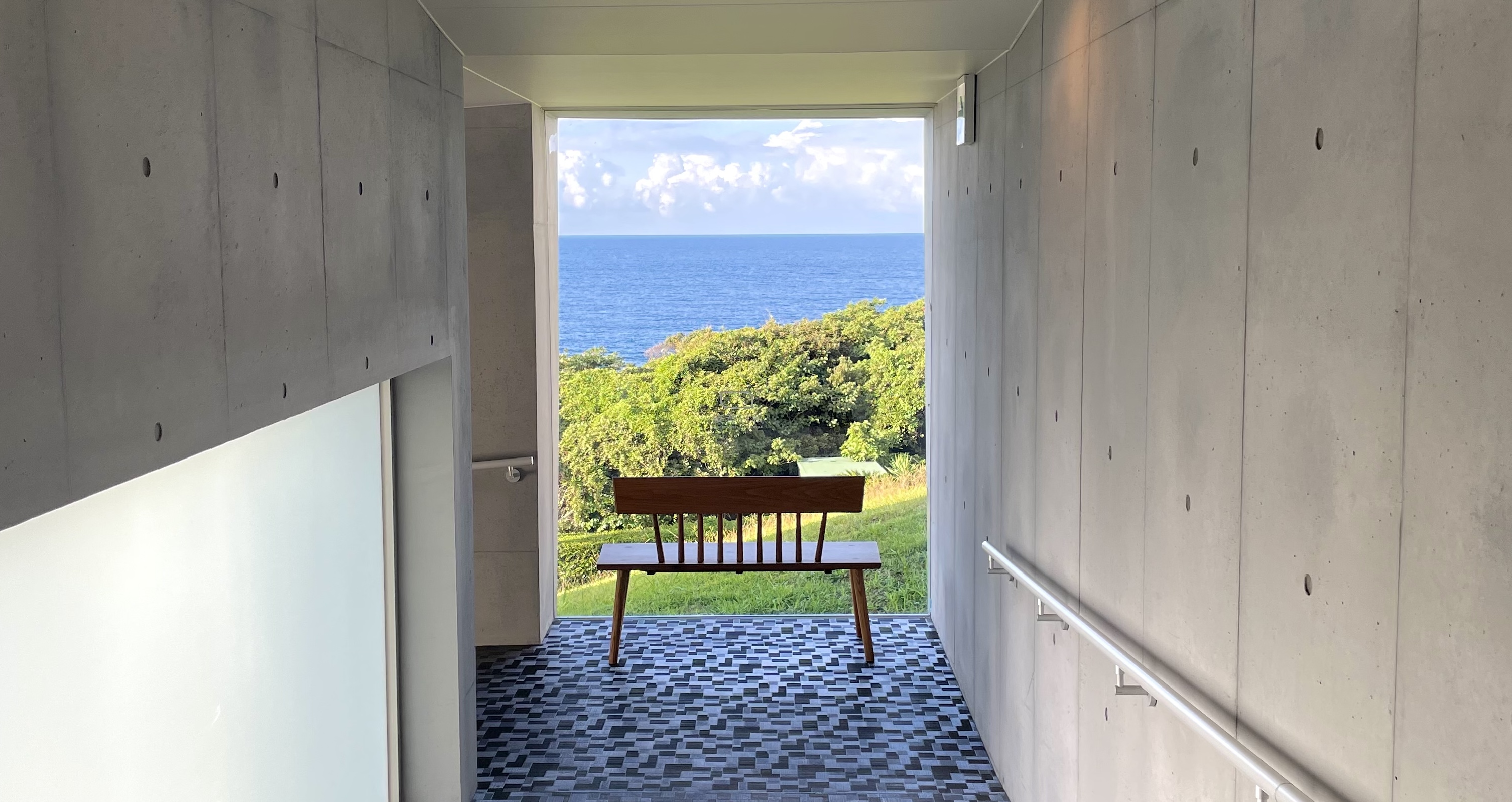
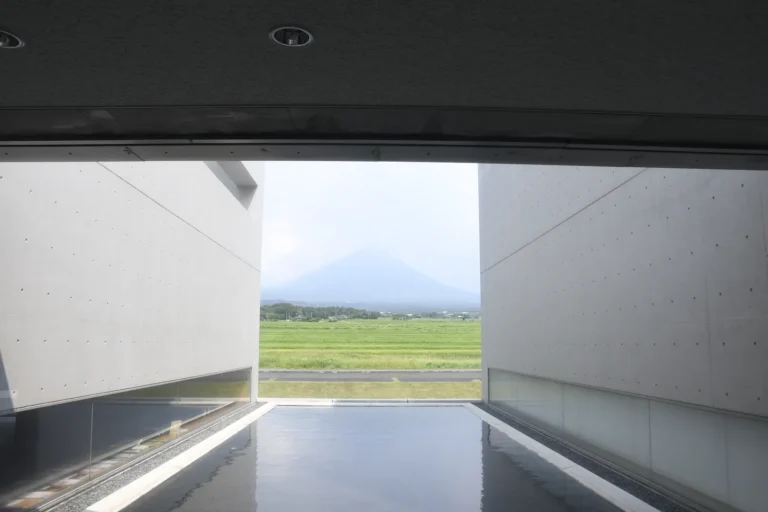
You walk in through a low concrete corridor that frames the ocean as a single rectangle of blue at the far end. There’s a wooden bench in the middle of the corridor that nobody seems to actually sit on; it’s placed there to give the eye a stopping point on the way to the view. This was the moment I understood what kind of building I was in.
The hotel is built around a single architectural idea — that you should never see the ocean except framed by something. Every window is a frame. Every doorway is a frame. The pool is a frame. Even the bath is a frame. The result is that the Pacific feels like a different painting in every room, and you spend two days noticing the difference.
The location: a short hill above Miyanoura Port
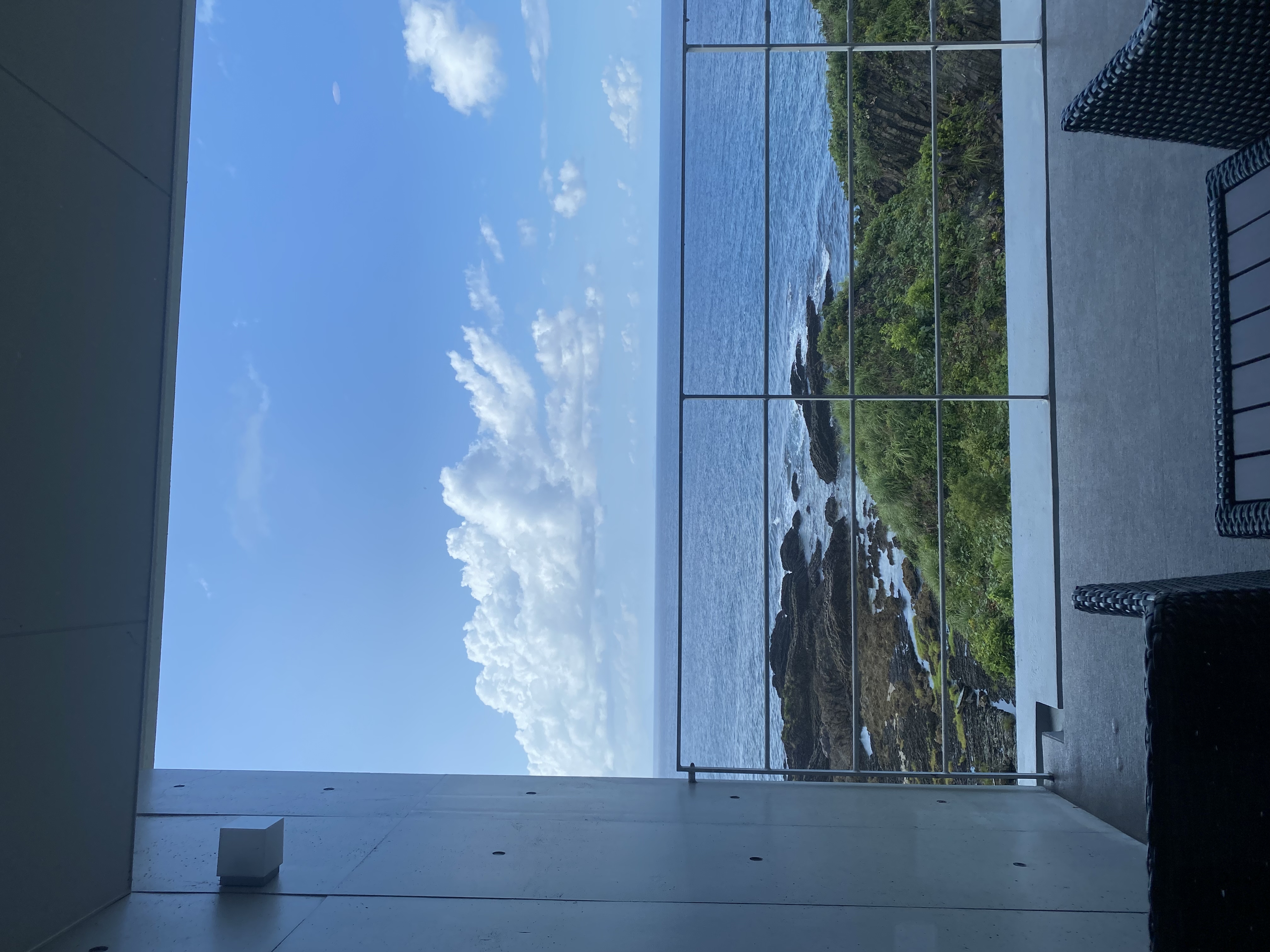
The hotel sits on a small hill a 15-minute walk above Miyanoura Port — the main ferry terminal and the busier of Yakushima’s two town centers. From the headland the view is due west, looking past black volcanic rock straight out into the East China Sea. The road below is the coastal route to the airport (15 minutes) and the Jomon Sugi shuttle hub (about 50 minutes).
From the villa terrace you look due west — not at boats, not at a road, just at black rock and ocean. At sunset there is nothing between the sun and your room. This is the geographic argument for the villa wing specifically: the standard rooms in the main building have ocean views but not the same uninterrupted sunset corridor.
The trade-off is driving distance to the trail. From Miyanoura the Jomon Sugi shuttle hub at Yakusugi-shizen-kan is about 50 minutes south. The hotel will help you arrange a 4 a.m. taxi for trek day; you can also rent a car or use the regular Anbo-bound bus that starts running before dawn. From Yakushima Airport the hotel is 15 minutes by rental car or hotel pickup.
The room: small, expensive, and exactly what it needs to be
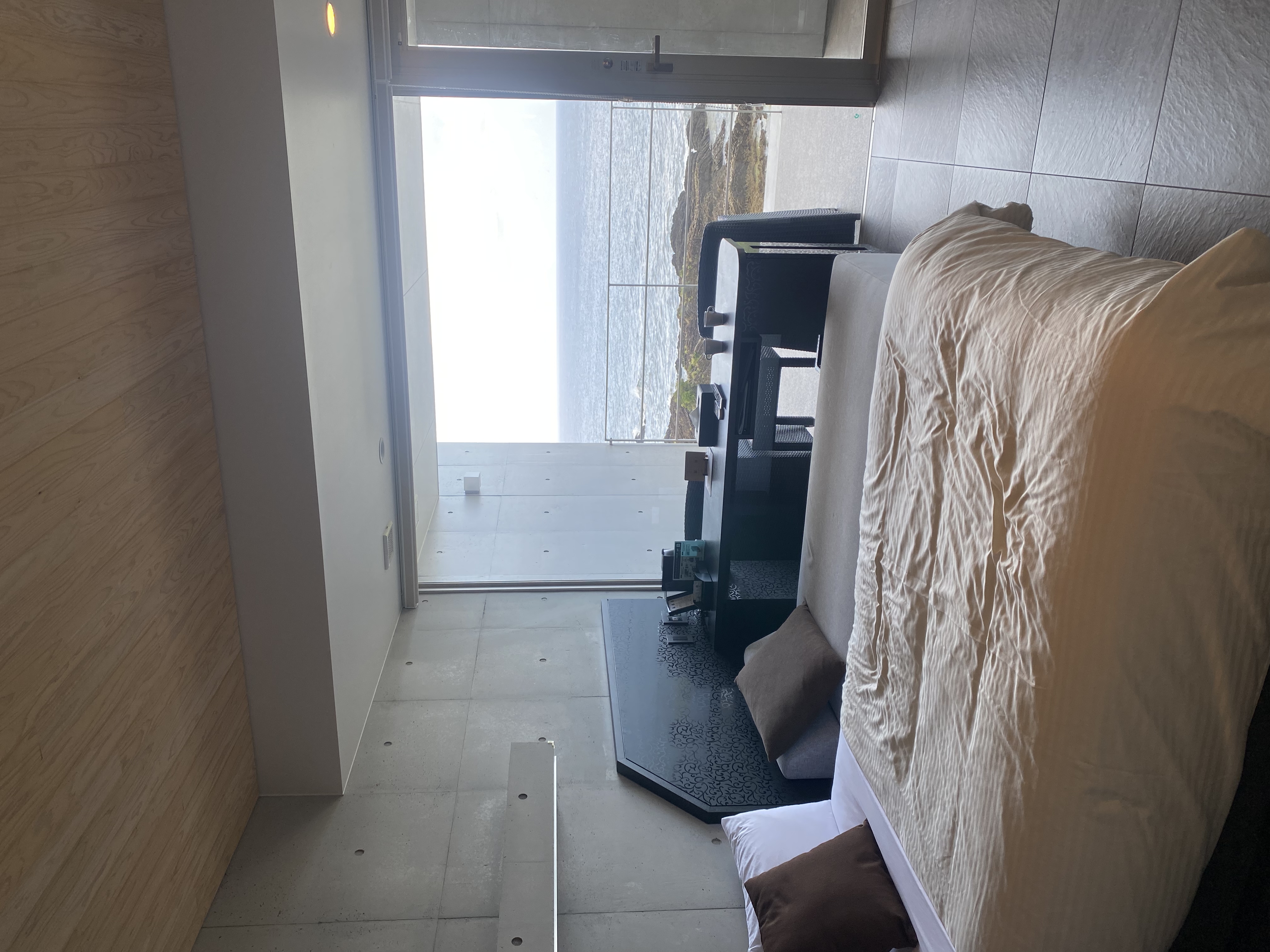
The villa rooms are not large by international resort standards — mine was about 50 square meters with the bathroom included. The architecture spends every meter on the view. There’s a king bed, a single low desk, a small lounge corner with two armchairs, and a floor-to-ceiling window that opens onto a private balcony with the ocean directly below. That’s the whole room.
What it doesn’t have: a TV, a mini-fridge stocked with ¥800 cans, an excessive welcome amenity, or anything that would distract you from the window. There’s a small Bluetooth speaker, a pour-over coffee setup with locally-roasted beans, and a single book about the Yakushima cedars in Japanese and English. The rest of the room exists so you can sleep, change, and look out.
The bed is a high-quality Japanese hotel bed (not a futon) with cotton-and-linen layers. The sound insulation is what surprised me — I could hear waves on the rocks but no other guest, no road, no air conditioner hum. Yakushima is loud at night with cicadas and the surf, and the room is acoustically tuned to let the natural sound in without anything else.
The bath that everyone photographs
The signature feature of the room — the thing that ends up on every Instagram post about this place — is the bathroom. A freestanding tub on slate-tile floor, behind a full-height arched concrete opening that frames the Pacific. The shower next to it is the same: open to the ocean, separated only by a single glass panel.
It works because the rooms are at sufficient elevation that nobody can see in. From the bath you see waves and rock and sky. From the rocks looking up, you see concrete arch and white wall — not a person.
One practical note: the open-air bath uses regular tap water, not onsen water. If hot-spring soaking is the point of your trip, this isn’t the right hotel — you’d be better at one of the inland onsen ryokan. What this room offers is a different thing: a private, quiet, view-led bath that you don’t share with anyone.
The sea-facing deck at sunset
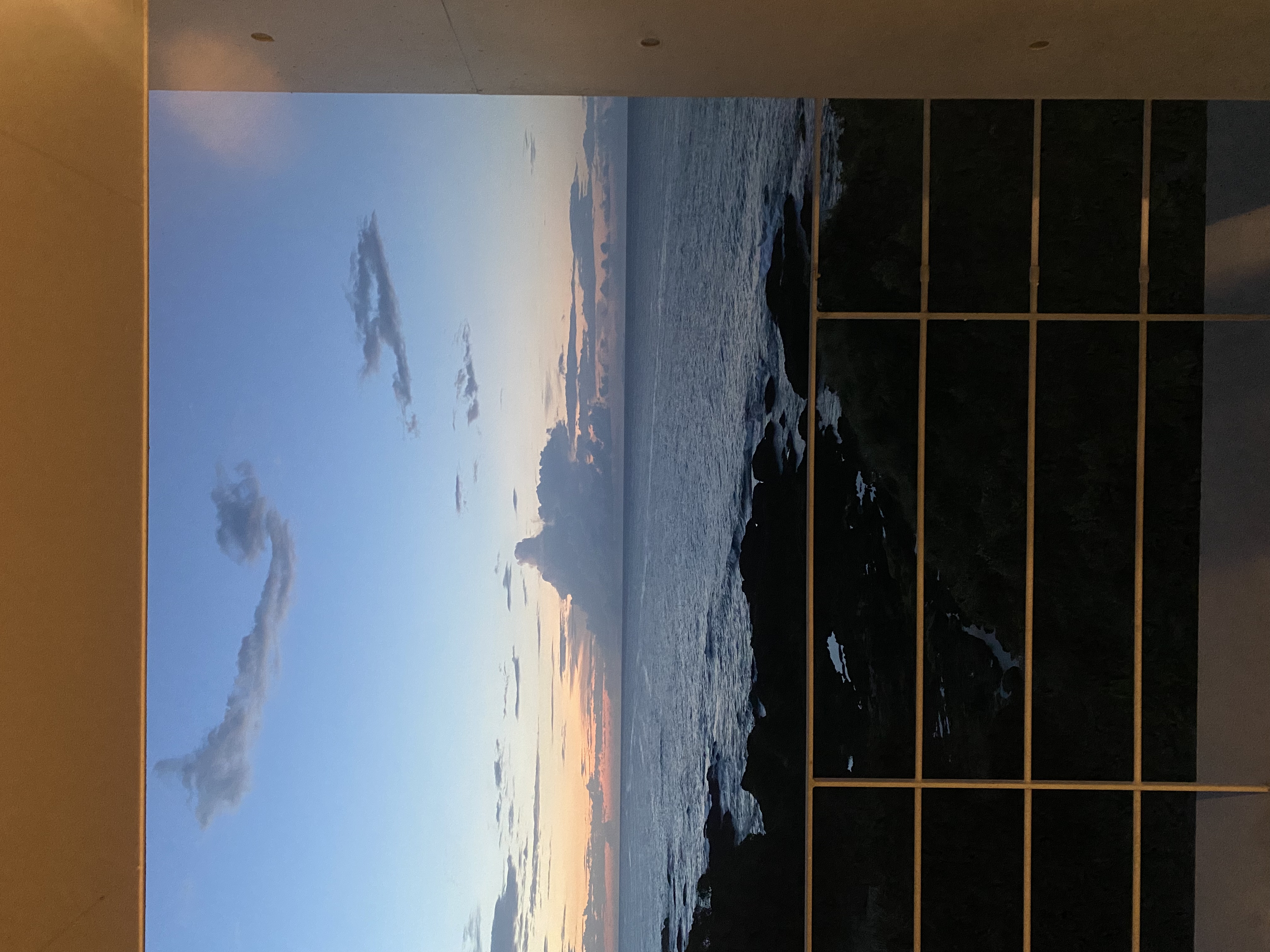
There’s a tile-paved sea-facing deck on a level above the villa rooms, west-facing, that catches the entire sunset. It’s small — not a resort terrace you would lounge on for hours — but it’s where guests gather for the half-hour around sunset, when the wet tiles go molten copper and the East China Sea turns flat-pink under the light.
The deck is open year-round. There is no heated pool or onsen on the property — what this place offers is the view-led private bath in your room and this communal deck at golden hour, not a soaking experience.
For most of the day the deck is empty — lounge chairs out, no time pressure. From maybe 18:30 onward in summer it fills up gradually. By 19:00 every guest who came for sunset is here. By 19:20 the sun is down and most people drift back inside for dinner.
The design language
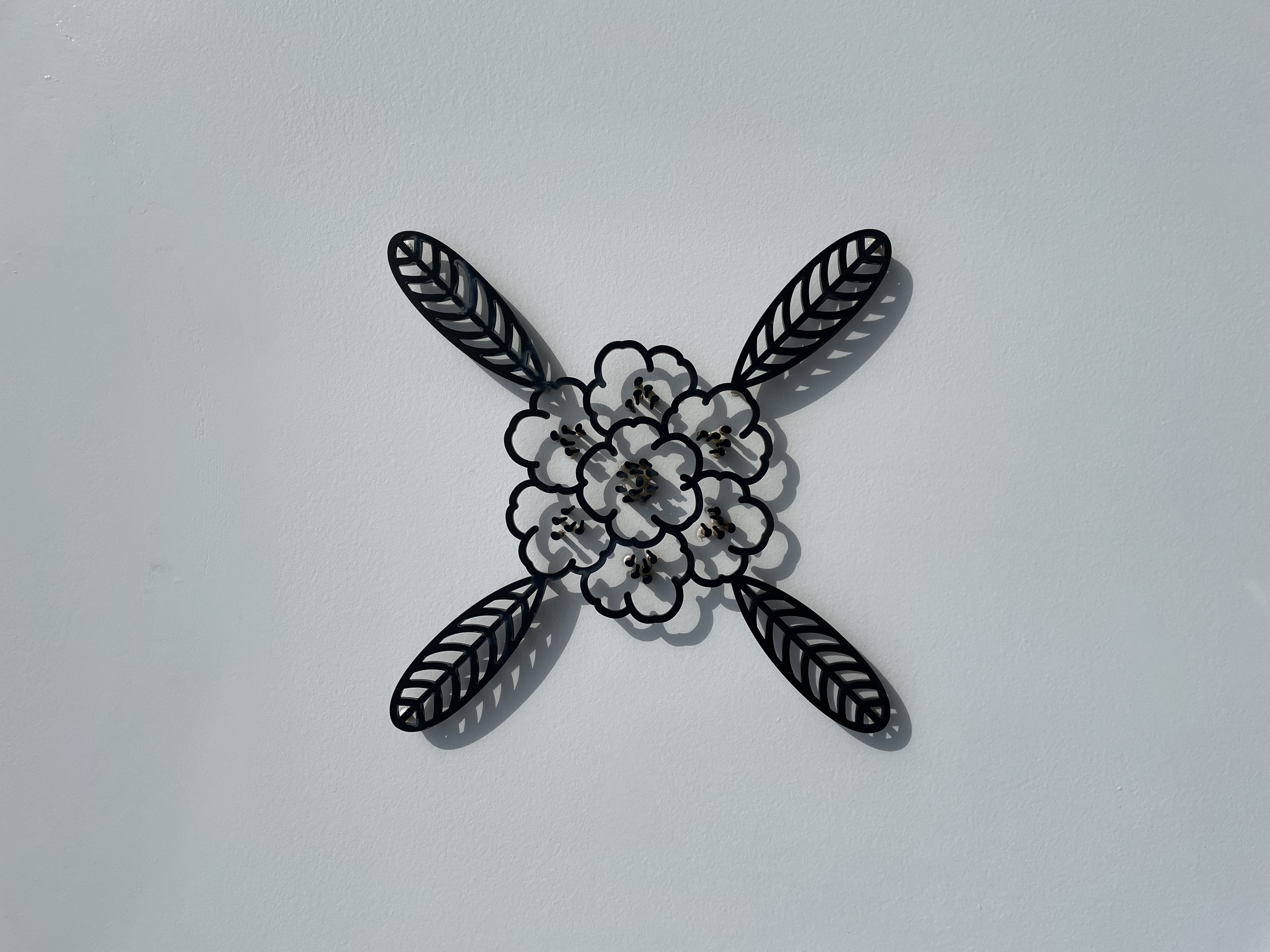
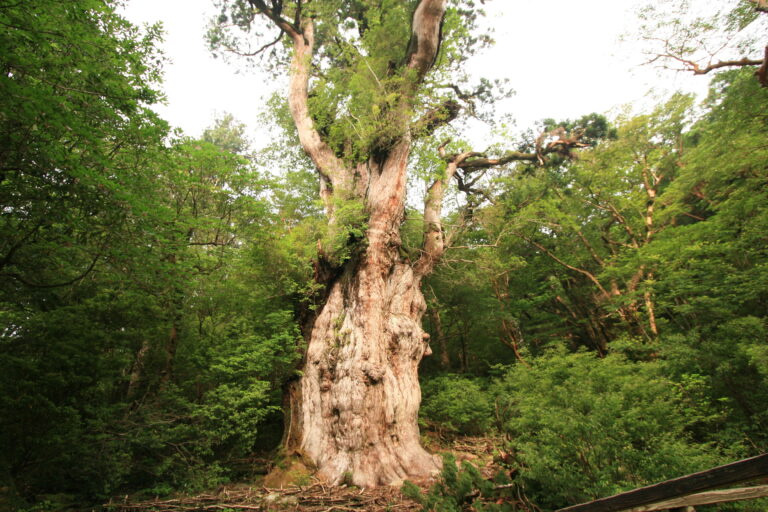
One detail you only notice on day two: the artwork in the rooms and corridors isn’t generic hotel art. The black-iron wall pieces are stylized renderings of the Yakushima-shakunage — the alpine rhododendron that blooms in pink and white above 1,500 meters on the island, found nowhere else. They are commissioned for the property by a local metal artist.
This is the kind of small choice that distinguishes an architect-led property from a chain. The art is not decoration; it’s a translation of where you are. The same goes for the in-room reading material, the breakfast plates (a Yakushima studio), and the wood used in the corridors (locally-sourced cedar offcuts).
Service and food
Service is calm rather than effusive. There’s a check-in counter staffed by two people, no concierge desk, no bellhop — you carry your own bag from the parking lot to the room (about 80 meters). The staff English is functional but not strong; book through email or the website if you have specific requests, not in person.
Breakfast is served in the small dining room from 7:30 to 9:30. It’s a set Japanese-style meal: grilled fish (caught locally that morning when possible), miso soup, three small obanzai-style sides, rice, pickles, fruit, coffee or tea. There’s a Western option on request but the Japanese set is what the kitchen does best.
Dinner is an optional add-on (around ¥15,000-22,000 per person depending on course). It’s a kaiseki served either in the dining room or in your room. I had it in the room on night one and the dining room on night two; the food was identical but the in-room option was significantly more comfortable in the same way that flying business class is more comfortable than economy. The fish (mostly tobiuo flying fish, a Yakushima specialty) was excellent.
If you’d rather skip the kaiseki, the village has two small restaurants — a soba shop and an izakaya — both within ten minutes’ walk. They close around 21:00. There is no convenience store within driving distance after 22:00.
Best for · Not ideal for
Best for
- Couples or solo travelers who want a quiet, design-focused stay
- Photographers (the architecture and light reward returns)
- Travelers building a 3-4 day Yakushima trip with a rental car
- Anyone who’d rather pay more for fewer rooms with better windows
- Sunset-watchers (the west-facing geography is rare in Japan)
Not ideal for
- Day-of-arrival Jomon Sugi trekkers (a 50-minute drive at 4 a.m. is real)
- Travelers without a rental car (limited bus connections)
- Onsen seekers (this is bath, not hot spring)
- Families with young kids (no children’s amenities; fragile architecture)
- Budget trips (the entry price is high for the room size)
Check rates and availability
Standard rooms run about ¥22,000–35,000 per night for two; the villa wing runs ¥55,000–90,000+ depending on season. Booking platforms typically beat the direct-booking rate in shoulder season; during peak (Golden Week, Obon, year-end) the direct site is sometimes the only place with availability.
Search availability →Frequently asked questions
How does this compare to Sankara Hotel and Spa?
Sankara is smaller (29 rooms), inland in the cedar forest with no ocean view from rooms, opened 2010, and has Japan’s only Relais & Châteaux property in Yakushima. THE HOTEL YAKUSHIMA is larger overall (~48 rooms across categories) and oceanfront, with the villa wing being the architectural showpiece. Different products. If your priority is a recognized luxury brand and a forest setting, Sankara. If your priority is a sea view from your bath and modern Japanese minimalism, this one — specifically the villa wing, not the standard rooms.
Can I do Jomon Sugi from here?
Yes. From Miyanoura the Jomon Sugi shuttle hub is about 50 minutes south by car — meaning a 4:00 a.m. taxi or rental-car start to make the 5:00 a.m. shuttle. The hotel can arrange the early taxi if you book ahead. Plenty of guests do exactly this; staying at Anbo just trims that drive by 25 minutes.
Is there an onsen or pool on site?
No onsen, no swimming pool. Each room has its own bath that fills with regular tap water; there’s a communal sea-facing deck for sunset and a small lobby café. If hot-spring soaking is the point of your trip, look at one of the inland onsen ryokan (Sankara, or one of the Anbo-area properties). What this hotel offers is private rooms with the architecture and view, not a hot-spring experience.
How do I get there without a rental car?
You can. The hotel offers a paid airport transfer (around ¥10,000 each way for up to 4 people) booked in advance. Once at the hotel you can walk to the village (10 minutes) or rent an electric bicycle from the hotel. For day trips like Jomon Sugi or the west drive, you’d need either a guided tour or a taxi reservation; a rental car is far simpler.
Is it worth the price?
For two nights as part of a longer Yakushima trip — yes. As a standalone destination, it’s a stretch unless architecture and design are explicitly what you’ve come to Yakushima for. The price reflects the room count (only 9), the architecture, and a peninsula location nobody else has built on. You’re paying for scarcity as much as luxury.
Last updated: May 2026 · Visit: August 2024, two nights in the villa wing, paid in full, no comp.
All photos by Nobutoshi.
Join 1,000+ travelers discovering Japan's hidden side
Weekly dispatches from off-the-beaten-path Japan — spots and stories you won't find in guidebooks.
No spam. Unsubscribe anytime.
Welcome aboard!
You're in. See you in your inbox soon.