

Shiga · Lake Biwa · Floating Torii
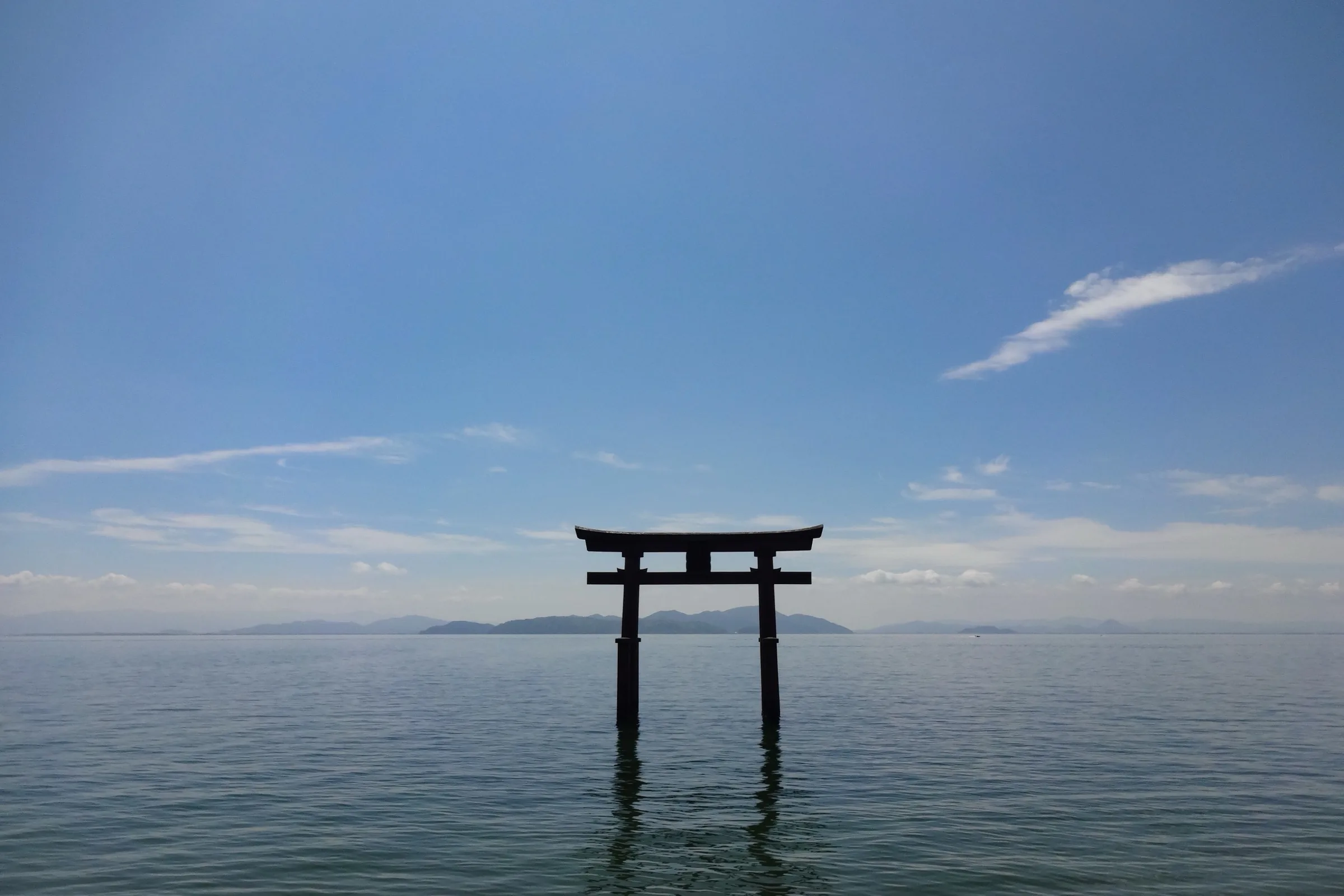
Shirahige Shrine and the floating torii in Lake Biwa.
A vermillion gate standing thirty metres out in Japan’s biggest lake. Mountains on the horizon. A small shrine across a busy road. Nothing about this place looks particularly spectacular until you actually stand at the water’s edge — and then it’s the picture you came to Japan to take.
Where
Takashima, Shiga
~60 min north of Kyoto
Cost
Free
parking + entry
Time needed
30–60 min
photo + shrine grounds
Best moment
Sunrise / equinox
most agree; see below
The shot, before anything else
If you arrived at this article from a Pinterest pin or an Instagram reel of a glowing red torii in still water, you already know what brought you here. That photo is real and it’s of Shirahige Jinja (白鬚神社, “White Beard Shrine”) in Takashima City, on the western shore of Lake Biwa.
The lake torii (湖中大鳥居, kochū ōtorii) stands roughly thirty metres offshore, lacquered vermillion, with the eastern shore of the lake visible in the distance on clear days. It’s sometimes called the “Itsukushima of Ōmi” because the composition rhymes with the famous gate at Miyajima in Hiroshima Bay. Both involve a red torii standing in water; both are a long-running source of photographic cliché that nevertheless still works.
What it actually is — not just a photo prop
Shirahige Shrine is the parent shrine of about three hundred Shirahige shrines across Japan, and it’s widely cited as the oldest shrine in Ōmi (the historical name for present-day Shiga Prefecture). The principal deity is Sarutahiko no Mikoto (猿田彦命) — a guide-deity associated with crossroads and openings, often depicted with a long white beard, which gave the shrine its name. He’s also the deity of longevity, which is why elderly visitors from across western Japan come here to pray for long life.
Founding dates depend on which tradition you trust. Shrine records say the buildings were established by Yamato Hime-no-Mikoto in the 25th year of Emperor Suinin’s reign — a date that is essentially mythological. The historical record becomes firmer in the late 7th century: a 675 CE imperial decree by Emperor Tenmu granted the shrine the title Hira-meishin. Another tradition places the current shrine site at 825 CE. Either way, this is not a recent building.
The lake torii itself is much younger. The current torii in the water dates from the 1980s rebuild, although the shrine maintains that there has been a torii on the lake at this point for centuries.
Why is there a torii in the water?
Two stories run together. The shrine’s tradition says the torii marks the deity’s arrival point — that Sarutahiko, as a guide-deity, came across the water and the gate marks the boundary between the lake and the shrine ground. The pragmatic reading is that the lake’s historical water level was lower; the shoreline shifted over centuries; the gate that once stood on land now stands offshore. Both readings can be true at the same time. They usually are with shrines like this.
Getting there
Address: 215 Ukawa, Takashima-shi, Shiga 520-1122 (滋賀県高島市鵜川215)
Official: shirahigejinja.com
Hours: shrine grounds are open during daylight; the priest’s office for amulets and goshuin stamps generally operates 09:00–17:00. Verify on the official site before you go — rural shrines do change hours seasonally.
Admission: free. Free parking on-site (~30 spaces) plus a larger lot ~150 m south (~50 spaces). Both fill up on clear weekend mornings during sakura season.
From Kyoto by car
About 50–65 minutes via Route 161 north along the lake’s western shore. Pick up a rental car at Kyoto Station and follow signs for Ōtsu, then continue past Hieizan; the shrine sits directly on Route 161. Compare rental cars on Klook. This is by far the most convenient option, and it’s how most local visitors come.
From Kyoto by train
Take the JR Kosei Line from Kyoto Station to Ōmi-Takashima Station (近江高島駅). The shinkaisoku (new rapid) takes about 40 minutes and costs around ¥1,170 one-way. From the station, the shrine is roughly 3 km north along the lake. Options:
- Taxi — about 5 minutes, ¥1,200–1,500. The reliable choice.
- Rental bicycle from in front of the station — about 15 minutes flat ride along the lake; ¥500–1,000 for the day depending on the rental shop.
- Walking — technically possible (~40 minutes) but the path is along Route 161 and not a pleasant pedestrian experience.
The road crossing — this is real
What I do: cross only at the white-painted crossing line directly outside the shrine’s torii on the inland side. Wait for a clear gap in both directions. Don’t look at your camera until you’re on the lakeside walkway. If you’re photographing in low light at sunrise or sunset, wear something visible (a light-coloured jacket helps; black is invisible against the road).
I’m flagging this not to be alarmist. The view is worth coming for. The crossing is also genuinely the most dangerous part of visiting any shrine in Japan I can think of.
When to come
The shrine has roughly four useful visiting windows:
- Sunrise (most photographed): the torii silhouettes against the sky as the sun rises over the eastern lake. On the spring and autumn equinoxes (around March 20 and September 23), the sun is widely cited as rising through the gate. I cannot confirm this from my own visit; the shot in this article was taken mid-morning.
- Mid-morning to early afternoon (most reliable): calm water, full colour, no harsh shadows. Easy parking. This is when 90% of visitors arrive and you can usually still find space.
- Sunset: the torii backlit, silhouettes; works best in autumn and winter when the sun sets further south.
- After dark on lit nights: on certain dates the torii is illuminated. I haven’t personally photographed it lit up, and the lighting schedule changes year to year, so check the shrine’s official site for the current calendar.
What to do at the shrine itself
Most visitors photograph the lake torii and leave. That’s a reasonable choice for a 20-minute stop. If you’ve travelled here by train and want to make the visit count more, walk inland (away from the lake), up the stone steps, into the shrine grounds proper. The main shrine hall is small, painted dark wood with white paper lanterns, set against the wooded slope behind. Above the main hall is a steeper path leading to several auxiliary shrines further up the hillside.
If you want a goshuin stamp, the priest’s office is to the right of the main hall during daylight hours. Custom is the same as any shrine: present your goshuin book, pay the ¥500 fee, accept the calligraphy with both hands, do not photograph the priest while they write.
Visiting etiquette in 60 seconds
- Bow once at the torii on the way in, once on the way out.
- Walk to the side, not the centre of the path — the centre is reserved for the deity.
- At the chōzuya (water basin) near the entrance, rinse your left hand, then your right, then a small handful into the left to rinse your mouth (do not put the ladle to your lips), then rinse the ladle handle. Replace the ladle face-down.
- At the main hall: drop a coin (any amount; ¥5 is traditional), bow twice, clap twice, pray silently, bow once more.
What I’d pair this with
Shirahige Shrine is a 30–60 minute stop on its own. To make the trip from Kyoto worthwhile, pair it with at least one or two of these:
- Our full one-day Takashima itinerary — Shirahige is Stop 1 on a five-stop western lake-shore route covering Metasequoia Avenue, Kaizu-Osaki cherry road, and the Edo-era Kaizu stone walls. This is what I recommend if you have a full day from Kyoto.
- The Hira mountains hike behind the lake — for a half-day hike with views back over the lake.
- Otsu on the southern lake shore for evening dinner before returning to Kyoto. Otsu has decent restaurants and a quiet evening lake walk.
FAQ
Is Shirahige Shrine worth visiting if I’ve already seen Itsukushima?
Yes — though for different reasons. Itsukushima at Miyajima is a much grander shrine with a temple complex behind it; Shirahige is a small inland shrine whose lake torii is the main visual point. The compositions are similar but the experience is the opposite: Itsukushima feels formal and crowded, Shirahige feels quiet and peripheral. If you’ve done Itsukushima, Shirahige is a 30-minute add-on, not a destination in itself.
Can I touch or walk to the torii in the water?
No. The torii is offshore in the lake. The shoreline is the closest you’ll get. There is no boat service from the shrine.
Is there a fee to enter or photograph the shrine?
No fee for shrine entry, photography, or parking. Goshuin stamps are around ¥500, and amulets sold at the priest’s office are typically ¥500–1,000.
What’s the best time of year?
There is no bad season. Spring and autumn give the cleanest air; summer mornings can be hazy with humidity; winter offers the lowest crowds and rare snow scenes. The most photographed time is sunrise on a clear morning, when the torii silhouettes against the sky.
Can I visit at night?
Shrine grounds are technically accessible during the night but the priest’s office is closed and there’s no formal lighting most of the year. On specific scheduled illumination nights the torii is lit; check the shrine’s official site for the current schedule.
Are there cafes or restaurants near the shrine?
A few small cafes and a tea-stand operate seasonally on the lake side of Route 161, just south of the shrine. Selection is thin compared to a normal tourist site — this is a working rural shrine, not a tourist village. Plan to eat in Ōmi-Takashima town or pair with our full Takashima day trip itinerary for proper meal stops.
One torii, an hour from Kyoto.
Shirahige is a 30-minute photograph if you stop briefly, or a 60-minute moment of quiet if you sit on the lake-side wall and watch the water. Pair it with the rest of Takashima for a full day from Kyoto.
See the full Takashima day trip → Find your Japan region →Join 1,000+ travelers discovering Japan's hidden side
Weekly dispatches from off-the-beaten-path Japan — spots and stories you won't find in guidebooks.
No spam. Unsubscribe anytime.
Welcome aboard!
You're in. See you in your inbox soon.