

Current date: 2025-12-27 (JST)
What Is Happening
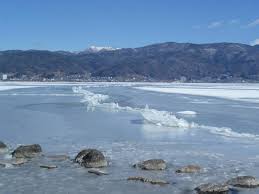
The traditional winter phenomenon known as “Omiwatari” (御神渡り), or “The God’s Crossing,” on Lake Suwa in Nagano Prefecture has not occurred since the winter of 2018. If the lake does not freeze completely and form the iconic ice ridge this winter (2025-2026), it will mark the eighth consecutive season without an appearance. This would be the longest period of non-appearance since records began in the 15th century, matching a streak from the Sengoku (Warring States) period.
Why This Matters for Travelers
For travelers, the absence of the Omiwatari is a significant sign of a changing climate. This rare and culturally important natural event, once a regular winter occurrence, is now highly unpredictable. It highlights how rising winter temperatures are affecting traditional landscapes and events in Japan. While visitors can still enjoy the winter scenery of Lake Suwa, the chance to witness this specific phenomenon is now extremely low. It is no longer an event that can be reliably included in a travel itinerary.
Location & Context
•Location: Lake Suwa, Nagano Prefecture.
•Context: The Omiwatari is a natural ice ridge that forms across the frozen surface of the lake. According to local tradition at the Yatsurugi Shrine, the ridge is the path of a male deity crossing the lake to visit a female deity. Priests from the shrine have officially observed and recorded the appearance of the Omiwatari for nearly 600 years, creating one of the world’s longest-running climate records.
Dates & Timing
•Official Observation Period: Early January to early February, annually.
•Last Confirmed Appearance: February 2018.
•This Winter’s Outlook: Unlikely. The formation requires several consecutive days of temperatures around -10°C, which has become increasingly rare.
How to See It (Theoretically)
There is no way to guarantee seeing the Omiwatari. It is a natural phenomenon, not a scheduled event.
•Access: The lake is easily accessible from JR Kami-Suwa Station.
•Observation: If it were to occur, the event would be observed from the lakeside. There are no tickets or designated viewing areas.
•Status: The Yatsurugi Shrine makes the official declaration of its appearance. In recent years, the declaration has been that of “Ake no Umi” (明けの海), meaning the lake did not freeze over.
Practical Notes
•Do Not Plan a Trip Around It: Given the high probability of non-appearance, travelers should not make the Omiwatari the sole purpose of a trip to Suwa.
•What to Do Instead: The Lake Suwa area offers other winter attractions, including onsen (hot springs), sake breweries, and beautiful mountain scenery.
Official Information
The historical records are maintained by the Yatsurugi Shrine in Suwa City. The recent news and analysis are based on reporting from Japanese media outlets like the Yomiuri Shimbun, citing the shrine’s records and the increasing frequency of non-appearances.
Summary
Lake Suwa’s Omiwatari, a historic ice formation with deep cultural roots, is facing a record-breaking eighth consecutive year of absence due to warmer winters. This makes the once-reliable phenomenon a powerful symbol of climate change in Japan. Travelers visiting Lake Suwa in winter should appreciate the scenery but should not expect to witness this increasingly rare event.
Sources / References
Notes & Limitations
•The official observation for the 2025-2026 winter season will begin in January 2026. The final outcome will not be known until the observation period ends in February.
•The connection to climate change is based on analysis of long-term temperature and ice formation data.
Certainty Level
High