


Current date: 2025-12-23 (JST)
This article provides a practical guide to Japan’s train ticket system. It is not a travelogue, but a manual for understanding what tickets you need, how to buy them, and how to use them without confusion. We cover the essential two-ticket system for Shinkansen, the difference between reserved and non-reserved seats, and the various ways to purchase tickets. The goal is to demystify the process and help you travel efficiently and confidently.
What This Article Explains
This guide clarifies the central problem for travelers using Japan’s train system: the confusing requirement for two separate tickets when riding the Shinkansen or other limited express trains. Many visitors assume a single ticket covers the entire journey, which is incorrect. This article breaks down the system, explaining the Basic Fare Ticket (乗車券, jōshaken) and the Limited Express Ticket (特急券, tokkyūken). We will detail why you often need both, how to choose between reserved and non-reserved seats, and the most practical ways to purchase tickets, whether at a machine, a counter, or online.
The Two-Ticket System: Why You Often Need More Than One
The most common point of confusion for travelers is the two-ticket system. For long-distance travel on a Shinkansen or Limited Express train, you must have two separate tickets to make a complete, valid fare. Think of it as paying for the distance and then paying for the speed and seat quality.
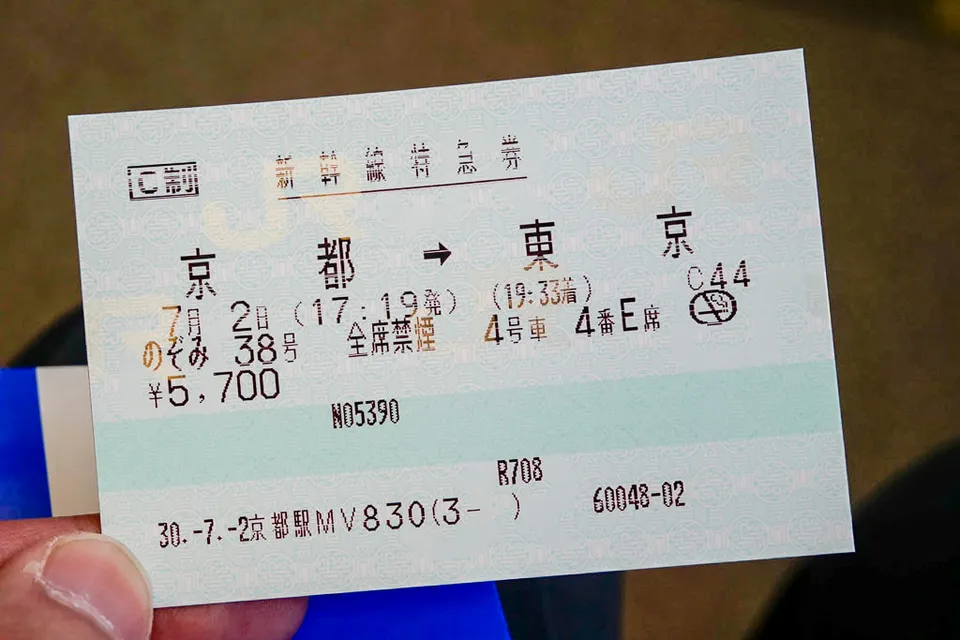
1.Basic Fare Ticket (乗車券, jōshaken): This ticket covers the base cost of traveling from Point A to Point B. Its price is based on the distance of your journey. You need this ticket for any train ride on the JR network, from a local commuter train to the fastest Shinkansen.
2.Limited Express Ticket (特急券, tokkyūken): This ticket is an additional surcharge required to ride faster, more comfortable trains like the Shinkansen or other limited express services. It pays for the premium service and speed. This ticket will also specify whether your seat is reserved or non-reserved.
When you pass through the ticket gates, you will typically insert both tickets into the slot at the same time. The machine will validate them and return them to you. Do not lose them, as you will need them again to exit at your destination.
| Train Type | Required Tickets |
| Local/Rapid Train | Basic Fare Ticket only |
| Shinkansen | Basic Fare Ticket + Limited Express Ticket |
| Limited Express Train | Basic Fare Ticket + Limited Express Ticket |
Reserved vs. Non-Reserved Seats: What’s the Difference?
Your Limited Express Ticket will indicate whether you have a reserved seat or a non-reserved seat. This choice affects both your cost and your travel experience.
•Reserved Seat (指定席, shiteiseki): This guarantees you a specific seat in a specific car. It provides peace of mind, as you know you will have a place to sit, which is crucial during busy travel periods. The cost is typically a few hundred yen more than a non-reserved seat.
•Non-Reserved Seat (自由席, jiyūseki): This allows you to sit in any available seat within the designated non-reserved cars. These cars are usually the first few on the train. If all seats are taken, you may have to stand. This option offers flexibility, as you can take any train on the same day and route, but it carries the risk of not finding a seat.
| Feature | Reserved Seat (指定席) | Non-Reserved Seat (自由席) |
| Seat Guarantee | Guaranteed | Not Guaranteed (may have to stand) |
| Cost | Slightly higher | Slightly lower |
| Flexibility | Tied to a specific train and time | Can take any train on the same day/route |
| Best For | Peak travel, groups, long journeys | Off-peak travel, solo travelers, flexible schedules |
Important Note: Some Shinkansen trains, like the Hayabusa (Tohoku/Hokkaido Shinkansen) and Kagayaki (Hokuriku Shinkansen), are fully reserved and have no non-reserved cars. Additionally, during peak holiday periods like New Year, Golden Week, and Obon, all seats on the popular Nozomi trains may become reserved.
Where to Buy Train Tickets: Four Main Options
Purchasing tickets is a straightforward process with several convenient options available.
1.Ticket Vending Machines: Found in every JR station, these machines are the most common method for buying tickets. All modern machines have an English language option. You can purchase both basic fare and limited express tickets, and most machines allow you to make seat reservations. They accept cash, credit cards, and IC cards.
2.JR Ticket Offices (Midori no Madoguchi): For complex itineraries or if you prefer human assistance, the green-signed ticket offices are staffed by JR employees who can help you book tickets and make reservations. Be prepared with your destination, desired travel date, and time.
3.Online: You can book tickets in advance through official JR websites (like the Tokaido Sanyo Kyushu Shinkansen Online Reservation Service or the JR-EAST Train Reservation site). This is the best way to secure seats during peak season. After booking, you will receive a QR code to scan at a station ticket machine to print your physical tickets.
4.Travel Service Centers: Located at major airports and train stations, these centers are designed for foreign tourists. Staff can assist with purchasing tickets, exchanging rail passes, and providing travel information.
The IC Card Option: Suica, ICOCA, and TOICA
For local travel on subways, buses, and non-express JR trains, an IC card is essential. These rechargeable prepaid cards allow you to simply tap a card reader at the ticket gate, automatically deducting the correct fare. This eliminates the need to buy a paper ticket for every short trip.
•What they are: Cards like Suica (greater Tokyo), ICOCA (Kansai region), and TOICA (Nagoya region) are functionally interchangeable for most basic travel across Japan.
•How to use: Load the card with cash at a ticket machine and tap it on the gate when you enter and exit a station.
•Important Limitation: An IC card only covers the Basic Fare Ticket portion of your journey. You cannot use it to pay for the Limited Express surcharge on a Shinkansen. You must still purchase a separate Limited Express Ticket.
What Travelers Commonly Assume (and Why It’s Wrong)
| Assumption | Reality |
| “One ticket is enough for the Shinkansen.” | You need two tickets: a Basic Fare Ticket and a Limited Express Ticket. |
| “I can just buy a second seat for my large suitcase.” | This is prohibited. Oversized luggage requires a special, pre-booked luggage space. |
| “Non-reserved is always the best value.” | For a few hundred yen more, a reserved seat guarantees you won’t have to stand for hours. |
| “My Suica card works for everything.” | It only covers the basic fare. You still need an express ticket for the Shinkansen. |
| “All Shinkansen have non-reserved cars.” | Some popular and fast trains are fully reserved, especially on certain lines and during holidays. |
Practical Takeaways
•For Shinkansen, you need two tickets: a Basic Fare Ticket and a Limited Express Ticket.
•Reserved seats are worth the small extra cost for guaranteed seating and peace of mind.
•Use ticket vending machines with English menus for the easiest purchasing experience.
•Book tickets in advance if traveling during peak holidays or with oversized luggage.
•An IC card (like Suica) is for local travel and does not cover your Shinkansen express fee.
Summary
Japan’s train ticket system is logical once you understand its core principles. Always remember the two-ticket rule for Shinkansen travel and the value of a reserved seat. Use the modern, multilingual ticket machines for a smooth transaction, and consider an IC card for effortless local journeys. By planning ahead, especially for luggage and peak travel times, you can navigate one of the world’s best rail systems like a seasoned traveler.
Sources / References
[1] Central Japan Railway Company. (n.d.). Types of Tickets.
[2] Central Japan Railway Company. (n.d.). How to buy Tickets.
[3] East Japan Railway Company. (n.d.). Ticket Overview & Purchasing Guide.
[4] japan-guide.com. (2025). Shinkansen.
[5] Japlanease. (2024). 10 Mistakes Not To Make on the Shinkansen.
Notes & Exceptions
•Ticket prices and rules are subject to change. Always confirm with official JR websites or station staff.
•While major IC cards are largely interoperable, minor regional cards may not be.
•Online booking systems may have different rules and user interfaces depending on the JR Group company (e.g., JR East vs. JR Central).
Certainty Level
•High: The two-ticket system (Basic Fare + Limited Express) is a fundamental and unchanging rule for Shinkansen travel.
•High: The process for purchasing tickets at vending machines and ticket offices is well-established and consistent.
•Medium: Specific online booking interfaces and third-party options may change over time.
Join 1,000+ travelers discovering Japan's hidden side
Weekly dispatches from off-the-beaten-path Japan — spots and stories you won't find in guidebooks.
No spam. Unsubscribe anytime.
Welcome aboard!
You're in. See you in your inbox soon.

[…] in unreserved cars. If you are using a JR Pass, I strongly recommend reading our guide on how to buy JR tickets and reserving your seats at a ticket counter the moment you arrive in […]