

About Yasaka Shrine
Located in Gion-machi Kitamachi, Higashiyama-ku, Kyoto City, “Yasaka Shrine (Yasaka-jinja)” is an ancient shrine known as the head shrine of approximately 2,300 Yasaka shrines and related shrines throughout Japan that enshrine Susanoo-no-Mikoto. Locals affectionately call it “Gion-san” or “Yasaka-san,” and it continues to be beloved as one of Kyoto’s most representative shrines.
The shrine is particularly famous nationwide as the organizer of the “Gion Matsuri” held in July, one of Japan’s three major festivals that has been registered as a UNESCO Intangible Cultural Heritage. Its historical and cultural value as the host of this millennium-old tradition is immeasurable.
History of Yasaka Shrine
Origins of Foundation
According to shrine records, there are two theories about Yasaka Shrine’s founding:
First Theory: Founded in 656 CE (2nd year of Empress Saimei) This theory states that Irishi-no-omi, an immigrant from Goguryeo, enshrined Susanoo-no-Mikoto who had descended upon Mount Gozu.
Second Theory: Founded in 876 CE (18th year of Jogan) This theory suggests that the monk Ennyo from Nanto built a temple hall at this location, and in the same year, the deity (Gion-shin) descended upon Gion Forest at the foot of Higashiyama.
Current academic research favors the 876 CE founding theory, suggesting that monk Ennyo built Kankei-ji Temple (which later became a shrine temple), and shortly after, the Gion deity descended and manifested at Gion Forest at the foot of Higashiyama.
Evolution of the Shrine Name
Yasaka Shrine was originally called “Gion Shrine,” “Gion-sha,” or “Gion Kanshin-in.” This was because the original deity, Gozu Tenno, was considered the guardian deity of Gion Shoja (Jetavana Monastery).
The shrine was renamed to its current “Yasaka Shrine” following the Shinbutsu Bunri Rei (Separation of Shinto and Buddhism Decree) in 1868 (Keio 4/Meiji 1). This renaming was part of the Meiji government’s policy to separate Shinto and Buddhism.
From Heian Period to Medieval Times
From around the mid-Heian period, the shrine became worshipped as the local tutelary deity (ubusuna-gami) and received deep reverence from the imperial court. Although it is an ancient shrine, it was not recorded in the Engishiki Jinmyocho (Register of Shrines), likely because it had strong Buddhist influences and was initially under the control of Kofuku-ji Temple and later Enryaku-ji Temple, making it viewed more as a temple than a shrine.
However, it was later selected as one of the Twenty-Two Shrines (Nijuuni-sha), indicating its recognition as an important shrine.
Origins of Gion Matsuri
Gion Matsuri originated from the Goryo-e (spirit pacification ritual) held at Shinsen-en in 869 CE (11th year of Jogan) when epidemics spread throughout various regions. The festival began being held at Yasaka Shrine in 877 CE (1st year of Gangyo) and became an annual shrine festival from around 970 CE (1st year of Tenroku), continuing for over 1,000 years to the present day.
Enshrined Deities
Current Enshrined Deities
The current enshrined deities at Yasaka Shrine are as follows:
Main Deities
•Central Seat: Susanoo-no-Mikoto – Heroic deity of Japanese mythology, god of warding off evil and epidemics
•Eastern Seat: Kushinada-hime-no-Mikoto – Wife of Susanoo-no-Mikoto, goddess of matchmaking and marital harmony
•Western Seat: Yahashira-no-Mikogami – Collective name for Susanoo-no-Mikoto’s eight children
Associated Deities
•Kamioichi-hime-no-Mikoto, Samira-hime-no-Mikoto (both wives of Susanoo-no-Mikoto)
•Inada-no-Miyanushi-Suga-no-Yatsumimi-no-Kami
Pre-Meiji Deities
Before the Shinbutsu Hanzen Rei (Clarification of Shinto and Buddhism Decree) of the Meiji period, the three main deities were:
•Central Seat: Gozu Tenno – Deity of epidemic prevention
•Eastern Seat: Hachioji – Eight princes of Gozu Tenno
•Western Seat: Haritsai-nyo (Bari-uneme) – Consort of Gozu Tenno
Gozu Tenno was a syncretic deity of unknown origin who was said to protect Gion Shoja and was considered the same deity as Susanoo-no-Mikoto in Japan.
Highlights of the Shrine Grounds
Main Hall (National Treasure)
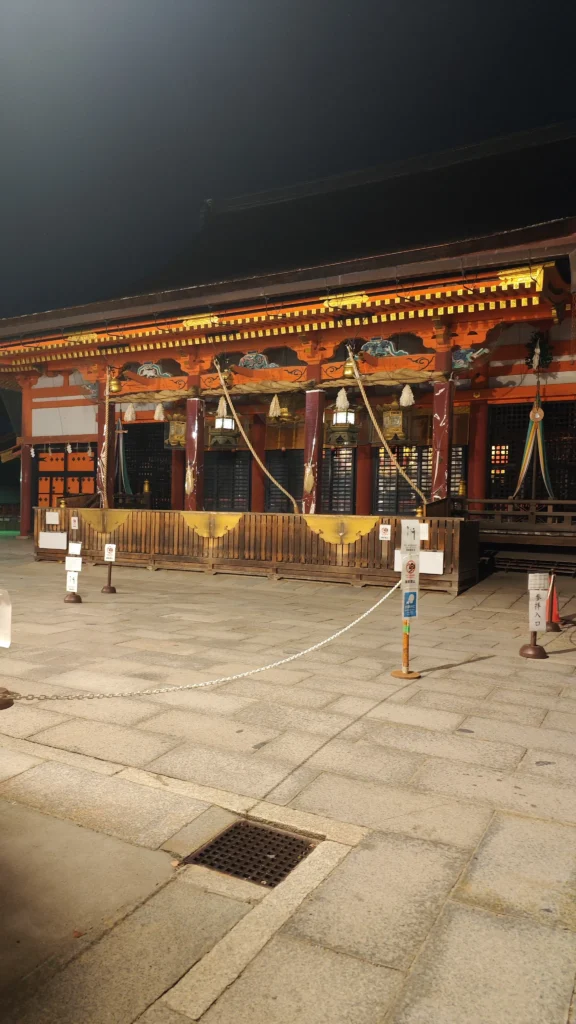
The main hall of Yasaka Shrine was designated as a National Treasure in 2020 (Reiwa 2). Built in the unique architectural style called “Gion-zukuri” or “Yasaka-zukuri,” it features a distinctive structure where the main hall and worship hall are integrated.
Features of the Main Hall:
•Architectural Style: Gion-zukuri (Yasaka-zukuri)
•Structure: Unique form integrating main hall and worship hall
•Roof: Beautiful curves of cypress bark roofing
•Color: Striking vermillion color
•Legend: It is said that a blue dragon dwells beneath the main hall
West Tower Gate (Important Cultural Property)
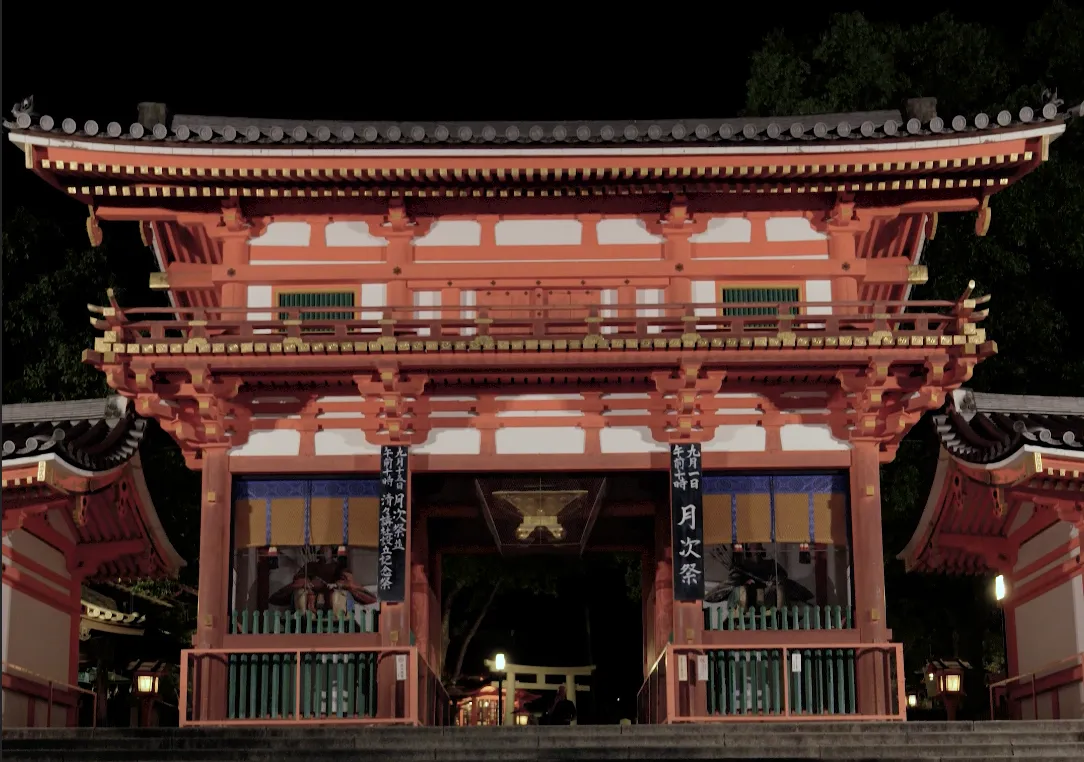
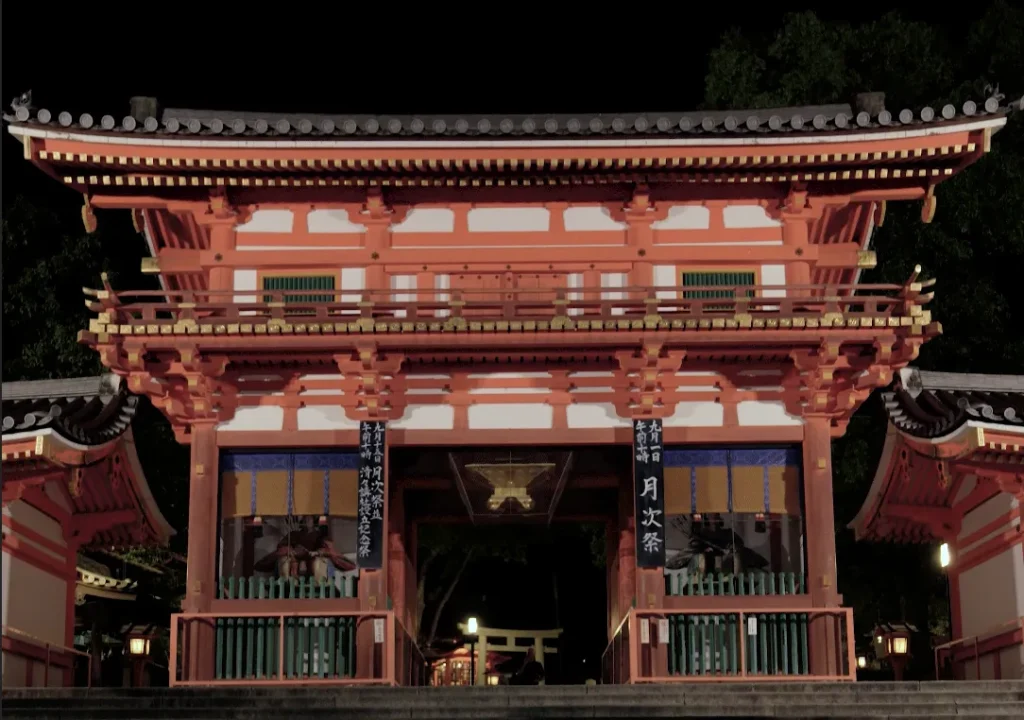
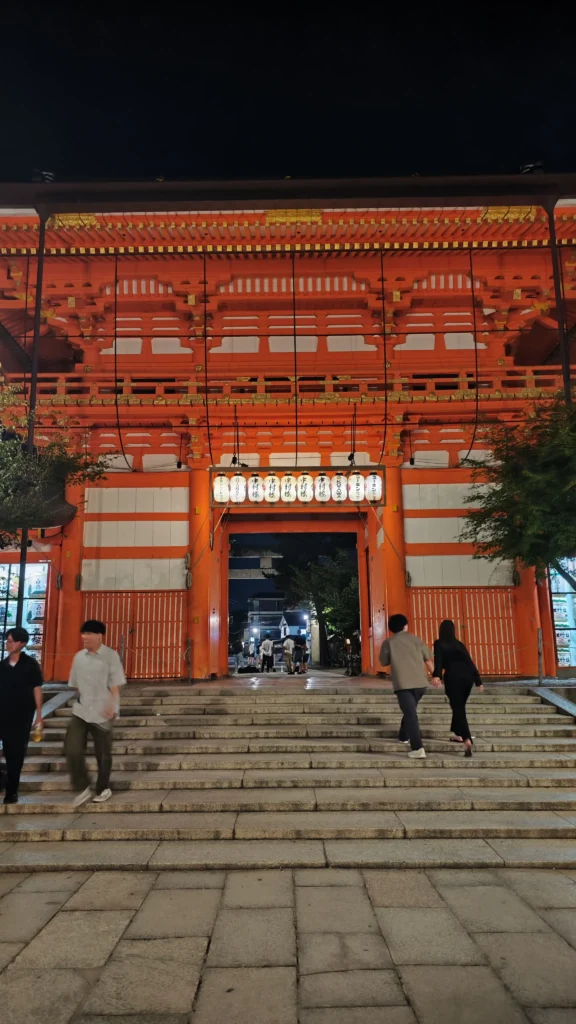
The West Tower Gate facing Shijo-dori is an iconic structure of Yasaka Shrine. The beautiful vermillion tower gate creates a quintessentially Kyoto landscape that stands out in the Gion streetscape.
Features of the West Tower Gate:
•Construction: Rebuilt after the Onin War
•Structure: Two-story gate, irimoya-zukuri style
•Height: Approximately 9.7 meters
•Features: Main entrance from Shijo-dori, illuminated at night
South Tower Gate (Important Cultural Property)
The South Tower Gate facing Maruyama Park is one of the entrances used by many worshippers.
Dance Hall (Important Cultural Property)
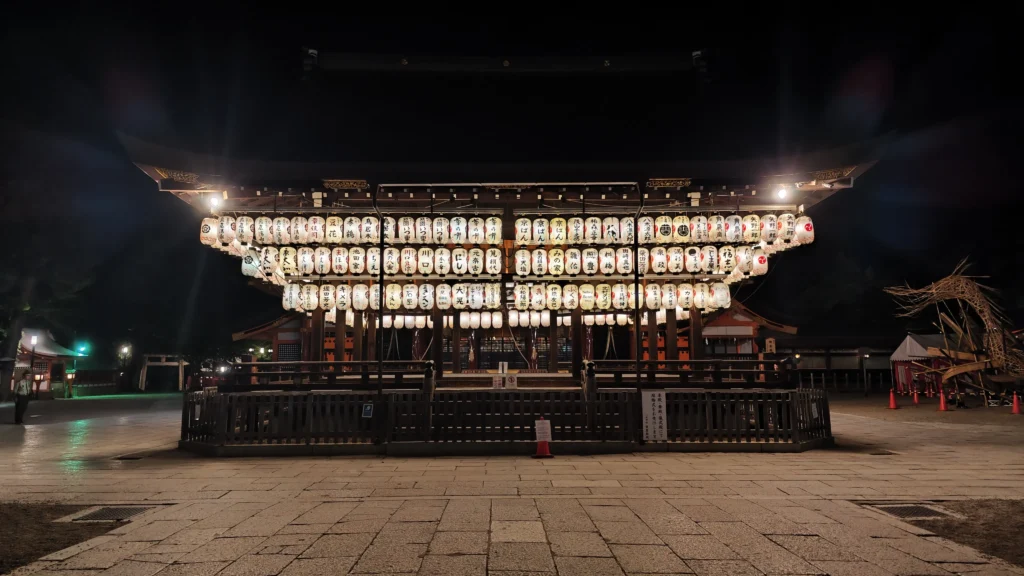
Located in the center of the shrine grounds, the dance hall is an important building used for various Shinto rituals including Gion Matsuri.
Features of the Dance Hall:
•Purpose: Dedication of kagura and dance performances
•Structure: Irimoya-zukuri style, cypress bark roofing
•Decoration: Elaborate carvings and coloring
Stone Torii (Important Cultural Property)
A myojin torii built in 1646 (3rd year of Shoho) on the main approach. It collapsed in an earthquake in 1662 (2nd year of Kanbun) but was repaired and rebuilt in 1666 (6th year of Kanbun).
Utsukushi-gozen-sha (Beauty Shrine)
One of the auxiliary shrines within the grounds, known as the shrine of beauty deities.
Features of Utsukushi-gozen-sha:
•Deities: Tagiri-hime-no-Mikoto, Tagitsu-hime-no-Mikoto, Ichikishima-hime-no-Mikoto
•Benefits: Beauty, improvement in performing arts
•Features: Has “beauty water” – applying a few drops to the skin is said to enhance beauty
Okuninushi-sha
A popular auxiliary shrine known for the deity of matchmaking.
Features of Okuninushi-sha:
•Deity: Okuninushi-no-Mikoto
•Benefits: Matchmaking, success in love
•Features: Popular among young women
Major Festivals and Events
Gion Matsuri (July)
The largest festival of Yasaka Shrine and one of Japan’s three major festivals.
Overview of Gion Matsuri:
•Period: July 1-31 (one full month)
•Highlights: Yamahoko Junko (Float Procession) – Sakimatsuri: July 17, Atomatsuri: July 24
•Mikoshi Togyo: July 17, 24
•Yoiyama: Sakimatsuri (July 14-16), Atomatsuri (July 21-23)
•UNESCO Intangible Cultural Heritage: Registered in 2009
Okera Matsuri (Fire Festival)
A fire festival held from New Year’s Eve to New Year’s Day.
Features of Okera Matsuri:
•Time: December 31, 7:00 PM to early morning January 1
•Content: Taking home sacred fire from burning okera (white atractylodes)
•Meaning: Praying for good health in the new year
•Features: Unique custom of taking fire home on rope
Setsubun Festival (February 3)
Spring event featuring bean throwing and dance dedications.
Annual Festival (June 15)
One of Yasaka Shrine’s most important festivals.
Cultural Properties
National Treasure
•Main Hall – Representative building of Gion-zukuri architecture
Important Cultural Properties (Buildings)
Along with the designation of the main hall as a National Treasure in 2020 (Reiwa 2), a total of 29 buildings within and outside the shrine grounds were designated as Important Cultural Properties.
Major Important Cultural Properties:
•West Tower Gate
•South Tower Gate
•Dance Hall
•Ema-do (Votive Picture Hall)
•Stone Torii
•Auxiliary shrine buildings
•Other shrine buildings
Intangible Cultural Properties
•Kyoto Gion Matsuri Yamahoko Gyoji – Important Intangible Folk Cultural Property, UNESCO Intangible Cultural Heritage
Divine Benefits
Yasaka Shrine is known for various divine benefits.
Main Benefits
•Warding off Evil and Epidemics – Divine virtue of Susanoo-no-Mikoto
•Matchmaking and Success in Love – Divine virtue of Kushinada-hime-no-Mikoto
•Marital Harmony and Family Safety – Divine virtue of the married deities
•Business Prosperity – From being located in the commercial district of Gion
•Improvement in Performing Arts – From connection with Gion’s entertainment districts
•Beauty and Good Looks – Divine virtue of Utsukushi-gozen-sha
Annual Events
Major Annual Events
January
•January 1: New Year Festival
•January 3: Karuta Hajime Ceremony
February
•February 2-4: Setsubun Festival
April
•Second Sunday of April: Spring Grand Festival
June
•June 15: Annual Festival
July
•July 1-31: Gion Matsuri
October
•Second Sunday of October: Autumn Grand Festival
December
•December 31: Okera Matsuri
Shrine Map and Access
Basic Information
Address: 625 Gion-machi Kitamachi, Higashiyama-ku, Kyoto City, Kyoto Prefecture
Phone: 075-561-6155
Worship Hours: 24 hours available
Shrine Office Hours: 9:00 AM – 5:00 PM
Prayer Reception Hours: 9:00 AM – 4:00 PM
Access Methods
By Train:
•Keihan Electric Railway: 5-minute walk from “Gion-Shijo Station”
•Hankyu Railway: 10-minute walk from “Kyoto-Kawaramachi Station”
•JR: About 20 minutes by city bus from “Kyoto Station”
By Bus:
•City Bus: Get off at “Gion” bus stop, immediate walk
•Kyoto Bus: Get off at “Gion” bus stop, immediate walk
By Car:
•About 20 minutes from Meishin Expressway “Kyoto Higashi IC”
•Parking: Paid parking available on shrine grounds (40 spaces)
Nearby Tourist Attractions
Tourist spots within walking distance:
•Maruyama Park – Adjacent, famous for cherry blossoms
•Chion-in – 5-minute walk, head temple of Jodo sect
•Kiyomizu-dera – 15-minute walk, World Heritage site
•Gion Hanami-koji – 3-minute walk, Traditional Buildings Preservation District
•Kennin-ji – 10-minute walk, head temple of Rinzai Kennin-ji sect
The Appeal of Yasaka Shrine
1. Historical Value
As an ancient shrine with over 1,300 years of history, it occupies an important position in Japanese religious and cultural history. It is also a valuable historic site that tells the story of the transition from syncretism to the separation of Shinto and Buddhism.
2. Architectural Value
The shrine grounds, featuring the National Treasure main hall and 29 Important Cultural Property buildings, can be called a treasure house of Japanese architecture. The main hall’s Gion-zukuri style is particularly highly valued academically as a unique architectural style found nowhere else.
3. Cultural Value
Traditional events including Gion Matsuri represent Kyoto’s culture and attract attention from both Japan and abroad. Gion Matsuri, registered as a UNESCO Intangible Cultural Heritage, has gained worldwide recognition for its value.
4. Locational Appeal
Located in Gion, Kyoto’s representative entertainment district, it creates beautiful scenery in harmony with traditional streetscapes. With excellent access from Shijo-dori, it serves as an ideal base for tourism.
5. Contemporary Significance
As a deity of warding off evil and epidemics, it continues to gather faith from many people in modern times. Particularly since the COVID-19 pandemic, it has gained renewed attention as a deity for epidemic prevention.
Worship Etiquette and Precautions
Worship Etiquette
1.Bow at Torii – Bow before passing through the torii gate
2.Purification Ritual – Cleanse hands and mouth at the purification fountain
3.Worship Procedure – Two bows, two claps, one bow
4.Behavior on Grounds – Maintain quiet demeanor, show consideration for other worshippers
Photography
•Photography within the shrine grounds is generally permitted
•Photography inside the main hall or during rituals is prohibited
•Avoid flash photography
•Show consideration for other worshippers
Crowded Periods
•New Year’s First Three Days – Extremely crowded with New Year visitors
•Gion Matsuri Period – Especially crowded on float procession days
•Cherry Blossom Season – Crowded with cherry blossom viewers at Maruyama Park
•Autumn Foliage Season – Crowded during autumn tourist season
Summary
Yasaka Shrine, with over 1,300 years of history, stands as one of Kyoto’s representative shrines with immeasurable value. As the head shrine of approximately 2,300 shrines nationwide and the organizer of Gion Matsuri, it continues to play an important role in Japanese religious culture.
With precious cultural properties including the National Treasure main hall, the UNESCO Intangible Cultural Heritage Gion Matsuri, and the appeal of its location in the historic entertainment district of Gion, Yasaka Shrine offers numerous attractions.
Known for various benefits including warding off evil and epidemics, matchmaking and success in love, it continues to be beloved by everyone from locals to tourists. When visiting Kyoto, be sure to worship at Yasaka Shrine and experience the depth of its history and culture.
The unique feature of 24-hour worship availability allows visitors to enjoy different charms depending on the time of day, such as worship in the fresh morning air or in the illuminated shrine grounds at night – characteristics unique to Yasaka Shrine.
Yasaka Shrine Basic Information
•Official Name: Yasaka Shrine
•Location: 625 Gion-machi Kitamachi, Higashiyama-ku, Kyoto City, Kyoto Prefecture
•Main Deities: Susanoo-no-Mikoto, Kushinada-hime-no-Mikoto, Yahashira-no-Mikogami
•Founded: Traditionally 656 CE or 876 CE
•Shrine Rank: Former Kanpei-taisha, Beppyo-jinja, Nijuuni-sha
•Cultural Properties: 1 National Treasure, 29 Important Cultural Properties
•Major Festivals: Gion Matsuri (July), Okera Matsuri (December 31 – January 1)
•Worship Hours: 24 hours available
https://maps.app.goo.gl/skHCSDVZKNZYv5nj9
#YasakaShrine #GionMatsuri #KyotoTourism #Shrine #NationalTreasure #ImportantCulturalProperty #SusanooNoMikoto #WardingOffEvil #Matchmaking #Gion #Higashiyama #UNESCOIntangibleCulturalHeritage #JapanThreeMajorFestivals #GozuTenno #ShinbutsuShugo
Join 1,000+ travelers discovering Japan's hidden side
Weekly dispatches from off-the-beaten-path Japan — spots and stories you won't find in guidebooks.
No spam. Unsubscribe anytime.
Welcome aboard!
You're in. See you in your inbox soon.