

Date: 2025-12-26 (JST)
Visiting a Japanese shrine during the New Year period is a memorable experience, but many foreign travelers find the customs around Hatsumōde (the year’s first shrine visit) confusing. Questions about proper etiquette, when to go, and what to do can cause unnecessary stress. This guide explains the practical realities of Hatsumōde, clarifies common misunderstandings, and helps you participate confidently and respectfully.
What This Article Explains
This article is a practical guide to the customs of Hatsumōde. It is not a list of famous shrines to visit. Instead, it focuses on the process itself: the etiquette, the timing, and the optional activities like buying charms. We will cover the step-by-step procedure for visiting a shrine, address common assumptions travelers make, and explain which details matter less than you might think. The goal is to demystify the experience so you can enjoy this unique cultural tradition.
How Hatsumōde Actually Works in Practice
Hatsumōde is the first visit to a Shinto shrine or Buddhist temple in the new year, typically made during the first week of January. The purpose is to express gratitude for the past year and pray for health, happiness, and good fortune in the year ahead. While the etiquette has several steps, it’s important to understand that there are no strict, unforgiving rules. According to the Tokyo Shrine Association, a sincere and respectful attitude is far more important than performing each step perfectly 2. Procedures can also vary slightly by shrine and region, so don’t worry if you see others doing things a little differently.
The Shrine Visit Procedure: A Step-by-Step Guide
While perfection isn’t required, following the general procedure shows respect. Here is the most common sequence of actions.
1.Entering the Torii Gate: The torii gate marks the boundary between the everyday world and the sacred space of the shrine. It is customary to stop just before the gate and perform a shallow bow.
2.Walking the Sando (Approach): The path leading to the main hall is called the sandō. The center of this path is considered the walkway for the kami (deity), so visitors should walk along the sides.
3.Purification at the Temizuya: Before approaching the main hall, you purify your hands and mouth at a water basin called a temizuya. You will need a handkerchief for this. The steps are:
•Hold the ladle (hishaku) in your right hand and scoop water to wash your left hand.
•Switch the ladle to your left hand and wash your right hand.
•Switch the ladle back to your right hand, pour water into your cupped left hand, and use it to rinse your mouth. Do not drink directly from the ladle.
•Wash your left hand one more time.
•Finally, tilt the ladle vertically to let the remaining water run down and cleanse the handle before returning it.
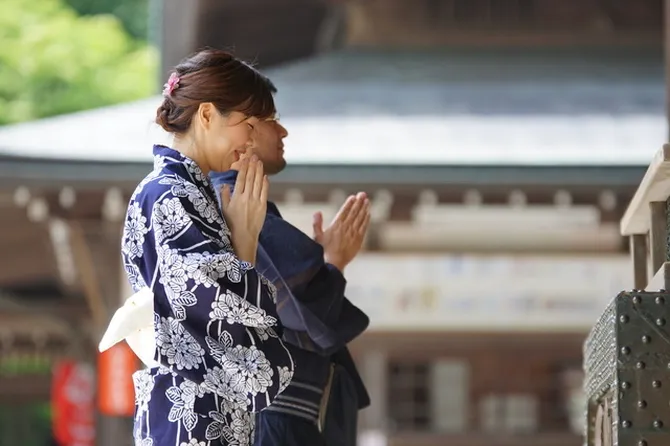
4.Prayer at the Main Hall: Once at the main hall, the general prayer method is “two bows, two claps, one bow.”
•Toss a coin into the offering box (saisen-bako). The amount does not matter; it is a symbolic offering.
•Perform two deep bows.
•Clap your hands twice, with your right hand positioned slightly below your left.
•Offer your prayer silently with your hands held together.
•Perform one final deep bow.
5.Exiting the Shrine: When you leave, it is customary to turn back towards the main hall after passing through the torii gate and make one final bow.
What Travelers Commonly Assume (and Why It’s Wrong)
Many visitors worry unnecessarily about getting the etiquette wrong, leading to some common misconceptions.
Assumption: “I must perform every step of the etiquette perfectly.” Reality: Sincere intention is what matters most. No one expects a foreign visitor to be an expert. Simply observing others and acting respectfully is more than enough. The process is flexible.
Assumption: “Hatsumōde must be done on January 1st.” Reality: While January 1st is the most popular and crowded day, visiting any time during the first week of January is considered Hatsumōde. Many people visit on the 2nd or 3rd, or even later.
Assumption: “I need to wear formal clothing.” Reality: While some Japanese people dress in fine clothes or kimono, it is not a requirement. Clean, casual clothing is perfectly acceptable for travelers. The key is to be respectful, not fashionable.
What You Should Decide Before You Go: Timing
Your experience will be shaped by when you choose to visit. You must decide whether you prefer a vibrant, crowded atmosphere or a more peaceful visit.
| Time Period | Crowd Level | Experience |
| Jan 1 (Midnight – 3 AM) | Extreme | Festive, long waits (can be 3+ hours at major shrines) |
| Jan 1 (Morning – Afternoon) | Very High | The most traditional and crowded time. Peak is around noon to 2 PM. |
| Jan 1 (Evening) | Medium | Crowds begin to thin, offering a more manageable experience. |
| Jan 2-3 (Morning/Afternoon) | High | Still very busy, but generally less packed than New Year’s Day. |
| Jan 4 onwards (Weekdays) | Low | The quietest time, allowing for a relaxed and contemplative visit. |
For most travelers, visiting in the early morning (before 9 AM) or evening on January 2nd or 3rd offers a good balance of festive atmosphere and manageable crowds.
Situations Where Crowds Become a Problem
While the festive crowds are part of the experience, they can be a significant issue in certain situations. At major shrines like Meiji Jingu in Tokyo or Fushimi Inari in Kyoto, the sheer volume of people on January 1st can mean waiting in a slow-moving line for hours just to reach the prayer hall. This can be particularly challenging for those with mobility issues, small children, or a tight travel schedule. If you wish to avoid this, visiting a smaller, local shrine or going after January 3rd is a much better option.
What Matters Less Than People Think
Travelers often focus on details that are not critical to the experience.
•The Amount of Your Coin Offering: Any amount is fine. A 5-yen coin is considered lucky by some because its pronunciation (go-en) is a homophone for good fortune (ご縁), but any coin is acceptable.
•Buying Charms and Fortunes: All the items for sale at a shrine—such as omamori (amulets), ema (prayer plaques), and omikuji (paper fortunes)—are completely optional. The act of visiting and praying is the core of the experience.
•Visiting a Famous Shrine: A visit to a small, neighborhood shrine is just as valid and meaningful as a visit to a famous one. In fact, it can often be a more personal and less stressful experience.
Practical Takeaways
•Your intention is more important than perfect etiquette. Be respectful, and don’t worry about making small mistakes.
•You can go any day during the first week of January. Avoid the extreme crowds of January 1st by visiting on a later day or during off-peak hours (early morning or evening).
•Bring a handkerchief. You will need it to dry your hands after the purification ritual.
•Shrine items are optional. Participate in what interests you, but feel no pressure to buy anything.
•Consider visiting a local shrine. It offers a more intimate experience away from the massive crowds.
Summary
Hatsumōde is a flexible and welcoming tradition. The core of the experience is to offer gratitude and prayers for the new year in a respectful manner. The formal steps of etiquette are a way to show respect, but a sincere heart is what truly matters. By choosing a time that suits your tolerance for crowds and following the basic procedures, you can participate in this important Japanese cultural event with confidence and peace of mind.
Sources / References
[1] ANA. “Visiting a Shrine for Hatsumode.” Japan Travel Planner.
[2] Tokyo Jinjacho. “参拝の作法 (Shrine Visiting Etiquette).”
[3] Mynavi News. “初詣は何時に行くのがいい? (What is the best time to go to Hatsumōde?).”
Notes & Exceptions
•This article focuses on Shinto shrine etiquette, which is most common for Hatsumōde. Buddhist temples have slightly different procedures (e.g., no clapping during prayer).
•The information on crowding is a general guide. Specific times can vary greatly depending on the shrine’s location and fame.
Certainty Level
High